
The Street That Reads You Before You Read It
You step off the train and the city already knows what you are. Not from anything you said — you haven’t spoken to anyone — but from the way the turnstile hesitates a half-second longer before releasing you, from the angle of the security camera that tilts almost imperceptibly as you pass beneath it, from the fact that the map on the wall has been positioned at a height comfortable for someone three inches taller than you, in a font size that assumes you are standing in good light with rested eyes and somewhere else to be if you make a wrong turn. The architecture is not hostile. That is the precise and terrifying thing about it. It is simply calibrated for someone who is not you.

The exit corridors branch in three directions and none of the signs agree with each other. One points toward a street name, another toward a landmark that no longer exists under that name, a third toward a bus line that was rerouted eighteen months ago without anyone updating the placard. You follow the logic of foot traffic instead, the invisible grammar of people who know where they are going, and you realize that to navigate this space correctly you must already belong to it. The knowledge required to move through the city is not posted anywhere. It is inherited, absorbed, worn in the body like a second skeleton. Those who do not carry it move with a slight but legible hesitation — a half-pause at junctions, a glance upward that signals uncertainty — and that hesitation is enough. It marks you. Not as criminal, not as dangerous, but as out of place, which in certain architectures amounts to the same administrative problem.
Above ground, the light changes. The street opens into a plaza that feels generous until you try to sit down. The benches have been divided by thin metal armrests installed at intervals of exactly twenty-two inches — close enough to look like a normal bench, too narrow to lie across. The planter ledges are beveled at the precise angle that makes them usable for standing but not for resting. A small brass fixture bolts the base of a wall where someone had previously sheltered. None of this is signposted. There is no ordinance visible, no notice, no law being visibly enforced. The hostility is purely geometric, coded into the dimensions of public furniture with the serene neutrality of engineering. The city does not tell you to leave. It simply makes staying, for certain bodies, a sustained physical effort that eventually becomes indistinguishable from punishment.
You walk further and notice that the storefronts shift. In the space of four blocks, the density of surveillance cameras doubles. Not because crime has doubled — the demographics have shifted. The cameras do not appear because something happened. They appear because of who is now present, which means they were always waiting, infrastructure held in reserve for a particular kind of body crossing a particular invisible threshold. Mike Davis wrote about this in 1990, in his anatomy of Los Angeles, describing how the militarization of urban space operated not through explicit prohibition but through the spatial encoding of social fear — sprinkler systems timed to activate at 2 a.m., lighting designed to create pools of visibility that function as surveillance without surveillance officers, the “sadistic street environments” built to make the homeless uncomfortable enough to self-remove. The year matters: this analysis preceded the widespread deployment of digital tracking by a full generation, which means the logic was architectural before it was algorithmic. The city learned to read bodies and redirect them long before it had the data infrastructure to do so at scale.
The man in the expensive coat who passes you now does not experience any of this. The same street, traveled by a different body, is simply a street.
Urban Traffik

Thriller, by Jason Figgis, United States, 2017.
In the heart of a dark and hidden Dublin, Adam appears to be a kind-hearted man when he offers shelter to Sue, a lonely and vulnerable young woman who has just arrived in the city. The reality, however, is far more tragic: Adam serves as bait for a ruthless human trafficking ring led by the cold and calculating Dan and managed by his partner, Alex. Their chilling scheme is simple: lure defenseless young women and sell them into the international sex trade. But this seemingly perfect criminal enterprise is about to unravel. As disturbing family secrets linking Dan to Adam's sister come to light, and Adam desperately tries to break free from a brutal world he can no longer endure, the lives of everyone involved spiral into uncontrollable violence.
Directed by acclaimed independent filmmaker Jason Figgis, Urban Traffik leaves horror behind to embrace the raw, tense, and hyper-realistic territory of urban crime drama, recalling the visceral intensity of British cult films such as London to Brighton. The film's greatest strength lies in its outstanding performances: thanks to its razor-sharp screenplay, the cast succeeds in making viewers empathize even with its darkest and most morally ambiguous characters. Visually, the film is a noir gem. Alan Rogers' striking cinematography captures Dublin's hidden and ghostly side, transforming neglected alleyways and bare interiors into landscapes of palpable despair. Avoiding easy moralizing, Urban Traffik offers a hypnotic, intimate, and uncompromising look at the inner workings of organized crime.
LANGUAGE: English
SUBTITLES: Spanish, French, German, Portuguese
Noir as Epistemology, Not Aesthetics
You walk through a city you have lived in for eleven years and still cannot shake the feeling that you are trespassing. The streets are familiar — the café on the corner, the underpass where the acoustics change, the square that floods in March — and yet something in the architecture insists that your presence here is provisional, that the space was calibrated for someone else’s comfort and you have simply been allowed to use it temporarily, on conditions you were never shown.
This is not paranoia. It is a form of knowledge, and urban noir is its most precise cartography. The mistake most readers and viewers make is to treat noir as a mood, a palette of shadows and rain-slicked asphalt, a genre convention borrowed from Raymond Chandler and recycled into atmosphere. That reduction is itself a symptom of the trap, because it converts a mode of perception into a decoration, drains it of its epistemological weight, and hands it back to the people who have never needed it for survival. Noir, understood seriously, is not how a city looks. It is how a city is experienced by those for whom its promises were never intended to be kept.
Walter Benjamin spent over thirteen years assembling his Arcades Project, that enormous unfinished architecture of fragments and citations that traced the logic of nineteenth-century Paris through its covered shopping passages. What he identified was not merely a history of consumer culture but something more unsettling: the city as a dream-space that produces the sensation of meaning, progress, and legibility while systematically concealing the machinery generating those sensations. The arcades were radiant, climate-controlled, filled with light and merchandise and the illusion of abundance, and they functioned precisely by making their own conditions of production invisible. The worker who manufactured the gloves displayed in the glass case was nowhere in the picture. The passage did not permit that kind of looking. Benjamin called this the phantasmagoria — a collective hallucination presented as reality — and he understood that the city’s genius lay in its capacity to enchant even those it was exploiting.
What Benjamin could not fully articulate, writing from the position he occupied, was that the phantasmagoria does not grip everyone equally. For certain bodies — racialized, feminized, economically disposable — the dream has always had a different texture, thinner, more permeable, interrupted constantly by friction that others simply do not encounter. A Black man in a department store in 1950s Chicago does not experience the phantasmagoria as Benjamin described it; he experiences its underside, the place where the dream fabric tears and exposes the mechanism. That exposure is exactly what noir encodes. It is the epistemology of those who were never fully admitted into the collective hallucination, who have always had to read the city against its official surfaces because their lives depended on that counter-reading.
This is why the knowledge produced by noir is structurally different from the knowledge produced by, say, urban planning or civic rhetoric. Both planning and rhetoric operate on the city’s visible face, its stated intentions, its announced purposes. Noir operates on the gap between what the city announces and what it actually does to specific categories of people. It is, in the most rigorous sense, a diagnostic practice — not a representation of darkness but a methodology for reading the forces that distribute darkness unequally. When sociologist Loïc Wacquant documented in Punishing the Poor, published in 2009, how American cities from the 1970s onward systematically dismantled welfare infrastructure while expanding carceral infrastructure, he was producing precisely this kind of counter-reading: not lamenting the city’s failure but tracing the logic of its success at goals it had never publicly declared.
The city is not broken when it disappears certain people. It is functioning exactly as the deeper architecture intended, and noir is the name for knowing that without being destroyed by it.

The Infrastructure of Exclusion

You have probably stood at a bus stop that made no sense — too far from where people actually live, exposed to weather on three sides, placed on a road that buses use only twice a day — and felt, for a moment, the faint suspicion that this was not an accident.
It was not. Georges-Eugène Haussmann’s transformation of Paris beginning in 1853 is taught as an act of modernization, a reimagining of the medieval city into something rational and breathable. What it also was, and what contemporaries understood at the time, was a surgical removal of the working poor from the city’s center. The wide boulevards Haussmann drove through the old neighborhoods were not only aesthetic achievements or tactical preparations against future barricades, though they were both of those things. They were instruments of displacement. The rents in the newly rebuilt arrondissements climbed beyond what laborers could pay, and the bodies that had crowded the rue de Rivoli and the Île de la Cité were pushed outward to the periphery, to Belleville and Ménilmontant, where the city’s obligations to them — in terms of sanitation, lighting, policing — quietly diminished. The built form carried the policy. You did not need a law excluding the poor from the center. You needed stone, mortar, and a rent ledger.
Robert Caro’s documentation of Robert Moses in The Power Broker, published in 1974, reveals the same logic operating with a specificity that borders on malice. Moses, who shaped New York’s physical landscape from the 1930s through the 1960s and controlled more unelected power than any figure in American urban history, built the parkway bridges on Long Island at a height of nine feet — low enough that the twelve-foot clearance required by public buses made it structurally impossible for those buses to pass beneath them. The parks and beaches those parkways led to were therefore inaccessible to the transit-dependent poor, who were disproportionately Black. Moses himself, according to the testimony Caro gathered from colleagues and engineers, was explicit about his intentions. The infrastructure did not discriminate in writing. It discriminated in concrete. This is the mechanism that makes such exclusion so durable: it cannot be repealed like a statute, it cannot be challenged in a courtroom, and it outlives the intentions of its architect by decades. Those bridges still stand.
What this means for the body moving through the city is that legibility — being a person whose presence the built environment has anticipated and accommodated — is never neutral. Henri Lefebvre argued in The Production of Space, published in 1974, that space is not a passive container for social life but an active production of it, shaped by and in turn shaping the social relations that organize power. When a neighborhood has no sidewalks, when a transit hub is designed without seating so that people cannot linger, when a park is ringed with single-occupancy benches engineered to prevent someone lying down, the space is performing an argument about who belongs there and in what posture and for how long. The hostile architecture that cities now deploy openly — the anti-homeless spikes, the slanted surfaces, the deliberately inadequate shelter — is simply the visible tip of a program that has been written into the geometry of cities for two centuries.
The noir city knows this before it can articulate it. Its streets are not merely dangerous in the thriller sense of containing criminals. They are dangerous in the structural sense of containing rules that only some bodies discover they are subject to, usually at the worst possible moment, usually after having believed for some time that the city was simply open to them on the same terms it was open to everyone else, which was always the central lie, and the one most completely enforced not by signs or guards but by the angles of a bridge, the frequency of a bus line, the height of a curb.
Illegibility as a Weapon
You already know which side of the street the police car slows down on. You have known it since childhood, with the particular certainty that bypasses reasoning and lives instead in the muscles, in the automatic calculation of which route home adds seven minutes but removes a certain kind of exposure. That knowledge is not paranoia. It is cartography.
Frantz Fanon understood the colonial city as a fundamentally divided organism, not merely in the sociological sense of inequality but in the ontological sense of existence itself. In The Wretched of the Earth, published in 1961, he described the settler’s town and the native’s quarter as two species of space that do not share the same temporality, the same light, the same relationship to the future. The settler’s district is solid, stone-built, permanent — it aspires to eternity. The native quarter is described as a place that crouches, a place perpetually on the edge of not-quite-existing. What Fanon was anatomizing was not poverty. He was describing a deliberate architecture of illegibility, a spatial design whose function was to make certain bodies unreadable to the protections of the state while rendering them hypervisible to its instruments of control. The distinction matters enormously. To be illegible to protection means your assault goes uninvestigated, your landlord goes unpunished, your child’s school goes unfunded. To be hypervisible to surveillance means you are stopped, catalogued, and filed before you have committed any act. These are not contradictions. They are the two synchronized functions of the same machine.
The data from Chicago’s public housing program after 1945 makes this visible with a precision that is almost clinical. Between 1950 and 1970, the Chicago Housing Authority constructed the majority of its high-rise projects — the Robert Taylor Homes, the Cabrini-Green complex, Stateway Gardens — on a near-unbroken corridor running along State Street on the South Side. Urban planner and critic Martin Meyerson documented in 1955, in a study conducted with Edward Banfield, that site selection for these projects had been systematically steered away from white neighborhoods through aldermanic veto, concentrating Black residents into a narrow strip of hyper-dense vertical structures that planners themselves privately acknowledged were unsuitable for families. By 1962, the Robert Taylor Homes alone housed nearly 28,000 people in 28 identical sixteen-story buildings. The density was not accidental. The isolation was engineered. And the consequence was a zone where municipal services — garbage collection, street lighting, police response times — operated on a visibly different standard, while the same police presence that failed to respond to internal violence conducted aggressive stop-and-search operations at the perimeter, treating the boundary between the projects and the surrounding city as a frontier requiring enforcement.
Paris generated an almost symmetrical geography through its postwar grands ensembles program, the massive housing estates constructed at the urban periphery between 1950 and 1975. The cités that absorbed North African immigrant labor — essential to French reconstruction yet legally and socially marginal — were built at distances from the city center that were not merely geographic. Nanterre, La Courneuve, Clichy-sous-Bois: these names became shorthand for a spatial logic that the sociologist Loïc Wacquant, in his 2008 comparative study Urban Outcasts, described as “territorial stigmatization,” the process by which a place itself acquires a reputation that adheres to every body that comes from it. The address becomes a sentence. A job application with a Clichy-sous-Bois postal code in the 1990s statistically reduced callback rates by margins researchers found difficult to explain through any variable other than geographic prejudice.
What this produces is a subject who is simultaneously over-mapped and unmapped — whose movements are tracked, whose face is recognized, whose presence is registered as threat, but whose suffering generates no administrative urgency, no institutional memory, no file that someone in power considers worth opening.
The Psychology of Being Unmapped
You learn, very early, that your body is a problem to be managed before it becomes a problem for someone else. Not a lesson anyone teaches you directly — it arrives through repetition, through the slight tension in a shopkeeper’s shoulders when you enter, through the pause before a taxi stops, through the way conversations in a lobby reset when you walk in. The city does not announce its hostility. It performs it in increments small enough that each one, taken alone, could be dismissed as coincidence.
Erving Goffman, writing in Stigma in 1963, described the social architecture of this experience with a precision that still stings. He identified the mechanism by which certain individuals carry what he called a “spoiled identity” — a mark, visible or suspected, that contaminates every interaction before it begins. The spoiled identity is not a fixed quality of the person. It is a relational production: the stigma exists in the gap between what the marked person knows about themselves and what the unmarked world projects onto them. What Goffman exposed was that the truly devastating labor is not the discrimination itself but the cognitive work required to anticipate, manage, and absorb it continuously. The person navigating hostile space is never simply moving through it. They are running a parallel calculation — reading every environment for threat level, adjusting posture, tone, pace, volume, deciding at each moment how much of themselves is safe to make visible.
This is not metaphor. The metabolic cost of sustained social vigilance has been measured. Arline Geronimus, a public health researcher at the University of Michigan, published findings in 1992 that introduced the concept of “weathering” — the hypothesis that chronic exposure to social and economic adversity causes accelerated biological aging in marginalized populations, particularly Black Americans. The data showed patterns of hypertension, cardiovascular disease, and cellular deterioration appearing in younger cohorts than population averages would predict. Geronimus was not describing the effects of poverty alone. She was describing what happens to a body that spends decades performing the double-consciousness of self-monitoring — the physiological residue of never being allowed to simply exist in a space without calculating the cost of your own presence. The city, in this reading, is not just socially hostile. It is carcinogenic.
What makes this violence so difficult to name is that it operates through the normal. The architecture of a neighborhood — where the well-lit streets end, where the crosswalks disappear, where the park benches have armrests designed to prevent sleeping — these are not accidents. They are decisions embedded in municipal planning documents, zoning codes, budget allocations. The city presents itself as a neutral surface, a grid, an infrastructure, and this neutrality is precisely the lie that makes the harm invisible. When harm has no perpetrator, when it is distributed across a thousand small administrative choices made over decades, the person absorbing the harm is left without a legible target for their anger, which means the anger often turns inward, or expresses itself in ways the city’s institutions are well-prepared to criminalize.
There is a particular cruelty in being asked to prove that a system is hostile when the system’s primary mechanism is plausible deniability. The unmapped person — the one whose daily routes, whose habits, whose very presence does not register in the urban imaginary as natural or belonging — is also the one least likely to be believed when they describe the texture of their experience. Their testimony is treated as anecdotal. Their pain is treated as predisposition. The scientific literature Geronimus built over subsequent decades, extending into telomere research and allostatic load measurements, spent thirty years converting lived experience into data legible enough for institutions that had already decided not to listen, and the conversion itself is a kind of secondary exhaustion — the demand that you translate your body’s suffering into a language the city’s administrators will accept before they will consider whether the city might owe you something different.
A vision curated by a filmmaker, not an algorithm
In this video I explain our vision
When the Map Lies

She pulls up the city’s official planning portal on her phone, standing at the corner of a street that the map insists contains a functioning health clinic, a green square labeled “community garden,” and a bus line with twelve-minute frequency. What she sees instead is a shuttered building with a hand-painted sign reading “closed until further notice” — the notice itself sun-bleached to illegibility, meaning it has been there for years. The garden is a rectangle of compacted dirt behind a chain-link fence. The bus, according to three separate residents she asks, stopped running this route in 2019. The map has not been updated. Or rather: it has been updated, selectively, in the parts of the city where updates serve a purpose.
Guy Debord understood in 1955, when he published his “Introduction to a Critique of Urban Geography,” that the official representation of a city was never neutral — that maps encode power, that the visual grammar of urban planning produces subjects as much as it serves them. The dérive, his method of unanchored drifting through the city following psychic currents rather than designated routes, was a direct assault on this grammar. To drift was to refuse the city’s instructions about where you were supposed to go, what you were supposed to want, which streets were meant for your feet. The Situationist International that formed around him between 1957 and 1972 extended this into a full epistemology: the spectacle wasn’t only in advertisements or television but in the geometry of streets, the placement of walls, the decision about where a park would not be built.
What psychogeography correctly identified was that urban space is always an argument. Every pedestrian zone that ends precisely where the wealthy neighborhood begins, every highway ramp that Robert Moses drove through the South Bronx in the 1950s and 1960s — deliberately positioned, Robert Caro documented in “The Power Broker,” to prevent bus-dependent Black residents from reaching Jones Beach — is a sentence in a language designed to be read unconsciously. The body absorbs the city’s syntax before the mind can translate it.
But Debord’s dérive carried inside it an assumption he never examined: that the city could be reclaimed by the act of drifting itself, that psychic disorientation was available as a political tool to anyone willing to walk. This is where the theory reveals its own limits. The Situationists were mostly men, mostly European, mostly without the specific embodied vulnerabilities that make certain forms of urban wandering not liberatory but dangerous. A woman alone drifting through industrial zones at two in the morning is not conducting counter-cartography. She is navigating a risk calculation that the male theorist of the dérive never had to make, because his body was not the territory that strangers felt licensed to occupy.
The sociologist Elijah Anderson, in “The Cosmopolitan Canopy” published in 2011, identified urban space as radically stratified by what he called the “iconic ghetto” — the way certain bodies trigger an immediate recoding of any space they enter. A young Black man drifting through a neighborhood outside his own is not enacting Situationist freedom; he is producing, involuntarily, a threat signal in the nervous systems of people who have been trained by decades of political rhetoric and media imagery to read his presence as out of place. The drift that Debord imagined as a recovery of subjective freedom is, for this body, an exposure.
The map that lies to the woman at the shuttered clinic is not only inaccurate. It is performing a function: it makes the area legible to investors, to planners, to city council presentations, as a place where services exist — which means the area does not require new investment, does not register as underserved, does not appear in the data that might trigger intervention. The lie is administrative. And administrative lies have the peculiar quality of being entirely deniable while remaining structurally load-bearing.
The Trap That Looks Like a Neighborhood
You grow up in a neighborhood and you learn its rules before you learn its name. You learn which corners belong to which hours, which doors open and which ones were sealed shut before you were born, which streets narrow imperceptibly as you age until one morning you realize you cannot see over the walls.
David Harvey argued in The Limits to Capital, published in 1982, that capital does not simply flow through space the way water moves through pipes — it actively constructs the container. The spatial fix is not a metaphor for inequality; it is a precise economic mechanism by which overaccumulated capital exports itself into the built environment, converting surplus value into roads, housing blocks, industrial corridors, and administrative boundaries that then harden into permanence long after the original investment has rotted. The neighborhood is not where poor people ended up. It is where a specific economic logic required them to be concentrated, available, and contained.
This distinction matters enormously because it dismantles a particularly durable fiction: the idea that urban poverty is the residue of individual failure collecting in low-rent areas. What Harvey’s analysis reveals is that the low-rent area is itself a produced object, manufactured through zoning decisions, infrastructural disinvestment, redlining protocols — the Federal Housing Administration explicitly codified racial geography into mortgage risk maps from the 1930s onward — and the deliberate withholding of public services calibrated to maintain a population precarious enough to accept wages and conditions that a more stable workforce would refuse. The slum is not a failure of the city. It is one of its functional outputs.
The sociologist Loïc Wacquant, tracing the collapse of the American inner city across the latter decades of the twentieth century, showed that what replaced the industrial wage relationship after deindustrialization was not unemployment in a neutral sense but a new institutional architecture: the prison, the workfare program, the predatory lender, the temp agency. These did not emerge to solve poverty. They emerged to manage a surplus population that capital had made necessary to produce and simultaneously unnecessary to employ. The hyperghetto Wacquant described in Punishing the Poor, published in 2009, is not a zone that fell outside the system. It is a zone the system constructed with administrative precision.
When noir sensibility saturates these spaces — and it does, not because filmmakers chose to aestheticize them but because the residents themselves describe their lives in exactly those terms, the perpetual surveillance, the exits that appear open and close the moment you approach — it is because the structural conditions of noir are materially present. The feeling of being watched without protection, of moving through a grid that was designed without you as its intended beneficiary, of encountering institutions that present themselves as neutral while operating with unmistakable directionality — these are not paranoid projections. They are accurate readings of the built environment.
What makes the spatial fix so insidious as a lived reality is that it presents itself as geography rather than policy. The neighborhood looks like a place that simply exists, with its particular density and its particular decay, its particular distance from the transit lines that lead to the districts where wages are legible. The distance is never accidental. Robert Bullard documented in Dumping in Dixie, in 1990, that toxic facilities across the American South were sited in Black communities not despite regulatory frameworks but through them, with formal environmental impact assessments that treated demographic vulnerability as a locational advantage. The administrative language was neutral. The outcomes were surgical.
A trap that announces itself is not a very effective trap. The genius of the produced space — the spatial fix made permanent, buried under decades of normalized geography — is that it looks like weather, like the natural condition of a place that simply never caught its luck, when in fact every contour of its limitation was drawn by someone who benefited from drawing it exactly there.
Visibility Without Recognition
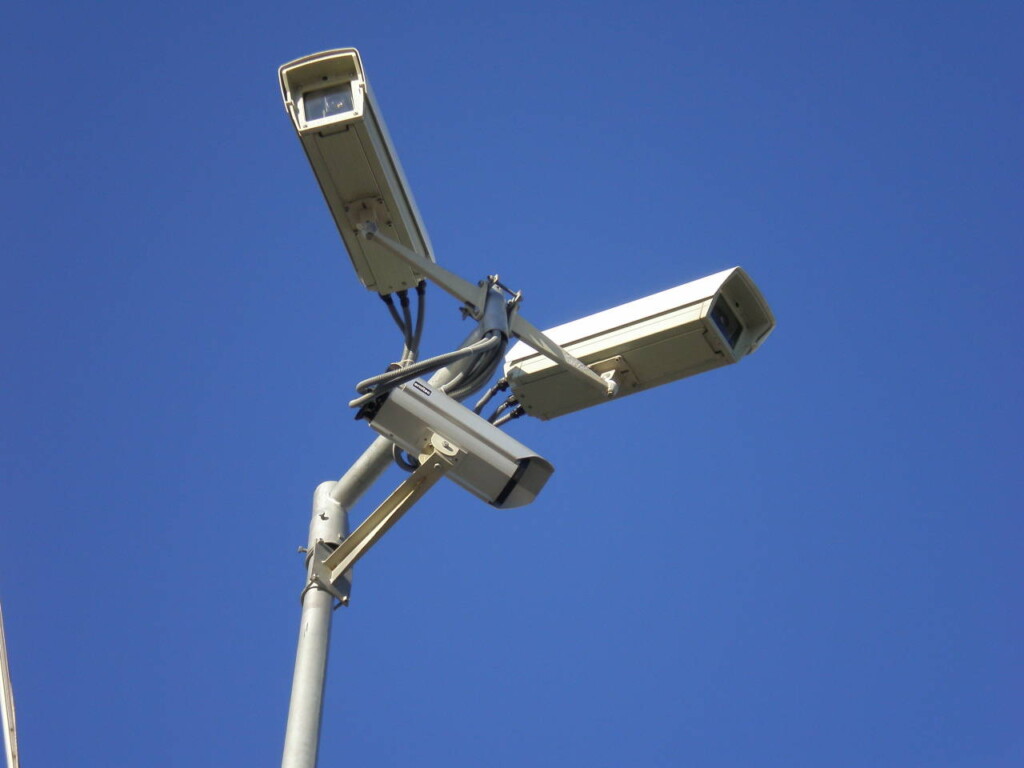
You stand on a corner in a city that has been photographed ten thousand times, and you understand, in a way that requires no explanation, that the cameras are not there to see you — they are there to track you.
This is not paranoia. It is the operating logic of a surveillance infrastructure built on a fundamental conflation: the act of being watched and the act of being recognized are treated as identical, when in practice they are violently opposed. To be watched is to be rendered legible to a system. To be recognized is to have your interiority acknowledged as something that generates obligations in others. Cities in the twenty-first century have become extraordinarily efficient at the first operation while systematically refusing the second, and this refusal is not a failure of the system — it is the system working exactly as designed.
Achille Mbembe, writing in his 2003 essay “Necropolitics” published in Public Culture, extended Foucault’s biopolitics into territory that Foucault’s European framework could not fully reach: the governance not merely of life but of death, the political management of who is allowed to die slowly, who is allowed to die quickly, and who is simply ungrievable in advance. Mbembe’s argument was not metaphorical. It was a structural diagnosis of how certain populations are administered as problems of risk rather than as reservoirs of human interiority. The city, in this framework, does not merely fail to see certain bodies — it sees them with extraordinary precision while simultaneously refusing to grant them the status of subjects whose inner lives might create any moral demand on the urban order.
The paradox becomes most visible when the numbers are taken seriously. In Paris between 2017 and 2022, facial recognition systems were piloted in public transit hubs with a stated purpose of security management. In London, the Metropolitan Police’s live facial recognition deployments between 2020 and 2023 generated thousands of alerts, the majority flagging individuals from Black and South Asian communities at disproportionate rates documented by civil liberties organizations. These bodies were hypervisible — scanned, catalogued, flagged, processed — and simultaneously invisible as persons, because the infrastructure that saw them had no mechanism for receiving them as anything other than a pattern to be compared against a database of threats. Hypervisibility and social invisibility are not opposing conditions on a spectrum; they are the same political gesture executed at two different registers of the same apparatus.
What noir cinema understood intuitively, and what urban theory has struggled to articulate without retreating into abstraction, is that the city generates a specific kind of loneliness that has nothing to do with being alone. It is the loneliness of being seen without being met — of existing in a space saturated with cameras, algorithms, social workers, police reports, demographic data, and municipal planning documents, all of which contain your image in some form, none of which contain your experience. The urban body that falls into this condition is not rendered invisible by neglect. It is rendered invisible by an excess of administrative attention that forecloses the possibility of encounter.
Ralph Ellison published Invisible Man in 1952, and the narrator’s opening claim — that he is invisible not because people cannot see him but because they refuse to — describes a mechanism that has only grown more elaborate in the decades since. The refusal is no longer interpersonal; it is infrastructural. It is encoded in zoning laws, in algorithmic policing, in the spatial logic of urban renewal projects that displace the poor into peripheries where the distance to the center serves as a daily reminder that the city’s tolerance has geographic limits.
What the city finally cannot bear is not the difficult body, not the poor body, not even the criminal body — it is the body that insists, despite everything the city has arranged to prevent this, on having a perspective that might judge the city back.
🌆 Shadows, Labyrinths & the Invisible City
Urban noir is not merely a genre but a way of seeing: the city as an organism that devours its most fragile inhabitants, rendering them anonymous, expendable, and ultimately invisible. The articles below trace the philosophical, literary, and cinematic contours of this labyrinthine urban condition, from alienation and bureaucratic entrapment to the psychogeography of streets that no longer belong to those who walk them.
Franz Kafka and Urban Alienation
Kafka’s Prague is not a city but a sentence—a space where bureaucratic corridors multiply endlessly and the individual dissolves into procedure. Franz Kafka and Urban Alienation examines how the author transformed the modern metropolis into an architecture of guilt and erasure, making visible the invisible violence of institutional indifference. His novels remain the most precise maps of a city that traps without walls.
GO TO THE SELECTION: Franz Kafka and Urban Alienation
Situationist Psychogeography: The City as Lived Space
Situationist Psychogeography reframes urban space as a political and emotional territory, where the drift—the dérive—becomes an act of resistance against the spectacle of capitalist geography. This article explores how Guy Debord and the Situationists decoded the city as a system designed to control movement, desire, and identity. Their theory is indispensable for understanding how noir urban spaces are never neutral but always already ideological.
GO TO THE SELECTION: Situationist Psychogeography: The City as Lived Space
Existentialist Noir: History and Meaning
Existentialist Noir investigates the deep philosophical roots of a genre in which the city is not background but fate, and the protagonist is always already condemned before the story begins. This article traces the genealogy of noir from Sartre and Camus through hard-boiled fiction, revealing how existential dread and urban entrapment are two faces of the same modern condition. The genre’s invisible bodies are those who fall through the cracks of a world that never acknowledged them.
GO TO THE SELECTION: Existentialist Noir: History and Meaning
Georg Simmel and the Metropolis: The Metropolis and Mental Life
Georg Simmel‘s foundational essay The Metropolis and Mental Life diagnoses the psychological cost of urban existence: the blasé attitude, the overstimulation of the senses, and the radical anonymity that renders city-dwellers simultaneously hypervisible and profoundly unseen. This article situates Simmel’s thought within the broader tradition of urban sociology, showing how his insights anticipate the noir imagination of the city as a place of lonely crowds and invisible suffering. To walk through a Simmel city is to understand why noir protagonists are always strangers, even on streets they have known for years.
GO TO THE SELECTION: Georg Simmel and the Metropolis: The Metropolis and Mental Life
Discover the City's Hidden Cinema on Indiecinema
If these dark urban corridors have opened something in you, Indiecinema is where the journey continues. Our streaming platform is dedicated to independent and auteur cinema that refuses to look away from the invisible bodies the city leaves behind—films that see what mainstream culture chooses not to. Come explore a curated world of noir, social realism, and visionary storytelling, available to stream now on Indiecinema.
👉 EXPLORE THE CATALOG: Watch Indie Films in Streaming
A vision curated by a filmmaker, not an algorithm
In this video I explain our vision

