
The Morning You Became a Function
You leave before the city is fully awake, and yet it is already waiting for you. The platform knows your weight before you step onto it. The train arrives with the indifference of a machine that has never needed your gratitude. You find your position in the crowd — not a seat, not a choice, but a position, the precise gap between two other bodies that your body fills by a logic you did not invent — and then something happens that you have learned not to examine too closely: you disappear. Not physically. Your coat is still there, your shoes, the bag with its familiar weight on your shoulder. But you are gone. Somewhere between the closing doors and the second stop, the part of you that might have noticed anything — the color of light through the window, the expression of the man across the aisle, the particular smell of collective exhaustion — that part simply clocks out. You arrive at your desk with no memory of the journey. You have been transported, processed, delivered. The city did not ask whether you consented to this. It assumed you already had, long ago, before you were old enough to read the terms.

This is not a metaphor for something else. It is the literal structure of daily life in any large modern city, and it has been the structure for over a century, long enough that most people alive today have never known anything different. What Georg Simmel described in 1903 in his essay “The Metropolis and Mental Life” was not a sociological hypothesis but a physiological observation: the urban nervous system, bombarded by too many stimuli moving too fast, develops what he called a blasé attitude not as a moral failing but as a survival mechanism. The mind learns to filter, to flatten, to reduce the overwhelming particularity of every face and every street corner into manageable abstraction. The man you pass every morning for eleven years is not a person to you. He is a landmark, a data point, part of the legible grammar of a route you have stopped reading.
What Simmel could only describe from the outside, Franz Kafka dramatized from within. Born in Prague in 1883, working as an insurance official at the Workers’ Accident Insurance Institute for the Kingdom of Bohemia from 1908 until tuberculosis forced him out in 1922, Kafka spent his most productive writing years inside the exact machine he was simultaneously dismantling on the page. His position was not clerical but evaluative: he assessed claims, classified risk, wrote official reports in a prose so lucid and organized that his superiors consistently praised him. He was, by every bureaucratic measure, functional. And it was this word — functional — that he could not survive without turning inside out.
The bureaucratic institution does not destroy the individual through malice. This is perhaps the detail that readers most consistently misread in Kafka’s fiction. The terror in his work is not the terror of cruelty but the terror of indifference operating at perfect efficiency. A system that hates you can be resisted, argued with, exposed. A system that simply processes you without noticing whether you are suffering or thriving, whether you are the same person who arrived last Tuesday or a subtly different one — that system offers no surface to push against. Your resistance finds nothing to grip. This is the specific quality of alienation that the twentieth century industrialized and the twenty-first century has digitized into something even more total.
The word alienation itself carries a long philosophical freight, but in the context of urban life it refers to something more immediate than any theory: the sensation of being a stranger to your own actions, of performing your life rather than living it, of recognizing, in some peripheral and quickly suppressed way, that the person going through your motions today could be almost anyone.
A Better Life
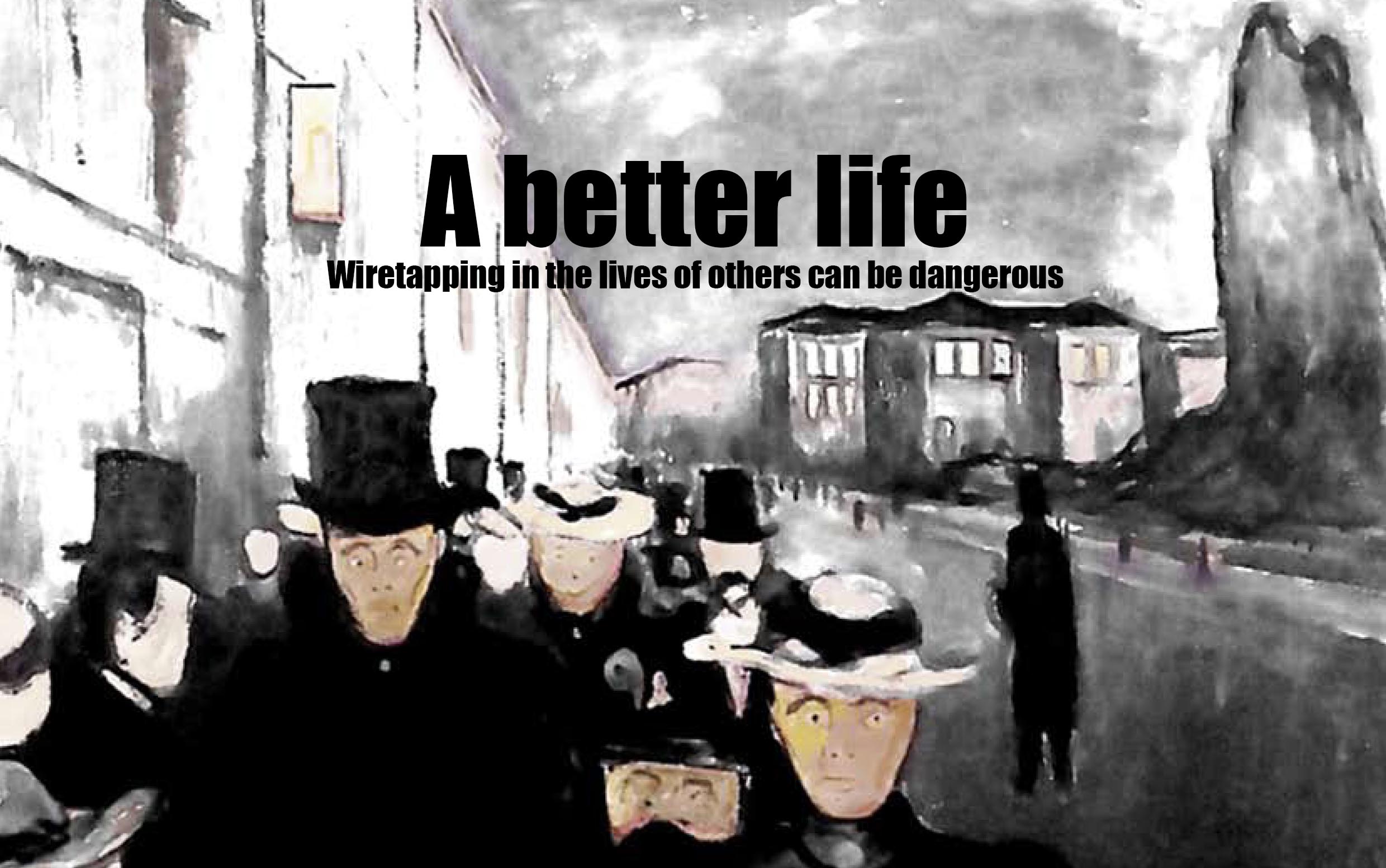
Drama, thriller, by Fabio Del Greco, Italy, 2007.
Rome: Andrea Casadei is a young investigator specializing in audio wiretapping who conducts investigations commissioned by husbands betrayed by their wives, or by parents worried about what their children are doing outside the home. But what interests him most is understanding the human soul, listening to casual conversations in the streets, knowing what people think. He often meets in Piazza Navona with his friend Gigi, a frustrated street artist obsessed with success at all costs, with whom he shares a passion for wiretapping. Shocked by the mystery of the disappearance of Ciccio Simpatia, another street artist common friend, Andrea decides to abandon the commissioned works to seek a better life and reflect on his own and others' existence. He will meet the actress Marina and with a bug he will slowly enter her life until he discovers her most unthinkable secrets. The film deals with an important theme of contemporary Western society: the lack of love. The mysterious and tormented figure of Marina is reflected in a gloomy and soulless Rome.
Director Fabio Del Greco declared about his film: "Perhaps this film is a reflection on the art of observing, of listening, in short, of what one does when one leaves the real world to tell about it. Perhaps he wants to talk about the subtle relationship between the mirages of success touted by today's society, power and the most authentic human relationships.A 'dark cloud' hangs over the city: it is engulfing everyone in a sort of indistinct, uniform mass, where everyone thinks the same things, where everyone they are more alone. Where is the truest part that makes us unique? Maybe you can try to intercept it only secretly."
LANGUAGE: Italian
SUBTITLES: English, Spanish, French, German, Portuguese, Dutch.
Kafka’s Prague and the Architecture of Bureaucratic Dread
You have already filled out the form. You were told this at the window, by the clerk who did not look up, whose name was not displayed, whose office had no number on the door you were directed to find by another clerk in another corridor who has since, apparently, ceased to exist. The form you filled out was the wrong form. The correct form is available only after the first form has been processed, which cannot happen until the correct form is submitted.
Prague in 1914 was not a metaphor. It was a city of eleven administrative districts governed by an imperial apparatus whose bureaucratic machinery had expanded so far beyond its original purpose that it had become, in the words of historian Gary B. Cohen in The Politics of Ethnic Survival, a system oriented less toward governance than toward the perpetuation of its own procedural existence. The Austro-Hungarian Empire administered its multilingual, multi-ethnic territories through a layered civil service of approximately three million functionaries by the turn of the century, each tier accountable to the tier above it and none of them, at any point in the chain, accountable to the individual standing at the counter. Kafka worked inside this structure. From 1908 until tuberculosis forced his departure in 1922, he was employed at the Workers’ Accident Insurance Institute for the Kingdom of Bohemia, writing reports, adjudicating claims, and moving paper through a system designed to exhaust the claimant before the claim could succeed.
What The Trial enacts, published posthumously in 1925, is not a nightmare distortion of this reality but its precise replication in symbolic key. Josef K. is arrested without being told the charge, tried without being shown the evidence, and executed without the verdict ever being announced. Every interpreter who approaches this as surrealism misses the administrative literalism at its core. In the Habsburg system, access to legal documents was routinely denied to defendants on the grounds of procedural confidentiality. Max Weber, in Economy and Society, completed in draft by 1920, identified this as the structural signature of modern bureaucracy: the keeping of files as an instrument of power, the transformation of knowledge into a hierarchical resource withheld from those most affected by its contents. K.’s guilt is never the point. His inability to locate the institution that has judged him is the point.
The Castle pushes the same logic further into the geography of the city itself. K. arrives in a village that exists in permanent subordinate relation to a castle on the hill, a castle he can see but never reach, whose officials communicate through intermediaries who communicate through other intermediaries, each of whom insists on their own irrelevance to the actual decision being made. Prague’s civic architecture had developed analogously: the German-speaking administrative elite occupied the upper city, the Bohemian Czech population the lower quarters, and the Jewish community, to which Kafka belonged by birth though not by practice, occupied a legal and spatial position that the historian Hillel Kieval, in The Making of Czech Jewry, describes as permanently provisional. The old Jewish quarter, Josefov, had been demolished between 1893 and 1913 in a modernization campaign that displaced thousands while installing in its place a geometry of boulevards that looked progressive and functioned as erasure.
Kafka watched the demolition from childhood. He wrote, in a letter to his friend Oskar Pollak in 1902, that they were living in the ruins of a city that had not yet finished falling. The buildings were new but the fear was older, and the fear had the specific texture of not knowing which authority, exactly, had the power to make it stop. That texture is not Kafkaesque in the borrowed, diminished sense the word has come to mean in contemporary usage. It is the felt experience of a subject embedded in an administrative order that processes him without ever needing to acknowledge him, and the horror is not that the system is cruel but that it is indifferent in a way that feels, to the person inside it, indistinguishable from targeted malice.

The City as a System That Was Never Designed for You
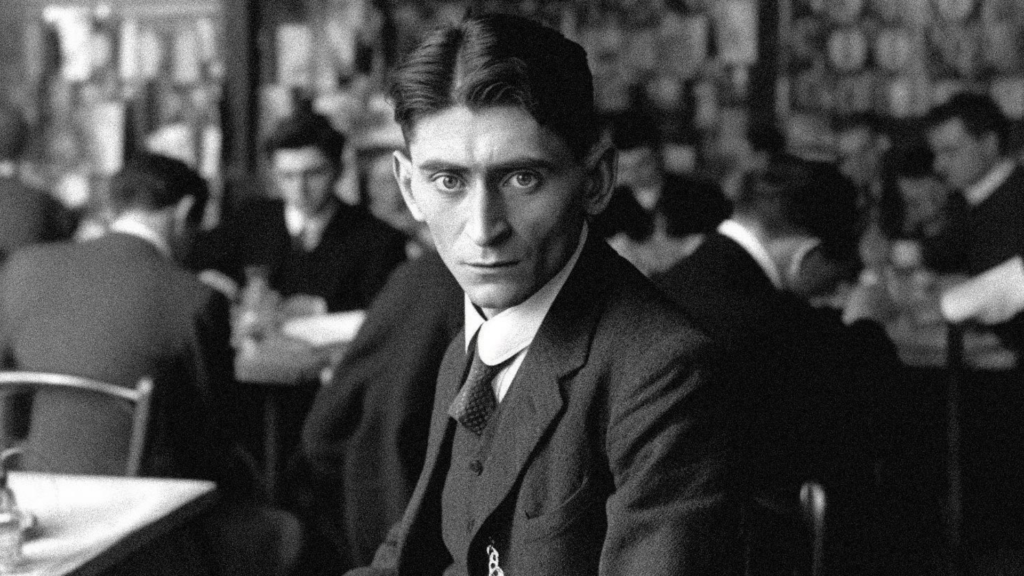
You move through the morning crowd with your eyes slightly unfocused, not quite looking at anyone, registering faces as shapes rather than persons, processing the street as a sequence of obstacles rather than a human landscape. It is not rudeness. It is not depression. It is a skill your nervous system learned quietly, without your permission, as the price of functioning inside a machine that produces more stimulation than any single mind was built to absorb.
Georg Simmel understood this a century before neuroscience had the vocabulary for it. In his 1903 essay “The Metropolis and Mental Life,” he described what happens when a person is exposed to the relentless intensity of urban sensory input: the mind develops what he called the blasé attitude, a deliberate flattening of responsiveness, a learned indifference to the cascade of faces, sounds, transactions, and demands that constitute city life. Simmel was not diagnosing a moral failure or a spiritual poverty. He was identifying an adaptive mechanism, a psychological armor that urban existence forces upon its inhabitants not as a choice but as a condition of survival. The metropolitan type, he argued, responds to overstimulation by blunting the instrument of perception itself.
What makes this observation devastating in retrospect is that Simmel was writing about Berlin in 1903, a city of roughly two million people moving through streets lit by gas and early electric light, connected by horse-drawn carriages and a nascent underground rail. The density of stimulation he was describing would register today as relative quiet. The metropolis of the early twenty-first century has amplified every variable Simmel identified to a degree that would have made his theoretical framework feel inadequate even to him. The number of strangers a city-dweller passes in a single commute, the volume of transactional language absorbed before noon, the way public space is now simultaneously physical and digital — all of this means the armor must be thicker, more comprehensive, more continuously maintained.
Kafka lived and worked inside exactly this pressure. He spent his professional life as an insurance lawyer in Prague, handling industrial accident claims, and the bureaucratic architecture he navigated daily was not a metaphor he invented but a reality he inhabited. Prague in the early twentieth century was a city fractured across linguistic, ethnic, and imperial lines — German-speaking Jews operating within a Czech-speaking population inside an Austro-Hungarian administrative structure — and the experience of belonging fully to none of these categories while being subject to all of them produced something more specific than alienation in the general sense. It produced the sensation of being structurally irrelevant to a system that nonetheless required your constant participation. His fiction does not describe this condition from the outside. It reconstructs the texture of it from the inside, which is why it refuses to explain itself.
The city in Kafka’s work is never named, never mapped, never given the kind of descriptive specificity that would allow a reader to feel oriented. The courthouse in The Trial exists across multiple floors of apartment buildings, its jurisdiction undefined, its procedures opaque. The castle in his final novel sits above the village but is never physically reached, its authority pervasive but its logic inaccessible. What Simmel had theorized as a psychological withdrawal Kafka rendered as an architectural condition: the environment itself is organized against you, not through malice but through a structural indifference that is somehow worse than malice, because it offers nothing to push against.
This is the detail that the blasé attitude cannot protect you from. Simmel’s armor works against overstimulation, against the flood of impressions that would overwhelm a sensitive mind. But it is useless against under-recognition, against the particular cold of a system that processes you without registering you, that requires your compliance while remaining completely indifferent to whether you understand why. The withdrawal that was meant to preserve the self ends up isolating it inside a structure that was never designed to acknowledge its existence in the first place.
When the Self Becomes a Case Number
You arrive at the counter with your documents already in hand — birth certificate, proof of address, the form you downloaded and printed twice because the first copy had a margin error — and the clerk does not look at you. He looks at your papers. There is a distinction there that most people have stopped noticing, and Kafka noticed it before the bureaucratic state had even finished assembling itself.
What the clerk sees is not a person but a dossier in motion. The human being standing at the counter is incidental; what matters is whether the documents are complete, whether the boxes are filled in the right order, whether the signature falls within the designated area. Identity, in this architecture, is not something you possess — it is something the system produces about you, incrementally, through successive acts of registration and classification. The self becomes legible only insofar as it has been processed.
Michel Foucault spent much of Discipline and Punish, published in 1975, tracing precisely this genealogy — the slow historical transformation by which modern institutions learned to manufacture subjects rather than simply punish them. The prison, the clinic, the school, the barracks: each institution developed what Foucault called “techniques of individualization,” procedures that broke populations into discrete, documented, comparable units. The individual that emerges from this process is not the sovereign self of Enlightenment philosophy. It is a file. A case. A number assigned by an administration that existed before you were born and will continue functioning after you die. The individual is not the origin of the system; the individual is its product.
What Kafka understood, with the uncanny precision of someone who worked for seventeen years at the Workers’ Accident Insurance Institute in Prague — filing claims, assessing injury classifications, writing reports that determined whether broken men received compensation or were quietly denied — is that this production of the administrative subject is experienced not as violence but as normalcy. Josef K. in The Trial does not feel that something monstrous has happened to him in the opening chapter. He feels confused, slightly embarrassed, as though he has arrived late to a meeting whose purpose no one will explain. The machinery of his own reduction operates so smoothly that he participates in it, schedules his own hearings, writes his own defense. He has internalized the logic of the case so thoroughly that he cannot imagine himself outside of it.
Cities accelerate this internalization because cities require it. A metropolis of millions cannot function on recognition — the mayor does not know your face, the transit authority does not know your name, the housing office does not know your history. It knows your registration number, your tax bracket, your zone of residence. The urban body is a body that has been disaggregated into administrative categories, each one captured by a different department, none of which communicate the complete picture to the others. You exist fully to no one. You exist partially to everyone who has jurisdiction over some fragment of your documented life.
Georg Simmel, writing in 1903 in “The Metropolis and Mental Life,” described how city dwellers develop what he called a blasé attitude — not indifference born of cruelty, but a psychological defense against the overwhelming volume of stimuli that urban life demands be processed simultaneously. What he did not quite say, but what follows from his argument, is that this blasé attitude extends inward. You begin to relate to yourself the way the city relates to you: as a cluster of functions, obligations, and registered attributes rather than as a continuous, irreducible presence. The self-concept thins. What remains is the résumé, the record, the profile.
There is a particular form of modern suffering that has no clinical name and no cultural vocabulary, which is the suffering of a person who has all their documents in order and still cannot locate themselves in any of them.
The Trap of Legibility
You are handed a form at the door. It asks for your name, your occupation, your reason for being here, and the name of the person responsible for your visit. You fill it out. You hand it back. The clerk reads it without looking at you, then asks you to wait. You sit in a chair that faces a wall. Behind the wall, presumably, someone is deciding whether you are legible enough to proceed.
This is not a metaphor borrowed from Kafka. This is the administrative experience that Kafka lived daily as an insurance officer in Prague, and it is also the experience that James C. Scott spent decades anatomizing in his 1998 work Seeing Like a State, where he argued that modern states reorganized human life not for the benefit of those living it but for the convenience of those measuring it. The forest that produces a hundred species of timber is illegible to the state; the monoculture plantation, brutal and ecologically hollow, is perfectly legible. The same logic migrated into cities with a violence that was architectural, demographic, and irreversible.
When Georges-Eugène Haussmann tore through medieval Paris between 1853 and 1870, demolishing roughly 12,000 buildings and displacing at least 350,000 people, the official language was hygiene, circulation, modernity. The hidden grammar was control. The new boulevards were wide enough for artillery. The warren of alleyways where the revolutionary poor had built barricades in 1830 and 1848 were erased in favor of long, straight sightlines — streets along which a crowd could be seen, followed, dispersed, or shot. The city was being rewritten in a script legible to power, and the inhabitants who had authored the previous text in their bodies and habits were expelled from the narrative entirely.
What Scott identified, and what most urban planning textbooks still fail to absorb, is that legibility is not neutral. To make something readable to a distant authority is to subtract everything about it that exceeds that authority’s categories. The street vendor who knows which corner catches the afternoon shade and positions herself accordingly possesses knowledge that no municipal database can encode. The moment the city grid rationalizes her into a licensed vendor in zone C, subsection 4, operating under permit number 7741, her local intelligence is not preserved — it is replaced by a record that satisfies the state and means nothing to her survival.
The urban grid itself, which Americans tend to experience as simply the way cities are shaped, carries the full weight of this history. The Land Ordinance of 1785 divided the American continent into townships of six square miles before anyone had walked most of the land being divided. The grid preceded the settlers, preceded any encounter with actual terrain, and imposed a geometry of ownership that could be administered from a distance. This is the deepest form of violence in the history of urban design: the application of abstract order to living space before the living space has had any chance to speak.
What Kafka renders in fiction — the unnavigable corridor, the authority that cannot be located, the accusation that cannot be answered because its terms are never disclosed — is structurally identical to what Scott documents in policy. The accused man in Kafka’s courtrooms cannot mount a defense because the law does not exist to be understood; it exists to be obeyed in advance of comprehension. This is not satire of a paranoid mind. It is the phenomenology of a city that has been made legible upward and illegible downward — transparent to the state, opaque to the person standing inside it, trying to understand why the door that was open yesterday is locked today and who, if anyone, holds the key.
The question that neither Kafka nor Scott fully closes is whether the person who cannot be read by the system is endangered or, in some narrow and terrible sense, free.
A vision curated by a filmmaker, not an algorithm
In this video I explain our vision
Loneliness as Infrastructure
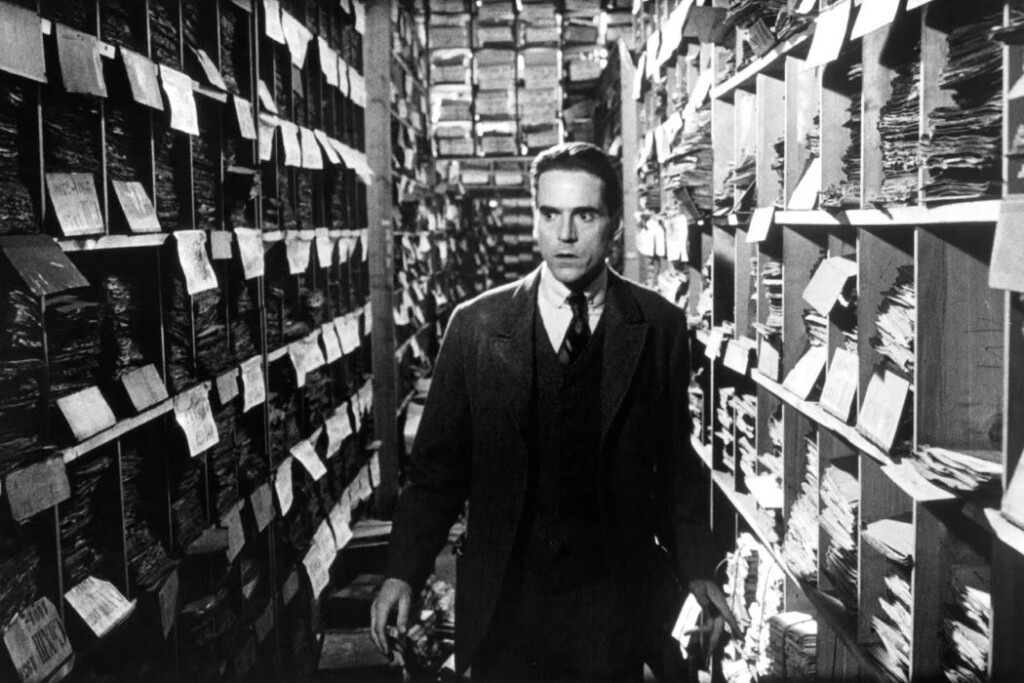
You are standing on a platform in a city you have lived in for eleven years, surrounded by forty people you have never spoken to, and it occurs to you that the silence between all of you is not accidental. It has been engineered. The distance between your body and the nearest stranger has been calculated, optimized, reproduced at scale. The loneliness you feel in that moment is not a failure of your personality or a wound from your childhood — it is the intended output of a system that was designed, brick by brick, zoning law by zoning law, to produce exactly this.
Robert Putnam spent years mapping the erosion of American civic life before publishing Bowling Alone in 2000, and what he found was not a story about individual withdrawal but about the systematic dismantling of the conditions under which people had once, briefly, gathered. Between 1950 and 1990, membership in civic associations collapsed. Attendance at town meetings fell by more than forty percent. The number of Americans who reported having no one to discuss important matters with tripled between 1985 and 2004. These are not emotional statistics — they are architectural ones. They describe a built environment that had quietly, over decades, removed every surface on which community might accidentally form. The bowling alley remained, but you bowled alone because the parking lot was too large, the commute too long, the front porch abolished by the garage, the garage set back from the street, the street designed for vehicles that move too fast to permit eye contact.
Émile Durkheim understood something about this more than a century before Putnam quantified it. In his 1897 study of suicide, he identified anomie not as sadness but as the condition of a person who has been cut loose from the normative frameworks that give action meaning — not freed, but untethered. The modern city, in Durkheim’s reading, was a machine for producing anomie at scale: it accelerated the division of labor, dissolved traditional bonds faster than new ones could form, and left the individual exposed to a vastness of social possibility that felt, paradoxically, like total emptiness. The freedom to be anyone turned out to mean, for many people, the experience of being no one in particular to anyone in particular.
Kafka never theorized this. He lived it as sensation. The city in his fiction — Prague rendered into nightmare geometry, into bureaucratic labyrinths where no room leads to another room that leads to resolution — is not a symbol of alienation. It is the actual spatial logic of a society organized around the individual as economic unit rather than social being. Joseph K. wanders through institutional corridors not because Kafka wanted to write allegory but because Kafka had walked those corridors himself, had felt the way that modern urban institutions are designed to process you rather than receive you, to route you rather than recognize you.
What has deepened since Kafka’s Prague and Putnam’s America is the degree to which this infrastructure of isolation has been internalized as personal preference. Urban design theorist Jane Jacobs argued in 1961 that the death of cities came not from density but from the elimination of mixed use, of the accidental contact between strangers that only happens when streets are built for people rather than cars, when ground floors are inhabited rather than blank. The planners who overruled her built highways through neighborhoods, erected towers that turned inward, replaced the corner store with the retail park reachable only by vehicle. They did not intend loneliness. They intended efficiency. But efficiency, when applied to human settlement, produces isolation as its exhaust.
The deepest trap is that the person standing alone on that platform has been given an explanation for their aloneness that locates it entirely inside themselves — their anxiety, their introversion, their phone. The phone is real. But it arrived into a space that was already empty.
The Second Scene: A Man Who Cannot Leave
Picture a man in his mid-forties sitting in a government office at 2:47 in the afternoon on a Tuesday in November. He has been there since 8:15 in the morning. He holds a number — 347 — and the screen above the service counter has been displaying 291 for the last two hours without moving. He is not in a country at war. He is not fleeing anything. He is trying to register a change of address so that his health insurance will continue to cover his prescriptions. Without the registration, the system flags him as a non-resident. Without the coverage, he cannot afford the medication. Without the medication, he cannot reliably get to work. He understands the chain perfectly. Understanding it changes nothing.
The Kafkaesque is often described as a literary atmosphere, a mood of dread and absurdity that belongs to fiction. But what Kafka captured in works like The Trial, published posthumously in 1925, and The Castle, left unfinished at his death in 1924, was not atmosphere — it was architecture. He had worked for fourteen years at the Workers’ Accident Insurance Institute in Prague, processing claims from injured laborers, writing reports that determined whether a man who lost three fingers would be compensated at the rate of a full limb or something less. He knew bureaucracy not as metaphor but as daily material, as the specific texture of forms that referenced other forms, of departments that existed to redirect inquiries to departments that no longer answered. When Josef K. is arrested in The Trial without being told his charge, and spends the entire novel trying to locate the accusation so he can defend himself against it, Kafka was not inventing a nightmare. He was describing a structure he had watched grind human beings down every working day of his adult life.
What makes entrapment of this kind so specifically modern is that it carries no visible antagonist. The man with number 347 is not being persecuted by anyone. The clerk behind the counter is following protocol. The protocol was written by a committee that no longer meets. The committee acted on a directive from a ministry that has since been reorganized. Every individual in the chain is doing their job correctly, and the cumulative effect is a wall. Hannah Arendt, writing in The Origins of Totalitarianism in 1951, identified this as one of bureaucracy’s most devastating features: it produces outcomes for which no one can be held responsible, because responsibility has been successfully distributed into invisibility. There is no tyrant to confront, no face to address, no single point at which the logic can be interrupted.
This is where the city becomes essential rather than incidental. The labyrinthine administrative structure Kafka described required the city as its physical host — the proliferation of offices, departments, waiting rooms, counters, corridors that only an urban density could sustain. The village has a mayor you can knock on the door of. The city has a Bureau of Residential Services, which refers you to the Office of Civil Registration, which informs you that your matter falls under the jurisdiction of the Municipal Affairs Division, which is open on alternate Thursdays. Georg Simmel had already observed in 1903, in his essay The Metropolis and Mental Life, that urban existence demanded a particular kind of intellectual distance as a survival mechanism — what he called the blasé attitude, the dulling of response to stimulation that would otherwise be overwhelming. But what happens when you cannot afford that distance? When the stimulation is not aesthetic but bureaucratic, not excessive beauty but excessive obstruction, and you cannot simply look away because your medication depends on the outcome?
The man with number 347 does not storm out. He does not make a scene. He sits very still and stares at the number 291 on the screen, and something in him — not his will exactly, more like his sense that the world is addressable — quietly adjusts downward to meet the room.
Complicity and the Bureaucracy We Defend

You have filed the complaint. You know the office is wrong, you know the form requires information you cannot provide, you know the person behind the window will not help you — and still you fill it out, still you wait, still you lower your voice when you speak to the clerk because somewhere inside you believe that your frustration is the problem, not the system that produced it.
This is not naivety. It is something more precise and more damning: it is complicity dressed as compliance, and the city runs on it. The machinery of urban alienation does not sustain itself through the force of tyrants or the malice of administrators. It sustains itself through the participation of people who consider themselves decent, rational, and essentially powerless — people who are, in fact, none of those things. Hannah Arendt, watching the trial of Adolf Eichmann in Jerusalem in 1961 and publishing her account two years later, arrived at a conclusion that scandalized her contemporaries: that the most destructive bureaucratic systems in history were not operated by monsters but by functionaries who had simply stopped thinking. The evil was banal precisely because it was distributed, normalized, embedded in procedure. Nobody was responsible because everybody was just doing their part.
The urban subject recognizes this structure immediately, even if they never name it. The building inspector who knows the housing code is being violated but approves the permit anyway because his supervisor has approved permits like this for a decade. The HR officer who processes the termination of an employee she knows was targeted unfairly, because the paperwork is in order and her job is to process paperwork. The neighbor who reports the family downstairs for a noise violation not because the noise is unbearable but because the city’s complaint portal is open at midnight and something has to be done about the feeling of helplessness. Stanley Milgram captured the mechanism with clinical precision in his 1963 obedience experiments at Yale, where ordinary American citizens delivered what they believed to be severe electric shocks to strangers, not out of sadism, but because an authority figure in a lab coat told them to continue and because the experimental structure made stopping feel like the aberration. Sixty-five percent went to the maximum voltage. The system held not because people wanted to cause harm but because the architecture of the situation made compliance feel more reasonable than refusal.
This is the insight that bureaucratic critique almost always stops short of delivering: the city’s alienating apparatus does not merely happen to its inhabitants. Its inhabitants are its operators. Every interaction with a dehumanizing system that ends in submission rather than refusal is a vote for the system’s continuation. The person who waits three hours at the housing authority without speaking to anyone about the absurdity of the wait is not a victim in any simple sense — they are also a collaborator, their patience being harvested as evidence that the system functions acceptably. The urban fabric is held together not by coercion alone but by the daily, unremarkable, exhausted consent of people who have decided, reasonably enough, that today is not the day to make it worse.
What makes this genuinely difficult to face is that the complicity is not cynical. It emerges from the same rational calculus that Kafka’s characters employ — the assessment that the system is too large, too old, too entrenched to be effectively resisted by a single person who still has rent to pay and a job to keep and energy only enough to survive the week. The tragedy is not that this calculation is wrong. In most individual cases, it is correct. The tragedy is that it is correct for everyone simultaneously, which is precisely how the architecture of administration reproduces itself across generations — not through force, but through the accumulated reasonableness of people who each, separately, decide that this particular moment is not quite the right one to stop.
🌀 Lost in the Labyrinth: Alienation, Identity & the Absurd
Franz Kafka’s vision of urban alienation — where faceless bureaucracies swallow the individual and identity dissolves into corridors without end — resonates across generations of literary thought. The following works explore kindred themes of existential wandering, labyrinthine identity, and the crushing weight of modern existence. Each offers a unique lens through which to deepen your understanding of Kafka’s haunting world.
Jorge Luis Borges and the Labyrinth of Identity
Jorge Luis Borges and Kafka share an obsessive fascination with the labyrinth as both a physical space and a metaphor for the self in crisis. In Borges’ literary universe, identity is never stable — it fractures, mirrors, and loops back on itself in infinite regress. Reading Borges alongside Kafka reveals how the maze is not merely a setting but the very structure of modern consciousness.
GO TO THE SELECTION: Jorge Luis Borges and the Labyrinth of Identity
Jorge Luis Borges: Life and Works
This deep dive into Borges’ life and works illuminates the philosophical architecture that underpins his fiction, much of which echoes Kafka’s existential anxieties. Both authors treat literature as a system of infinite corridors where meaning is perpetually deferred. Understanding Borges’ biography and creative evolution enriches our reading of any author grappling with alienation and the unknowable.
GO TO THE SELECTION: Jorge Luis Borges: Life and Works
Samuel Beckett: Life and Works
Samuel Beckett, like Kafka, constructs worlds where characters are trapped in cycles of waiting, futility, and systemic incomprehension. His life and body of work reveal a sustained meditation on the collapse of meaning in the modern era. Exploring Beckett’s trajectory as an artist offers essential context for understanding the literary tradition in which Kafka’s urban nightmares remain so profoundly relevant.
GO TO THE SELECTION: Samuel Beckett: Life and Works
Waiting for Godot by Beckett: Analysis
Beckett’s Waiting for Godot is perhaps the most iconic theatrical expression of the same void that Kafka mapped in prose — a world where authority is absent, purpose is elusive, and the individual is left suspended in agonizing uncertainty. This analysis of the play examines how stasis itself becomes a dramatic and existential condition. It is indispensable reading for anyone exploring the theatre of alienation that Kafka’s fiction helped inspire.
GO TO THE SELECTION: Waiting for Godot by Beckett: Analysis
Discover More Worlds on Indiecinema
These literary labyrinths find their cinematic echo in the bold, uncompromising films of independent cinema. On Indiecinema, explore a curated streaming catalog of independent films that dare to portray alienation, identity, and the human condition with the same raw intensity that Kafka brought to the page. Step into the maze — your next cinematic discovery is waiting.
👉 EXPLORE THE CATALOG: Watch Indie Films in Streaming
A vision curated by a filmmaker, not an algorithm
In this video I explain our vision

