
The Invisible Architecture of Exclusion
You are standing in a room full of paintings and you realize, after a long moment, that you cannot find a single woman’s hand in any of them — not because women did not paint, but because the room was never built to hold what they made.

The Royal Academy of Arts in London admitted its first two female members, Mary Moser and Angelica Kauffmann, in 1768, the year of its founding. It would then admit no other women for over a century. When the Academy’s membership rolls were painted into Johan Zoffany’s famous group portrait of 1772, Moser and Kauffmann could not be depicted standing among their male peers — convention forbade women from attending the life-drawing sessions that formed the symbolic core of academic legitimacy — so Zoffany rendered them as portraits hung on the wall in the background, present as images within an image, framed and flattened while their colleagues occupied living three-dimensional space. The exclusion was not incidental. It was architectural.
The Académie royale de peinture et de sculpture in Paris set formal quotas on female membership as early as 1706, capping women at four at any given time regardless of talent or output. This was not ignorance — it was policy. The reasoning offered was rarely crude: women were said to lack the sustained rational concentration that great art demanded, or the physical stamina required for monumental work, or the freedom from domestic obligation necessary for a truly dedicated career. These arguments did not emerge from observed failure. They preceded any observation. They were written into the institutional grammar before a single woman had been tested against their terms.
The patronage system compounded what the academies codified. Linda Nochlin, in her landmark 1971 essay “Why Have There Been No Great Women Artists?”, dismantled the romantic myth of the solitary genius to expose what she called the “white Western male” infrastructure of art production — the workshops, the guild apprenticeships, the relationships between master and student that operated almost entirely through networks of masculine homosociality. A woman who sought formal training before the nineteenth century typically had one viable path: to be born into the household of a male artist. Artemisia Gentileschi’s father was Orazio Gentileschi. Marietta Robusti’s father was Tintoretto. The exceptions that history preserved were exceptions precisely because they had found a door left accidentally ajar within a structure designed to keep it shut.
Even when women achieved recognition, the apparatus of art history moved to contain it. Giorgio Vasari, whose Lives of the Artists published in 1550 and expanded in 1568 functioned for centuries as the foundational canon of Western painting, included women so rarely and so briefly that their entries read less like biography than like footnotes inserted to prove the rule. Properzia de’ Rossi, the only female sculptor he mentioned, was praised primarily for her small-scale work in cherry pits — a detail that encoded her femininity as a limit, her delicacy as evidence of confinement rather than mastery.
The salon system of the eighteenth and nineteenth centuries offered what appeared to be a partial opening. The Paris Salon accepted female submissions and, between 1801 and 1900, women did exhibit there in growing numbers. But acceptance at the Salon and access to the Prix de Rome — the state prize that funded years of study in Italy and functioned as the true launching pad for monumental careers — were entirely different things. The Prix de Rome was formally closed to women until 1903. A century of exhibition without the infrastructure of patronage, travel, and institutional endorsement produced visibility without power, presence without permanence.
Naming What Was Never Named: Pioneer Figures and Their Erasure
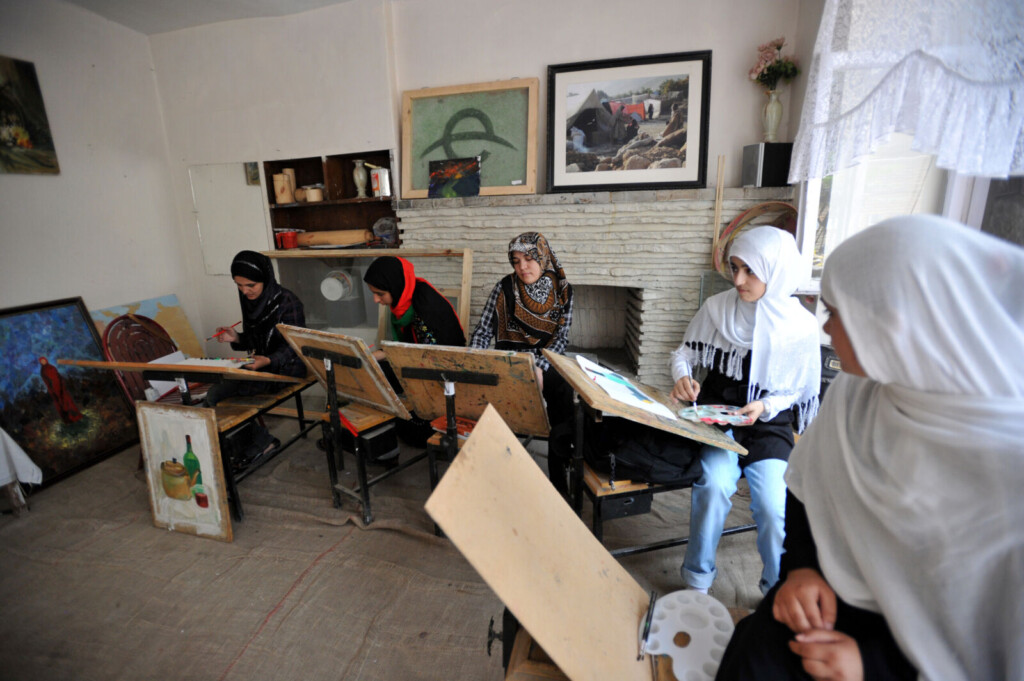
You are standing in a gallery room that should be famous but somehow never is — the placard on the wall lists a name you half-recognize, a woman born in 1593, and you realize with a slow, uncomfortable weight that you only know her story because someone was eventually shamed into telling it.
Artemisia Gentileschi painted violence the way only someone who had survived it could: not as spectacle, but as anatomy. Her Judith Slaying Holofernes, executed around 1614 to 1620, carries a muscular intentionality that art historians spent centuries attributing to her mentor, her father, or simply to the Caravaggesque school as an anonymous inheritance. The logic was tidy and self-sealing — a woman could absorb influence but not generate it. What she produced was derivative; what she endured was private. The trial of her rapist, Agostino Tassi, became the documentary lens through which her entire body of work was filtered, so that even when scholars acknowledged her technical mastery, they embedded it inside victimhood, which is a more comfortable category than genius.
The mechanism is not simply bias — it is something more structural and harder to dislodge. Linda Nochlin, writing in 1971 in her essay “Why Have There Been No Great Women Artists?”, identified the problem not as an absence of talent but as an institutional architecture designed to make female talent illegible. The Royal Academy of Arts in London did not admit women as full members until 1936. The École des Beaux-Arts in Paris barred women from its ateliers until 1897. These are not footnotes — they are load-bearing walls of the canon, and everything built inside them carries their shape.
Berthe Morisot exhibited in seven of the eight Impressionist exhibitions between 1874 and 1886, a consistency of participation that exceeds most of her male contemporaries, yet she was systematically positioned as the movement’s decorative margin. Critics praised her work as instinctive, spontaneous, feminine — a vocabulary that placed her outside the domain of deliberate artistic intelligence. Her brushwork, now recognized as among the most formally radical of the Impressionist period, was read as accident rather than method. After her death in 1895, her estate was managed by her family, her correspondence edited, her professional relationships reframed as social ones. The archive itself was shaped by the assumption that what mattered about her life was proximity to Édouard Manet, not distance from every institutional structure that might have formalized her standing.
What makes Hilma af Klint’s case philosophically vertiginous is that she anticipated her own erasure. She left instructions that her abstract paintings — produced between 1906 and 1915, years before Kandinsky and Mondrian staked their claims to abstraction’s origin — should not be exhibited until at least twenty years after her death. She died in 1944. The Hilma af Klint Foundation began seriously exhibiting her work in the 1980s, and the 2018 retrospective at the Guggenheim Museum in New York became one of the most visited shows in the institution’s history. The art historical problem her work creates is not merely chronological — it is categorical. If abstraction did not begin where the textbooks say it began, then the entire narrative of modernism’s heroic male vanguard requires not revision but demolition.
What these three careers share is not martyrdom but a specific kind of productive invisibility — they made work of such formal consequence that the only way to neutralize it was to surround it with biography, to make the life so loud that the painting went quiet. The women were present. The work was present. The erasure required active maintenance, institutional decisions, editorial choices made decade after decade to keep certain names at the edge of a story whose center kept being reassigned.

The Feminist Intervention and Its Theoretical Weapons
Contemporary Protagonists and the Refusal of Legibility

The Market, the Canon, and the Persistence of the Gap
A vision curated by a filmmaker, not an algorithm
In this video I explain our vision
Infinite Maze: Further Explorations
Influencer Marketing: History and Culture of the New Persuaders
GO TO THE SELECTION: Influencer Marketing: History and Culture of the New Persuaders
Social Media and the Loss of Identity
GO TO THE SELECTION: Social Media and the Loss of Identity
The Culture of Performance on Social Media: Psychology and Sociology
GO TO THE SELECTION: The Culture of Performance on Social Media: Psychology and Sociology
Anthrozoology: History and Science of the Human-Animal Relationship
GO TO THE SELECTION: Anthrozoology: History and Science of the Human-Animal Relationship
Stream Independent Cinema
👉 EXPLORE THE CATALOG: Watch Indie Films in Streaming
A vision curated by a filmmaker, not an algorithm
In this video I explain our vision

