
The Flicker in the Mirror
A man stands before the bathroom mirror at dawn, the first gray light seeping through the frosted window, his face half-shaved, razor paused mid-stroke. There, behind the reflection of his own bleary eyes, a shadow flickers—not quite a face, not quite a form, but something that lingers just beyond the edge of the glass, pulling at the corners of his vision like a half-remembered dream refusing to dissolve. He blinks, leans closer, breath fogging the surface, but the shadow retreats, leaving only the familiar lines of exhaustion etched into his skin. Yet the unease remains, a subtle rhythm pulsing beneath the ordinary act of seeing himself, as if the mirror has betrayed the completeness of what he is, hinting at layers the eye alone cannot grasp.

This is where perception fractures, where the solid self we clutch like a shield begins to reveal its seams. Rudolf Steiner called anthroposophy a path of knowledge to lead what is spiritual in the human being to the spiritual in the universe, arising not from abstract theory but from the heart’s elemental need, like hunger or thirst. It starts in moments like this, when the material world—cold tile, steam-clotted air—presses against an inner sensing that something more moves within us. Steiner saw the human as no mere physical shell but a fourfold vessel: the dense physical body we mistake for our entirety, woven with an etheric force that shapes life and growth, an astral body carrying desires and emotions, and at the core, the “I,” that eternal, hidden entelechy directing our course through warmth and fire, linked to the heart’s hidden rhythm.
He did not invent this; echoes ripple through ancient understandings—the Chinese named the etheric forces long before, just as Steiner traced the “I” as the crown of physical creation, eternal spirit veiled in flesh. In the mirror’s flicker, this “I” stirs, not stimulated by sensory input alone, but radiating outward to meet the world, then drawing back what it has touched, transforming external impressions into inner structure. Steiner described it precisely: the ego sends its essence to the point of contact, as in touch, allowing the outer world’s imprint to become one’s own only through resistance, through an inner recoil that absorbs and owns it. Sight works similarly—the external sends a fragment of itself inward, imprinting upon what the “I” has already projected, so we do not merely receive the world but reenact it within, building the “I-human” from echoes of what was once outside.
Consider how this plays out in the quiet unraveling of daily illusion. A woman pauses mid-conversation, her words trailing as a sudden warmth floods her chest, not from the room’s heat but from an inner directive, willing her toward a choice that defies the room’s logic. Or a child, playing alone, suddenly stills, gaze fixed on nothing, as if detaching from the body to watch its own impulses from afar—like walking alongside oneself as a stranger, Steiner said, exercising a will that operates beyond the physical, connecting feeling across inner and outer realms. This is no poetic fancy; it mirrors the anthroposophical unfolding, where sense-free thinking becomes the gateway, creating an inner space free of the body’s drag, where concepts like cause and effect reveal themselves not as inventions but as ideal essences shared across all minds, uniting thought’s content with perception itself.
Steiner’s spiritual science demands we bridge the sciences, arts, and spirit, not as divided realms but as facets of human culture, each revealing the spiritual in the tangible. The man in the mirror, shaking off the shadow, returns to his day, but the flicker persists—a reminder that the merely material self is the grandest of conventions, a trap we enter at birth, mistaking the physical for the whole. The “I” hides, eternal yet unrevealed, accessible only through thinking, feeling, willing in their archetypal purity. What if that shadow is not illusion but the first glimpse of what continues beyond death, the soul-spirit detaching, carrying life’s acquisitions into higher forces? The unease lingers, unanswered, as the dawn hardens into day.
Echoes of Invisible Bodies
A child asks her grandmother at the dinner table what happens to people after they die, and the room goes silent in that particular way that silence goes when everyone suddenly realizes they have no honest answer. The grandmother reaches for her wine. The mother changes the subject. The father studies his plate. This is how we teach the spiritual anatomy of human beings in the modern West—through omission, through the swift redirection of attention, through the collective agreement that certain questions belong to childhood and should not resurface in adults except as embarrassments to be quickly suppressed.
Rudolf Steiner spent his life insisting that this silence was not wisdom but a profound cultural catastrophe, a deliberate amputation of human knowledge. He argued that we do not actually know what a human being is because we have agreed to see only what our physical senses can verify. Strip away that agreement, he suggested, and an entirely different architecture of the person becomes visible. Not as metaphor, not as comforting abstraction, but as observable reality to those who have trained themselves to perceive it. What appears at the dinner table as an unanswerable question becomes, in Steiner’s framework, a failure of collective courage to acknowledge what continues when the physical body ceases.
The human being, according to Steiner’s anthroposophy, consists not of a single material form but of nested layers of increasingly subtle organizational principles. The physical body—what the anatomist and the physician know—is only the densest expression, the visible trace of forces that operate at different frequencies of manifestation. Below the physical body, so to speak, lies what Steiner called the etheric body, also termed the body of formative forces. This is not a mystical invention but a description of what he understood to be the organizing principle that keeps the physical materials arranged in their particular configuration, that maintains the form that allows a human being to be recognizably human rather than a heap of the same chemical elements in random arrangement. The etheric body holds the pattern. It is why a corpse, still composed of nearly identical material as a living person, is so radically different. Something has withdrawn.
Beyond the etheric body exists what Steiner termed the astral body, the vehicle of sensation and feeling. Here is where the inner weather of a human being actually occurs—not in the brain, not in the nervous system as mainstream science proposes, but in this subtle layer that contains the capacity for desire, emotion, suffering, joy. The brain reflects the astral body’s activities into consciousness, as a mirror reflects light, but the light itself originates elsewhere. This distinction matters enormously. It means that feeling is not merely electrical impulses; it means that the sorrows and loves we experience possess a structure that is as real as any bone or organ, even though it cannot be dissected or photographed by standard instruments.
And then there is the ego—the sense of I-ness, the distinctive human faculty that can stand apart from its own experiences and observe itself. This is what Steiner saw as the specifically human spiritual principle, that which separates us from all other forms of existence. The mineral has a physical body only. The plant adds the etheric body—hence growth, reproduction, the organizing principle. The animal adds the astral body—hence sensation, inner life, mobility. But the human being alone adds the ego, the self-aware consciousness that can think about its own thinking, that can say I and mean something entirely unprecedented in creation.
These layers do not exist in the vague, interchangeable way that spiritual systems sometimes describe them. According to Steiner, they interpenetrate completely. The warmth organism—the circulation of blood—is where the ego works its will into the world. The air organism carries feeling into physical expression. Every organism within us works upon every other organism. This is not poetic metaphor. This is the claim of observable structure. The child at the dinner table, asking what happens to people after death, is asking which of these layers persist when the physical body can no longer host them. Everyone at that table knows, at some level, that something does persist—we speak to people we have lost, we feel their presence, we inherit their fears and ambitions and peculiar gestures—yet we have agreed collectively to speak of such things only in whispers, as though acknowledging them would breach some fundamental law of acceptable discourse.

Whispers from the Threshold
A woman sits in a crowded café, her coffee growing cold beside her while conversations layer over one another like translucent sheets. Someone across from her speaks about the weather, about deadlines, about the irritating efficiency of their workplace—but she notices something else entirely. There is a tremor beneath the words, a current of wanting and fearing that the speaker themselves seems unaware of. The café hums with this double life: the life of what is said, and the life of what is felt but never spoken. Most people move through moments like these without registering the gap. They accept the surface as complete. But what if that surface is precisely the problem, a threshold beyond which we are discouraged from looking?
This is where Rudolf Steiner’s investigation into the stages of consciousness becomes not a mystical abstraction but a diagnosis of modern captivity. We live, according to Steiner, under the dominion of thinking that has abandoned its moorings in the spiritual world and now floats in what he calls “a stratum of being where it does not reach down to realities.” The everyday experience of that woman in the café—sensing something true that exists beyond what can be measured or named—represents a collision between two orders of knowledge. One is the rationalized, sensory-bound thinking that has become the unquestioned authority of modern life. The other is something older, something that knows the world not as a collection of dead objects but as a living expression of spirit.
Steiner proposes that human consciousness passes through distinct stages, each one a threshold into greater depths of reality. Imagination is the first genuine access to the supersensible world, and it is radically different from mere fantasy or wishful thinking. True imagination, in Steiner’s terms, is a faculty that perceives living thought-forms, the spiritual prototypes that underlie physical manifestation. When the woman in the café senses the hierarchy of unspoken needs and fears surrounding her, she is glimpsing something like this—patterns of intention and desire that have shape and substance in the supersensible realm, even if they leave no trace on a thermometer or a scale. This capacity has been systematically devalued by a culture that recognizes only what the senses report and what instrumental reason can process.
The second stage, inspiration, goes deeper. It is not the romantic notion of artistic inspiration but rather direct cognition—knowing something not through symbols or images but through immediate presence. To achieve inspiration, one must move beyond the representational thinking that characterizes our normal waking consciousness. This is where the Ahrimanic grip tightens most visibly in modern life. Ahriman, in Steiner’s cosmology, is the force that drives consciousness toward ever-greater intellectualization, toward the reduction of all knowing into systems, schemas, and mechanical models. The sterility that permeates contemporary intellectual life, where knowledge is preserved in books that no one reads and where ideas are divorced from the lived breath of reality, bears the signature of Ahrimanic influence.
What makes this grip particularly insidious is that it masquerades as clarity and progress. The Ahrimanic deception presents the world as knowable through reason alone, as if the mechanical universe of Galileo and Copernicus were not merely one perspective but the totality of what is real. In this framework, the woman’s intuition in the café becomes not a valid form of knowing but a subjective distortion, something to be dismissed or explained away through psychology. And yet Steiner argues that the soul carries a knowledge beneath waking consciousness, a communion with the spiritual dimensions of existence that contradicts the official narrative of a dead, mechanical cosmos. The discord that many feel in modern life—the sense that something essential is missing—arises from this profound dissonance between what the soul knows and what the waking intellect is permitted to acknowledge.
Intuition, the third stage, represents the capacity to become one with the object of knowledge, to dissolve the separation between knower and known. This is the threshold that Ahrimanic forces work most desperately to keep sealed. For if human beings were to develop genuine intuitive knowledge, they would reconnect with the spiritual realities that have been systematically obscured by the tyranny of rationalism masquerading as objectivity. The woman’s pause in the café, that moment of hesitation where she senses something real that has no official name, is a crack in that sealed door. What presses against it from the other side is not mysticism but a form of knowing that Western civilization has been trained to fear.
Shadows of Rooted Souls
The argument begins innocuously enough—two people discussing family patterns, inherited trauma, the inexplicable weight of belonging to a particular lineage. One mentions that certain struggles seem to run through generations like an underground current, that blood carries not just biology but something older, something chosen. The other nods, recognizing this from their own experience, and suddenly the conversation has shifted into territory that feels both intimate and dangerous, where personal destiny and collective identity become indistinguishable.
This is where Steiner’s vision of reincarnation and karma enters not as abstract cosmology but as lived mythology, shaping how we understand ourselves in relation to family, nation, and evolutionary progression. The soul, according to this framework, does not arrive as blank slate but as returning actor in an ancient drama, carrying with it the accumulated weight of previous earthings. Each incarnation represents not random placement but deliberate choice—the soul selects its circumstances, its parents, its historical moment, all in service of spiritual development that stretches across millennia. This doctrine offers profound comfort: suffering becomes meaningful, injustice transforms into opportunity for growth, and the accidents of birth reveal themselves as destiny authored by the deepest self.
Yet embedded within this liberating narrative lies a trap so subtle that those who fall into it often cannot see the walls closing around them. If souls choose their incarnations, then the poor have chosen poverty, the enslaved have chosen bondage, the colonized have chosen subjugation. The mythology of reincarnation, which should dissolve the boundaries between self and world, instead hardens them into cosmic justification. This is not Steiner’s explicit teaching, but it is the inevitable consequence when karma becomes the lens through which we view social hierarchies.
The tension deepens when we consider Steiner’s framework of human evolution itself, structured around the concept of folk souls and racial development. In this cosmology, different peoples are positioned at different stages of spiritual maturation, each with particular tasks within humanity’s overall ascent. A group described as more evolved carries different responsibilities than one deemed less developed; a nation understood as bearing particular spiritual destinies moves differently through history than one without such cosmic assignment. The language becomes careful, qualified, rarely openly hierarchical—and this very caution reveals where the pressure lies. When a teaching requires such delicate navigation, when it cannot be stated plainly without appearing troubling, perhaps the trouble resides not in misunderstanding but in the structure itself.
What makes this particularly insidious is that Steiner’s vision genuinely attempts to honor the sacred dimensions of human experience that mechanistic materialism has flattened. His critique of modern science’s blindness to the etheric, to subtle dimensions of human being, speaks to a real hunger—the sense that something essential has been lost in our reduction of existence to measurable particles. By restoring the soul to philosophical respectability, by insisting that consciousness and spirit matter cosmically, Steiner addresses a genuine wound in modern consciousness. But in doing so, he creates a language in which older hierarchies can disguise themselves as spiritual truth.
The inherited unspokenness operates precisely here. Those who encounter anthroposophy often absorb its liberatory aspects—the dignity restored to inner life, the sense of personal agency through spiritual development, the dissolution of mechanical determinism—without fully confronting how this framework can be mobilized to naturalize social domination. The racial dimensions, the evolutionary hierarchies, the idea that certain groups represent higher stages of human development, these can be absorbed almost osmotically, appearing not as imposed doctrine but as obvious spiritual reality.
A family inherits not only genes and trauma but also the invisible architectures of thought through which it understands itself. When that architecture contains hidden evolutionary hierarchies, when it assigns different spiritual stations to different peoples, when it suggests that present circumstances reflect past karma and future destinations, then the conversation about family patterns becomes something other than what it initially appeared. Heritage and fate intertwine not as personal mystery but as participation in a cosmic order where some souls are simply more advanced, some peoples more spiritually mature, some historical positions more evolved than others.
The Unseen Horizon
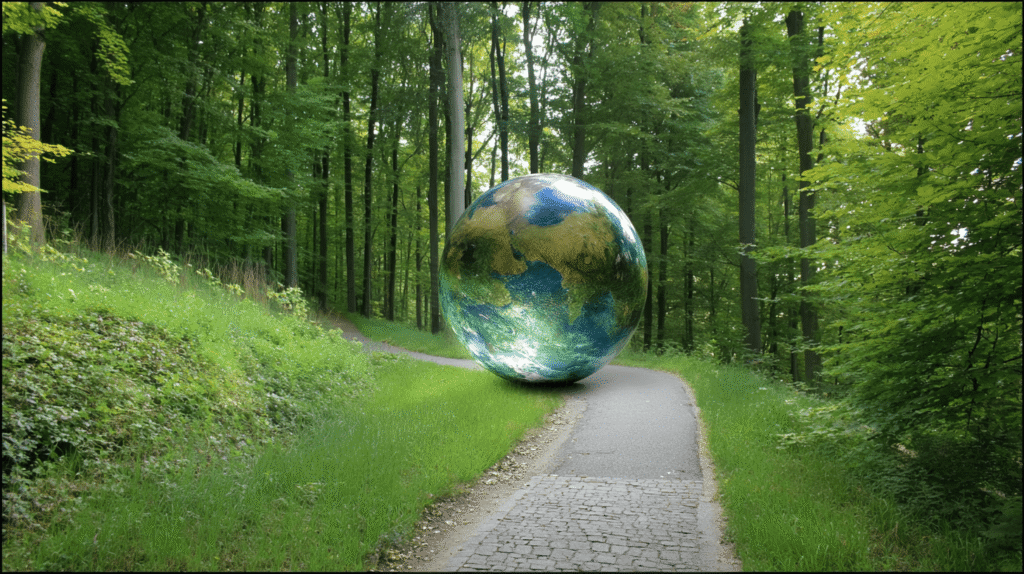
You step onto the damp earth of the forest path as the last light bleeds from the sky, branches clawing overhead like forgotten thoughts. Your footfalls crunch leaves that were once vibrant, now brittle underfoot, and in that sound you sense the echo of something withdrawing—not dying, but retreating into depths you cannot yet name. The air thickens with the scent of moss and decay, and for a moment, the boundary between your skin and the surrounding dusk blurs. What if this blurring is not illusion, but the first tremor of organs stirring within, organs not of flesh but of soul, demanding you perceive the etheric weave that binds tree to thought, matter to the macrocosm’s hidden pulse?
In those hours between day and night, the human form reveals itself as more than vessel. Picture a man pausing mid-stride, his breath syncing with the wind’s sigh through ancient trunks, suddenly aware that his etheric body—feminine in its formative grace if he is man, masculine in its structuring force if woman—expands outward, mirroring the cosmos while drawing it inward. This is no mere fancy; it echoes Steiner’s illumination of the human microcosm entwined with realms beyond the physical, where elements and archetypes pulse behind every leaf’s vein, every root’s grasp into soil. You feel it viscerally: the astral currents of feeling and will surging like sap, the ‘I’ vehicle turning inward to confront what earthly life conceals—the becoming of your own existence, hour by hour, forged not from isolation but from cosmic streams.
Yet this awakening unsettles. As you press deeper into the gloom, shadows lengthening into forms that whisper of disintegrating earth and ascending spirit, recall how consciousness faltered around A.D. 300, spirit vanishing from nature’s veil, leaving us to slumber in materialism’s blind grip. Here, the path forks not by chance but by necessity. One trail clings to the apparent world, matter’s solid half, ignoring the spiritual forces threading through it like unseen rivers carving stone. The other demands cultivation: thinking honed to pierce illusion, feeling balanced against willing, an inner harmony toning the soul as exercise sculpts sinew. Steiner maps this modern initiation, urging activation of soul-spiritual organs rooted in the astral, awakening wisdom slumbering within—the Kingdom encoded in your being, as Christ phrased it, not as distant heaven but immanent fire.
But what of the horizon’s edge? You halt, heart quickening, as a figure emerges in memory—not from screen or tale, but lived: a child by a flowing stream, absorbing surroundings that flow unseen beneath earth’s crust, mirroring the child’s own etheric absorption, Christ impulse introduced not as dogma but living education to avert denial or fossilized faith. Interwoven, another soul withdraws into timeless core, beholding eternity stripped of externals, echoing Schelling’s secret ability to escape time’s flux into the immutable self. And there, a thinker observes pure thinking, living in its self-sustaining spiritual web, a cogito reborn where intellect spiritualizes into consciousness no longer passive but strenuous, wrested from nothingness to grasp the All.
This is Anthroposophy’s demand: not passive reception of stale wisdom, but personal forging of perception, broadening to encompass spirit’s disintegration and earth’s decay, finding Christ amid the rubble. You resume walking, but now each step reverberates—cosmos forming your earthly unfoldment from its immeasurable expanse. The faculties hum, insistent, yet unresolved. For in this twilight, the interplay lingers: spirit pressing through matter’s veil, awakening what slumbers, but to what end? The forest envelops you, silent witness, as the question coils tighter—will you broaden the horizon, or let it narrow to the familiar dark, forever half-asleep to the realms that claim you?
A vision curated by a filmmaker, not an algorithm
In this video I explain our vision
🌀 Infinite Maze: Esoteric Cinema Paths
Delve into the ‘Infinite Maze’ of films echoing Rudolf Steiner’s anthroposophical visions of spiritual mysteries and universal consciousness. These curated articles unlock cinematic explorations of the esoteric, mystical, and profound. Perfect companions to modern esoteric thought.
Esoteric Movies to Watch
Esoteric Movies to Watch invites viewers into hidden spiritual dimensions akin to Steiner’s anthroposophy, featuring films that reveal occult truths and inner transformations. These selections mirror the mystical quest for higher knowledge central to Steiner’s teachings. Discover narratives where the veil between worlds thins, resonating with esoteric wisdom.
GO TO THE SELECTION: Esoteric Movies to Watch
Spirituality: Movies to Watch
Spirituality: Movies to Watch captures the soul’s journey toward enlightenment, paralleling Steiner’s insights into spiritual evolution and cosmic guidance. Films here explore divine encounters and inner awakening, much like anthroposophical paths to higher realms. Essential viewing for those seeking cinematic reflections of eternal spiritual truths.
GO TO THE SELECTION: Spirituality: Movies to Watch
Mystical Films not to Be Missed
Mystical Films not to Be Missed unveils transcendent visions and enigmatic rituals that echo Steiner’s mystical facts and spiritual hierarchies. These cinematic gems transport audiences beyond the material veil into realms of divine mystery and revelation. A perfect maze thread for anthroposophy enthusiasts craving otherworldly depth.
GO TO THE SELECTION: Mystical Films not to Be Missed
Universal Consciousness
Universal Consciousness delves into films probing the interconnected oneness of existence, aligning with Steiner’s anthroposophical view of cosmic unity and human spirit. These works challenge perceptions of reality, inviting profound contemplation of collective awareness. Ideal for navigating the infinite layers of esoteric thought through cinema.
GO TO THE SELECTION: Universal Consciousness
Escape the Maze on Indiecinema
Wander deeper into independent cinema’s boundless realms on Indiecinema streaming, where esoteric visions and spiritual odysseys await. Uncover hidden gems that expand your anthroposophical horizons today.
👉 EXPLORE THE CATALOG: Watch Indie Films in Streaming
A vision curated by a filmmaker, not an algorithm
In this video I explain our vision

