
The Child at the Threshold
The fluorescent lights buzz like distant hornets over rows of plastic desks, where a six-year-old boy named Elias hunches, pencil gripped too tight in his small fist. His worksheet demands he circle the correct answer: which shape is a triangle? But his eyes drift to the window, where autumn leaves whirl in a secret dance, calling him to chase them, to feel their crisp edges crumble underfoot. The teacher’s voice slices through: “Focus, Elias. Eyes on your paper.” He blinks hard, forces his gaze back, but inside, something tightens—a quiet ache, like a bird battering against a cage too narrow for its wings. By recess, he’s slumped, the lines on his page jagged and wrong, while the other children erupt into the yard, their laughter a fleeting rebellion against the clock that ticks them back inside all too soon.

This is the grind most children know by heart, that mechanical churn of early schooling where intellect is sharpened like a blade before the hand that wields it has grown steady. Before seven, Rudolf Steiner warned in his 1923 lectures on child development—gathered later in “The Kingdom of Childhood”—the young soul thrives not on abstraction but on imitation, on the rhythmic pulse of play and story that mirrors the body’s own unfolding. Yet in standard classrooms, we thrust them into the abstract too soon, demanding they decode symbols when their world still pulses with sensory life: the warmth of bread dough rising under small palms, the cadence of a fairy tale spun from a teacher’s voice, not a screen’s cold glow. Elias feels it viscerally, that fracture between the head’s rigid drill and the heart’s unspoken pull toward wonder, a disconnect echoed in studies from the early 2000s onward, where preschoolers in conventional settings showed eroded executive functions—focus splintering under premature cognitive loads, motivation fraying like old rope.
Picture another child, a girl of five, her fingers sticky from hurried glue as she pastes numbered cutouts in sequence, one-two-three, the siren’s song of standardization that began seeping into American kindergartens by the 1990s, post-No Child Left Behind’s shadow. She pauses, stares at the numbers as if they were strangers, her mind wandering to the mud puddle outside where yesterday she molded castles from earth, learning gravity’s pull through collapse and rebuild. In that moment, the soul yearns—not for rote order, but for the chaos of creation, the imitation of a parent’s kneading or a bird’s nest-weaving. Steiner saw this threshold at seven, when baby teeth fall away like a shedding of infancy’s sheath, marking readiness for formal letters and sums introduced not as drills but through myth and art. Push earlier, and you starve the imaginative faculties; Piaget himself, in his 1936 “The Origins of Intelligence in Children,” mapped similar stages, where preoperational minds grasp through symbols born of play, not imposed logic.
Elias kicks at his desk leg later that week, outburst masked as fidgeting, while the girl withdraws into silence, her drawings reduced to straight lines because curves “aren’t on the test.” These aren’t anomalies; they’re the hidden ruptures of a system that prizes intellect’s supremacy, blind to the soul’s deeper architecture. In Waldorf’s founding vision, born in 1919 amid Stuttgart’s factories to educate workers’ children holistically—head, heart, hands intertwined—education waits for the child’s inner ripening. No screens before the teens, no worksheets before the will has strengthened through free play’s trials: falling while learning to walk, snatching toys then mending the rift by watching adults model repair. Data from Waldorf cohorts hints at the cost of ignoring this: children in tech-saturated early years lag in empathy and resilience, their social learning stunted without the unhurried modeling of rhythm and ritual.
Yet Elias dreams that night of flying among leaves, the worksheet forgotten. The girl hums a tune half-remembered from a story circle she once knew at home. What if the threshold weren’t a barrier but a portal, where the soul’s yearnings aren’t silenced but awakened? In the grind’s shadow, that question lingers, pulling at the edges of what we’ve accepted as inevitable.
Echoes of the Unseen

You step out alone into the crisp dawn, boots crunching frost underfoot along a forest path that twists without promise of company, the kind of walk where thoughts unspool like smoke from a hidden fire, each breath pulling you deeper into the rhythm of your own pulse against the world’s indifferent hush. Hours pass unmarked until voices rise suddenly from the underbrush—a cluster of strangers, faces flushed from their own solitary circuits, converging on the same clearing as if summoned by an invisible thread, sharing bread and silence that blooms into stories of lost directions and found directions. In that instant, the isolation shatters, not by plan but by the raw pull of bodies drawn together, souls brushing against souls in a bond as old as the earth itself.
This is no accident of chance, but the quiet architecture of what Rudolf Steiner glimpsed in Stuttgart on August 21, 1919, amid the rubble of a war-torn factory, when he gathered workers’ children and insisted that true education must weave the human being’s body, soul, and spirit into a living whole, refusing the modern lie that we are mere intellects adrift in meat. He spoke then of the child’s etheric body settling into form by age seven, freeing itself from mere growth to forge memory, conscience, temperament—those unseen forces that filter the world not as raw data but as personal fire, demanding imitation of heroes, not rote facts. The wanderer alone mirrors this: the soul wandering its inner wilds, imprinting habits on the etheric until a communal spark ignites, revealing the spirit’s hidden hand in every meeting.
Steiner’s anthroposophy, born from those 1919 lectures, unmasks the cultural phantom of the isolated mind, that Enlightenment ghost haunting classrooms where children are drilled as data processors, their hearts and hands sidelined as afterthoughts. Jean Piaget watched children in 1920s Geneva labs, noting how they construct knowledge not in solitude but through active assimilation, yet even he glimpsed only the intellect’s machinery; Steiner pierced further, to the soul’s triadic pulse—thinking as spirit’s clarity, feeling as soul’s rhythm, willing as body’s deed—insisting the teacher must first permeate their own being with this knowledge, recognizing divine rhythms in the child’s unfolding. Picture the teacher not as lecturer but as wanderer-turned-gatherer, preparing inwardly each dawn, not with lesson plans alone but with the vulnerability of their own soul’s path, faithful to its unfolding as the sacred ground for the child’s.
In 1919 Stuttgart, with Germany’s empire shattered and 1,100 children from Waldorf-Astoria factory families before him, Steiner rejected the soul-less metrics of industrial schooling—those Prussian models born in 1763 under Frederick the Great, churning compliant cogs from fragmented psyches. Instead, he incarnated the triad: hands molding beeswax into forms that will the body awake, heart stirred by epics recited in rhythmic verse that souls remember before words, intellect kindled later, after the etheric has rooted. Emile Durkheim, dissecting education’s social glue in 1922’s “Education and Sociology,” saw schools binding individuals to collectives, yet missed the spirit’s etheric weave; Steiner revealed it as the child’s priest, artist, scientist stirring from one source—the soul—unfolding through seven-year rhythms where isolation yields to communal bloom.
The solitary path fractures the illusion of self-containment; the sudden bond exposes it. A boy, lost in his midday reverie during circle time, suddenly joins the hand-clasp song, his willing body syncing with twenty others, etheric forces aligning in laughter that echoes the 1919 vision: education as soul economy, tending not isolated intellects but the human as microcosm of cosmic evolution, Christ as karma’s lord pulsing through every developmental gate. Yet culture peddles the contrary—screens severing the triad since the iPhone’s 2007 debut, fragmenting attention spans to 8 seconds by 2015, per Microsoft studies, training souls to skim rather than steep. Steiner’s teachers counter this, artists of presence, their inner reflections each evening mirroring the child’s: what resistances colored the day, what growth pierced through?
These echoes resound in the child who, having wandered her inner myths through wet-on-wet painting, finds her soul voiced in the group’s choral ode, spirit-body-soul no longer abstract but flesh—against the societal trap of minds prized as machines, hearts as soft errors, hands as tools. What happens when the wanderer refuses the bond, soul starved in intellect’s sterile solitude? The forest path circles back, but the clearing waits, unseen forces tugging.

Rhythms of Becoming
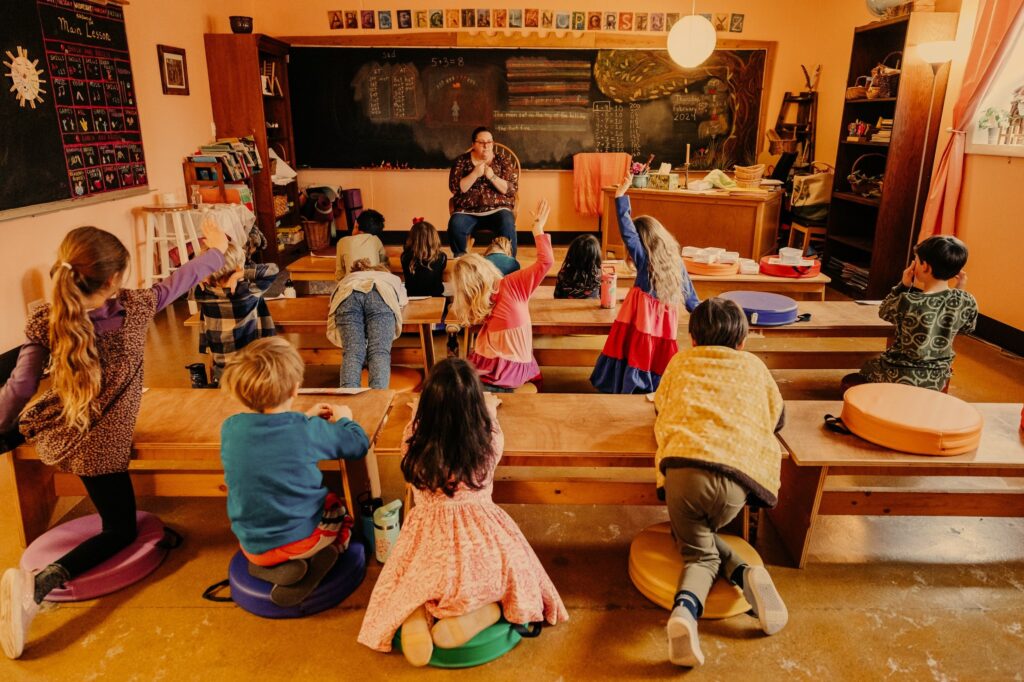
A child kneels at a low wooden table, her small hands plunging into a bowl of wet earth, fingers splaying through the cool, yielding clay that gives no resistance yet demands form from nothing. She pats it into a rough bowl, then a snake that coils and uncoils, her breath syncing with the slap and stretch, until the teacher circles the room humming a low melody that pulls the class into a sway, bodies leaning in like reeds to a wind they cannot name. This is no mere craft; it is the first whisper of will taking shape, where imitation breathes life into the limbs before the mind sharpens its blade. In those kindergarten mornings, before the seven-year change hardens the etheric body—Steiner spoke of it in his 1923 lectures on human development as the sheath that knits physical growth to soul forces—the child mirrors not through command but through the rhythmic pulse of the day: circle songs that rise and fall like breath, outdoor romps that expand into the world’s wild edges, then contract into quiet tales spun from the teacher’s voice, Norse myths of giants wrestling storms or fairy rings blooming under moonlit dew.
Watch how the rhythm breathes: an outbreath of free play in the frost-rimed garden, children tumbling through January’s hush after holiday whirl, building resilience not by force but by the quiet return to pattern—soup on Tuesdays, bread-kneading Wednesdays, painting Mondays where pigments bleed into silk scarves like feelings unfurling. This is the pedagogy of becoming, where the will, dormant in the neonate’s blind trust, awakens through mimicry. The teacher models the flute’s trill, the finger-knitting’s loop, and the child echoes without why, her etheric forces weaving habit into destiny. Yet here the trap glints: society, in its haste for precocity, shoves the intellect forward from age four, screens flickering with algorithms that mimic rhythm but starve the soul’s deeper cadence. Finnish schools, delaying formal reading past six, mirror this Waldorf restraint, their students outpacing global peers in PISA scores by 2015 data, proving that rhythm’s delay forges not weakness but unhurried strength.
By seven, the shift stirs—a tooth loosens, the gaze turns inward, and feeling claims the throne. Now the grade school child enters the astral body’s reign, where beauty is the bridge to knowledge. Bodies move through epic tales: a class recites Pentateuch verses while forming human archways, arms linking in rhythmic undulations that evoke the desert wanderings, or they enact the Greek myths, feet stamping iambs as Achilles drags Hector’s corpse in vengeful circles, the horror softened by the form’s necessity. The main lesson block immerses them for three weeks in history’s heartbeat—review yesterday’s sketch, practice the verse, unveil tomorrow’s fresco—memory lodging not in rote but in the diurnal pulse, day-night strengthening recall as Steiner outlined in his Stuttgart lectures of 1919, where forgetting becomes the soil for true retention. Painting now captures sunset’s glow on wet paper, formless color yielding to the heart’s discernment of harmony; eurythmy gestures vowels into space, the ‘A’ arm arcing like a soul’s longing sigh.
But compromise lurks in the copybooks’ neat script, the festivals’ earnest pageantry—Michaelmas dragons slain in autumn plays, Advent spirals walked in candlelit hush—echoing ancient solstice rites yet sanitized for modern suburbs. Is this soul formation or cultural sleight? The weekly breath persists: inward contraction for storytelling’s dream, outward expansion for nature walks on Fridays, where acorns crunch underfoot and the child’s feeling attunes to seasonal death and rebirth, winter’s quietude mirroring the soul’s descent into mystery. Adorno, in his 1951 “Minima Moralis,” warned of culture industry’s rhythmic hypnosis, commodifying play into consumption; here, Waldorf counters with unpainted toys and unprescribed joy, yet bows to institutional calendars, bells ringing like factory shifts disguised as bells of mindfulness.
The older child, post-fourteen, faces the spirit-self’s call, rhythms now intellectual spirals—math gnomon proofs etched in beeswax, science blocks chasing planetary orbits through observation’s austere gaze—but the early imprint lingers, will and feeling coiled beneath thought’s throne. A girl traces the wet-on-wet watercolor’s bleed, watching blue yield to purple without boundary, her hands remembering the clay’s obedience; nearby, a boy drums fingers on desk to the teacher’s recited epos, body still craving the mythic gait it once embodied. What if this rhythmic scaffold, so lauded for security, veils a deeper trap: the soul’s becoming tethered to anthroposophic stages, every seven years a rung on Steiner’s ladder, while the world beyond demands adaptive chaos? The child who breathed with the circle now questions the circle’s breath—does rhythm free or enclose, nurture resilience or domesticate wild becoming? In the painting’s fade, the myth’s echo, the answer blurs like color into formless wet.
Shadows of the Collective Soul
A child stands at the edge of a refugee camp in Amman, January 2019, his small hands clutching a frayed drawing of a house with smoke curling from its roof, while a teacher kneels beside him, not with words of pity but with colored pencils, inviting him to redraw the sky above. The boy hesitates, then traces bold strokes of blue, as if willing the color back into a world drained gray by flight. In that moment, loss isn’t cataloged like a symptom in a clinician’s chart; it breathes, insistent, demanding to be met not with analysis but with the quiet rhythm of making something new. Dr. Torin Finser, there with his wife Karine, witnesses this not as charity but as the raw pulse of Waldorf’s forgotten social justice vein—a pedagogy that threads empathy through the needle of shared creation, far from the secular intellect’s sterile dissection of suffering into data points.
Nearby, in the shadow of Jordan’s borderlands, Palestinian children gather for what looks like play but unfolds as first aid for the soul. Emergency Pedagogy, as practiced since the late 1990s by figures like Michaela Ruf in Karlsruhe’s Parzival School Centre—with its refugee classes, special needs kindergartens, and children’s homes—doesn’t chase trauma’s ghost with therapy’s scalpel. Instead, it erects “safe places”: tents in camps, marked circles amid ruins, where boundaries reassert footing amid internal chaos. Neurobiological studies affirm what these interventions intuit: new, dependable relationships correct the violation of basic trust, stimulating self-healing powers the child already holds. A girl, orphaned by conflict, molds clay into figures that dance rather than shatter; her laughter pierces the air, not as denial but as biography reclaiming itself. Finser ponders aloud to the teachers: How does a school forge resilience when death shadows every face? Not through resilience curricula—those Phase II modules for grades 6-12, with their 90-minute literature discussions on refugee plights—but through bonds that bind students, teachers, parents into emotional fortitude.
Yet polarization lurks, a collective shadow that Waldorf’s roots strain against. In conflict zones spanning three decades—from Peace Olympic festivals where an 11-year-old Palestinian scrawls “Yesterday enemies, today friends/Where hatred ends, healing begins”—Waldorf-inspired walks transform memory’s wreckage into future’s impulse. Longitudinal research, like Schaefer’s Master’s thesis, charts the arc: 83% drop in negative stereotyping, surges in self-esteem and tolerance. But step into Fargo-Moorhead’s tensions, where local media snarls at immigrants, and story exchanges—listener becoming storyteller, storyteller finding resilience—forge radical empathy’s bridge. Here, compassion frays against identity’s barbed wire. Decolonizing voices within Waldorf cry out: the consciousness soul, as Edith Stein unpacked in 1917, embodies empathy as sentient encounter with the other, yet the movement’s anthroposophic weave has marginalized people of color, women, refugees demonized rather than understood—tied to EU agricultural policies that uproot lives.
Steiner’s holistic vision, echoed by Peter Selg in chronicles of Waldorf’s origins amid post-World War I ruins, confronts secular education’s convention: intellect as sovereign, soul as byproduct. Schools sequence curricula to developmental stages—doing for the young, not abstract intellection—yet in polarized worlds, this risks complicity. Finser’s global circuit in 2019, from Amman to uncertain futures, unmasks the trap: we build walls of self-reflection while children flee ours. A boy in a Karlsruhe VAB-O class, once adrift in trauma’s sea, now anchors in vocational preparation, his hands steady on tools that shape not just wood but self. But what of the collective soul’s shadow, where empathy’s universality splinters? In Belfast’s echoes or Palestine’s dust, participants in social artistry circles—Spatial Dynamics weaving bodies into democratic flow—encounter the “other” not as statistic but as mirror. Still, institutional racism lingers, unqueried, as Carlgren warned in Education Towards Freedom: Waldorf isn’t methods summed but an attitude flowing through all.
The fragile thread holds in the unlikeliest press: a walk through strife’s landscapes, where a child’s redrawn sky meets an adult’s recounted loss, and for a breath, enemies dissolve into friends. Yet as refugee tents multiply—VAB classes swelling since 1999—what convention of intellect blinds us to this soul’s quiet insurgency? Does compassion’s universality endure when the collective turns inward, or does it demand we walk, perpetually, into the other’s fractured gaze?
The Open Horizon of Incarnation
A child stands at the edge of the schoolyard, fingers tracing the wet blur of watercolor bleeding across damp paper, the colors refusing to stay in their lines, merging into something alive and unforeseen. The teacher watches, not correcting, as the red seeps into blue, birthing a purple horizon that no outline could contain. This is no mere exercise; it’s the soul’s first breath in a body that still remembers the vastness from which it came, descending through veils of flesh and time. In that moment, the hand moves not by rigid command but by a fluid will, echoing the anthroposophical image of the human as spirit enfolding into soul and body, where the physical form is but the precipitate of an eternal journey, the Self pursuing incarnation across successive lives.
Yet here, in the fragmented pulse of our age—screens flickering with instant certainties, algorithms dictating the next thought—these wet-on-wet strokes feel like defiance. The child paints as if reclaiming what modernity has parceled out: thinking severed from feeling, willing orphaned from intuition. Rudolf Steiner, in his 1924 lectures gathered as The Kingdom of Childhood, described this descent not as fall but as sacred unfolding, the spirit accustomed to pre-birth ethers gradually sheathing itself in earthly sheaths, demanding a pedagogy that mirrors this rhythm rather than shattering it with abstract drills before the seventh year, when milk teeth yield to the permanent, marking the etheric body’s anchoring. Balance the threefold human—thinking, feeling, willing—not through force but through artistic immersion, he urged, lest the head dominate prematurely, leaving the soul thought-tired, reactive to a world already swaying us unconsciously.
But tensions gather, unresolved, like shadows at the painting’s edge. Anthroposophy posits karma not as fixed fate but as weaving with freedom, choices in feeling, acting, thinking that propel the soul toward upright stance. Critics glimpse heresy here, a Gnostic ladder of racial ascent through reincarnations, souls climbing to lighter skins via occult discipline, Lucifer and Ahriman pulling against Christ’s equilibrium in Steiner’s cosmology. Is this the trap, then? A veiled esotericism cloaked in fairy tales and eurythmy, where teachers meditate as a collective organ of spiritual sight, guiding incarnations while parents sense only the wholesome hum of handmade books? Steiner’s path demands of educators not rote knowledge but unending self-development, anthroposophical study of child stages—0-7 the will’s sensory baptism, 7-14 the heart’s rhythmic flowering, 14-21 the intellect’s balanced throne—fidelity to archetypes amid personal karma’s flux.
Recall the boy in the circle, modeling beeswax into forms that hold then dissolve, his breath syncing with the group’s verse, as if the room itself breathes back the spirit world he left. Or the girl reciting myths, her voice carrying the weight of ancient gods not as history but as living forces imprinting the soul’s furniture, the inner landscape etched before reason’s sharp tools arrive. Nancy Jewel Poer evokes this trust: children lay themselves on life’s altar, imitating us to forge moral ground for emerging spirit, expecting a world reflecting divine law—truth, justice, love—yet finding instead fragmented veils of materialism, where the body is origin, not instrument.
Resilience emerges not in rigid archetype worship but in wet-on-wet’s fluidity, allowing soul forces to intermingle without fracture. In 2005, Woods, Ashley, and Woods documented varying transparency in Steiner schools, anthroposophy’s spiritual scaffold often softened for outsiders, raising the question: does concealment protect the unfolding or obscure it? The teacher, committed to meditative life, stands not alone but linked in spiritual perception, balancing personal karma against the child’s freedom. Yet in our era’s babel—post-2020 surges in homeschooling blending Waldorf methods with secular screens—can this fidelity hold? The soul, descending from cosmos to earth, faces veils thicker now: AI tutors mimicking intuition, metrics quantifying wonder.
Fluidity tests resilience; archetype fidelity demands it. The child at the paper’s edge watches colors resolve into form, not by erasure but emergence, poised between spirit’s call and body’s claim. What if incarnation’s horizon, stretched across these tensions, reveals not resolution but perpetual weaving—karma’s thread met by choice, wet strokes against dry certainties, the soul ever half-veiled, half-revealed, asking if we, too, can paint without lines?
A vision curated by a filmmaker, not an algorithm
In this video I explain our vision
🌀 Infinite Maze: Soulful Cinema Paths
Waldorf pedagogy nurtures the soul through imagination, storytelling, and holistic experiences beyond mere intellect. These cinematic explorations echo that spirit, delving into spirituality, consciousness, and profound self-discovery. Venture into films that awaken inner worlds much like Waldorf’s artistic rhythms.
Spirituality: Movies to Watch
Spirituality: Movies to Watch invites viewers into cinematic realms that mirror Waldorf’s soulful education, emphasizing inner growth and mystical insights over rote learning. These films use visual poetry and narrative depth to engage the imagination, fostering emotional and spiritual awakening akin to Waldorf storytelling. Perfect for those seeking transcendence through the silver screen.
GO TO THE SELECTION: Spirituality: Movies to Watch
Universal Consciousness
Universal Consciousness explores films that probe the interconnectedness of all being, resonating with Waldorf’s holistic view of educating the soul and intellect in harmony. Through mind-expanding visuals and philosophical narratives, these movies cultivate a sense of unity and wonder, much like Waldorf’s rhythmic, experiential lessons. They invite audiences to ponder existence beyond the material world.
GO TO THE SELECTION: Universal Consciousness
Must-See Movies About the Meaning of Life
Must-See Movies About the Meaning of Life delve into existential quests that parallel Waldorf’s emphasis on nurturing the whole child through myth, art, and reflection. These profound stories challenge viewers to find purpose amid chaos, echoing the pedagogy’s focus on imagination and emotional depth. An ideal companion for soul-enriching contemplation.
GO TO THE SELECTION: Must-See Movies About the Meaning of Life
The Unconscious and its Relationship With Cinema
The Unconscious and its Relationship With Cinema uncovers films that tap into hidden psyche layers, aligning with Waldorf’s approach to awakening creativity and instinctual soul forces. By blending dreamlike sequences with symbolic depth, these works bypass intellect to touch the subconscious, much like Waldorf’s fairy tales and hands-on arts. Essential viewing for inner exploration.
GO TO THE SELECTION: The Unconscious and its Relationship With Cinema
Discover More on Indiecinema
Indiecinema streaming unveils independent cinema’s hidden gems, where bold visions challenge the soul just as Waldorf pedagogy does. Dive into these and countless other films that expand consciousness and ignite imagination. Start your cinematic journey today.
👉 EXPLORE THE CATALOG: Watch Indie Films in Streaming
A vision curated by a filmmaker, not an algorithm
In this video I explain our vision

