
The Flicker in the Mirror
You are sitting in a café, the kind that exists everywhere now, with its bare brick and industrial lighting that is supposed to feel like authenticity but feels like surrender instead. A stranger across the room catches your eye for longer than is comfortable—not aggressive, but sustained enough that you cannot pretend it did not happen. There is something in that gaze that says: I recognize you. Not your face, not your history, but something beneath both. A kinship you did not consent to, a belonging you cannot refuse. You look away, but the moment has already done its work. You are no longer entirely alone in the room, and this troubles you more than you can explain.

This is the precise disturbance that the Theosophical Society asked its followers to cultivate in September of 1875, when Helena Petrovna Blavatsky and Henry Steel Olcott gathered in an apartment in New York to formalize something that could not remain formless. It was not simply a spiritual organization or an intellectual club, though it pretended to be both. It was an apparatus designed to shatter the comfortable isolation of the modern self, to insert into consciousness a recognition of connection that undermined the very foundations on which industrial civilization had begun to rest.
The nineteenth century was experiencing a peculiar kind of fracture. Charles Darwin‘s evolutionary theories had circulated through the Western world like a solvent, dissolving the certainties that had held religious and ethical life together for centuries. The promise that humans occupied a divinely ordained place in creation, that meaning flowed downward from heaven to earth in an orderly chain of being, had become untenable for thinking people. What followed was not enlightenment but vertigo. If humans were simply the product of natural selection, if consciousness itself was merely an accident of matter, then what remained of ethics, of purpose, of the spiritual moorings that had organized human society? The Industrial Revolution amplified this disorientation; it was not enough that humans had lost their cosmic significance, they had also become interchangeable units of labor, their individuality subordinated to the machinery that was reshaping the world.
Yet something else was stirring beneath the surface of nineteenth-century rationalism, a hunger that Darwin and the industrial machine could not satisfy. A few years before Blavatsky and Olcott formed their society, three sisters named Margaretta, Kate, and Leah Fox had begun to propagate reports of communications from the dead in their home in Hydesville, New York, in 1848. What began as a hoax—or perhaps as something more complex that later commentators would reduce to hoax—sparked a spiritualist craze that spread across America and Europe like an infection of longing. People desperate to believe that consciousness survived death, that the material world did not exhaust the totality of existence, lined up to sit in darkened rooms and wait for rappings on tables, for manifestations, for proof that the dead could speak and the invisible was real.
Blavatsky and Olcott recognized that something genuine lay beneath these spectacles, even if the spectacles themselves were often fraudulent. They understood that what people were really seeking was not communication with the dead but communion with the living—a recognition that they were not isolated atoms bouncing meaninglessly through an indifferent cosmos, but participants in something vast and interconnected. The café stranger’s gaze, sustained and unexpected, carries within it exactly this recognition: the moment when you understand that the boundary between self and other is more permeable than civilization teaches you to believe.
The Theosophical Society emerged as an attempt to institutionalize this moment, to create a space where the hunger for meaning that Darwinism and industrialization had created but could not satisfy might be addressed. It would claim to unite numerous religious traditions, to put members into contact with higher truths, to suggest that hidden spiritual realities still existed and remained accessible to those willing to seek them. What made this different from conventional religious revival was its willingness to embrace the scientific method and skepticism even while defending the metaphysical. Olcott, in his Inaugural Address delivered in November of 1875, stated clearly that the society’s purpose was to “aid in freeing the public mind of theological superstition and a tame subservience to the arrogance of science,” that its members would “study all things, prove all things, and hold fast to that which is good,” that they were “students, not teachers.” This was not a return to medieval faith, but an attempt at something more sophisticated: a modern spirituality that could survive rational scrutiny.
Whispers from the East
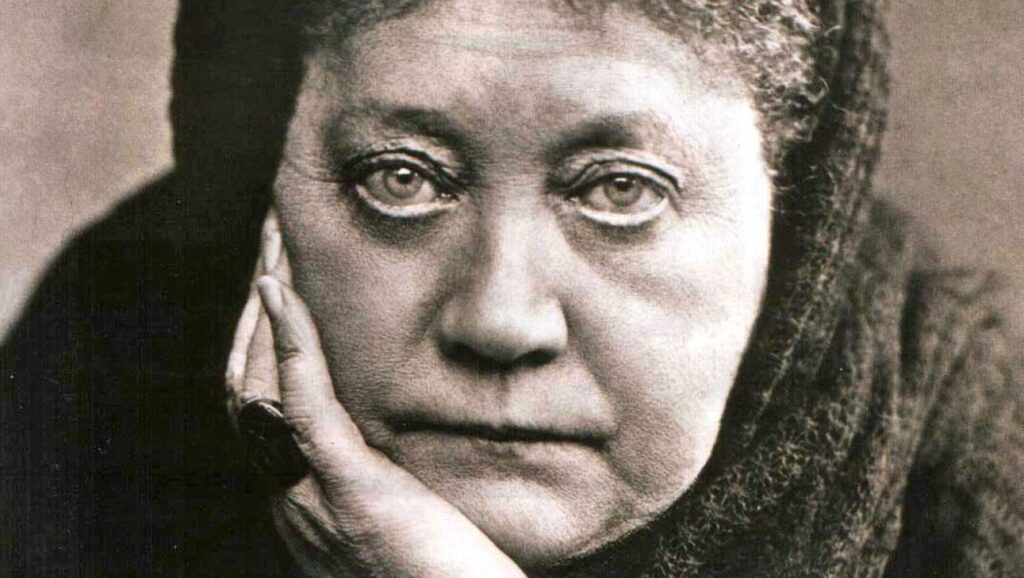
In the dim gaslight of a New York apartment on Irving Place, late summer 1875, seventeen souls crammed into Helena Blavatsky’s parlor, their faces flushed from wine and the humid air seeping through cracked windows. George H. Felt, a wiry lecturer with ink-stained fingers, unrolled charts of ancient Egyptian geometry, claiming lost canons that bound the pyramids to the stars, proportions whispered by gods to pharaohs and forgotten by a rational West chasing Darwin’s cold mechanics. Blavatsky sat chain-smoking, her dark eyes piercing the smoke like twin augurs, as Colonel Henry Steel Olcott—lawyer turned spiritualist, haunted by battlefield ghosts from the Civil War—paced the rug, proposing a society not for séances but for truths buried under centuries of dogma. By November 17, at Mott Memorial Hall, it formalized: the Theosophical Society, born to collect laws governing the universe, fusing occultism’s ciphers with science’s scalpels.
You know this pull, that itch when the day’s ledgers close and the mind wanders to what factories and telegraphs can’t measure—the soul’s hidden weight, the dream that lingers like a half-remembered face. Blavatsky embodied it, this Russian noblewoman who crossed oceans fleeing tsarist salons, arriving in 1873 with tales of Himalayan masters, invisible adepts dictating letters from thin air, their missives materializing in sealed rooms to guide her pen. These Mahatmas, as she called them—Koot Hoomi, Morya—were no Christian angels but living sages from Tibet’s fastnesses, custodians of an ancient wisdom predating Vedas and Kabbalah, now thrusting it westward to shatter the era’s brittle rationalism. Olcott, her “chum,” bought in wholly; together they dubbed Theosophy a synthesis of science, religion, philosophy, where karma’s wheel turned souls through reincarnations, emancipation the only telos worth pursuing.
Four years on, 1879, the pair fled America’s skeptics—exposés branding Blavatsky a fraud for spirit raps and Mahatma stationery—sailing to Bombay, then up India’s sun-baked coasts. Adyar, 1882: a mango grove suburb of Madras, riverside estate bought for 2,000 rupees, became the vortex. Here, Hinduism’s polymath depths flooded in—Upanishads’ atman-brahman unity, yoga’s prana breath, tantra’s subtle bodies—not as exotic curios but as rational antidotes to Europe’s positivist fever. Blavatsky pored over Sanskrit tomes with pandits, Olcott championed Sri Lankan Buddhists against colonial priests, igniting a revival that crowned him national hero decades after his 1907 death. Science entwined occultism: evolution not mere descent from apes but septenary chains of root-races, Atlantis’ fall etched in etheric memory, provable by clairvoyance as telescopes proved nebulae.
This was the rupture. Victorian drawing rooms, once smug with Herbert Spencer’s “survival of the fittest,” now hosted seances decoding akashic records, etheric chronicles of all history vibrating in space itself. Nietzsche, peering from Turin in 1888, might have sneered at such “slave morality” from the East, yet his Zarathustra echoed the overman’s transmutation, kin to Blavatsky’s higher evolution. William James, psychologist of the unseen, nodded to these “varieties of religious experience,” testing Theosophy’s claims against his radical empiricism—did hidden masters’ letters defy physics, or merely statistics? By 1888’s “Secret Doctrine,” Blavatsky mapped cosmos as emanations from a rootless root, stanzas of Dzyan blending Rig Veda hymns with Laplace’s nebular hypothesis, 357 octavo pages birthing a lexicon that seeped into Yeats’ gyres, Kandinsky’s synesthesia.
The migration exposed the trap: Western reason, crowned since Descartes’ cogito, feigned universality while blind to half the world’s seers. Adyar’s whispers—mantras chanting through palm fronds, phenomena baffling British investigators—unmasked it as provincial, a cog in karma’s mill. Olcott’s 1884 Buddhist catechism, printed in Tamil and Sinhala, revived monasteries shuttered by Portuguese inquisitors in 1505; 25,000 pledges to the Five Precepts by 1886, a tidal wave against missionary smugness. Fusion, yes: occultism’s Hermetic chains yoked to Hinduism’s chakras, science’s atoms to pralaya’s dissolutions. But rupture? Profound. The rational self, that sovereign I think therefore I am, cracked open to reveal not void but vastness—a reincarnating monad navigating maya, accountable to cosmic law.
Schopenhauer’s “world as will and representation,” penned 1818, found echoes here: blind striving quelled by Eastern denial of the will, yet Blavatsky weaponized it, urging initiates to wield occult force ethically, lest black magic rebound as nemesis. In Adyar’s halls, amid elephant processions and monsoon downpours, seekers from Pasadena’s splinter faction to Bombay’s Parsis grappled with it—could Newton’s gravity bend to levitation’s will? Theosophy didn’t console with heaven’s promise; it destabilized, demanding you trace your soul’s prior births through the ether, confront the East’s mirror to your culture’s hubris. What if your reason was the illusion, and the masters watched still, from Shambhala’s peaks, awaiting your rupture into light? Or was it all a noble smoke-screen, Blavatsky’s parlor tricks scaled to empire? The whispers persist, unresolved, as Adyar’s gopuram bells toll into the night.

The Veiled Objects

You wake in the dim haze of a candlelit room, the air thick with incense and murmured chants from voices you half-recognize, bodies pressed close in a circle that feels both intimate and infinite, hands linking across continents without touch, a vow forming on lips that promise unity yet splinter at dawn into accusations of betrayal. This was no dream but the pulse of those early gatherings in 1875 New York, where Helena Blavatsky’s piercing gaze held the room, her words weaving a nucleus of universal brotherhood without distinction of race, creed, sex, caste, or color—the first object, etched into the society’s charter as if carved from some ancient stone unearthed in the Adyar sands. Yet even as fingers intertwined, the fractures began, whispers of who truly embodied this brotherhood, Olcott pacing the floor with his lawyerly precision, demanding tolerance as the only creed, while Judge lurked in the shadows, his eyes alight with visions of powers latent in man that no mere pledge could contain.
The scene shifts to a library heavy with dust-moted sunlight, pages turning furiously under gas lamps in 1884 London, where scholars bent over Sanskrit scrolls and Vedic hymns beside Darwin’s latest edition, the second object igniting minds: to encourage the study of comparative religion, philosophy, and science. Here, Blavatsky’s Isis Unveiled lay open like a battlefield map, urging seekers to trace the golden thread uniting Zoroaster’s fire with Kant’s noumena, Buddha’s void with Newton’s laws. But the unity dissolved in schism; Olcott, ever the organizer, saw it as a practical bridge for East and West, founding schools in Ceylon by 1880 where Tamil and Sinhalese children recited Vedanta alongside Euclidean proofs, numbers swelling to thousands under his gaze—over 100 branches by 1891—yet he clashed with Judge over the purity of this study, Judge insisting it masked deeper mysteries, not mere scholarship. Their letters flew like daggers, Olcott decrying Judge’s American Section as a cult of mesmerism, Judge retorting that Olcott’s Adyar empire stifled the soul’s fire, the 1895 split birthing rival societies, Pasadena’s five objectives splintering from Adyar’s three, each claiming the true flame.
Deeper still, in the velvet dark of meditation chambers overlooking the Indian Ocean, participants felt the stir of the third object: to investigate unexplained laws of nature and powers latent in man—changed to “human being” in some branches by the 1890s, a nod to the era’s shifting tongues. Bodies trembled as if struck by unseen currents, visions of astral travel and akashic records unfolding, echoes of the Delphic “Know thyself” that Blavatsky invoked as the key to gods and universes. Olcott documented these in his Old Diary Leaves, volumes chronicling seances where Mahatma letters materialized from ether, yet he grew wary, expelling members in 1884 for fraud after the Coulomb expose shook the foundations. Judge, undeterred, proclaimed these powers the society’s beating heart, his Echoes from the Orient in 1890 rallying occultists to unleash the inner god, tensions erupting in the 1894 election crisis where accusations of psychic forgery tore the General Council asunder. Brotherhood fractured not in words but in the lived rift—Olcott excommunicating Judge posthumously in 1896, the objects revised that year amid the rubble, their “inner sense” now an open secret of transmitting divine wisdom, yet veiled by the very humans sworn to unveil it.
These objects emerged not as pristine decrees but through the grit of rituals where participants chanted unity while plotting coups, studies devolving into doctrinal wars. Nietzsche might have seen in this the will to power masquerading as universal love, his Thus Spoke Zarathustra warning of brotherhood’s abyss where men chain supermen, much as Judge chained his visions to Blavatsky’s legacy against Olcott’s reforms. William James, probing the fringes of consciousness in The Varieties of Religious Experience (1902), would recognize the latent powers as genuine eruptions of the subliminal self, not delusions but doors cracked by schism’s hammer. Yet the veils persist: in 1896’s council vote, brotherhood tallied votes by faction, comparative study pitted Theosophy against itself, latent forces invoked to justify exiles. Who truly forms the nucleus when the circle breaks? The candle gutters, hands unlink, and the incense fades into morning’s unforgiving light.
Echoes in the Arts
A painter stands before his canvas in a dim Paris studio, the gas lamp flickering as he mixes pigments that seem to vibrate with inner life, not mimicking the curve of a cheek or the fold of a drape, but chasing vibrations from some unseen realm, his brush slashing lines that pulse like thoughts made visible. This was no idle reverie; it was the quiet revolution brewing in the early twentieth century, when Rudolf Steiner, having parted from the Theosophical Society in 1913 amid accusations of doctrinal drift toward Christology, carried its embers into anthroposophy, igniting artistic souls who sensed the material world as a frail veil over cosmic truths. Steiner’s lectures on the etheric body and astral forms, drawn from Blavatsky’s Secret Doctrine of 1888, whispered to creators that color and form were not mere decoration but keys to the akashic records, those ethereal chronicles of all human striving. In this split, Theosophy did not fracture so much as propagate, its principles scattering like seeds into fertile modernist soil, where artists, weary of photography’s mechanical gaze, sought to unmask the soul’s hidden architecture.
Wassily Kandinsky, gripping his treatise Concerning the Spiritual in Art in 1912, declared that science groped blindly while the artist pierced the veil, his improvisations—swirling blues evoking the soul’s descent into melancholy, acute angles thrusting like spiritual arrows—born from Theosophy’s promise of thought-forms, those subtle energies Madame Blavatsky mapped in 1877’s Isis Unveiled as bridging the physical and divine. Not far off, Piet Mondrian, initiated into the Dutch Theosophical Society in 1909, pared reality to grids of black lines and primary colors, his Composition with Red, Blue, and Yellow of 1930 a hymn to universal harmony, echoing the society’s dictum of universal brotherhood amid the carnage of the Great War, where 16 million lay dead by 1918, yet painters envisioned equilibrium beyond the trenches. These were not isolated visions; Frantisek Kupka and Kazimir Malevich, contemporaries in this theosophic chorus, dissolved form into color waves and black squares, Malevich’s 1915 Black Square hanging like a portal to the infinite, all four artists converging on abstraction as the only language for “things unseen,” as Kathleen Hall termed it in her 2002 Quest analysis, their canvases scribes of ancient wisdom reborn.
Yet this infiltration ran deeper, threading into psychological shadows where Jiddu Krishnamurti’s repudiation loomed. Proclaimed World Teacher by the Society in 1911, only to shatter the idol in 1929 with his dissolution of the Order of the Star, Krishnamurti exposed the guru’s throne as a cultural trap, his The Kingdom of Happiness that year unmasking organized esotericism as another chain on the seeking mind. In art’s undercurrents, this shadow lingered: Symbolists like those weary of industrial din—factories belching smoke over London since the 1880s—turned to occult reveries, their works prefiguring abstraction’s leap. Joseph Beuys, steeped in Steiner’s Christ-as-creative-force from the 1920s onward, sculpted pyramidal forms in 1979 that evoked shamanic fat and felt, blending Theosophy’s latent psychical powers with performance’s raw immediacy. Even Mark Rothko’s color fields, vast veils of hovering hue from the 1950s, traced back through this lineage, pulling viewers into metaphysical abysses where Rothko himself meditated on the soul’s vibration, a direct heir to Kandinsky’s awakenings.
Theosophy’s grip on modernism was no accident of zeitgeist but a philosophical insurgency, validating abstraction as the antidote to naturalism’s superficial mimicry, as art historians Charles Cramer and Kim Grant observed, with its meta-reality defying empirical chains. In Amsterdam’s 1904 Theosophical exhibition, forty Dutch artists displayed works that prefigured this shift, while Nordic trails and Irish offshoots like Margaret Cousins wove it into national fabrics. Painters became messengers at the world’s threshold, their diverse geometries—from Mondrian’s rectilinear rigor to Kandinsky’s exuberant floods—mirroring theosophy’s eclectic fusion of Eastern mandalas and Western occultism. But what of Krishnamurti’s echo, that refusal of hierarchy? It destabilized the movement’s core, revealing how even spiritual seekers craved messiahs, their art now haunted by the question: does the abstract canvas liberate the soul or merely drape it in new symbols? Steiner’s anthroposophical heirs built Waldorf schools by 1919, infusing education with eurythmy’s gesture-dance, yet the original society’s principles pulsed on, infiltrating not just paint but the psyche’s depths, where Rothko’s voids confront us still with the unspoken terror of the infinite. In these echoes, Western culture glimpsed its own veiled hunger, artists unmasking the convention that truth resides in the seen, leaving us to wander the gallery’s silence, brushes dry, wondering if the real abstraction lies in our refusal to see.
The Unseen Thread
You sit at a crowded café table, steam rising from your coffee as the barista calls out an order two tables over, and without thinking, you pull out your phone to check the daily horoscope—not because you believe it, but because the stars aligning with your mood feels like a secret nod from the universe, a whisper that your scattered day might hold some hidden pattern. That casual glance, that momentary surrender to cosmic suggestion, traces back further than you imagine, to a thread woven in 1875 New York by Helena Blavatsky, Henry Steel Olcott, and William Quan Judge, when they founded the Theosophical Society amid the gaslit skepticism of a world splitting between Darwin’s evolution and crumbling creation myths. Reincarnation, karma, those words you skim in self-help books or mutter during a bad breakup, didn’t drift into Western parlors on their own; Theosophists smuggled them from suppressed Eastern traditions, repackaging them for a public starved for meaning beyond church pews or laboratory benches.
Picture a woman in fin-de-siècle London, much like the one pacing her drawing room in a woolen dress too tight at the waist, poring over letters from invisible Mahatmas—ascended masters dictating wisdom through Blavatsky’s hand, promising that every soul evolves through cycles of birth and consequence, watched over by unseen adepts who ripple through history like stones in a pond. She doesn’t know it yet, but her quiet conviction will seep into the artists and reformers around her: Wassily Kandinsky will paint abstractions that pulse with spiritual vibration, seeing colors as souls in ascent; Mahatma Gandhi, encountering Annie Besant’s fervor in India after 1879, will carry Theosophy’s brotherhood ideal into his satyagraha, that universal oneness where no nation ripples alone. Even as scandals erupt—accusations of fraud against Blavatsky in 1885, schisms splitting Judge from Olcott in 1895—the ideas endure, birthing the New Age by the 1960s, where yoga studios dot American suburbs and meditation apps track your “spiritual evolution.”
Peter Berger, in his 1967 treatise The Sacred Canopy, described how communities drape meaning over chaos, constructing canopies of belief to shield the void; Theosophy didn’t build a new cathedral but tore holes in the old ones, insisting on direct inquiry into the “Omnipresent, Eternal, Boundless, and Immutable Principle” that Blavatsky unveiled in The Secret Doctrine’s proem of 1888, a force beyond symbols or dogmas, fusing Hindu atman with Western esotericism into an “absolutist metaphysics.” Zygmunt Bauman, dissecting late modernity’s ethical drift in 1993, saw universality crumbling under individualism; yet here was the Society’s first object, forged in 1875, proclaiming all humanity from one essence, infinite and uncreate—God or Nature, it didn’t matter—which a stone thrown into the collective pond would unsettle forever. By 1891, 258 branches spanned continents, bridging East and West not as colonial plunder but mutual entanglement, Olcott tilting Buddhism toward Protestant rationality while Blavatsky admired its depths, lines of influence flowing both ways.
In your own life, that same thread tugs when you question the grind of daily ambition, sensing perhaps a latent power coiled in routine—a subtle body, as Theosophists termed it, evolving through lives unseen. Scientists like those influenced in the early twentieth century pondered consciousness beyond neurons; educators spread interfaith inquiry, the Society’s second object comparing religion, philosophy, science since its New York inception. William James echoed this in his 1902 Varieties of Religious Experience, drawn to mysticism’s fringes where Theosophy lurked, destabilizing the rational self. Yet controversies persist: the Mahatmas’ letters debunked as tricks, Besant’s Krishnamurti declared a false messiah in 1929, fractures mirroring the belief systems they sought to unify.
Today, with branches in nearly seventy countries, the Society hums quietly, its members pursuing “practical realization of the oneness of all life,” as their pamphlets still proclaim. You feel it in the wellness retreats peddling karma cleanses, in the eco-activists invoking universal brotherhood amid climate collapse, in the philosopher’s quiet doubt that science alone explains the self. But what if those Mahatmas still watch, not from Adyar’s halls but from the fractures in your certainties? The thread pulls tighter in the café’s hum, your coffee cooling as the horoscope fades from the screen—what unseen evolution stirs in the ordinary, and does it guide, or merely mock, the seeker left staring into the pond’s endless ripples?
A vision curated by a filmmaker, not an algorithm
In this video I explain our vision
🌀 Infinite Maze of Esoteric Paths
Delve into the labyrinthine corridors of Theosophy’s influence, where spiritual quests mirror cinematic explorations of the unseen. These films unravel mysteries akin to the Society’s synthesis of ancient wisdom and modern thought. Discover narratives that echo Helena Blavatsky’s revolutionary esoteric legacy.
Helena Blavatsky and Theosophy: the Woman Who Revolutionized Esoteric Thought
Helena Blavatsky’s pioneering role in Theosophy revolutionized esoteric thought, blending Eastern mysticism with Western occultism in ways that parallel cinema’s exploration of hidden realities. Her writings, like The Secret Doctrine, serve as a narrative blueprint for films delving into spiritual emancipation and cosmic evolution. This article illuminates her foundational impact, inviting viewers to see movies as modern theosophical texts.
GO TO THE SELECTION: Helena Blavatsky and Theosophy: the Woman Who Revolutionized Esoteric Thought
Rudolf Steiner and Anthroposophy: A Guide to Modern Esoteric Thought
Rudolf Steiner’s Anthroposophy extends Theosophy’s esoteric principles into practical realms of education, medicine, and architecture, much like films that visualize spiritual journeys through symbolic mazes. Emerging from Theosophical roots, Steiner’s ideas emphasize soul development beyond intellect, resonating with cinematic portrayals of inner transformation. Explore how these philosophies inspire deep, reflective storytelling in independent cinema.
GO TO THE SELECTION: Rudolf Steiner and Anthroposophy: A Guide to Modern Esoteric Thought
Esoteric Movies to Watch
Esoteric movies capture the enigmatic essence of Theosophy’s quest for universal truths, weaving narratives of occult knowledge and reincarnation akin to Blavatsky’s teachings. These films act as visual labyrinths, guiding audiences through mysteries of karma and hidden powers latent in humanity. This selection reveals cinema’s role in perpetuating the Society’s influence on Western esoteric culture.
GO TO THE SELECTION: Esoteric Movies to Watch
Spirituality: Movies to Watch
Spirituality in cinema mirrors the Theosophical Society’s promotion of brotherhood, comparative religion, and unexplained laws of nature through transcendent visuals and philosophical depth. Films here evoke the soul’s journey toward emancipation, echoing the Society’s three core objects in storytelling. Perfect for those navigating the infinite maze of esoteric Western influences.
GO TO THE SELECTION: Spirituality: Movies to Watch
Journey Deeper into IndieCinema
Venture beyond the infinite maze into the boundless world of independent cinema on Indiecinema streaming. Uncover films that challenge perceptions and illuminate esoteric truths, continuing Theosophy’s legacy of spiritual discovery.
👉 EXPLORE THE CATALOG: Watch Indie Films in Streaming
A vision curated by a filmmaker, not an algorithm
In this video I explain our vision

