
The Body That Wakes Before You Do
It happens at 3am, almost always at 3am. You surface from sleep like something pulled reluctantly from deep water, and for a moment there is no reason for it — no sound, no dream you can name, no external disturbance. Just the ceiling, the dark, and a heart that is beating slightly too fast, or a low-grade dread sitting in your chest like a stone that wasn’t there when you closed your eyes. You lie still. You run through the usual suspects: work, money, a conversation that went wrong, the ambient hum of a life that asks too much. You tell yourself it’s stress. You tell yourself this is what modern existence does to a body. You wait for sleep to return, sometimes it does, sometimes it doesn’t, and by morning you’ve forgotten the whole episode except for a faint residue of exhaustion that you attribute, again, to stress, to the times, to everything except what is actually happening inside you.

What is actually happening is that your liver is working.
Not metaphorically. Not as some vague biological background process. Your liver, at 3am, is in the middle of its most intense metabolic labor of the entire twenty-four hour cycle — processing glucose reserves, filtering accumulated toxins, synthesizing proteins, regulating the blood chemistry that will determine whether you wake up clear-headed or foggy, energized or already depleted before the day has begun. And the disturbance that pulled you from sleep, the racing heart, the anxiety with no object, the inexplicable wakefulness — these are frequently not psychological symptoms at all. They are physiological signals from an organ operating at peak load, asking for conditions you are not giving it.
The body runs on a schedule. Not the schedule you set on your phone, not the schedule imposed by office hours or school runs or the arbitrary social agreement that productivity begins at nine. Something older. Something so old it predates every civilization that has ever organized human time, predates every clock and calendar, predates even the concept that time is something to be organized at all. The circadian system — from the Latin circa dies, approximately a day — is a biological architecture that evolved over hundreds of millions of years, calibrated to the rotation of the Earth itself. Every living thing that has ever had to navigate the difference between light and dark carries some version of it. Cyanobacteria, which appeared on this planet roughly 2.7 billion years ago, already possessed circadian oscillators. The mechanism is that ancient. It is older than sleep as we understand it. Older than hunger. Older than consciousness.
In 2017, Jeffrey Hall, Michael Rosbash, and Michael Young received the Nobel Prize in Physiology or Medicine for their work mapping the molecular mechanisms that drive this internal clock — the feedback loops of proteins like PER and TIM that accumulate and dissolve in a roughly twenty-four hour rhythm, governing not just wakefulness and sleep but the timed activation and suppression of every major organ system in the body. What their research confirmed, and what chronobiology has been building toward for decades, is something that Chinese medicine intuited over two thousand years ago without the vocabulary to name it precisely: the organs do not all run at the same time. Each one has its window. Each one has its hour of maximum function and its hour of necessary withdrawal. The body is not a machine that runs uniformly until it breaks. It is a composition, and like all compositions, it depends entirely on timing.
You already know this. Your body has been demonstrating it to you your entire life. You simply haven’t been told what you were looking at.
The Meridian Clock and the Medicine That Was Never Forgotten
There is a man who has coughed every winter night of his adult life between three and four in the morning. Not at midnight. Not at six. Always then, with a precision that embarrasses his doctors because it fits no bacterial logic, no allergen schedule, no obvious environmental trigger. He has tried antihistamines, humidifiers, elevated pillows. Nothing moves the hour. The cough arrives like a appointment no one made but everyone keeps.
What his doctors could not explain, a physician working in China roughly two thousand years ago would have recognized without hesitation. The Huangdi Neijing, the foundational classical text of Chinese medicine codified approximately in the second century BCE, describes a continuous twenty-four-hour circuit in which vital energy moves through twelve organ systems in two-hour intervals, each organ receiving its peak charge in sequence, each reaching its lowest ebb exactly twelve hours later. The lungs govern the hours between three and five in the morning. That is not a metaphor. That is a schedule. The man coughing at three-fifteen is simply living inside a clock he was never told about.
The circuit begins at three in the morning and moves with a logic that is almost architectural. Lungs from three to five, large intestine from five to seven, stomach from seven to nine, spleen from nine to eleven, heart from eleven to one, small intestine from one to three in the afternoon, bladder from three to five, kidneys from five to seven, pericardium from seven to nine, triple warmer from nine to eleven, gallbladder from eleven to one in the morning, liver from one to three, and then the lungs again. Each organ at its peak is flooded with what classical medicine called qi, and each organ at its nadir twelve hours later is working at minimal capacity. The system does not ask permission. It simply runs.
Consider the person who cannot eat breakfast. Not someone who dislikes eggs, but someone for whom food before nine in the morning produces genuine nausea, as if the body is rejecting a demand that arrives too early. Western medicine tends to pathologize this as a motility disorder or anxiety, but the stomach in this framework does not reach its peak activity window until seven to nine in the morning, and if a person’s internal rhythm runs slightly late, asking it to process food at six-thirty is asking a machine to operate before it has powered on. The stomach’s corresponding low falls between seven and nine in the evening, which is precisely when many people find large dinners sit heavily, undigested, restless.
What makes this ancient map remarkable is not that it existed, but that molecular biology arrived two thousand years later and confirmed its geometry from an entirely different direction. Franz Halberg, a Romanian-American physiologist who coined the term circadian in 1959 from the Latin circa diem, meaning approximately a day, spent decades demonstrating that biological functions do not fluctuate randomly but follow measurable, reproducible rhythms tied to the rotation of the earth. His work established that blood pressure, hormone secretion, immune response, and cellular division each have their own peak windows, their own refractory periods, their own insistence on sequence. The body is not a machine that runs uniformly. It is an orchestra playing a score written long before any conductor arrived.
When Jeffrey Hall, Michael Rosbash, and Michael Young received the Nobel Prize in Physiology or Medicine in 2017, they were awarded for identifying the molecular mechanism behind this score: the period gene, the proteins it encodes, the feedback loops that cause cells to oscillate on roughly twenty-four-hour cycles entirely independent of external light cues. The clock is not a response to the environment. It is built into the cell itself. Every cell already knows what time it is.

Industrial Time Against Biological Time
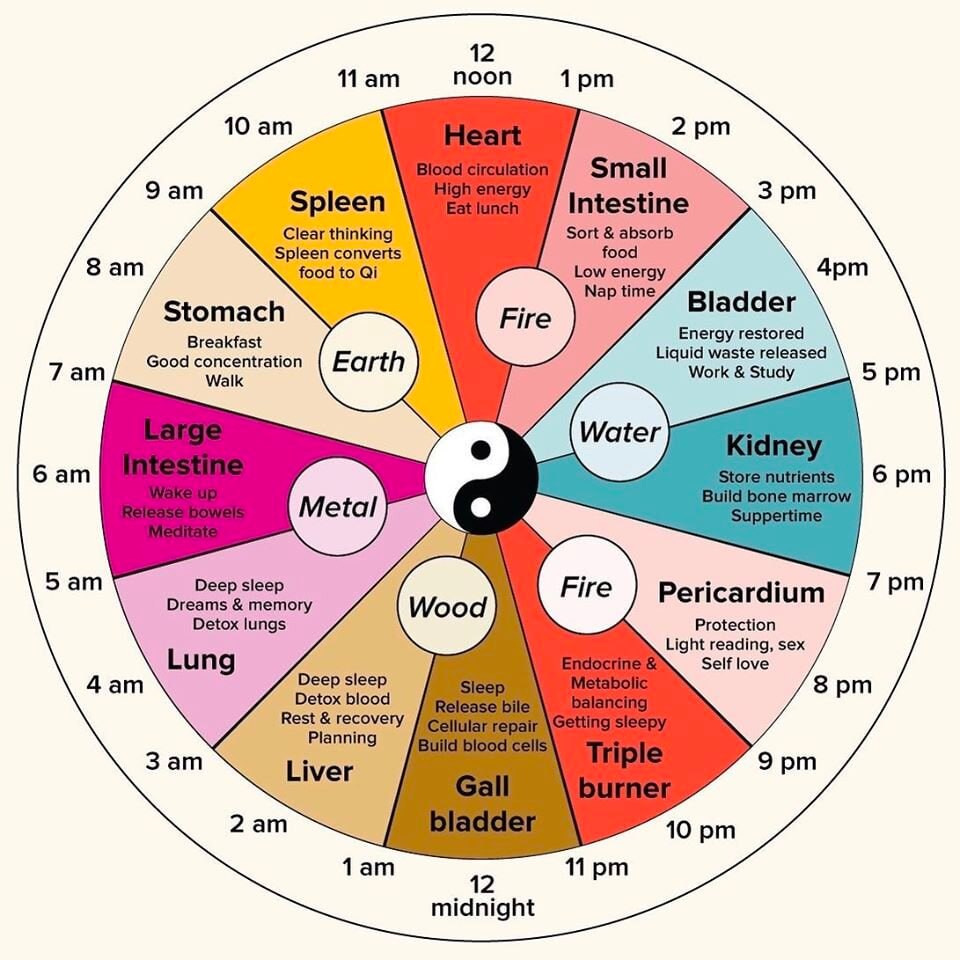
There is a man eating a sandwich at 10:47 in the morning because his shift ends at noon and the cafeteria will be crowded by eleven, so he learned to eat before he is hungry, to anticipate the institution rather than listen to his body. His gallbladder, which reaches its energetic nadir somewhere between eleven at night and one in the morning according to the organ clock’s traditional mapping, is not prepared for this. The bile is sluggish, the secretion poorly timed, the fat in his sandwich moving through a digestive corridor that has not yet fully opened for business. He will feel heavy by two in the afternoon. He will blame the sandwich.
The year 1884 is rarely taught as a moment of biological consequence, but it was. The International Meridian Conference in Washington, convened by forty-one delegates representing twenty-five nations, divided the surface of the earth into twenty-four standardized time zones not because human bodies required synchronization but because railways did. Freight schedules, passenger timetables, the commercial logic of industrial expansion — these were the actual architects of what we now call clock time. The human organism was not consulted. It had been keeping its own time for hundreds of thousands of years, organized around the slow gradient of sunlight and darkness, and in the space of a single diplomatic conference it was subordinated to the needs of locomotive infrastructure.
Wolfgang Schivelbusch documented with unsettling precision how the railway did not merely accelerate movement but fundamentally restructured the experience of time and space — collapsing distances that had previously carried their own duration, annihilating what he called the intermediate landscape, the territory between departure and arrival that had once given the body time to adjust. What the railway began, electric light completed. Thomas Edison’s commercial grid, operational in Manhattan by 1882, was not sold as a convenience but as a productivity tool. The night shift became possible. The body’s darkness, its signal to begin the long repair sequence that organs depend on, became optional.
Hartmut Rosa, writing in his 2013 work on social acceleration, describes a modernity that does not merely move faster but structurally compresses the time available for biological and psychological recovery. His argument is not nostalgic — he is not mourning some pastoral slowness — but anatomical in its implications. When the rate of social change outpaces the body’s capacity to adapt, what follows is not simply stress but a kind of temporal dislocation, a chronic misalignment between lived experience and biological rhythm that the body registers as illness before the mind registers it as anything at all.
The organ clock was not discovered in any single moment of revelation. It was known, in various forms, across Chinese medicine’s meridian theory, across Ayurvedic timing practices, across the circadian observations that European physicians were making as early as the eighteenth century. Christoph Wilhelm Hufeland, the German physician who published his work on macrobiotics in 1796, was already describing what he called the body’s inner clock and arguing that health depended on living in accordance with it. These observations did not disappear because they were disproved. They were buried because they were inconvenient. An organism with fixed energetic windows is an organism that cannot be scheduled at will, and an organism that cannot be scheduled at will is a problem for industrial production.
So the knowledge was not lost so much as repeatedly set aside, filed under traditional medicine, under folklore, under the soft sciences, every time the economic machinery required a workforce that could eat at 10:47 because the shift demanded it and sleep at midnight because the entertainment industry had learned to monetize the hours that the body had always reserved for its own repair.
The Hours We Misread as Weakness

There is a woman who wakes every night at the same time. Not at four, not at three-thirty, but at two, precisely, as though something internal has set an alarm she never agreed to. She lies there and begins, immediately, to replay a conversation. Not from yesterday. From three years ago. A thing someone said to her at a dinner table, a dismissal so casual the other person has certainly forgotten it entirely, and she turns it over and over in the dark like a stone she cannot put down. By morning she is exhausted. Her doctor has suggested melatonin, then a low-dose anxiolytic, then cognitive behavioral therapy for rumination. Nobody has asked what her liver is doing.
In the framework of the organ clock, the liver governs the hours between one and three in the morning. This is its peak — the interval when the body routes maximum energy through this organ for its night work: metabolizing, detoxifying, regulating the blood that will be redistributed come dawn. But in classical Chinese medicine, the liver has never been understood as a purely mechanical instrument. It is the seat of hun, the ethereal soul, the part of the psyche that plans, that envisions, that presses forward. And its emotional correspondent is anger — not the explosive kind, but the subterranean variety, the anger that was never permitted to surface, the decision that was swallowed instead of made, the boundary that was violated and quietly absorbed.
Bessel van der Kolk spent decades demonstrating something that medicine kept trying to reduce to metaphor: the body does not release what the mind refuses to process. His clinical observations, gathered across thousands of patients and consolidated in his 2014 synthesis of traumatology research, show consistently that unresolved emotional experience does not dissolve — it migrates. It embeds itself in physiological patterns, in chronic muscle tension, in the rhythms of sleep and digestion, in the particular shape of a person’s inflammation. The body, he argued, keeps the score with perfect fidelity, indifferent to whether the mind has declared the matter closed.
Antonio Damasio arrived at a parallel understanding from a different direction. His somatic marker hypothesis, developed through his studies of patients with damage to the ventromedial prefrontal cortex, proposed that emotions are not decorative responses layered over rational cognition — they are the substrate of decision-making itself. When the emotional signal is absent or suppressed, the capacity to choose coherently collapses. The person who never allowed themselves to feel their anger about a relationship, a career, a betrayal, does not thereby become free of it. They become incapable of resolving it. The somatic marker keeps firing without a decision ever being reached.
This is the woman at two in the morning. She is not anxious in any clinical sense that requires pharmaceutical management. She is living inside an unresolved decision her nervous system keeps returning to because the liver — her liver, working at peak capacity, demanding that she process — is speaking in the only language the body has left when every other channel has been closed. The replaying is not pathology. It is physiology trying to do its job.
And she is not alone in being misread. There is the man prescribed a proton pump inhibitor for acid reflux that flares every evening between nine and eleven, precisely during the triple burner’s window of thermal regulation. There is the person whose profound, inexplicable sadness descends every autumn afternoon around three, when the lungs are at their energetic nadir and grief, according to TCM’s precise emotional cartography, becomes the organ’s native tongue. These people have been given diagnoses that name the symptom while leaving the timing — the only truly diagnostic element — entirely unexamined.
Rhythm as Resistance
There is a man who does his best thinking at night. He is proud of this. He has built an identity around it — the late hours, the lamp in the corner, the city gone quiet outside the window. By eleven he is finally alone with the problem, finally free of the interruptions that colonize daylight. He opens the document. He begins to write. And something is wrong that he cannot name: the thoughts arrive but don’t connect, the sentences form but loop back on themselves, the argument he was sure he had dissolves the moment he tries to hold it. He makes a note to return to it tomorrow. Tomorrow he makes the same note.
He is not tired in the way that sleep deprivation is tired. He is something more specific: metabolically unavailable. The hours between eleven at night and one in the morning are, in the body’s own accounting, reserved for the gallbladder’s peak work — the processing of fats, the conjugation of bile, but also, in the Chinese medical tradition that mapped these cycles centuries before biochemistry confirmed their rhythmic logic, a kind of psychic digestion, the sorting of what has been taken in. The hours between one and three belong to the liver, which is not merely filtering toxins but running its deepest repair sequences, its glycogen regulation, its hormonal recalibration. To use these hours for demanding intellectual labor is not simply to work late. It is to ask the mind to perform at the exact moment the organism has redirected its resources elsewhere. The fragility he feels, the circularity — these are not failures of discipline. They are the body reporting accurately on its own condition.
None of this changes the fact that his most important meeting is at nine in the morning, which is, for a chronotype that does not reach its cortisol peak until mid-morning, a demand made before the instrument has tuned itself. Till Roenneberg, the chronobiologist at Ludwig Maximilian University of Munich, spent decades mapping what he called social jetlag — the chronic misalignment between the body’s biological clock and the schedule civilization imposes on it. His data, drawn from tens of thousands of participants across multiple countries, revealed that more than seventy percent of the Western population lives in a state of permanent temporal displacement, their social obligations pulling them out of their biological time every single day, the cumulative effect resembling the physiological stress of crossing two time zones without ever boarding a plane. The consequences Roenneberg documented were not abstract: metabolic disruption, increased risk of depression, compromised immune function, cognitive deficits that no amount of caffeine fully corrects. The organ clock is not a metaphor for attunement. It is a system under siege.
What makes this knowledge genuinely unsettling is not that it reveals something new. It is that it confirms what the body has been saying all along, in a language that civilization has systematically trained us to misread as laziness, weakness, poor character, or clinical disorder. The man who cannot think clearly at eleven at night is told he lacks focus. The person whose energy collapses at three in the afternoon is told they need more coffee. The child who cannot wake at six is diagnosed before anyone asks what time his cortisol rises naturally. The organ clock does not care about productivity schedules, quarterly reviews, or the moral architecture of early rising. It runs on a logic older than any institution that has ever tried to override it.
To actually live inside the body’s time — to eat when the stomach is genuinely ready, to rest when the organs genuinely require it, to think when the brain has genuinely arrived at its peak — would require a reorganization of social life so total that it is almost impossible to imagine without also imagining the collapse of everything built on top of the body’s suppression, which may be precisely why no one seriously proposes it.
A vision curated by a filmmaker, not an algorithm
In this video I explain our vision
🕰️ The Body’s Inner Rhythms: Time, Energy & Ancient Wisdom
The Organ Clock reveals that the human body is not a static machine but a living symphony governed by cycles of energy. Ancient Chinese medicine mapped these rhythms with astonishing precision, connecting each organ to a specific window of time and vitality. These related articles deepen that exploration, tracing the invisible currents that flow beneath skin, breath, and daily life.
The 12 Energetic Channels: The Secret Map of Meridians in Body
The meridian system is the hidden architecture that makes the Organ Clock possible, providing the energetic pathways through which Qi flows from organ to organ across the day. Understanding these 12 channels transforms the abstract idea of peak and low energy into a mapped, navigable terrain. This article illuminates the secret geography underlying every rhythm your body obeys.
GO TO THE SELECTION: The 12 Energetic Channels: The Secret Map of Meridians in Body
Vital Breath: if Your Qi is Blocked, Weak, or Scattered
If the Organ Clock is the schedule of your body’s energy, then the quality of Qi is the currency being spent and replenished at each hour. Blocked, weak, or scattered Qi can distort the natural peaks and troughs that each organ depends upon to function optimally. This article examines the vital breath itself, revealing what happens when the flow falters and how to restore it.
GO TO THE SELECTION: Vital Breath: if Your Qi is Blocked, Weak, or Scattered
Zheng Qi: How to Nourish Upright Energy to Protect Against External Pathogens
Zheng Qi, or Upright Energy, is the body’s sovereign force that keeps external pathogens from disrupting the delicate timing of each organ’s cycle. When your defensive energy is strong, the Organ Clock runs cleanly and each system receives its due vitality at the appointed hour. This article explores how to nourish and sustain this foundational energy as a living shield.
GO TO THE SELECTION: Zheng Qi: How to Nourish Upright Energy to Protect Against External Pathogens
The Dance of Yin and Yang: Harmony Between Opposing Forces
The Organ Clock is itself an expression of Yin and Yang dancing through the body in a continuous 24-hour embrace, with each organ presiding over its own balance of expansion and rest. Without understanding the interplay of opposing forces, the clock’s meaning remains half-read. This article traces how harmony and tension between Yin and Yang give rhythm its life and purpose.
GO TO THE SELECTION: The Dance of Yin and Yang: Harmony Between Opposing Forces
Discover the Cinema of Inner Worlds on Indiecinema
If these explorations of energy, time, and the body’s hidden intelligence resonate with you, Indiecinema streaming is the natural next step. Our curated selection of independent and esoteric films brings these themes to life through visionary storytelling and rare documentary works you won’t find on mainstream platforms. Join us and let cinema become another doorway into deeper understanding.
👉 EXPLORE THE CATALOG: Watch Indie Films in Streaming
A vision curated by a filmmaker, not an algorithm
In this video I explain our vision

