
The Morning You Chose One and Lost the Other
You wake before the alarm and lie still in the dark, aware that today is the day you finally have to answer. The offer is real, the deadline is real, and somewhere across the city the person you love is also awake, also waiting, also pretending to sleep. You have rehearsed this moment in the shower for weeks, turned it over at traffic lights, lost it and found it again at three in the morning. And yet now that it has arrived, what you feel most acutely is not excitement or grief but a strange, sourceless guilt — as though choosing one thing means murdering another, as though the self that walks through one door will be haunted forever by the ghost of the self that didn’t.

That guilt is not irrational. It is, in fact, one of the most honest things you will ever feel.
Western culture has spent roughly two and a half millennia teaching you to ignore it. From Aristotle’s law of non-contradiction — the foundational logical principle that something cannot simultaneously be and not be — to the Enlightenment’s ferocious appetite for clarity, the organizing project of Western thought has been the elimination of ambiguity. Not its management, not its navigation, but its elimination. You are this or you are that. You choose the career or you choose the love. You are strong or you are vulnerable. You move forward or you stay. The either/or is not merely a grammatical construction. It is a metaphysical instruction, and most of us received it so early and so completely that we have never once questioned whether the instruction itself might be the source of the wound.
The philosopher Alan Watts, writing in 1951 in “The Wisdom of Insecurity,” observed that the Western mind’s greatest anxiety does not come from the problems it faces but from the method it uses to face them — the compulsive need to fix, to resolve, to land on solid ground. The ground, he argued, was always going to move. The attempt to stop it moving was not wisdom but terror wearing the costume of rationality. What Watts was circling, without yet naming it directly, was the same insight that had been encoded for centuries in Taoist philosophy under the symbol of the yin and yang — that symbol so domesticated by Western pop culture into bumper stickers and tattoos that its actual content has become nearly invisible.
The actual content is this: opposing forces are not problems to be solved. They are the structure of reality itself.
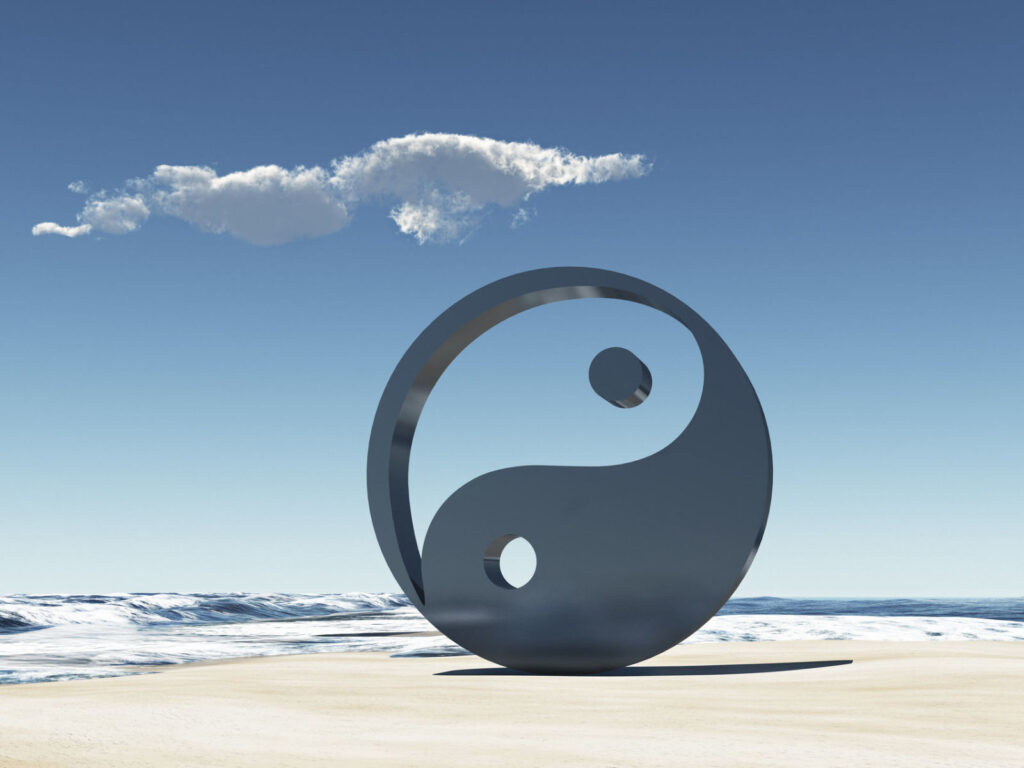
The yin and yang symbol — the taijitu, formalized in Chinese cosmological thought during the Song dynasty around the tenth and eleventh centuries CE — does not show two forces in opposition. It shows two forces in rotation. Each contains a seed of the other. The dark carries a point of light. The light carries a point of dark. And crucially, neither is dominant. The image is not a battle. It is a dance, and a dance requires both partners to remain present.
What Western modernity did, with extraordinary efficiency, was convince us that one partner needed to go. That the dance was inefficient. That you could achieve more, become more, feel more secure if you simply chose a side and held it. The career over the love. The ambition over the rest. The strength over the softness. And so you chose, lying there in the dark before your alarm, and something in your chest registered the choice as an amputation before your mind had even finished making it.
That feeling in your chest was not weakness. It was intelligence. It was the body reporting accurately on what the mind had been trained to deny.
What the Ancient Chinese Knew That Descartes Buried
There is a man sitting across from his father for the first time in eleven years. The father is dying. The son is a surgeon — precise, controlled, famous in his field for his ability to remain emotionally detached under pressure, for the steadiness of his hands when everything around him is chaos. What nobody in his operating theater has ever understood is that the steadiness came from the wound. The absence of the father was the wound. The wound became the discipline. The discipline became the gift. He does not know this yet, sitting in that hospital room. He is still telling himself the story where these two things are separate — the damage and the capability — where one must be overcome so the other can survive.
This is exactly what Laozi was writing against in the sixth century BCE, and what Zhuangzi turned into something approaching comedy — the tragic human insistence on drawing clean lines between what helps us and what harms us, between what we call strength and what we have been taught to bury. The Tao Te Ching, in its eighty-one brief, devastating chapters, does not offer a system of opposites so much as a demonstration that opposites are a grammatical illusion, a failure of the human nervous system to tolerate complexity. “Being and non-being produce each other,” Laozi writes in the second chapter. “Difficult and easy complement each other. Long and short contrast each other.” The pairing is not rhetorical decoration. It is a description of how reality actually functions, at every scale, from the oscillation of seasons to the interior architecture of a single human life.
The I Ching, that ancient diagnostic instrument misread for centuries by Western audiences as fortune-telling, is in fact a rigorous mapping of the sixty-four possible configurations of yin and yang energy in dynamic interaction. It does not predict outcomes. It describes tendencies, movements, the direction in which a particular energy is traveling and what it will become when it reaches its extreme — because this is the central insight: yin, when it reaches its maximum, becomes yang, and yang, when it exhausts itself, becomes yin. Not as metaphor. As the structure of transformation itself.
René Descartes, in 1637, performed an act of intellectual violence that we are still recovering from. His radical separation of mind from body, of subject from object, of the thinking self from the extended world, gave Western modernity its operating system — clean, binary, extraordinarily productive in some domains, and catastrophically blind in others. The Cartesian framework cannot process the surgeon in that room, because it has no language for an identity built from its own negation, for a competence that metabolizes its originating trauma into something that saves lives. It can only offer a before and an after, a problem and a solution, a wound that must be healed before the work can begin.
Carl Jung spent a lifetime trying to smuggle the other logic back into the Western tradition without anybody noticing how foreign it actually was. His concept of the Shadow — the repository of everything we have split off, denied, refused to integrate — is essentially a translation of the yin-yang dynamic into the grammar of Western psychology. His Coincidentia Oppositorum, borrowed from the Renaissance philosopher Nicholas of Cusa, describes the same principle: that apparently irreconcilable opposites, held in tension long enough, reveal themselves as aspects of a single movement. Jung understood that the thing a person most despises in others is almost always the thing they have refused to see in themselves, and that the thing they are most proud of is almost always built on the foundation of what they are most ashamed of. He called this individuation. Laozi would have called it returning to the Tao. Zhuangzi would have laughed at both of them for needing the name.

The Trap of the Resolved Life
There is a specific kind of Sunday afternoon that arrives not as rest but as verdict. The dishes are done. The inbox is empty. The children are asleep. The mortgage is manageable. Every box on the list that was supposed to constitute a good life sits checked, and the person standing in the kitchen looking at the clean countertop feels something that has no name in the vocabulary they were given — not sadness exactly, not ingratitude, but a kind of translucent dread, as though the walls of the room are slightly closer than they were yesterday.
He had done it. Reduced the noise, eliminated the disorder, built the routines that every productivity system promised would deliver clarity. He had optimized his mornings, his diet, his relationships, even his emotional responses — learning to reframe conflict as opportunity, friction as inefficiency, uncertainty as a variable to be managed. And standing there in the silence he had engineered, the silence he had worked for years to achieve, he felt not peace but disappearance. As though the tension he had spent so long extinguishing had been, all along, the very signal that he existed.
Isaiah Berlin spent decades insisting on something that the optimistic tradition of Western thought found nearly intolerable: that genuine values are not merely difficult to reconcile but are in permanent, irresolvable conflict with one another. In “Two Concepts of Liberty,” published in 1958, and later in “The Crooked Timber of Humanity,” Berlin argued that freedom, equality, justice, and belonging cannot all be maximized simultaneously — that to fully honor one is inevitably to compromise another, and that anyone who tells you otherwise is either selling something or preparing a tyranny. There is no final harmony, no achieved synthesis where all tensions dissolve into agreement. The friction is the structure, not a flaw in it.
Gregory Bateson arrived at something parallel from a completely different direction. Working at the intersection of cybernetics, anthropology, and ecology through the 1960s and 1970s, Bateson developed what he called an ecology of mind — a framework in which difference itself is the unit of information. A living system, whether a cell, a forest, or a human relationship, does not sustain itself by eliminating variation. It sustains itself precisely through the tension between differentiated states. In “Mind and Nature,” published in 1979, he wrote that the pattern which connects is always a pattern of relationships, of contrasts, of things that are not identical to one another. Remove the difference and you do not achieve harmony. You achieve entropy. You achieve the clean countertop that feels like a tomb.
What is strange, almost darkly comedic in its irony, is that the cultural moment most obsessed with eliminating tension is also the moment that first formally named burnout. Christina Maslach, working at the University of California in the late 1970s, developed the framework that would become the Maslach Burnout Inventory, published in 1981, and what she described was not a condition caused by too much conflict but by a particular kind of relentless, unvarying demand — by the erasure of meaningful difference, the collapse of agency into mechanical repetition, the disappearance of the self into a function. The epidemic of exhaustion was not the result of too much friction. It was, in many cases, the result of a system designed to eliminate it.
The self-help industry that grew alongside these diagnoses offered the precise opposite of what was actually needed. It sold equilibrium as the destination rather than the dynamic. It sold stillness as health. And so an entire generation learned to pathologize the very turbulence that meant they were alive, optimizing themselves toward a smoothness that felt, once achieved, indistinguishable from erasure.
When the Darkness Teaches

There is a particular kind of person who arrives at middle age with an immaculate life. No catastrophic losses, no years wasted on the wrong person, no season of genuine failure. They have been vigilant, careful, surgical in their avoidance of anything that threatened to undo them. And if you watch them long enough, you begin to notice something unsettling: they move through the world like a house where all the windows have been sealed. Warm, orderly, airless.
At some point a man sits in a room he has not left in years, surrounded by the evidence of a life he constructed entirely to avoid being hurt again. The clocks stopped decades ago. The wedding dress is still on her body. The cake has rotted to dust on the table. Nothing was allowed to change, because change meant the darkness could enter. But the darkness was already there. It had moved in the moment she decided to hold time hostage, and everything she built to keep it out had simply become its architecture.
This is what we rarely say plainly: the refusal to be broken is itself a kind of breaking. The wound that is not allowed to bleed does not heal. It calcifies.
Nietzsche’s amor fati, that ferocious love of fate including its most devastating passages, is not an instruction toward masochism. It is a diagnosis. In his letters and in the late work, he was describing what he observed in people who had genuinely become themselves: they had not merely survived what destroyed them, they had incorporated it. The suffering was not erased from the story. It became the story’s spine. What he was arguing against was not pain but the lifelong contraction around it, the energy spent making sure it could never happen again, which is also the energy that might have been used to live.
John Keats, writing to his brothers in December 1817, named it differently. Negative Capability: the capacity to remain in uncertainty, mystery, doubt, without any irritable reaching after fact and reason. He was talking about poetry, yes, but he was also describing a psychological posture that very few people ever achieve. Most of us cannot tolerate the unresolved. We rush toward conclusions, diagnoses, explanations, anything that closes the open wound of not-knowing. And in doing so we destroy exactly what the not-knowing was cultivating in us.
A woman spends years building a perfect translation of a great work, only to realize that the version she has produced is technically flawless and utterly dead. It was not until she stopped trying to control the text, until she allowed herself to be confused by it, undone by it, that something true began to move through the language. The incomprehension was not the obstacle. It was the door.
Simone Weil wrote in her notebooks that affliction, at its most extreme, does not simply cause suffering. It causes a special kind of knowledge, a knowing that cannot be accessed from the comfortable position. She was not romanticizing devastation. She was making an epistemological claim: that certain truths about existence are only available from inside the experience of being broken open. Not because suffering ennobles, but because it removes the insulation. The carefully maintained distance between the self and reality collapses, and for a time you are in direct contact with something you had been managing from afar your entire life.
The compulsion to resolve ambiguity prematurely, to diagnose what is actually a necessary disorientation, to medicate what is actually a transformation in progress, is not compassion. It is a particularly sophisticated form of fear. And what it destroys, quietly, without announcement, is the very capacity it was trying to protect.
The Body Knows Before the Mind Agrees
There is a moment that happens in the body before language arrives to name it. You are standing in a room — maybe the kitchen, maybe a doorway — and something shifts in the chest, a slight loosening, as if a tension you had forgotten was there suddenly decides to release. You did not choose this. You did not reason your way into it. The body simply moved, the way a muscle finally drops after holding too long against a weight it was never designed to carry alone.
Antonio Damasio spent decades arguing, most rigorously in his 1994 work Descartes’ Error, that the body does not merely execute decisions — it participates in making them. His somatic marker hypothesis proposes that emotional signals registered in the body act as filters and guides for cognition, that what we call reason is always already saturated with felt sense. The rational mind likes to imagine itself as the primary author of the self. Damasio’s evidence — drawn from patients with damage to the ventromedial prefrontal cortex, who retained intact logic but lost the capacity for coherent choice — suggests otherwise. Without the body’s quiet commentary, the mind spins without traction.
Peter Levine, working from a different angle entirely, arrived at a similar threshold. His research into trauma and the autonomic nervous system, developed through decades of clinical practice and crystallized in Waking the Tiger, identified something that most therapeutic models had overlooked: the body does not simply record unresolved experience, it holds the polarity of it. The impulse to flee and the command to freeze, simultaneously active, create a kind of internal paralysis — not a metaphor, but a measurable physiological state in which opposing forces lock against each other without resolution. Healing, in Levine’s model, is not the victory of one state over the other. It is the slow, trembling permission to let both exist until the nervous system finds its own way through.
This is where yin and yang stop being philosophy and become biology.
There is a man — this is someone’s actual memory, lived and irreversible — who has spent the better part of his adult life in a posture of controlled competence. He is good at managing things. Problems, people, his own interiority. One evening he is sitting at a table and something ordinary happens — a piece of music through an open window, or the particular quality of late light across a wall — and he feels, arriving uninvited, a grief he has no category for. Not for a specific loss. For the whole structure of the life he has constructed against loss. He does not leave the table. He does not explain himself. He simply sits there and allows, for the first time in a long time, both things to be true simultaneously: that he has built something real, and that building it cost him something he cannot name. He does not resolve this. He does not choose between pride and sorrow. He holds them the way the lungs hold air at the top of a breath — completely, briefly, without forcing what comes next.
This is not enlightenment. It is not transformation. It is something smaller and more durable than either of those words. It is the body recognizing, below the level of argument, that the self is not a problem to be solved but a tension to be inhabited — that the place between the opposing forces is not a void but a kind of ground.
The exhale begins. The inhale has not yet answered it, and in that interval, in that unmeasured space between going out and coming back, the question of how to live with everything you are remains exactly as open as it has always been.
A vision curated by a filmmaker, not an algorithm
In this video I explain our vision
☯️ Navigating the Dance of Opposites: Paths to Inner Balance
The interplay of opposing forces — light and shadow, matter and spirit, self and cosmos — has fascinated mystics, philosophers, and seekers across centuries. The articles below trace how thinkers and traditions have wrestled with duality, seeking the hidden harmony that unites contradictions into a greater whole. Each path offers a unique map for those drawn to the deeper rhythms underlying existence.
Universal Consciousness
Universal Consciousness explores the idea that beneath all apparent division lies a single, unified field of awareness — a concept that resonates deeply with the Taoist vision of Yin and Yang as two faces of one indivisible reality. Understanding the self as both a distinct wave and part of an infinite ocean mirrors the dance between opposites that Taoism celebrates. This article offers a philosophical foundation for anyone seeking to grasp how unity and multiplicity can coexist without contradiction.
GO TO THE SELECTION: Universal Consciousness
Buddhism and 3 Documentaries to Understand it
Buddhism, like Taoism, teaches that clinging to one pole of experience — pleasure over pain, existence over emptiness — is the root of suffering, and that liberation lies in embracing the dynamic flow between opposites. The three documentaries explored here illuminate how Buddhist practice cultivates equanimity precisely by dissolving rigid boundaries between self and other, stillness and movement. It is a tradition in profound dialogue with the Yin-Yang principle of balance through perpetual transformation.
GO TO THE SELECTION: Buddhism and 3 Documentaries to Understand it
Rudolf Steiner and Anthroposophy: A Guide to Modern Esoteric Thought
Rudolf Steiner and Anthroposophy engaged deeply with the tension between spirit and matter, seeing human evolution as a continuous negotiation between polar forces — a cosmological drama that echoes the Taoist understanding of opposing energies sustaining creation. Steiner taught that true knowledge arises not by eliminating contradiction but by holding opposites in creative tension, much as Yin cannot exist without Yang. His system offers a rich Western esoteric parallel to Eastern philosophies of dynamic equilibrium.
GO TO THE SELECTION: Rudolf Steiner and Anthroposophy: A Guide to Modern Esoteric Thought
Jiddu Krishnamurti: the Man Who Refused to Be God
Jiddu Krishnamurti spent a lifetime questioning every fixed belief, insisting that freedom arises only when the mind ceases to fragment reality into opposites and simply observes what is. His radical teaching dissolves the boundary between observer and observed, echoing the Taoist sage who flows with the Tao rather than fighting the natural interplay of forces. To read Krishnamurti is to be invited into the stillness at the very heart of the dance between Yin and Yang.
GO TO THE SELECTION: Jiddu Krishnamurti: the Man Who Refused to Be God
Discover the Cinema of Duality and Harmony on Indiecinema
If these reflections on opposing forces, inner balance, and the hidden unity of existence have stirred something in you, Indiecinema invites you to continue the journey through film. Our streaming platform gathers the most visionary works of independent and arthouse cinema — films that dare to explore the mysteries of consciousness, spirituality, and the human condition. Join us and let the screen become your guide through the infinite maze of being.
👉 EXPLORE THE CATALOG: Watch Indie Films in Streaming
A vision curated by a filmmaker, not an algorithm
In this video I explain our vision

