
The Wall That Refuses to Be a Background
You are standing in front of a wall, and the wall is moving. Not metaphorically, not as some critic’s lazy shorthand for emotional impact — the surface actually appears to shift, the figures pressing forward through the plaster as though the architecture itself has become insufficient to contain what was put inside it. Your eyes search for a fixed point and find none. The bodies are too large, the perspective too aggressive, the colors too saturated for the scale of a human standing still before them. You take a half-step back and realize you were already too close. You have been too close since you walked into the room.

This is not the experience most of us are trained to have in front of a painted wall. We learn early, through museums and school corridors and bank lobbies, that murals are decoration that has grown ambitious. They fill space. They commemorate. They remind the passerby of something important in a tone that does not demand anything in return. A good mural, by this logic, should feel like a dignified backdrop — historically resonant, aesthetically pleasing, fundamentally passive. You walk past it on your way to somewhere else, and it lets you go.
David Alfaro Siqueiros spent his entire life building something that would not let you go.
Born in 1896 in Chihuahua, Mexico, Siqueiros came of age during a revolution that was not a metaphor. The Mexican Revolution, which consumed the first two decades of his life and claimed somewhere between one and two million dead depending on which historian you consult, was not an abstraction waiting to be aestheticized. It was a physical fact, and Siqueiros was inside it as a teenager, fighting under the Constitutionalist forces before he was old enough to have fully formed the politics that would define his later decades. By the time he was nineteen he had already understood something that most artists spend careers avoiding: that beauty without confrontation is a form of compliance.
The philosopher John Dewey, writing in Art as Experience in 1934, argued that the separation between art and lived experience was not a natural condition but a historical construction, something produced by the same forces that turned museums into temples and turned viewers into reverential observers rather than participants. Dewey was writing in New York, at a desk, in the language of pragmatist philosophy. Siqueiros was arriving at the same conclusion simultaneously through scaffolding, through pyroxylin and automotive lacquer sprayed onto surfaces that had never seen a paintbrush, through the bodies of miners and soldiers rendered at a scale that made the individual figure feel both monumental and endangered.
What he developed technically was as radical as what he developed politically. He rejected fresco, that ancient and revered medium of his great contemporaries, in favor of industrial materials precisely because industrial materials were what surrounded the workers he was painting for. He used spray guns and projectors to achieve spatial distortions that anticipated cinematic perspectives by decades. He studied the relationship between a moving body and a painted surface and concluded that static composition was itself a kind of lie — that a mural seen by someone walking through a room should change as the viewer moved, should track them, should refuse to resolve into a single stable image. He called this dynamic vision, and it was not a stylistic preference. It was an argument about what art owed the people looking at it.
This is where the sensation you felt standing there — that instability, that refusal of the wall to remain background — comes from. It was engineered. Not to disorient for its own sake, but because Siqueiros had decided that a viewer who felt settled was a viewer who had already been lost. The discomfort was the point of contact. The moment you reached for a fixed point and found the image pressing back at you — that was the work beginning.
Don Barry: A Quixotic Exploration

Docufiction, Experimental, by Paul Smart, Mexico, 2026.
Don Barry: A Quixotic Exploration is a debut feature that places the biography of an eighty-year-old experimental filmmaker and artist, Barry Gerson, within the metanarrative of Miguel de Cervantes’ Don Quixote. Don Barry was filmed in the city of Guanajuato during the 51st edition of the Cervantino Festival, as well as during the vibrant Day of the Dead celebrations held in the city’s UNESCO-listed tunnels. The film honors the director’s long friendship with artist Barry Gerson, drawing inspiration from Cervantes’ Don Quixote. Paul Smart’s directorial choices create something new that celebrates life and goes beyond conventional storytelling. A search for magic in our real lives. A moving film about the meaning of life, art, and death. Not to be missed.
Paul Smart is a proud outsider filmmaker with a long history of film screenings. In the 1980s, he emerged in New York’s vibrant youth art scene, working in theater production and later filmmaking, before retreating to rural upstate New York, in the Catskill Mountains, where he made a living writing and screening independent films in old parish halls for rural audiences, many of whom had never seen a film.
LANGUAGE: English
SUBTITLES: Spanish, French, German, Portuguese
A Body Born Into Fire: The Formation of a Revolutionary
He was born in 1896 in the high desert of Chihuahua, a state that seemed designed by geography itself to produce men who understood violence not as aberration but as climate. The land there does not soften you. It teaches you instead that the world has edges, that the sky is enormous and indifferent, and that whatever you become, you become it by force of will against the resistance of everything around you. David Alfaro Siqueiros arrived into this landscape as if the landscape had been waiting for him — or as if he had been waiting for it, which amounts to the same thing when you are speaking about the kind of formation that does not feel chosen because it is total.
Walter Benjamin wrote, in the dense constellation of ideas he left unfinished at his death in 1940, that the dialectical image is not a metaphor but a collision — the moment when a historical past and a living present crash into each other so violently that something true becomes visible for an instant before it disappears. He was describing how history works on the body of a person who does not yet know they are inside it. Siqueiros was fourteen years old when he enlisted in the Constitutionalist Army under Venustiano Carranza in 1910, and what happened to him in those years was precisely this kind of collision. He did not join the revolution because he had read about injustice. He joined it because injustice had been the ambient noise of his entire childhood, the frequency underneath everything, so normalized it had no name until suddenly it did.
You do not choose radicalism in those circumstances. It chooses you through the specific texture of what you touched and saw before you had language for it. The Chihuahua of his childhood was not an abstraction of poverty. It was the particular color of exhausted faces, the precise weight of silence in a house where there is not enough, the smell of a country that has been administered for decades as a personal estate by a single aging dictator while the population worked its own land as debt slaves. Porfirio Díaz had ruled Mexico since 1876, and by the time Siqueiros was old enough to notice, the Porfiriato had perfected a system in which modernization and dispossession moved together like two blades of the same scissor.
There is a scene that stays with you long after you have forgotten the context surrounding it: a young soldier, barely formed, walking through a landscape devastated by conflict, his eyes carrying something that is not yet ideology but is already irreversible. The expression is not rage. It is recognition. The boy has understood something about the structure of the world that cannot be unknown, and his body has reorganized itself around that understanding. This is what Benjamin meant by the dialectical image made flesh — not a painting, not an archive, but a human being whose biography has become a site where historical forces collide and leave their mark permanently.
Siqueiros would later describe these years of military service as his first real education, and he meant it with the full weight of that word. Not schooling but formation. The kind of learning that happens when your body is the instrument and the world is applying direct pressure. He emerged from the revolution not as a young man who had witnessed historical events but as someone whose entire nervous system had been reorganized by them. The ideology came later, sharpened in Europe, articulated in manifestos, refined through decades of political struggle. But the raw material — the refusal, the fury, the absolute conviction that art must be a weapon or it is nothing — that was already there, burned in by fire, altitude, and the specific quality of Chihuahua light on a country that had been stolen from itself for so long it had almost forgotten what ownership felt like.

The Manifesto as Weapon: Barcelona, 1921, and the Declaration of a New Art
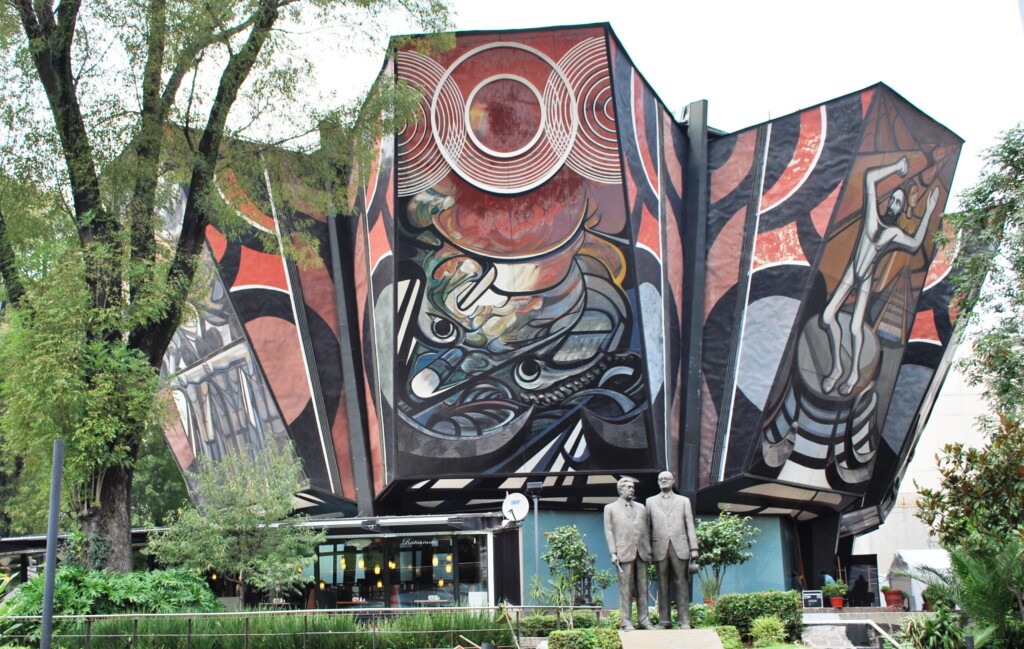
There is a particular kind of document that arrives not to describe the world but to wound it. Not to propose an alternative but to declare the old order already dead, even while it is still breathing, still signing checks, still hanging its portraits in the right academies. Barcelona, 1921. Siqueiros is twenty-five years old, recently arrived from Mexico carrying the particular fury of a man who has already been to war and already seen what official culture does with the bodies of the poor — decorates around them, aestheticizes over them, pretends they are scenery. He sits with a group of artists and writes what becomes known as the Declaration of Social, Political and Aesthetic Principles, and what he writes is not a program. It is an act of aggression dressed in the grammar of a proposal.
This distinction matters more than it might seem. Antonio Gramsci, writing in his prison notebooks between 1929 and 1935, made a distinction that illuminates exactly what Siqueiros was doing in that room. Gramsci separated the traditional intellectual — the figure who imagines himself floating above class and history, connected to nothing but universal truth — from what he called the organic intellectual, the thinker who emerges from within a specific social group and articulates that group’s experience back to itself and outward to power. The organic intellectual does not observe the struggle. He is inside it, shaped by it, accountable to it. His ideas are not decorations. They are instruments.
Siqueiros never floated. He could not have, even if he had wanted to. He had fought in the Mexican Revolution as a teenager, had seen the Constitutionalist army from the inside, had understood that a rifle and a paintbrush were not metaphors for each other but actual parallel tools of the same transformation. The Barcelona Manifesto carries this understanding in every sentence. It calls for the rejection of easel painting as a bourgeois form, an art made to be privately owned, privately contemplated, privately consoling. It calls for monumental public art rooted in pre-Columbian traditions, for an art that belongs to walls and streets and the bodies that move through them daily. The document is insisting that beauty without social function is not beauty — it is decoration in service of somebody’s comfort, and that somebody is never the person hauling stone or grinding corn.
What this cost him is harder to see because it is distributed across decades rather than concentrated in a single moment. The choice to become a soldier inside history rather than a witness above it means accepting that history will eventually demand more from you than your aesthetic convictions. It means that the same logic that made the manifesto possible will eventually ask you to sign other documents, follow other orders, subordinate your judgment to a collective discipline you have pledged to honor. Siqueiros joined the Mexican Communist Party in 1919, and his political commitments would propel him into organizing labor struggles in Latin America, into the Spanish Civil War, into the catastrophic 1940 attempt on Trotsky’s life in Mexico City — a raid he led that failed, which Trotsky survived, and which left Siqueiros on the wrong side of a historical verdict that has never fully reversed itself.
But in Barcelona, in 1921, none of that weight has accumulated yet. There is only the page, the argument, the declaration. And the declaration is not predicting what art should become. It is asserting that the art already surrounding them is a lie, a comfortable lie, a lie with excellent lighting and generous patrons, and that the job of the genuine artist is not to produce more beautiful objects for that system to absorb but to make something the system cannot comfortably digest. The manifesto as weapon does not ask permission to transform the world. It announces, with the particular arrogance of the young and the serious, that the transformation has already begun.
Paint as Physics: The Technological Obsession
There is something almost violent about the way pyroxylin dries. It does not wait for you. It shrinks, it wrinkles, it creates textures no brush could plan or predict, and Siqueiros understood immediately that this was not a defect to be corrected but a truth to be amplified. By the early 1930s he had largely abandoned traditional oil paint and embraced Duco, the industrial lacquer developed for automobile finishing, precisely because it behaved like the world he was trying to describe: fast, corrosive, indifferent to the intentions of any single hand.
This was not eccentricity. It was argument made material.
The spray gun arrived in his studio as a political instrument. When you hold a brush, the myth of individual genius has a physical correlate: the unique pressure of a unique hand, the irreproducible trace of one consciousness moving across a surface. The spray gun dissolves that fiction. It atomizes the gesture, distributes it, makes the mark no one’s property and everyone’s product. Walter Benjamin had written in 1935, in his essay on the work of art in the age of mechanical reproduction, about the destruction of aura as a potentially emancipatory act. Siqueiros did not need to read Benjamin to arrive at the same threshold. He arrived through the logic of his own hands.
In 1937 he painted a small panel in pyroxylin, less than four feet tall, that contains more anguish than most paintings ten times its size. A child’s mouth is open in a scream so wide it has become architectural, and around the figure the industrial wreckage of a world accumulates like evidence at a crime scene. The texture of the surface is not painted so much as deposited, layered through accident and pressure and the chemical life of the material itself. What you see is not a representation of suffering. It is suffering as physical event, suffering as something that happened to the surface.
Two years later he led a team through eleven months of work on a mural for an electrical workers’ union in Mexico City, covering hundreds of square feet of curved and angled walls with a vision of capitalism as a machine that eats human bodies and produces flags. The choice to work on curved surfaces was not decorative. Siqueiros had been theorizing since at least 1932, in his New York lecture to the John Reed Club, that flat painting was a lie about how human perception works. We do not see in planes. We move through space, and a mural that acknowledges the architecture it inhabits, that wraps around a corner and continues, forces the viewer’s body into the meaning. The image pursues you. You cannot step back from it into the comfortable position of the spectator. You are already inside.
He used photographic projectors to scale his sketches onto walls, which scandalized the traditionalists who believed that the master’s hand should touch every inch. Siqueiros called this superstition. The sociologist Howard Becker would later describe in Art Worlds, published in 1982, how the ideology of the individual artist systematically obscures the collective labor that produces every work of art. Siqueiros had no patience for waiting on theory. He organized his murals like construction sites, with collective labor as the explicit method, because a painting about the dignity of workers that required the suppression of workers to be made was a contradiction he refused to inhabit.
The philosophical stakes here are rarely acknowledged. To choose a material because of how it behaves rather than how it can be controlled is to make an ontological claim: that the world resists individual will, that matter has its own agency, that art which pretends otherwise is telling a comfortable lie. Pyroxylin knows nothing about your intentions. It does what it does, and the painter who accepts this is forced into a collaboration with physics itself, which is perhaps the most honest thing you can be forced into.
The Assassin Who Painted Liberation: The Trotsky Affair

There is a moment, before the thing is done, when a man checks his equipment with the same focused attention he brings to any craft. The brushes are clean. The ammunition is counted. The difference between the two actions exists somewhere in the moral imagination, but in the hands, in the breath, in the narrowed eyes measuring distance and angle, there is no difference at all. This is not a metaphor. This is what preparation looks like when a person has decided that history requires something of them personally.
In May 1940, Siqueiros organized and led a paramilitary assault on Leon Trotsky’s fortified villa in Coyoacán, Mexico City. He did not do this reluctantly. He did not do this under duress. He dressed in a Mexican army uniform, gathered roughly two dozen men, overpowered the guards, entered the bedroom where Trotsky slept, and fired more than seventy rounds into the room. Trotsky survived by hiding under his bed. His grandson was wounded. Siqueiros fled, was arrested, was released through the intervention of powerful political allies, went into exile in Chile, and later — this is the part that catches in the throat — returned to Mexico and continued painting murals about human dignity and the liberation of the oppressed.
Hannah Arendt, reporting on the Eichmann trial in Jerusalem in 1963, arrived at her famous formulation: that the most terrible evil is not performed by monsters but by functionaries, by people who have simply stopped thinking, who have outsourced their moral imagination to a bureaucratic structure larger than themselves. The banality of evil is the evil of the man who processes paperwork, who follows orders, who never once looks at the face of what he is doing. But Siqueiros inverts this completely, and the inversion is more disturbing, not less. He was not banal. He was fervent. He looked directly at what he was doing and called it necessary. He had, in fact, a richly developed moral imagination — one that had simply been restructured so that the future absolved the present, so that the liberation of millions justified the murder of one.
This is the architecture of ideological violence that Hannah Arendt’s framework, brilliant as it is, does not fully account for. Eric Hoffer, in his 1951 study of mass movements, identified what he called the true believer: the person for whom a cause has become total, for whom doubt is not a sign of intelligence but of weakness, for whom the individual human being in front of them has become an abstraction, a variable in a historical equation. Siqueiros was not thoughtless. He thought constantly, obsessively, with great sophistication. But his thinking had been entirely colonized by a vision of history so absolute that a seventy-two-year-old man hiding under his bed was, to him, not a man but an obstacle.
There is a kind of coldness that looks exactly like warmth. You have seen it — the person who speaks with beautiful passion about justice while something behind the eyes remains entirely still, entirely calculating, entirely unmoved by the specific weight of the person standing before them. The cause is real to them. The individual is not. Siqueiros painted faces with enormous emotional force, painted the suffering of workers and peasants with what appears to be genuine anguish. And then he counted his ammunition and checked the sight lines of a bedroom where an old man slept.
Trotsky himself, writing in the weeks after the attack, expressed something stranger than outrage. He expressed a kind of philosophical bewilderment at what it meant to be hunted by people who believed, sincerely, that they were on the right side of history. He had, after all, believed the same thing about himself. He had made the same calculations. He recognized the logic because he had used it.
A vision curated by a filmmaker, not an algorithm
In this video I explain our vision
Prison, Exile, and the Murals That Could Not Be Contained
There is a particular cruelty in imprisoning a man whose entire artistic vocabulary was built from walls. When Siqueiros was arrested in 1960 — charged with “social dissolution,” a legal instrument so vague it could swallow almost any dissent — the Mexican state believed it was removing him from the equation. It was not. What the state did not understand, could not understand, was that Lecumberri Prison, that grim polygonal structure that had been swallowing inconvenient Mexicans since 1900, was simply another total environment. And total environments were precisely what Siqueiros had spent his entire life learning to inhabit and transfigure.
Michel Foucault argued in Discipline and Punish, published in 1975, that the modern prison is not fundamentally about punishment but about transformation — about remaking the subject through the disciplinary gaze, through surveillance, through the organized partitioning of space and time. The panopticon, Bentham’s architectural dream of perfect visibility, was designed to produce docility. What Foucault could not account for, because he was theorizing a generalized subject, was the artist who had already made the enclosing wall his instrument. Siqueiros had spent decades understanding exactly how a bounded surface creates its own gravity, how it pulls the eye and the body into a field of meaning that cannot be escaped. When the state put him inside Lecumberri, it placed a man who understood total environments into one. The intended lesson in docility became, instead, a residency.
He spent four years there, from 1960 to 1964, when President Gustavo Díaz Ordaz — under considerable international pressure and through the intercession of figures including the poet Octavio Paz — finally authorized his release. During those years, Siqueiros continued to work. He drew, he planned, he wrote. The prison did not silence him; it gave him time to think at a scale he had rarely been permitted before. The project that would become the Polyforum Siqueiros began to take shape precisely in that period of enforced stillness. It was as though the state, by removing every other context, had inadvertently handed him the most ambitious commission of his life: his own mind, uninterrupted, for years.
His imprisonments were not singular. They were a pattern that repeated across decades with the regularity of a colonial rhythm — arrested in 1930, exiled, returned, involved in the catastrophic 1940 attempt on Trotsky’s life in Coyoacán that left him fleeing to Chile, further exiles, further conflicts. Each time, the logic of the state was the same: remove the body and the work ceases. Each time, the logic failed. There is something the prison cannot reach in a man who has already decided that his nervous system and the wall are the same thing.
You know this failure intuitively, even if you have never articulated it. You have seen it in smaller registers — the colleague silenced in a meeting who goes on to write the memo that changes everything, the voice suppressed in one room that finds its way into every other room. Power that operates through containment always underestimates what containment cannot touch. It cannot touch the imagination already trained on surfaces larger than any room that can be built around it.
When Siqueiros emerged from Lecumberri in 1964, he was sixty-eight years old. Most careers would have been concluding. His was approaching its most audacious gesture: a twelve-sided building in Mexico City, every interior and exterior surface covered, a structure that was itself a mural, that refused the distinction between architecture and painting, between the gallery and the street, between the contained and the uncontainable. The state had spent years trying to teach him the meaning of walls. He had spent those same years deciding what the largest wall he had ever painted would look like.
The Polyforum: Architecture Swallowed by Paint
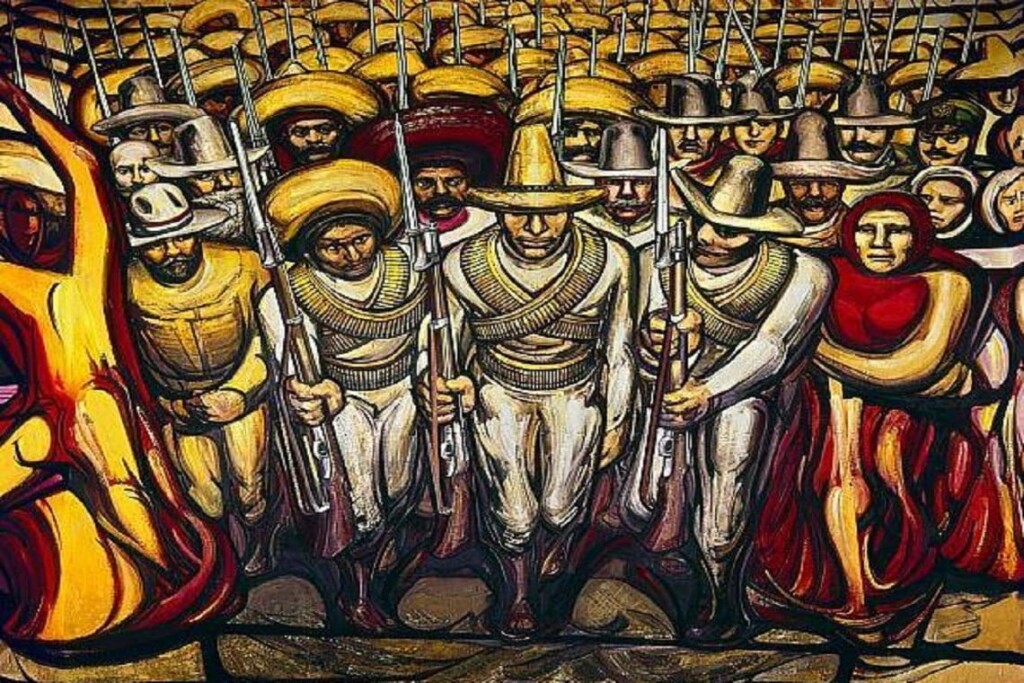
There is a moment, inside that building in Mexico City, when you stop being a visitor and become something closer to a particle. The walls are not beside you. They are around you, above you, pressing forward and receding and folding in ways that deny the comfortable geometry of rooms. You came in looking for something to look at. You find instead that looking is no longer the operative verb. Something else is happening to your body.
The Polyforum Cultural Siqueiros was completed in 1971, when Siqueiros was seventy-five years old and had spent more than half a century insisting that painting was not an object to be contemplated but a force to be inhabited. The building, situated on Insurgentes Avenue in the south of the capital, is not a museum that happens to contain murals. It is a mural that happens to have assumed the form of a building. Every exterior face of its twelve-sided structure carries painted and sculpted surfaces in which figures surge outward from the architecture as if the stone itself were in labor. And inside, across approximately 4,600 square meters of continuous painted surface — the work known as The March of Humanity — the distinction between ceiling and wall, between vertical and horizontal, between the space where figures exist and the space where you stand, has been systematically dismantled.
Maurice Merleau-Ponty argued in his Phenomenology of Perception, published in 1945, that the body is not an instrument through which consciousness perceives the world. The body is perception. There is no seeing that happens behind the eyes, in some protected interior theater. Seeing is a bodily event, which means that the space around the body is not neutral. It acts on what you know, on what you fear, on what you feel capable of. When you move through a space that refuses to let the eye settle — that keeps tilting the horizon, that places figures at scales the body registers as threat or embrace rather than as aesthetic proportion — you are not being given a visual experience. You are being reorganized.
This is what Siqueiros was building. Not a monument to his politics, not a late-career summation of his technique, but an environment designed to make the separation between the observer and the observed literally impossible to maintain. The figures in The March of Humanity are not illustrations of struggle. They are struggle at the scale of architecture, which is to say at the scale of lived experience. Workers, soldiers, mothers, hands reaching upward or downward or outward in a continuous wave that has no frame because the room has no wall that isn’t also the painting. You cannot step back from it. Stepping back is still being inside it.
The political logic of this is precise and unforgiving. For decades, institutional power had managed the relationship between citizens and public art through exactly this mechanism — the frame, the pedestal, the gallery wall, the respectful distance that converts a demand into a decoration. You can feel something looking at a framed image. You cannot be implicated by it in the same way you are implicated by something that surrounds you before you have decided to engage. Siqueiros had watched his murals photographed, reproduced, reduced, discussed in symposia. He understood that reproducibility was its own form of neutralization. A space you can only experience with your body, in real time, in real proportion, resists that particular form of domestication.
Whether it succeeds is a question the building keeps asking without answering. There are moments inside the Polyforum when the effect collapses into spectacle, when the sheer accumulation of visual information produces not implication but overwhelm, and overwhelm is its own distance. Siqueiros knew this risk. He had spent his life walking the edge between art as weapon and art as theater, and the Polyforum is where that tension stops being theoretical and becomes the room you are standing in, whether you wanted it to or not.
What the Living Owe the Unfinished
He died on January 6, 1974, in Cuernavaca, and the Mexican state gave him a funeral with honors, which was perhaps the most precise insult anyone could have devised. The man who had spent decades in exile, in prison, in the crosshairs of governments that feared what a wall could do — that man was folded, at the end, into the official narrative of national culture, draped in the flag of the very institution he had spent his life trying to detonate from within. The murals stayed. The rage was archived. The museums opened their doors a little wider and called it inheritance.
There is a particular mechanism that civilizations use on their most inconvenient artists, and Nietzsche identified it with surgical clarity in his 1874 essay “On the Uses and Disadvantages of History for Life.” He called it monumental history — the transformation of a living, destabilizing force into a statue that can be admired from a safe distance. The monument does not ask anything of the body standing before it. It only asks for reverence, which is another word for stillness. Reverence is what you perform when you have already decided not to act. Siqueiros understood this instinctively, which is why he built his work against its own future domestication — painting on curved surfaces that refused the flat logic of galleries, using industrial lacquers and pyroxylin that were never meant to hang in climate-controlled rooms, designing spaces where the image surrounded you before you could choose whether to receive it.
And yet here we are. The Sala de Arte Público Siqueiros in Mexico City preserves his studio with institutional care. Scholars produce monographs. Graduate students write dissertations analyzing his technique. There is nothing wrong with any of this, and none of it is what he wanted. What he wanted was for the person standing in front of the mural to feel their own body as a political fact — to feel the floor beneath them as contested ground, the air they were breathing as something that had been fought over and would be fought over again. He wanted the image to produce not contemplation but obligation.
A man walks into a room where the walls are not walls anymore but accusations, and he cannot quite locate himself in the geometry, and the figures above him are not allegorical but immediate, and something in his chest tightens in a way that has nothing to do with aesthetic appreciation. That tightening is what Siqueiros was after. Not beauty. Not even justice as an abstraction. The somatic recognition that history is not behind you — it is the room you are standing in.
The question of what the living owe the unfinished is not sentimental. It is structural. Siqueiros left works in states of deliberate incompletion, not because he ran out of time but because he understood that an image which closes itself off entirely becomes an object, and objects can be owned. The incompletion was the demand. The unfinished edge was the place where the viewer’s body was supposed to enter and continue something that no single life could finish. This is not a romantic notion about artistic legacy. It is a specific theory of collective responsibility translated into pigment and scale.
What makes him dangerous still — occasionally, in the right light, in front of the right wall — is not the ideology, which can be historicized, or the biography, which can be mythologized, but the fact that the surfaces he left behind still do something to the nervous system that institutional framing has not entirely neutralized. The fury did not fully survive its own archiving. But enough of it remains, in the curve of a fist, in the pressure of a figure that seems to be falling toward you rather than away, to remind you that you are standing somewhere, and that standing somewhere has always been a choice that carries consequences you have not finished reckoning with.
🎨 Art, Rebellion, and the Visionary Spirit
David Alfaro Siqueiros lived at the crossroads of art, politics, and radical transformation, channeling his revolutionary ideals into monumental murals that shook the world. His life invites us to explore other visionaries who challenged the boundaries of consciousness, power, and creativity. The following articles illuminate parallel journeys of awakening, defiance, and profound inner change.
Masterpieces of Rebellion and Counterculture Cinema
Siqueiros believed art must provoke and disrupt, a conviction shared by the filmmakers of rebellion and counterculture who refused to comply with the dominant cultural order. This collection of films explores the same refusal to bow down that animated the great Mexican muralists. It is a cinema of fists raised against conformity, painted in light and shadow.
GO TO THE SELECTION: Masterpieces of Rebellion and Counterculture Cinema
Hannah Arendt: the Philosopher Who Unmasked the Banality of Evil
Hannah Arendt, like Siqueiros, confronted the machinery of power with unflinching intellectual courage, asking how ordinary systems produce extraordinary evil. Her philosophy of political action and human plurality resonates deeply with the muralist tradition of giving a face to the voiceless masses. Understanding Arendt means understanding what it truly costs to think against the current.
GO TO THE SELECTION: Hannah Arendt: the Philosopher Who Unmasked the Banality of Evil
Mass Social Homologation Today
Siqueiros painted the crushing weight of social homologation and the forces that reduce individuals to interchangeable units of labor and consumption. This article examines how mass conformity operates in contemporary society, eroding the very individuality that artists like Siqueiros fought to defend. The murals of the Mexican masters were, in essence, a war cry against the grey uniformity of modernity.
GO TO THE SELECTION: Mass Social Homologation Today
Jiddu Krishnamurti: the Man Who Refused to Be God
Jiddu Krishnamurti, like Siqueiros, spent his life dismantling the authority structures that others tried to impose upon him, insisting on radical freedom and self-determination. Where the muralist wielded a brush against oppression, Krishnamurti wielded words to dissolve the psychological chains of tradition and ideology. Together they stand as monuments to the human refusal to be owned or defined by any single system.
GO TO THE SELECTION: Jiddu Krishnamurti: the Man Who Refused to Be God
Discover More on Indiecinema
If these articles have stirred your curiosity about visionary lives, political art, and radical consciousness, Indiecinema is the streaming platform where that spirit lives on screen. Explore a curated selection of independent films that dare to ask the questions mainstream cinema ignores. Join us and let the journey continue, one extraordinary film at a time.
👉 EXPLORE THE CATALOG: Watch Indie Films in Streaming
A vision curated by a filmmaker, not an algorithm
In this video I explain our vision

