
The Ordinary Face of the Unthinkable
There is a man in an office somewhere right now, and he is doing his job. He has a cup of coffee going cold beside his keyboard. He has a family photograph on the desk, children in summer, squinting at the sun. He has a deadline. He opens a spreadsheet, reviews a column of names against a column of numbers, and with the practiced efficiency of someone who has performed this task three hundred times before, he begins to sign. He does not read the files. The files are beside the point. The files are, in fact, an obstacle to the efficient completion of the task. What matters is the column, the number, the signature, and then the next column. By the time he leaves for lunch, forty-three people will have been notified that their positions have been eliminated. He will eat a sandwich. He will check his phone. He will feel, if anything, the mild satisfaction of having cleared his inbox.

This is not a story about a monster. That is precisely the problem.
In another office, in another city, in another decade, a clerk sits behind a counter processing transfer orders. The papers arrive in stacks. Each page represents a human being, but the page is not a human being — it is a document, and documents require processing. The clerk has a procedure. The procedure is clear. You check the identification number against the registry, you stamp the form, you place it in the outgoing pile, you take the next form. The clerk is not cruel. The clerk does not hate the people whose names appear on the forms. The clerk does not think about them at all, which is, in the end, a far more terrible fact than hatred would have been.
Hannah Arendt arrived in Jerusalem in April 1961 as a correspondent for The New Yorker. She had fled Nazi Germany in 1933. She had been stateless, interned, displaced, and she had survived all of it with an intellectual ferocity that seemed almost unreasonable given the circumstances. She was not naive. She had already published The Origins of Totalitarianism in 1951, a work of such unflinching analytical force that it had redrawn the map of how political philosophy understood mass violence. She knew what she was going to see. Or she believed she did.
What she saw was a man in a glass booth.
Adolf Eichmann, the SS-Obersturmbannführer who had been the chief logistical architect of the deportation of millions of Jewish people to the extermination camps, sat in that booth looking like a middle manager with a slight cold. He wore a suit. He had a thin neck and weak eyes behind thick glasses. He took notes. He spoke in the clipped, procedural language of someone testifying to a human resources committee about a procurement decision. He repeatedly insisted, with what appeared to be genuine conviction, that he had always followed orders and always obeyed the law. He said this not as a defense calculated to save his life, but with the tone of a man who considered it self-evidently admirable. Following the rules was, in his understanding, a form of virtue.
Arendt sat in that courtroom and felt something she later described as a profound shock — not at the presence of evil, but at its absence. She had come prepared for a demon. What she found was, in her own words, something far more terrifying: a man who was not stupid, not psychologically aberrant, not driven by ideological hatred in any deep personal sense, but who had, through a kind of sustained and deliberate thoughtlessness, made himself into an instrument. He had outsourced his moral imagination entirely to the institution that employed him. He had confused compliance with conscience and had never, it appeared, noticed the difference.
This is what she meant when she wrote, in Eichmann in Jerusalem, published in 1963, about the banality of evil. Not that evil is mundane. Not that it is unimportant. But that its most industrially effective form does not require malice. It requires only the systematic abdication of the capacity to think.
Mystery of an Employee

Drama, thriller, by Fabio Del Greco, Italy, 2019.
Someone wants to control the life of the employee Giuseppe Russo: the products he buys, his political and religious faith, his private life, even his dreams. But he will do anything to escape control and find his true self. Giuseppe is a man of around 45, married, with a stable job and a home of his own. His life flows seemingly peacefully when he meets a mysterious tramp who gives him some old VHS video cassettes. Giuseppe begins to see video tapes in which he is filmed in some moments of his life since he was a child, then as a teenager and as a young man. Who shot those videos that he remembers nothing about? Giuseppe has the strange sensation of being constantly observed and begins to investigate what is happening. Through his investigation of him, he begins to rediscover his true identity and become aware of who he truly is.
Employee's Mystery is a film that highlights the danger of social control and shows a society where everyone is constantly monitored and conditioned in their deepest selves. The film is also an analysis of human nature and identity. Fabio Del Greco, who plays Giuseppe, gives an engaging performance. Equally good is Chiara Pavoni, in the role of Giada Rubin and Roberto Pensa in the role of the tramp. Employee's Mystery is a film that addresses important themes in an original way, a psychological thriller that keeps the viewer glued to the screen until the end: a metaphor for contemporary society, in which people are increasingly monitored and conditioned by the media and technologies . It is a courageous and provocative work, which addresses important themes in an original way.
LANGUAGE: Italian
SUBTITLES: English, Spanish, French, German, Portuguese
Eichmann in the Glass Booth: When the Monster Refuses to Appear
He sat behind bulletproof glass and adjusted his headphones. That was the first thing people noticed — the headphones, the way he fussed with them, tilting them slightly, as though the quality of the audio feed mattered enormously to him. He took notes. He conferred quietly with his lawyers. He wore a dark suit. When he spoke, he spoke in the careful, slightly wooden language of a mid-level bureaucrat recounting a project he had managed competently and with appropriate attention to protocol. He was not evasive exactly, but he was imprecise in a way that felt rehearsed — not to deceive, but because the language of moral responsibility had genuinely never been his language. He had another language entirely. He had the language of logistics.
Hannah Arendt sat in that Jerusalem courtroom in 1961 and waited for the monster to appear. She was not alone in that waiting. The entire architecture of the trial seemed designed to summon him — the glass booth like a terrarium for something dangerous, the prosecutors who built their case as though excavating the chambers of a uniquely diabolical mind. The world needed a demon. The world had earned a demon, after everything. And instead there was Adolf Eichmann, fussing with his headphones, a man who had organized the transportation of millions of human beings to their deaths and who seemed, above all else, to be someone who had always wanted to do his job well.
What Arendt published two years later in 1963, the dispatches she had written for The New Yorker gathered into “Eichmann in Jerusalem: A Report on the Banality of Evil,” was not a defense of Eichmann. It was something far more disturbing than a defense. It was an observation. The observation that evil, at the level of its most efficient and most catastrophic execution, does not require a demonic interiority. It requires, instead, a radical absence of thought. Eichmann’s crime, she argued, was not hatred — he was at pains to say he bore no personal animosity toward Jewish people — but what she would call “thoughtlessness,” a word she meant with almost clinical precision: the failure to think from the standpoint of anyone else, the collapse of the inner dialogue through which human beings examine their own actions.
The intellectual scandal this provoked was immediate and ferocious. Survivors felt betrayed. Scholars of the Holocaust objected that she had minimized the machinery of ideology, the genuine antisemitism threading through the system. Gershom Scholem accused her of lacking love for the Jewish people. The argument has never entirely resolved, and perhaps it shouldn’t. But what her critics often missed, in the heat of the wound she had opened, was that her observation was not exculpatory — it was exponentially more terrifying. Because if Eichmann was a monster, we could relax. Monsters are rare. Monsters are other. If Eichmann was ordinary, we could not.
In the same years Arendt was sitting in that courtroom, Stanley Milgram was conducting experiments in a basement laboratory at Yale that would eventually be published in their full form in 1974 but whose preliminary results by 1963 had already begun to circulate with the force of an intellectual detonation. Milgram asked ordinary American citizens — teachers, engineers, postal workers, the full demographic spectrum of a functioning society — to administer what they believed were electric shocks of increasing severity to another person, at the instruction of a figure of authority. Sixty-five percent of participants administered what they had been told were potentially lethal doses. They were not sadists. Many of them were visibly distressed. Several wept. They continued anyway, because someone with a clipboard and an institutional affiliation told them the experiment required it, and because stopping felt like a failure of procedure.
Milgram described this as the “agentic state” — the psychological condition in which a person understands themselves as an instrument of someone else’s will rather than a moral agent in their own right. The self does not disappear. The conscience does not disappear. But it relocates. Responsibility travels upward, toward authority, and the person following the instruction is left feeling not guilty but correct. Procedurally faithful. A good employee.
This is the man in the glass booth. Not the exception. The mirror.

The Seduction of Not Thinking
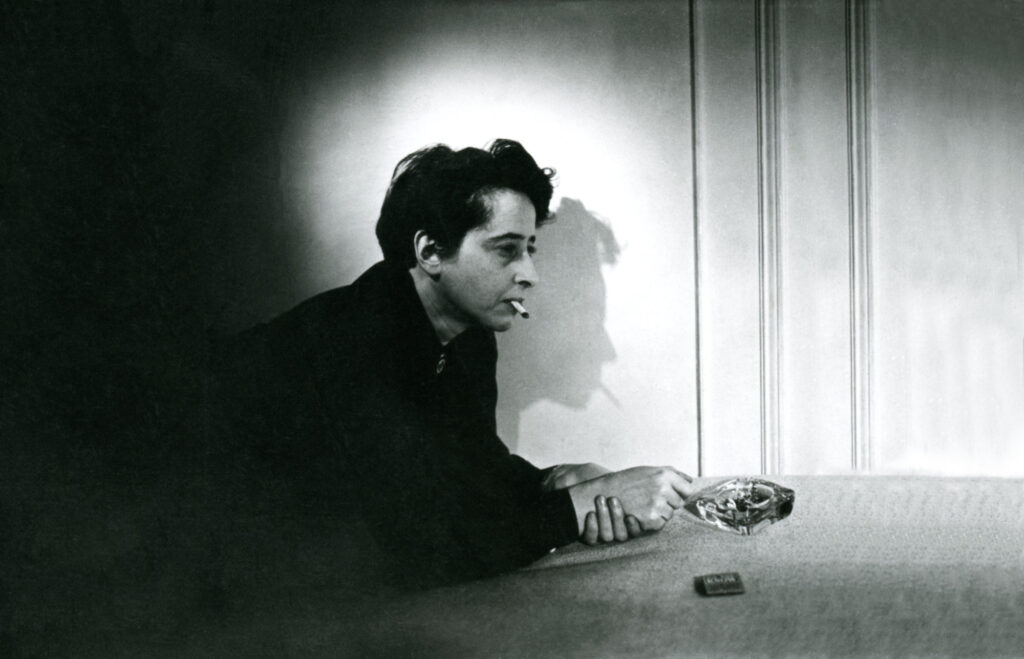
There is a particular expression that appears on certain faces at the moment they stop questioning. It is not the face of stupidity, not the glazed look of someone who never understood. It is something else entirely — a kind of release, almost beatific, the expression of a person who has finally been relieved of an unbearable weight. You have seen it in offices, in institutions, in the quiet satisfaction of someone who says “I’m just following procedure” and means it, completely, without remainder.
This is not ignorance. Arendt was precise about this, and the precision matters enormously. In her lectures later collected as “The Life of the Mind,” she drew a sharp distinction between thinking and cognition. Cognition is the acquisition and application of knowledge, the ability to solve problems, to navigate systems, to perform tasks with skill and even excellence. Thinking is something altogether different — it is the internal dialogue that Socrates described, the conversation the self holds with itself, the activity that refuses to let any action pass without interrogation. Most people who stop thinking never lose their cognition. They become, if anything, more efficient. The bureaucrat who processes forms with inhuman speed, the officer who executes orders without friction, the manager who optimizes workflows without asking what those workflows are optimizing toward — these are not failures of intelligence. They are triumphs of cognition over thinking, and they represent, Arendt argued, one of the most dangerous conditions a human being can inhabit.
What Zygmunt Bauman added to this diagnosis, in 1989, was the sociological architecture that explains how such a condition becomes not exceptional but systematic. In “Modernity and the Holocaust,” Bauman argued that the genocide was not a rupture in Western civilization but its logical extension — that the same rationalization of labor, the same division of tasks, the same bureaucratic distancing of action from consequence that made the industrial revolution possible also made industrialized murder possible. The moral horror, he showed, was not produced despite the efficiency of the system but through it. Each participant was responsible only for their fragment. The train scheduler scheduled trains. The form processor processed forms. The fence installer installed fences. No single person, within the logic of the system, was doing anything that felt like killing. This is not a metaphor. This is how it worked.
There is something in this that goes beyond the merely chilling. It touches something recognizable in the texture of ordinary institutional life. A man sits in a room reviewing documents and finds, in that review, a strange peace. The documents require attention, not reflection. The criteria are established, the protocols clear, the hierarchy legible. He knows exactly what he is supposed to do and what he is not supposed to question. In that knowledge there is a profound comfort — the comfort of having a defined self, a role, a function. The uniform, whether literal or metaphorical, resolves the anxiety of selfhood. You are not required to decide who you are. The institution decides for you.
Arendt saw in this the seduction that totalitarianism exploits but does not create. It finds a hunger that is already there, in ordinary people, in ordinary conditions — the hunger to be relieved of the burden of judgment. Eichmann was not an anomaly produced by an extreme system. He was a recognizable human tendency that the system rewarded rather than punished. He was, in his own words, doing his job. And he said it with something that was not quite pride and not quite shame — something more like the satisfaction of a craftsman describing his work.
What makes this so difficult to confront is that the relief of not thinking is real. It is not merely false consciousness, not merely self-deception. The weight that thinking imposes — the refusal to let any action pass unchallenged, the perpetual discomfort of the examined life — is genuinely heavy. Socrates himself acknowledged it. He also ended up on trial, condemned by people who found his insistence on questioning not enlightening but intolerable, an irritation to be removed rather than a voice to be answered.
She Was Never Forgiven for Being Right

There is a particular kind of silence that falls after someone has said the true and unsayable thing. Not the silence of awe. The silence of doors closing. Of invitations that stop arriving. Of people who used to embrace you now looking slightly past your shoulder when they speak.
Arendt knew this silence intimately after 1963. The publication of “Eichmann in Jerusalem” did not provoke a debate. It provoked something closer to a wound in collective tissue, and the organism responded the way organisms do: it expelled her. The Anti-Defamation League condemned her. Scholars who had admired her work for two decades issued public denunciations. Friends disappeared. The charge was not that she had been inaccurate. The charge was something older, more tribal, more visceral: that she had betrayed her own people in their hour of historical sacredness.
Gershom Scholem, the great scholar of Jewish mysticism, wrote her a letter that has since become one of the more painful documents in twentieth-century intellectual history. He accused her of lacking “Ahabath Israel” — love of the Jewish people. He meant it as a theological indictment. She was not simply wrong; she was cold, she was unloving, she was a woman without loyalty to the flesh that had formed her. Arendt’s response was precise and devastating: she told him she had never in her life “loved” any people or collective, only individuals. That love of a people as abstraction had always struck her as something politically dangerous, a sentiment that immunized itself against critical thought. She was right, and she knew she was right, and this made things considerably worse.
Karl Jaspers, her mentor and one of the deepest intellectual relationships of her life, received her book with something more complicated than hostility — a kind of worried admiration that contained, nonetheless, reservations about the tone. Even he felt the tremor. Even the man who had shaped her thinking about guilt and political responsibility hesitated at the edge of what she had written. This is worth holding. When even those closest to you flinch from what you have produced, you understand that you have touched something that does not want to be touched.
What made the argument so threatening was precisely its structure. A monster does not implicate you. A monster is by definition alien, other, outside the human range. If Eichmann had been the sadistic demon that so many needed him to be, his crimes would have remained safely contained in the category of the incomprehensible. You could mourn, you could condemn, and you could walk away intact. Arendt refused this comfort. She looked at the man in the glass booth and saw someone who could have sat in any office in any country, who could have processed any category of people with the same bureaucratic diligence, who would have organized the logistics of almost anything if the forms required it and the career demanded it. This was not exoneration. This was something far more disturbing than accusation. This was implication.
Erik Erikson wrote in 1968 that societies construct images of absolute evil partly to protect their sense of their own potential goodness. Arendt had demolished the mechanism. She had taken the protective monster and replaced it with a mirror, and the mirror showed something recognizable. The fury this generated was not intellectual. It was the fury of someone who has had a necessary illusion removed by force.
Think of a man who stands in a courtroom and tells the truth about what he saw, and finds that every face in the room turns against him — not because he is lying, but because what he saw cannot be incorporated into the story everyone has already agreed to tell. The exclusion that follows is not punishment for error. It is punishment for precision. He has made the collective narrative impossible to maintain, and the collective will never forgive him for it. He will spend years understanding that being right and being welcomed are not always compatible conditions, that truth-telling is sometimes indistinguishable, in its social consequences, from an act of violence.
Arendt had committed exactly this act. And she was Jewish. Which meant the accusation of betrayal did not land as criticism.
It landed as excommunication.
Power, Plurality and the Space Between People
There is a moment that some people carry with them for the rest of their lives, usually without knowing quite why. A room, a square, a stairwell. A handful of people who had no particular reason to trust each other, no shared history, no guaranteed outcome. And yet something happened there, something that could not have been predicted from the individual parts. A decision was made, a word was spoken, a threshold was crossed together — and afterward, none of them could fully return to who they had been before. The moment was irreversible. It had created something that belonged to no single person and yet lived inside all of them.
Hannah Arendt spent years trying to find the precise philosophical language for that experience, and what she arrived at in The Human Condition in 1958 was a concept of power so counterintuitive that it still unsettles anyone who encounters it for the first time. Power, she argued, is not something a person possesses. It is not stored in weapons, offices, or institutional titles. It exists only between people, in the space that opens up when human beings act in concert, and it vanishes the moment they disperse. A ruler who believes he holds power is actually holding only the shadow of a moment when real power once existed between people who consented to act together. The moment that consent dissolves, the apparatus collapses — not because it has been defeated, but because the substance that gave it meaning has evaporated.
This distinction between power and violence was one of the most radical moves in twentieth-century political thought. Violence, for Arendt, is not power’s extreme form or its ultimate expression. It is power’s replacement, always a symptom of power’s failure. When a government reaches for violence, it is announcing, however unconsciously, that it can no longer summon the genuine agreement of those it governs. Violence can destroy and compel, but it cannot generate the one thing that legitimate political life requires — a shared world that people recognize as their own creation. You can force a person to move, to speak, to sign. You cannot force them to begin.
That last word carried enormous weight for Arendt. Beginning — the capacity to initiate something radically new, to introduce into the world an action that could not have been deduced from whatever came before — was what she called natality, and she considered it the deepest human capacity, more fundamental even than mortality, which philosophy had obsessed over since the Greeks. We are not defined only by the fact that we will die, she insisted, but by the fact that we were born, that our arrival in the world was itself a beginning, and that every human action carries within it the structure of that first beginning.
Think of what it means to sit across a table from someone whose entire experience of the world differs from yours, whose language, whose losses, whose way of calculating trust runs along entirely different lines, and to find yourselves, despite everything, building something neither of you had planned. There is a scene that lives in the memory of anyone who has experienced it: the moment when the argument stops not because someone won but because something new entered the room, some possibility that did not exist before two people — wrong people, mismatched people, people history would have kept apart — decided to act together. That is Arendtian power in its purest form. It is also, she would say, the only serious answer to the banality of evil.
Because the banality of evil depends on exactly the opposite — on the elimination of that space between people, on the replacement of genuine plurality with function, role, procedure, and the comfortable numbness of those who have decided that thinking is not their job. What interrupts the machinery is not heroism in any grand sense. It is the stubborn, almost inconvenient act of remaining present to another person, of refusing the abstraction that makes harm so easy, of choosing, in the most ordinary possible moment, to begin.
A vision curated by a filmmaker, not an algorithm
In this video I explain our vision
What We Recognize When We Stop Looking Away
There is a moment most people have experienced and almost no one names. You are moving through a routine — filling out a form, clicking through an agreement, forwarding an email, processing a request — and somewhere in the middle of it you notice a small interior silence where a thought should have been. Not doubt exactly. Not guilt. Just the absence of the pause that would have made it real. You continue anyway. The system expects your next move and you provide it. The moment closes over itself like water.
This is not a metaphor for something larger. This is the thing itself.
Arendt’s insight about Eichmann was not that ordinary people are secretly monstrous. It was almost the opposite: that monstrousness no longer requires the secret. It operates in plain sight, distributed across enough hands that no single hand feels the weight. What she called thoughtlessness — Gedankenlosigkeit — was not stupidity and not indifference in any emotional sense. It was the active, almost disciplined refusal to let experience become thought. The cognitive habit of remaining a functionary of one’s own life. And what she could not have fully seen in 1963, when Eichmann in Jerusalem was published to a storm of outrage and misreading, was how comprehensively the architecture of modern life would be redesigned to reward exactly that refusal.
Digital systems do not merely permit thoughtlessness. They are engineered around it. The terms of service that no one reads — studies have estimated that reading every privacy policy encountered in a year would consume roughly 76 work days — are not an accident of complexity. They are a structure of distributed innocence. You agreed. You clicked. The responsibility migrated upward into abstraction, into a corporation, into a server somewhere, into a legal clause that no one you will ever meet actually wrote. And you remain clean, or feel that you do, which is the more important thing.
A man sits at the end of a chain of decisions he does not fully remember making. He works in compliance. He processes flags, generates reports, ensures that numbers match other numbers. Somewhere upstream, those numbers correspond to people — their data harvested, their profiles sold, their vulnerabilities mapped and monetized. He knows this in the way you know the news: as information that does not quite reach the place where action begins. He has never lied. He has never stolen. He has never, in any moment he can clearly identify, chosen to cause harm. And yet the harm is there, structural and documented, and his hands have touched every link in the chain. When it finally surfaces — in an investigation, a headline, a conversation he cannot avoid — he says, with complete sincerity, that he was just doing his job. He means it. That is what makes it so difficult to argue with and so impossible to accept.
Zygmunt Bauman, building on Arendt in Modernity and the Holocaust, argued that modern bureaucracy doesn’t corrupt moral instincts so much as it makes them functionally irrelevant. The system absorbs them. You can feel empathy, regret, even shame, and still perform the action. The machinery doesn’t need your consent. It needs only your presence at the keyboard, your signature at the bottom, your silence in the meeting.
What thinking actually costs, in Arendt’s sense, is the willingness to let the weight land. Not to process it from a distance. Not to outsource the discomfort to a procedure or a chain of command or the reasonable fact that everyone else is doing the same thing. To let what you are participating in become fully visible to you, and then to remain with that visibility long enough for it to require something.
🧠 When Thought Confronts Power and Evil
Hannah Arendt dedicated her life to understanding how ordinary people become instruments of totalitarian horror. Her philosophy resonates deeply with broader questions about consciousness, conformity, and the courage to think independently. The articles below trace parallel journeys through minds that refused to surrender to the expectations of their time.
Mass Social Homologation Today
Mass social homologation is one of the phenomena Arendt feared most: the erosion of individual judgment under the pressure of collective conformity. This article examines how modern society manufactures consent and silences critical thought, echoing Arendt’s warnings about the ‘banality’ lurking in unquestioned obedience. Reading it alongside Arendt’s work reveals just how contemporary her insights remain.
GO TO THE SELECTION: Mass Social Homologation Today
Deep Movies that Make You Think
Deep cinema has long been a vessel for the kind of radical thinking that Hannah Arendt championed in her philosophical writings. These films force viewers to sit with uncomfortable truths about human nature, responsibility, and moral failure. Like Arendt herself, they refuse easy answers and demand genuine intellectual engagement.
GO TO THE SELECTION: Deep Movies that Make You Think
Jiddu Krishnamurti: the Man Who Refused to Be God
Jiddu Krishnamurti, like Arendt, was a thinker who defied every institutional role assigned to him in order to protect the integrity of free thought. His refusal to become a spiritual authority mirrors Arendt’s insistence that no ideology should replace the individual’s capacity for judgment. Both figures remind us that true thinking is always an act of courage and solitude.
GO TO THE SELECTION: Jiddu Krishnamurti: the Man Who Refused to Be God
Must-See Movies About the Meaning of Life
The question of life’s meaning sits at the heart of Arendt’s political philosophy, particularly in her concept of the ‘vita activa’ — the life of action, labor, and thought. The films gathered in this selection wrestle with the same existential urgency that drove Arendt to write about natality, freedom, and the human condition. Together, they form a cinematic companion to her most enduring ideas.
GO TO THE SELECTION: Must-See Movies About the Meaning of Life
Explore Bold Ideas on Indiecinema
If Hannah Arendt‘s fearless thinking has stirred something in you, Indiecinema is the place to keep that flame alive. Our streaming platform is home to independent films that dare to ask the hardest questions about power, conscience, and what it means to be human. Join us and discover cinema that thinks as deeply as you do.
👉 EXPLORE THE CATALOG: Watch Indie Films in Streaming
A vision curated by a filmmaker, not an algorithm
In this video I explain our vision

