
The Court Painter Who Learned to See
You know the feeling. You have sat across a table from someone whose decisions you found indefensible, whose vanity you found exhausting, whose power over your salary was absolute — and you smiled. Not a performance you were proud of, not a mask you chose consciously, but something that simply happened in the musculature of your face because the alternative was unthinkable. You produced the smile the way a body produces sweat: automatically, under pressure, as a survival mechanism so deeply encoded it barely registered as a choice.

Francisco Goya spent the better part of two decades producing that smile in oil on canvas. Appointed court painter to the Spanish Crown in 1786, and later elevated to First Court Painter under Charles IV in 1799, he stood before kings and queens and ministers of state and rendered them magnificent. He gave Charles IV the posture of a man who deserved his throne. He gave María Luisa of Parma the dignity she expected. He dressed power in light and called it portraiture. Every brushstroke was, in one sense, a lie agreed upon by both parties — the painter who knew what he was doing, and the subject who preferred not to examine it too closely.
What makes this arrangement historically ordinary is precisely what makes it psychologically treacherous. The philosopher Erving Goffman, in his 1959 work “The Presentation of Self in Everyday Life,” described the way human beings perform identity rather than simply inhabit it — how every social interaction involves a stage, a role, and an audience whose approval structures what we allow ourselves to say or show. Goya’s court commissions were Goffman’s thesis rendered in royal pigment. The studio was the stage. The sitter was the audience. And Goya was the performer who had learned, with extraordinary technical precision, exactly which performance was required.
But here is what Goffman’s framework does not fully account for: what happens to the performer’s private vision over time. What accumulates behind the eyes of someone who spends years showing people a version of themselves they want rather than what exists. There is a particular kind of internal pressure that builds in that space — not exactly resentment, not exactly guilt, but something closer to what the psychoanalyst Donald Winnicott would later call the False Self: a functional adaptation to external demand that gradually hollows out the interior until the gap between performed identity and actual perception becomes almost unbearable.
Goya did not leave written testimony of this hollowing. He was not a man of elaborate journals or theoretical correspondence. What he left instead was the work itself, and the work tells a story that is almost brutal in its honesty once you know where to look. The same hands that produced ceremonial portraits of aristocrats in full regalia were already, by the 1790s, beginning to produce private drawings of a ferocity that had no place in any royal collection. The gap between the public canvas and the private sheet of paper was not merely stylistic. It was the distance between what he was paid to see and what he had actually learned to see — and those two things, over twenty years of service, had become irreconcilable.
This is the central problem of Goya’s early career, and it is more than biographical. It is a question about what the eye does when it is disciplined by money and proximity to power. Does it become corrupted, trained slowly into a kind of voluntary blindness? Or does it become, through the very effort of controlled misrepresentation, more sharply attuned to the truth it is being asked to suppress? There is evidence, in what followed, that for Goya the answer was the second. That the long education in flattery sharpened rather than dulled his perception. That the smile produced something the smile was never meant to produce.
Don Barry: A Quixotic Exploration

Docufiction, Experimental, by Paul Smart, Mexico, 2026.
Don Barry: A Quixotic Exploration is a debut feature that places the biography of an eighty-year-old experimental filmmaker and artist, Barry Gerson, within the metanarrative of Miguel de Cervantes’ Don Quixote. Don Barry was filmed in the city of Guanajuato during the 51st edition of the Cervantino Festival, as well as during the vibrant Day of the Dead celebrations held in the city’s UNESCO-listed tunnels. The film honors the director’s long friendship with artist Barry Gerson, drawing inspiration from Cervantes’ Don Quixote. Paul Smart’s directorial choices create something new that celebrates life and goes beyond conventional storytelling. A search for magic in our real lives. A moving film about the meaning of life, art, and death. Not to be missed.
Paul Smart is a proud outsider filmmaker with a long history of film screenings. In the 1980s, he emerged in New York’s vibrant youth art scene, working in theater production and later filmmaking, before retreating to rural upstate New York, in the Catskill Mountains, where he made a living writing and screening independent films in old parish halls for rural audiences, many of whom had never seen a film.
LANGUAGE: English
SUBTITLES: Spanish, French, German, Portuguese
A Body That Stopped Hearing the World
There is a particular kind of silence that is not peaceful. Not the silence of a library or a country morning, but the silence that arrives without warning and stays forever, sealing you inside yourself like a room whose door has been bricked over from the outside. In the winter of 1793, Francisco Goya survived a severe illness — its precise nature still debated, possibly encephalitis, possibly some form of neurological catastrophe — and emerged from it permanently and totally deaf. He was forty-six years old. He had spent those forty-six years inside a world of sound: the court gossip, the clatter of Madrid’s streets, the laughter of the duchess, the whispered commissions, the approving murmur of aristocrats who needed their vanity confirmed on canvas. All of it gone. Not gradually diminished, not partially muffled, but annihilated.
The instinct of biographers has always been to frame this as tragedy overcome, as the obstacle that the heroic artist transcended. This framing is false, and it is false in a way that reveals more about the biographers than about Goya. What happened in 1793 was not a tragedy he overcame. It was a perceptual revolution he survived.
Oliver Sacks, in his 1989 work Seeing Voices, argued something that most neurologists of his era preferred to leave unspoken: that the loss of a dominant sense does not simply diminish the perceiving mind but reorganizes it at a structural level. The brain does not mourn passively. It compensates, recruits, redirects. What had been devoted to processing and filtering auditory information becomes available for something else. Sacks was specifically writing about the Deaf community and the cognitive richness of sign language, but the underlying principle extends further: when the ear stops mediating the world, the eye begins to do work it was never asked to do before. It sees what it previously left to sound to confirm. It reads atmospheres, tensions, the microexpressions that a hearing person’s brain offloads onto tone of voice. The deaf man is not deprived of information. He is flooded with a different kind.
What Goya lost was not only sound. He lost the social insulation that sound provides. You know this without realizing you know it: conversation allows you to half-listen, to smile in the right places, to perform attention while your inner life retreats behind the noise. Deafness strips that cover away. You are present, utterly and uncomfortably, to the visual spectacle of human beings pretending to be other than they are. You watch mouths move and see the gap between expression and meaning. You observe the body language of power — who leans in, who leans away, who laughs a half-second too late. The hearing man filters this out because the ear keeps telling him a simpler story. The deaf man cannot filter. He is condemned to see.
This is the rupture that the winter of 1793 produced in Goya. Not blindness but the opposite of blindness. A brutal, involuntary sharpening. The portraits he had painted before this moment — technically astonishing, socially legible, performing the flattery required by their subjects — begin to change afterward in a way that no account of artistic development can fully explain through craft alone. The faces grow more unsparing. Something in the eyes of his subjects begins to look back with an unease that the subjects themselves would not have recognized in time to object. He was still painting them. But he was no longer hearing the story they told about themselves. He was only watching.
There is a man in one of his later small-format works, part of a series he completed in the months following his illness, standing at the edge of a crowd engaged in some festival celebration. The crowd is joyous, or performing joy, which is not the same thing. The man at the edge watches. His expression is not sad. It is precise. That precision is what silence does to a man who cannot stop looking.

What the Smile of Power Actually Looks Like
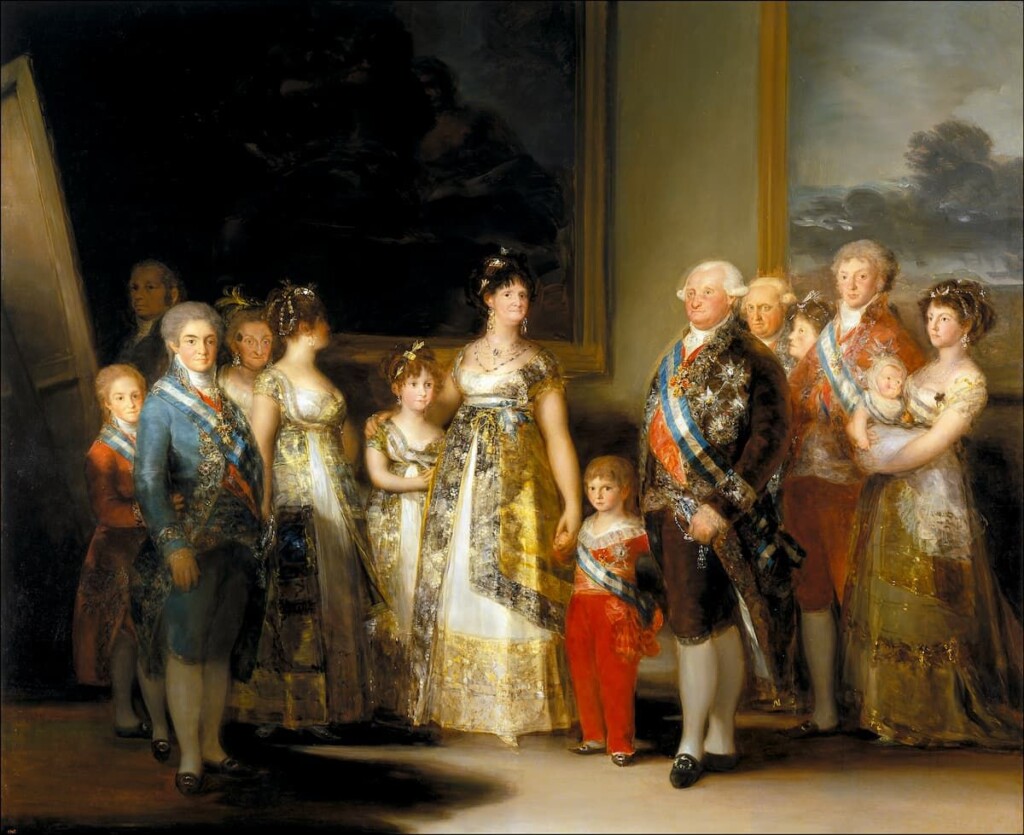
There is a specific kind of silence that fills a room when power sits for its portrait. Not the silence of absence, but of performance — the held breath before the official mask settles into place. You have felt it, perhaps, in the anteroom of someone important, watching faces rearrange themselves as the door opens. The jaw lifts, the eyes calibrate to a practiced distance, the body remembers how it is supposed to occupy space. This is not vanity. This is sovereignty making itself legible.
Goya understood this ritual with the precision of a surgeon who has memorized the body he is about to cut open. When he was commissioned in 1800 to paint the royal family of Charles IV, he produced something that has never been fully explained away — a canvas that fulfills every contractual obligation of dynastic portraiture while simultaneously dismantling it from the inside. Fourteen figures, rendered in extraordinary technical fidelity, arrayed in their decorations and silks and jeweled orders. And yet. The longer you stand before it, the more something refuses to resolve into dignity.
The faces are the problem. Not caricatured, not distorted in any way that would permit accusation. Simply painted as they were. The king stands with the soft, bewildered expression of a man who has wandered into a room and cannot remember why. The queen, Maria Luisa, occupies the visual center with the aggressive certainty of someone who has understood, long before the sitting began, that she is the one actually governing. The children have the glassy, uninhabited eyes of those who have been dressed and positioned too many times to find it strange anymore. The bodies are grouped with an awkward density that suggests merchandise arranged for display rather than a family arranged for affection. There is no psychological warmth passing between them, no glance, no lean of the shoulder. They are adjacent. They are not together.
Roland Barthes, writing in Mythologies in 1957, identified what he called the naturalizing function of myth — the process by which a historically constructed arrangement of power presents itself as simple, obvious, given. Official representation is always this kind of myth. The portrait commission does not merely record; it instructs the viewer in what to see, which is always the legitimacy of the person depicted. The agreement is made in advance, between patron and painter, between institution and public: you will show us as we wish to be understood, and we will confirm that this is merely how we are. The lie is not in any single brushstroke. The lie is in the contract itself.
Goya signed the contract. He cashed the payment. And then, with a patience that is almost frightening, he found the one crack where the contract could not follow him — inside the faces themselves, inside the faithfulness of his technique. Because the most devastating thing he could do was tell the exact truth. A flattering lie would have been exposed eventually. A visible satire would have been destroyed immediately. But an honest record of what these people actually looked like, held, wore, and failed to project — that was defensible, unassailable, and permanent.
In the corner of the same canvas, half-submerged in shadow, Goya himself watches. He is at his easel, observing the family from behind his work, present but not integrated, seeing but not seen. It is the same position occupied by another great painter in another royal portrait half a century earlier — that doubled gaze where the artist looks at us looking at the painting looking at power. But where that earlier image shimmers with courtly mystery, Goya’s self-placement has something colder in it. He is not participating in the myth. He is documenting the room where the myth is being manufactured, standing just far enough outside it that the door is still visible.
The War That Didn’t Look Like the Paintings
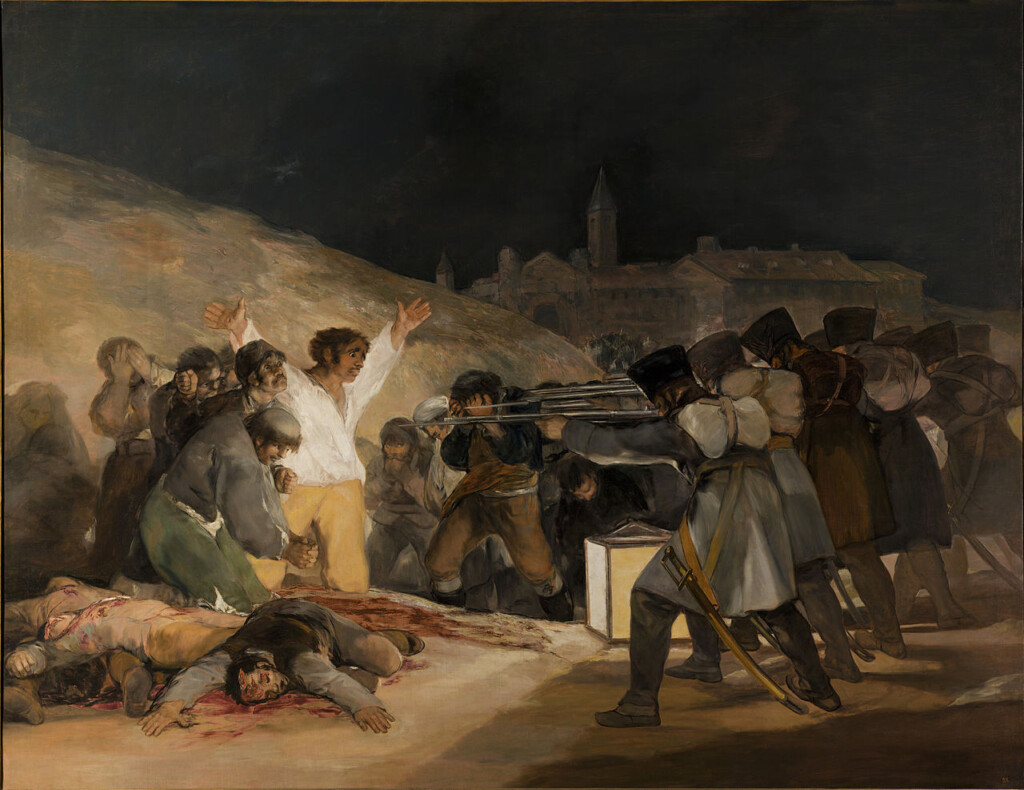
There is a moment when a man raises a lantern over a body on the ground and realizes, with a horror that has no name in any military manual, that the face looking back at him could be his own. The enemy, stripped of uniform, stripped of the cause that was supposed to make him killable, is simply a person who was also afraid, also hungry, also carrying something in his chest that resembled a future. The lantern trembles. The man holding it does not lower it. He stands there, suspended between the world he was trained to inhabit and the one that has just cracked open beneath him.
This is precisely where Goya lived between 1808 and 1820. Not in the triumph of armies or the rhetoric of liberation, but in that trembling interval between the raising of the lantern and the impossibility of what it illuminates. When Napoleon’s forces entered Spain in 1808, the official machinery of representation was already prepared: history would be written in cavalry charges and strategic maps, in allegories of heroism and the clean grammar of sacrifice. Goya produced 82 etchings instead. He called the series, privately, the fatal consequences of the bloody war against Bonaparte, and he showed nobody. They were not published until 1863, thirty-five years after his death, long after the men who had ordered the violence were safely historical figures, long after the survivors had been taught to remember differently.
Hannah Arendt, in On Violence, published in 1970, makes a distinction that most people find counterintuitive until they have seen what she is pointing at: violence and power are not the same thing, and in fact they are almost opposites. Power, for Arendt, is what emerges when people act together, when collective will generates something that holds. Violence is what appears when power collapses, when the structures that organized human action disintegrate and what remains is the naked instrument, the gun, the blade, the body used as a tool of another body’s fear. Violence is not the extension of power. It is the sign of its absence. It is what fills the vacuum.
Goya illustrated this with the precision of someone who had witnessed the thing itself. In plate after plate, there is no power visible. There are no causes, no flags, no ideologies that survive contact with the specific weight of a human body rendered helpless. There is only the machinery of collapse: men hanged from trees in postures that resemble the grotesque parody of a crucifixion, women assaulted by soldiers who do not look triumphant but mechanical, corpses arranged by unknown hands in configurations that seem almost bureaucratic in their indifference. One plate carries the caption: I saw this. Another: This too. The documentary flatness of those words is more devastating than any artistic commentary could be. He is not interpreting. He is testifying. He is insisting that someone, eventually, look directly at what was done.
What the official paintings of the Peninsular War produced — and they were numerous, they were commissioned, they were hung in places where power confirmed itself to itself — was a narrative in which violence served something larger, in which the body that fell was redeemed by the cause it fell for. Goya’s etchings produce the opposite. They insist on the irreducibility of the fallen body, on the fact that it was a person first and a symbol never. The enemy is not a symbol. The soldier is not a symbol. They are specific, terrified, mortal, and the war has done something to them that no allegory can metabolize.
He etched these images in private, knowing they could not be shown. The act of making them was itself a form of refusal, a counter-archive assembled in the full knowledge that archives can be suppressed, that history is edited by the living before it reaches the dead.
Saturn, or The Logic of Devouring
There is a moment, somewhere in the middle of life, when you realize that the thing which shaped you is also the thing that nearly destroyed you. Not an enemy. Not a stranger. The very structure that held you — family, nation, church, party, profession — the one you served and defended and sometimes loved, reveals itself to have been feeding on you all along. You were not its child. You were its meal.
Goya understood this with a clarity that borders on the unbearable. When he retreated to the Quinta del Sordo — the House of the Deaf Man, named after a previous owner but somehow fitting for a man who had lost his hearing to illness in 1792 — he was already in his mid-seventies, exhausted by history, by war, by the grotesque theatre of Spanish power. He painted directly onto the plaster walls of his own home fourteen murals that no one commissioned, no patron requested, no institution would ever sanction. They were made for no audience, perhaps not even for himself. They were made because they could not remain unpainted.
At the center of this private apocalypse hangs a figure so brutal in its simplicity that it requires no interpretation, only recognition. A colossal body, eyes white and blown open with a madness that is not chaos but method, grips a smaller human form and bites into it with the focused efficiency of something that has always known exactly what it was doing. The giant does not look wild. He looks determined. That is what makes it impossible to look away.
Erich Fromm, writing in The Anatomy of Human Destructiveness in 1973, drew a distinction that most people resist because it is too precise to be comfortable: the difference between biophilia, the orientation toward life and growth, and necrophilia in its broader psychological sense — the orientation toward control, rigidity, and ultimately the destruction of what lives. He argued that necrophilic character structures are not individual pathologies but social products, cultivated by institutions that prize obedience over vitality, submission over creativity. The devouring god is not a myth about the past. It is a structural description of the present.
Every institution that accumulates sufficient power eventually turns on the generation it produced. This is not cynicism — it is mechanism. The revolutionary party devours its revolutionaries. The church that sheltered the poor begins taxing them. The nation that was born from a declaration of freedom builds prisons faster than schools. The corporation that disrupted the market becomes the monopoly that crushes the next disruptor. Goya had watched it happen with the Bourbon monarchy, with the Inquisition, with Napoleon’s promise of enlightened liberation that arrived in Spain as occupation and massacre. He had painted the official portraits of the very faces that would later authorize the horrors he documented in the Disasters of War. He knew the mechanism intimately, from inside.
What makes the image on that wall so philosophically precise is not the violence but the expression. There is no pleasure in it, no cruelty for cruelty’s sake. There is only necessity — or rather, the face of a system that has convinced itself its devouring is necessary. Power does not eat its children out of malice. It eats them because growth, change, and the new generation represent the one thing power cannot tolerate: the possibility of its own obsolescence.
The walls of the Quinta del Sordo were never meant to last. The house was sold after Goya’s death in 1828, the murals transferred to canvas decades later, eventually finding their way to the Prado. But something in their survival feels almost accidental, as if the paintings themselves resisted being consumed by the same logic they depicted, slipping through history by the narrowest of margins, the way certain truths do.
A vision curated by a filmmaker, not an algorithm
In this video I explain our vision
The Exile Who Took His Darkness With Him
He left at seventy-eight. Not fleeing in panic, not driven out in chains, but walking out with the deliberate weight of a man who has finally stopped pretending that the place he inhabits is worth the pretense. The court of Ferdinand VII had reasserted itself with the grinding certainty of restored tyranny, and Goya, who had painted kings and queens and ministers and generals for nearly half a century, who had made his career inside the machinery of power and learned to survive its every convulsion, simply decided he was done. Bordeaux received him in 1824 as it receives all exiles — with the mild indifference of a city that has seen too much history to be moved by any single person’s arrival.
The paradox is worth sitting with. Here was a man who had spent decades perfecting the art of proximity to power, who understood the grammar of court portraiture well enough to use it as a weapon against the very subjects he painted, and who now, in the final decade of his life, chose distance. Not because he had been expelled, but because he had seen clearly. This is the distinction that Edward Said draws with surgical precision in his Reflections on Exile — that the true exile is not defined by the loss of a homeland but by a transformation in vision, a sudden inability to accept the familiar as natural. The exile sees the seams in the wallpaper, the violence beneath the ceremony. What once passed as normal becomes intolerable not because it has changed but because you have.
Goya had been changing for a long time. The Black Paintings were already sealed inside the walls of the Quinta del Sordo when he crossed the border, that entire universe of dread he had created for no patron and no public, painted for himself alone in a house he seems to have understood as a kind of anteroom to the world’s end. Albert Camus, writing in his notebooks during the 1940s, observed that the moment a man chooses exile he is admitting something most people spend their lives refusing to admit — that belonging was always, at some level, a performance. The comfort of place is borrowed. The self that fits seamlessly into a context is a self that has been carefully reduced to fit. Goya had painted himself into the margins of his own country for years before he finally made the geography match the feeling.
And then, in Bordeaux, something unexpected happens. Something that almost no narrative of Goya’s darkness has the patience to accommodate. He paints the Bordeaux Milkmaid in 1827, two years before his death, and the painting is not what you would expect from a man carrying the residue of everything he had witnessed and imagined and recorded across eight decades. It is tender. The young woman, carrying her heavy jug through the pale morning light, is painted with a softness that feels almost confessional, as though exile had loosened something in him that the court had kept tightened for fifty years. The brushwork is loose, luminous, surprisingly modern — there are critics who see in it an anticipation of Impressionism, though that word arrives from a future he could not have known. What matters is not the category but the quality of attention. He is looking at an ordinary woman doing an ordinary thing, and he is treating it as though it were sacred.
This is not the consolation of old age. Consolation would be too easy, too symmetrical. What the Milkmaid suggests is something stranger — that the man who spent decades inside the architecture of power discovered, only after leaving it, that tenderness was not weakness but the most honest response available to someone who had seen what he had seen.
The Technique That Refused to Comfort
There is a face you have seen somewhere — not in a museum, not in a book — a face caught in bad light, half-turned away, the skin showing every fatigue the person thought they had hidden. No one posed for that moment. No one arranged the shadows. The ugliness of it was so precise that it became something else entirely, something closer to a confession than a portrait. You looked away first.
Goya never looked away. And that refusal, which can seem like cruelty when you first stand before his late work, is in fact the most rigorous ethical position an artist can occupy. To smooth the face is to lie about the person. To idealize the body is to lie about what bodies endure. His contemporaries understood this at some level, which is exactly why they continued to smooth and idealize with such disciplined fervor. Jacques-Louis David was producing his immaculate allegories of republican virtue in those same decades — figures with the musculature of gods, draped in the clean geometry of moral certainty, every brushstroke a small act of political theology. The neoclassical project was not simply an aesthetic preference. It was an argument about what reality deserved to look like, which is always an argument about what reality is permitted to reveal.
Goya made the opposite argument with his hands. The brushwork in his later paintings is broken, almost violent in its incompleteness — pigment dragged and smeared, forms that refuse to resolve into the clean contours that academic tradition demanded. A figure emerges from darkness not because the painter has illuminated it but because the darkness has partially released it, and what comes forward is never the whole. You get a shoulder, a mouth, the suggestion of an eye. T.J. Clark, in his sustained meditation on the materiality of paint and what it can witness, argues that how pigment is applied is never neutral — that the physical substance of paint, the thickness of it, the gesture that laid it down, carries within itself a moral weight that no subject matter can override or redeem. Clark was writing about a very different painter and a very different century, but the principle lands on Goya with the force of retrospective recognition. The impasto that builds up on a Goya canvas is not decoration and not style. It is the record of a refusal. Each unresolved edge says: I will not pretend this resolves.
The anatomies he paints are wrong by academic standards — wrong in the way that real bodies under stress are wrong, compressed and distorted by fear or exhaustion or the specific indignity of being dragged somewhere against your will. When you look at the figures in his war scenes, you do not see the noble suffering that history painting had always promised. You see the particular awkwardness of a body that has not had time to arrange itself into meaning. The limbs fall where physics puts them, not where symbolism requires them. This is an almost unbearable honesty, and it produces in the viewer something that comfort-seeking art never produces: the sensation of being implicated. You are not watching history. You are standing in it, and the paint is the evidence.
What Goya understood — and what his neoclassical contemporaries were magnificently equipped not to understand — is that technique is never innocent. Every choice about how to render a surface is a choice about what that surface is allowed to mean. To give a dying body the graceful arc of a classical figure is to perform a kind of retrospective mercy that the dying person never received. Goya withheld that mercy. Not from callousness, but from something that looks, the longer you look at it, remarkably like respect — the terrible respect of someone who refuses to make your suffering prettier than it was.
What He Left on the Walls When He Moved Out
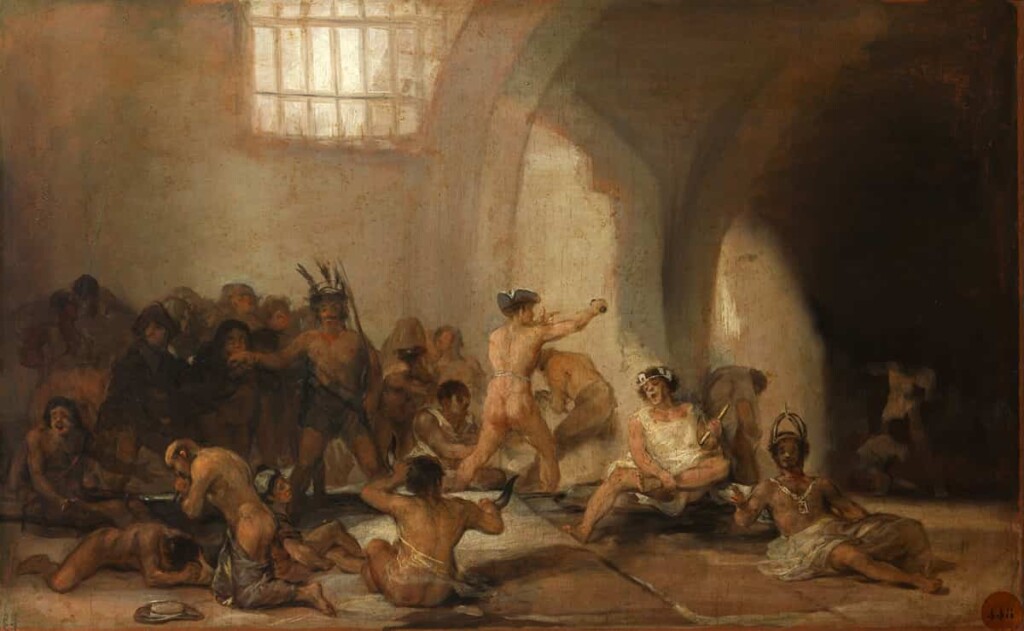
He painted them on the walls of his own house. Not on canvas, not on commission, not for any gallery or palace or patron waiting with payment in hand. He mixed pigment into plaster and covered the rooms where he ate and slept with figures that seem to arrive from somewhere beyond intention — a man being eaten alive by a giant, two men beating each other with clubs while sinking slowly into mud, a dog’s head barely cresting a horizon that offers nothing on the other side. He did not sign them. He did not title them. When he eventually left the house, moving to Bordeaux in 1824 at the age of seventy-eight, he simply left them there. On the walls. In the rooms. As if the house itself were now their problem.
Walter Benjamin argued in 1935 that mechanical reproduction destroys the aura of a work of art — that singular, unrepeatable presence born from its embeddedness in a specific place and moment. But these paintings invert that logic entirely. They were not made to have an aura. They were not made to travel, to be reproduced, to circulate through the channels by which art becomes culture and culture becomes consensus. They were made on plaster walls in a house outside Madrid that Goya called the Quinta del Sordo — the House of the Deaf Man, a name that arrived before him and somehow fit too well. Benjamin’s framework assumes a work desires its own survival, that it reaches toward posterity with something like ambition. These works reached toward nothing. And yet they survived anyway, transferred to canvas in 1873 by the German banker Frédéric Émile d’Erlanger, then donated to the Prado in 1881, where they now hang in a room that is always slightly too quiet for what they contain.
The question of why he made them cannot be answered honestly. The tempting answer — that he painted for himself alone, that these are the truest expressions of an unfiltered interior — is seductive precisely because it flatters a romantic idea of artistic authenticity, the notion that only the work made without witness is genuinely free. But Goya had spent fifty years in professional life, navigating courts and commissions and the social mathematics of reputation, and no one emerges from that without understanding that the self is always partly constructed for an audience, even in private. The psychologist D.W. Winnicott wrote about the capacity to be alone in the presence of another — the developmental achievement of playing freely while someone watches, neither performing nor pretending to be unobserved. Perhaps Goya had arrived at something stranger than that: the capacity to make something in the presence of no one, not even himself as future witness, not even history as implied spectator.
Or perhaps he was not painting for anything at all. Perhaps the distinction between painting for oneself and painting against something — against the century’s cruelties, against the silence that deafness imposed, against the specific darkness of a Spain that had ground the bodies and minds of his generation into rubble — perhaps that distinction simply does not hold at the threshold where making becomes compulsion. Georges Bataille wrote about art as expenditure without return, creation as a form of sacred waste, and there is something in these wall-paintings that belongs to that register: energy poured into a surface that was never meant to preserve it, meaning distributed into forms that resist interpretation as if interpretation were itself a kind of violence. The dog looks out from its shrinking ground. The giant consumes. The two men sink together, still fighting.
He walked out of that house and took none of it with him, which is either the most desolate thing an artist ever did, or the most honest.
🎨 Art, Vision, and the Spanish Soul
Goya stands at a crossroads between Enlightenment reason and the dark depths of human imagination, making his life and works inseparable from the broader cultural currents of Spain and beyond. These related articles illuminate the artistic, literary, and spiritual worlds that shaped and echoed his singular vision.
Frida Kahlo: Life and Works
Like Goya, Frida Kahlo transformed personal suffering and cultural identity into a radical visual language that continues to resonate across generations. Her work bridges the intimate and the mythological, making her one of the most compelling figures in the history of art. Exploring her life deepens our understanding of how biography and brushstroke become inseparable.
GO TO THE SELECTION: Frida Kahlo: Life and Works
The Spanish Golden Age: Literature and Culture
Goya lived through the turbulent twilight of Spain’s Golden Age and the upheavals that followed, making the cultural legacy of that era essential context for his art. The Spanish Golden Age forged an aesthetic and philosophical atmosphere dense with mysticism, humanism, and a fascination with darkness and beauty. Understanding this period reveals the deep roots from which Goya’s imagination grew.
GO TO THE SELECTION: The Spanish Golden Age: Literature and Culture
Francisco de Quevedo: Life and Works
Francisco de Quevedo, like Goya, possessed a razor-sharp vision of human folly, corruption, and mortality that he expressed with savage wit and unflinching honesty. His literary world is populated by grotesque figures and moral contradictions that find striking visual parallels in Goya’s Black Paintings and satirical etchings. Reading Quevedo alongside Goya reveals a shared Spanish tradition of unsparing cultural critique.
GO TO THE SELECTION: Francisco de Quevedo: Life and Works
Miguel de Cervantes: Life and Works
Miguel de Cervantes and Goya belong to a continuous thread of Spanish genius that confronts illusion, madness, and the ambiguity of reality with extraordinary depth. Just as Don Quixote blurs the boundaries between dream and waking, Goya’s late works dissolve the line between nightmare and allegory. Exploring Cervantes enriches the literary and philosophical backdrop against which Goya’s darker visions can be fully understood.
GO TO THE SELECTION: Miguel de Cervantes: Life and Works
Discover More on Indiecinema
If these explorations of art, history, and the human condition have stirred your curiosity, Indiecinema is the streaming destination where independent cinema brings these themes to vivid life. Discover films that dare to look deeply at artists, culture, and the shadows of the world — stream them now on Indiecinema.
👉 EXPLORE THE CATALOG: Watch Indie Films in Streaming
A vision curated by a filmmaker, not an algorithm
In this video I explain our vision

