
The Body as the Only Canvas That Cannot Lie
You wake before thought arrives. Before language, before memory, before the organized story of who you are assembles itself into something bearable — there is only the body, and what the body is saying. For most people, that message is neutral, almost boring: a heaviness in the limbs, the slow engine of breath, the ambient warmth of sheets. You roll over and the machinery of selfhood starts up again. You forget the body almost immediately, because it has nothing urgent to report.

Now imagine that it does. Imagine that the first language of every morning is pain, and that this language is more precise, more honest, more philosophically rigorous than anything you will think or say for the rest of the day. Imagine that the body does not retreat into the background but insists, constantly, on remaining the foreground — that it will not let you dissolve into abstraction or ideology or social performance, because it is always there, pulling you back to the irreducible fact of itself.
This is not a metaphor. This is a material condition. And out of that condition, one of the twentieth century’s most uncompromising bodies of visual work was produced — not despite the suffering, not as a therapeutic exercise in converting agony into something prettier, but because the suffering revealed something that health conceals. Frida Kahlo did not paint because she was broken. She painted because being broken had stripped away every comfortable lie about where knowledge actually comes from.
The philosophical tradition has a long and complicated relationship with the body’s claim to truth. René Descartes, writing in 1641 in his Meditations on First Philosophy, performed his famous amputation: he severed the thinking self from the deceiving flesh, elevated the mind to the position of sole reliable witness, and demoted the body to the status of a mechanism that could not be trusted. For nearly four centuries, Western epistemology largely ratified that hierarchy. The senses lie. The passions distort. The intellect alone ascends toward certainty. What Kahlo’s work does — viscerally, without footnotes, without a single appeal to academic authority — is reverse that verdict entirely. Her canvases insist that the body does not lie. Everything else might, but this does not.
Phenomenologist Maurice Merleau-Ponty would spend years constructing the philosophical architecture for exactly this intuition. His 1945 Phenomenology of Perception argued that the body is not an obstacle to knowledge but its very medium — that we do not have bodies the way we have objects, but that we are our bodies, that perception is always already corporeal, that the lived experience of physical existence is the foundation upon which all other understanding is built. Kahlo arrived at the same conclusion not through systematic philosophical inquiry but through a bus accident in September 1925, a spinal column fractured in three places, a pelvis shattered, a steel handrail that entered her hip and exited through her uterus, and thirty-five surgical operations distributed across the remaining twenty-nine years of her life.
What emerges from that biography is not tragedy aestheticized. It is epistemology embodied. When you look at her self-portraits — and she returned to the mirror obsessively, producing fifty-five self-portraits out of a total of one hundred and forty-three known works — you are not looking at confession. You are not watching someone exorcise private demons for public sympathy. You are watching someone use the only instrument she trusted absolutely to investigate questions that civilization had agreed, collectively, not to look at too directly: What is real? Whose pain counts? Who gets to define the boundary between self and world, between interior experience and verifiable truth?
She painted from a custom easel built above her bed, a mirror fixed to the canopy above her, her own face the first data point every time. Not vanity. Method.
Don Barry: A Quixotic Exploration

Docufiction, Experimental, by Paul Smart, Mexico, 2026.
Don Barry: A Quixotic Exploration is a debut feature that places the biography of an eighty-year-old experimental filmmaker and artist, Barry Gerson, within the metanarrative of Miguel de Cervantes’ Don Quixote. Don Barry was filmed in the city of Guanajuato during the 51st edition of the Cervantino Festival, as well as during the vibrant Day of the Dead celebrations held in the city’s UNESCO-listed tunnels. The film honors the director’s long friendship with artist Barry Gerson, drawing inspiration from Cervantes’ Don Quixote. Paul Smart’s directorial choices create something new that celebrates life and goes beyond conventional storytelling. A search for magic in our real lives. A moving film about the meaning of life, art, and death. Not to be missed.
Paul Smart is a proud outsider filmmaker with a long history of film screenings. In the 1980s, he emerged in New York’s vibrant youth art scene, working in theater production and later filmmaking, before retreating to rural upstate New York, in the Catskill Mountains, where he made a living writing and screening independent films in old parish halls for rural audiences, many of whom had never seen a film.
LANGUAGE: English
SUBTITLES: Spanish, French, German, Portuguese
The Bus, the Trolley, and the Architecture of Catastrophe
On September 17, 1925, Frida Kahlo boarded a wooden bus in Coyoacán. She was eighteen years old. That is the biographical fact. What happened next resists the language of biography entirely, because biography assumes a continuous self that endures through events, a thread pulled taut from birth to death. What the collision between that bus and the Mexico City trolley car produced was not an interruption of a life but the demolition of one self and the violent manufacture of another.
The bus splintered on impact. A steel handrail tore through her pelvis and exited from the other side. Her spinal column fractured in three places. Her collarbone broke. Her right leg shattered in eleven places. Her foot was crushed. Fellow passengers described the moment as one of those ruptures in ordinary time when the world reveals its indifference with sudden, almost formal precision. A packet of gold powder someone had been carrying burst open in the collision, coating Kahlo’s broken and bleeding body in metallic light. Even the witnesses understood, without being able to articulate it, that they were looking at something that had passed beyond accident into the territory of symbol.
Simone Weil, writing in the early 1940s in what would become her posthumously assembled work on affliction, drew a distinction that most people who have not experienced catastrophic suffering will resist instinctively. She did not describe suffering as a refiner’s fire, the ennobling trial that produces wisdom and character. She described malheur — affliction, in its deepest form — as a mechanism that uproots life and destroys the soul’s capacity to maintain its previous coherence. Affliction does not test you. It disassembles you. What emerges, if anything emerges, is not the same person made stronger but a different person entirely, assembled from materials the original self would not have chosen. Weil was writing from her own experience of chronic illness and voluntary deprivation, but her phenomenology of suffering maps onto Kahlo’s body with an accuracy that feels almost violent. The accident did not make Kahlo the artist she became. It unmade the girl she was and left behind someone who had no choice but to begin building from the wreckage.
She spent thirty-two days in the hospital immobilized in a plaster cast. That was only the beginning. Over the following decades she underwent more than thirty surgical operations, endured steel corsets that she was sometimes required to wear for months at a time, experienced spinal fusions that failed, amputations that altered her sense of her own physical boundaries. The medical record reads like an involuntary autobiography, each procedure leaving its mark on a body that had become simultaneously her subject and her medium. When she began to paint from her bed, it was not a therapeutic exercise or an act of sublimation. It was closer to what happens when someone takes inventory after a flood — not to mourn what is gone but because inventory is the only legible act remaining.
There is a particular quality of attention that emerges when the body becomes unreliable, when its continuity can no longer be assumed. You stop living inside chronological time and begin living inside something more cyclical, more mythological, more governed by recurrence than by progress. This is not wisdom. It is adaptation of an extreme kind. What Kahlo began to understand, and what she eventually began to paint with systematic ferocity, is that the self which presents itself to the world as unified and coherent is always a construction — and that catastrophe simply makes the construction visible by destroying it. Most people spend their entire lives maintaining the fiction. She was eighteen years old when the fiction was taken from her, embedded in fractured bone, and scattered across the floor of a Mexican street.
The trolley did not interrupt her life. It ended one and forced another into existence, without asking permission.

Diego Rivera and the Mythology of the Devouring Love
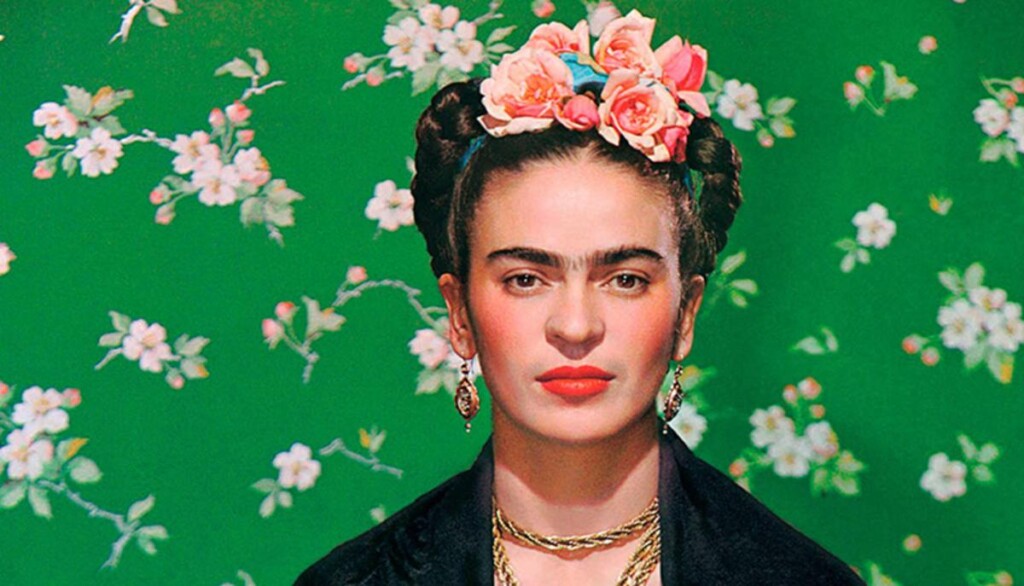
There is a moment when you stop asking yourself whether you are loved and start asking yourself whether you exist without the person who claims to love you. It is not a dramatic moment. It is quiet, almost administrative. You simply notice that your own outline has become dependent on his gaze to stay visible.
Frida and Diego married in 1929, divorced in 1939, remarried in 1940. The dates are so clean they almost look like a diagram. But what lived inside those coordinates was not a love story in any conventional sense — it was something closer to what Roland Barthes described in A Lover’s Discourse, published in 1977, as a system of signs that the subject mistakes for the structure of reality itself. The lover does not love a person. The lover loves a language, a set of signals and responses that have become indistinguishable from the self. Remove the beloved and you do not lose comfort or companionship. You lose the syntax through which you understand your own existence.
Diego Rivera was twenty-one years older than Frida, enormous in every dimension — physically, politically, already legendary as a muralist before she was old enough to have painted anything. He called her his little deer, his little girl. She called him her child, her everything, her nothing. The nicknames they gave each other were not tender accidents. They were structural: they described the architecture of a relationship in which each person occupied the role the other needed them to play, regardless of the damage those roles required.
He slept with her sister Cristina. She slept with Trotsky, with women, with men, with anyone who could briefly return to her the sensation of being chosen. And yet the infidelities were never symmetrical in their consequences. His were the infidelities of a powerful man navigating a world built to accommodate him. Hers were acts of retrieval — attempts to locate herself outside his gravitational field, to verify that she had weight independently of him. She painted herself over and over again precisely because the mirror was the one witness she could control. The self-portrait is not narcissism. It is survival documentation.
There is a scene that stays with you: a woman stands at a bus stop in the rain, watching the windows of the apartment she has just left. She is not waiting for him to come after her. She is waiting to find out whether she will still be able to breathe once the light in that window goes out. She goes back. Not because she is weak. Because the alternative — existing in a world where no one has memorized the exact frequency of your pain — feels more terrifying than staying inside the damage. Simone de Beauvoir wrote in The Second Sex in 1949 that women learn to define themselves through the male gaze not by nature but by a long process of social habituation so thorough it becomes indistinguishable from desire. Frida did not escape that process simply because she was a communist, a radical, a woman who wore her indigenous heritage as political armor. The conditioning goes deeper than ideology. It reaches the place where you feel yourself to be real.
What made the Rivera-Kahlo relationship so seductive as mythology was precisely its revolutionary costume. Two artists, two comrades, two people who had placed themselves outside bourgeois convention. But the revolutionary aesthetic did not dissolve the power asymmetry. It decorated it. It gave codependence the visual grammar of freedom, which is perhaps the most elegant trap a culture can construct: making the cage look like a choice you would make again.
She wrote in her diary, near the end, that she had suffered two grave accidents in her life — the bus collision that shattered her body at eighteen, and Diego. And then she added that Diego was by far the worst.
Self-Portrait as Political Act
You are standing in front of a mirror and you catch yourself adjusting. Not your hair, not your collar — something subtler, something in the expression itself. A slight softening around the eyes, a relaxing of the jaw, as though the act of being seen requires a kind of apology for being there at all. It happens before you can stop it. It happens because you have been trained for it.
Frida Kahlo never did that. In fifty-five self-portraits out of roughly one hundred and forty total works, she looked back at whoever was looking — and she did not soften a single thing. The unibrow stayed. The faint mustache stayed. The wounds stayed. And what is strangest, what produces a discomfort that takes a moment to name, is that she does not appear to be performing suffering for your sympathy. She is simply there, watching you watch her, and the asymmetry of power that you expected — the one in which you are the viewer and she is the viewed — collapses entirely.
John Berger, in Ways of Seeing published in 1972, identified the structural grammar of Western painting with a precision that still cuts: men act, women appear. The surveyor of woman is male, the surveyed is female. A woman’s relationship to her own image, Berger argued, is inevitably contaminated by this — she turns herself into an object of vision and simultaneously watches herself being seen, splitting her consciousness in two. The self-portrait, in this tradition, is almost always a form of compliance. Even when a woman holds the brush, she tends to paint what the gaze expects to receive.
Kahlo dismantled this with something that looks, on the surface, like simple stubbornness. There is a woman — this is a real memory, or it could be yours — sitting before a camera in a documentary interview, and the interviewer asks her something slightly diminishing, something that expects her to recede, and instead she holds the lens with her eyes and lets the silence expand until the discomfort migrates entirely to the person watching. You feel it in your own chest even seeing it secondhand. That is what the Kahlo self-portrait does. It transfers the discomfort of being watched back to the watcher.
The philosophical weight of this transfer is not small. Laura Mulvey, whose 1975 essay Visual Pleasure and Narrative Cinema extended Berger’s framework into the moving image, described the male gaze as a mechanism of control — to look is to possess, to be looked at is to be rendered passive. What Kahlo enacted was not merely a refusal of passivity but something more destabilizing: she made the act of looking suddenly legible as an act. You look at her and you become aware, perhaps for the first time consciously, that you were looking. That awareness is a kind of trap springing shut.
She painted herself in a broken column for a spine, in a medical corset, with nails embedded in her body, after a miscarriage, after surgeries, after Diego Rivera‘s betrayals. But the gaze in these paintings never asks for pity. It asks — and this is the word that keeps arriving — for witness. Not the soft witness of consolation but the harder kind, the kind that requires you to remain present with what you are seeing without flinching away into sentiment. Simone de Beauvoir wrote in The Second Sex in 1949 that woman has been defined and differentiated with reference to man, not he with reference to her. The self-portrait, in Kahlo’s hands, becomes the refusal of that differential — not a mirror showing the viewer what they want, but an eye that refuses to look away first.
And you are still standing in front of that mirror, catching yourself adjust.
The Tehuana Dress and the Invention of the Self as Resistance

You put on the dress before you leave the house. Not because it is comfortable, not because the occasion demands it, but because it says something before you open your mouth. It draws a boundary. It announces a refusal. Frida Kahlo understood this with a precision that most people only reach after decades of living — that what you wear is never merely what you wear.
The long skirts of the Tehuantepec women, the huipil blouses, the headdresses woven with flowers and ribbon — Kahlo adopted this aesthetic in her twenties and never relinquished it. It would be convenient, and entirely wrong, to call this a romantic attachment to indigenous heritage, a nostalgic gesture toward a Mexico that modernization was already dismantling. What she was doing was closer to what Stuart Hall described in his 1990 essay “Cultural Identity and Diaspora” as the politics of representation — the understanding that identity is not something you discover passively but something you actively construct, and that this construction is always political, always happening against something. Hall argued that marginalized subjects don’t simply recover a lost authentic self; they produce a self strategically, from the materials history has left them. Kahlo was producing herself with extraordinary deliberateness.
The 1930s in Mexico were a decade of violent cultural negotiation. The indigenismo movement — championed by intellectuals like Manuel Gamio, whose 1916 work “Forjando Patria” had argued for the integration of indigenous culture into a unified Mexican national identity — was simultaneously a celebration of pre-Columbian heritage and a means of absorbing it into a modernizing state project. The government wanted indigenous aesthetics as symbol, not as substance. Diego Rivera‘s murals filled public buildings with Aztec imagery while the living descendants of those civilizations remained among the most economically excluded people in the country. Kahlo moved through this contradiction with full awareness. She did not wear the Tehuana dress to endorse a state program. She wore it because the Tehuana woman, in that specific cultural imagination, represented a matriarchal power, an unassimilated femininity, a body that had not submitted to European standards of beauty or comportment.
Think of a woman walking into a room where everyone expects her to diminish herself — to speak quietly, to take up less space, to defer. Instead she enters in colors that demand to be seen, in fabric that carries an entire geography of resistance in its embroidery. The room does not know how to process this. That is precisely the point. Kahlo’s self-portraits, and there are fifty-five of them across her life, are inseparable from this logic. She painted herself in full Tehuana regalia not as documentation but as declaration. The clothing in those canvases is not background — it is argument.
There is something in this that goes beyond personal style and touches what Frantz Fanon analyzed in “Black Skin, White Masks” in 1952 — the colonial condition that teaches the colonized to internalize the aesthetic values of the colonizer, to see themselves through borrowed eyes, to experience their own appearance as deficiency. Kahlo refused this internalization with every canvas. She painted her unibrow, her faint mustache, her indigenous features, her mixed and unresolved body, and she surrounded all of it with flowers and silk and gold. She made herself monumental in a world that had built its entire visual culture around making her kind of body invisible.
And yet the dress was also armor over a body that was genuinely suffering. The long skirts concealed a leg damaged by polio and shattered further by the 1925 bus accident that broke her spine in three places, her collarbone, her right leg in eleven places. The concealment and the declaration occupied the same fabric simultaneously. She was covering what hurt and announcing what she refused to surrender. These two gestures were never in contradiction.
A vision curated by a filmmaker, not an algorithm
In this video I explain our vision
Surrealism’s Mistake: When a Label Becomes a Cage
There is a particular kind of violence in being named by someone who does not understand what they are seeing. André Breton arrived in Mexico in 1938 and looked at Kahlo’s canvases — the split bodies, the hearts torn open and displayed like anatomical specimens, the ribbons of blood pooling on tiled floors — and saw what he needed to see: automatic imagery, the unconscious set free, desire erupting past the censorship of reason. He called her a natural Surrealist, as though she had stumbled accidentally into a movement that Parisian intellectuals had constructed with considerable theoretical labor. The compliment was also a capture.
Kahlo knew exactly what was being done to her. Her response was not diplomatic. She had never painted dreams, she said. She had painted her own reality. This distinction, which critics have repeated so often it risks becoming decorative, is actually a precise philosophical claim about the origin and nature of images, about where symbols come from and what work they do in the world.
Breton’s Surrealism was fundamentally a theory of escape. The unconscious, in the Freudian framework he borrowed and aestheticized, was the reservoir of what civilization had suppressed — desires, fears, erotic energies that the waking mind refused to acknowledge. The dreamwork processed them into disguised forms, and the artist’s task was to lower the guard of consciousness and let those forms surface. The resulting image was valuable precisely because it was foreign to lived experience, alien to the body standing in daylight. It came from elsewhere. This elsewhere was its power.
Kahlo’s images came from nowhere else but here. Maurice Merleau-Ponty, writing in the 1940s in his Phenomenology of Perception, argued that the body is not a vessel that carries consciousness around but the very medium through which the world becomes intelligible. We do not have bodies; we are bodies. Sensation, memory, spatial orientation, the sense of being a self at all — these are not mental operations performed on bodily data but constitutively bodily events. Pain, on this account, is not a signal that something has gone wrong with the machine. It is a reorganization of the entire perceptual world around a new center. The body in chronic pain does not experience pain as one experience among others. It becomes pain’s architecture.
Kahlo’s spine was fractured in three places. Her pelvis, crushed in the 1925 bus accident, was reconstructed and shattered again across thirty-five surgical interventions over the following decades. The corset she wore, which appears in her paintings as both prison and second skin, was not a metaphor she chose. It was a fact of her morphology, a condition of her upright existence. When she painted a deer pierced by nine arrows, the arrows are not symbols requiring interpretation. They are the precise phenomenological description of a nervous system that had catalogued damage for twenty years. When she painted her spine as a crumbling classical column, she was not constructing an image. She was reporting a sensation.
This is the difference that Breton could not see because his entire framework was built on the premise that the significant image must be distanced from the body, must arrive from the unconscious as from a foreign country. Kahlo’s imagery required no such journey. It had not traveled anywhere. It was already present in every waking hour, already visible to anyone willing to inhabit a body as thoroughly as hers had been inhabited, as thoroughly as pain forces you to inhabit anything it decides to occupy.
To call this Surrealism is to mistake the wound for the dream about the wound. The cage that Breton built with his admiration was elegant and well-intentioned and completely wrong. What she painted was not the unconscious liberated from reality. It was reality so intensely itself that it had no need of liberation.
Communism, Trotsky, and the Seduction of Belonging
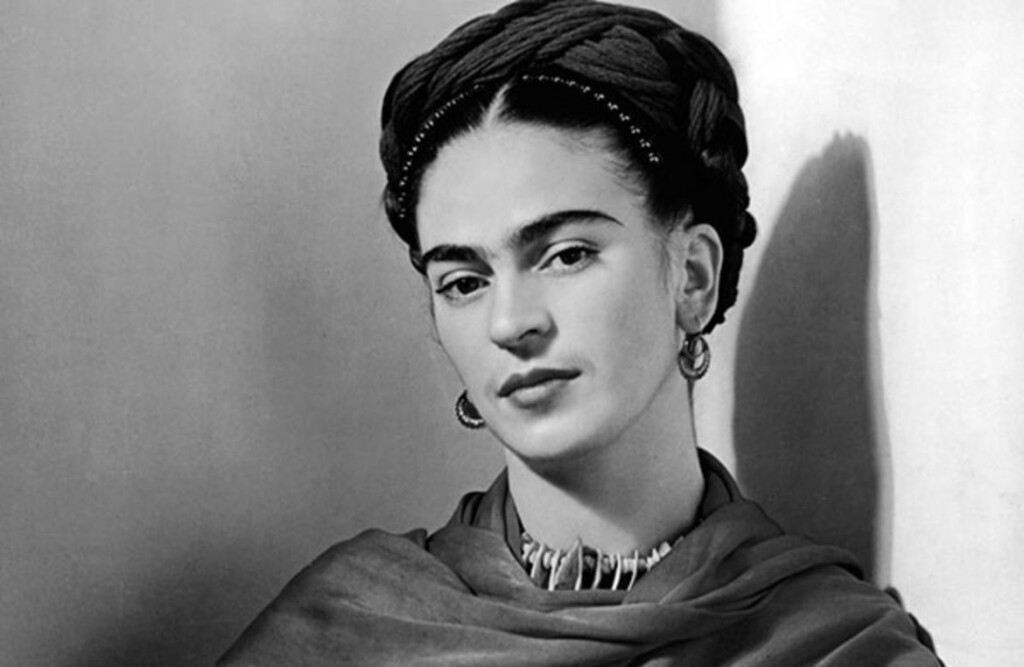
She joined the Mexican Communist Party for the first time in 1927, left it, rejoined it, was expelled from it, and spent the last years of her life fighting to be readmitted. That oscillation alone tells you something that no manifesto ever could. It tells you that the ideology was never quite the point.
There is a particular kind of person who gravitates toward collective movements with an intensity that seems, from the outside, almost desperate. Eric Hoffer described them in 1951 with a precision that still cuts: the true believer is not primarily motivated by doctrine but by the need to dissolve a self that has become unbearable to inhabit. The movement offers what solitude cannot — a borrowed coherence, a story larger than the one your body keeps telling you. Kahlo’s body had been telling her a story since 1925, and it was not a story with clean lines or redemptive arcs. It was a story of fracture, interruption, and pain that recycled itself without permission.
When Leon Trotsky arrived in Mexico in January 1937, granted asylum through Rivera’s diplomatic maneuvering, he was already a man erased from the official Soviet narrative — excised from photographs, renamed as traitor, rendered historically nonexistent by Stalinist decree. Kahlo welcomed him into the house in Coyoacán, the Blue House, and the affair that followed lasted several months before dissolving into an awkward epistolary cooling. What is rarely examined is the symmetry between them: two people whose identities had been violently reorganized by forces outside their choosing, both clinging to an idea of revolution that the revolution itself had already started to betray.
Hannah Arendt, writing in “The Origins of Totalitarianism” in 1951 — the same year as Hoffer, a coincidence that feels almost too neat — argued that political belonging answers a need that precedes ideology: the need to appear before others as a somebody, to exist inside a shared world that confirms your existence. For Arendt, the truly dangerous individual is not the fanatic but the superfluous person, the one who has been made to feel that their presence in the world is accidental, unnecessary, and temporary. Kahlo, whose physical crises had made her intimate with exactly that feeling of superfluity, found in Communism something Arendt might have recognized: not a set of beliefs but a grammar of significance.
The affair with Trotsky reads differently once you place it inside this frame. It was not simply a romantic transgression or a political flirtation. It was two people recognizing in each other the same structural wound — the wound of having been central and then peripheralized, of having built an identity on a foundation that kept shifting. There is something in the image of them together in that house, surrounded by Diego’s murals and the noise of Mexican political life, that resembles a scene from another kind of exile entirely: a man sitting in a room he does not own, writing letters to a movement that has already decided he is a ghost, and a woman painting herself in pieces, trying to reassemble a face the mirror keeps returning to her differently.
She dedicated a portrait to him when he left. He wrote her letters she apparently found grandiose. The whole episode has the texture of two people who needed the encounter more than they needed each other.
And then came the rupture. By 1940, she had distanced herself from him ideologically; by August of that year, he was dead, killed in the same house where she had welcomed him, a man already erased twice over. What Kahlo made of that — whether it confirmed her cynicism about revolutions or deepened her need to believe in them — is not entirely clear from the record.
But she fought to rejoin the Party until the very end.
What the Last Diary Knows
The diary does not begin as a farewell. It begins as an explosion.
Sometime around 1944, Kahlo started filling a small notebook with watercolor washes, ink drawings, automatic writing, and passages that blur the line between poetry and hallucination. By the time she died in July 1954, she had filled ninety-five pages with imagery so compressed, so violently interior, that reading it feels less like observing a record and more like standing inside someone’s nervous system while it fires.
Walter Benjamin wrote about the dialectical image as the moment when past and present collide so forcefully that meaning does not unfold — it detonates. He was describing historical perception, the way certain objects or fragments concentrate time until it becomes unbearable to look at directly. But the diary is exactly this. It is not a document of a life winding down. It is meaning pressed so hard against its own limits that the pages seem to vibrate.
The handwriting changes. Anyone who has spent time with reproductions of the journal will notice it without being told. Early entries have her characteristic boldness, letters that lean forward as if impatient. Later, the script becomes looser, sometimes barely legible, not because she was losing her mind but because the body was consuming itself and the hand was following. In 1953, her right leg was amputated below the knee. The pain she had carried since the 1925 bus accident — which shattered her spine, her collarbone, her pelvis, drove a steel handrail through her hip — had never truly lifted, but now it had taken something visible, something she could look down and see missing. And still the diary continued.
There is something almost unbearable about watching someone draw when their body is in open revolt. A man sits at a table, his hands shaking so badly that the marks he makes are nothing like what he intends, and yet he keeps making them, not because he believes in the result but because the act of making is the last boundary between himself and disappearance. A woman speaks into a recorder long after her voice has become unrecognizable, not to leave a message for anyone, but because silence would confirm what she is not yet willing to confirm. This is not heroism. It is something stranger and more desperate — the refusal to stop performing the self even as the self is being dismantled from the inside.
Kahlo’s final diary entry is dated weeks before her death. It does not read like a conclusion. It reads like someone in the middle of a thought who was interrupted. She wrote about joy, about hoping never to return, about a journey she seemed to be anticipating rather than dreading. Whether she was writing about death or something she had transformed death into, something personal and hers, is impossible to say cleanly. That ambiguity is not a flaw. It is the entire point.
Susan Sontag argued in Illness as Metaphor, published in 1978, that we damage sick people by imposing narrative onto their conditions — the battle, the journey, the lesson. Kahlo’s diary resists this almost constitutionally. It does not teach. It does not resolve. It does not even mourn particularly. It makes images because images were what she used to prove she existed, and existing was something she had been fighting for since she was six years old and contracted polio and learned that the body is not a home but a negotiation.
The question that the diary leaves — not as a rhetorical gesture but as a genuine unresolved pressure — is what it means to keep making images when the ending is already known, and whether the making changes the ending, or simply changes the maker, or whether, in the space between those two possibilities, something else entirely takes place that we do not yet have the language to describe.
🎨 Art, Identity, and the Inner Labyrinth
Frida Kahlo’s art was never merely paint on canvas — it was a relentless excavation of the self, a confrontation with pain, identity, and transformation. The themes that run through her work echo across philosophy, psychology, and esoteric thought in unexpected and illuminating ways. These articles open doors into the deeper currents that shaped and continue to resonate with Kahlo’s singular vision.
The Unconscious and its Relationship With Cinema
Frida Kahlo’s paintings operate as direct transmissions from the unconscious, bypassing rational language to speak in symbols, wounds, and dreamlike imagery. This article explores how cinema — and by extension visual art — functions as a mirror of the hidden psyche, drawing on Jungian and psychoanalytic frameworks. Understanding the unconscious helps us read Kahlo’s self-portraits not as autobiography alone, but as maps of an interior universe.
GO TO THE SELECTION: The Unconscious and its Relationship With Cinema
Jiddu Krishnamurti: the Man Who Refused to Be God
Like Kahlo, Jiddu Krishnamurti refused every label and identity imposed upon him, insisting on radical self-inquiry as the only path to authentic living. This article traces his extraordinary journey from a projected messianic figure to a solitary thinker who trusted only direct personal experience. His rejection of authority and his embrace of suffering as a teacher resonate deeply with Kahlo’s unflinching self-examination.
GO TO THE SELECTION: Jiddu Krishnamurti: the Man Who Refused to Be God
Jungian Individuation and the Great Work
Carl Jung‘s concept of individuation — the lifelong process of integrating the shadow, the anima, and the deeper self — finds a vivid visual counterpart in Frida Kahlo’s painted inner world. This article explores how the Great Work of alchemy mirrors the psychological journey toward wholeness, transformation, and self-knowledge. Kahlo’s art, with its symbols of death, duality, and rebirth, can be read as a deeply personal alchemical process.
GO TO THE SELECTION: Jungian Individuation and the Great Work
Spiritual Alchemy: Inner Transformation and Symbolism
Spiritual alchemy is not about transforming lead into gold but about the profound inner metamorphosis of the human being through suffering and awareness. This article unpacks the rich symbolic language of the inner path — putrefaction, dissolution, and luminous rebirth — that alchemical tradition encoded in its imagery. Kahlo’s life and paintings enact precisely this symbolic journey: the body broken, the spirit forged, the self endlessly reconstructed.
GO TO THE SELECTION: Spiritual Alchemy: Inner Transformation and Symbolism
Discover More on Indiecinema
If the life and vision of Frida Kahlo have stirred something in you, Indiecinema streaming is where that curiosity finds its natural home. Our curated selection of independent and art-house films celebrates exactly the kind of raw, uncompromising creative spirit Kahlo embodied. Explore the catalog and let independent cinema take you further into the worlds that matter most.
👉 EXPLORE THE CATALOG: Watch Indie Films in Streaming
A vision curated by a filmmaker, not an algorithm
In this video I explain our vision

