
The Wall You Don’t Look At
There is something on the wall of a room you know well, and you have learned not to look at it directly. Maybe it has been there for years. A photograph that captures a version of yourself you no longer recognize, or an image that arrived during a period you have since closed off, or simply a face that asks something of you every time your eyes land on it. You have arranged your daily movement through that room so that your gaze slides past it. Not dramatically. Not with effort. Just the small, practiced avoidance that becomes so natural you forget you are doing it at all. The thing stays on the wall. You stay in the room. And between you and it there exists a kind of agreement: I will not look at you, and you will not make me.

This is one of the most honest things human beings do. Not the avoidance itself, but the keeping. Because you do not take it down. You could. The decision not to remove it is the part that contains everything.
Francisco Goya was seventy-three years old when he bought a two-story farmhouse on the outskirts of Madrid, a place locals called the Quinta del Sordo — the house of the deaf man, named after a previous owner, though Goya himself had been nearly deaf for over two decades by then. He had survived two catastrophic illnesses, a war that dismembered the country he had spent his life serving, and the particular exhaustion of a man who has watched everything he believed in collapse with bureaucratic efficiency. He was celebrated, technically retired, and completely lucid. Between 1819 and 1823 he covered the interior walls of that house with fourteen paintings in oil applied directly to plaster, works of such sustained darkness that centuries of subsequent interpretation have never quite settled on what they are for. They were not commissioned. They were not intended, as far as anyone can determine, for public exhibition. They were made for the walls of the rooms where he lived and slept and ate.
This is not an art-historical footnote. This is a man deciding what to put on his walls when he has finally stopped pretending.
The paintings — later transferred to canvas and eventually housed in the Prado in Madrid — contain figures dissolving into darkness, a giant consuming a human body, a procession of faces twisted into something between ecstasy and terror, two men sinking in quicksand while they beat each other with clubs. There is no redemption arc. There is no allegorical reassurance of the kind that makes difficult imagery bearable. Goya had spent decades producing exactly that kind of imagery for courts and churches, had mastered the grammar of symbols that transforms horror into meaning and suffering into lesson. He knew precisely what he was refusing to do.
What he made instead was something closer to what the philosopher George Santayana, writing nearly a century later, would identify as the condition of those who have moved entirely beyond hope — not into despair, which still contains hope as its negative image, but into a kind of ferocious clarity. The Black Paintings do not ask for your sympathy. They do not explain themselves. They occupy the walls of a private house the way certain thoughts occupy the mind after a certain age: not as conclusions, but as permanent residents.
You already know this feeling. You have had the thought that stays. You have looked at something in your own life — a relationship, a decade, a version of yourself in action — and understood it with a completeness that had nowhere to go. No narrative would carry it. No conversation would dissolve it. So it stayed, the way things stay on walls, present in the peripheral vision of every ordinary day.
Goya painted his peripheral vision directly onto plaster. That is where this begins.
Don Barry: A Quixotic Exploration
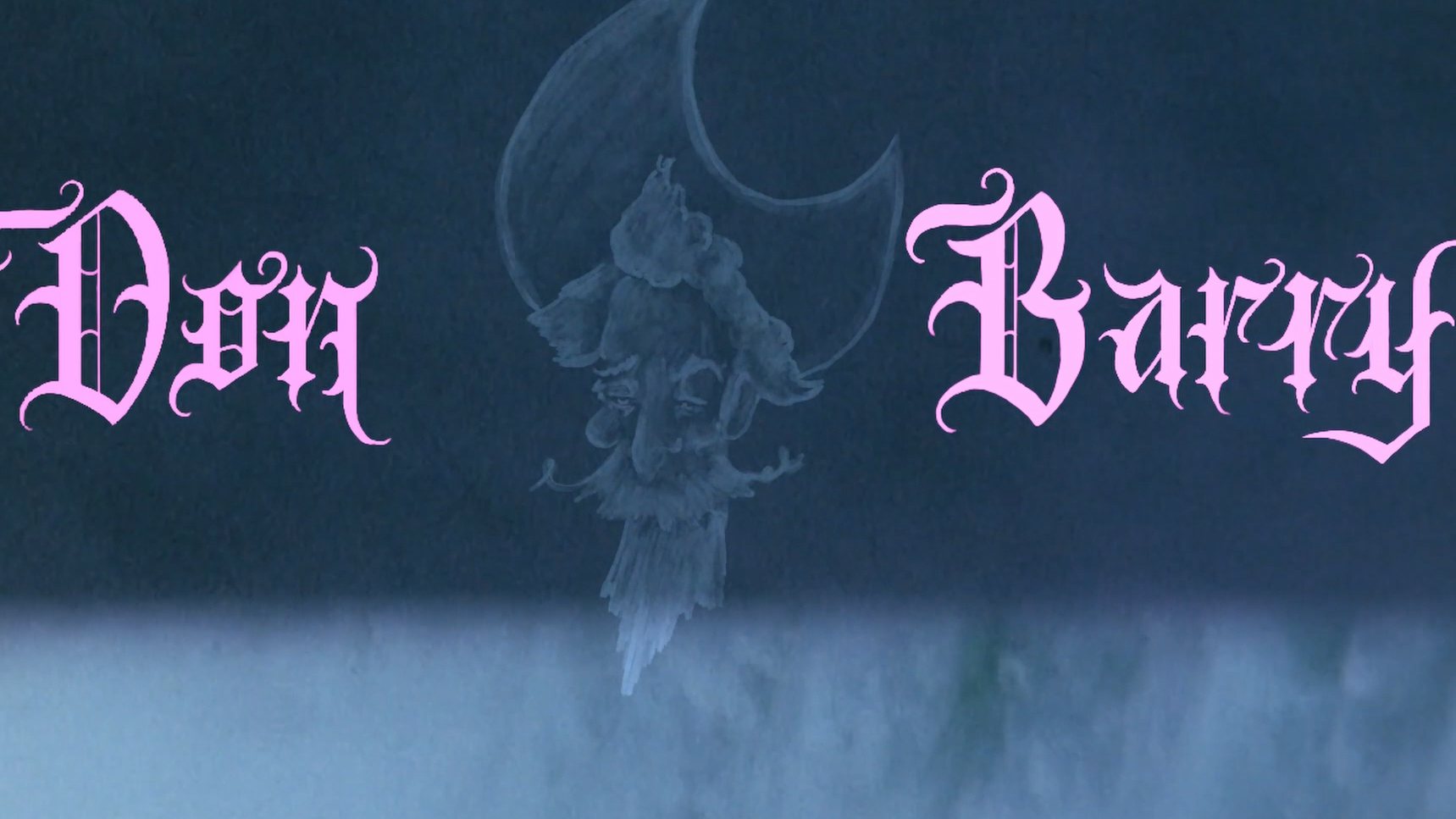
Docufiction, Experimental, by Paul Smart, Mexico, 2026.
Don Barry: A Quixotic Exploration is a debut feature that places the biography of an eighty-year-old experimental filmmaker and artist, Barry Gerson, within the metanarrative of Miguel de Cervantes’ Don Quixote. Don Barry was filmed in the city of Guanajuato during the 51st edition of the Cervantino Festival, as well as during the vibrant Day of the Dead celebrations held in the city’s UNESCO-listed tunnels. The film honors the director’s long friendship with artist Barry Gerson, drawing inspiration from Cervantes’ Don Quixote. Paul Smart’s directorial choices create something new that celebrates life and goes beyond conventional storytelling. A search for magic in our real lives. A moving film about the meaning of life, art, and death. Not to be missed.
Paul Smart is a proud outsider filmmaker with a long history of film screenings. In the 1980s, he emerged in New York’s vibrant youth art scene, working in theater production and later filmmaking, before retreating to rural upstate New York, in the Catskill Mountains, where he made a living writing and screening independent films in old parish halls for rural audiences, many of whom had never seen a film.
LANGUAGE: English
SUBTITLES: Spanish, French, German, Portuguese
A Deaf Man’s House Full of Screaming
You buy a house. You are seventy-two years old, your body has survived things that should have killed you twice, and you are finally, quietly, alone. You paint the walls yourself. Not with flowers or pastoral landscapes or the kind of soft domestic imagery that a retired court painter might reasonably choose to surround himself with in his final years. You paint a giant cramming a human body into his mouth. You paint two men sinking into mud, beating each other with clubs, neither of them able to escape. You paint a dog, half-submerged, staring at something above the frame that will never arrive.
Francisco Goya purchased the Quinta del Sordo in 1819, and the name the property already carried before he arrived was almost too precise to be accidental. The House of the Deaf Man. He had been deaf since 1793, when a mysterious illness — probably viral encephalitis, possibly a stroke, certainly something that dragged him to the threshold and left him permanently altered — had taken his hearing and very nearly taken everything else. Then in 1819, at exactly the age he moved into that house, he nearly died again. A second illness. Another threshold crossed and somehow survived. He recovered under the care of his friend Arrieta, and painted the two of them together in what reads as a private document of gratitude and terror: himself half-collapsed, Arrieta holding him upright, shadowy figures looming in the background like witnesses to something they were not invited to see.
He survived. And then he painted the walls.
This is not metaphor. The Black Paintings were executed directly onto the plaster of the ground floor dining room and the first floor salon, applied in oil without any preparatory canvas. They were not commissioned. They were not meant for anyone’s eyes. The people who eventually saw them — when the Belgian art collector Frédéric Émile d’Erlanger had them transferred to canvas decades after Goya’s death in 1828 — were encountering something that was never structured as communication. Which makes the question of what they mean considerably more difficult and considerably more honest than most analyses allow.
The comfortable interpretation reaches immediately for madness. An old man, isolated, traumatized, losing his grip. But this explanation requires ignoring almost everything about the historical moment in which Goya was living. The Peninsular War had ended in 1814 after leaving the Iberian Peninsula in a condition that can only be described as psychic ruin. Goya had witnessed it, had documented it in the Disasters of War with a clinical brutality that remains among the most unsparing records of human violence ever made. Ferdinand VII had returned to the throne and immediately dismantled the liberal Constitution of 1812, reinstating the Inquisition and beginning a systematic persecution of the reformers and intellectuals with whom Goya had spent his life in conversation. The brief liberal revolution of 1820 had offered a window, and then slammed shut again by 1823 when French troops marched in to restore absolutist order.
Goya was not mad. He was a man who had watched an entire historical project collapse, repeatedly, across decades, and who had reached the age where he no longer needed to pretend otherwise for anyone.
Hannah Arendt wrote in The Origins of Totalitarianism that loneliness — not solitude, but enforced social isolation and the destruction of a shared world — is the common ground of terror. What Goya built on his walls was not the product of a broken mind but of a mind that had been stripped of every social buffer that normally allows a person to look away. He could not hear. He had outlived or been separated from most of his world. He had no public to perform coherence for. And so, in the privacy of his dining room, he painted exactly what he knew.

Saturn’s Mouth and the Logic of Power
There is a man eating in a vast dining room, alone. The table could seat forty. He tears at the food with a concentration that has nothing to do with hunger — his eyes are fixed on something beyond the plate, beyond the walls, beyond any present moment. The servants have been dismissed. No one watches. The consumption is total and private, which is precisely why it feels obscene.
This is the image Goya placed on his wall, scaled to the size of a human body, painted not for exhibition but for habitation. Saturn grips his son with both hands, white-knuckled, the fingers sunk deep into flesh that has already partly disappeared. The head and one arm are gone. The remaining arm hangs at an angle that belongs to no living body. The eyes of the devourer are not monstrous — this is the detail that refuses to let you go — they are terrified. He eats out of fear. He has always eaten out of fear.
The mythological frame collapses the moment you look directly at the image. The story, as Hesiod tells it in the Theogony, is about succession and prophecy: Cronus, warned that his own child would overthrow him, swallowed each one at birth. A political problem presented as cosmic drama. But Goya strips away the cosmology and leaves only the mechanics. What remains is a structure, not a story. Walter Benjamin, writing in his 1921 “Critique of Violence,” argued that all legal and political power contains within itself a founding violence it must perpetually repeat in order to remain power — what he called “law-preserving violence,” the maintenance of dominance through the continuous threat and enactment of force. Saturn’s grip is not an exception to the system. It is the system demonstrating its own logic.
The formal qualities of the painting are not psychological symptoms. They are a political anatomy. The scale matters: the figure fills the frame almost entirely, leaving almost no space outside the act itself. There is no landscape, no court, no witness, no context that might relativize what is happening. The darkness behind the figure is not atmospheric — it is the erasure of all alternative possibility. Hannah Arendt, in “The Origins of Totalitarianism” published in 1951, identified a particular feature of totalitarian systems that she found more disturbing than their cruelty: their tendency to destroy the very populations they claim to protect, to consume their own human material in purges, in forced labor, in wars they themselves provoked. The system does not fail when it turns on its children. Turning on its children is what the system does when it is functioning correctly.
The white knuckles are the detail that will not leave you. They indicate effort, resistance in the act itself — not ease, not pleasure, but compulsion. He cannot stop. This is not appetite but obligation. The already-devoured portion of the body is the evidence of what came before this moment, the long history of consumption that preceded the particular instant Goya chose to freeze. We are not seeing the beginning. We are seeing the continuation.
The man in the empty dining room eventually stands, leaves, and the plates are cleared by hands he will never see. What was consumed means nothing to him nutritionally, economically, symbolically. It was consumed because consumption was possible. Because the room was his, the food was his, the silence was his. Power does not need justification for its appetites — it needs only the absence of anyone positioned to object. Saturn’s eyes, wide and white in the darkness, are not the eyes of a monster discovering what it has done. They are the eyes of a system briefly aware of its own momentum, unable to reverse it, not entirely sure it would choose to if it could.
The Pilgrimage to San Isidro: Collective Derangement
You have been in a crowd at night. Maybe it was a protest, maybe a concert, maybe something with fire and noise that you joined because the pull of it was stronger than any decision you made consciously. The sound reached you before the meaning did — a low vibration in the chest, mouths open around you, faces lit from below by the light of phones held up like torches, and at some point you stopped wondering where you were going and simply moved with it. That is not a memory of weakness. That is a memory of being human. And Goya painted it two hundred years before you lived it.
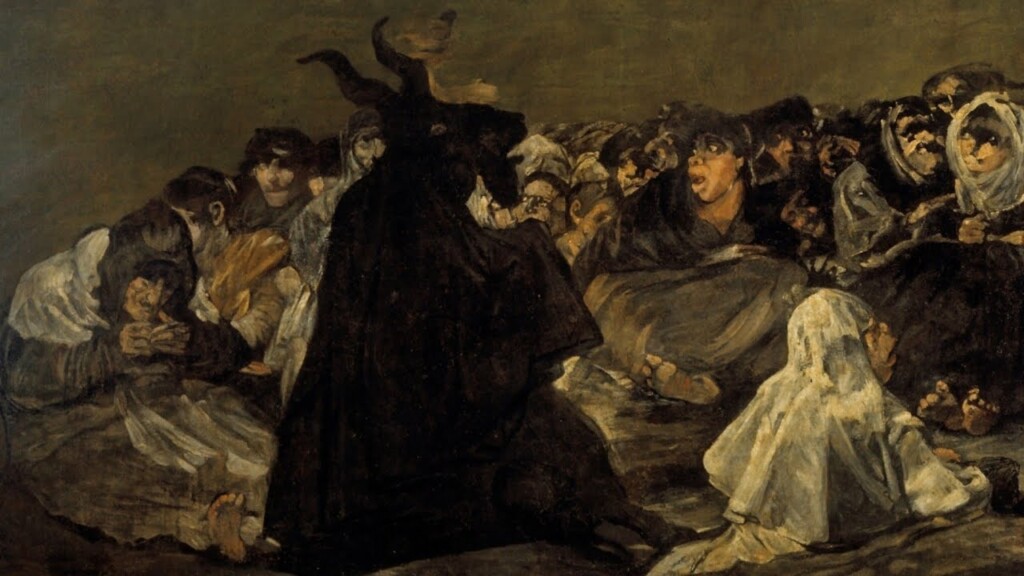
The procession moves through a landscape that offers no destination. The figures press together across the canvas in a horizontal crush that has no beginning and no end visible within the frame — the crowd simply is, extending beyond what can be seen, beyond what can be counted. Their mouths are open, many of them, in what might be singing or might be screaming or might be the particular sound that is neither, the sound a group makes when it has surrendered individual register. The faces are not caricatures. That is the first thing to understand and the thing most frequently missed. Goya is not laughing at these people. He is not standing outside the frame in the position of the educated man looking down at rural superstition. He is recording a phenomenon, with the precision of someone who knows it from the inside.
Gustave Le Bon would not publish La Psychologie des foules until 1895, nearly seventy years after Goya sealed the Quinta del Sordo and left Spain forever. Le Bon’s central argument — that the crowd reduces the individual to a lower psychological state, that it is “always intellectually inferior to the isolated individual,” that contagion replaces reason — has often been read as scientific insight. But it is also, unmistakably, an aristocratic anxiety. Elias Canetti pushed harder and more honestly in Crowds and Power in 1960, recognizing that the crowd is not a regression but a transformation, that the loss of individual boundary within a mass produces something the isolated self cannot access: a sensation of equality, of discharge, of what Canetti called the “reversal of the fear of being touched.” The crowd is not stupidity. It is a different state of being. Goya understood this before either of them had words for it.
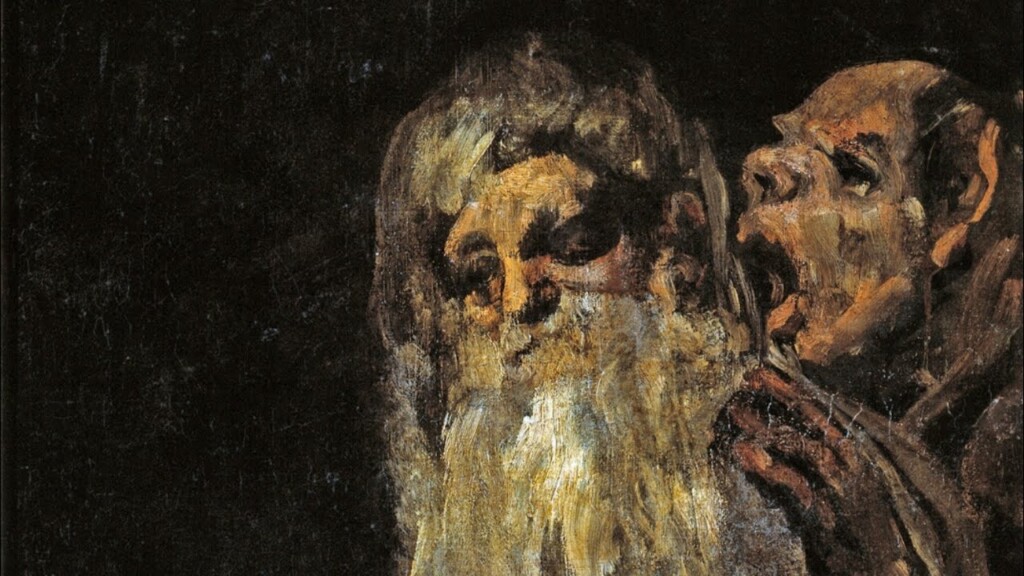
What the procession shows is not the failure of reason. It is reason’s temporary irrelevance. Elsewhere in the same room, the great goat presides over a gathering at night, and the faces turned toward it wear expressions that are not simple fear or simple worship but something more uncomfortable — need, hunger, the specific vacancy of people who have found, in collective presence, something they could not find alone. The goat does not explain itself. It does not need to. The congregation has already decided.
Theodor Adorno and Max Horkheimer, writing in Dialectic of Enlightenment in 1944 while Europe burned through precisely this dynamic, described the mass as the product not of irrationality but of rationality’s own logic taken to its endpoint — the individual so thoroughly processed by modern systems that the crowd becomes the only available form of release. The mouths open because there is no other outlet. The procession moves because stillness has become unbearable.
You have felt this. Not the peasant version, not the pre-industrial Spanish version, but your version — the stadium, the feed, the comment section that somehow pulls you downward into unanimity, the group text where everyone is suddenly saying the same thing with the same borrowed fury. Goya’s procession is not a historical document. It is a mirror angled toward the part of you that moves before you decide to move, that opens its mouth before you know what sound will come out.
Judith and the Knife She Was Never Supposed to Hold
There is a moment you have seen without knowing it. A woman stands in a corridor, or a kitchen, or the threshold between two rooms, holding something — a letter, a bottle, a blade — and the decision is not yet made. Her face gives you nothing. You cannot tell if she is about to act or about to put it down and walk away, and the unbearable part is that she knows you are watching and does not care. That is the moment Goya paints.
Every previous version of this scene wanted to give you resolution. Caravaggio’s Judith holds the sword with the fastidious distance of someone handling a task she finds distasteful, her brow furrowed, her body leaning backward even as her arms move forward, the whole composition screaming reluctance so that we might forgive her. Artemisia Gentileschi, who knew something about violence from closer proximity than most, painted the same woman with locked arms, braced shoulders, full commitment — a Judith who had decided long before the sword was raised and would not waver. Both versions are, in their own way, reassuring. The horror is contained. The woman acts, the act is legible, the story has a shape.
Goya removes the shape. His Judith is mid-stroke, or mid-thought, or mid-change of mind — the grammar of the moment is deliberately broken. She looms forward in a way that feels almost accidental, her expression suggesting neither triumph nor revulsion but something closer to a private arithmetic she is still calculating. Holofernes is barely present. The painting is not about the killing. It is about the instant before the irreversible, held open past the point of comfort.
Simone de Beauvoir, writing in 1949, described how Western culture constructed the female body as the ground on which male myth was written — never the author, always the text. Woman as symbol, as allegory, as the screen onto which heroism, danger, seduction and sacrifice were projected with an ease that required her to remain still, interpretable, fixed. The heroic Judith served this structure perfectly: she could be permitted one act of violence because that act confirmed rather than disrupted the order around it. She killed for her people. She went home afterward. She stayed Judith.
Mary Beard, tracing in 2017 the deep grammatical structures that exclude women from public power, notes that the problem is not only exclusion but the shape of the narrative itself — the way power stories are built around a masculine subject so thoroughly that a woman who enters them is immediately legible only as exception, as anomaly, as the one who acted this once. The heroic Judith is exactly this. She is granted agency as a one-time dispensation. The mythology insists she was reluctant, or acting for others, or did not really enjoy it. Because a woman who holds the knife with genuine intention, without apology, without the clean resolution of victory — that is the figure culture cannot comfortably metabolize.
That is Goya’s Judith. The discomfort she produces is not about the violence. Violence in painting is ancient, ordinary, almost decorative. The discomfort is that she looks like she might stop. And if she stops, you have to ask why she started. And if you ask that, you have to ask what she wanted, and who she was before this moment, and whether this is the only option she ever had, or the only one she was ever shown. The painting does not answer. It holds the question open with something close to cruelty.
A woman in a corridor, holding something, deciding. The camera — or your eye — stays on her face waiting for the expression that will tell you what to feel. It does not come. She is not performing the decision for your benefit. She may not even be making it yet. And the not-yet is the thing that neither heroism nor its refusal can fully contain.
A vision curated by a filmmaker, not an algorithm
In this video I explain our vision
The Dog and the Unbearable Lightness of Being Buried
There is a moment — you have had it — when you are standing at a window and something outside has caught your attention, and you stay there longer than you intended, and the thing you are looking at gradually ceases to matter, and what replaces it is the looking itself, the fact of your own gaze suspended in a direction that no longer has an object. Someone watching you from behind would see a person at a window. They would not see that you had already left.
This is the painting that breaks the series open from inside. A dog’s head, emerging — or sinking, the two are indistinguishable — from a field of ochre and brown that might be sand, might be water, might be the texture of consciousness itself dissolving at its lower edge. There is no Saturn, no witch, no biblical atrocity, no crowd. There is only this animal, this upward gaze, and the enormous emptiness above it that occupies three-quarters of the canvas and answers nothing. Whatever the dog is looking at, Goya refused to paint it. Not because it does not exist. Because it cannot be represented.
Kierkegaard, writing in 1844 in “The Concept of Anxiety,” described dread not as fear of something specific but as vertigo in the face of freedom itself — the dizziness that comes not from standing at the edge of an abyss but from recognizing that you are free to step forward, and that freedom and annihilation are, at that precise instant, the same sensation. He called it the dizziness of freedom. The dog is not afraid of a predator. The dog is not trapped by anything visible. The dog is experiencing something closer to what Kierkegaard meant: an orientation toward an open that offers no foothold, a looking-toward that finds no surface to land on.
What makes this painting almost unbearable is the scale of its restraint. After rooms full of violence and distortion, after faces melting into screaming and bodies consumed by other bodies, Goya reduced everything to this: one small creature and a void. The figure is not centered. It is pushed to the lower right, as if already being claimed by whatever is below the frame. The emptiness above is not neutral. It has weight. It presses. And the dog’s expression — if that word is permissible for a brushmark — holds something that resists every consoling interpretation. It is not pleading. It is not suffering in a way that invites pity. It is simply looking, with the full commitment of a creature that does not yet know how this ends.
This is the one painting in the Black series where Goya made no argument. He encoded no political allegory, reached for no mythological scaffold, addressed no historical injustice. He painted a feeling that has no name in any language because every language was built to negotiate between people, and this feeling exists before or beneath or after that negotiation fails. It is the feeling of existing without an interlocutor. The feeling of having a gaze with nowhere to direct it that will hold it back.
He painted this on the wall of his own house. Not for the Academy. Not for a patron. Not even, one suspects, for posterity, since no one with a sense of posterity chooses this image as a self-portrait. But it is one. The dog looking at what cannot be shown is Goya looking at what he could no longer translate into the shared vocabulary of human event and human meaning. He had painted wars, he had painted monsters, he had painted the whole theater of power and its cruelty. And then he came to this wall and painted the thing that precedes all of it: the bare fact of consciousness aimed at an absence that does not even have the decency to be dark.
What It Means to Paint in Secret
There is a particular kind of making that happens only when you are certain no one is watching. Not performance, not expression in the social sense, not communication dressed as confession — something closer to what happens when the body moves before the mind has decided what it means. You have felt this, perhaps, in a notebook never shown to anyone, in a drawing made and immediately folded, in words spoken aloud in an empty room. The making was real. The audience would have falsified it.
Donald Winnicott, in his 1960 paper on ego distortion, drew a line that most people feel but cannot name: between the self that forms in response to the world’s demands and the self that exists prior to any demand at all. The false self is not pathological in origin — it is adaptive, intelligent, necessary for survival. But it accumulates. It learns to speak in ways that will be received, to make things that will be understood, to shape its outputs toward legibility. The true self, by contrast, does not perform. It does not know how. When it makes something, that something is not addressed to anyone. It is more like a secretion than a statement.
Goya lived in the Quinta del Sordo for over four years with those paintings surrounding him. He woke inside them and ate beside them and aged in their company. He did not title them. He did not write about them in letters with any specificity. He did not invite collectors or critics to view them before he left for Bordeaux in 1824, where he would die four years later at eighty-two, still working. The paintings remained on the plaster walls of rooms that were not galleries, in a house that belonged to a deaf old man who had survived two near-fatal illnesses, a war, and the quiet erasure of almost everyone he had known.
When Baron Émile d’Erlanger purchased the property in 1874, forty-six years after Goya’s death, he found the paintings deteriorating, the plaster cracking, the figures darkening into their grounds. The transfer to canvas that followed — technically extraordinary for its time, carried out by the restorer Salvador Martínez Cubells — inevitably changed what was there. Specialists still argue about how much: how much the blacks deepened, how much the spatial relationships compressed, how much the original scale distorted once the work left the architecture it had grown inside. Something was lost that cannot be recovered, because what was lost was not paint but context — the specific walls, the specific light, the body of one man moving through those rooms each day.
Susan Sontag argued in 1964 that the compulsion to interpret art is often a refusal to experience it — that meaning-making functions as a defense against the work’s actual force. She was writing against a critical culture that treated every surface as a code to be deciphered, every image as a symptom of something else more real. What she was protecting was the possibility that some things are not ciphers. That some things were made not to mean but to be. The Black Paintings have accumulated centuries of interpretation — Saturn as political allegory, the dog as existential symbol, the witch sabbath as commentary on superstition and mob psychology. None of these readings are wrong. All of them are, in some sense, beside the point.
Think of a man who spends months building something in a room he alone enters, and then, understanding that it is finished, burns it before dawn — not from shame but from completion. The work was never for anyone else. Its existence was the private act of making it. He watches it go without grief.
The question the Black Paintings leave open is whether they became something different the moment they became visible — whether leaving the walls was also, in some sense, a second creation, or a betrayal of the first.
The Eyes That Do Not Console
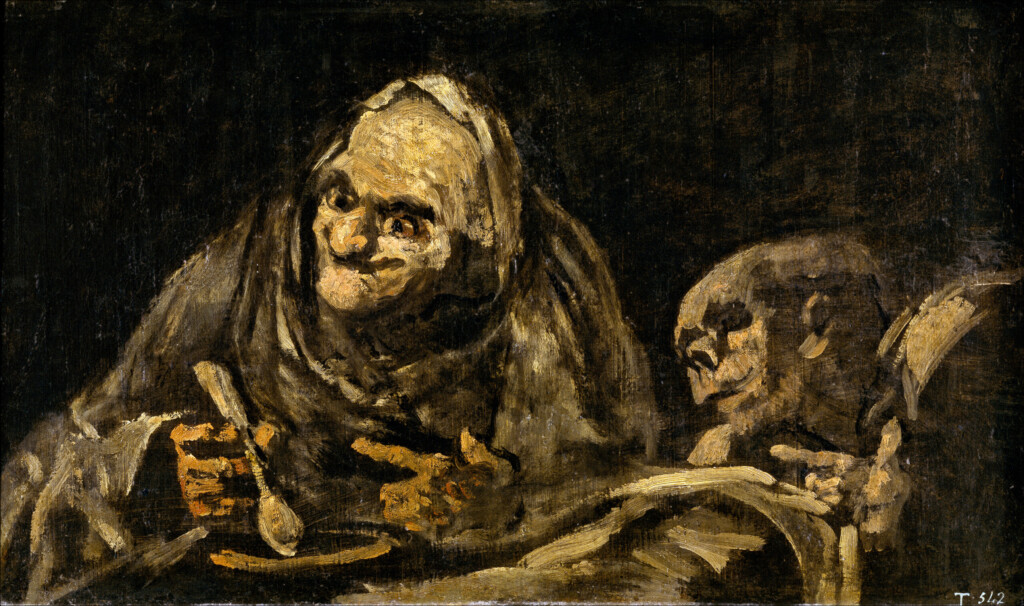
You are back in the room. The paint is still dark. The figures are still mid-scream, mid-devouring, mid-whatever-it-is-they-are-doing-that-you-still-cannot-name with any single word from any language you own. But now you are looking at something you were not equipped to see the first time: the eyes.
They appear across nearly all fourteen of them. Enormous, disproportionate, blown open past what anatomy allows. They do not belong to the faces they inhabit in any naturalistic sense — they are too large, too present, too aware. And what they are aware of is not you. That is the crucial thing you keep misreading. You assume, because you are the one standing in front of the canvas, that the gaze is aimed at you. It is not. These eyes are fixed on something you are not shown, something that exists at an angle to your position, somewhere outside the frame, in a place the painting has no obligation to reveal. This is not a stylistic tic. It is not the tremor of an old man’s hand. It is a decision, made with full deliberation across fourteen separate works, to refuse you the organizing comfort of being looked at.
Theodor Adorno argued in his Aesthetic Theory, published posthumously in 1970, that authentic art resists precisely the demand the culture industry makes of every object: the demand for resolution, for the transformation of suffering into something bearable, legible, and ultimately consolable. The culture industry does not require that you feel nothing — it requires that you feel something that ends. A catharsis with a closing time. What Goya’s eyes do is refuse that closing time. They do not invite you into the horror and then escort you gently back out. They hold open a space of irresolution that has no interest in your comfort, your processing, or your capacity to leave the room feeling that you have understood something and may now proceed.
Giorgio Agamben, writing about testimony and witness in Remnants of Auschwitz in 1999, identified what he called the impossibility of bearing witness fully — the gap between the one who survived to speak and the one who went all the way down into the experience and could not return. The true witness, in Agamben’s reading, is the one who cannot testify, the one whose testimony is structurally unavailable. What remains is an incomplete archive, a gaze that points toward what cannot be said. These eyes in the plaster, these eyes too large for the skulls that contain them, are pointed at exactly that unavailable thing. They are not withholding information from you out of cruelty. They are simply looking at something for which no report is possible.
A man eats what he has made. Dogs sink into a ground that will cover them by morning. Women lean and whisper around a face that may or may not be alive. And across all of it, these eyes that have seen something and will not organize it into a lesson, a warning, or a symbol you can carry out with you like a souvenir. The paint on the walls of the Quinta del Sordo was not made for museums. It was not made for you, and its indifference to your need for meaning is not a failure of communication but the most precise communication possible.
You came into the room. You looked. You thought you were the one doing the looking. But those eyes were already open before you arrived, fixed on their unshowable object, and they will remain open long after you have gone back out into whatever you call your ordinary life, carrying the unresolved weight of a gaze that asked nothing of you and gave you, for that very reason, no way to put it down.
🖤 Darkness, Vision, and the Weight of Art
Goya’s Black Paintings stand at a crossroads of obsession, mortality, and artistic isolation. To fully grasp their haunting power, it helps to explore the broader worlds of Spanish art, the symbolism of death, and the painters who confronted the abyss with equal ferocity. These related articles trace the cultural and philosophical threads woven into Goya’s darkest masterworks.
Goya: Life and Works
Goya’s life is inseparable from the radical transformation his art underwent over decades of political turmoil, illness, and disillusionment. This article traces the full arc of Francisco Goya’s career, from his early tapestry cartoons to the devastating late works painted directly onto the walls of his home. Understanding his biography illuminates why the Black Paintings feel less like decoration and more like confession.
GO TO THE SELECTION: Goya: Life and Works
Titian: Life and Works
Titian stands as one of the towering figures of Western painting, and his late works — loose, almost violent in their brushwork — anticipate the expressive freedom Goya would push to its extreme centuries later. This article explores Titian’s life and artistic evolution, revealing how a master’s final years can become the most radical of his entire career. The parallels with Goya’s own late period are impossible to ignore.
GO TO THE SELECTION: Titian: Life and Works
Vanitas in Art: Symbolism and Meaning
Vanitas painting emerged in the seventeenth century as a meditation on the futility of earthly life, filling canvases with skulls, hourglasses, and rotting fruit. This article unpacks the rich symbolic language of vanitas art, a tradition deeply embedded in the Spanish and European cultural soil from which Goya grew. Saturn devouring his son carries echoes of this memento mori tradition, transformed by Goya into something far more visceral and personal.
GO TO THE SELECTION: Vanitas in Art: Symbolism and Meaning
Memento Mori: History and Meaning
Memento mori — the ancient reminder that all living beings must die — runs like a dark current beneath centuries of art and philosophy. This article traces the history and meaning of this concept, from Roman death masks to the skull-strewn canvases of the Baroque. Goya’s Black Paintings represent perhaps the most psychologically raw expression of this tradition in the entire Western canon.
GO TO THE SELECTION: Memento Mori: History and Meaning
Explore the Depths on Indiecinema
If Goya’s dark visions stir something in you — that restless appetite for art that refuses easy comfort — then Indiecinema is your next destination. Our streaming platform is dedicated to independent and auteur cinema that shares Goya’s fearless gaze: films that confront mortality, madness, and the beauty hidden in shadow. Discover a world of cinema that dares to look where others turn away.
👉 EXPLORE THE CATALOG: Watch Indie Films in Streaming
A vision curated by a filmmaker, not an algorithm
In this video I explain our vision

