
The Skull on the Desk
You are not thinking about death. You are sitting at your desk in the middle of an ordinary afternoon, maybe waiting for a file to load or reaching for a cup of coffee that has gone cold without your noticing, and then something catches the corner of your eye. A plant on the windowsill, one you bought months ago during a brief domestic optimism, its leaves now curled inward like closed fists, the soil cracked and pale. You look at it for a second longer than you intended to. Something shifts.

It is not grief, exactly. It is not fear. It is more like a sudden pressure behind the sternum, a recognition that arrives before language does, before you have time to dress it in any concept or dismiss it with any rationalization. The afternoon is still the same afternoon. The light through the window is unchanged. But something in the room has changed its temperature, and you feel, with a clarity that is almost physical, that time is not a background condition of your life. It is the substance of it. It is what everything is made of, including you, including right now.
This is the vanitas experience. Not a genre, not a category in an art history survey, not a Latin word you half-remember from a museum placard. It is this: the ordinary moment cracking open along a fault line you did not know was there, revealing something you already knew and had been, with impressive efficiency, not thinking about.
The word itself comes from the opening of Ecclesiastes, that restless, inconsolable book of the Hebrew Bible, where Qohelet declares with the weariness of someone who has tried everything: vanity of vanities, all is vanity. The Hebrew hevel, often translated as vanity, means more precisely breath, vapor, mist. Not emptiness as a moral judgment. Emptiness as a physical description. What you hold dissipates. What you build disperses. The stopped clock on your mantelpiece, the one you keep meaning to replace the battery in and never do, is not a decorative object. It is a small monument to exactly this.
European painters of the sixteenth and seventeenth centuries understood something that the contemporary world has spent considerable energy forgetting: that placing certain objects together in a composition could reproduce this exact psychic event in a viewer. A skull resting beside an open book. A candle burned to its last inch of wax, the flame alive but barely. A pocket watch, its lid open, its hands arrested. Flowers at the precise moment before they begin to decline. The arrangement was never accidental and never merely decorative. It was engineered to do to the person standing in front of it what the wilted plant on your windowsill just did to you: crack the surface of the present and let the cold air of transience in.
What makes this tradition extraordinary is not its subject matter but its mechanism. It does not argue for the brevity of life. It does not deliver a philosophical proposition you must evaluate and accept or reject. It simply places things in relation to each other and waits. The skull on the desk is not a symbol you decode. It is a presence you feel, the way you feel the cold cup in your hand before you consciously register that the coffee is no longer worth drinking.
You put the cup down. You look again at the plant. You are still not thinking about death, not really, not in any organized or sustained way. But something has been acknowledged between you and the afternoon, some agreement you did not seek and cannot now un-sign. The crack in the ordinary is already there. It has always been there. The painters simply knew how to make it visible.
Don Barry: A Quixotic Exploration
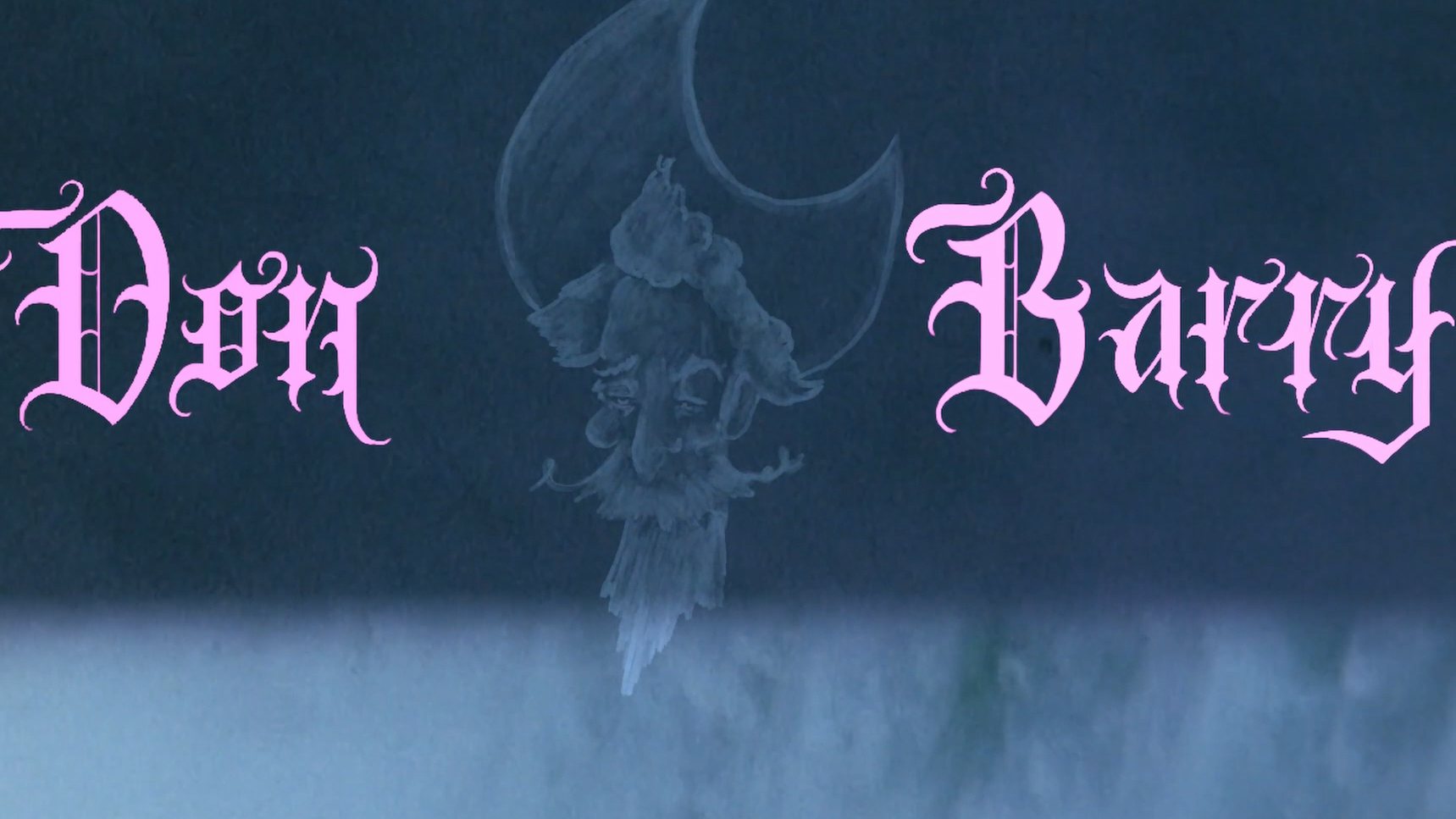
Docufiction, Experimental, by Paul Smart, Mexico, 2026.
Don Barry: A Quixotic Exploration is a debut feature that places the biography of an eighty-year-old experimental filmmaker and artist, Barry Gerson, within the metanarrative of Miguel de Cervantes’ Don Quixote. Don Barry was filmed in the city of Guanajuato during the 51st edition of the Cervantino Festival, as well as during the vibrant Day of the Dead celebrations held in the city’s UNESCO-listed tunnels. The film honors the director’s long friendship with artist Barry Gerson, drawing inspiration from Cervantes’ Don Quixote. Paul Smart’s directorial choices create something new that celebrates life and goes beyond conventional storytelling. A search for magic in our real lives. A moving film about the meaning of life, art, and death. Not to be missed.
Paul Smart is a proud outsider filmmaker with a long history of film screenings. In the 1980s, he emerged in New York’s vibrant youth art scene, working in theater production and later filmmaking, before retreating to rural upstate New York, in the Catskill Mountains, where he made a living writing and screening independent films in old parish halls for rural audiences, many of whom had never seen a film.
LANGUAGE: English
SUBTITLES: Spanish, French, German, Portuguese
What the Flemish Painters Knew That We Pretend Not To
There is a painting — a table, a meal recently interrupted, the cloth still creased from where an elbow rested. A lemon has been peeled in one continuous spiral, the rind hanging over the table’s edge like something that ran out of reason to continue. A roemer glass stands half-full, or half-emptied, depending on what kind of morning you are having. A watch lies open. A skull occupies the corner of the composition with the calm of something that has nowhere else to be.
This is not a memento of death. It is a balance sheet.
The Dutch Golden Age produced more concentrated mercantile wealth than any civilization before it had managed, and it did so with extraordinary speed. By 1650, Amsterdam had become the financial capital of the known world, its exchange bank holding assets that dwarfed the treasuries of monarchies. The Dutch East India Company, the VOC, was the first corporation in history to issue publicly traded shares, in 1602, and within decades it commanded private armies, minted its own currency, and governed territories across three continents. Spices, silk, sugar, and slaves moved through Dutch ports in quantities that would have been incomprehensible to previous generations. The merchant class that emerged from this machinery was suddenly in possession of more objects than anyone had ever needed to possess.
And then, precisely then, they commissioned paintings that told them those objects meant nothing.
Pieter Claesz worked in Haarlem during the height of this expansion. Willem Claesz Heda, his near-contemporary and rival, refined the genre into something so technically precise it almost becomes cruel — the textures of pewter, the translucence of glass, the specific way that light moves through wine at ten in the morning. Harmen Steenwyck added the skull to the equation with a directness that left no interpretive exit. These were not religious paintings in any conventional sense. They hung in the homes and offices of men who counted coins for a living, who understood leverage before the word existed in that sense, who could price a cargo of nutmeg to three decimal places. The skull sat on the desk because the merchant who commissioned it wanted it there.
The philosopher Simon Schama, in his 1987 study of Dutch culture, identified what he called “the embarrassment of riches” — the profound discomfort at the center of a culture that had grown wealthy faster than its moral frameworks could accommodate. Calvinism had taught these men that material accumulation was simultaneously a sign of divine favor and a spiritual danger, that comfort was suspect, that the body would betray the soul eventually. The vanitas painting was the resolution to this contradiction, or rather, it was the elegant refusal to resolve it. You could own the lemon and the goblet and the watch. You could display them in the most technically accomplished painting money could acquire. And the skull in the corner absolved nothing, confirmed nothing, threatened nothing specific. It simply remained.
This is what the Flemish and Dutch painters understood that we have since decided to unlearn: the acknowledgment of transience and the accumulation of wealth are not opposites. They are partners. The overturned goblet is not a warning against owning goblets. It is a way of owning them more completely, of framing them so carefully in the awareness of their eventual absence that the possession becomes almost metaphysical. The half-eaten lemon, with its peel spiraling downward, is an exquisite object precisely because it is already becoming something else.
Thorstein Veblen, writing his theory of conspicuous consumption in 1899, diagnosed the social performance of ownership but missed something the Dutch had understood two centuries earlier: that the most sophisticated performance of ownership includes the theatrical staging of its own futility.

Objects That Accuse
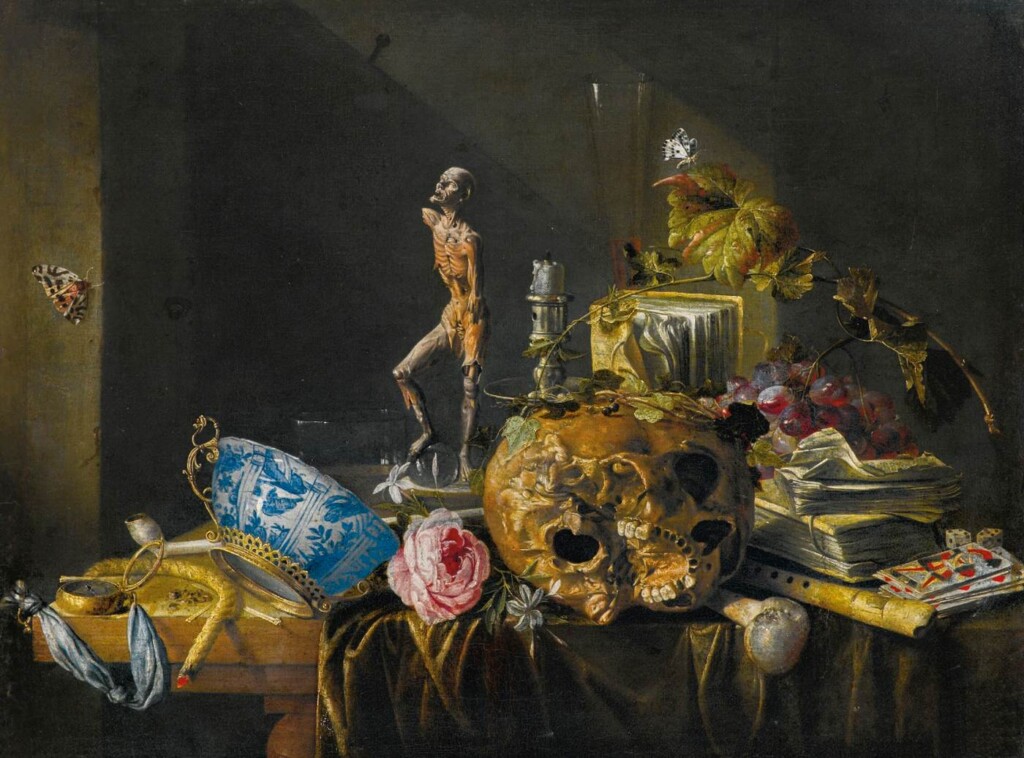
The hourglass sitting on your desk right now — or the one you imagine there, because you have learned to keep such things out of sight — is not measuring time. It is measuring you. The sand does not fall neutrally. It falls as an accusation. Every grain is a small verdict on what you did or did not do with the previous one, and the glass that contains it all is so deliberately narrow at the center that the metaphor becomes almost cruel in its precision: everything passes through a single point, and that point is always now, and now is always almost gone.
This is the oldest trick of the vanitas lexicon. Not to frighten with death in the abstract, but to make you feel the pressure of the specific hour. The painters who arranged these objects on oak tables in the low light of seventeenth-century Flemish studios understood something about attention that most productivity systems have spent centuries trying to rediscover and always getting wrong. The hourglass does not motivate. It indicts. There is a difference, and it is the difference between a coach and a prosecutor.
The soap bubble is older still, in the philosophical sense. Marcus Terentius Varro, writing in the first century BCE, gave the image its Latin name and its philosophical weight: homo bulla, man is a bubble. The phrase arrived already carrying everything. A bubble is luminous, iridescent, briefly perfect, and it pops without leaving a trace that could be called a mark. Not a scar, not a shadow, not even a sound that lasts. When a painter placed a child blowing a soap bubble into a still life composition — and many did, across generations and national schools — the child was not there for tenderness. The child was there because innocence makes the accusation sharper. You knew, the image says. You knew from the beginning how fragile this was. The brightness was always a countdown.
The skull is the most direct of the symbols and paradoxically the most misread. Contemporary culture has domesticated it into decoration, printed it on fabrics and phone cases until it means nothing more than a vague aesthetic of transgression. But the skull in a vanitas painting carries a genealogy that has nothing to do with rebellion. Its roots go back to Roman triumphal processions, where a slave would stand behind the victorious general and whisper, repeatedly, into his ear: memento mori. Remember that you will die. Not as a taunt. As a structural correction. The greatest power the empire could confer was not enough to exempt a man from the one appointment that democracy enforces absolutely. The skull on the painted table is that slave’s voice, frozen into pigment, still whispering to anyone who looks.
The thread that connects all of these objects runs through a text that predates the paintings by roughly two millennia. The opening of Ecclesiastes — vanity of vanities, all is vanity — is not a lament. It is a forensic observation. The Hebrew word used, hevel, means breath, vapor, the thing that dissipates the moment it leaves the body. When the ancient writer surveyed accumulated wisdom, labor, pleasure, and construction and found in all of it the same quality of vapor, he was not collapsing into nihilism. He was clearing the ground of illusion with the precision of a diagnostician. That diagnostic thread ran without interruption from the Hebrew text into the Septuagint, from there into Patristic readings, and from there directly into the iconographic programs of early modern European painting. The objects on those tables are not decorative choices. They are citations from a very long argument about what human beings persistently refuse to see about themselves.
The question the objects ask is not philosophical in any comfortable sense. It is practical, almost administrative. What have you done with the hours you were given.
A Man Arranges His Belongings Before Dying
There is a man who spent thirty years signing papers he never read, approving requests he never examined, moving through corridors of a municipal building like water moves through pipes — without will, without friction, without memory of having passed. Then a doctor hands him a diagnosis wrapped in clinical euphemism, and something ruptures. Not dramatically. Not with tears or screaming. He simply walks out of the office and stands on a street corner in the middle of an ordinary afternoon, watching people who do not yet know they are going to die, and he understands, with a clarity so violent it resembles pain, that he has been dead for decades already. The sentence is not a beginning of dying. It is the first moment he has been alive.
What follows is not a bucket list. What follows is the vanitas made flesh. He begins to move differently through the world, not because he has found meaning but because the absence of meaning has become unbearable to look at directly. He builds a small playground for children in a neglected corner of the city — a ludicrous project, bureaucratically impossible, something his office had buried in files for years. He pushes it through with a ferocity that looks, to his colleagues, like madness. They do not understand that he is not building for children. He is building against the accumulated weight of everything he chose not to do. Every swing set is a correction. Every sandpit is a small monument to the time he allowed to be stolen.
The Flemish painters knew this grammar. When they placed a pocket watch beside a half-eaten peach, they were not decorating. They were performing an autopsy on a life not yet finished. The man with the playground performs the same operation in real time, his last months becoming a kind of living still life, every object rearranged in relation to death. Erik Erikson called this the crisis of integrity versus despair — the confrontation, in the final stage of life, with the question of whether what was lived had any coherence. When the answer is no, despair does not always look like weeping. Sometimes it looks like building something small and necessary at the very last moment.
Elsewhere, an old professor travels through the landscapes of his own past on the day he is to receive an honorary degree, the crowning confirmation of a life well-constructed. He drives through towns he knew as a young man and something keeps breaking open in him that he cannot name. He was brilliant. He was respected. He was, in the precise vocabulary of social performance, successful. And yet the further back into his past he travels, the more he recognizes that every achievement was a flight from feeling, every publication a door closed against intimacy, every accolade a substitute for the simpler and more terrifying act of remaining present with another human being. The honorary degree, by the time he arrives to receive it, feels like a skull placed on a banquet table. An emblem of vanishing dressed up as triumph.
And then there is the father who burns everything. His house, his possessions, everything accumulated across a life — he sets it all alight in an act that looks to observers like insanity and is, in fact, the most rigorous symbolic logic. He has made a vow: if catastrophe can be halted, he will give everything. The burning is not destruction. It is an offering. The objects arranged around a life are surrendered back to time. What the Flemish painters showed as symbol — the extinguished candle, the fallen goblet, the skull resting among flowers — he enacts literally, standing in front of the flames with the expression of a man who has finally said what he has been trying to say for years.
These three men are not allegories. They are the painting walking around in the world, rearranging their belongings because death has made the arrangement suddenly, absolutely visible.
Vanitas and the Lie of Progress
There is a particular kind of exhaustion that sets in around Sunday evening, when the week ahead assembles itself in your mind like a balance sheet demanding settlement. You run through the tasks, the deliverables, the metrics of your own usefulness, and somewhere in that mental accounting you realize you have not once, not for a single unguarded moment, thought about the fact that you are going to die. This is not an accident. It is a cultural achievement, centuries in the making, and it required dismantling an entire visual tradition to accomplish it.
Modernity did not simply forget the vanitas worldview. It declared war on it, systematically and with genuine ideological conviction. The skull on the painter’s table was replaced by the growth chart on the boardroom wall. The hourglass measuring out what remains of a human life was replaced by the quarterly projection measuring out what remains of untapped market share. The equation was almost surgical in its precision: wherever the old tradition had placed a reminder of finitude, progress installed a fantasy of expansion. The direction of gaze was reversed entirely. Instead of looking backward toward the grave, civilization trained its eyes forward toward a horizon that, by definition, never arrives.
Ernest Becker understood this substitution with a clarity that cost him something. Writing in 1973, the year he died of cancer, he argued in The Denial of Death that human civilization in its entirety functions as an elaborate defense mechanism against the terror of mortality. Every monument, every ideology, every career ladder, every nation-state is at some level a symbolic system designed to make individual humans feel that they participate in something that will outlast the decomposition of their particular body. Becker drew on Otto Rank and Søren Kierkegaard and Norman O. Brown to build a thesis that the Pulitzer committee recognized and that mainstream culture has spent the subsequent decades quietly absorbing while carefully ignoring its most destabilizing implications. The implication being this: that the busier you are, the more thoroughly you may be running.
The historical mechanism by which death was removed from daily life is traceable with uncomfortable precision. Philippe Ariès, in his monumental research into Western attitudes toward death spanning centuries, documented how the nineteenth century accomplished something that no previous era had managed: it moved dying from the home to the hospital, from the community to the specialist, from the visible to the hidden. Death had once been a public event, witnessed by neighbors and children and the local priest, a moment that folded back into the rhythms of ordinary life. By the time industrialization had finished reorganizing human experience around productivity and economic utility, dying had become a medical failure, a bureaucratic problem, an embarrassment to be managed behind institutional walls. The dying person, once the protagonist of their own final scene, became a patient. The body, once washed and mourned at home, became a case to be processed.
What this means, looking back at the painters who arranged their canvases of skulls and wilting flowers and guttered candles, is that they were not morbid. They were not obsessed with death in any pathological sense. They were simply honest in a way that became, over the following centuries, socially impermissible. To place a skull next to a pocket watch was not an act of despair but of precision, the same precision a doctor shows when speaking plainly about a diagnosis rather than managing around it with euphemism. The vanitas tradition assumed that a person who genuinely understood their situation, who felt the weight of finitude in the afternoon light falling across an open book, would live differently than one who had been successfully distracted from it.
The question that remains, the one that Sunday evening keeps trying to ask before the to-do list drowns it out, is what exactly was gained by making that honesty unspeakable.
A vision curated by a filmmaker, not an algorithm
In this video I explain our vision
Women, Mirrors, and Who the Vanity Was Really About

There is a painting you have likely seen without stopping long enough to feel its accusation. A woman sits alone, unclothed or loosely draped, holding a mirror. Her gaze meets her own reflection. Around her, a skull, an hourglass, perhaps a guttering candle. The composition is serene, even beautiful. And the label attached to it, across centuries of iconographic tradition, is vanity. The moral verdict is already in the frame before you have finished looking.
What strikes you, if you stay long enough, is the precision of the accusation. Not ambition. Not greed. Not the pride of conquest or the arrogance of doctrine. Vanity, that particularly feminized sin, the one that locates corruption in self-regard, in the act of a woman looking at herself. The mirror in these paintings is not a neutral object. It is a weapon pointed in a very specific direction.
John Berger, writing in 1972 with a clarity that still lands like a cold hand on the shoulder, identified the structural logic underneath this tradition. In Western painting, he argued, women are depicted as aware of being seen. The female figure in the European nude, from the Renaissance forward, is organized around the gaze of a presumed male spectator, and she has internalized that gaze so thoroughly that she performs it herself. The mirror, Berger wrote, was used to make women complicit in their own objectification. Painters gave women mirrors and then called the act of looking into them vanity, while it was the painters, the patrons, the entire institutional apparatus of image-making, that arranged those women to be looked at in the first place. The accusation was a perfect circle: she was placed there to be seen, and then condemned for being seen.
This is not an abstraction. Consider what was happening simultaneously in the world where these paintings were commissioned and collected. The merchants who funded vanitas still lifes were accumulating capital through trade networks that stretched from Amsterdam to Batavia, networks built on extraction, coercion, and the disciplined exploitation of human bodies. The clerics who commissioned meditations on earthly transience were managing institutional fortunes, wielding doctrinal authority as social control, purchasing indulgences, and building basilicas whose cost in labor and material wealth would take centuries to calculate. None of this accumulated power produced its own symbol. There was no canonical object in the vanitas tradition standing in for a ledger book, a papal bull, a land deed, a colonial charter. The skull did not sit beside a merchant’s account book and say: this too shall pass. It sat beside a woman’s mirror.
The word vanitas itself, drawn from Ecclesiastes, means emptiness, futility, breath. Qoheleth used it to describe the whole of human striving, indiscriminately. But the iconographic tradition did not apply it indiscriminately. It applied it with surgical gender specificity, condensing a vast philosophical concept about mortality and impermanence into the figure of a woman caring about her face. The result was a symbolic system that looked like metaphysics but functioned like surveillance. It told women that their self-regard was a moral failing, that looking at themselves was a rehearsal for death, that attention to the body was vanity while attention to power, wealth, and theological authority was simply the order of things, too obvious to symbolize, too foundational to question.
Berger’s analysis does not exhaust the problem, but it names the mechanism. To be inside a painting is not the same as being its subject. The woman in the mirror is looked at; she is not looking. Even her own gaze, directed at her own reflection, is framed by a composition designed for someone standing outside the frame entirely. The moral lesson is delivered to her, but it was never really about her. It was about keeping her looking inward, keeping the mirror between her and the world, while the world continued its accumulations unexamined and unaccused.
The Room You Cannot Leave
There is a woman you may have heard of, though perhaps not by name, who sat at a table set for a wedding feast for decades. The cake had rotted into a grey architecture of mold and cobweb. The clocks in the house had all been stopped at the same moment, twenty minutes to nine, the precise instant when the letter arrived and the man did not. She continued to wear the dress. She continued to sit. Time, she had decided, would not be permitted to move, because if time moved, loss would become real, and if loss became real, she would have to become someone who had survived it.
This is not a story about madness. It is a story about a logic most of us understand more intimately than we admit. The clocks were stopped because the hourglass was unbearable. The rotting cake was not neglect but insistence. Every vanitas painter who ever placed a skull beside a half-eaten meal knew exactly what that room contained: not grief, but the refusal of grief, which is a different and more consuming condition entirely.
Across the world and across decades, a soldier continued to guard a house in a jungle, tending his post, maintaining his weapons, living in absolute fidelity to an order that had long since dissolved into history. The war he was fighting had ended. The nation that issued his commands had moved on, rebuilt, forgotten, grown old. He did not know this, or perhaps — and this is the more disturbing possibility — on some level he did, and chose the structure of waiting over the chaos of return. To come back would mean accounting for the decades. To stay was to keep time suspended, to remain inside a moment that could not be completed and therefore could not be mourned.
These two figures — the woman at her ruined table, the soldier in his disciplined solitude — are living vanitas paintings. They did not defeat the hourglass. They merely stopped looking at it, which is not the same thing at all. The sand continued to fall. The cake continued to rot. The body continued to age. Stopping the clocks changes nothing about time; it only changes your relationship to evidence.
Zygmunt Bauman spent much of his later career arguing that contemporary consumer culture operates on precisely this mechanism. In his framework of liquid modernity, the characteristic anxiety of the present age is not poverty or oppression in the classical sense, but the terror of impermanence — the recognition that nothing holds, nothing lasts, no identity or relationship or possession is durable. His response, he observed with characteristic cool precision, is accumulation. You buy the new object not because you need it but because the act of acquisition briefly produces the sensation of solidity, of having arrested something. The new phone, the new coat, the renovation, the subscription — each one is a stopped clock. Each one says: at this moment, I have enough, I am enough, time is not passing.
But of course it is passing. The object becomes ordinary within weeks, sometimes days. Bauman noted that consumer capitalism is uniquely brilliant at manufacturing the experience of novelty as a substitute for meaning, and meaning, unlike novelty, requires duration, requires the acceptance that time moves and that things are lost within it. The vanitas painters understood this in the seventeenth century with a directness that the advertising industry has spent enormous resources trying to bury. The lemon half-peeled on the table, the watch face catching light, the fly on the bread crust — these were not symbols of despair. They were symbols of what you already know but have agreed, collectively, to keep in the room you do not open.
The woman in the wedding dress kept all her clocks stopped. The soldier kept his rifle oiled. You keep the cart full.
What the Candle Knows
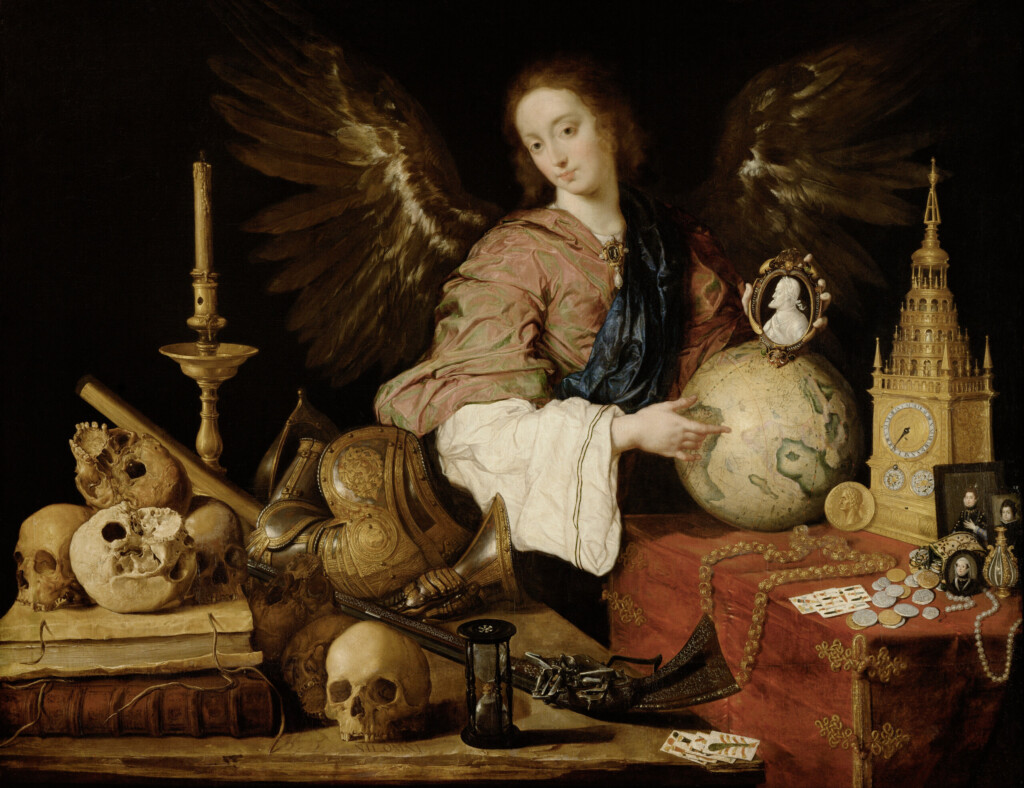
There is a particular moment when a candle burns low enough that the flame begins to stutter. Not yet extinguished, not fully alive — just flickering in its own pooled wax, consuming the last of what it was given. You have watched this. Everyone has. And in that watching, something happens that has nothing to do with sentiment: you become briefly, involuntarily aware that the room will go dark, and that you are sitting in it.
The Flemish painters of the seventeenth century returned to this image compulsively. Harmen Steenwyck arranged his vanitas compositions around 1640 with a guttering candle placed among books, shells, a Japanese sword, a skull — objects that span continents and centuries of human effort, and yet the candle makes them all provisional. Pieter Claesz in the 1630s did something similar with even starker economy: a near-spent candle beside a glass vessel, a watch, scattered papers. The candle in these works is never decorative. It is structural. It organizes the moral geometry of everything else on the table. While it burns, the other objects have a context. When it goes out, they become simply things.
What these painters understood, and what Martin Heidegger would articulate nearly three centuries later in Being and Time, is that death is not an event that happens at the end. It is a condition that pervades. Heidegger called it Being-toward-death — not morbidity, not grief, but the fundamental orientation of a creature that knows its own finitude and must decide, consciously or not, what to do with that knowledge. But Heidegger’s language can make this feel abstract, architectural, removed from the body. The candle makes it physical. You do not read about impermanence when you watch a flame stutter. You feel it somewhere below the sternum, in the part of you that precedes language.
The vanitas painters were not interested in philosophy as such. They were interested in attention. The candle does not mourn itself. This is what separates it from every human response to mortality — it simply burns, completely, without reservation, without the elaborate detours we construct to avoid looking directly at what we are doing here. A candle spends itself entirely on the act of giving light. There is no remainder, no residue of unused life. And this, if you sit with it long enough, becomes less a comfort than a challenge.
The tradition as a whole was never consolatory. This is the misreading that strips it of its actual force. People encounter a skull on a painted table and assume they are being instructed — memento mori, remember you will die, adjust your priorities accordingly. But instruction implies a gap between the teacher and the taught, a distance across which wisdom can be safely transmitted and received. Vanitas works do not maintain that distance. They close it. The skull is not a symbol pointing toward death; it is death, present, already in the room, already among the peeled lemon and the overturned goblet and the pocket watch whose hands have stopped at no particular hour.
What the tradition offers instead of consolation is visibility. And visibility is already something — perhaps the most uncomfortable something available to a person — because it cannot be unfelt once it arrives. A man sits before a painted table in a quiet room, watching a filmed scene in which everything a character has accumulated is revealed as scaffolding, not foundation — the career, the careful relationships, the managed self-image — and something in him recognizes the arrangement without being able to name it. He has seen the skull clearly, even if briefly, even if accidentally.
Once you have seen it clearly, you cannot arrange the other objects around it in quite the same way again. The candle goes on burning. That is all it knows how to do.
💀 Symbols of Mortality: Art, Time, and the Void
Vanitas painting is far more than a collection of skulls and wilting flowers — it is a meditation on transience, meaning, and the hidden language of symbols. The articles below trace the deepest cultural and philosophical roots of this tradition, from Baroque Spain to Aztec ritual, from alchemical emblems to existential thought.
Day of the Dead: History and Meaning
The Day of the Dead is one of the most vivid living expressions of vanitas culture, transforming the confrontation with death into communal celebration and artistic spectacle. Rooted in pre-Columbian Aztec beliefs and reshaped by Catholic influence, it shares with vanitas painting the same core impulse: to look death directly in the face without flinching. Skulls, marigolds, and offerings become symbols as loaded with meaning as any Flemish still life.
GO TO THE SELECTION: Day of the Dead: History and Meaning
Solve et Coagula: Alchemical Meaning
The alchemical motto Solve et Coagula — dissolve and coagulate — encapsulates a symbolic worldview strikingly parallel to the vanitas tradition, where destruction and renewal are inseparable. Both alchemy and vanitas art use material objects — bones, hourglasses, candles — as vessels for deeper truths about the soul’s transformation. Understanding this phrase unlocks a hidden layer of meaning in much of early modern European symbolism.
GO TO THE SELECTION: Solve et Coagula: Alchemical Meaning
Aztec Culture: History Religion and Art
Aztec culture developed one of history’s most elaborate symbolic vocabularies around death, sacrifice, and the cyclical nature of time — themes that resonate directly with the European vanitas tradition. Skulls in Aztec iconography were not merely signs of mortality but powerful emblems of regeneration and cosmic order. Exploring Aztec art reveals how universal the impulse to symbolize transience truly is, spanning continents and centuries.
GO TO THE SELECTION: Aztec Culture: History Religion and Art
Camus’s Myth of Sisyphus: The Absurd Explained
Camus’s essay on the myth of Sisyphus confronts the same existential abyss that vanitas painters rendered in oil and shadow: the absurdity of human striving in the face of inevitable death. Where the vanitas artist placed a skull beside a book or a snuffed candle, Camus placed Sisyphus beside his boulder — both images asking whether life holds meaning despite its ending. Reading Camus alongside vanitas iconography deepens the philosophical resonance of both.
GO TO THE SELECTION: Camus’s Myth of Sisyphus: The Absurd Explained
Discover Cinema That Thinks About Mortality
If these themes of transience, symbolism, and the search for meaning move you, Indiecinema streaming is the place to go deeper. Our curated catalog brings together independent and art-house films that explore mortality, beauty, and the hidden layers of human experience with the same depth you find in a vanitas painting. Join us and let cinema become your mirror.
👉 EXPLORE THE CATALOG: Watch Indie Films in Streaming
A vision curated by a filmmaker, not an algorithm
In this video I explain our vision

