
The Mirror You Avoid in the Morning
You catch it for a fraction of a second before your brain catches up. Not in the bathroom mirror where you stand deliberately, cataloguing yourself, but in the dark glass of a shop window, or the black screen of a phone before it lights up, or the unexpected reflection in a colleague’s framed certificate hanging crookedly on an office wall. For that one unmeasured instant, before recognition floods in and you reassemble the familiar story of who you are, you see something else entirely. A face that is moving toward its own erasure. A body that is, right now, in the middle of disappearing. Then your brain performs its merciful trick, and you see yourself again, and you keep walking.

That flash — that quarter-second before the self-narrative reactivates — is not a psychological malfunction. It is not morbidity, not depression, not what well-meaning people mean when they tell you that you spend too much time in your head. It is, in fact, the only moment in any given day when you are seeing clearly. Everything that comes after, the reassembled identity, the forward momentum, the calendar and the coffee and the pleasant numbness of routine, is the management system your mind constructed specifically to prevent you from sitting down on the pavement and not getting up.
The Romans had a phrase for what just happened to you. Two words that were not, originally, the inscription on a skull or the title of a philosophical treatise, but a spoken instruction delivered by a human voice. Memento mori. Remember that you will die. Not as a metaphor. Not as a meditation to be undertaken at leisure, in a garden, with adequate preparation. As a command issued in real time, in public, on the occasion of what the culture had decided was its greatest triumph. The general returning from war, riding through the city in a chariot while crowds thinned the air with noise, would have a slave standing directly behind him, mouth close to his ear, saying it continuously. Remember you are mortal. Remember you are mortal. The laurel crown and the whisper arriving together, inseparable, designed that way.
This is not a curiosity from a civilization that no longer concerns you. This is a technology — one of the most sophisticated psychological instruments ever devised — that your culture has systematically dismantled over the past three centuries and replaced with nothing except the vague, ambient dread that now saturates modern life like a frequency you cannot locate but cannot stop hearing.
Ernest Becker spent most of the 1970s building the argument, culminating in The Denial of Death in 1973, that the whole of human civilization — its monuments, its religions, its heroism projects, its consumer behaviors — is essentially an enormous collective apparatus for not finishing that sentence. His central claim was not that death-awareness is pathological but that the refusal to hold it consciously is what generates pathology, including the specific modern pathology of living with constant low-grade terror that attaches to everything except its actual source. He was awarded the Pulitzer Prize two months after he died, which has a kind of terrible elegance to it.
What the Romans understood, and what Becker reconstructed from the wreckage, and what you already knew before you had any language for it — because your body has always known it, as it knew it in that reflection before your mind intervened — is that the awareness of death is not the enemy of life. It is its precondition. The thing that makes a moment specific, that makes a face matter, that makes the particular texture of an afternoon in a particular city in a particular year irreplaceable rather than interchangeable with any other afternoon anywhere else. The mirror you avoid is not showing you something terrible. It is showing you the only true thing.
Don Barry: A Quixotic Exploration
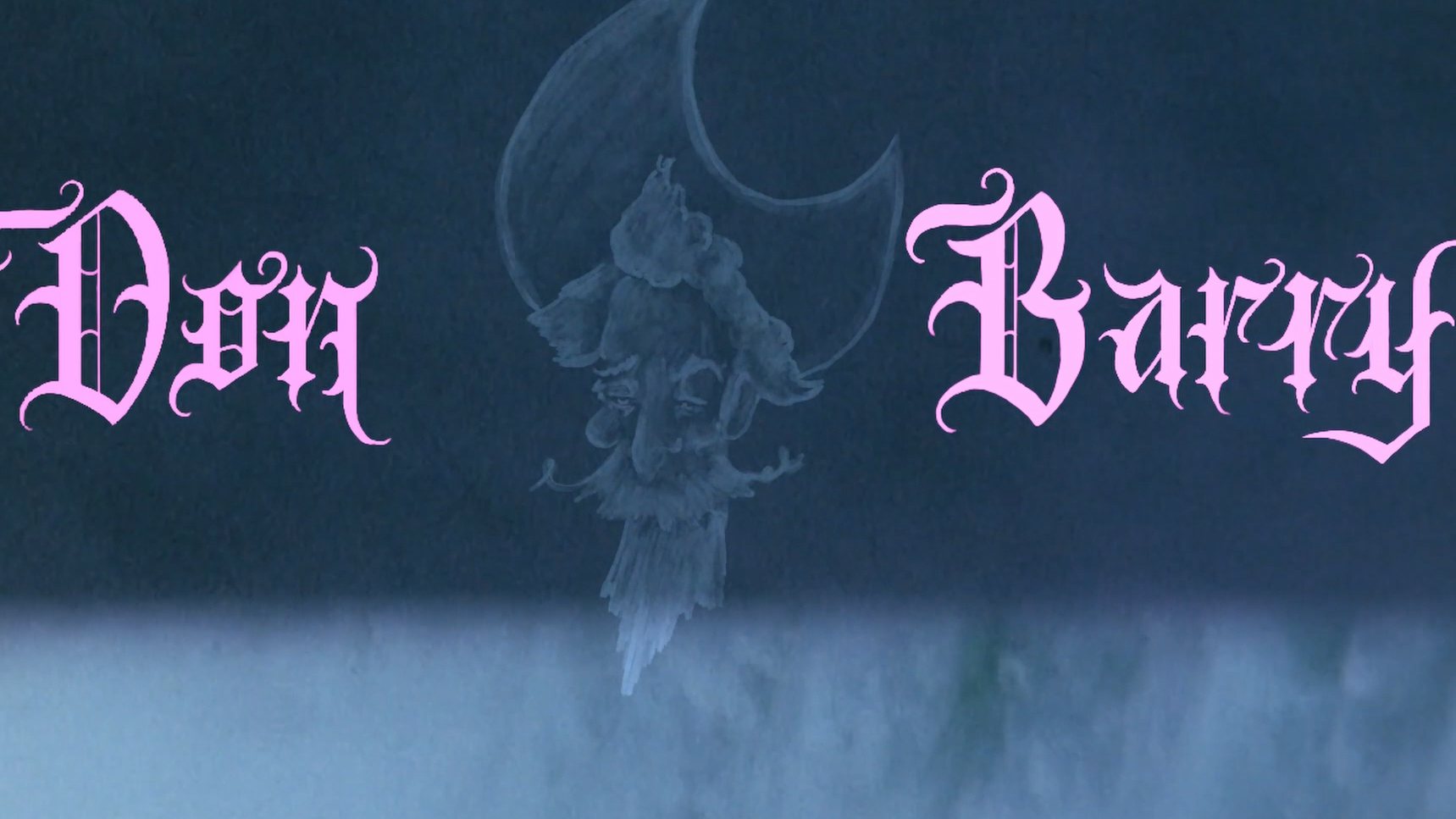
Docufiction, Experimental, by Paul Smart, Mexico, 2026.
Don Barry: A Quixotic Exploration is a debut feature that places the biography of an eighty-year-old experimental filmmaker and artist, Barry Gerson, within the metanarrative of Miguel de Cervantes’ Don Quixote. Don Barry was filmed in the city of Guanajuato during the 51st edition of the Cervantino Festival, as well as during the vibrant Day of the Dead celebrations held in the city’s UNESCO-listed tunnels. The film honors the director’s long friendship with artist Barry Gerson, drawing inspiration from Cervantes’ Don Quixote. Paul Smart’s directorial choices create something new that celebrates life and goes beyond conventional storytelling. A search for magic in our real lives. A moving film about the meaning of life, art, and death. Not to be missed.
Paul Smart is a proud outsider filmmaker with a long history of film screenings. In the 1980s, he emerged in New York’s vibrant youth art scene, working in theater production and later filmmaking, before retreating to rural upstate New York, in the Catskill Mountains, where he made a living writing and screening independent films in old parish halls for rural audiences, many of whom had never seen a film.
LANGUAGE: English
SUBTITLES: Spanish, French, German, Portuguese
A Skull on the Desk Was Once Normal
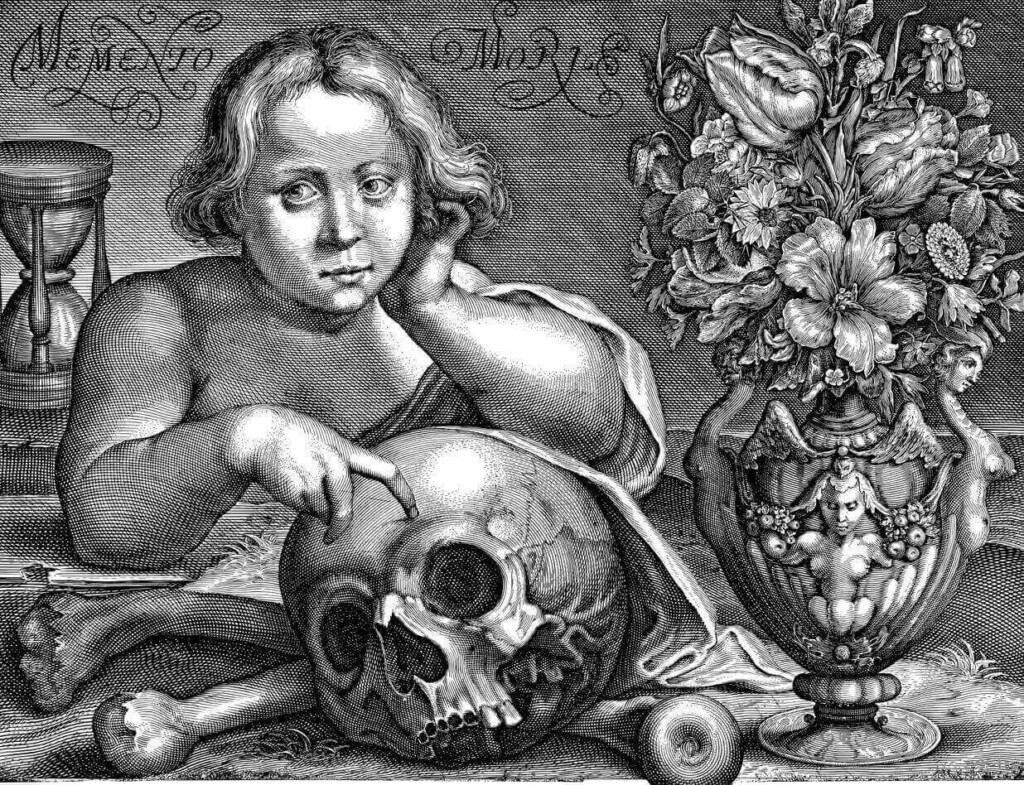
There is a particular kind of stillness in a room where someone keeps a human skull on their desk. Not the stillness of morbidity or theater, but the stillness of a person who has decided to stop lying to themselves. For centuries, this was unremarkable. Scholars, philosophers, physicians, and clergymen placed skulls beside their inkwells and candles not as a provocation to visitors but as a tool for themselves — a cognitive anchor to the one fact that every waking hour conspires to make you forget.
The Romans had a formula for this, precise and unsentimental. When a general returned from war to march through the streets of Rome in triumph, a slave rode beside him in the chariot with a single appointed task: to whisper, again and again, “Memento mori.” Remember that you will die. The applause of the crowd, the garlands, the intoxication of conquest — all of it was intended to be heard through that whisper. The skull on the desk was simply the domestic version of that slave. It sat in the corner of vision while you read, while you wrote, while you argued with yourself about whether your work mattered. It did not let you forget the appointment you shared with every other living thing.
By the seventeenth century, Dutch painters had systematized this into an entire genre, and what is extraordinary about the vanitas tradition is not its darkness but its precision. A half-peeled lemon, its rind spiraling off the edge of a marble ledge. A pocket watch with its cover open. A glass of wine catching the light from a window that the eye never quite reaches. A skull resting against a book, sometimes draped with flowers already browning at the petals. These were not decorations. They were arguments rendered in oil and pigment — arguments about the relationship between beauty and duration, between possession and loss. The objects chosen were always objects of pleasure and status: musical instruments, fine fabrics, maps of newly discovered continents. Everything a prosperous Dutch merchant might own. And everything decaying within the frame.
What the vanitas painters understood, and what we have spectacularly unlearned, is that proximity to the fact of death does not produce despair. It produces a particular quality of attention. Philippe Ariès, in his monumental 1977 study of Western attitudes toward dying across a thousand years of history, traces with forensic patience the slow withdrawal of death from the center of daily life. In “The Hour of Our Death,” he describes what he calls the “tame death” of medieval and early modern Europe — a death that was public, ritualized, and domestically integrated. People died at home, in beds surrounded by community. Children were present. The dying person often choreographed their own end according to known scripts, making peace, distributing objects, offering last words that carried legal and spiritual weight. Death was, in Ariès’s reading, a social event that belonged to the living as much as to the person leaving.
The rupture Ariès identifies is not gradual evolution but something closer to a flinch. The nineteenth century begins to professionalize death, to move it into institutions, to render it a medical failure rather than a human threshold. By the twentieth century, dying has been almost entirely evacuated from the spaces where ordinary life unfolds. The skull moves off the desk and into the horror genre. The hourglass becomes a cliché. The rotting fruit becomes a hygiene problem.
We did not mature past the need for these objects. We decided, without ever quite deciding, that the whisper in the chariot was too uncomfortable to keep riding with. The slave was dismissed. The desk was cleared. And the forgetting, which had always been the real enemy, was left to work in peace.

The Roman General and His Whisperer
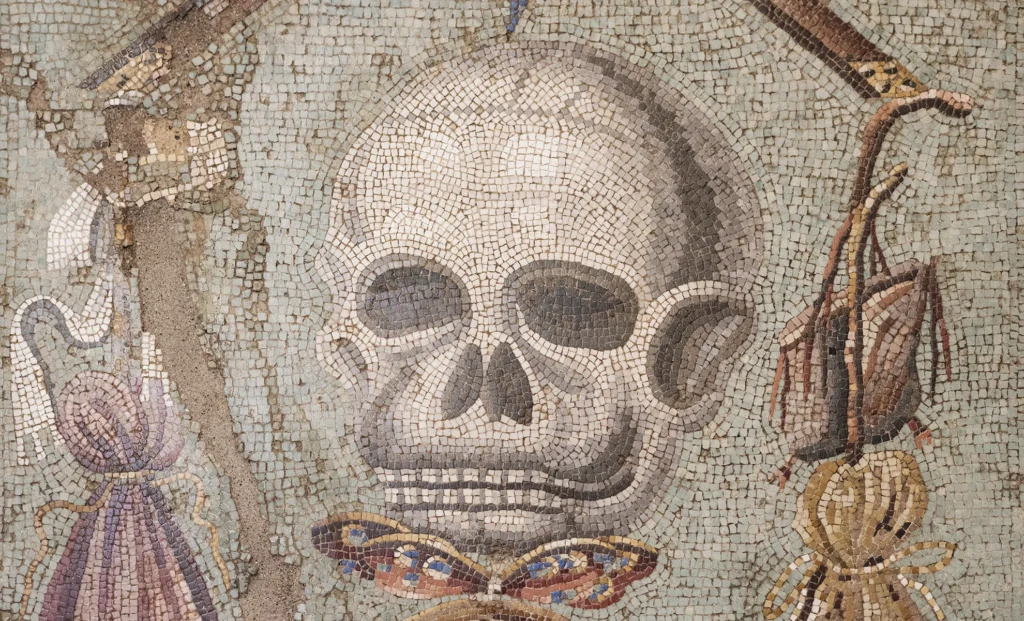
The chariot moves through streets dense with bodies pressing against each other, with the smell of sweat and laurel, with the sound of a city that has decided, for one afternoon, that a single man contains its greatness. The crowd does not see a person. It sees a symbol of its own survival, its expansion, its appetite confirmed by conquest. And the man in the chariot — painted red to resemble Jupiter, draped in purple, holding a laurel branch that trembles slightly with each turn of the wheel — begins, almost inevitably, to believe what the crowd believes. This is the mechanism. This is the trap.
Behind him, standing in the same chariot, close enough to be heard above the roar, is a slave. Not a counselor. Not a philosopher. A slave. His function during the triumph is singular and strange: to lean toward the ear of the most celebrated man in the Roman world and repeat, at intervals, a phrase that the noise of the crowd cannot drown out. Memento mori. Remember that you will die. Some sources record the phrase as memento te hominem esse — remember that you are a man. The distinction matters less than the structure. Someone paid to own nothing is assigned the task of reminding someone who owns everything that ownership is temporary.
This is not anecdote. This is institutional architecture. The Romans built the whisper into the ceremony itself, understanding something that most cultures prefer to forget: that glory is the precise moment when a human being becomes most vulnerable to the illusion of permanence. The historian Tertullian recorded this practice in the second century, and whether the specific details varied across different triumphs matters less than the fact that the Romans considered the correction necessary enough to formalize it. They legislated humility into the peak of pride. They made mortality procedural.
The phrase was never designed for the dying. The dying already know. You do not need to whisper memento mori to someone lying in a bed, watching the ceiling, counting breaths. The whisper belongs to the man in the chariot. It belongs to the moment of maximum visibility, maximum validation, maximum distance from the ordinary weight of being human. Epictetus understood this — a man who had himself been a slave — when he wrote that the chief task in life is simply to identify and separate within oneself what is in our power from what is not. Fame, he argued, belongs entirely to the second category. The crowd’s roar is not yours. It was never yours. And the slave behind you knows this better than you do, because he has never been permitted the luxury of forgetting it.
There is a scene that belongs to this exact topology, though it occurs in a different century and a different kind of theater. A man stands at the summit of his professional life, receiving the recognition he has spent decades pursuing. The room rises for him. Hands meet. His name becomes, briefly, the organizing principle of a crowd’s attention. And you can see it in his face — not happiness exactly, but something more dangerous: the sense that this is a reckoning, that the world has finally confirmed what he always suspected about himself. He cannot hear the whisper. The whisper has been drowned by the applause, and more importantly, there is no one behind him whose job it is to speak it. The slave has been abolished. The ceremony has been redesigned to remove the correction.
What remains when you extract the whisper from the triumph is not liberation. It is a man in a chariot who will eventually step down into ordinary life and find that the ground feels wrong, that his feet do not recognize the texture of the unremarkable, that he has confused the roar of a single afternoon with the sound of something permanent. The Romans knew the difference. They employed someone specifically to enforce it.
What the Stoics Actually Said (And What We Sanitized)
There is a moment that appears in the historical record of one man’s private notebooks — written in Greek, never intended for publication, composed during military campaigns somewhere on the Danube frontier in the second century CE — where he reminds himself, with a severity that has no warmth in it whatsoever, that Alexander the Great and his mule driver ended up in the same condition. Not as consolation. Not as equalizing comfort for the mule driver. As a cognitive scalpel turned inward, against the emperor himself, against every instinct he had to treat his own decisions as cosmically significant.
This is what Marcus Aurelius was actually doing in the Meditations, and it bears almost no resemblance to what airport bookshops sell under his name today. He was not practicing gratitude. He was not optimizing his mornings. He was systematically dismantling his own sense of importance by pressing the fact of death against every thought he had until the thought either held its weight or collapsed. Most thoughts collapsed. That was the point.
The Stoic practice of meditatio mortis — the deliberate, methodical contemplation of one’s own death — was a cognitive instrument before it was anything else. Seneca, writing to his friend Lucilius in letters that move between domestic detail and existential ferocity with unsettling ease, is explicit about this function. Death is not the thing you prepare for at the end. Death is the lens you use now, today, on this conversation, on this ambition, on this anxiety about what someone said about you at dinner. In Letter 77 he writes that it is not the duration of life but its quality that matters — but the Latin carries a sharpness the translations often soften: the question is whether you have lived, not how long you have been alive. He is not being encouraging. He is asking you to consider whether the thing you are currently treating as urgent would survive contact with the actual weight of your finitude.
Epictetus, who was a slave before he was a philosopher, had less patience for softening. His Discourses return again and again to the simple, brutal observation that we suffer not from circumstances but from our judgments about circumstances — and that death, properly contemplated, reveals how many of those judgments are fabricated hierarchies, false urgencies manufactured by social pressure and ego. He does not say this gently. He says it the way someone says it who has had his leg broken by his owner and reportedly remarked, with complete composure, that it would break. The meditatio mortis in Epictetus is not a peace practice. It is a demolition tool.
What happened to these texts in the twenty-first century is a case study in cultural digestion that philosophers of ideology would recognize immediately. The same apparatus that turned Nietzsche into motivational posters extracted from the Stoics a usable vocabulary of resilience, focus, and equanimity, while systematically removing the confrontational core. Tim Ferriss, Ryan Holiday, and an entire ecosystem of productivity culture have sold Marcus Aurelius to people who want to be more effective at their careers — which is precisely the inversion the emperor was trying to perform on himself when he noted that the fame of men like him dissolves faster than smoke. He was trying to make ambition feel like smoke. The contemporary reading makes smoke feel like fuel.
The domestication is not accidental. A philosophy that genuinely uses death as a cognitive instrument to shatter false hierarchy is threatening to almost every structure of modern life — to the logic of careers, to the premise that accumulated status means something, to the entire architecture of deferred living. A philosophy that teaches you to wake up earlier and focus better is a product. The Stoics wrote documents of radical psychological confrontation. We turned them into a subscription service.
The Man Who Wrote Notes to a Dead Woman
There is a man who writes letters every day to a woman who will never read them. He sits at the same table, at the same hour, with the same pen, and he describes the morning light coming through the window as if she might still care about morning light. He is not grieving. He finished grieving years ago. What he is doing now is something more stubborn and more dangerous: he is using her absence as a wall between himself and the knowledge that he, too, will disappear.
This is where the memento mori function collapses. Not with a bang, not with dramatic denial, but with this quiet daily ritual that looks from the outside like devotion and feels from the inside like survival. The dead become tools. We recruit them into service against our own terror.
Think of the man who stopped trusting his own mind and began writing everything onto his skin. Facts. Dates. Names. The logic was simple: if he could not remember, he could not be deceived. So he tattooed certainties into his flesh, turning his body into an archive, a system of external verification designed to protect him from the unreliability of consciousness. What he did not understand, what perhaps he could not afford to understand, was that the forgetting he feared most had nothing to do with memory loss. It had to do with the forgetting that precedes death, the slow erasure that begins while you are still breathing, still walking, still convinced you are the one holding the pen. His tattoos were not a system for remembering the dead. They were a system for refusing to join them.
Ernest Becker argued in The Denial of Death, published in 1973, that most of what we call culture is a defense mechanism, an elaborate structure built to keep mortality out of sight. The heroism systems, the love bonds, the legacy projects, the religious architectures, all of it functions, at least in part, as what he called immortality projects, symbolic structures that promise the self a continuation beyond the biological fact. When Becker wrote that man is literally split in two: he has an awareness of his own splendid uniqueness in that he sticks out of nature with a towering majesty, and yet he goes back into the ground a few feet in order to rot and disappear forever, he was not describing a psychological curiosity. He was describing the operating condition of every person who has ever written a letter, carved a stone, or tattooed a fact onto their own arm.
The woman who returns to a house she once loved is not looking for the house. She already knows it has changed, that the rooms have been repainted, that someone else’s furniture fills the spaces where her memory placed other objects. She goes anyway. She stands outside. She measures the distance between what was and what is. And in that measurement, she is briefly, almost unbearably alive, because she is touching the reality of loss without yet touching the reality of her own ending. The dead loved one becomes a rehearsal she never finishes.
Philippe Ariès, in his monumental study The Hour of Our Death, traced how Western civilization moved over roughly five centuries from a culture of tamed death, in which dying was a communal, public, almost liturgical act, to a culture of forbidden death, in which mortality is hidden in hospitals, managed by professionals, and kept as far from daily consciousness as bureaucracy allows. The memento mori tradition belonged entirely to the first culture. It was a technology of presence, not of evasion. The skull on the desk, the hourglass in the painting, the inscription on the ring: these were not invitations to despair. They were instruments of calibration, tools for measuring the weight of a living hour against the certainty of its end.
When we use the dead to avoid that calibration, we have not honored them.
A vision curated by a filmmaker, not an algorithm
In this video I explain our vision
Vanitas Paintings and the Lie of the Still Life

There is a skull on the table. Next to it, a half-peeled lemon, its rind spiraling downward in a single elegant gesture that will never complete itself. A pocket watch, open. A snuffed candle, its smoke still visible, frozen mid-dissolution. A glass of wine, full, waiting for a hand that will not come. These objects are painted with such technical devotion, such painstaking attention to surface and light, that you almost reach out to touch them. That is precisely the trap, and the painters knew it.
The Dutch vanitas tradition of the seventeenth century was not a genre of mourning. It was something structurally more uncomfortable than that. Painters like Pieter Claesz, who worked in Haarlem through the 1620s and 1630s, and Harmen Steenwyck, whose most celebrated work dates to around 1640, and Jan Davidsz de Heem, who moved between Antwerp and Utrecht and brought a southern lushness to the northern severity, were not warning you that life was sad. They were demonstrating, through the act of beautiful making, that beauty and cessation are the same gesture. The skull does not interrupt the feast. The skull is the feast, seen from the correct angle.
The word vanitas comes from Ecclesiastes — vanitas vanitatum, all is vanity — but the paintings are not theological in any simple sense. They are epistemological. They are asking what it means to look at something, to want it, to render it permanent through representation, knowing that the representation itself is a lie. The lemon will rot. The watch will stop. The candle, in the painting, never goes out, which is the real horror. The painting freezes the moment of decay without letting it proceed. You are held there, in the imminence of ending, permanently.
What these painters understood, with a sophistication we have largely refused to inherit, is that the image does not preserve life. The image documents the distance between the living thing and its representation. Susan Sontag, writing in 1977, pressed exactly this nerve when she argued that photography, despite its apparent modernity, performs the same fundamental act as the vanitas still life — it converts the living into the static, the present into the already-past. Every photograph, she wrote, is a certificate of death. The moment you capture something, you have already begun to mourn it, though almost no one admits this while holding their phone up and adjusting the light.
The difference, and it is a catastrophic one, is that the vanitas painters admitted what they were doing. Claesz placed the skull in full view. De Heem let the fruit soften at its edges. Steenwyck arranged his objects so that the viewer could not mistake the symbolic grammar being deployed. There was no pretense that the image redeemed its subject. The contemporary image-making apparatus, by contrast, is built entirely on that pretense. The filter, the retouching, the carefully composed frame that cuts out the disorder at the edges — all of it is vanitas painting with the skull removed. You have kept the lemon. You have kept the wine glass. You have hidden the watch and snuffed the candle in the part of the room the camera does not reach.
Sontag understood that this denial was not accidental. It was structural, built into the logic of how images circulate and what they are asked to do. An image that acknowledged death would not perform correctly in an economy that requires desire to remain permanently unfulfilled and permanently renewable. The vanitas painters were working inside a culture that still integrated death into daily symbolic life, that still found it intellectually honest to sit with a skull at the table and call it beautiful.
You look at a painting of a half-eaten feast, a guttered candle, a watch face tilted toward you, and you understand something the photograph will not let you feel — that the most precise act of attention is also an act of farewell.
The Civilization That Forgot It Was Dying
There is a moment, sometime in the middle of the twentieth century, when the dying stopped happening at home. Not dramatically, not announced. Simply, gradually, the bed in the back room where three generations had exhaled their last breaths was replaced by a phone call, an ambulance, a set of automatic doors that closed behind someone you loved and never opened for you again. The dying migrated to corridors you were not allowed to walk. Death became a procedure performed by professionals in a building designed so that its outputs — the body, the grief, the disruption — could be managed, contained, invoiced.
This was called progress.
Ernest Becker, writing in 1973 in what would become one of the most uncomfortable books in the American intellectual tradition, had a different name for it. In “The Denial of Death,” which won the Pulitzer Prize the year after his own death from cancer, Becker argued with relentless precision that human civilization is not primarily a project of meaning-making or beauty or justice. It is, at its metabolic core, a system for not thinking about dying. Every institution, every hierarchy, every symbolic achievement — the pyramid, the cathedral, the career, the family name — is what Becker called an “immortality project,” a structure erected against the one fact the animal body already knows but the conscious mind cannot tolerate. We are, in his phrase, “gods who shit.” Creatures aware of their own annihilation, condemned to build elaborate fictions that let them keep moving through the day.
What Elisabeth Kübler-Ross published in 1969 as “On Death and Dying” was, on its surface, a humane corrective — a call to restore dignity to the dying, to listen to them, to stop the clinical avoidance. Her five stages of grief entered the cultural vocabulary so completely that they became a kind of grammar for loss. But something happened in translation. The stages — denial, anger, bargaining, depression, acceptance — were never meant as a checklist, yet they became exactly that: a protocol, a timeline, a way of administering grief so that it would conclude. Grief with a finish line is grief that has been domesticated. And a civilization that turns grief into a managed sequence of emotional phases has not learned to face death. It has built a more sophisticated cage for looking away.
You have met this avoidance in the flesh of a person you know. Someone who, after an unbearable loss, reconstructed their entire daily life around a system of tasks, rituals, records — not to remember, but to maintain the illusion that if the system held, nothing irreversible had happened. A man who kept filing papers, updating calendars, writing notes to himself on scraps arranged with obsessive care, as though the architecture of control could substitute for the memory of a life. The system was not grief. The system was the refusal of grief wearing grief’s clothing. Every note he wrote was a small act of magical thinking: if I stay organized, if I maintain the record, the loss has not yet fully landed.
This is precisely what Becker meant. Terror management — the phrase borrowed and expanded by psychologists Jeff Greenberg, Sheldon Solomon, and Tom Pyszczynski in their decades of experimental research building on Becker’s framework — is not a pathology of certain fragile individuals. It is the default operating mode of the species. Studies conducted from the 1980s onward consistently demonstrated that even brief reminders of mortality — a questionnaire, a word flashed subliminally, a conversation near a funeral home — measurably increase people’s hostility toward those who hold different worldviews, their attachment to cultural symbols, their need for self-esteem. Death anxiety does not make us more tender. It makes us more tribal, more rigid, more frantic in our need to believe our particular story is the true one.
The twentieth century did not conquer death. It industrialized the denial.
The Skull Beneath Every Ordinary Tuesday
You are standing in your kitchen on a Tuesday morning. Not a significant Tuesday. The coffee is brewing, the light is coming through the window at that particular angle it always comes through, and you are thinking about something small — a message you need to send, a meeting you are already half-dreading. The mugs are where you left them. The chair has the slight wobble it has always had. Everything is exactly as it should be, and then, for no reason you can name, it isn’t.
Something shifts. Not dramatically. Not with the weight of a diagnosis or a funeral or any of the officially sanctioned moments when mortality is permitted to enter the room. Just a small, vertiginous recognition that none of this — not the mug, not the light, not the hand holding the mug — is guaranteed to be here tomorrow. The ordinary objects in the room do not change. But you have briefly stopped pretending.
This is what the memento mori actually does, stripped of its ecclesiastical robes and its Renaissance iconography and its philosophical footnotes. It is not a lesson. It is a perceptual event. Epictetus understood this when he wrote in the Enchiridion that when you kiss your child goodnight, you should whisper to yourself that this child is mortal — not to destroy the tenderness of the moment, but to make it real in a way that comfort actively prevents. The Stoics were not morbid. They were precise. They understood that love without the awareness of loss is not love at all but a kind of low-grade anesthesia.
There is a man, middle-aged, unremarkable in the way most of us are unremarkable, who one afternoon finds himself standing in the living room of the house where he grew up, now emptied of furniture after his mother’s death. The walls still carry the faint shadows where the pictures hung. The floor has a pale rectangle where the rug lay for forty years. He does not weep. He stands there with the peculiar clarity of someone who has just understood a sentence he has been reading his whole life without comprehension. The ordinary room, made strange by absence, is suddenly more real than any room has ever been to him. He was always going to lose this. He lost it before he knew he had it. That is not tragedy. That is the structure of every human life, and the only question is whether you live inside that structure or spend your years pressing your face against the window from outside.
Martin Heidegger called this Sein-zum-Tode — being-toward-death — and argued in Being and Time that authentic existence becomes possible only when we stop treating death as something that happens to other people at some unspecified future date. The inauthenticity he diagnosed is not a philosophical failing. It is a Tuesday morning failing. It is the choice, made constantly and unconsciously, to keep the wobbling chair and the cooling coffee inside the sealed room where nothing ends.
The skull beneath the feast, the hourglass in the corner of the painting, the fly landing on the perfect peach — these were never meant to punish you with your own finitude. They were meant to crack the sealed room open, just slightly, just enough to let the actual temperature of your life come through. Not so you would grieve. Not so you would renounce. So you would finally, for a moment, be where you are.
The coffee is ready. The light is still coming through the window. The hand holding the mug is the same hand it was a moment ago, and it is also nothing like it, because you are now looking at it the way you would look at something you are about to lose, which is the only way anyone has ever truly looked at anything worth keeping.
💀 Death, Time, and the Art of Living
Memento Mori — ‘remember that you must die’ — is one of the most enduring philosophical and artistic motifs in human history. From ancient stoic meditations to baroque vanitas paintings, the contemplation of mortality has shaped how cultures find meaning, create beauty, and face the unknown. The articles below explore the deepest echoes of this tradition across philosophy, literature, and ritual.
Day of the Dead: History and Meaning
The Day of the Dead is one of the most vivid living expressions of the memento mori tradition, transforming grief into celebration and the skull into a symbol of joyful continuity. Rooted in pre-Columbian Aztec rituals and reshaped by Catholic influence, this Mexican festival invites the living to sit alongside the dead rather than flee from them. It remains one of the most profound cultural responses to mortality ever conceived.
GO TO THE SELECTION: Day of the Dead: History and Meaning
Viktor Frankl: Life and Logotherapy
Viktor Frankl survived the Nazi concentration camps and emerged with a radical insight: the awareness of death does not destroy meaning but can intensify it beyond measure. His logotherapy, born directly from confrontation with annihilation, argues that human beings can endure any suffering if they understand why they are living. In this sense, Frankl’s entire philosophy is a living meditation on the memento mori imperative.
GO TO THE SELECTION: Viktor Frankl: Life and Logotherapy
Camus’s Myth of Sisyphus: The Absurd Explained
Albert Camus built his philosophy of the Absurd on the foundational tension between human beings’ desperate search for meaning and the universe’s cold, indifferent silence — a tension that the awareness of death makes unbearable and inescapable. In ‘The Myth of Sisyphus,’ Camus confronts the question of whether life is worth living precisely because it ends, and answers it with defiant affirmation. His work stands as one of the most powerful modern reworkings of the memento mori into a philosophy of rebellion.
GO TO THE SELECTION: Camus’s Myth of Sisyphus: The Absurd Explained
Solve et Coagula: Alchemical Meaning
The alchemical motto ‘Solve et Coagula’ — dissolve and coagulate — carries within it a philosophy of transformation that parallels the memento mori tradition: only through the death of one form can a higher form emerge. In Hermetic and alchemical practice, the contemplation of dissolution was not morbid but regenerative, mirroring nature’s own cycles of decay and renewal. This principle connects the art of dying to the art of becoming, making alchemy one of the esoteric traditions most deeply intertwined with mortality symbolism.
GO TO THE SELECTION: Solve et Coagula: Alchemical Meaning
Explore the Cinema of Mortality and Meaning
If these reflections on death, time, and the search for meaning have stirred something in you, Indiecinema streaming is where those questions come alive on screen. Discover independent and auteur films that dare to look mortality in the eye — without flinching, without consolation, but always with depth and beauty.
👉 EXPLORE THE CATALOG: Watch Indie Films in Streaming
A vision curated by a filmmaker, not an algorithm
In this video I explain our vision

