
The Room That Refuses to Apologize
There is a room you walk into and your chest tightens slightly, not from anxiety but from something closer to pressure — the walls covered in a dense, almost aggressive pattern of blue and ochre and coral, a tablecloth bleeding into a wallpaper bleeding into a curtain so that you cannot find the edge of anything, goldfish circling in a glass bowl on a table that seems to exist in three places at once, the window beyond it all opening onto a garden so green it reads almost as noise. You stand there and your body responds before you have had time to form an opinion. Your pulse does something. You breathe differently. The room is not asking for your approval.

This is the first and most important thing to understand about Henri Matisse: he built that room. He built it over and over again, across fifty years, in paint and paper and cut color, and he built it without apology and without the philosophical anxiety that Western art had decided was the price of seriousness. He had looked at the suffering-as-credential tradition that had settled over modern painting like a weather system and he had decided, with a precision that reads in retrospect as almost aggressive, that joy was not the enemy of depth. It was, in fact, its most demanding form.
This is the claim that still discomforts people, and it is worth sitting with that discomfort rather than smoothing it away. Born in Le Cateau-Cambrésis in northern France on December 31, 1869, Matisse came of age in an art world where seriousness wore darkness as its uniform. Cézanne was reorganizing the visible world with the gravity of a geologist. Van Gogh was consuming himself. The aesthetic vocabulary of the suffering artist — the tortured, the restless, the existentially displaced — was already calcifying into convention by the time Matisse walked into the École des Beaux-Arts in 1895 under Gustave Moreau, who was, by every account, one of the rare teachers in the history of art who told his students to look at what they actually saw rather than at what painting had already decided was there.
What Matisse saw was color. Not as decoration. Not as the finishing touch applied to a drawing that had already done the real intellectual work. Color as structure, as sensation, as the primary grammar of lived experience. John Gage, in his essential study of color in Turner and the broader history of chromatic thought, traces the long European ambivalence about color versus line — a hierarchy in which drawing was considered the domain of reason and color the domain of appetite, the senses, the body. Matisse demolished this hierarchy not by arguing against it but by making it irrelevant, by creating canvases in which the sensation and the structure were inseparable, in which the pleasure and the rigor arrived simultaneously and could not be disentangled.
The French critic Louis Vauxcelles famously coined the term “Fauves” — wild beasts — in 1905 after seeing the room at the Salon d’Automne where Matisse and his circle had hung their work. The phrase was meant to sting. What Vauxcelles saw, and what disturbed him, was color liberated from its descriptive function, color that did not stay where objects ended and space began, color that behaved, in his understanding, like something unleashed. He was not wrong about the unleashing. He was wrong about what had been released. It was not chaos. It was a different kind of discipline — one organized around sensation and presence rather than around the illusion of depth that Western perspective had been constructing since Brunelleschi calculated the vanishing point in Florence sometime around 1415.
Matisse understood that the room which refuses to apologize for what it is takes more courage to build than any ruin.
Don Barry: A Quixotic Exploration

Docufiction, Experimental, by Paul Smart, Mexico, 2026.
Don Barry: A Quixotic Exploration is a debut feature that places the biography of an eighty-year-old experimental filmmaker and artist, Barry Gerson, within the metanarrative of Miguel de Cervantes’ Don Quixote. Don Barry was filmed in the city of Guanajuato during the 51st edition of the Cervantino Festival, as well as during the vibrant Day of the Dead celebrations held in the city’s UNESCO-listed tunnels. The film honors the director’s long friendship with artist Barry Gerson, drawing inspiration from Cervantes’ Don Quixote. Paul Smart’s directorial choices create something new that celebrates life and goes beyond conventional storytelling. A search for magic in our real lives. A moving film about the meaning of life, art, and death. Not to be missed.
Paul Smart is a proud outsider filmmaker with a long history of film screenings. In the 1980s, he emerged in New York’s vibrant youth art scene, working in theater production and later filmmaking, before retreating to rural upstate New York, in the Catskill Mountains, where he made a living writing and screening independent films in old parish halls for rural audiences, many of whom had never seen a film.
LANGUAGE: English
SUBTITLES: Spanish, French, German, Portuguese
Nice, 1869: A Body Born Into the Cold
He was born in December, in Le Cateau-Cambrésis, a town that the industrial north of France had shaped into something close to a moral landscape — flat, grey, resistant to ornament. The year was 1869, and the region wore its severity like a second skin. Textile mills dominated the horizon. The air carried the particular density of places where beauty is considered a distraction from work, and work is considered the only honest proof of existence. His father, Émile Hippolyte Henri Matisse, was a grain merchant, a man who understood the world through weight and measurement, through what could be counted and sold. The household was not cruel. It was something more quietly suffocating than cruelty. It was purposeful.
You recognize this kind of childhood even if you did not live it. The kind where the future is already decided before you learn to ask questions about it, where ambition is channeled into respectable channels and everything else is gently, firmly, buried. Matisse was sent to Paris to study law, and he did, without apparent rebellion, without the dramatic rupture that biographical myths prefer. He returned north to work as a law clerk in Saint-Quentin. He was twenty years old and moving through his life like a figure in a landscape that had nothing to do with him.
Then his body intervened.
In 1890, appendicitis and its long convalescence pressed him into a stillness that the life he had been living would never have permitted. His mother, passing time during his recovery, brought him a paint box. The gesture was probably casual — something to occupy idle hands, to fill the hours that illness had emptied of obligation. But what happened in that stillness was the opposite of idleness. It was, in Simone Weil’s precise and demanding sense, attention. In her 1942 essay “Waiting for God,” Weil argues that attention is not concentration, not willpower aimed at an object. It is a kind of emptying — the suspension of the self so that something real can enter. She called it a form of waiting for grace, and she meant that the most genuine forms of perception require a prior abdication of control.
Matisse, flat on his back in the industrial north, was stripped of the controlling narrative his father’s world had written for him. He could not go to the office. He could not perform usefulness. He could only look. And in that enforced looking, something structural shifted — not a talent suddenly discovered, which is always the lazy version of the story, but a relationship to perception that the busy life of a law clerk would have systematically prevented. The philosopher Maurice Merleau-Ponty, writing in “Phenomenology of Perception” in 1945, argues that the body is not a vehicle for consciousness but its very condition — that we do not perceive through the body, we perceive as the body. The illness gave Matisse back his body as an instrument of genuine encounter with the visible world, precisely by making it temporarily useless for everything else.
He described the experience himself as a kind of paradise. The word matters. Not relief, not pleasure — paradise. A state prior to the obligations of the fallen world. There is something almost theological in the confession, and it sits strangely against the grey mills and the grain merchant’s ledgers. But paradise was always the name for a place where you are allowed to see without purpose, to be present without justification.
He was twenty-one. He had spent his entire conscious life inside a framework that measured existence by what it produced. And now, briefly, legitimately, thanks to a rupture in his own abdomen, he was exempted from production. He picked up a brush the way you might pick up a language that was always yours, simply not yet spoken.

The Scandal of Pleasure
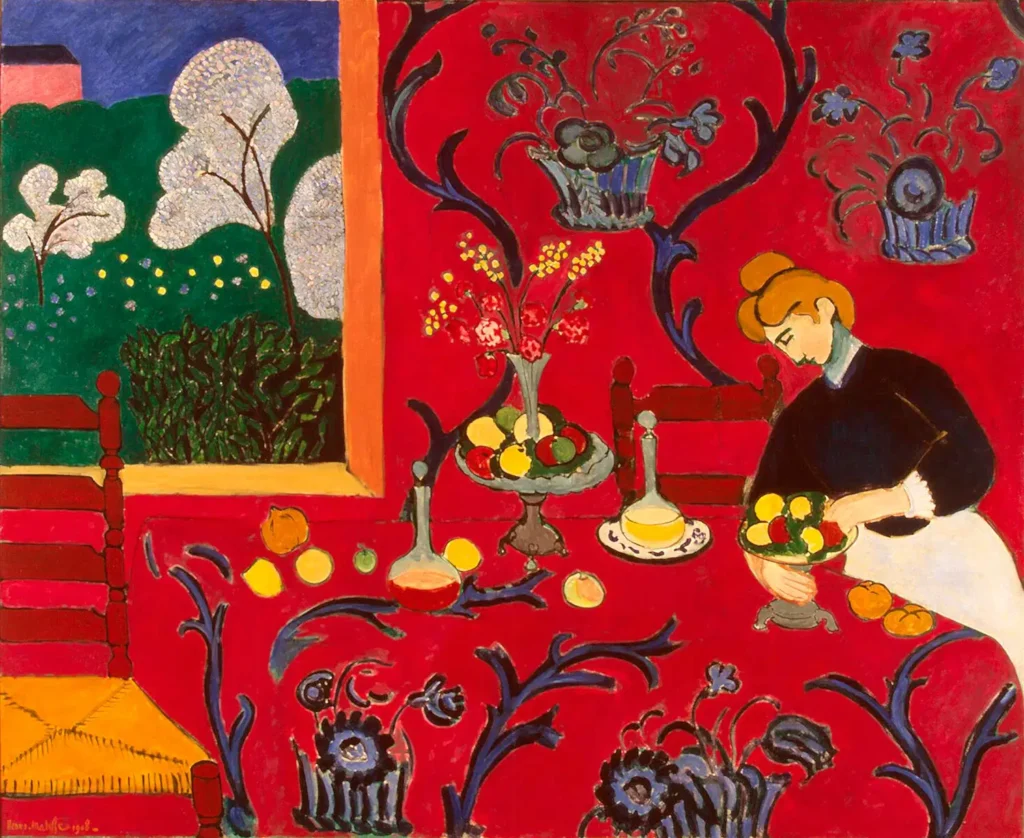
You have stood in front of something beautiful and felt, obscurely, that you should not be enjoying it quite so much. That the colors were too loud, the pleasure too immediate, too easy. That real art was supposed to cost you something — some effort of interpretation, some friction of understanding. That sensation arriving this fast, this directly, must be somehow cheap.
This is exactly the feeling that swept through the Salon d’Automne in Paris in the autumn of 1905, except amplified into public fury. A room of paintings — among them a portrait of a woman in a green stripe of paint dividing her face, and another of a window open onto a harbor of Collioure where the water and the boats dissolved into pure chromatic invention — provoked reactions that went beyond aesthetic displeasure into something closer to moral outrage. The critic Louis Vauxcelles called the artists wild beasts, les fauves, and the name stuck precisely because it captured the anxiety beneath the contempt. These weren’t simply bad painters. They were dangerous ones. They had done something that felt like an attack.
What had Matisse actually done? He had separated color from its obligation to describe. In the portrait of his wife, the face is divided by a stripe of green that corresponds to no shadow in nature, serves no illusionistic purpose, exists purely because the color holds the composition in a particular tension of sensation. The hat on her head is an explosion of pigment — orange, green, violet — that reads as pure chromatic event before it reads as hat. In the harbor painting, turquoise and vermillion and acid green do not represent the scene at Collioure so much as they communicate the experience of standing there in August light. The pleasure is immediate, almost aggressive in its directness. And that is precisely what offended.
Thorstein Veblen, writing his Theory of the Leisure Class just seven years before these paintings appeared, described a mechanism that helps explain the hostility. Veblen’s insight was that cultures develop hierarchies of taste that function to distinguish classes and communities, and one of the most durable of these hierarchies is the equation of difficulty with value. What costs effort — to produce, to understand, to endure — acquires prestige. What arrives easily, what pleases immediately, what the body receives before the mind can deliberate, is suspect. This is not merely aesthetic snobbery. It is a moral architecture, a way of organizing who is serious and who is merely sensual, who is deep and who is decorative. Suffering, in this framework, is not incidental to great art. It is its credential.
Matisse refused this equation with something close to deliberate philosophical stubbornness. He would write later, in his Notes of a Painter in 1908, that what he dreamed of was an art of balance, of purity and serenity, something like a good armchair that rests the tired businessman. The critics who quoted this passage used it as evidence of his shallowness. They missed, with extraordinary consistency, that he was mounting a direct argument against their deepest assumption — that art which does not exhaust you has not done its work. He was proposing that clarity of sensation, directness of pleasure, the capacity to make the nervous system sing without first making it suffer, might be among the most difficult and radical things a painter could achieve.
The rage directed at those 1905 canvases was not really about ugliness. It was about an implicit accusation. If color could do this without the machinery of chiaroscuro, without the labor of illusion, without the centuries of accumulated technical suffering — then what exactly had all that suffering been for?
What the Odalisques Were Really Saying
There is a woman lying on cushions in a room that does not quite exist. The walls are too decorated, the fabrics too layered, the light too warm and sourceless, as if the sun itself had agreed to perform. She is looking nowhere in particular, or perhaps looking directly at you in a way that refuses to give you what you came for. This is the trap Matisse laid, and almost no one noticed it for decades because everyone was too busy walking into it.
The Odalisque series, painted through the 1920s in Nice and in the constructed studio interiors Matisse built specifically for this purpose, has never stopped generating discomfort, and it should not. Edward Said‘s Orientalism, published in 1978, gave critical culture the vocabulary to name what was happening in this tradition: the East as theater, as fantasy projection, as a space where Western desire could dress itself in the costume of scholarship or aesthetics and still remain desire. The harem image, Said argued, was never about its subject. It was about the one looking. Matisse painted dozens of these figures, women in Moorish costume against Algerian textiles he collected obsessively, and to look at them through Said’s framework is to feel the weight of an entire geopolitical apparatus pressing down on a single canvas.
Frantz Fanon adds the layer that Said sometimes leaves in the abstract. In Black Skin, White Masks, published in 1952, Fanon dissected the colonial gaze not as ideology but as a lived experience of the body — the way being looked at by power reorganizes the one being seen, turns flesh into symbol, makes a person into a category. The odalisque in Western painting is precisely this: a body that has been categorized before it is perceived. She arrives pre-interpreted. The viewer does not discover her; he confirms her. She is already what he expected to find.
And yet. Matisse was not Gérome. He was not producing the academic titillations of the previous century, those hyper-detailed fantasies of submission that made the Salon crowds comfortable in their longing. Something stranger is happening in his canvases, something that does not absolve him but cannot be collapsed into the simpler charge. He said it himself, in terms that have irritated both his defenders and his critics equally: he was building a theater of light. Not a document. Not a report from somewhere real. A constructed space in which color could behave according to its own logic, in which the human figure was one element among many in a chromatic argument he was making about seeing itself.
This defense is partial and it knows it is partial. You cannot simply declare your intentions and dissolve the historical sediment of what you have made. The women in these paintings are still women in these paintings, still unnamed, still available to the gaze in the postures that the tradition prescribed. The theater he built used real bodies as its props, and those bodies carried meanings he did not invent and could not fully control.
What makes the Odalisques genuinely difficult, rather than merely problematic, is that both things are simultaneously true and neither cancels the other. The paintings are implicated in the Orientalist fantasy that Said mapped with such precision. They are also something else: investigations into flatness, pattern, and the way a surface can vibrate if you press the right colors against each other. Matisse was working a problem in perception, and he chose, out of his particular historical formation and personal desire, to work it with these bodies, in these costumes, in this constructed nowhere that looks like somewhere colonized.
The question that remains is whether a theater of light built on borrowed geography and unnamed women can also be, at the same time, one of the twentieth century’s most serious inquiries into what it means to look at anything at all.
Picasso in the Room
There is a moment when you realize that the person who understands you most completely is also the one who would dismantle everything you have built, given the chance. Not out of malice. Out of the same obsessive need to find the truth of things that drives you. Matisse understood this about Picasso sometime around 1906, when they first met at Gertrude Stein‘s apartment on the rue de Fleurus, and he never stopped understanding it for the next forty-eight years.
The rivalry that followed has been narrated as competition, as ego, as the art world’s most glamorous cage match. This is the wrong story. What was actually happening between them was a philosophical argument conducted entirely in paint, and the argument was this: what does a painted surface owe to reality? Matisse believed it owed reality a transformation, a translation into pure sensation, into the color and light that the eye truly receives before the brain intervenes with its naming and categorizing. Picasso believed reality itself was already fractured, already multiple, already impossible to contain in a single coherent view, and that painting’s task was to make that fracture visible. These are not competing answers to an aesthetic question. They are competing answers to a question about what human perception actually is.
Hannah Arendt, in The Human Condition published in 1958, drew a distinction that illuminates this precisely. She separated work, the production of durable objects that outlast their maker and enter a stable world, from action, the unpredictable intervention in human affairs that leaves no fixed object behind, only consequences that ripple through other lives. Matisse was a worker in Arendt’s sense with an almost frightening purity. He built canvases that were meant to endure as complete worlds, self-sufficient, radiating their own internal logic. The joy in his color, the stability of his compositions even when sensuous and loose, all of it was oriented toward permanence. He famously described wanting to make an art like a good armchair, something that offered rest and mental recovery. This has been mocked as bourgeois comfort-seeking, but it was in fact a metaphysical position. The world, for Matisse, was capable of producing genuine serenity, genuine beauty, and painting’s task was to distill that possibility into something that could be held.
Picasso was action in Arendt’s sense. His canvases were interventions, provocations, ruptures that did not resolve. He painted the same face from twelve simultaneous angles not to celebrate perception but to violate it, to make it impossible to settle into any single relationship with what you were seeing. A woman’s face in his hands becomes a theater of incompatible truths. There is no armchair available. You cannot rest. You can only keep moving, keep adjusting, keep failing to arrive. This is not a lesser achievement than Matisse’s. It is a different theory of what reality demands from honest eyes.
What is astonishing, and what the long record of their exchanges makes undeniable, is that neither man destroyed the other’s argument. They sharpened it. Matisse pushed deeper into color and pattern precisely because Picasso had claimed form. Picasso circled back toward decoration and sensuality, toward Matisse’s territory, repeatedly and almost involuntarily. When Matisse was dying and working in paper and scissors, cutting pure shapes of color from painted sheets, Picasso reportedly said that Matisse was the only painter alive he truly had to think about. That sentence is not admiration. It is the acknowledgment that the argument was still unresolved, still alive, still demanding answers neither of them had fully given.
Two men who spent half a century proving that two radically different answers to the same question can coexist without one annihilating the other. Not because both are equally right. Because the question itself is large enough to contain both of them, and still remain open.
A vision curated by a filmmaker, not an algorithm
In this video I explain our vision
The Cut That Heals
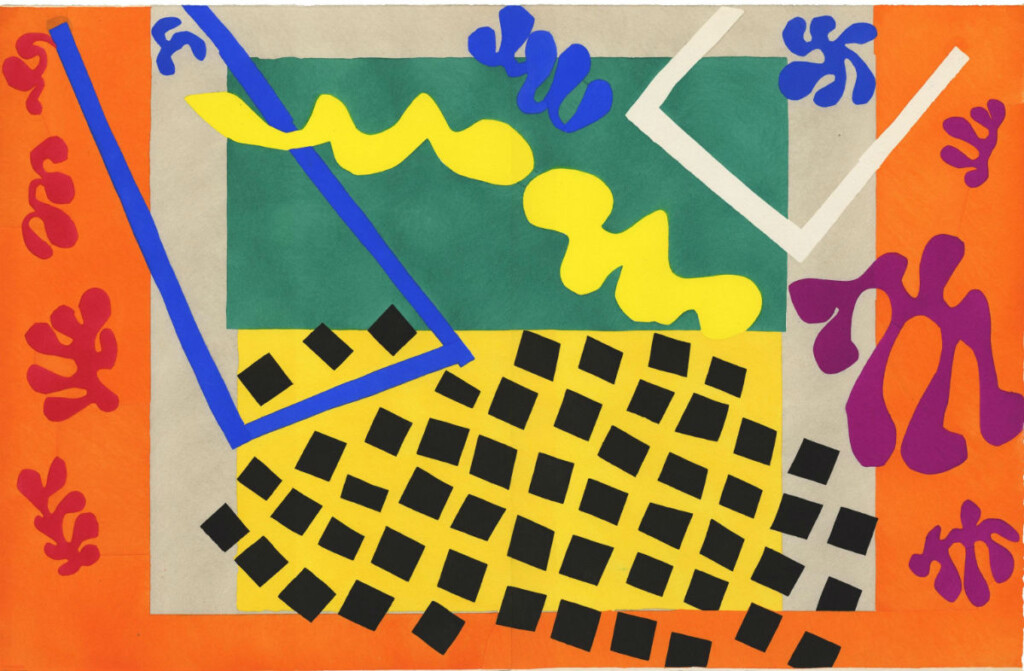
There is a moment, somewhere in the mid-1940s, when you watch an old man direct a long pole from his bed, moving a piece of colored paper pinned to a distant wall, adjusting by fractions of an inch what his assistant’s hands cannot quite feel without instruction. He is not diminished. He is extraordinarily precise. The sickness did not slow him down so much as it stripped away every gesture that had been unnecessary all along.
Georges Canguilhem argued, in his 1943 “Le Normal et le Pathologique,” that illness is not the absence of norms but the establishment of new ones — that the sick body does not fail to be a body, it becomes a different kind of body with its own internal logic, its own standards of what works and what does not. He was writing against the medical habit of treating health as a fixed point from which disease is a deviation. The body, for Canguilhem, is always norming itself, always generating the rules by which it operates. What looks like loss from the outside is, from within, a reorganization.
Matisse after the surgeries of 1941 — abdominal cancer, two operations, months of convalescence from which his doctors privately expected he would not emerge into sustained work — is the clearest possible embodiment of this idea, though he would never have used that language. He called it a second life. He called the scissors a direct contact with color that the brush, with all its centuries of mediation, had never quite given him. The cut, he said, allowed him to draw in color simultaneously, to eliminate the ancient separation between line and hue that painting had always forced upon him.
The pages of Jazz, published by Tériade in 1947 after years of assembly, arrive like something between a dream and a shout. The shapes are not simplified — that word implies a previous complexity that was lost. They are distilled, which is something entirely different. Distillation keeps everything essential and removes what was diluting it. The blue swimmer suspended mid-arc, the yellow circus horse, the dense red and black of the Codomas trapeze artists — these are not images of things, they are the emotional temperature of things, the color that a body in flight feels from the inside rather than how it appears from the outside.
By the time he turned to the Chapelle du Rosaire in Vence, completed in 1951, the cut and the drawn line had fused into a single system. The ceramic murals, the stained-glass windows flooding the interior with yellow and green and blue light, the vestments he designed — every element governed by the same logic of essential form, of shapes that contain their own justification. A Dominican nun who saw the chapel in its early weeks reportedly said it felt like being inside a living thing. She was closer to the architectural truth than any formal description.
What Canguilhem understood that most people still resist is that the new norm is not a consolation prize. It is not what you settle for when the original capacity is gone. It is what becomes possible precisely because the old pathways are closed. Matisse could no longer stand at a canvas for hours. The wheelchair, the bed, the long pole with the charcoal attached — these were not substitutes for the studio. They were a different studio, one that enforced a scale and a directness and a relationship to color as physical material that oil and canvas had never demanded.
The cut that heals the title insists upon is not the surgical cut, though that is where it begins. It is the scissors moving through prepared gouache paper, the clean edge of a shape becoming itself without apology. He once said he did not add, he revealed. That is not the language of a man making do with what remained.
The Chapel at Vence and the Trap of Transcendence
There is a moment you may have experienced without knowing what to call it — standing inside a space so precisely calibrated to light and silence that your body responds before your mind can intervene. Your breathing slows. Your shoulders drop. Something in your chest loosens that you had not known was clenched. This is not mysticism. This is architecture doing exactly what it was designed to do, and the man who designed it did not believe in God.
Matisse was in his late seventies when he undertook the Chapelle du Rosaire de Vence, completing it in 1951 after four years of work that he called, without irony, the culmination of his entire life. He had been ill, had nearly died, and had been nursed partly by a young Dominican novice named Monique Bourgeois, who would become Sister Jacques-Marie. The chapel grew from that relationship, from convalescence, from proximity to death — not from faith. He said so plainly. He said he was not a believer in the conventional sense, that he had built a space for spiritual experience the way an engineer builds a bridge: by understanding the forces involved and working with them rather than invoking anything beyond them.
This is the paradox that the twentieth century has never quite been able to metabolize. We have inherited, so thoroughly that we no longer see it as inheritance, a firm partition between the spiritual and the physical, between transcendence and the body. The sacred is supposed to live above sensation, above matter, above the merely sensory. What Matisse did at Vence collapsed that partition so completely that the debris is still falling.
Maurice Merleau-Ponty, writing in the Phenomenology of Perception in 1945 — six years before the chapel’s consecration — had already dismantled the philosophical scaffolding that made such a partition seem natural. Perception, he argued, is never a mental event that happens to use a body as its instrument. The body is the perceiver. There is no consciousness floating above flesh that then condescends to register color or warmth or space. When you stand in a room and the light changes, it is not your mind that first notices. It is your skin, your retina, the involuntary micro-adjustments of your posture. You are moved before you understand that you are being moved.
Matisse understood this not as philosophy but as practice. The chapel at Vence is a lesson in what happens when color is treated as a physical force. The stained glass — lemon yellows, deep greens, translucent blues — does not decorate the space. It transforms it. As the sun moves through the day, the light falling on the white ceramic tile walls shifts the entire emotional register of the interior without a single object being touched. The space itself breathes. Merleau-Ponty would have recognized this as confirmation of everything he was arguing: that the world presses against you with genuine weight, that perception is a form of contact, not representation.
What the chapel unmasks, then, is the absurdity of insisting that spiritual experience must be non-bodily to be legitimate. Every pilgrim who has entered that white room and felt something shift in their chest has been having an encounter with proportion, chromatic frequency, and the physics of reflected light. This does not diminish the experience. It relocates it. It places it squarely inside the human animal rather than above it, and this relocation is, in its own way, far more radical than any doctrinal claim.
The Church, to its credit, accepted the gift. What it may not have fully reckoned with is the argument embedded in the gift — that the sacred is not elsewhere. That it lives in the measured distance between a yellow pane of glass and a white wall at ten in the morning, in October, when the light comes in at exactly the angle a non-believing old man spent four years calculating.
Color as a Philosophical Act
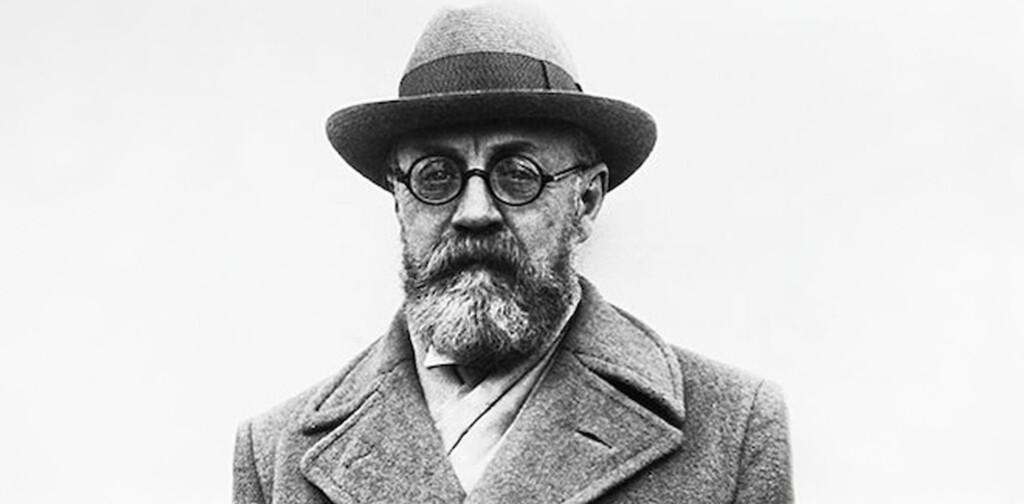
There is a particular kind of stubbornness that history tends to misread as indifference. Matisse in Nice, in those years when the continent was consuming itself, painting rooms flooded with Mediterranean light, arranging flowers in ceramic vases, studying how vermillion behaves against cadmium yellow — this image has always made certain critics uneasy, as if beauty pursued during catastrophe were a moral failure, a turning of the back. But what if the discomfort belongs to us, not to him?
Large Red Interior, completed in 1948, is not a quiet painting. It is almost violent in its insistence. The red does not decorate the room; it devours it, flattens it, makes the walls and floor a single pulsing field against which two canvases-within-the-canvas float like windows into other worlds. Three years after the liberation of the camps, two years after Nuremberg, while Europe was still excavating its dead from rubble and memory, Matisse was asking what red could hold. Not what it could represent. What it could hold.
Camus wrote, in 1948, that beauty and the absurd are born from the same soil — that to create is not to escape reality but to confront it through the only faculty that refuses reduction. He was not speaking of Matisse, but he might as well have been. The act of insisting on color, on light, on the sensory fullness of an inhabited room, in the immediate aftermath of industrialized annihilation — this is not consolation. Consolation would be smaller. Consolation would suggest that something has been resolved, that the painting makes the horror easier to carry. What Large Red Interior actually does is stranger and more disturbing: it refuses to acknowledge that the horror has changed the fundamental terms of existence, and in that refusal it forces you to ask whether the terms were ever what you thought.
Simone Weil, writing in her notebooks during the war years later collected and published posthumously, argued that beauty is the only thing that compels attention without demanding anything in return — that it is, in this sense, the closest human experience to grace, because it cannot be earned or explained, only received. Matisse’s late work operates exactly in this register. The cutouts he began making when illness had taken away his ability to stand at a canvas — those brilliant, weightless shapes of pure color swimming against white — are not the work of a man who has made peace with the world. They are the work of a man who has decided that color is not a language about reality but a reality in itself.
And here is where the destabilization becomes complete. Because if you accept that premise — if you follow Matisse into the room where red is not a symbol but a fact — then the question of whether he witnessed or evaded the catastrophe of his century becomes unanswerable in the terms we usually use. Witness implies documentation, implies the turned face, implies that the truthful response to horror is its representation. But there is a tradition, running through thinkers as different as Wittgenstein and Bachelard, that insists some truths can only be approached laterally, through what surrounds them rather than what depicts them. The room full of red light. The open window. The flowers that have nothing to say about the century they bloomed inside.
To look at Large Red Interior is to feel, with a strange precision, the weight of everything the painting refuses to show, which is perhaps the most honest accounting of catastrophe that art has ever managed — not because absence is more powerful than presence, but because Matisse understood that the human capacity for joy and the human capacity for atrocity are not opposites, and that color, relentless and indifferent to history, is the only thing that has ever told the truth about both simultaneously.
🎨 Color, Form, and the Modern Gaze
Henri Matisse stands at the heart of modern art’s most daring experiments with color and form. His work echoes through the careers of artists who, like him, refused the boundaries of tradition and pushed visual language toward new frontiers. These four articles illuminate the broader world of art and thought that surrounds his legacy.
Titian: Life and Works
Titian’s mastery of color and sensuous form made him one of the most influential painters in Western history, anticipating many of the chromatic freedoms that Matisse would later explore. His ability to charge a canvas with emotional warmth through pure pigment created a lineage of bold visual thinking that spans centuries. Understanding Titian helps us see how deeply rooted Matisse’s chromatic revolution truly was.
GO TO THE SELECTION: Titian: Life and Works
Frida Kahlo: Life and Works
Frida Kahlo transformed personal suffering and Mexican identity into a vivid, symbolic visual language that resonated across the entire twentieth century. Like Matisse, she used color as an emotional and psychological instrument rather than merely a descriptive one. Her life and works reveal how deeply autobiography and cultural roots can fuel an artist’s singular vision.
GO TO THE SELECTION: Frida Kahlo: Life and Works
Keith Haring: Life and Works
Keith Haring brought art out of galleries and onto the streets of New York, creating a bold graphic language rooted in energy, movement, and social engagement. His work shares with Matisse a joyful commitment to line and a belief in art’s power to communicate directly with any viewer. Exploring his career sheds light on how modern artists have continued to strip image-making down to its most essential and expressive elements.
GO TO THE SELECTION: Keith Haring: Life and Works
Jean Dubuffet: Life and Works
Jean Dubuffet championed raw, unmediated creativity and challenged the established hierarchies of the art world with radical passion. His concept of Art Brut celebrates the creative impulse in its purest form, untamed by academic convention — a spirit not entirely foreign to Matisse’s own quest for spontaneity and directness. Discovering Dubuffet opens a provocative window onto the avant-garde currents that shaped and surrounded modern Western art.
GO TO THE SELECTION: Jean Dubuffet: Life and Works
Art Lives On Screen Too
If these artistic journeys have stirred something in you, Indiecinema streaming is where the spirit of creative rebellion continues. Explore a curated selection of independent and art-house films that carry the same daring vision as the masters who changed how we see the world.
👉 EXPLORE THE CATALOG: Watch Indie Films in Streaming
A vision curated by a filmmaker, not an algorithm
In this video I explain our vision

