
The Man Who Refused to Grow Up Correctly
There is a child, somewhere in an apartment that smells of lunch, dragging a crayon across the wallpaper in wide, ecstatic loops. The lines go nowhere recognizable. The figures have too many fingers, or none at all. The sun is green. A dog is larger than the house it stands beside. And then an adult enters the room, and the child learns, in that moment, something that will take a lifetime to unlearn: that certain marks are wrong, that beauty has a direction, that art is a matter of correction.

Jean Dubuffet never forgot that room. Not because he was particularly sentimental about childhood, but because he understood, with the cold precision of a man who had spent decades watching people buy and sell wine while secretly studying everything they claimed to love about culture, that the correction itself was the problem. Not the child’s mark. The hand that stopped it.
He was born in Le Havre in 1901, the son of a prosperous wine merchant, and the trajectory laid out for him was entirely legible: commerce, respectability, the quiet accumulation of the kind of social authority that requires no drama because it wears a suit. He went to Paris at seventeen to study painting, enrolled at the Académie Julian, and then did something that confused everyone around him: he stopped. He quit after six months. Not because he was failing, but because he could see exactly where success in that direction would take him, and the destination repelled him. He understood the machinery of cultural prestige before he had a name for it.
Pierre Bourdieu would later give it that name, most systematically in Distinction, published in 1979, where he argued that aesthetic taste is never innocent, never purely personal, but is always a mechanism of class differentiation, a way of marking and maintaining social boundaries through the performance of refinement. What the academies teach is not merely technique but allegiance, the willingness to reproduce the hierarchies that elevated certain forms of expression and buried others. Dubuffet intuited this with a ferocity that preceded the theoretical vocabulary. He saw that to paint well, in the accepted Parisian sense of the early twentieth century, was to submit, to signal membership in a world that had decided in advance what mattered and what did not.
So he did what seems, on the surface, like surrender. He went back to Le Havre. He ran the family wine business. He married. He fathered children. He moved between commerce and half-hearted artistic attempts for two decades, not the romantic detour of a man escaping his destiny but something stranger and more deliberate: a man choosing to remain unformed, refusing the crystallization that success would have forced upon him. He was in his thirties, his late thirties, watching the world move toward catastrophe, and still he had not declared himself. There is something almost violent in that patience.
He did not fully commit to painting until 1942, when he was forty-one years old. The timing matters enormously. This was not a young man’s rebellion, hot with the need to distinguish himself from his father, intoxicated by the romance of the avant-garde. This was a middle-aged man’s philosophical decision, made in occupied Paris, surrounded by a civilization in the process of demonstrating exactly what its highest achievements were capable of producing. He had had time to think. He had had time to watch. And what he chose, coming to painting at the age most artists consider their defining decade already behind them, was not beauty in any recognized form. He chose ugliness. He chose the child’s green sun, the dog larger than the house, the lines that went nowhere recognizable. He chose them not because he could not do otherwise, but because he had looked at the alternative and found it morally uninhabitable.
Don Barry: A Quixotic Exploration
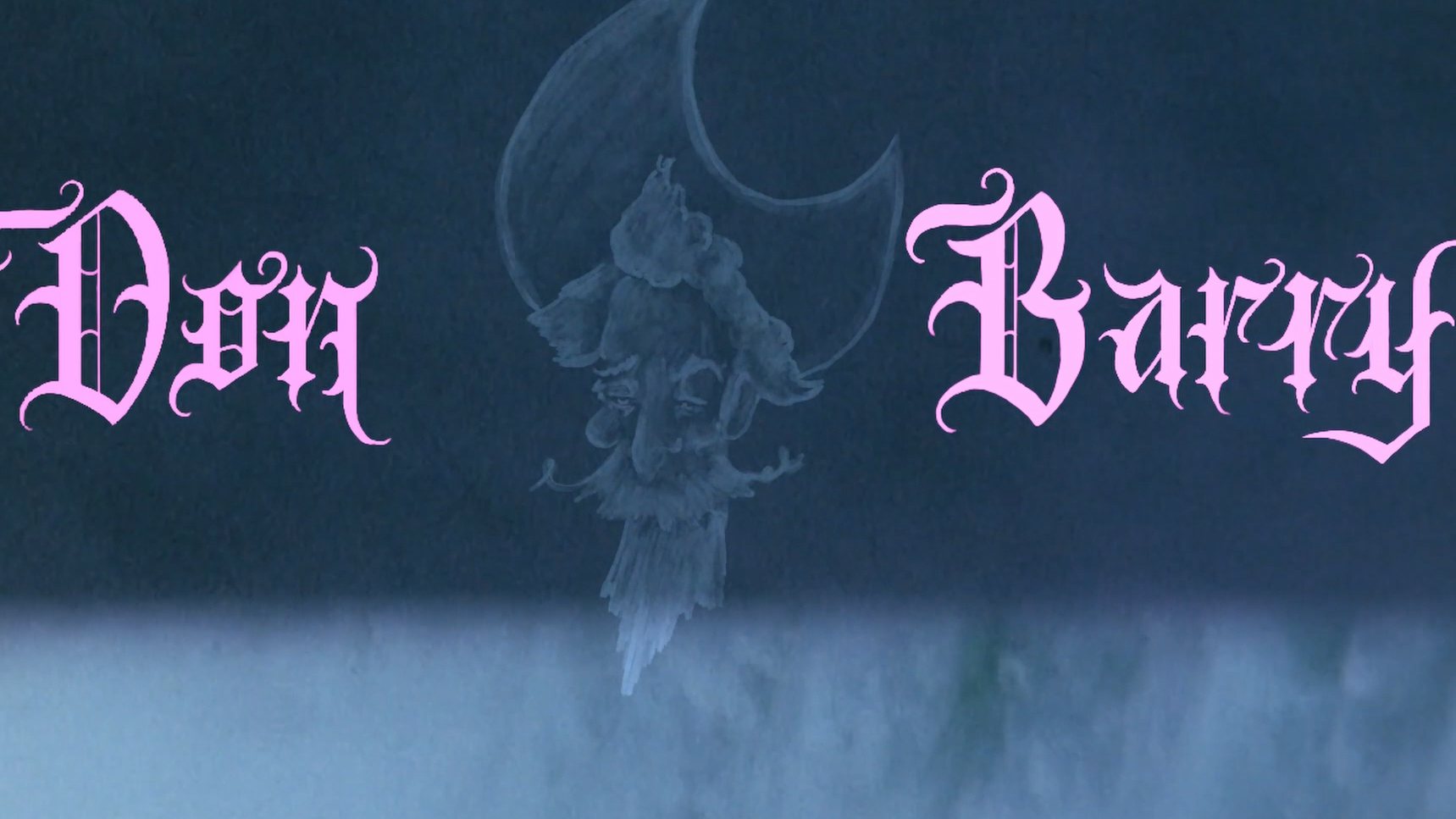
Docufiction, Experimental, by Paul Smart, Mexico, 2026.
Don Barry: A Quixotic Exploration is a debut feature that places the biography of an eighty-year-old experimental filmmaker and artist, Barry Gerson, within the metanarrative of Miguel de Cervantes’ Don Quixote. Don Barry was filmed in the city of Guanajuato during the 51st edition of the Cervantino Festival, as well as during the vibrant Day of the Dead celebrations held in the city’s UNESCO-listed tunnels. The film honors the director’s long friendship with artist Barry Gerson, drawing inspiration from Cervantes’ Don Quixote. Paul Smart’s directorial choices create something new that celebrates life and goes beyond conventional storytelling. A search for magic in our real lives. A moving film about the meaning of life, art, and death. Not to be missed.
Paul Smart is a proud outsider filmmaker with a long history of film screenings. In the 1980s, he emerged in New York’s vibrant youth art scene, working in theater production and later filmmaking, before retreating to rural upstate New York, in the Catskill Mountains, where he made a living writing and screening independent films in old parish halls for rural audiences, many of whom had never seen a film.
LANGUAGE: English
SUBTITLES: Spanish, French, German, Portuguese
Art Brut and the Violence of the Normal
There is a man walking down a corridor that smells of bleach and boiled vegetables, carrying a notebook. He is not a doctor. He does not wear a white coat. He is looking at the drawings pinned to the walls — not to diagnose them, not to classify them, but because something in them is more alive than anything he has seen in a gallery in years. The lines are wrong by every academic measure. The proportions collapse. Faces dissolve into texture. And yet there is a pressure behind them, an urgency that the paintings in the Louvre, for all their technical sovereignty, have stopped pretending to have.
This is roughly how Jean Dubuffet moved through the world in 1945, the year he coined the term Art Brut — raw art, uncooked art, art that had never passed through the digestive system of culture and come out the other side as something tasteful and dead. He was not romanticizing mental illness. He was making a precise and devastating argument: that civilization, in its hunger to normalize expression, does not refine it. It amputates it. What survives in the work of psychiatric patients, prisoners, mediums, and self-taught visionaries is precisely what the institutions of culture are designed to remove — the unmediated pressure of a self that has not yet learned to apologize for its own existence.
Michel Foucault, writing in Madness and Civilization in 1961, traced the historical moment when European society stopped treating madness as a form of unreason that might carry its own dark wisdom, and began treating it as a deviation to be corrected, confined, and eventually silenced. The great confinement of the seventeenth century was not merely administrative — it was epistemological. It declared a boundary between those whose inner lives counted as knowledge and those whose inner lives counted as symptom. Dubuffet understood this boundary not as a medical fact but as a political one, and he crossed it deliberately.
Between 1945 and 1951 he assembled what would become the Collection de l’Art Brut, eventually comprising thousands of works. He traveled to Switzerland, to Germany, to psychiatric institutions across France, not as an anthropologist cataloguing curiosities but as someone who recognized, in rooms where the official story was pathology, a counter-archive of human truth. A man confined behind institutional walls draws the same figure eight thousand times, each iteration a fraction different from the last, the obsession itself becoming a form of precision no formal training would have tolerated. A woman who has never held a paintbrush covers every surface available to her with a cosmology entirely her own, populated by entities that answer to no mythological tradition, no art historical period, no market.
The violence Dubuffet was naming was not the dramatic violence of exclusion. It was the quieter violence of the normal — the slow administrative pressure by which a civilization teaches its members what counts as expression and what counts as noise. Think of the particular cruelty in a scene where a human being, surrounded by people with clipboards, is asked to describe their inner experience and then watched as that description is immediately translated into a category, a diagnosis, a file number. The person is still speaking. The institution has already stopped listening. What they said has been processed into something manageable, something that requires a response defined in advance.
Foucault called this the great division, but Dubuffet made it physical. He collected. He preserved. He built an institution — eventually housed permanently in Lausanne — that was, in its founding logic, the structural opposite of the institutions whose corridors he had wandered: a place where the work of those who had been classified as unreasonable was treated as the most serious evidence available about what it means to be human.
The question he was asking was simple and almost unbearable. What if the ones we locked away were the ones who were seeing clearly?

Paris, 1945: Painting Against Beauty
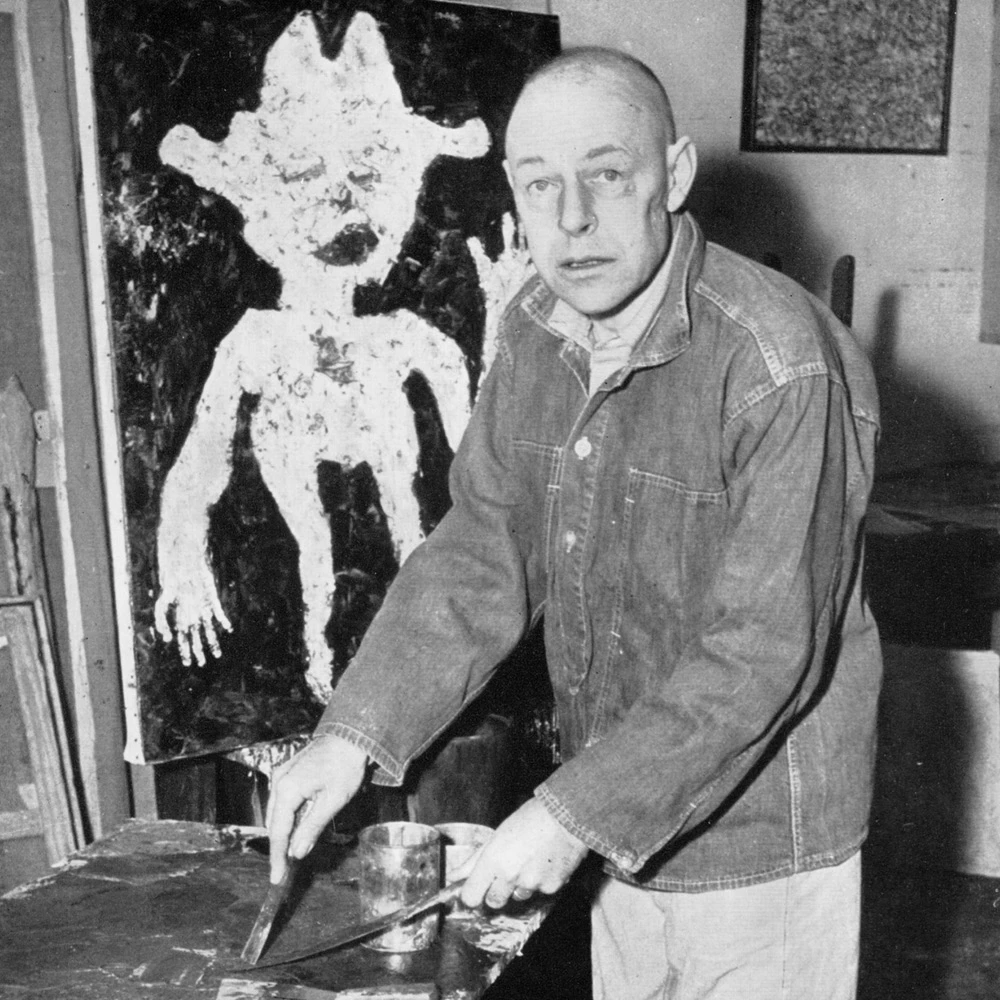
The plates have been cleared, the wine is still moving, and someone at the table has said the wrong thing. Not something cruel, not something false — something aesthetically wrong. A casual enthusiasm for something the room considers vulgar. The correction comes quickly, dressed as helpfulness: a slight tilt of the head, a gentle redirect toward something more considered, more refined. The person who spoke learns something in that moment, and what they learn has nothing to do with beauty.
Paris in the autumn of 1945 was running precisely this kind of table. The Liberation had arrived with all its promises of renewal, but beneath the euphoria the cultural hierarchies had reconstituted themselves with remarkable speed, and the art world was among the first institutions to reassert its old grammar. Elegance was not simply a preference — it was a credential, a proof of surviving the occupation without having become coarse. To paint beautifully was to signal that civilization had held, that the refined eye had not been bruised by years of deprivation and horror. T.J. Clark, in his methodical excavation of how art functions as social inscription, argued that aesthetic judgment is never merely aesthetic — it encodes class relations, distributes legitimacy, marks who belongs to which side of a cultural frontier. In Paris in 1945, that frontier was being redrawn with particular urgency.
Into this climate, Jean Dubuffet planted his first major solo exhibition at the Galerie René Drouin in October of that year. He was forty-four years old, a man who had spent decades oscillating between painting and the wine trade, who had come to his vocation late and sideways, and who arrived now with canvases that seemed to have been made in direct, almost aggressive refusal of everything the room valued. The figures were grotesque, the surfaces thick and abraded, the drawing like something scratched into wet concrete by a hand that had forgotten — or refused — the lessons of the academy. Critics did not politely redirect. They attacked.
Gaston Diehl wrote of a deliberate assault on taste. Others spoke of provocation for its own sake, of infantilism, of regression. The word that kept appearing, in various conjugations, was indefensible. And what is striking about that word is its precision, because what the critics were really saying was that Dubuffet’s work could not be defended at a table like the one described above — it could not survive the gentle correction, could not be assimilated into the conversation about what refinement required. It was not merely ugly. It was stubbornly, systematically ugly, in ways that suggested the ugliness was load-bearing.
Dubuffet understood this. He had been reading, absorbing, building a theoretical architecture around what he was doing, and he knew that the scandal was not a side effect but a kind of proof. If the dominant aesthetic was itself a class performance — a way of making inherited taste look like universal truth — then the only honest response was a work that the performance could not incorporate. His paintings were not failed attempts at beauty. They were a different proposal entirely, one that named the whole category of refinement as a confidence trick.
There is something almost mechanical in how cultural consensus defends itself. A man stands at a party, says the wrong painter’s name with the wrong degree of admiration, and the room recalibrates him. No one raises their voice. The correction is absorbed so quickly that the man himself may not notice it has happened — may even feel grateful for the education. This is how taste operates when it functions as power: invisibly, frictionlessly, with the smoothness of something that has been practiced for generations. What Dubuffet introduced into that room, in October 1945, was friction. Visible, unapologetic, structural friction — the kind that does not smooth itself away when the evening ends.
The Lost Poet
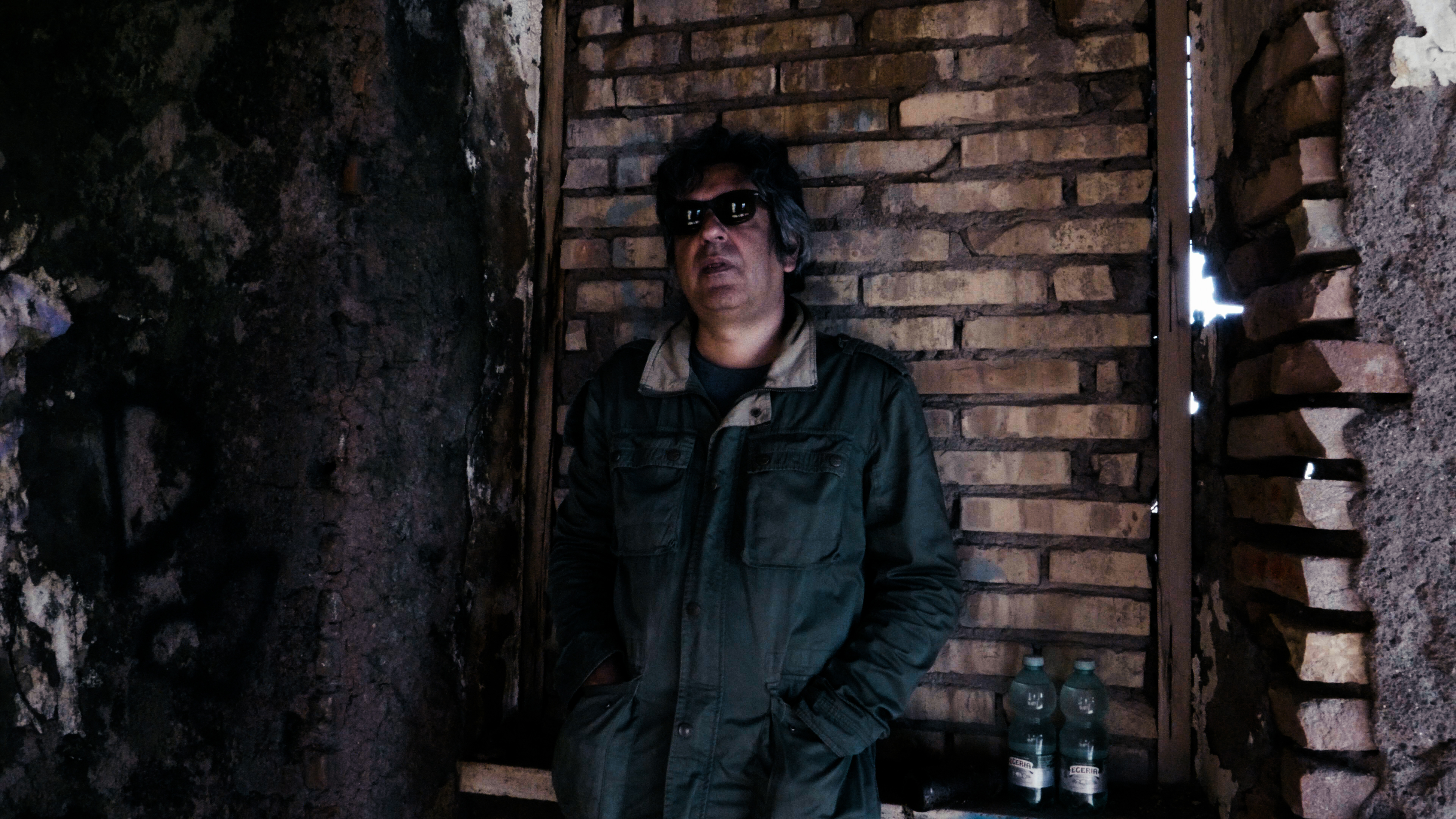
Drama, by Fabio Del Greco, Italy, 2024.
Dante Mezzadri wants to see an old friend, nicknamed the Iguana, whom he has lost sight of for many years, and who has managed to turn their shared youthful passion for poetry into a job, becoming a famous writer and poet. The man escapes from his bourgeois life and his wife to live homeless on the Roman coast, printing and trying to sell his poetry collections. At night he sleeps in a park of old carnival floats, inside a papier-mâché tank, and waits for the opportunity to meet his old friend, who however never shows up for appointments in the places they frequented when they were young, now in ruins. Dante's poetry books do not interest anyone and to support himself he is forced to "change product": he starts selling the infamous "cannibal pill" on behalf of young drug dealers, a new drug that sells like hot cakes and causes sensory and consumerist ecstasy. However, he realizes that this powerful drug is very dangerous for those who take it, he comes into conflict with his ethical conscience and throws all the pills into the sea. However, the dealers want to collect their money.
Shot over a period of 2 years, the film is a reflection on the cultural and artistic rubble of the society in which the protagonist lives, in an increasingly mechanized, consumerist and arid world. Dante Mezzadri is yet another human being who has renounced his inspiration and his creativity, but unlike many he is not willing to give his life to a system that distances him from his true identity. The physical world around him, however, seems constructed in such a way that it seems impossible to escape from this "invisible cage". The enthusiasm of the people he meets is ignited only by sensory gratification, by unreal visions of personal affirmation and success, by "metaverses" that offer an escape into an illusory and destructive reality. The poet's house on the coast, where he met with his friends as a young man, is just a pile of abandoned rubble. What happened to all those who wanted to become poets and ended up becoming something else? Are there internal forces with which that house can be "rebuilt"?
LANGUAGE: Italian
SUBTITLES: English, Spanish, French, German, Portuguese
The Body as Dirty Material
She stands in front of the mirror for longer than usual. Not because she is vain — she is past that particular performance — but because something has shifted and she cannot name it. The face looking back is correct. The body is correct. And yet there is a gap between the surface and the sensation, between what she has been shown women look like and what she actually feels herself to be from the inside: something messier, more mineral, more strange.
Dubuffet understood that gap as the central violence of Western aesthetics. Between 1950 and 1951 he produced the Corps de Dames series, roughly thirty paintings of the female body rendered in what his critics immediately called obscene, barbaric, degrading. The women in these works are flattened and splayed, their flesh the color of mud and sand and dried blood, their bodies mapped like geological formations — fissured, granular, erupting at the edges. There are no curves designed to please. There is no softness arranged for consumption. There is, instead, something that looks disturbingly like truth: a body as it might describe itself if no one had ever taught it to perform.
The hostility was immediate and it was revealing. When viewers said these paintings were misogynist, they were actually confessing something about what they considered the alternative. The alternative, they implied, was the nude tradition — Ingres, Boucher, the long European lineage of female flesh made luminous and available, the body transformed into an aesthetic object, its materiality dissolved into light and proportion. Dubuffet refused that dissolution with something approaching fury. He painted flesh as matter: dense, bacterial, indifferent to the gaze. The grotesque in his work is not an insult to women. It is an insult to the idea that a woman’s body exists to be beautiful for someone else.
Simone de Beauvoir published The Second Sex in 1949, one year before the Corps de Dames began. She was working an entirely different material — philosophy, lived testimony, history — but she was cutting through the same fantasy. Her argument was precise and devastating: woman has been constituted as the Other, defined not by her own subjectivity but by her function within male consciousness. The body, in this construction, becomes a symbol before it becomes a fact. It carries meaning it never chose, is interpreted before it is inhabited. De Beauvoir wrote that women are not born, they are made — a sentence that has been quoted so many times it has lost its violence, but what it means in the flesh is that the woman at the mirror is looking at something that was constructed before she arrived.
Dubuffet’s women refuse that construction by existing in a register where construction has broken down. They are made of the same material as walls and earth and rock. A figure in one of the paintings has a torso that dissolves into what might be ground or might be viscera — the boundary is deliberately unintelligible. Another is painted so flat she seems pressed into the canvas like a fossil, like evidence of a body rather than its idealization. There is something in these images that is genuinely difficult to look at, and the difficulty is not aesthetic failure. It is the discomfort of recognition: flesh without the mediation of desire, without the permission of beauty, without the reassurance that the body has been made acceptable.
The woman at the mirror eventually turns away. Not because she has resolved anything. Because the question underneath the question — who taught you what you were supposed to see? — is not the kind of question that gets answered in a single morning, in a single room, in the quiet that falls between one’s face and its reflection.
Dubuffet was not painting women. He was painting what looking at women had always cost them.
Texture, Mud, and the Philosophy of Materials
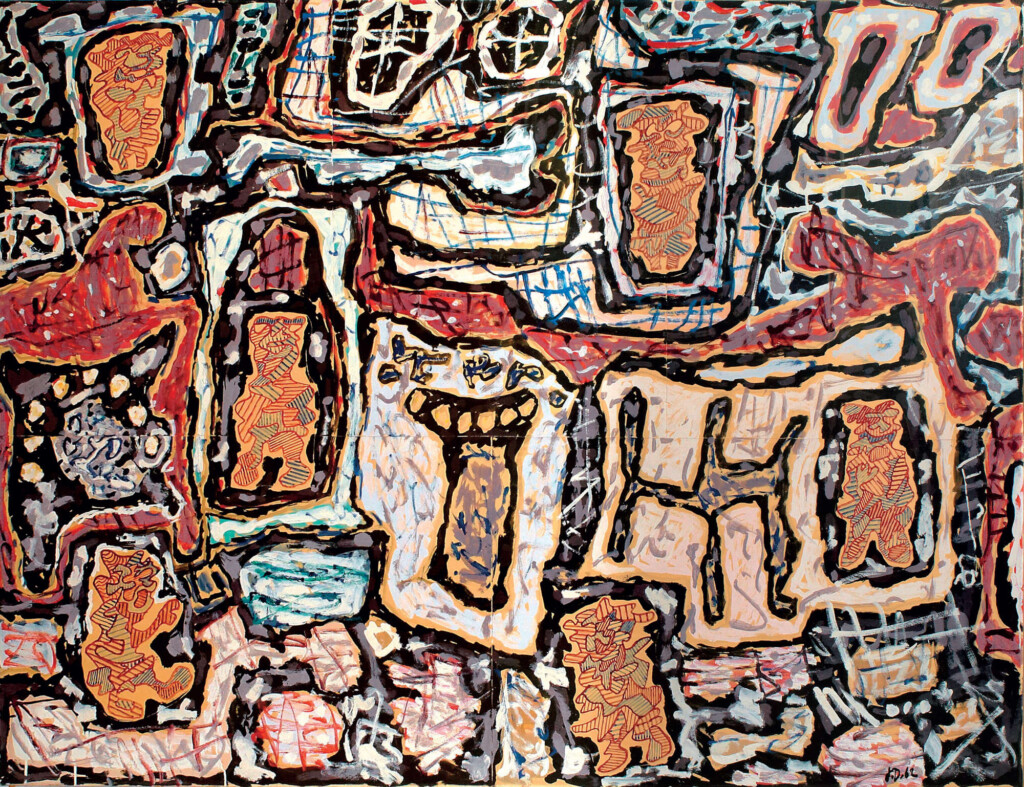
There is a specific moment when you push your hands into wet soil and feel it resist — not give way, but resist, push back with a kind of sullen autonomy that no smooth surface ever offers. The mud does not want to be shaped. It has its own agenda, its own viscosity, its own memory of being earth before you arrived with your intentions. Most people wash their hands quickly after. Dubuffet stayed there, in that resistance, and made it the entire subject of his life’s work.
He did not use mud metaphorically. He used tar. He used gravel pressed into still-wet pigment until the surface became geological rather than painted. He used coal slag, butterfly wings crushed and embedded, aluminum foil crumpled and laminated into layers that caught light like industrial wreckage. Sand arrived not as texture but as argument — the argument that a surface could refuse to be beautiful, could insist on being something older and less cooperative than beauty. The material was never a vehicle. It was the destination.
Gaston Bachelard, writing in 1938 in his Psychoanalysis of Fire, proposed something that art history has never quite finished absorbing: that human imagination does not begin with images but with matter. We do not first see the world and then dream about it. We first touch it, resist it, are resisted by it, and from that physical negotiation all metaphor eventually grows. His later work on earth, water, air, and fire extended this into a full phenomenology of elemental imagination — the idea that our deepest psychic life is structured not by symbols but by the specific weight and texture of the substances we encounter. Mud thinks differently than marble. Tar remembers differently than glass.
Dubuffet understood this without having read it, or perhaps having read it and finding it merely confirmed what his hands already knew. A surface scraped with gravel is not a representation of a rough world. It is a rough world. It does not stand in for something. It stands there, dense and indifferent, the way the actual ground stands there when you kneel on it. The over ten thousand works catalogued across his career — a number that sounds industrial precisely because it was, because Dubuffet worked with the relentless material accumulation of a man who believed that quantity itself was a philosophical position — were not variations on a theme. They were iterations of a single confrontation, repeated until the confrontation yielded something the previous iteration had withheld.
He once described wanting to strip art of its culture, meaning not its references but its refinement, its trained incapacity to tolerate the uncooperative. A painter schooled in tradition learns, above all else, how to make materials behave. The medium submits. The surface becomes what the artist intends. Dubuffet saw this mastery as a form of violence — not against the material but against reality itself, which is never smooth, never obedient, never organized around human preference. He wanted a surface that retained the memory of its own making, including all the places where the making went wrong, where the tar bled further than intended, where the butterfly wing dissolved rather than held, where the gravel shifted and the composition became something no one planned.
There is a man on a street somewhere, late afternoon, noticing a wall where the plaster has split and fallen away in layers, revealing older layers beneath — grey over white over something the color of old newspaper. He stops. He does not know why. He feels the layers as time, as evidence, as the wall’s refusal to be simply a wall. He runs his finger along the edge where the plaster broke and feels the specific sharpness of that rupture, which is nothing like the sharpness of a blade and nothing like the sharpness of glass. It is the sharpness of something that broke from within, under pressure that accumulated invisibly for years.
That is what Dubuffet’s surfaces feel like. Even from across a room.
A vision curated by a filmmaker, not an algorithm
In this video I explain our vision
The Hourloupe and the System That Swallows You
It begins with a phone call. You are doodling on a notepad while you wait for someone to pick up, your pen moving in small automatic loops, hatching one shape into another, filling the gaps with crosshatching, and suddenly there is a whole landscape on the paper that you did not decide to make. The hand did it. The mind was elsewhere, suspended in the bureaucratic hold music of daily life, and the hand produced a world.
This is precisely where Jean Dubuffet found himself in the summer of 1962, pen moving across paper during a telephone conversation, when he looked down and recognized something he could not name but could not stop making. He called it L’Hourloupe — a word he invented, a word that sounds like a gurgle and a howl and a fairy tale warning all at once — and for the next twelve years, until 1974, he made almost nothing else. The cycle consumed him with the logic of its own expansion. Interlocking cell-like forms, outlined in thick black, filled with flat red or blue hatching against white, each shape pressing into its neighbor without hierarchy, without center, without exit. The forms look almost recognizable — a face, a hand, a chair — and then do not. They are familiarity held one degree past legibility, like a word you have repeated until it dissolves into pure sound.
What began as drawings became paintings, then sculptures in polyester resin, then entire environments — rooms and facades and gardens — where a person could walk inside the system and be surrounded on all four walls and the ceiling and the floor by the same relentless interlocking. The Closerie Falbala, completed in 1973 outside Paris, is perhaps the most radical instance: an architectural complex you enter not as a visitor who maintains the critical distance of observation, but as a body absorbed. You are inside the argument. There is no position outside it from which to evaluate.
Henri Lefebvre, writing in The Production of Space in 1974 — the same year Dubuffet closed the Hourloupe cycle — argued that capitalism does not only colonize labor and time. It colonizes space itself, restructuring perception, reorganizing the body’s movements, encoding ideology into the very architecture of the everyday until the built environment feels not like a political choice but like nature. Space, for Lefebvre, is never innocent. It is always already a product, a message, a form of power made invisible by its own ubiquity. What Dubuffet was building, cell by cell, was a visual model of exactly this mechanism — a system that does not announce itself as a system, that presents its totalizing logic as playfulness, as color, as something almost childlike.
A man once walked into a shopping complex built sometime in the late twentieth century — the kind of space designed by people who had studied how to prevent orientation, who knew that a person who cannot locate themselves in space will eventually stop trying to leave and start buying. The corridors curved gently without ever returning you to an entrance. The lighting had no source. Every surface was cheerful, branded, primary-colored. He walked for what felt like an hour looking for the exit and found only more interior, more brightness, more smiling design. There was no malice in it. That was what made it perfect. A labyrinth that smiles does not need walls.
Dubuffet understood this seduction from the inside because he was not standing apart from it, pointing. He was its author and its prisoner simultaneously. The Hourloupe is a critique that operates through the very method it critiques — total immersion, the abolition of outside. You cannot appreciate it from a safe distance because it has eliminated the conditions under which safe distance becomes possible. The forms keep interlocking. The red fills the white. The system smiles and opens another door, and behind that door is more system, and it is beautiful, and you walk in.
The Outsider Who Built an Institution

There is a particular kind of morning — anyone who has spent years in opposition knows it — when you sit down at a desk and sign something, and the pen moves across the paper with a smoothness that feels almost obscene. Not because the act is wrong. Because it is so easy. Because the hand does not tremble, the signature looks exactly like all your other signatures, and outside the window the city continues its ordinary noise, indifferent to the fact that you have just done the thing you spent decades arguing no one should do.
Jean Dubuffet signed the donation agreement transferring his entire Art Brut collection to the City of Lausanne in 1971. Thousands of works. Paintings, sculptures, assemblages, notebooks, obsessive drawings made by people who had never heard of galleries and would not have cared. The collection found its permanent home in the Château de Beaulieu, a neoclassical building with proper walls, proper lighting, proper staff, proper opening hours. A museum. An institution. Exactly what Art Brut was never supposed to need.
Nietzsche, in the Genealogy of Morals, described ressentiment as the psychology of those who define themselves entirely through what they oppose. The rebel whose identity depends on the existence of the system they fight. Take away the adversary and the rebel dissolves, becomes formless, has no story left to tell about themselves. Dubuffet had built forty years of thinking — and a considerable personal mythology — on the proposition that authentic creation exists outside institutions, that the asylum wall and the gallery wall were the same wall dressed differently. And then he built a wall of his own, hung things on it, hired people to guard them, and applied for public funding. The question Nietzsche forces us to ask is not whether Dubuffet was a hypocrite. The question is whether the opposition was ever really about the works, or whether it was always, at least in part, about the man doing the opposing.
Hannah Arendt, thinking about how systems perpetuate themselves not through malice but through the simple gravitational pull of procedure, would have recognized the scene at that desk immediately. The banality she analyzed was never limited to evil. It extends to the bureaucratization of everything, including revolt. Institutions do not typically swallow their opponents through force. They offer them a form to fill out, a legal framework, a building with adequate climate control. They make the alternative — letting the collection disperse, letting the works return to disorder — seem irresponsible. Preservation becomes the argument that defeats every other argument. And who, in the end, can argue against preservation?
A man who had written ferociously about how culture digests and neutralizes everything that threatens it found himself, at seventy, providing culture with one of its more elegant meals. The Collection de l’Art Brut in Lausanne is genuinely important. It holds work by Adolf Wölfli, by Aloïse Corbaz, by Heinrich Anton Müller — people whose creations had existed in institutional margins and might easily have been lost. The museum protects them. It also, inevitably, frames them. It places a label beside each work. It attributes. It contextualizes. It turns the unclassifiable into a classified collection. This is what institutions do — not out of cruelty but out of necessity, out of the simple requirement that a building function, that visitors be able to move through it without becoming lost.
What survives of the original idea is not nothing. But it is something different from what was intended. Ideals do not typically die in confrontation. They die in administration, in the small daily decisions that each seem reasonable, in the morning the pen moves too smoothly. Whether that constitutes betrayal depends on what you believe ideals are for — whether they exist to be kept pure or to collide with the world and see what remains after the impact.
What Remains When the Rebellion Is Framed and Hung
He died in May 1985, in Paris, the city he had spent decades trying to unsee. By then the museums had already moved in around his work like water finding its level, surrounding it, absorbing it, making it theirs. The Centre Pompidou held his paintings. MoMA held his paintings. The Guggenheim held his paintings. The same institutions whose cultural authority he had treated as a kind of organized violence against the human spirit were now the custodians of that spirit’s most furious protests. The rebellion had been framed, lit from above, and mounted at a height calibrated to prevent touching.
There is something almost unbearable about returning to a place where you once felt genuinely free — a neighborhood where you lived before money arrived, a bar where serious conversations happened before it became known for serious conversations, a stretch of coastline that existed, for one summer, as if it belonged to no one. You go back and the coordinates are identical. The walls are the same walls. But something has been extracted from it, some animating friction, and what remains is a surface that reflects your own nostalgia back at you without adding anything new. The place has become its own documentation. It has become, in the precise sense Walter Benjamin intended, a site of pure aura without presence — the shimmer of originality without the risk.
Benjamin wrote in 1935, in his essay “The Work of Art in the Age of Mechanical Reproduction,” about what happens to an artwork when it is removed from the context of its making and inserted into a new one. He was thinking about photography and film, but the institutional mechanism he described works with equal precision on paint and plaster. The aura, for Benjamin, was not a quality of beauty or permanence. It was the quality of being embedded — in a place, a moment, a set of living conditions that gave the work its meaning through friction rather than reverence. What the museum does, and what the auction house accelerates, is not preserve that aura but replace it with its ghost. A Dubuffet canvas that sold at Christie’s in 2021 for over twenty million dollars is no longer primarily a rejection of cultural hierarchy. It has become one of its highest expressions.
This is not hypocrisy on Dubuffet’s part, and it would be too easy to call it failure. The sociologist Pierre Bourdieu spent much of his career, most systematically in “Distinction” published in 1979, demonstrating that culture does not simply reflect social power — it actively produces and reproduces it. The avant-garde gesture, however sincere, is always at risk of becoming the next generation’s credential. The act of transgression gets metabolized. It becomes a style, then a period, then a category in the auction catalog, then a name dropped in a certain kind of dinner party conversation to signal that the speaker is not the kind of person who needs to drop names. Dubuffet understood this. He wrote about it with a corrosive clarity that has not aged. And yet understanding a trap with perfect precision does not mean you escape it.
What troubles most is not that the institutions won. Institutions tend to win. What troubles is what we do with that knowledge, how we carry it, whether it hardens into cynicism or remains, uncomfortably, as a kind of open question about where the real thing actually lives now. Somewhere outside the frame. Somewhere still damp and unlit. Somewhere a child is pressing a crayon against a wall that was not made for this — drawing something that has no name yet, that does not know it is supposed to be naive, that is simply the mark of a hand that needed to make a mark — and somewhere nearby, moving quietly, steadily, without malice but without hesitation either, someone is already reaching for the cloth.
🎨 Art, Rebellion, and the Depths of the Human Soul
Jean Dubuffet’s radical vision — raw, instinctive, and fiercely anti-establishment — connects to a broader universe of thought that challenges cultural norms and celebrates the untamed creative impulse. From the experimental margins of cinema to the psychological depths explored by Jung, these articles illuminate the same spirit of liberation that drove Dubuffet to invent Art Brut and reimagine what art could be.
Masterpieces of Rebellion and Counterculture Cinema
Dubuffet’s lifelong war against ‘culture’ finds its cinematic equivalent in the films that dared to break every rule of mainstream storytelling. This article explores the movies that, like Dubuffet’s graffiti-like canvases, embraced the raw, the subversive, and the gleefully transgressive. It is essential reading for anyone who believes art must disturb before it can liberate.
GO TO THE SELECTION: Masterpieces of Rebellion and Counterculture Cinema
Jungian Alchemy: Jung and Alchemical Psychology
Carl Gustav Jung‘s fascination with the irrational and the unconscious provides a powerful lens through which to understand Dubuffet’s obsession with Art Brut — the art of the mad, the untrained, and the visionary. Jungian alchemy, with its symbols of transformation and shadow, mirrors the metamorphic energy that Dubuffet channeled in works like the Hourloupe cycle. This article traces the deep psychological currents that connect inner transformation to artistic creation.
GO TO THE SELECTION: Jungian Alchemy: Jung and Alchemical Psychology
The Unconscious and its Relationship With Cinema
Dubuffet believed that the unconscious was the only honest source of creative expression, a conviction shared by filmmakers who have explored the hidden architecture of the psyche on screen. This article examines how cinema has mapped the unconscious through image, rhythm, and dream logic, offering a compelling parallel to Dubuffet’s assault on rational aesthetic conventions. Understanding these connections enriches our appreciation of both visual art and moving image as languages of the deep self.
GO TO THE SELECTION: The Unconscious and its Relationship With Cinema
The Avant-Garde Cinema: Movies to Watch
The avant-garde cinema movement shares with Dubuffet a fundamental refusal to be domesticated by institutional taste or commercial expectation. This curated selection of avant-garde films celebrates the same anarchic energy that made Dubuffet one of the most provocative figures of twentieth-century art. Watching these works alongside studying Dubuffet reveals a shared manifesto: that true creativity begins precisely where comfort ends.
GO TO THE SELECTION: The Avant-Garde Cinema: Movies to Watch
Discover Independent Cinema on Indiecinema
If Jean Dubuffet’s fierce independence and boundless imagination have stirred something in you, Indiecinema is the streaming home you have been looking for. Our platform is dedicated to films that refuse easy answers — visionary, provocative, and deeply human works from independent filmmakers around the world. Join us and let cinema surprise you, just as Dubuffet always intended art to do.
👉 EXPLORE THE CATALOG: Watch Indie Films in Streaming
A vision curated by a filmmaker, not an algorithm
In this video I explain our vision

