
The Garden Nobody Looked At
There is a particular kind of invisibility that belongs to the useful. You have seen it yourself — the person tending a patch of ground behind a building, kneeling in soil that nobody else bothers to cross, doing something that registers to the passing eye as mere maintenance, as background, as the kind of labor that sustains the world precisely because it demands nothing back from the world in return. You walk past. Of course you walk past. The work is quiet, the results are slow, and there is nothing about the posture of a person on their knees in a garden that announces itself as the site of a revolution.

This is where the story of inheritance begins. Not in a laboratory with polished instruments and institutional prestige, not in a lecture hall where ideas receive the immediate consecration of an audience, but in a rectangle of soil measuring roughly thirty-five meters long, tucked behind the Augustinian monastery of St. Thomas in Brno, in what was then the Moravian region of the Austrian Empire. The man who worked there was not young, not celebrated, not positioned anywhere near the centers of nineteenth-century scientific power. He was a monk and, later, an abbot — which is to say, he occupied a role that secular scientific culture already condescended to in advance, before he had opened his mouth or published a single word.
Gregor Johann Mendel was born in 1822 in Heinzendorf, a small village whose name does not appear in most maps that people bother to memorize. His family were peasant farmers, which means that before he ever touched a pea plant in a monastery garden, he already understood at the level of the body what it meant to work land and watch it yield or refuse to yield, to observe the stubbornness of living things across seasons. This is not a romantic detail. It is a structural one. The knowledge of someone who has grown up watching animals and crops does not resemble the knowledge of someone who has only ever handled them as objects of formal study. It moves differently inside a mind.
What Mendel did between roughly 1856 and 1863 was cultivate approximately twenty-nine thousand pea plants across eight years of systematic observation, tracking seven distinct traits across multiple generations with a precision that would have been remarkable even for someone working inside a well-funded institution. He was working outside one. The monastery provided him shelter and time — a strange, underappreciated form of support — but it provided him no particular scientific infrastructure, no community of peers who were following his questions, no journal that was waiting eagerly for his results. He presented his findings to the Natural History Society of Brno in 1865 and published them the following year in the society’s proceedings, a journal that circulated in relative obscurity and was read, by most accounts, by almost nobody who was equipped to grasp what they were reading.
Michel Foucault, in his work on the archaeology of knowledge, argued that what gets heard in any historical moment is never simply a function of truth. It is a function of who is permitted to speak, from which positions, under what institutional authorizations. Mendel spoke from a position that nineteenth-century scientific culture had not pre-authorized for revelation. He was a monk. He was in Brno. He was working with vegetables. The combination was, apparently, disqualifying — not through any formal act of exclusion, but through the far more efficient mechanism of collective indifference.
And here is the question that refuses to stay only historical: what are you currently walking past? What patch of ground, what quiet and unglamorous labor, what work proceeding without an audience and without the aesthetics of importance, are you stepping around right now on your way to something that feels more serious?
Eve of the Irises
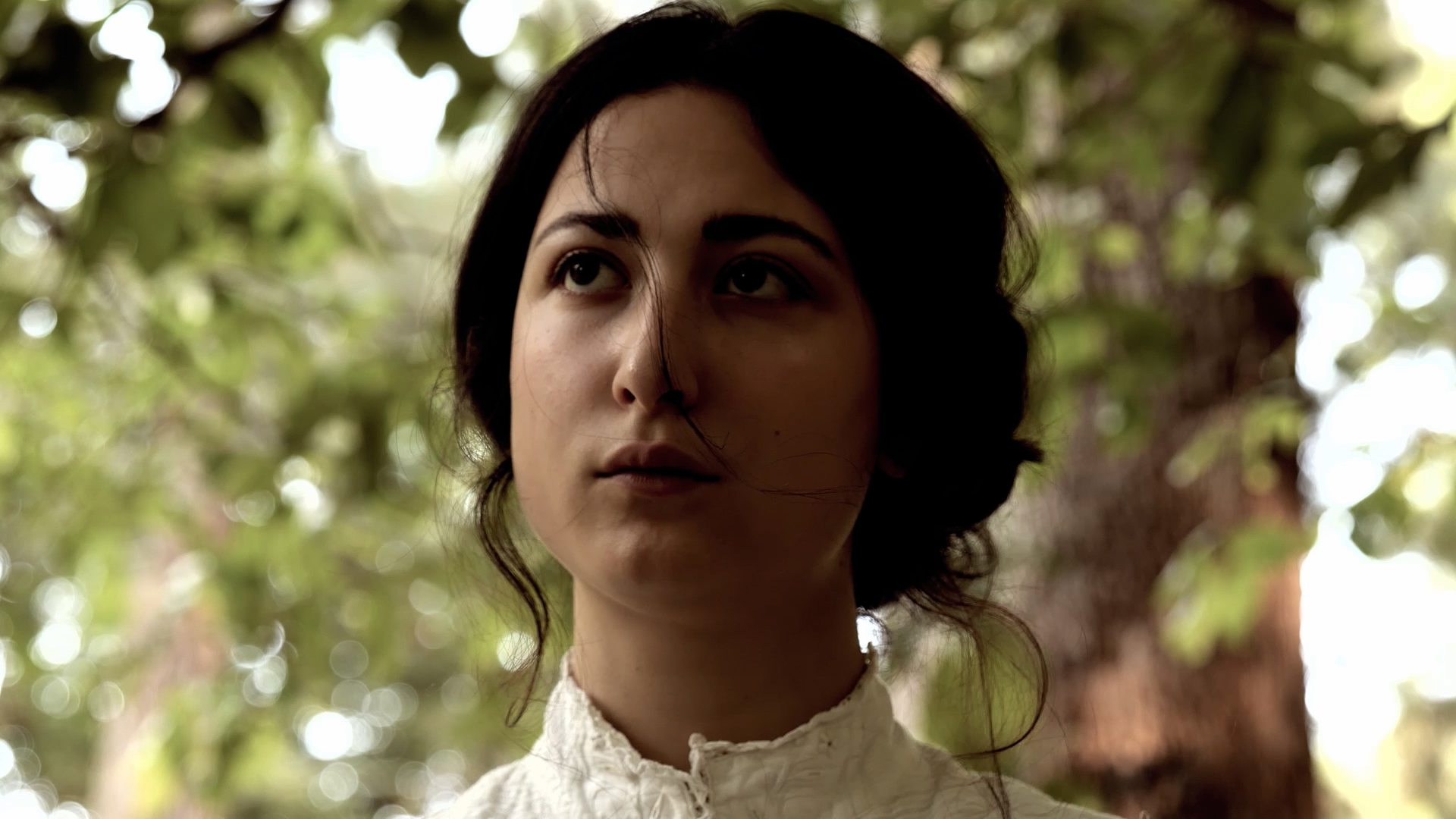
Documentary, by Isabel Russinova, Rodolfo Martinelli Carraresi, Italy, 2026
Eva of the Irises is a historical biographical docu-film about the scientist Eva Mameli Calvino, a botanist and pioneer of environmentalism in Italy, mother of the writer Italo, born in Sassari in 1886. The film, based on a multidisciplinary approach that combines several genres—such as theatre, documentary, cinema, and research—moves between memories, reflections on life, as well as the goals and missions the scholar still wished to achieve.
The multifaceted artistic sensibility of Isabel Russinova is expressed across many fields, from writing to acting, from directing to civic engagement, and finds one of its highest expressions in the docu-film Eva of the Irises, created with Rodolfo Martinelli Carraresi. The film blends scientific rigor and poetic refinement to portray the extraordinary figure of the botanist Eva Mameli Calvino, mother of Italo Calvino but above all an independent protagonist of 20th-century scientific culture. It is told through a combination of archival materials, interviews, and evocative staging capable of elegantly and profoundly conveying her intense human and professional story.
LANGUAGE: Italian
SUBTITLES: English, Spanish, French, Portuguese
A Monk Who Should Not Have Been a Scientist
There is a particular kind of desperation that wears the face of devotion. When Johann Mendel walked through the gates of the Augustinian monastery of St. Thomas in Brno in 1843, he was twenty-one years old, the son of a peasant farmer from Silesia, and he was not, by any honest account, running toward God. He was running away from poverty. His father had been partially disabled in a farming accident. The family could not support him. He had already suffered what his letters describe as a severe psychological collapse brought on by the anxiety of financial precarity during his studies. He needed shelter, stability, and access to books. The monastery offered all three. The habit was, in this sense, a scholarship with vows attached.
This is not a diminishment of Mendel. It is the most honest thing you can say about him, and it is also the thing that makes his story philosophically uncomfortable for everyone involved. The Church does not want to own it, because it implies that one of history’s most consequential scientific minds joined their ranks as an economic refugee rather than a convert. Science does not want to own it either, because it means acknowledging that the institution most commonly cast as reason’s ancient enemy was, in this particular case, the only structure on the continent willing to financially sustain a working-class intellect. History is rarely as clean as either side needs it to be.
The Augustinian monastery at Brno was not a place of suppression. Under Abbot Cyril Napp, who had been in charge since 1824, it had become something genuinely unusual: a community that encouraged scientific inquiry, maintained a substantial library, cultivated an experimental garden, and harbored men who thought carefully about the natural world. Napp himself was interested in the hereditary improvement of sheep and plants. The monastery subscribed to scientific journals. Several of its members corresponded with naturalists across Europe. When Mendel arrived, he entered not a cloister designed to extinguish curiosity but one that had, almost accidentally, created the material conditions for it to flourish.
This is the institutional paradox that Michel Foucault spent much of his career circling without ever quite landing on it directly. In Discipline and Punish, published in 1975, and throughout his lectures at the Collège de France, Foucault described how institutions produce knowledge as a byproduct of their mechanisms of control, how the very infrastructure of discipline, record-keeping, observation, and ordered routine generates ways of seeing the world that eventually escape the institution’s original purpose. The monastery trained Mendel in patience, in systematic observation, in the keeping of meticulous records. It gave him time. It gave him a garden. It gave him the eight years between 1856 and 1863 during which he cultivated approximately 29,000 pea plants and recorded the transmission of seven distinct traits across multiple generations. None of that would have existed without the structure that also required him to perform canonical hours and submit to ecclesiastical authority.
And yet there is something almost too neat about framing this as the Church accidentally producing its own undoing. Mendel’s results, had they been properly understood in his lifetime, would have been deeply unsettling to any institution whose authority rested on a fixed and divinely ordered nature. The idea that traits are inherited not as blended essences but as discrete, separable units, that there is a combinatorial logic operating beneath the surface of living things that no one designed and no one oversees, cuts against every teleological reading of the natural world. Mendel must have known this. He was not naive. He had studied physics and mathematics in Vienna under Christian Doppler between 1851 and 1853, and he understood what it meant to describe nature in terms of ratios and probabilities rather than purposes.
He wore the habit. He said the prayers. And in the garden, in the silence between obligations, he was quietly dismantling the foundations of the house that fed him.

The Language of Peas
There is a particular kind of focus that looks, from the outside, like a refusal to participate in the world. You have seen it — someone bent over a table covered in small objects, sorting them with a patience so absolute it borders on ceremony. The objects do not matter to anyone else. The sorter knows this and continues anyway, because the sorting is not about the objects. It is about something the objects are saying that no one else has yet learned to hear.
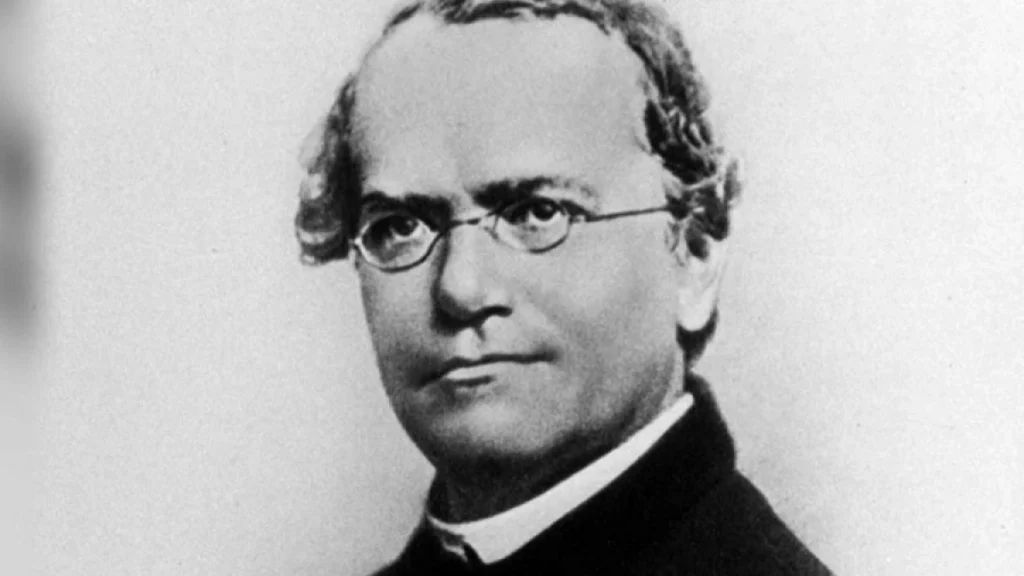
Between 1856 and 1863, Gregor Mendel cultivated approximately 29,000 pea plants in the monastery garden at Brno. He chose Pisum sativum with a precision that was itself already a kind of argument — selecting a plant with clearly distinguishable trait pairs, stable varieties, and a short enough growing cycle to yield multiple generations within a single experimental lifetime. He identified seven characteristics: seed shape, seed color, pod shape, pod color, flower color, flower position, stem length. Seven binary pairs, each one a question asked in botanical form. Round or wrinkled. Yellow or green. Tall or short. The garden was not a garden in any casual sense. It was a counting machine he had built from soil and light.
What he did next was not observation in the way his contemporaries understood observation. He did not watch. He crossed plants with surgical deliberateness, controlled pollination by hand to prevent contamination, waited through entire seasons, harvested, classified, and recorded. Then he crossed again. Then he counted. The numbers he produced were not impressions or tendencies. They were ratios. 3:1 in the second generation, again and again, across thousands of plants and multiple traits. The regularity was not beautiful to him the way a landscape might be beautiful. It was evidence of something structural, something underneath the visible surface of living things — a grammar that inheritance was secretly following.
His colleagues at the Natural History Society of Brünn, before whom he read his results in 1865, did not know what to do with this. Not because they were unintelligent, but because the question Mendel was answering was not yet a question anyone had thought to ask. This is the distinction Ian Hacking draws in his work on styles of reasoning — first elaborated in a 1982 essay and later expanded throughout his philosophical career — between the content of a claim and the style in which it becomes thinkable at all. Hacking argues that different historical periods do not simply disagree about facts. They operate within different epistemic frameworks, different ways of establishing what counts as evidence, what counts as a question worth asking, what counts as an answer. Mendel was not simply ahead of his time. He was reasoning in a mode — statistical, combinatorial, focused on discrete units rather than continuous flows — that his moment had not yet assembled the conceptual infrastructure to receive. The silence that greeted his paper was not stupidity or jealousy. It was the silence of a language spoken into a room where no one had yet learned its grammar.
There is a scene that stays with you: a man meticulously labeling small envelopes, each one containing seeds from a specific cross, arranged in a sequence so elaborate it fills an entire work surface. Someone walks in, looks at the envelopes, and walks out again without asking a single question. The silence between them is not hostile. It is simply the silence of two people standing in different centuries, sharing the same room. The man at the table does not look up. He has learned not to expect comprehension. What he expects, what he has trained himself to expect across eight years of seasons and crossings and harvests, is the numbers. The numbers do not need to understand him. They only need to appear.
Presented, Ignored, Buried
There is something particular about the silence that follows a presentation where no one asks questions. Not hostility, not disagreement — just the ambient noise of people gathering their coats, the scrape of chairs on a wooden floor, the polite murmur of men moving toward the exit. On the eighth of February, 1865, Gregor Mendel stood before the Brünn Natural History Society and spoke for the first time about his pea plants, his ratios, his invisible factors. He returned on the eighth of March to complete the presentation. The audience was not unlettered — it included physicians, pharmacists, amateur naturalists, men of reasonable education and genuine curiosity. And they listened, and then they left, and the world continued exactly as before.
The paper that followed, published in 1866 in the Verhandlungen des naturforschenden Vereines in Brünn, the society’s proceedings, ran to forty-four pages. It was not a pamphlet or a note. It was a rigorous, mathematically precise account of eight years of controlled experimentation, containing the clearest articulation of hereditary transmission that science had yet produced. Mendel himself understood its potential reach: he arranged for the paper to be distributed to approximately one hundred and twenty scientific institutions across Europe and North America, including the major academies and natural history societies of Vienna, London, Paris, and St. Petersburg. One hundred and twenty copies sent outward into the world of organized science. The response that returned was, in its near-totality, nothing.
Pierre Bourdieu spent decades trying to explain precisely this kind of event. In his work on the sociology of knowledge, and particularly in his analysis of what he called the scientific field, Bourdieu described how intellectual recognition is never simply a matter of the intrinsic quality of an idea. Every scientific community constitutes a structured space of positions, where credibility, visibility, and legitimacy are distributed according to accumulated capital — institutional affiliation, disciplinary pedigree, the endorsement of those who already hold authority. An idea enters this field not as a naked truth but as a bid, and whether that bid is heard depends less on its content than on who is making it and through which channels. Mendel was a friar from a provincial Moravian city, publishing in a regional journal that no one of consequence was actively reading. His bid arrived without the credentials that would have made it legible to those with the power to amplify it.
But Bourdieu’s framework helps clarify something more unsettling than mere gatekeeping. Rejection, in the scientific field, is itself a form of engagement. To be refuted is to be taken seriously enough to be argued against. What happened to Mendel’s paper was something structurally different and considerably more brutal: it was not rejected. It was rendered invisible. The distinction matters enormously. Invisibility does not leave a trace in the record. There is no published critique to overcome, no famous dispute to be eventually resolved in one’s favor. There is only the absence of any reaction whatsoever, which means there is no entry point for rehabilitation, no controversy to be revisited. The paper simply sat in the proceedings of the Brünn society, indexed nowhere that mattered, cited by almost no one, while the men who might have recognized its significance continued their own work in complete ignorance of its existence.
The single exception that is always cited — the botanist Carl Nägeli, with whom Mendel corresponded for several years — proves the rule in a particularly painful way. Nägeli read the paper. He engaged, at least superficially. And then he directed Mendel toward experiments with hawkweed, a plant whose reproductive biology would have confounded any attempt to replicate the pea results, as though steering a navigator away from the one coastline where the map was accurate. Whether this was carelessness or something more subtly possessive of his own theoretical territory, the effect was identical to silence.
The Weight of Administration
There is a particular kind of cruelty that wears the face of honor. You have spent years in a garden, in silence, in the slow accumulation of evidence, and then one morning the institution that housed your silence decides to reward you for it by making you its manager. The promotion arrives before anyone has understood what you were doing. It arrives, in fact, precisely because no one has understood.
In 1868, two years after the paper on pea plants was read into the proceedings of the Brünn Natural History Society and quietly began its journey toward obscurity, Gregor Mendel was elected abbot of the Augustinian monastery of St. Thomas. He was forty-six years old. The experiments in the garden, the meticulous counting of seven thousand plants across eight years, the ratios that kept returning with the patience of a mathematical proof — all of it was essentially finished. Not because he had lost interest, but because the role that now defined him had different demands, and those demands were not negotiable.
Hannah Arendt, in The Human Condition published in 1958, drew a distinction that cuts through this moment with uncomfortable precision. She separated what she called the vita activa — the life of labor, work, and political action — from the vita contemplativa, the interior life of thought and sustained attention. Arendt was not simply restating the old Aristotelian preference for contemplation. She was examining how modernity had systematically collapsed the space in which contemplation was possible, how the demands of institutional and civic life had absorbed the interior entirely. What happened to Mendel was not unusual. It was the institutional norm. You think carefully, you produce something that does not yet fit the existing categories, and the system responds by making you responsible for its own continuity.
The ledger that replaced the garden was not metaphorical. Mendel’s abbacy brought with it a prolonged and exhausting legal conflict with the Austrian government over a new taxation law targeting monasteries, introduced in the 1870s under the ministry that sought to rationalize church property across the empire. He refused to comply. He fought the enforcement with a tenacity that those who knew him later recognized as the same stubbornness that had kept him counting peas through seasons of ambiguous data. But there is a difference between stubbornness in the service of discovery and stubbornness in the service of institutional survival. One opens. The other fortifies.
The battle consumed his final decade. The correspondence thickened. The administrative weight pressed down on what remained of his scientific imagination. He made some attempts to extend his work, crossing hawkweed plants in a project that frustrated him deeply because hawkweed reproduces in ways that do not follow his own ratios — a fact that, had he possessed the tools to understand it, might have added crucial complexity to what he had already found. But the tools did not exist yet, and the time was gone.
There is a man in a room, late in his life, surrounded by papers that are not his. The letters he writes are formal, legal, resistant. Outside, in a garden he no longer tends, something he planted is still growing, still dividing, still following rules he named without knowing their full implications. He will die in 1884 without knowing that the implications exist.
Arendt argued that action — political, institutional, administrative — has a tendency to consume the one who enters it, to pull the person into a web of consequences that cannot be controlled or retracted. Thought, by contrast, leaves no trace in the world until someone else picks it up. Mendel’s thought left almost no trace. His institution left him with nothing but traces, none of them his.
A vision curated by a filmmaker, not an algorithm
In this video I explain our vision
Rediscovery and the Violence of Credit

There is a particular kind of theft that does not feel like theft at all, not even to the person committing it. You find something extraordinary, something that confirms and extends what you yourself have been laboring toward for months, perhaps years, and in the exhilaration of recognition you reach for a pen. The unsigned canvas is already masterful. You simply add an initial before anyone else can.
In the spring of 1900, three botanists in three different countries published findings about hereditary transmission that each believed, with varying degrees of sincerity, to be substantially their own. Hugo de Vries in Amsterdam, Carl Correns in Tübingen, Erich von Tschermak in Vienna — all three had been running hybridization experiments that pointed toward ratios, toward dominant and recessive traits, toward patterns in the distribution of characteristics across generations. All three then encountered Mendel’s 1866 paper in the Verhandlungen des naturforschenden Vereines in Brünn. And all three published in the same year, each citing Mendel’s work, though with rather different degrees of enthusiasm for just how much of the fundamental architecture Mendel had already built.
De Vries, the most accomplished and the most aggressive of the three, had actually circulated a paper in French in February 1900 that made no mention of Mendel whatsoever. It was only after Correns wrote to him privately, pointing out that what he was calling his own discovery had been formulated with greater precision thirty-four years earlier by a monk in Brno, that the references appeared. The correction was made only when caught. This is the part that scientific hagiography tends to soften into graciousness, into the narrative of magnanimous scholars rallying around a forgotten genius. The less comfortable truth is that the record was set straight under pressure, not out of spontaneous intellectual honesty.
The philosopher of science Thomas Kuhn argued in The Structure of Scientific Revolutions, published in 1962, that science does not progress by the clean accumulation of truths but through ruptures, through paradigm shifts that restructure the very questions a field is permitted to ask. What Kuhn understood, and what the Mendel rediscovery illustrates with uncomfortable clarity, is that scientific history is written backward. Glory is assigned retroactively, and the assignment tends to follow power, prestige, and proximity to the moment of institutional recognition rather than the actual chronology of thought.
Consider what the year 1900 represented. Mendel had been dead for sixteen years. He had spent his final decade as abbot of St. Thomas’ Monastery, consumed by an administrative dispute over taxation that embittered him profoundly and left almost no time for science. The work he had done between 1856 and 1863, crossing approximately twenty-nine thousand pea plants across eight years of methodical observation, had generated exactly zero substantive scientific response in the decades following its publication. He had written to the Swiss botanist Karl Wilhelm von Nägeli, considered one of Europe’s foremost authorities on plant hybridization, seeking engagement and guidance. Nägeli responded with something between condescension and indifference, advising him to work with hawkweed instead of peas — a recommendation that led Mendel into years of frustrating experimentation with a plant whose reproductive peculiarities made his statistical method nearly impossible to apply.
When the three botanists of 1900 stepped into the light, they stepped into it alone. Mendel’s name was attached, but as antecedent, as precursor, as the modest friar who had gestured at something that real scientists now confirmed. The vocabulary of rediscovery is itself a kind of colonization. To rediscover something implies the original discoverer was insufficient, incomplete, a rough sketch that needed professional hands to render legible. What gets absorbed into this framing is not just credit but the intelligence of the method itself, the extraordinary statistical rigor of a man working without any formal framework for probability theory, intuiting through sheer precision of observation what would not be theoretically grounded until Ronald Fisher’s work in the 1930s.
What Inheritance Actually Means
There is a moment, usually at a family gathering, when someone points across the table and says: you have your grandmother’s eyes. And something in you accepts this without question, because it feels true, because resemblance feels like continuity, like a river that flows through generations carrying the same water. But this is precisely the illusion that Mendel’s work dismantled, quietly and without ceremony, in a monastery garden in the 1860s. What he demonstrated, through years of counting peas that no one wanted counted, is that inheritance is not a river. It is a lottery.
Traits do not blend. They do not meet in the middle, soften into compromise, become the diplomatic average of two parents. They sort, they segregate, they recombine according to probabilities that care nothing for family feeling or cultural narrative. The grandmother’s eyes did not flow into you. A discrete unit, sitting dormant and silent in the genome for a generation, suddenly expressed itself in your face. There is something almost violent in this — the randomness of it, the arbitrariness of which combination you received from the approximately twenty-three thousand protein-coding genes that constitute the human genome, half from each parent, shuffled through meiotic recombination into an arrangement that has never existed before and will never exist again.
Richard Dawkins built an entire philosophical edifice on this foundation. In The Selfish Gene, published in 1976, he argued that organisms are best understood not as unified selves but as temporary vehicles for genes competing to replicate. The individual, in this view, is almost incidental — a survival machine assembled by genes that preceded it and will, in fragments, outlast it. This is Mendelism carried to its logical extreme: identity is not a property of the person but of the discrete units that constituted them. You are, in a certain cold light, a recombinant archive, a particular shuffle of ancestral material that happened to cohere into something that walks and thinks and believes itself continuous.
And yet you should resist the seduction of this picture, not because it is wrong but because it is incomplete in ways that matter enormously. Eva Jablonka, alongside Marion Lamb in their 2005 work Evolution in Four Dimensions, demonstrated that inheritance operates through at least four distinct systems simultaneously — the genetic, the epigenetic, the behavioral, and the symbolic. The epigenetic layer alone is sufficient to unsettle the clean Mendelian architecture: chemical modifications to DNA, methylation patterns, histone changes, none of which alter the sequence of genes but all of which alter whether and how those genes are expressed, and some of which can be transmitted across generations. What your grandmother experienced — chronic stress, nutritional scarcity, a particular emotional landscape — may have left marks not on her genes but on the regulatory apparatus around them, marks that arrived in you not as sequence but as tendency, as sensitivity, as a predisposition you never chose and cannot easily see.
This means that the nation, the family, the ethnic identity that claims to flow through blood is both more and less than it pretends. Less, because the genetic differences between human populations are negligible compared to the variation within them — a fact that molecular anthropology has confirmed repeatedly since Luigi Luca Cavalli-Sforza’s monumental work in the 1990s on the history and geography of human genes. More, because something genuinely does transmit across generations, not the mythology of pure blood or unbroken lineage, but the residue of lived experience, the epigenetic echoes of what bodies endured before yours existed.
Mendel gave us the particles. He showed that inheritance is not a substance but a structure, not a fluid but a combinatorial code. What he could not see, and what we are only beginning to map now, is that the code itself is read differently depending on conditions that the code did not write.
The Monastery Garden as a Map of Everything Unseen
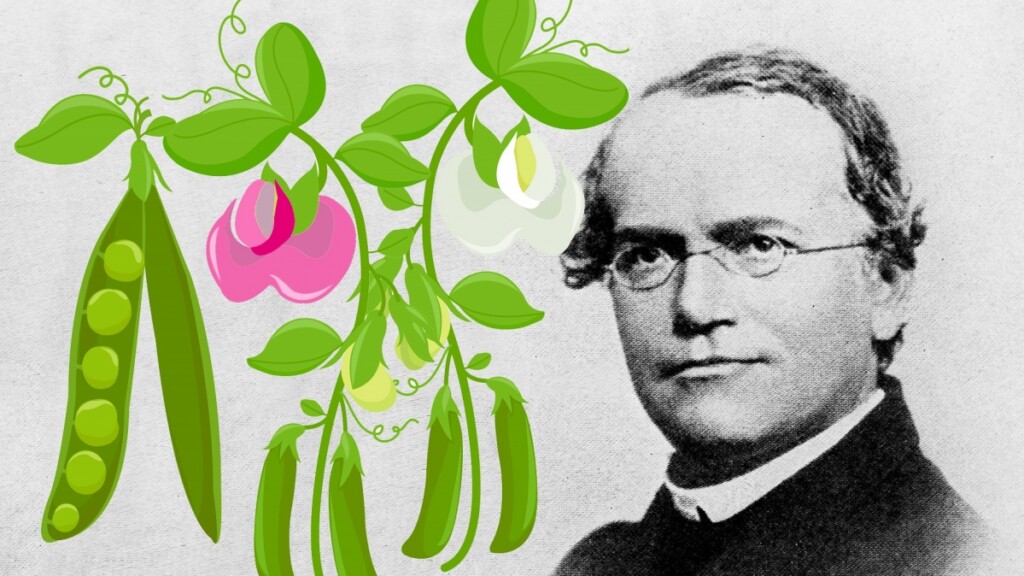
There is a garden in Brno that still exists. You can visit it. You can walk the same gravel paths, stand in approximately the same light that fell across approximately the same beds of soil where a man spent the better part of eight years watching pea plants grow, flower, and die, then watching their children grow, flower, and die, then counting. Just counting. Thirty thousand plants across a decade of deliberate, almost incomprehensible patience. The garden is not large. That is perhaps the first thing that disturbs you when you see it — how small a space was sufficient to contain the question that would eventually rewrite biology.
But the garden was never a symbol. That is the retrospective sentimentality of people who know how the story ended. While Mendel was in it, the garden was simply a place where he worked, often alone, often in the early morning before the administrative demands of monastic life consumed the day. He was not meditating on the mystery of heredity in any grand sense. He was counting wrinkled peas and smooth peas, noting the color of seed coats, measuring the height of stems. The attention he brought to these objects was not poetic. It was almost mechanical in its discipline, which is precisely why it worked.
What the history of knowledge actually looks like, when you strip it of its heroic mythology, is someone staring at something ordinary for longer than anyone thought reasonable. A man once described spending an entire afternoon watching the way light moved across a prison corridor wall — the same corridor he had passed through hundreds of times — until suddenly the pattern of shadow and plaster was no longer a wall but a legible text about time, about containment, about the geometry of power made material. Nothing changed. The wall did not change. What changed was the quality of the looking, which had finally become serious enough to see what was always there. Simone Weil, who understood attention as a form of moral and intellectual practice better than almost anyone in the twentieth century, wrote in her 1942 essay on school studies that attention is not concentration in the ordinary sense but a kind of waiting, a receptivity, a willingness to remain with an object until it yields what it has always contained. Most people, she argued, are never taught this. Most educational systems, most professional structures, most social rhythms actively train people away from it by rewarding speed, output, visible productivity.
Mendel was, by the standards of his institution, not especially productive. He failed his teaching examinations. He published once, in a journal almost no one read, and then he essentially stopped. The silence that followed his 1866 paper is not a mystery of historical accident — it is the entirely predictable outcome of a system that had no category for what he had done. Francis Galton, working in the same decades, was celebrated, funded, socially connected. He was asking questions that confirmed what his culture already believed about heredity and human hierarchy. Mendel was asking a question that had no social utility visible to anyone around him, about the mathematical ratios hidden inside the reproduction of garden peas. The invisibility of his work was not a failure of communication. It was a structural feature of how knowledge systems decide, in real time, what counts as knowledge.
A woman sits on a train and notices that the pattern of rivets along the interior wall follows an irregular sequence she cannot immediately explain. She looks at it for several stops. Then several more. The train empties and fills around her. What she is doing has no name in the language of productivity or professional development or personal growth. It is simply attention given freely to something that has not yet asked for it, which is perhaps the only condition under which anything genuinely new has ever been found.
🧬 Between Science, Nature, and the Depths of Thought
Gregor Mendel’s patient observation of pea plants in a monastery garden gave humanity the keys to understanding heredity. His work reminds us that great discoveries often emerge at the intersection of rigorous method and quiet contemplation — a crossroads shared by philosophers, artists, and scientists alike.
Epicurus: Life and Philosophy
Epicurus built his philosophy around the careful observation of nature and the pursuit of a life free from unnecessary suffering — a pursuit not unlike Mendel’s dedicated scientific inquiry within the walls of his monastery. Both figures remind us that the examined life, whether philosophical or empirical, yields the most enduring truths. Exploring Epicurus opens a window onto the ancient roots of rational thought that would centuries later inspire modern science.
GO TO THE SELECTION: Epicurus: Life and Philosophy
Martin Heidegger: Life and Philosophical Thought
Martin Heidegger’s philosophical investigation into the nature of Being raises profound questions about what it means to exist, to observe, and to understand the world around us. His thought invites us to reflect on the act of scientific inquiry itself — not merely as data collection, but as a fundamental human way of engaging with existence. Reading Heidegger alongside Mendel reveals how science and philosophy are twin endeavors in humanity’s search for meaning.
GO TO THE SELECTION: Martin Heidegger: Life and Philosophical Thought
Paracelsus: Life and Alchemical Thought
Paracelsus stands as one of the most fascinating precursors to modern scientific thought, blending alchemical tradition with careful empirical observation of the natural world. Like Mendel, he challenged the orthodoxies of his time and insisted that truth must be sought through direct engagement with nature rather than inherited dogma. His legacy bridges the mystical and the scientific, making him an essential figure for understanding how modern biology emerged from older ways of knowing.
GO TO THE SELECTION: Paracelsus: Life and Alchemical Thought
Albertus Magnus: Alchemy and Natural Philosophy
Albertus Magnus was a towering medieval intellect who synthesized natural philosophy, theology, and early experimental observation in ways that prefigured the scientific method Mendel would later embody. His encyclopedic curiosity about plants, animals, and minerals established a tradition of rigorous natural inquiry within the monastic world — the same world that would shelter Mendel centuries later. Discovering Albertus Magnus means tracing the deep roots of the scientific spirit in Western thought.
GO TO THE SELECTION: Albertus Magnus: Alchemy and Natural Philosophy
Discover the Cinema That Thinks Differently
If these explorations of science, philosophy, and human curiosity have stirred something in you, Indiecinema streaming is the place to follow that thread further. Our catalog is home to independent films and documentaries that dare to ask the questions others overlook — from the nature of life to the boundaries of knowledge. Join us and let independent cinema become your next great discovery.
👉 EXPLORE THE CATALOG: Watch Indie Films in Streaming
A vision curated by a filmmaker, not an algorithm
In this video I explain our vision

