
The Morning You Forgot You Were Going to Die
You wake up and the day is already waiting for you like a sentence you didn’t write. The coffee machine runs while you scroll through notifications you will not remember by noon. Someone posted something outrageous. Someone else responded. You form an opinion about it in roughly four seconds, carry it for twenty minutes, and then it evaporates without ceremony. The traffic is bad. The traffic is always bad. You sit in it with the low-grade irritation of a person who expected something different, even though this is the four hundred and thirty-seventh time the same road has done this to you. You arrive. You begin. The morning is gone.

Nothing about this feels like a philosophical crisis. That is precisely the problem.
Martin Heidegger, born in Messkirch in the Baden region of Germany in 1889, spent the better part of his intellectual life trying to locate something that everyone already knew but had successfully buried under the sheer volume of daily activity. His major work, Being and Time, published in 1927, opens not with a definition or a system but with a scandal: Western philosophy since Plato had asked every conceivable question about beings, about things that exist, about minds and matter and God and ethics, and had somehow forgotten to ask the only question that should have come first. What does it mean to be at all? Not what things are. What being is. The difference sounds subtle. It is, in fact, the size of an abyss.
But the philosophical architecture matters less right now than the phenomenological portrait he drew of ordinary human existence. Heidegger called the structure of everyday life das Man, a term that resists clean translation. In German it functions like the impersonal “one” or “they.” One does not behave that way. They say it will rain. It is a grammatical form that erases the subject, and Heidegger’s insight was that most of human life is conducted in exactly this grammatical mood. You do not choose what to worry about. You do not choose what to want. They choose it for you, and they are not a conspiracy or a ruling class. They are the anonymous average of everyone and no one, the social atmosphere you breathe without noticing that breathing is something you could theoretically control.
This is what the morning routine is. Not laziness. Not distraction. A fully operational system of evasion that has been refined across centuries and now runs so smoothly it feels like consciousness itself. The philosopher Charles Taylor, engaging with Heidegger in his 1989 work Sources of the Self, described modern identity as fundamentally structured by horizons of significance that remain almost entirely unexamined. We navigate by them constantly and look at them almost never. The coffee, the notifications, the traffic, the opinion formed in four seconds: each one is a small transaction with das Man, a minor confirmation that you are still safely inside the shared world of what one does, what one cares about, what one fears.
And what one does not fear. This is where the evasion becomes something more than inconvenient. Because underneath the structure of das Man, Heidegger argued, there is a knowledge you are actively not having. You are going to die. Not in a general, statistical, distant way. You, specifically, will cease to be, and you do not know when, and no arrangement of your calendar will change this. He called this condition Sein-zum-Tode, being-toward-death, and his claim was not that you should think about death more often but that your entire mode of existing is already organized around the refusal to let that knowledge land.
The morning you forgot you were going to die was not this morning. It was every morning. The system is not broken. The system is working exactly as it was designed.
Don Barry: A Quixotic Exploration
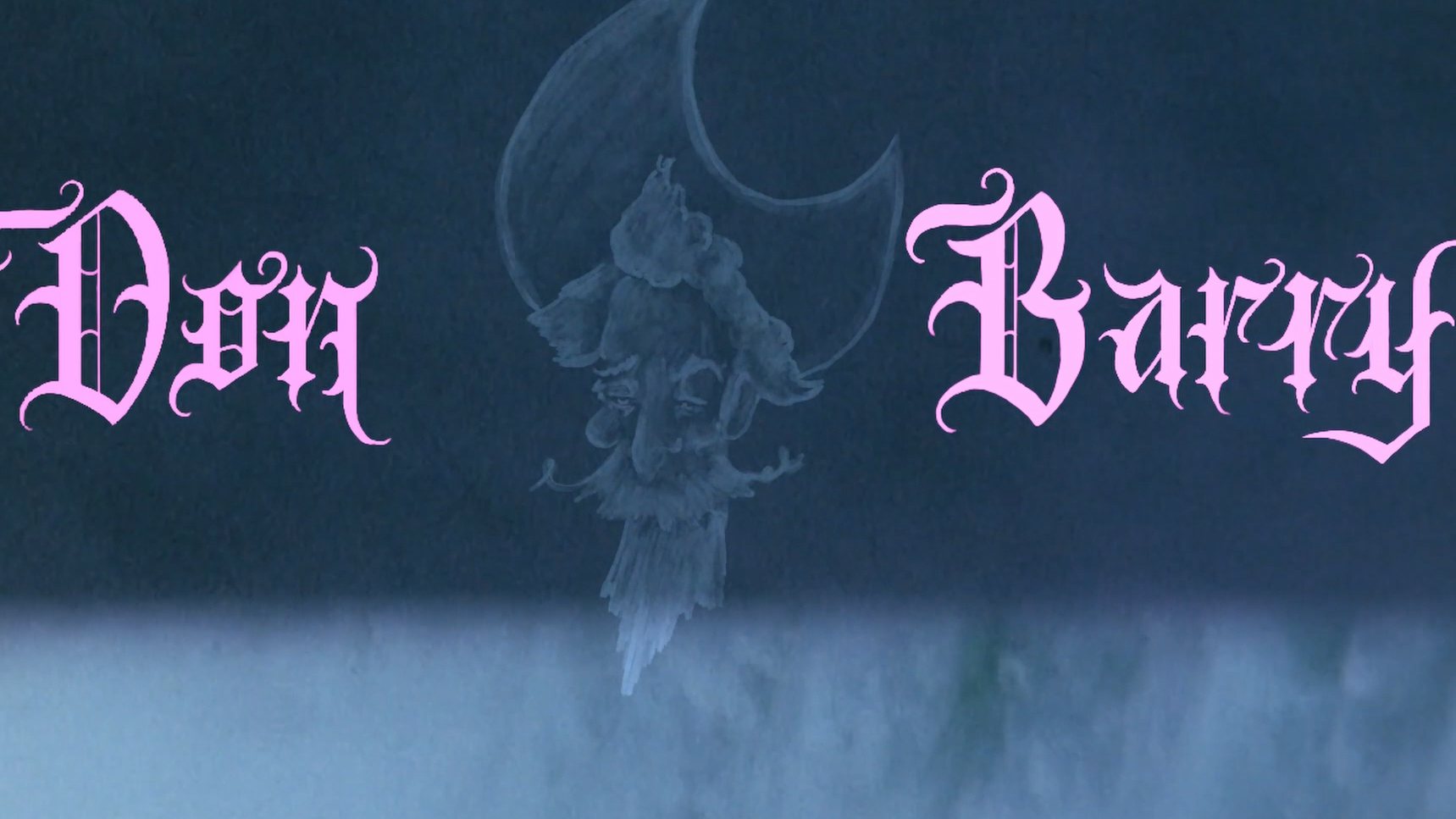
Docufiction, Experimental, by Paul Smart, Mexico, 2026.
Don Barry: A Quixotic Exploration is a debut feature that places the biography of an eighty-year-old experimental filmmaker and artist, Barry Gerson, within the metanarrative of Miguel de Cervantes’ Don Quixote. Don Barry was filmed in the city of Guanajuato during the 51st edition of the Cervantino Festival, as well as during the vibrant Day of the Dead celebrations held in the city’s UNESCO-listed tunnels. The film honors the director’s long friendship with artist Barry Gerson, drawing inspiration from Cervantes’ Don Quixote. Paul Smart’s directorial choices create something new that celebrates life and goes beyond conventional storytelling. A search for magic in our real lives. A moving film about the meaning of life, art, and death. Not to be missed.
Paul Smart is a proud outsider filmmaker with a long history of film screenings. In the 1980s, he emerged in New York’s vibrant youth art scene, working in theater production and later filmmaking, before retreating to rural upstate New York, in the Catskill Mountains, where he made a living writing and screening independent films in old parish halls for rural audiences, many of whom had never seen a film.
LANGUAGE: English
SUBTITLES: Spanish, French, German, Portuguese
A Philosopher Born Into the Ruins He Would Help Create
There is a photograph of Meßkirch that looks like a memory before it becomes a place. Stone churches, tilted light, the Black Forest pressing in from every direction like a thought that refuses to leave. Heidegger was born there in 1889, the son of a cooper and sexton, and the landscape never fully left his thinking — not because he romanticized it, but because it structured his sense of what belonging means, what rootedness costs, what is lost when a human being is torn from the soil of a particular world into the abstraction of modernity. He grew up in a Catholic household whose austerity was not merely devotional but metaphysical: the world had layers, the visible concealed the real, and the task of a serious mind was to push past surfaces toward something harder to name.
The seminary sent him toward theology, and theology sent him, unexpectedly, toward Aristotle. Franz Brentano’s 1862 dissertation on the multiple meanings of being in Aristotle — a text Heidegger would later describe as the single most decisive influence on his early thought — functioned as a kind of detonator. The question it planted was simple and bottomless: what does it mean for something to be? Not what kinds of things exist, not how we categorize them, but the sheer fact and structure of existence itself. By the time Heidegger completed his habilitation in 1916 at Freiburg, with a study of Duns Scotus, he had already begun to sense that Western philosophy had spent two and a half millennia answering every question except the one that made all the others possible.
Edmund Husserl recognized something in him. The founder of phenomenology took Heidegger under his care, and what followed was one of those intellectual relationships where the student absorbs the method and then uses it to detonate the teacher’s assumptions. Husserl wanted to ground knowledge in pure consciousness. Heidegger wanted to go further back — before consciousness, before the subject-object split, to the being who finds itself already thrown into a world it did not choose, already caring about things before it has time to reflect on why. Being and Time, published in 1927, was the result: arguably the most technically demanding and philosophically consequential book written in the twentieth century, a text that dismantled the Cartesian subject, reframed time as the horizon of all meaning, and introduced a vocabulary — Dasein, thrownness, fallenness, authenticity, Being-toward-death — that has never entirely left serious philosophical discourse since.
And then 1933. He joined the National Socialist Party in May of that year, accepted the rectorship of Freiburg University, delivered an address in which the German university was summoned to serve the historical destiny of the German people, and invoked leadership — Führung — with a directness that cannot be explained away by context or ambition alone. He resigned the rectorship the following year, but he did not resign from the Party until the war’s end forced that formality. He never offered a serious public reckoning. In the postwar years, when colleagues and former students asked him directly what he thought he had done, he offered deflections of remarkable philosophical ingenuity — as if the same intelligence that had theorized the evasions of das Man, the impersonal crowd-self that flees from its own responsibility into comfortable anonymity, had turned its full apparatus toward self-protection.
This is not a moral verdict. It is a philosophical observation. The man who wrote more penetratingly than almost anyone in the twentieth century about what it means to own your existence, to face it without illusion, to resist the seductions of the crowd — that man, when history demanded it, performed precisely the capitulation he had named and anatomized. The ruins were not incidental to the thought. They were, in some way still not fully understood, continuous with it.

Being and Time and the Thing That Cannot Be Delegated
There is a morning — you have had it, everyone has had it — when you wake before the alarm, in the gray interval between sleep and obligation, and for a few seconds you do not know who you are supposed to be that day. Not amnesia. Something more precise: a momentary suspension of the entire apparatus of role, name, schedule, relation. You are simply there, in a body, in a room, on a planet that did not ask your consent before placing you on it. The feeling lasts perhaps four seconds before the machinery reassembles itself. But those four seconds are, philosophically speaking, everything.
Heidegger spent a decade assembling the architecture of that four-second gap. Sein und Zeit, published in 1927, is one of the most demanding books in the Western philosophical canon, and also, paradoxically, one of the most intimate. Its fundamental question — why is there something rather than nothing — is not the idle curiosity of a scholar with too much time. It is the question that hides inside every ordinary morning, every moment when the scaffolding of self briefly fails to hold. Heidegger understood that Western philosophy had spent two millennia trying to define Being as if it were a property of objects, a predicate you could attach to things the way you attach a price tag. He wanted to dissolve that error by beginning somewhere else entirely: with the being for whom Being is itself a question. That being is Dasein — a German compound that means, literally, being-there. Not a subject. Not a soul. Not a rational animal. Something stranger and more accurate: existence as the site where the question of existence arises.
The concept of thrownness — Geworfenheit — is among the least comfortable ideas in modern philosophy, and therefore among the most honest. You were thrown into existence. Into a specific language, a specific historical moment, a specific body with its specific limitations, a specific family carrying its specific damage. No one consulted you. No one handed you a contract to sign or a manual to study before the event began. Jean-Paul Sartre, reading Heidegger with both admiration and competitive anxiety, would later construct his own vocabulary around this same abyss, but Heidegger’s version carries a different weight: it is not primarily about freedom, it is about facticity, about the sheer brute givenness of the situation you find yourself in before you have had the chance to form a preference about it.
Facticity is not fate. That distinction matters enormously. To acknowledge that you were thrown into conditions you did not choose is not to conclude that those conditions determine you completely. It is to see clearly, without the anesthetic of optimism or the paralysis of determinism, what the actual ground beneath your feet consists of. Erik Erikson, working decades later and from an entirely different disciplinary tradition, would describe the developmental crisis of identity as precisely this confrontation: the moment when the inherited structures are recognized as inherited, and the question of what to do with that recognition becomes unavoidable. Heidegger arrives at something similar, but strips it of its psychological packaging. There is no therapist at the end of this corridor. There is only the corridor.
Being-in-the-world — another of the book’s central formulations — is Heidegger’s refusal of the Cartesian split between a thinking subject sealed inside its own skull and a world of objects arrayed outside it. You are not in the world the way a coin is in a pocket. You are constituted by your being-in, your engagement, your care, your projects, your fear of death. The world is not something you encounter. It is something you always already are inside of, shaped by, oriented within. And the thing that cannot be delegated — the thing no institution, no relationship, no ideology can perform on your behalf — is the confrontation with that being-in as yours, irreducibly, without substitute.
The Lost Poet
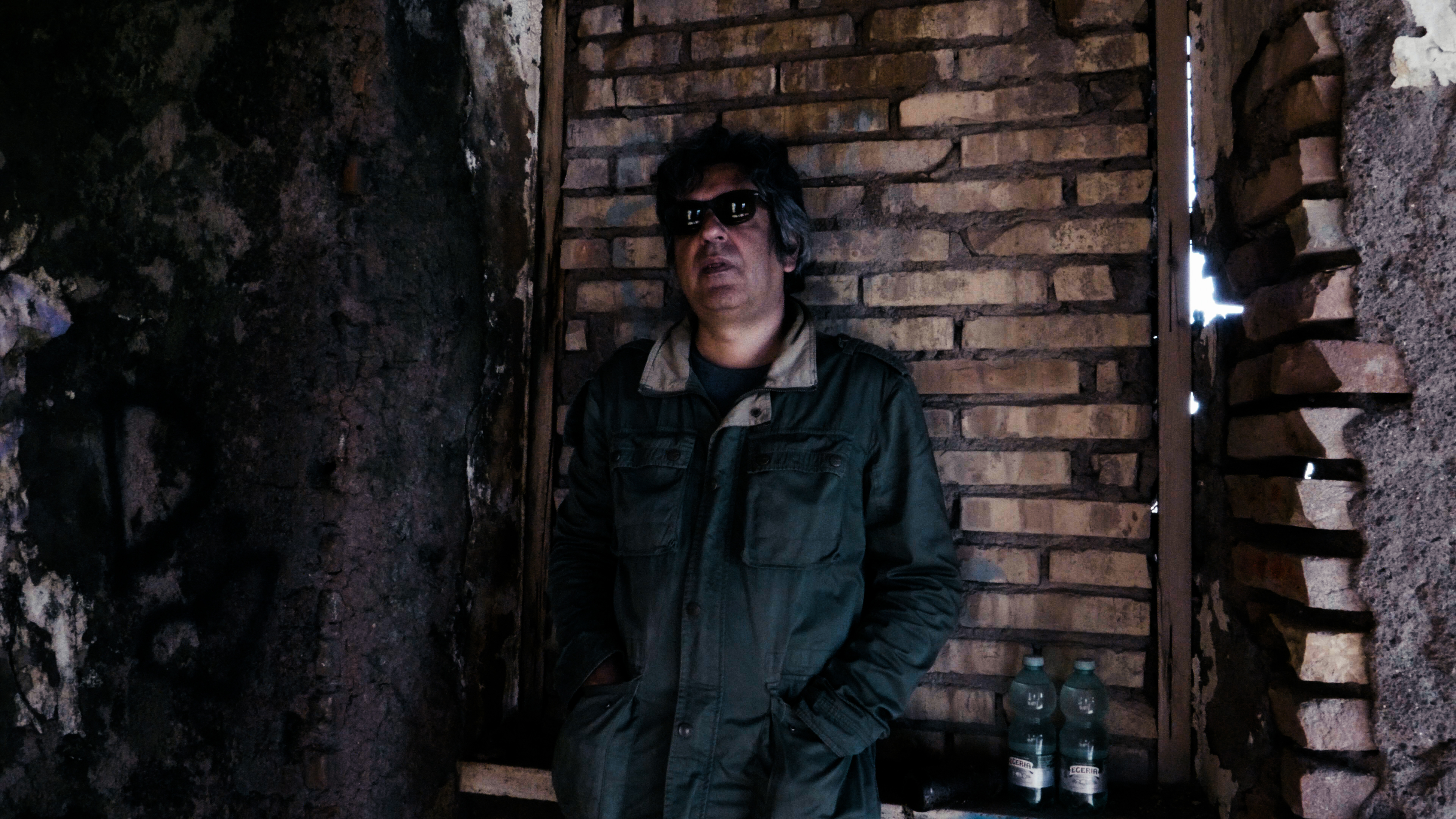
Drama, by Fabio Del Greco, Italy, 2024.
Dante Mezzadri wants to see an old friend, nicknamed the Iguana, whom he has lost sight of for many years, and who has managed to turn their shared youthful passion for poetry into a job, becoming a famous writer and poet. The man escapes from his bourgeois life and his wife to live homeless on the Roman coast, printing and trying to sell his poetry collections. At night he sleeps in a park of old carnival floats, inside a papier-mâché tank, and waits for the opportunity to meet his old friend, who however never shows up for appointments in the places they frequented when they were young, now in ruins. Dante's poetry books do not interest anyone and to support himself he is forced to "change product": he starts selling the infamous "cannibal pill" on behalf of young drug dealers, a new drug that sells like hot cakes and causes sensory and consumerist ecstasy. However, he realizes that this powerful drug is very dangerous for those who take it, he comes into conflict with his ethical conscience and throws all the pills into the sea. However, the dealers want to collect their money.
Shot over a period of 2 years, the film is a reflection on the cultural and artistic rubble of the society in which the protagonist lives, in an increasingly mechanized, consumerist and arid world. Dante Mezzadri is yet another human being who has renounced his inspiration and his creativity, but unlike many he is not willing to give his life to a system that distances him from his true identity. The physical world around him, however, seems constructed in such a way that it seems impossible to escape from this "invisible cage". The enthusiasm of the people he meets is ignited only by sensory gratification, by unreal visions of personal affirmation and success, by "metaverses" that offer an escape into an illusory and destructive reality. The poet's house on the coast, where he met with his friends as a young man, is just a pile of abandoned rubble. What happened to all those who wanted to become poets and ended up becoming something else? Are there internal forces with which that house can be "rebuilt"?
LANGUAGE: Italian
SUBTITLES: English, Spanish, French, German, Portuguese
The Hammer That Breaks and the World That Appears
There is a particular silence that is not silence at all. You have walked into a space where machines have stopped — a factory floor, a workshop, a server room suddenly dark — and what you encounter is not quiet but the sudden, overwhelming presence of everything that was always operating beneath your awareness. The hum was the background of thought itself. Without it, thought floats loose, unmoored, and for a moment you cannot remember what you were doing or why you came.
This is the moment Heidegger was describing in 1927 in “Being and Time” when he distinguished between two modes of encountering things. The hammer in the hand, while it is working, is what he called zuhanden — ready-to-hand, withdrawn into its function, invisible, transparent to the purpose it serves. You do not see a hammer when you are hammering. You see the nail, the wood, the joint that must hold. The tool disappears into use. This invisibility is not a failure of attention but its highest form: the world is a seamless web of purposes, and every object in it is a thread that leads somewhere else, toward the work, toward the other people the work is for, toward the whole structure of meanings in which a life is actually lived. Heidegger called this structure the Umwelt, the environment as lived, and it is never neutral. It always already matters.
Then the handle breaks. The machinery stops. The worker stands in the sudden silence of the factory floor, and the machines — enormous, grey, oil-stained — are no longer invisible instruments of production. They become objects. They become vorhanden — present-at-hand — things to be looked at, examined, theorized about. The seamless web tears, and through the tear you see, for the first time, the web itself. You see that there was a structure, that you were inside it, that it was holding you in a specific orientation toward the world without your ever having chosen it or even noticed it. What breaks in the breakdown is not just the tool. What breaks is the concealment.
This is Heidegger’s phenomenology of breakdown, and its implications reach far beyond workshops. The man walking through the stopped factory floor sees something that the man who works there every day cannot see: the machinery has become a landscape of pure facticity, stripped of purpose, strange, almost threatening in its materiality. The tools have become their own kind of question. And that question, Heidegger insists, is the oldest question in philosophy: what is the being of things? Science and technology, he argues, systematically suppress this question. They take the ready-to-hand, the living web of purposes and meanings, and convert it entirely into the present-at-hand — into objects available for measurement, calculation, manipulation. This is not a neutral operation. It is a decision about what reality is, and it forecloses others.
By 1954, in “The Question Concerning Technology,” Heidegger had given this foreclosure a name: Gestell, enframing. The essence of modern technology is not machinery or industry — those are symptoms. The essence is a way of revealing the world in which everything is reduced to Bestand, standing-reserve, a stock of resources waiting to be ordered, optimized, consumed. The Rhine River, he wrote, is now a water-power supplier. The hydroelectric plant does not adapt itself to the river; it adapts the river to itself. And this logic does not stop at rivers. Human beings, too, are enrolled in the standing-reserve — as human resources, as labor capital, as demographic data, as consumers whose preferences are themselves a resource to be extracted and monetized.
Angst as the Only Honest Weather
There is a night that comes for everyone eventually, though most people spend considerable energy ensuring it never arrives. You have built the life correctly. The apartment is warm, the relationship is stable, the career is moving in the right direction, the calendar for next month is already full in ways that feel like proof of something. And then at two in the morning you are suddenly awake, sitting upright in the dark, heart moving too fast, and there is nothing wrong. Absolutely nothing wrong. No sound, no threat, no memory of a bad dream. Just the ceiling and the dark and a feeling that the floor of things has silently given way.
Heidegger insists on a distinction that ordinary language tends to collapse. Fear, he argues in Being and Time, is always fear of something — a specific object, a definable threat, a danger that can in principle be located and managed. Angst is categorically different. It has no object. It cannot be resolved by identifying what is wrong, because nothing is wrong in any locatable sense. What Angst discloses is not a problem within existence but the groundlessness of existence itself, the fact that Dasein — being-there, you, thrown into a world you did not choose — has no ultimate foundation beneath it. The mood does not arrive from outside. It rises from inside the structure of being human, from the gap between the fact that you are here and the absence of any final reason why.
This is what that woman in the dark is actually experiencing. She has done everything right, and it has made no difference, because Angst is not a response to failure. It is what breaks through when the machinery of everydayness — what Heidegger calls das Man, the anonymous they-self, the collective murmur that keeps everyone oriented toward socially legible goals — briefly stops running. The anesthesia lifts for a moment, and what is underneath is not comfort. It is the open, vertiginous fact of being finite and free and entirely without a given meaning.
Kierkegaard saw this a century before Heidegger gave it its philosophical architecture. In The Concept of Anxiety, published in 1844, he described anxiety not as a response to evil or danger but as the dizziness of freedom — what he called the dizzying possibility of being able. The child at the edge of the precipice is not afraid of falling. She is undone by the knowledge that she could jump, that nothing in the structure of the world prevents it, that freedom extends even into self-destruction. This is not pathology. This is the direct perception of what freedom actually is when you strip away the social scaffolding that normally makes it invisible.
Sartre, working in a different register but triangulating the same experience, described nausea as the moment when the contingency of things — their sheer, brute, unjustified existence — becomes impossible to look away from. The chestnut tree root in Roquentin’s vision is not beautiful or ugly or meaningful. It simply is, massively, without reason, without necessity. The nausea that rises is the body’s response to a philosophical truth: that existence precedes essence, that there is no prior design, that everything including the self is radically without ground.
What connects Kierkegaard’s dizziness, Heidegger’s Angst, and Sartre’s nausea is not a shared pessimism but a shared insistence on honesty. All three are describing the same moment of ontological clarity, the same crack in the ordinary sediment through which something true and unbearable briefly shines. The woman sitting upright in the dark at two in the morning is not having a breakdown. She is, perhaps for the first time in months, fully awake. The question is only whether morning and the calendar and the warm apartment will succeed, as they almost always do, in putting her back to sleep.
Mystery of an Employee
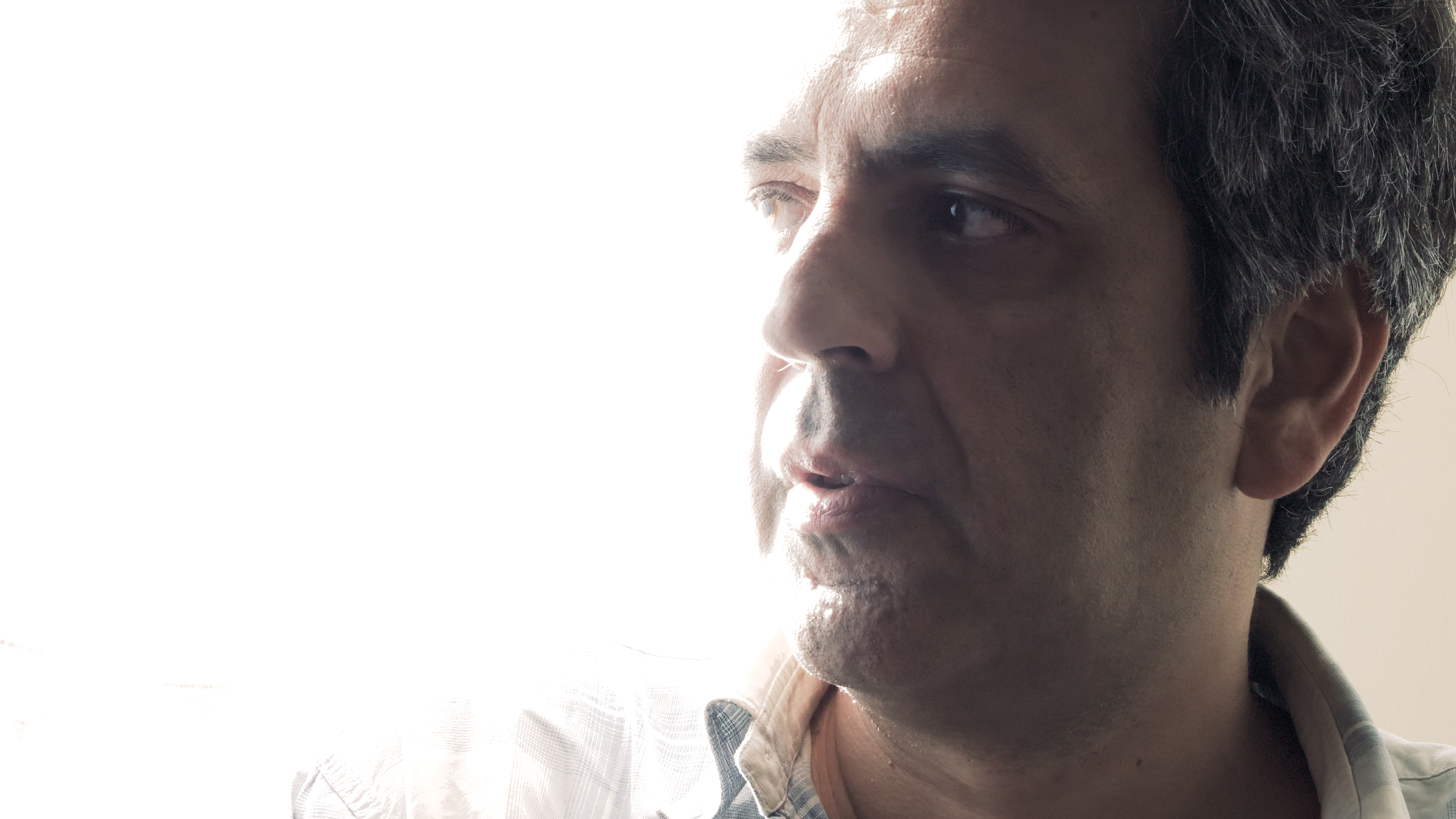
Drama, thriller, by Fabio Del Greco, Italy, 2019.
Someone wants to control the life of the employee Giuseppe Russo: the products he buys, his political and religious faith, his private life, even his dreams. But he will do anything to escape control and find his true self. Giuseppe is a man of around 45, married, with a stable job and a home of his own. His life flows seemingly peacefully when he meets a mysterious tramp who gives him some old VHS video cassettes. Giuseppe begins to see video tapes in which he is filmed in some moments of his life since he was a child, then as a teenager and as a young man. Who shot those videos that he remembers nothing about? Giuseppe has the strange sensation of being constantly observed and begins to investigate what is happening. Through his investigation of him, he begins to rediscover his true identity and become aware of who he truly is.
Employee's Mystery is a film that highlights the danger of social control and shows a society where everyone is constantly monitored and conditioned in their deepest selves. The film is also an analysis of human nature and identity. Fabio Del Greco, who plays Giuseppe, gives an engaging performance. Equally good is Chiara Pavoni, in the role of Giada Rubin and Roberto Pensa in the role of the tramp. Employee's Mystery is a film that addresses important themes in an original way, a psychological thriller that keeps the viewer glued to the screen until the end: a metaphor for contemporary society, in which people are increasingly monitored and conditioned by the media and technologies . It is a courageous and provocative work, which addresses important themes in an original way.
LANGUAGE: Italian
SUBTITLES: English, Spanish, French, German, Portuguese
A vision curated by a filmmaker, not an algorithm
In this video I explain our vision
The Call Nobody Makes and Everybody Hears

Someone you barely knew has died. You find out on a Tuesday, through a message forwarded from someone else, and the information arrives the way cold air enters a room when a window is left open in another part of the house — you feel it before you locate it. It is not grief. You did not love this person. You shared a conference table with them once, or stood beside them at a party for forty minutes, or exchanged three emails over something bureaucratic that was resolved and forgotten. And yet the news does something to the room. It does something to the Tuesday itself. You sit with your coffee going cold and something in you is very still and very awake in a way that has nothing to do with sorrow.
This is the call. Not the message. Not the death of the other person, which is ultimately their death and not yours. What has spoken is something that used no words and came from no external source, and yet it was more precise than anything anyone has said to you in months. Heidegger names this the Ruf des Gewissens, the call of conscience, and what makes it so philosophically disturbing — still disturbing, nearly a century after Being and Time appeared in 1927 — is that it has no caller. There is no God behind it, no social institution, no internalized authority in the Freudian sense. The superego speaks with borrowed voices, with the accent of a father or a culture. This has no accent. It is Dasein, the structure of your own being-in-the-world, calling to itself from the forward edge of its own existence.
That forward edge is death. Not death as the thing that will happen eventually, which the mind files under a manageable future and never opens. Death as the one certainty that is entirely, irreducibly yours. Nobody can die your death for you. This is not a consolation; it is a structural fact that Heidegger treats with the rigor of a geologist describing rock formation. Being-toward-death, Sein-zum-Tode, is not a meditation on mortality as morbidity. It is the recognition that your existence has a shape precisely because it ends, and that this shape — singular, bounded, yours — is the only ground from which authentic choice becomes possible.
A man watches his own hands doing something — signing a form, or lifting a glass, or buttoning a coat — and suddenly cannot remember deciding to be the person who does these things in this way in this life. The action continues, the hands move, but something has briefly surfaced that the ordinary forward motion of days keeps submerged. This surfacing is what Heidegger calls Angst, and it is categorically different from fear. Fear has an object. Angst has only the open. It is the mood in which the world, instead of pressing forward with its familiar demands and textures, briefly shows its groundlessness. And in that groundlessness, according to Heidegger, something becomes available that das Man — the anonymous They, the great averaging mechanism of social existence — perpetually forecloses: the question of whether this is actually your life.
The call of conscience does not tell you what to do. Heidegger is precise about this and the precision is almost violent. It does not deliver content. It delivers nothing except the silent insistence that you are the one who has to answer. Kierkegaard had already located the crisis of modern existence in the evasion of genuine selfhood, and Heidegger inherits that diagnosis while stripping it of its theological resolution. There is no leap of faith available here, no Abraham waiting to model the authentic individual. There is only the cold Tuesday, the news you received about someone you barely knew, and something in you that recognized itself in the wrong mirror and could not look away.
Language Is the House of Being, and You Did Not Build It
There is a moment after a serious argument — the kind that shakes the walls — when the silence that follows has a particular texture. You and the other person are still in the same room, breathing the same air, and neither of you can quite reconstruct what the fight was actually about. You remember the words. You remember the specific phrases that landed like blows, the names that were used, the accusations that had a strange precision even in their cruelty. But the original wound, the thing underneath, the actual substance of the injury — it has already retreated behind the language that carried it. The words remain. The grooves they cut remain. The meaning, whatever it was, is already gone, already reabsorbed into the phrases themselves. You did not speak the argument into being. The argument spoke itself through you.
This is not a metaphor. This is what Heidegger means when he writes, in his later period, die Sprache spricht — language speaks. Not: human beings use language as a tool to express pre-formed thoughts. But rather: language is the dwelling in which thinking occurs, the structure that precedes the thinker and outlasts every particular thought. The subject does not wield language. Language yields the subject. This reversal — quiet, almost offhand in how Heidegger states it — is in fact one of the most radical propositions in the entire history of Western philosophy.
The Kehre, the turning in Heidegger’s thought that becomes unmistakable after the 1930s, is precisely this shift. The early Heidegger of Being and Time had still placed Dasein — the human being as the site of the question of Being — at the center of the inquiry. After the turning, it is Being itself, in its historical self-disclosure and withdrawal, that takes priority. Human beings are no longer the agents who inquire into Being; they are the clearing, the Lichtung, through which Being briefly illuminates itself before retreating again into concealment. Language is the medium of that illumination and that concealment simultaneously.
Between 1936 and 1938, Heidegger delivered lectures on Friedrich Hölderlin that were not primarily literary criticism. They were something far more unsettling: an argument that the German poet had encountered, in language itself, the proximity of the divine and the withdrawal of the gods. In Hölderlin’s hymns — particularly “Germanien” and “Der Rhein” — Heidegger found not aesthetic achievement but ontological testimony. The poet, for Heidegger, is not someone who decorates reality with beautiful words. The poet is the one who listens to what language is already saying, who does not impose meaning but receives it, who stands in what Heidegger calls the between, between gods and mortals, between presence and absence.
The implication is one that does not stay comfortably inside philosophy. The words you use to describe your own life are not neutral instruments you picked up and chose to deploy. They arrived before you did. They were waiting, already structured, already weighted with assumptions about what counts as success and failure, as love and loneliness, as dignity and waste. When you say you feel like a failure, you are not reporting a private emotional state. You are activating a linguistic structure built over centuries of specific economic, moral, and theological history — a structure that frames what you are even capable of registering as real. The vocabulary of self-improvement, for instance, already contains within it a Protestant architecture of guilt and redemption. The language of productivity carries inside it the entire metabolic logic of industrial capitalism. You did not build any of this. You moved into it, the way you move into a house already furnished by someone else, and gradually stopped noticing the furniture.
What you can think about yourself is, in ways more fundamental than most people find comfortable, constrained by the words you have inherited for the thinking. And the house, as Heidegger insists, was never yours to begin with.
The Question That Was Never Answered
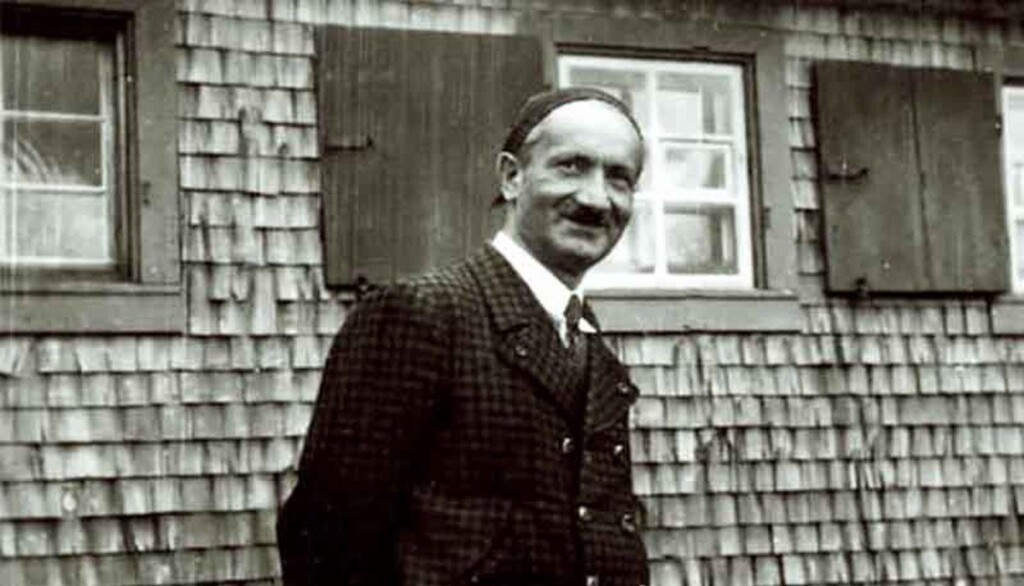
There is a photograph of Heidegger taken in the 1960s, late in his life, sitting in the Black Forest farmhouse he called his hut. He looks peaceful. Rooted. A man who has thought deeply and knows it. What the photograph cannot show, what no image ever could, is the specific quality of the silence he had chosen to maintain for two decades regarding what had happened to European Jews during the years he spent building his reputation inside a regime that murdered them systematically. The silence was not absence. It was architecture. He constructed it beam by beam, with the same deliberate care he brought to everything else.
When the Black Notebooks were finally published in 2014, edited by Peter Trawny, the question that scholars had debated for years in the conditional tense became suddenly, brutally declarative. The notebooks, written across the 1930s and 1940s, contained passages describing Jews as agents of a rootless calculative thinking, as figures of modernity’s most corrosive tendencies, as a people whose very capacity for self-organization represented something metaphysically suspicious. These were not offhand remarks. They were embedded in the philosophical vocabulary he had spent decades constructing. The antisemitism was not a residue from outside the philosophy. It had grown inside the same soil.
Hannah Arendt knew him better than almost anyone. She had been his student in Marburg in 1924, eighteen years old to his thirty-five, and what passed between them was the kind of intellectual awakening that is indistinguishable from love, because for certain minds those two experiences arrive as a single event. She spent decades afterward navigating the wreckage of what he had done, defending him in some moments, maintaining careful distance in others, returning to his concepts even when she was most clearly thinking against him. Then in 1969, in her essay on Walter Benjamin, she wrote something that reads less like analysis than like a wound finally stated plainly: that thinking does not make people good, that it does not even make them responsible, that the philosopher’s supposed love of wisdom coexists without apparent friction with the capacity for moral catastrophe.
This is the sentence that contains the entire problem. Not the antisemitism alone, not the Nazi party membership of 1933, not the rector’s speech at Freiburg where he aligned the university with the movement in language that was unmistakably his own — but the fact that the man who gave us the most precise philosophical vocabulary for describing evasion, inauthenticity, and the flight from death used every single one of those tools to avoid confronting what he had participated in. He theorized das Man — the anonymous they, the crowd-mind that disperses responsibility until no one is guilty of anything — and then dissolved into it when the reckoning came. He wrote with extraordinary precision about Verfallenheit, the fallenness into everydayness, the way human beings flee from what is most their own, and then performed that flight with a thoroughness that would be almost admirable if it weren’t obscene.
What remains is not a solved equation. Theodor Adorno, who had his own complicated account to settle with Heidegger’s legacy, wrote in Negative Dialectics in 1966 that philosophy lives on because the moment of its realization was missed — that thinking persists precisely because it failed to become truth in the world. There is something in that formulation that applies here with a terrible precision. The thought persists. The tools are real. The concepts cut through the fog of ordinary self-deception with a sharpness that very few philosophical systems have matched in any century. And the man who made them could not turn them on himself. The question of what it means to take seriously the ideas of someone who refused that same seriousness when it cost him something is not a question you can answer once and set down. It is the question you carry every time you open the book.
🌀 Labyrinths of Existence and Thought
Martin Heidegger’s philosophy of Being, thrownness, and authentic existence does not stand alone — it echoes across a constellation of thinkers who wrestled with the deepest questions of human life, meaning, and mortality. These related articles trace the corridors of existential and philosophical inquiry that intersect with Heidegger’s own labyrinthine path.
Schopenhauer: Life and Philosophical Thought
Like Heidegger, Schopenhauer confronted the brutal weight of existence head-on, building a philosophical system around the blind, insatiable Will that drives all living things. His vision of suffering as the fundamental condition of life anticipated many of the existential themes Heidegger would later radicalize. Exploring Schopenhauer’s thought offers an essential backdrop for understanding the darker corridors of Continental philosophy.
GO TO THE SELECTION: Schopenhauer: Life and Philosophical Thought
Albert Camus: Life and Philosophical Thought
Albert Camus and Heidegger shared the same existential territory — the confrontation with a world stripped of inherent meaning — though they arrived at radically different destinations. Where Heidegger pursued authenticity through a resolute embrace of Being-toward-death, Camus answered the Absurd with rebellion and passionate living. Together, these two thinkers form a remarkable dialogue about what it means to be human in a universe without guarantees.
GO TO THE SELECTION: Albert Camus: Life and Philosophical Thought
Hannah Arendt: the Philosopher Who Unmasked the Banality of Evil
Hannah Arendt was one of the most complex intellectual heirs of Heidegger, having studied under him and absorbed his phenomenological method before forging her own path into political philosophy. Her analysis of the human condition, labor, work, and action draws deeply on Heideggerian concepts while radically transforming them in the light of modern political catastrophe. Reading Arendt alongside Heidegger reveals how a single philosophical inheritance can be both illuminated and contested by history.
GO TO THE SELECTION: Hannah Arendt: the Philosopher Who Unmasked the Banality of Evil
Viktor Frankl: Life and Logotherapy
Viktor Frankl‘s logotherapy emerged from the most extreme confrontation with meaninglessness imaginable — the Nazi concentration camps — and shares with Heidegger a deep concern for authentic existence and the irreducible responsibility of the individual. While Frankl’s approach is therapeutic rather than ontological, both thinkers insist that human beings must choose how to face their own finitude. Their parallel journeys through the question of meaning make for one of philosophy’s most compelling comparisons.
GO TO THE SELECTION: Viktor Frankl: Life and Logotherapy
Discover Cinema That Thinks Deeply
If these philosophical labyrinths have opened something in you, Indiecinema streaming is your next destination — a curated universe of independent films that dare to ask the same questions Heidegger spent a lifetime exploring. From existential portraits to meditations on time, death, and authenticity, Indiecinema brings you cinema that thinks, feels, and refuses easy answers.
👉 EXPLORE THE CATALOG: Watch Indie Films in Streaming
A vision curated by a filmmaker, not an algorithm
In this video I explain our vision

