
The Quiet Scandal of Wanting Less
Someone asks you what you want from life, and for a split second — before the trained answer rises to your lips — you almost say it. Rest. A small garden. A few people you genuinely trust. Enough to eat, and time to think. The moment lasts perhaps half a second before you swallow it back down, because you are sitting at a table full of people with plans, projections, five-year strategies, and the vocabulary of relentless forward motion, and what you almost said sounds, in that room, like a confession of failure. It sounds like giving up. It sounds, if you are honest about the social grammar of the moment, almost obscene.

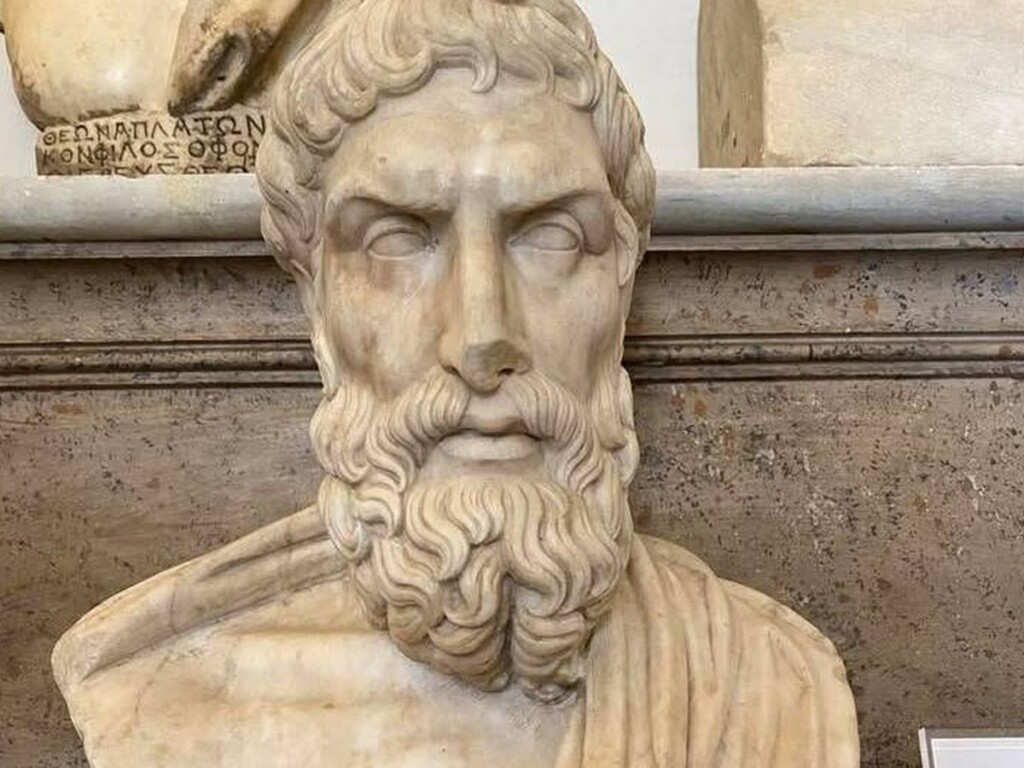
That reflex of suppression is not accidental. It has been cultivated over centuries with extraordinary care, and its origins are far older than the productivity culture you absorbed somewhere between adolescence and your first performance review. The discomfort you feel at the dinner table when the honest answer surfaces has a precise genealogy, and it runs directly through one of the most systematically misrepresented thinkers in the history of Western philosophy. His name was Epicurus, he was born on the island of Samos in 341 BCE, and the civilization that claims to revere Greek thought has spent roughly two thousand years making sure you misunderstand him completely.
The misunderstanding is not innocent. It is structural. Epicurus founded a school in Athens around 307 BCE known simply as the Garden, a modest piece of land outside the city walls where he lived and taught alongside students, women, enslaved people, and social outcasts — a composition so radical for its time that it was itself a philosophical statement before a single argument was made. He wrote prolifically: ancient sources catalogue over three hundred scrolls. Almost none of it survived. What remains are fragments, three letters preserved through the later compiler Diogenes Laertius, and a handful of maxims. The destruction was not entirely natural. Ideas that survive two millennia of institutional neglect do so despite, not because of, the institutions.
What Epicurus actually argued was this: the good life is one of ataraxia — a Greek word meaning tranquility, freedom from disturbance, the absence of mental turbulence — combined with aponia, the absence of physical pain. Pleasure, for Epicurus, was the highest good, but pleasure understood with a precision that his enemies immediately began to blur. He distinguished sharply between kinetic pleasures, which are dynamic and involve active desire, and katastematic pleasures, which are stable states of contentment. The greatest pleasures, in his accounting, were of the second kind: the pleasure of not being hungry rather than the pleasure of eating, the pleasure of not being afraid rather than the excitement of danger, the pleasure of friendship over the thrill of conquest.
This is the philosophy that was repackaged, almost immediately after his death, as a doctrine of gluttony and debauchery. Cicero did it. Early Christian writers did it with particular enthusiasm. The equation of Epicureanism with sensual excess became so thoroughly embedded in the cultural record that the word epicurean survives today primarily as a synonym for expensive taste in food and wine — which is almost the precise opposite of what the man taught. He reportedly lived on bread, olives, water, and the occasional small piece of cheese, which he described in one surviving letter as a luxury.
The question worth sitting with is not simply why a philosopher gets distorted — that happens. The question is why this particular distortion was so energetically maintained, so institutionally reinforced, so durable across radically different historical periods and belief systems. When a misreading persists with that kind of consistency, it is usually because the correct reading threatens something that power needs intact. And what Epicurus actually said, stripped of two millennia of noise, threatens something very specific: the entire architecture of manufactured desire on which most social control depends.
Don Barry: A Quixotic Exploration

Docufiction, Experimental, by Paul Smart, Mexico, 2026.
Don Barry: A Quixotic Exploration is a debut feature that places the biography of an eighty-year-old experimental filmmaker and artist, Barry Gerson, within the metanarrative of Miguel de Cervantes’ Don Quixote. Don Barry was filmed in the city of Guanajuato during the 51st edition of the Cervantino Festival, as well as during the vibrant Day of the Dead celebrations held in the city’s UNESCO-listed tunnels. The film honors the director’s long friendship with artist Barry Gerson, drawing inspiration from Cervantes’ Don Quixote. Paul Smart’s directorial choices create something new that celebrates life and goes beyond conventional storytelling. A search for magic in our real lives. A moving film about the meaning of life, art, and death. Not to be missed.
Paul Smart is a proud outsider filmmaker with a long history of film screenings. In the 1980s, he emerged in New York’s vibrant youth art scene, working in theater production and later filmmaking, before retreating to rural upstate New York, in the Catskill Mountains, where he made a living writing and screening independent films in old parish halls for rural audiences, many of whom had never seen a film.
LANGUAGE: English
SUBTITLES: Spanish, French, German, Portuguese
A Man Born in the Wreckage of Certainty
He was born in 341 BCE on the island of Samos, the son of a man who taught children their letters for a wage that barely sustained a family. That fact alone — the schoolteacher father, the modest household, the island existence at the edge of the Greek world — tells you something essential about what Epicurus would eventually build and why. He did not arrive at his philosophy from a position of inherited comfort, the way a young man with land and lineage can afford to speculate abstractly about the good life. He arrived at it from the inside of scarcity, from a childhood spent watching a learned man perform the daily indignity of depending on others for survival.
The world he was born into was one still convulsing from the campaigns of Alexander the Great. The old certainties of the polis — that tight, self-governing community of citizens where identity, morality, and political life were woven into a single fabric — had been blown apart. Alexander died in 323 BCE, when Epicurus was barely eighteen, leaving behind not a unified empire but a fracture zone of competing generals and dissolving loyalties. The philosophical consequence of this was enormous. When the city-state stops being the obvious container of human life, the individual is suddenly exposed. You cannot derive meaning from civic membership when civic membership has become precarious, fluid, suspect. You have to find another ground.
Hannah Arendt, writing more than two millennia later, would describe the polis as the space where human beings achieved their fullest reality through speech and action before others. What happened in Epicurus’s lifetime was precisely the collapse of that space — not just politically but existentially. The public world stopped being a reliable source of meaning, and the private world had not yet been philosophically dignified. Epicurus walked into that gap and built something there.
He spent years moving — through Teos, through Colophon, through Mytilene, through Lampsacus — teaching, gathering students, sharpening his thinking against real disagreement. By approximately 307 BCE he had settled in Athens and purchased a house with a garden attached. That garden became his school, known simply as the Garden, and what happened inside it was genuinely strange for its time. Women attended. Slaves attended. Courtesans were welcomed. In a philosophical culture where Plato’s Academy and Aristotle’s Lyceum were essentially institutions for free male citizens of means, the Garden was something categorically different. Not as a political statement — Epicurus was not interested in politics as a lever for social change — but as a natural consequence of what he actually believed. If the goal is to understand how a human being can live without unnecessary suffering, then the category of human being matters more than the category of citizen.
Throughout his life, Epicurus was ill. The details are documented in his own letters: kidney stones, chronic digestive ailments, physical pain that ran alongside his thinking like an unwanted companion for decades. He died in 270 BCE after what his correspondence describes as a day of acute suffering, and yet the same letter insists that the joy of philosophical conversation exceeded the pain. This is not a performance of Stoic endurance. It is something more unsettling — a man reporting, with apparent sincerity, that the texture of a good day can contain both agony and genuine happiness simultaneously, that these do not cancel each other out.
That biographical detail is not decorative. It is structural. A philosophy of pleasure written by a man in chronic pain is a philosophy that has already survived its own objection. It cannot be dismissed as the daydream of someone who has never suffered. It was forged inside suffering, tested against it daily, and still arrived at the conclusion that tranquility was possible. That is either the most honest thing in the history of thought, or the most precise.

The Garden Against the City
You have seen someone do it, or you have done it yourself. The moment when the door to a room full of important people closes behind you and you keep walking, not because you failed to get what was inside, but because you decided, mid-stride, that what was inside was not worth the person you would have to become to hold it. The street receives you. Ordinary, indifferent, slightly cold. And there is something in that indifference that feels, against all expectation, like relief.
This is the geometry of Epicurus’s Garden. Not a withdrawal born of defeat, not the sour consolation of those who could not compete, but a deliberate architectural choice about where to locate a life. Around 306 BCE, he purchased a house on the outskirts of Athens with a garden attached, and there he built a community that was, by the standards of its time, a radical provocation. He called what he practised lathe biosas — live hidden, live unnoticed. The phrase has been misread for centuries as a recipe for passivity, for the quiet cowardice of those who turn their backs on public responsibility. But that reading requires you to first accept that the public world of Athenian political life, or its modern equivalents, represents the apex of human seriousness. Epicurus did not accept that premise. He examined it, found it hollow, and said so clearly.
Hannah Arendt, writing in The Human Condition in 1958, drew a distinction that illuminates exactly what Epicurus was doing, even though she was not particularly sympathetic to his conclusions. Arendt argued that the public realm — the space of appearance, of politics, of action among equals — is where human beings achieve a kind of immortality through deeds and words that outlast them. The private realm, by contrast, is the realm of necessity, of the body, of what must be hidden to preserve the dignity of the public. For Arendt, the Greek polis was the highest expression of human freedom precisely because it was a space where individuals could transcend mere biological survival and act in the full sense of the word. To abandon that space, in her framework, was to abandon something essentially human.
Epicurus would have looked at that framework and seen, embedded inside it, the very trap he was trying to dismantle. Because what the polis actually required, in practice, was not freedom — it required performance. It required the management of appearances, the cultivation of allies and enemies, the endless expenditure of psychic energy on what others thought of you. Cicero, who disagreed with Epicurus on almost everything, nonetheless preserved the argument with enough precision for us to see its force: the man who chases public glory has handed the keys to his own contentment to strangers. He wakes every morning and checks, before he checks his own heart, how he appears in the eyes of the crowd.
The Garden refused that transaction. It was not a monastery, not a place of self-denial — the accusations of debauchery that Epicurus’s enemies levelled at it tell you more about what they feared than about what happened there. Women were admitted. Slaves were admitted. This alone was a political act of some magnitude in a society that organized its entire public life around their exclusion. The hidden life was not a life drained of content. It was a life whose content had been redirected toward something that could not be taken from you by an election result, a business failure, or the shifting loyalties of men who needed you only as long as you were useful.
There is a man walking down an ordinary street, having just closed a door on a room full of power. The camera of memory, if you have one like it, holds on his back. What looks like diminishment is the beginning of something the room could never have offered him.
Pleasure Misread: The Longest Lie in Western Philosophy
You have eaten. Not gorged, not celebrated — simply eaten, a plain meal, enough. You set down the cup. The room is quiet. There is no hunger left to name, no restlessness looking for its object. That stillness, that particular absence of wanting, is what Epicurus spent his life trying to describe. Not the pleasure of eating, but the pleasure of having eaten. Not the sensation arriving, but the sensation already settled. He called one kind kinetic — pleasure in motion, the surge and flush of appetite being answered — and the other katastematic, a pleasure of stable condition, the body resting in its own sufficiency. The second was incomparably deeper. The first was merely its vehicle.
This distinction is not subtle. It is not a philosopher’s fine print. It is the entire architecture of the man’s thought, and for approximately two thousand years it has been systematically destroyed, first by rivals who found it threatening, then by theologians who found it dangerous, then by moralists who found it inconvenient, until the word Epicurean came to mean precisely its opposite: the person who cannot stop, the appetite without ceiling, the gourmet, the sensualist, the man who mistakes stimulation for satisfaction.
The Stoics began the erasure almost immediately. Epicurus died in 270 BCE, and within a generation, Stoic philosophers were characterizing his Garden as a place of lax indulgence, a retreat for men too soft for duty. Epictetus would later describe Epicureans as people who placed the good in the belly. The charge was not analysis. It was competitive theology. Because if Epicurus was right that tranquility was the highest good and that it was achievable without cosmic alignment, without virtue as public performance, without submission to fate, then Stoicism’s entire architecture of endurance and discipline became decorative. You don’t need to harden yourself against pain if the goal is simply to remove the conditions that produce it. The Stoic project required that Epicurus be made ridiculous.
Christianity inherited the distortion and deepened it. For Augustine, writing in the early fifth century, pleasure as a philosophical end was inseparable from concupiscence, the disordered appetite that followed the Fall. To say that a man could locate his highest good in the quiet of a satisfied body was to locate it beneath the soul, in matter, in the flesh that sin had compromised. The philosopher Michel Onfray has traced extensively how patristic theology required a demonized Epicurus to function, a straw man of gluttony and godlessness against which Christian asceticism could define itself as superior. The real Epicurus, who wrote that the gods were indifferent to human affairs and that the soul dissolved with the body, was dangerous enough. The fake Epicurus, who allegedly urged men toward every bodily excess, was merely contemptible, and contemptible is always safer than dangerous.
By the Enlightenment the damage was permanent vocabulary. When Samuel Johnson compiled his Dictionary in 1755 he defined epicure as “a man given wholly to luxury.” No correction follows. The philosophical meaning had been so thoroughly buried that even educated men no longer knew it existed. Jeremy Bentham, constructing utilitarianism from ostensibly Epicurean foundations, collapsed katastematic and kinetic pleasure into a single calculus of units, a felicific arithmetic that Epicurus would have found incomprehensible, because for Epicurus the pleasures were not additive. More stimulation did not produce more tranquility. It produced its opposite.
A man sits after a meal, not reaching for more, not cataloguing what he enjoyed. The window is open. The light is moving. There is no name for what he feels because the culture handed him only two categories: pleasure, which means appetite, and virtue, which means restraint. The third thing, the still thing, the thing Epicurus was pointing at — it was taken from him before he had the language to claim it.
Death Is Nothing to Us — and Why That Terrifies Everyone Else
You are sitting beside someone who is dying. Not metaphorically. The room smells of antiseptic and something older, something the body begins releasing before it is finished. You are watching the chest rise and fall with that particular irregularity that tells you the interval between breaths is becoming a question. And somewhere in the middle of that vigil, between one breath and the next, something shifts in you that has nothing to do with grief. It is closer to vertigo. A sudden suspicion that the terror you have been carrying your whole life about this moment is not about the person in the bed at all. It is about you. About the unbearable idea that there will be a point at which you will no longer be able to say “I.”
Epicurus saw this with a clarity that has never quite been matched. His argument is almost insultingly simple: when death is present, you are not. When you are present, death is not. There is no moment in which you and death occupy the same room. The thing you fear is precisely the thing you will never experience, because experience requires a subject, and death is the dissolution of the subject. There is no suffering in non-existence because there is no one to suffer. The logic is airtight. And almost no one finds it comforting.
That gap — between the argument being sound and the dread persisting anyway — is itself the most honest thing Epicurus ever revealed about human psychology. The fear of death is not, at its root, a fear of pain or darkness or cold. It is a fear of discontinuity. Of the self losing its grip on its own narrative. Lucretius, writing sometime around 55 BCE in what remains the most complete and searingly beautiful transmission of Epicurean physics, put it as a symmetry: you were not afraid before you were born. The centuries before your existence did not torment you. Why should the centuries after be any different? The void behind you and the void ahead are made of identical material. You passed through pre-natal nothingness without complaint. There is no rational ground for asymmetry.
And yet the asymmetry persists, with a ferocity that defies argument. Ernest Becker, in his 1973 work that won the Pulitzer Prize the year he died of cancer, argued that virtually the entire architecture of human civilization — its religions, its monuments, its heroic projects, its need for legacy and children and fame — is a vast collective machinery for not thinking about this. Not as a conscious strategy but as a biological imperative so deep it operates beneath language. The self, Becker wrote, is a “causa-sui project,” a desperate attempt to be one’s own cause, to matter enough to survive one’s own ending. Culture is the shared agreement to keep performing permanence.
This is where Epicurus becomes not a consoler but a destabilizer. Because what his argument actually strips away is not the fear of death but the ego’s right to use death as a stage. The performance of mortality — the gravity we give our lives by holding our finitude in front of us like a torch — is itself a kind of theater. The terror is not of annihilation. It is of irrelevance. Of a self that has spent decades constructing its own continuity suddenly confronted with evidence that continuity was always a story it was telling itself.
The person in the bed is breathing. Then breathing again. And in the space between those breaths, what you are actually feeling is not compassion or grief or love, though all of those are present. What you are feeling, underneath all of it, is the recognition that you have been performing your own existence for an audience that includes, most importantly, yourself.
A vision curated by a filmmaker, not an algorithm
In this video I explain our vision
Friendship as the Architecture of the Good Life

There is a particular quality of silence that only exists at a table where no one feels the need to fill it. You have sat there, maybe twice in your life, maybe fewer times than that — with someone who has watched you fail at something you cared about, who has heard you say the wrong thing and understood why you said it, who stayed not because leaving was too complicated but because leaving simply never occurred to them. That silence is not emptiness. It has a specific gravity. It presses gently against the chest like a hand placed there.
Epicurus called friendship the greatest of all the goods that wisdom provides for a happy life. Not the most pleasant. Not the most useful. The greatest. And he was not speaking abstractly or aspirationally — he built a physical structure around that claim. The Garden was not a school in the Athenian sense, not a place where students sat in formation to receive transmitted knowledge from a master at the front. It was a compound. People lived there together. They shared meals, grew food, nursed each other through illness, argued and reconciled. The women who entered — unusual in the philosophical world of 300 BCE — were not guests. They were members. The slaves who entered were not servants kept at a functional distance. They sat at the same table. The philosophical life, for Epicurus, was not an interior condition you achieved alone. It was a social architecture you built deliberately, with chosen people, in chosen proximity.
The word he reached for was philia — a Greek term that English has always struggled to carry across without losing something essential. Not eros, which burns and possesses. Not storge, the warmth of blood and obligation. Philia: the freely elected bond between people who have made each other legible. You chose this person. They chose you back. Neither of you had to.
Émile Durkheim, writing in 1897 in his study of suicide as a social rather than purely individual phenomenon, identified what he called anomie — a condition in which the dissolution of shared norms and collective bonds leaves the individual suspended in a social void, tethered to nothing, accountable to no one. He was describing industrial modernity. He could have been describing us. Robert Putnam, a century later in Bowling Alone in 2000, traced the statistical collapse of American social capital across the second half of the twentieth century — the decline of civic associations, church attendance, union membership, dinner parties, the number of close friends people reported having. Between 1985 and 1998 alone, the average number of confidants an American adult listed dropped from three to two. More recent surveys suggest that number has continued falling. Putnam was measuring something Durkheim had already named and something Epicurus had already, in a different register, diagnosed and attempted to treat.
Because Epicurus was not living in an era of communal cohesion. The collapse of the city-state, the rise of Macedonian and then Hellenistic power, had already unmade the older structures of Athenian belonging. The agora, the demos, the civic religion — all of it was fraying or had already frayed. The individual was newly alone in a way that felt historical, irreversible. Epicurus looked at that condition and did not respond with a philosophy of interiority or withdrawal. He responded with architecture. He said: build a table. Invite the specific people who will not leave when the performance ends. Eat bread and water with them and call it pleasure, because it is — not because the bread is anything special but because of who is tearing it beside you.
There is a moment — a man sitting at the bedside of someone dying, holding a hand and not speaking — that contains the entire argument. No theory is being exchanged. No wisdom is being transferred. The presence itself is the philosophy. The staying is the practice.
The Atoms and the Swerve: When Physics Becomes Freedom
You followed every rule. You studied what you were told to study, built what you were supposed to build, measured your risks, moderated your appetites, showed up. And then, at some unremarkable Tuesday in your forties, something tilted. Not collapsed, not exploded — tilted. A slight, sourceless deviation, as if the floor of cause and effect had developed a barely perceptible lean. You did not fail. The universe simply swerved, and took you with it.
Epicurus inherited from Democritus the vision of a world made entirely of atoms moving through void. Everything you see, touch, love, and fear is matter in motion — infinite particles falling, colliding, forming temporary configurations that we call bodies, cities, lives. There is something initially cold about this picture, the mechanical clatter of a cosmos without intention. But Epicurus added something Democritus had not imagined, and in doing so transformed physics into one of the most radical arguments for human freedom ever constructed. He proposed that atoms, as they fall, occasionally deviate from their path. Not because something pushes them. Not because a god intervenes. For no external reason at all. A spontaneous, uncaused deflection — what Lucretius, writing two centuries later in his great poem on the nature of things, would call the clinamen, the swerve.
This is not a footnote. This is the hinge on which an entire conception of human dignity turns. If atoms fall in perfectly straight lines, each collision is the necessary consequence of the last, and the chain of causation stretches back without interruption to a beginning you never chose. Your decisions, your loves, your moments of resistance or surrender — all of them are simply geometry. The Stoics, who were Epicurus’s great philosophical adversaries, more or less accepted this and made peace with it, finding freedom in the interior acceptance of necessity. Epicurus refused. The clinamen breaks the chain. It introduces into the fabric of matter itself an irreducible spontaneity, a structural openness that prevents the universe from being a closed system of predetermined outcomes. Free will becomes thinkable not as something supernatural grafted onto a mechanical world, but as the macroscopic expression of something that is already happening at the level of atoms.
The man watching his life tilt sideways is not experiencing a malfunction. He is experiencing reality operating exactly as it does. The swerve is not the exception. It is woven into the architecture.
For roughly fifteen centuries, this idea lay buried. Lucretius wrote his poem sometime in the first century BCE, and then the manuscript disappeared into the long silence of an era that found its materialism intolerable, its rejection of divine providence dangerous, its celebration of pleasure scandalous. What survived was copied by monks who did not understand what they were preserving, and even those copies vanished. Then, in 1417, a papal emissary and book hunter named Poggio Bracciolini walked into a German monastery and found it on a shelf. Stephen Greenblatt, reconstructing this moment in his 2011 work, argues that the rediscovery of Lucretius’s De rerum natura was not a quiet philological event. It was a detonator. The ideas that entered European circulation through that recovered manuscript — that the universe is made of matter, that the soul dissolves at death, that pleasure is not sin but the basis of the good life, that the world was not made for us and does not answer to our prayers — these ideas leaked into everything. Into art, into science, into the slow dissolution of a cosmology that had held Europe in a particular kind of stillness for a millennium.
What Poggio found was not just a poem. It was the clinamen of Western thought itself — the moment when intellectual history swerved, for no sufficient reason, into a different trajectory.
And the swerve, as Epicurus understood it, cannot be predicted. It can only be lived forward, into the tilt.
What You Have Already Is Enough — and the Violence of That Sentence
You are standing in a checkout line holding something you did not need when you walked in. You know this. There is a half-second of clarity, the kind that arrives without invitation, in which you see yourself completely — the object in your hand, the mild restlessness that preceded its selection, the faint and already-fading conviction that acquiring it will settle something unnamed. Then the line moves forward, the moment dissolves, and you place it on the counter anyway. Not because you forgot what you saw. Because the silence on the other side of not buying it is a silence you have not yet learned to inhabit.
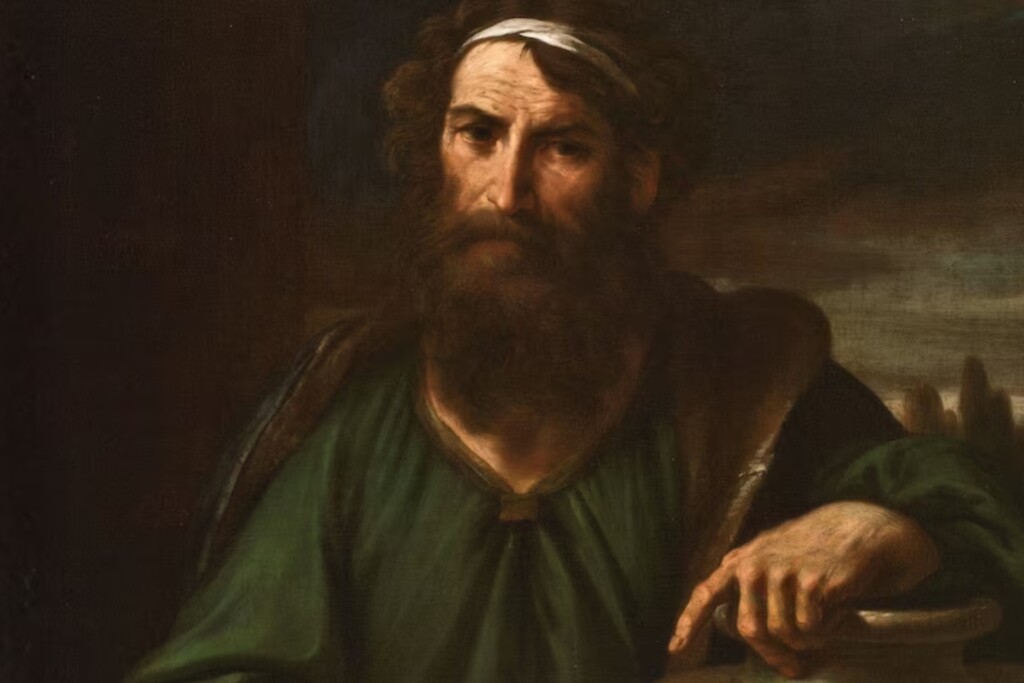
This is the most dangerous sentence Epicurus ever wrote, more unsettling than anything he said about death or the gods or the indifferent cascade of atoms. He wrote it in a letter to a friend, and it reads almost like a joke: send me a pot of cheese, so that I may feast whenever I wish. Bread and water, he said, produce the highest pleasure when someone who needs them puts them to his lips. If you want luxury, add a little cheese. That is the whole menu. That is the entire prescription. And if you feel a flicker of contempt or dismissal reading it — a reflex to call it naive, ascetic, monkish, beside the point — that reflex is worth examining, because it is not aesthetic disagreement. It is self-defense.
Herbert Marcuse, writing in One-Dimensional Man in 1964, described a society in which the very apparatus of liberation had been colonized by the system it was supposed to oppose. False needs, he called them — needs that have been superimposed on individuals by particular social interests, needs that perpetuate toil, aggressiveness, misery, and injustice. The brilliant cruelty of the mechanism is that the false need feels exactly like the real one. The hunger manufactured by an advertisement feels, in the body, indistinguishable from hunger. And so you stand in the checkout line genuinely wanting the thing you did not know existed forty minutes ago.
Epicurus was not prescribing poverty. This distinction matters enormously and has been deliberately obscured by centuries of misreading. He was describing a threshold — the actual, physiological, experiential line beyond which more produces not more pleasure but more agitation. Epicurean katastematic pleasure, the pleasure of stable equilibrium, of ataraxia, is not a lesser pleasure. It is the ceiling. Everything above that line is not addition but subtraction, because it introduces the anxiety of maintenance, the fear of loss, the restless scan for the next acquisition that will justify the last one. Thorstein Veblen mapped this dynamic in 1899 with his theory of conspicuous consumption — the idea that above subsistence, spending becomes primarily a social performance, a signal, a competition with no terminal point. You cannot win a race whose finish line moves.
There is a man eating alone at a small table. Outside, the city is conducting its usual business of velocity and noise. He has a glass of water, bread, something simple on the plate before him. He is not performing simplicity. He is not making a statement. He is, for reasons that have taken him years to understand, genuinely at rest. Not because he has renounced the world but because he has stopped confusing the world’s noise for his own desire. This is not peace achieved by deprivation. It is peace achieved by accuracy — by the precise identification of what was actually being sought underneath all the acquisition, all the upgrading, all the restless motion forward.
The violence of Epicurus’s sentence — you already have what you need — is that it is almost certainly true, and that its truth, if taken seriously, would require dismantling not just a purchasing habit but an entire architecture of self, the self that was built to want, trained to want, and now can barely remember what it feels like to simply arrive.
🏛️ Paths Through Ancient Wisdom and Meaning
Epicurus devoted his life to understanding happiness, friendship, and the nature of existence. His philosophy invites us to explore a broader landscape of thinkers who wrestled with similar questions about suffering, meaning, and the good life. These related articles trace parallel journeys through the history of human thought.
Albert Camus: Life and Philosophical Thought
Albert Camus spent his life confronting the tension between humanity’s desperate need for meaning and a universe that offers none in return. Like Epicurus, he sought a philosophy that could sustain joy and dignity in the face of mortality and absurdity. His thought stands as one of the most vivid modern echoes of ancient Epicurean concerns.
GO TO THE SELECTION: Albert Camus: Life and Philosophical Thought
Camus’s Myth of Sisyphus: The Absurd Explained
In The Myth of Sisyphus, Camus constructs a philosophical meditation on what it means to live fully despite the absence of ultimate purpose, a question Epicurus had already posed centuries earlier. The figure of Sisyphus rolling his boulder becomes a symbol of conscious, joyful resistance to despair. Reading this work alongside Epicurean philosophy reveals surprising and profound convergences.
GO TO THE SELECTION: Camus’s Myth of Sisyphus: The Absurd Explained
Viktor Frankl: Life and Logotherapy
Viktor Frankl, survivor of the Nazi concentration camps, built his therapeutic philosophy around the irreducible human need for meaning, a need Epicurus addressed through the pursuit of ataraxia and inner tranquility. Logotherapy and Epicureanism both insist that the quality of one’s inner life determines the experience of happiness. Their dialogue across centuries enriches our understanding of psychological resilience.
GO TO THE SELECTION: Viktor Frankl: Life and Logotherapy
Hannah Arendt: the Philosopher Who Unmasked the Banality of Evil
Hannah Arendt‘s unflinching examination of evil, freedom, and the human condition places her in a long tradition of thinkers who refused easy consolations, much like Epicurus before her. Her concept of the vita activa challenges us to consider whether true pleasure and peace are compatible with public life and political responsibility. Arendt’s work opens a fascinating philosophical counterpoint to Epicurean withdrawal from the public sphere.
GO TO THE SELECTION: Hannah Arendt: the Philosopher Who Unmasked the Banality of Evil
Discover Philosophy Through Independent Cinema
The greatest philosophical questions have always found their way onto the screen. On Indiecinema, you can explore a curated selection of independent and auteur films that bring thinkers, existential dilemmas, and the search for meaning to vivid cinematic life — films that Epicurus himself might have found worthy of contemplation.
👉 EXPLORE THE CATALOG: Watch Indie Films in Streaming
A vision curated by a filmmaker, not an algorithm
In this video I explain our vision

