
The Grass Under Your Feet
You know the exact moment. You step outside barefoot, early morning, the dew still on the blades, and something passes through the soles of your feet that is not merely temperature. It is not simply the softness of the ground or the slight give of soil beneath your weight. It is something older than any word you have for it, a recognition that moves upward through your body before your mind has time to intervene. For a fraction of a second — and this is what matters, this is precisely what we need to stay with — you do not feel like a person standing on grass. You feel like something that belongs to it.

And then you think about your coffee. Or the meeting at nine. Or whether it rained enough to skip watering the garden. The moment collapses back into the ordinary, and you walk inside, and the sensation is already gone, filed somewhere beneath conscious experience alongside all the other things you registered but declined to take seriously.
This is not a small thing. This suppression, this reflexive override of a perception that arrived before language could shape it, is one of the most consequential habits of the modern mind. It did not develop by accident, and it did not develop recently. It has a history, a philosophy, a series of decisions made by people long dead whose frameworks you have inherited so completely that they feel like common sense, like the obvious structure of reality, like simply how things are.
Aristotle, writing in the fourth century before the common era, did not experience this split. For him, the sensation you felt on that grass would not have been irrational or embarrassing. His concept of physis — nature as an internal principle of motion and rest, present within living things as their own animating logic — meant that the ground beneath you was not inert matter waiting to be used. It was a domain of purposes, of tendencies, of something recognizable as directed life. His Physica and De Anima together construct a world in which the human being is not an observer of nature but a participant in it, one kind of living thing among many, distinguished by the complexity of its soul but not by its fundamental separation from the material world that produced it.
You did not inherit that world. You inherited a different one, built over centuries by a series of ruptures so gradual and so thoroughgoing that each generation received them as neutral facts. The philosopher Charles Taylor, in his 1989 work Sources of the Self, traces the long construction of the modern inward turn, the way Western thought progressively relocated the self inside the mind and relocated nature outside it, something to be observed, measured, and managed. By the time René Descartes formalized the split between thinking substance and extended substance in the seventeenth century, he was not inventing a new idea so much as giving philosophical precision to a divorce that had been accumulating for three hundred years.
What Descartes gave you was the geometry of your discomfort on that grass. The body you stand on it with is matter. The mind that immediately rationalizes the experience is the real you. The ground is an object. You are a subject. The encounter between them can produce data but not kinship.
There is a scene that stays with you, even if you cannot say why. A man is led through a city he has crossed a thousand times, and for the first time he stops at a piece of exposed earth between two sections of pavement, a small rectangle of dark soil that someone has planted with something low and green, and he crouches and presses his fingers into it and remains there, held by something he cannot name, while the street flows around him as if he has become temporarily invisible to modernity itself. People step around him. He does not look embarrassed. He looks, for a moment, like someone who has just remembered something he was never told he had forgotten.
That pause, before the world pulls you back, is the oldest philosophical question we have.
Eve of the Irises
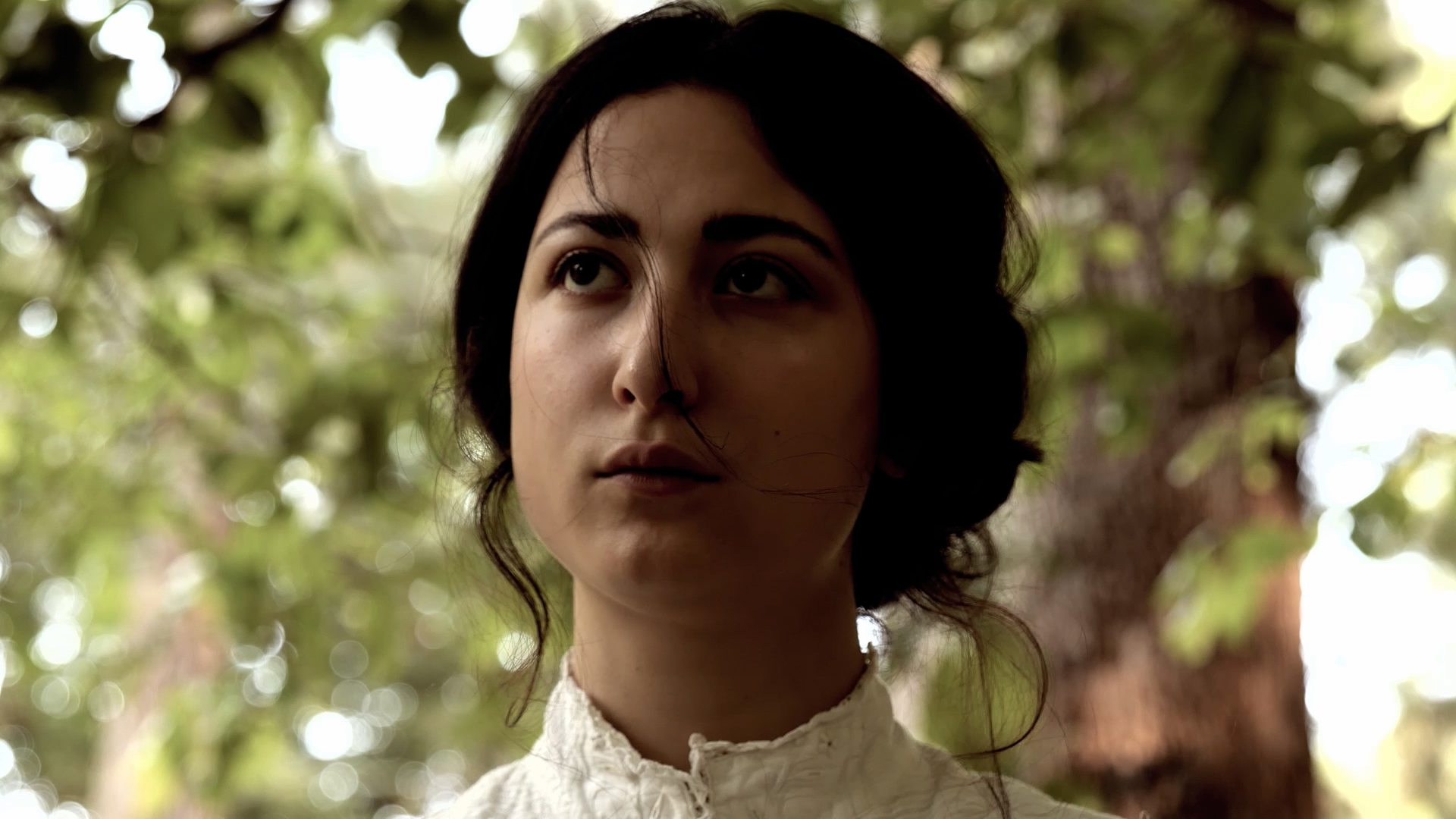
Documentary, by Isabel Russinova, Rodolfo Martinelli Carraresi, Italy, 2026
Eva of the Irises is a historical biographical docu-film about the scientist Eva Mameli Calvino, a botanist and pioneer of environmentalism in Italy, mother of the writer Italo, born in Sassari in 1886. The film, based on a multidisciplinary approach that combines several genres—such as theatre, documentary, cinema, and research—moves between memories, reflections on life, as well as the goals and missions the scholar still wished to achieve.
The multifaceted artistic sensibility of Isabel Russinova is expressed across many fields, from writing to acting, from directing to civic engagement, and finds one of its highest expressions in the docu-film Eva of the Irises, created with Rodolfo Martinelli Carraresi. The film blends scientific rigor and poetic refinement to portray the extraordinary figure of the botanist Eva Mameli Calvino, mother of Italo Calvino but above all an independent protagonist of 20th-century scientific culture. It is told through a combination of archival materials, interviews, and evocative staging capable of elegantly and profoundly conveying her intense human and professional story.
LANGUAGE: Italian
SUBTITLES: English, Spanish, French, Portuguese
Aristotle’s Living World and the First Great Divorce
You already know what a forest sounds like before you can name any of its parts. Something in your body registers the density of air under a canopy, the way sound behaves differently when it passes through living wood rather than concrete, the particular quality of silence that is not absence but presence held in suspension. Aristotle would have said you are recognizing physis — not nature as landscape or scenery or resource, but nature as the internal principle by which a thing moves and rests according to what it is. The acorn does not become an oak because something external pushes it. It becomes an oak because becoming an oak is what it already is, moving toward its own completion. This is telos not as divine command but as immanent grammar, the inherent directionality written into matter itself.
For Aristotle, writing in the fourth century BCE across works that would collectively shape Western thought for nearly two millennia, the natural world was not inert backdrop. In the Physics and De Anima he constructs a vision of reality in which soul and body are not opposed substances but a single living unity — the soul as the form of a body that has the potential for life. A knife does not have a soul because cutting is not the knife’s own movement toward its own fulfillment. But a tree does, a fish does, you do, because each of these beings carries within itself the principle of its own unfolding. The universe is not a machine with a ghost inside it. It is something closer to a verb.
What happened next took roughly two thousand years to fully detonate, but when it did, the consequences restructured everything from agriculture to law to the way human beings experience their own bodies. René Descartes, working in the 1630s and 1640s, performed what may be the most consequential philosophical surgery in the history of Western civilization. In the Meditations on First Philosophy published in 1641 and the earlier Discourse on the Method, he separated mind from matter so completely that everything outside the thinking subject became res extensa — extended stuff, measurable, divisible, operating according to mechanical laws with no interior life whatsoever. Animals were automata. Their cries under dissection were not expressions of pain but the grinding of gears. The natural world was a clock, and clocks do not suffer.
This was not merely a philosophical position. It was a permission structure. Once you have stripped interiority from matter, once you have declared that the forest has no physis, no internal principle, no telos of its own — only lumber potential and carbon mass — you have not just described the world differently. You have made certain actions possible that were previously imaginable only as violation. The enclosure of the English commons accelerated through the 17th and 18th centuries with a theological and philosophical blessing. By the early 19th century, the industrial transformation of land was proceeding with a speed that would have been not just technologically but conceptually impossible under an Aristotelian framework. You cannot run a factory farm inside a worldview that grants animals an animating soul.
The legal treatment of animals as property — not a biological accident but a juridical construction that persists with remarkable stubbornness into the present — finds its philosophical foundation precisely here, in this Cartesian expulsion of interiority from everything that is not a human mind. And the alienation from seasonal cycles that modern urban life produces, the experience of living in a world where temperature is managed, food arrives pre-severed from its origins, and the only seasons are those of commercial promotion — this too is downstream of that rupture.
Maurice Merleau-Ponty, working in the Phenomenology of Perception in 1945, would later argue that Descartes had not discovered the truth of the body but had amputated it, leaving Western thought to hobble on a ghost limb. The body knows the forest before the mind names it. Which means something was already known before it was taken away.

A Man Watches a Tree Fall and Feels Nothing

He signs the papers without looking up. There is a stack of them, maybe forty, maybe sixty, and each one authorizes the removal of a section of forest somewhere he has never been and will never go. His coffee is getting cold. His assistant is waiting for the next file. The window behind him shows a strip of grey sky, and he does not look at it either. This is not a monster. This is a man who has learned, with great precision, to see nothing where something is.
You have walked through a place like this. Not a forest exactly, but the ghost of one. The ground still holds the shape of roots that no longer exist. The air smells of cut wood and diesel, a smell that is not quite destruction and not quite anything else. You keep walking because stopping would require you to feel something, and feeling something would require you to name it, and naming it would mean admitting that something was lost here that had no replacement and no paperwork acknowledging its passing.
This is the central philosophical wound of modernity in its relationship to the natural world, and Baruch Spinoza diagnosed it three centuries before the diesel smell existed. In his Ethics, published posthumously in 1677, Spinoza drew a distinction that should have changed everything and instead was quietly set aside. He called it the difference between natura naturans and natura naturata: nature as the active, generative force that produces all things, and nature as the sum of things produced. The first is a verb. The second is a noun. The first is alive in the sense that it never stops becoming. The second is inventory.
Modernity chose the noun. It chose it deliberately, institutionally, and with the full endorsement of its economic architecture. When René Descartes in 1637 described non-human animals as automata, as machines without interior life, he was not making a philosophical error. He was making a political statement about what could be owned, managed, extracted from, and discarded. The Cartesian move was not intellectual curiosity. It was clearance.
What Spinoza understood and Descartes refused was that the tree in the forest is not a unit of timber waiting to be realized. It is an expression of something that cannot be inventoried. Natura naturans is not a romantic idea. It is a metaphysical claim about causality: the productive force of nature is not separate from nature itself, it is nature in its most fundamental mode. To forget this is not to make a category error. It is to perform a specific kind of violence that requires no physical contact.
The bureaucrat signing the permits is not evil. He is philosophically consistent with a system that was built on the decision, made centuries ago, to strip the world of its verbal quality. Gregory Bateson wrote in 1972, in Steps to an Ecology of Mind, that the Western epistemological error was to see mind as separate from nature, to treat the environment as a collection of things rather than a system of relationships. When you see the world as objects, he argued, you will inevitably treat it as objects. The destruction is not the cause. The destruction is the symptom of a prior and deeper amputation.
The man who walks through the razed forest without stopping is not callous by nature. He is the product of a training so thorough it no longer feels like training. He was taught, beginning very early, that what cannot be owned cannot quite be real. That what cannot be measured cannot quite be valued. That grief for something nonhuman is a category mistake, a sentimentality, an indulgence that serious people have moved past. He has moved past it. He walks quickly, hands in his pockets, already thinking about something else, and the absence around him registers as nothing more than open sky where there used to be shade.
This is not neutrality. This is not the natural conclusion of rational thought. This is a choice that someone made, long ago, and called philosophy.
The Romantics Were Right About One Thing
You are standing at the edge of something enormous — a cliff face, a coastline in late November, a forest that has swallowed the last trace of human sound — and what you feel is not beauty. It is something older and less comfortable than beauty. The ground beneath your certainty shifts slightly, and for a moment you cannot locate yourself in the usual coordinates. You are not appreciating the view. You are being undone by it.
That experience, which most people file under “aesthetic pleasure” and move on from, was for a generation of German thinkers in the late eighteenth and early nineteenth centuries nothing less than an epistemological emergency. Friedrich Wilhelm Joseph Schelling, writing his Ideas for a Philosophy of Nature in 1797 at the age of twenty-two, was not composing a nature poem. He was attempting to overturn the entire Cartesian settlement — the clean divorce between thinking subject and extended object — by arguing that nature is not the dead matter that mechanism requires it to be, but a self-organizing, self-producing subject in its own right. What Schelling called Naturphilosophie was not sentiment dressed in philosophy. It was a direct assault on the epistemological foundations of the scientific revolution.
The assault was largely defeated, and its defeat was not innocent. The mechanistic tradition had institutional momentum, industrial backing, and the seductive clarity of measurable results. Schelling’s nature — dynamic, purposive, irreducible to parts — was harder to monetize than Newton’s. Johann Wolfgang von Goethe, who was developing his morphology during roughly the same period, watched organisms with a patience and an intimacy that modern laboratory science was already beginning to regard as unscientific. His method required you to look at a plant long enough that you began to see not an object but a process — not a thing but a becoming. What he called the Urpflanze, the archetypal plant form underlying all botanical variation, was not a mystical fantasy. It was a structural insight about transformation, about how a single organizing principle could generate radically different forms through variation in time and environment. Contemporary developmental biology would spend the twentieth century arriving at conclusions he had sketched with colored pencil in his Italian notebooks.
A man stands in a driving storm, lashed by rain so cold it feels personal, and something in him stops performing the human. The social scaffolding falls away — the roles, the plans, the internal monologue that keeps the self coherent — and what remains is bare animal presence, wet and temporary. This is not a metaphor for spiritual growth. It is an ontological fact that most philosophical traditions have spent enormous energy preventing you from taking seriously.
Alexander von Humboldt took it seriously. His Cosmos, whose first volume appeared in 1845, was an attempt to describe the natural world not as a collection of separate domains — botany, geology, climatology, oceanography — but as a single interconnected whole animated by forces that flowed between every scale of being. Humboldt had spent years in South American jungles and Andean peaks observing exactly the kind of cross-domain interdependencies that ecology would not formally theorize until the following century. His vision preceded Ernst Haeckel’s coining of the word “ecology” in 1866 by two decades, and it preceded systems ecology by more than a century, yet it was systematically marginalized in the disciplinary specialization that dominated nineteenth-century science. The compartmentalization was not accidental. An integrated picture of nature made certain extractive projects conceptually incoherent.
A woman walks through a wilderness so quiet that her own heartbeat becomes audible, and she understands — briefly, against her will — that she is not observing the silence but participating in it. The Romantic tradition was trying to name that understanding and failing not because it was wrong but because it was reaching for a grammar that did not yet exist. What it grasped, imperfectly and sometimes theatrically, was that the hard boundary between the knowing self and the known world is not a fact of nature but a habit of thought — one with consequences that are still accumulating.
What Darwin Actually Broke
You have heard someone say it, probably in a boardroom or at a dinner table, with that particular tone of calm that people deploy when they want to make cruelty sound like wisdom. The weak get eliminated. That is just how it works. Nature is not sentimental. And the person saying this leans back, satisfied, as though they have not made a moral choice but simply observed a law of physics.
This is one of the great intellectual frauds of the modern era, and it has Darwin’s name attached to it without his permission.
What Darwin actually broke was not the idea that humanity occupies a special place in creation. That was the popular myth, the version that outraged bishops and sold newspapers in 1859. The real rupture was quieter and more devastating: Darwin made nature historical. Not cyclical, not hierarchical, not teleological — historical. Contingent. Improvised. Without direction, without design, without any destination it was moving toward. The giraffe’s neck is not the answer to a question nature was trying to solve. It is an accident that survived. The eye, that supposed triumph of purposeful engineering, is a cobbled assemblage of solutions to problems that kept changing. Ernst Mayr, the evolutionary biologist who spent the twentieth century clarifying what natural selection actually means, put it plainly: Darwinian evolution has no goal. It has no foresight. It cannot prefer anything. It responds, blindly, to what already exists.
This is a thought almost no one has been willing to sit with. Because if nature has no direction, then appealing to nature as moral authority collapses entirely. You cannot call something natural and mean by that word good, or inevitable, or just.
Herbert Spencer understood this immediately, which is why he refused to do it. He coined the phrase survival of the fittest in 1864, four years after reading Darwin, and he used it to mean something Darwin never intended: a social prescription dressed as biological description. Spencer wanted industrial capitalism to feel like gravity. He wanted the accumulation of wealth by the few and the destitution of the many to feel like oxygen and nitrogen — things simply present in the atmosphere, not chosen, not arrangeable otherwise. Darwin himself recoiled from this reading. He wrote privately that Spencer’s generalizations struck him as of very little scientific value. But Spencer’s version spread because it was useful. It gave the powerful a language in which their power appeared to be nature’s own verdict.
There is a man you might recognize — not a fictional composite but a recognizable type — who sits across a table and explains that someone will be let go, that certain communities will not receive the investment, that the merger makes the weaker firm disappear, and what underlies every sentence is the quiet grammar of naturalization. This is how markets work. This is how things are. He is not presenting a moral position; he is translating nature’s instructions. The Darwinian camouflage is so seamless that he no longer notices he is wearing it.
Richard Hofstadter documented this mechanism with surgical precision in Social Darwinism in American Thought, published in 1944, showing how an entire ideological tradition built itself on a misreading so systematic it could no longer be called accidental. The misreading was not a mistake. It was a decision to take Darwin’s description of contingency and replace it with a narrative of necessity, because necessity requires no justification.
But contingency — real Darwinian contingency — is the most radical thing in the text. It means that nothing about the present arrangement of life, or society, or power was determined in advance. The organisms that exist are not the organisms that were meant to exist. They are the ones that happened to survive a specific sequence of unrepeatable circumstances. Stephen Jay Gould spent much of his career, most forcefully in Wonderful Life in 1989, arguing that if you rewound the tape of life and played it again, almost nothing would be the same.
Which means that the person leaning back at that dinner table, certain that nature has endorsed his choices, is not reading Darwin at all.
A vision curated by a filmmaker, not an algorithm
In this video I explain our vision
Nature as the Last Convenient Stranger

You are watching a rewilding documentary on your phone. Wolves have returned to a valley somewhere in Europe, and the camera lingers on a riverbank where willows have begun to reclaim the eroded soil. The narrator’s voice is warm, almost reverent. You feel something genuine stir — call it longing, call it recognition — and then you shift slightly in your chair, and the air conditioning hums back into your awareness, and the glass in your hand is cold, and the room you are sitting in is sealed from the outside temperature by seventeen layers of industrial ingenuity, and none of this strikes you as contradictory until it does, all at once, with a faint nausea that you quickly set aside.
This is where philosophy of nature lives today. Not in seminar rooms, though it lives there too, but in that gap between the feeling and the forgetting of it.
The fractures in contemporary thought about nature are not accidental. They map precisely onto the historical errors that accumulated across centuries of Western metaphysics. Jane Bennett, in Vibrant Matter published in 2010, argues that matter itself is alive with agency — that a power grid, a food chain, a piece of metal each participates in a kind of distributed vitality that cannot be reduced to human intention or mechanical causation. Her new materialism is not animism exactly, but it rhymes with it, and that rhyme is philosophically significant. It suggests that the long campaign to drain the world of interiority, launched decisively in the seventeenth century and ratified by every industrial revolution that followed, may have been not a discovery but a decision, and a reversible one.
Meanwhile, indigenous ontologies from the Amazon to the Arctic never accepted the premise being contested. For Amerindian perspectivism, as Eduardo Viveiros de Castro documented through decades of ethnographic and philosophical work, the problem is not how to re-enchant a disenchanted world but how to understand a world that was never disenchanted in the first place — one where the subject-object boundary that Descartes made foundational is simply not a boundary at all, where other beings are persons in the full relational sense, where what you call nature and what you call culture are not opposing terms but aspects of a single continuous fabric.
Deep ecology, which Arne Naess formalized in the 1970s through the concept of biospheric egalitarianism, arrives at similar conclusions from within the Western tradition itself, insisting that the intrinsic value of non-human life is not a sentimental addition to ethics but its very ground. And then, pulling hard in the opposite direction, techno-optimism treats nature as a legacy system awaiting an upgrade — inefficient, brutal, improvable through genetic editing, carbon capture, rewilded algorithms, managed ecosystems calibrated to human survival metrics. For this position, the problem with nature is not that we have dominated it but that we have not yet dominated it well enough.
What all four positions share, including the ones that oppose it most loudly, is the word itself. Nature. The concept arrives pre-loaded with a boundary, a line drawn between what exists without us and what exists because of us, and nearly every philosophical argument about ecology, technology, and human responsibility is conducted on terrain that this boundary secretly shapes. Aristotle’s physis was not quite this concept — it was processual, internal, distributed through all things including humans. The hard separation came later, thickened with theology and calcified with mechanism, until what had been a description of becoming was transformed into a category of exclusion: nature as the place where the human is not.
And perhaps this is the oldest trap, the original philosophical error from which all subsequent errors flow — not any particular theory of nature but the very act of naming it as a separate domain, of installing that boundary as though it were a fact of the world rather than a choice of the mind, a choice so early and so total that we have forgotten it was ever made, and now watch wolves reclaim a riverbank on a glowing screen and call that feeling, with suspicious ease, a return to something real.
🌿 Nature, Mind, and the Living World
The philosophy of nature is not a closed chapter of history but a living current that flows from ancient Greek thought into modern ecology, biology, and environmental ethics. Exploring the thinkers and naturalists who shaped our understanding of the living world reveals how science and philosophy have always been deeply intertwined. These related articles trace that journey across centuries and ideas.
Deep Ecology: History and Philosophy
Deep Ecology represents one of the most radical philosophical responses to the environmental crisis, arguing that nature possesses intrinsic value independent of human interests. Rooted in thinkers like Arne Næss, it challenges the anthropocentric assumptions that dominated Western philosophy since Aristotle. Understanding its history is essential for anyone tracing the evolution of nature philosophy from ancient cosmology to contemporary ecological thought.
GO TO THE SELECTION: Deep Ecology: History and Philosophy
Charles Darwin: Life and Works
Charles Darwin stands as one of the most transformative figures in the history of natural philosophy, fundamentally reshaping how humanity understands life, species, and our place in nature. His theory of evolution by natural selection brought a new kind of dynamism to the study of living beings, replacing static essentialist categories with a vision of endless becoming. Darwin’s work marks a pivotal turning point between classical philosophy of nature and modern biological science.
GO TO THE SELECTION: Charles Darwin: Life and Works
Alexander von Humboldt: Life and Works
Alexander von Humboldt was a visionary naturalist who pioneered the idea of nature as an interconnected, dynamic whole rather than a collection of isolated phenomena. His holistic approach to the natural world anticipated many themes in modern ecology and systems thinking, bridging Enlightenment science with Romantic philosophy of nature. Humboldt’s legacy continues to resonate in every discipline that seeks to understand the Earth as a living, integrated system.
GO TO THE SELECTION: Alexander von Humboldt: Life and Works
Paracelsus: Life and Alchemical Thought
Paracelsus revolutionized the relationship between philosophy, nature, and medicine in the sixteenth century, insisting that the natural world was animated by hidden principles and spiritual forces. His alchemical naturalism represented an alternative tradition of nature philosophy that stood apart from Aristotelian scholasticism, emphasizing direct observation and the correspondence between microcosm and macrocosm. Exploring his thought reveals the rich plurality of ways Western culture has sought to interpret and engage with the natural world.
GO TO THE SELECTION: Paracelsus: Life and Alchemical Thought
Discover the Cinema of Ideas on Indiecinema
If these philosophical journeys through nature, science, and thought have sparked your curiosity, Indiecinema is the streaming platform where ideas come alive on screen. Explore a curated selection of independent and documentary films that challenge, inspire, and expand your vision of the world. Join the community of curious minds and start streaming today on Indiecinema.
👉 EXPLORE THE CATALOG: Watch Indie Films in Streaming
A vision curated by a filmmaker, not an algorithm
In this video I explain our vision

