
The Man Who Measured the World Without Owning It
You have stood somewhere — at the edge of a cliff above the sea, or at the treeline where the forest opens into altitude and silence — and felt it: that double pull that has no clean name. The pull toward the thing itself, the hunger to know it, and beneath that hunger, a quieter fear that the knowing might be the ending. That the moment you put a name to what you are seeing, the thing will recede behind its label and never come back. The wind stops being wind and becomes a measurement. The mountain stops being a presence and becomes an elevation. You feel this and you do not stop, because the impulse to name is also the impulse to love, and you cannot always tell them apart.

This is not a private neurosis. It is one of the oldest tensions in the history of human attention, and no one has ever lived it more completely or more painfully than a man who spent sixty years measuring everything he could reach and died believing he had only grazed the surface.
He was born in Berlin in 1769, the second son of a Prussian military officer, into a family of modest aristocracy and considerable inheritance. The inheritance would matter. He spent most of it within the first decade of serious work, and he would spend the rest of his life managing the consequences of having given himself entirely to something that does not pay. What money did not give him, discipline did, and what discipline could not reach, sheer stamina carried. He slept little, ate badly, wrote incessantly. By the time he died in 1859, at the age of eighty-nine, he had published enough to fill a small library, corresponded with thousands of people across five continents, and generated a body of scientific observation that touched botany, geology, meteorology, oceanography, cartography, and what we would now call ecology — a word that did not yet exist but whose concept he was already practicing.
None of this tells you anything about who he actually was.
What actually defines him is that tension at the cliff edge. He was a man constitutionally incapable of looking at a plant without also looking at the soil beneath it, the altitude around it, the humidity in the air above it, the animals that fed on it, the human cultures that had named it before he arrived. Goethe, who was one of the few people who genuinely understood what Humboldt was doing, recognized in him something that scientific convention at the time actively discouraged: the refusal to isolate. Johann Wolfgang von Goethe saw the two of them as working on adjacent problems — Goethe through poetry and morphology, Humboldt through measurement and synthesis — both convinced that nature was not a collection of separate objects but a single living fabric that you could only understand whole.
This was not a minor aesthetic preference. It was an epistemological revolution dressed in field notes.
And it came at a cost that is rarely discussed honestly. Because to want to understand everything at once is to be perpetually incomplete. There is a kind of violence in totality — not the violence of destruction but of incompleteness that never resolves. The more Humboldt measured, the larger the unmeasured became. Every answer extended the frontier of the question. He wrote about this, obliquely, with the controlled anguish of a man who has accepted a condition he cannot cure. The five volumes of Cosmos, his final attempt to describe the physical world as a unified whole, were begun when he was in his seventies and never finished. The universe, it turned out, was slightly larger than one lifetime.
And yet he kept going. Not because he believed he would finish. But because the alternative — to stop, to narrow the gaze, to settle for a corner of the picture — was the one thing he could not bring himself to do.
Eve of the Irises
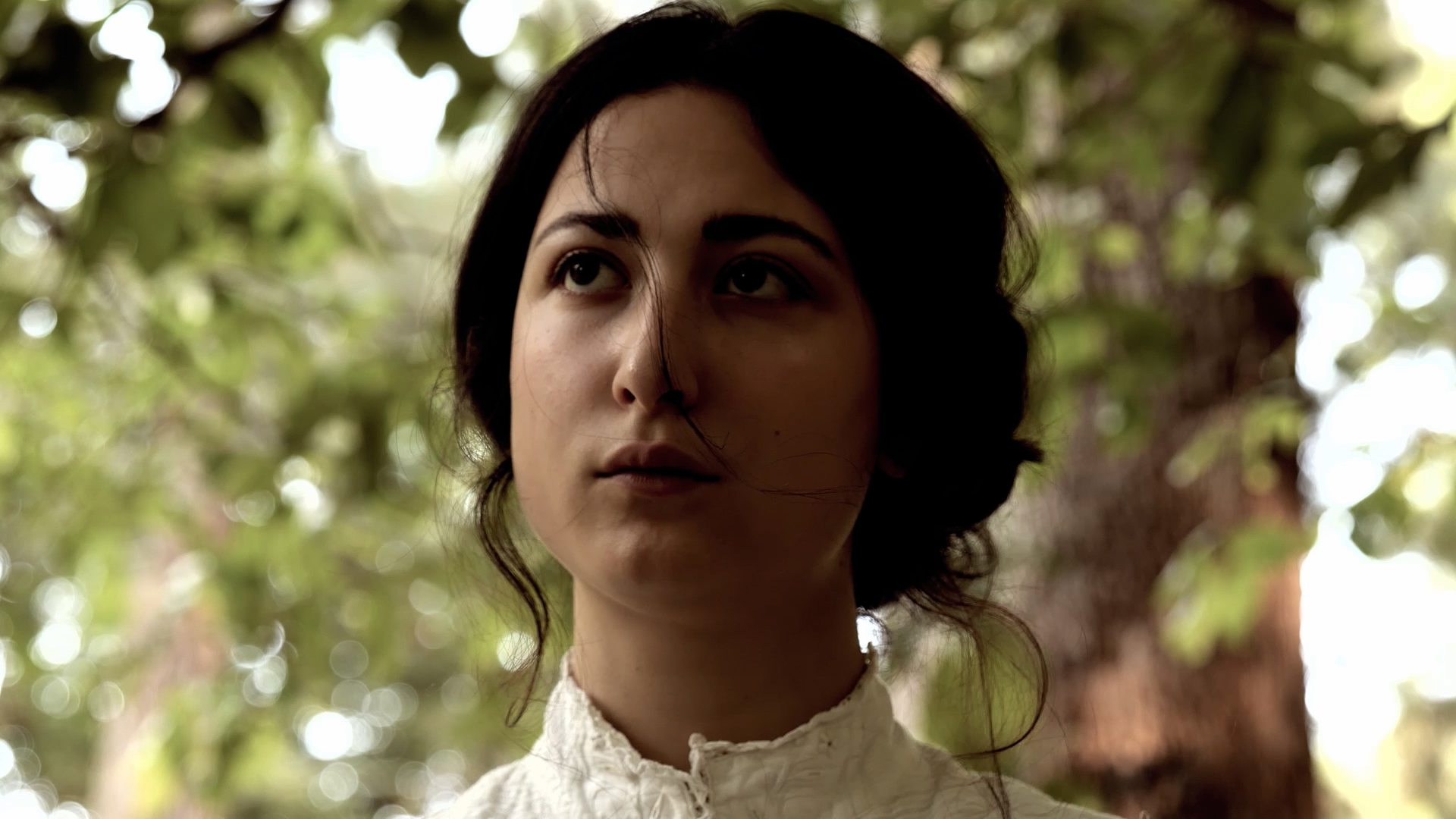
Documentary, by Isabel Russinova, Rodolfo Martinelli Carraresi, Italy, 2026
Eva of the Irises is a historical biographical docu-film about the scientist Eva Mameli Calvino, a botanist and pioneer of environmentalism in Italy, mother of the writer Italo, born in Sassari in 1886. The film, based on a multidisciplinary approach that combines several genres—such as theatre, documentary, cinema, and research—moves between memories, reflections on life, as well as the goals and missions the scholar still wished to achieve.
The multifaceted artistic sensibility of Isabel Russinova is expressed across many fields, from writing to acting, from directing to civic engagement, and finds one of its highest expressions in the docu-film Eva of the Irises, created with Rodolfo Martinelli Carraresi. The film blends scientific rigor and poetic refinement to portray the extraordinary figure of the botanist Eva Mameli Calvino, mother of Italo Calvino but above all an independent protagonist of 20th-century scientific culture. It is told through a combination of archival materials, interviews, and evocative staging capable of elegantly and profoundly conveying her intense human and professional story.
LANGUAGE: Italian
SUBTITLES: English, Spanish, French, Portuguese
A Prussian Cage and the Hunger That Grew Inside It
He was born into a house that expected everything from him except the thing he actually was. Tegel, 1769 — a manor outside Berlin where the air itself seemed to arrive pre-sorted, classified by class and obligation before it reached your lungs. The elder brother Wilhelm would become a philosopher and statesman, would shape Prussian education, would fulfill the architecture of aristocratic promise with an almost architectural precision. Alexander watched this and understood, somewhere below conscious thought, that fulfillment of that kind was its own form of erasure.
His mother, Marie Elisabeth, was not cruel in any dramatic sense. She was something more suffocating than cruel: she was purposeful. A widow managing an estate, managing two sons, managing the geometry of their futures with the cold efficiency of someone who has never once confused sentiment for strategy. She wanted Alexander to enter the Prussian civil service. She wanted him useful. Affection, if it existed at all between them, moved through the medium of expectation, which is to say it barely moved at all. Years later, when she died, Alexander received a modest inheritance and wrote almost nothing about grief. What he wrote about instead was South America.
The tutors came, as tutors do in such households, one after another, filling the boy’s head with languages and cartography and economics — not because anyone asked what the boy wanted to fill his head with, but because certain skulls are shaped by others before their owners are old enough to object. He was sent to study at Frankfurt an der Oder, then Göttingen, then Hamburg, then finally to the Freiberg Mining Academy, where Abraham Gottlob Werner was teaching a generation of young men to read the earth like a text. The year was 1791. Humboldt was twenty-two and had never yet stood on ground that felt like his own.
What Freiberg gave him, paradoxically, was a language for the restlessness he had been carrying without a name. Underground, descending into the mine shafts where the walls pressed close and the air thinned and the world above with its salons and administrative ambitions simply ceased to exist, something clarified. Not a decision — he was not yet free enough to make decisions — but a direction, the way certain rivers know the sea before they’ve found it.
Kant, in the Critique of Judgment published just one year earlier in 1790, had tried to give philosophical form to the experience of encountering something that exceeds the mind’s capacity to contain it — the sublime, that vertiginous collision between human smallness and the enormity of the natural world. For Kant it was a concept, a careful epistemological structure. For Humboldt it was a symptom. He had been experiencing the sublime as a kind of bodily turbulence since childhood — standing at the edge of something vast and feeling not peace but an almost unbearable urgency, as though the landscape were a question being asked of him and the only honest answer was movement. He had no philosophical vocabulary for this yet. He had only the feeling, which is often the more dangerous form.
The cage he lived in was well-appointed. This is the particular cruelty of privilege that goes unexamined: it furnishes the bars so beautifully that anyone who mentions them sounds ungrateful. He had access to books, to brilliant minds, to institutional education of a quality most humans in 1791 could not imagine. He was fed, housed, positioned. What he was not was free, and the people around him would not have recognized the word “freedom” applied to his situation as anything other than an insult to those who actually suffered.
He spent five years in the mines, filing reports, inspecting equipment, advancing through the bureaucratic architecture his mother had ordained. He was good at it. He was good at almost everything he tried, which is its own particular torment when nothing you try is the thing you actually need.

The Voyage That Was Not an Escape But an Eruption
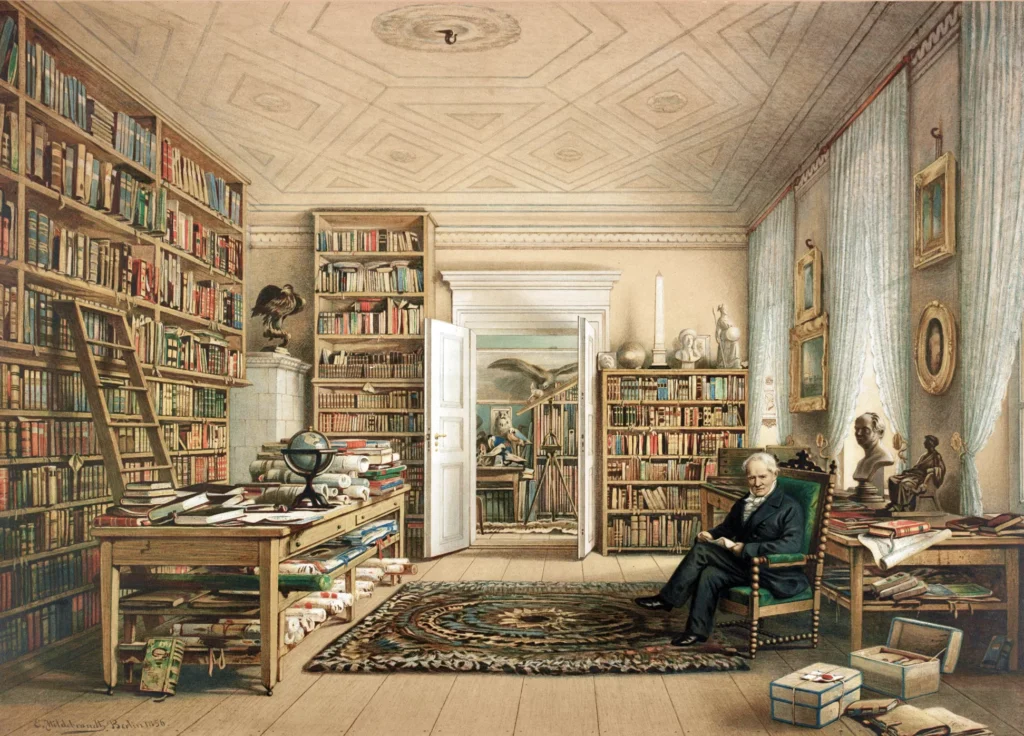
On June 5, 1799, two men boarded a ship at La Coruña and sailed into something they could not name. One of them, the younger, had spent the previous years watching doors close in front of him — bureaucratic refusals, diplomatic obstacles, the slow suffocation of a man who knows what he needs to do and cannot yet do it. When the Spanish crown finally granted permission, something in him did not simply open. It detonated.
The image we carry of that departure is wrong. We imagine the heroic naturalist, the enlightened European striding into the wilderness with his instruments and his notebooks, master of what he surveys. But what happened over the next five years across Venezuela, Cuba, Mexico, and the Andean cordillera was closer to the experience of descending alone into a cave with a single flickering instrument, unsure whether you are measuring the darkness or the darkness is measuring you. The deeper he went — into the jungle corridors of the Orinoco, toward the frozen summit of Chimborazo at over 5,800 meters, into the mercury-thick air of the Mexican plateau — the less the measurements explained. They multiplied the mystery. Every number opened another question. Every altitude reading implied a pressure system implied a current implied a climate implied a civilization implied a collapse. The instruments did not reduce the world. They revealed its relentlessness.
What Aimé Bonpland experienced beside him was, by most accounts, a kind of sustained astonishment that eventually settled into scientific habit. What Humboldt experienced was something harder to classify. Andrea Wulf, reconstructing his inner geography with forensic care in her 2015 study of his life and legacy, identifies the pivot point not as a discovery but as a perception — the moment when Humboldt stopped seeing nature as a collection of objects to be catalogued and began seeing it as a web of forces in continuous relation. Not a museum. A metabolism. This sounds, stated flatly, like a philosophical position one might hold comfortably in a study. In the field, at altitude, with the blood thinning and the compass behaving strangely and the local guides watching a European trust his instruments over their inherited knowledge, it was something else entirely. It was the recognition that everything you touch, you alter. That observation is not neutral. That the scientist standing at the center of a system is also inside it, also part of the web, also being registered by what he thinks he is registering.
That recognition does not bring peace. It brings a specific kind of vertigo that has no cure, only management. When he climbed Chimborazo in 1802 and could not reach the summit because of a crevasse that opened across the final approach, he recorded air pressure, temperature, humidity, the species of lichen growing at that altitude. He was still measuring. But the measurement had changed its meaning. He was not taking the pulse of a specimen. He was inside something alive, and it was indifferent to his instruments and entirely indifferent to his ambitions, and it would go on breathing long after his notebooks were dust.
Five years. Roughly 6,000 species of plants collected, approximately 60,000 specimens eventually brought back to Europe, hundreds of pages of field observations that would eventually become the thirty-volume Voyage to the Regions of the Equinoctial New Continent. The numbers are real. They are also, in a sense, beside the point. Because what came back from the Americas was not primarily a collection. It was a man who had been changed by the act of paying attention — changed in a way that made the civilization waiting for him in Europe look suddenly, irreversibly, like a very small and self-congratulatory room.
Chimborazo and the Vertigo of Wholeness
There is a moment, somewhere above five thousand meters, when your body begins to betray the ambition that drove it upward. The air thins not gradually but with a kind of malice, each breath returning less than the last. Your fingers go numb first, then the reasoning softens at its edges, and the mountain, which seemed like an object you were climbing, begins to feel like something that is simply happening to you.
He reached 5,878 meters on Chimborazo in June of 1802, higher than any European had ever climbed, and he did not reach the summit. A ridge of sheer rock blocked the final ascent. His gums were bleeding. His companions were vomiting. The clouds below him had closed over the valley like a lid, and he was suspended between the unattainable peak and the world he had left behind. He took measurements anyway. Barometric pressure, temperature, the species of lichen clinging to the stone at that impossible altitude. He noted the exact elevation at which vegetation ceased. He kept writing in his journal with hands he could barely feel.
What is extraordinary about this moment is not the altitude or the bleeding or the cold. It is the decision, made in that condition, to transform incompleteness into a diagram. Back from the mountain, Humboldt produced what he called the Naturgemälde, a single illustration, published in 1805 as the visual heart of his Essay on the Geography of Plants, that depicted Chimborazo in cross-section with every zone of life mapped vertically along its flanks. Temperature gradients, atmospheric pressure at each elevation, the precise species of plants growing at each band, the corresponding vegetation found at equivalent altitudes on the Alps and the Andes and the mountains of Lapland, all of it compressed onto a single page that measured roughly ninety by sixty centimeters. It remains one of the most audacious acts of synthesis in the history of science. And it is, looked at with sufficient honesty, the act of a man who understood that what he was drawing could never be complete.
Thomas Nagel, in his 1986 work The View from Nowhere, argued that the desire for objectivity — for a perspective so elevated, so purified of the personal, that it could see everything simultaneously — is both the engine of human knowledge and a philosophical impossibility. Every act of knowing is anchored somewhere. Every eye that sees is attached to a body that stands somewhere specific on the earth, at a specific moment in history, bleeding from a specific altitude. Nagel’s point was not that objectivity is worthless but that its absolute form is a fiction we pursue because the alternative — accepting that we are always inside the picture we are trying to draw — is genuinely vertiginous.
Humboldt knew this. Not abstractly, not as philosophical argument, but in his body on that mountain ridge with his instruments and his bleeding gums. The Naturgemälde is not a claim to have seen everything. It is a record of the attempt, with all its edges showing. He drew the summit of Chimborazo rising above his diagram, above the topmost label, as if to remind whoever looked at the image that the mountain exceeded its own representation. He left the peak outside the frame on purpose.
There is something almost unbearable in that choice. To climb as high as your body will carry you, to measure everything within reach, to draw the most comprehensive single image of natural life that had ever been produced, and then to leave the top of the mountain outside the image. Not because he forgot. Because he understood that the vertigo he felt at 5,878 meters was not a failure of stamina. It was the truth of the endeavor made suddenly, physically legible.
The Political Body Hidden Inside the Scientific One
There is a particular kind of discomfort that arrives when you realize the person who named the poison also understood exactly what it was doing to the body. Humboldt spent years measuring the dimensions of colonial wealth with a precision no European had yet achieved — the yield of the silver mines at Guanajuato, the volume of sugar produced in Cuba, the exact tonnage of goods extracted and shipped across the Atlantic — and then published those numbers alongside passages that described slavery as a moral catastrophe, a systematic deformation of human beings that contaminated not just the enslaved but the entire civilization that permitted it. He wrote, in language that was almost violently clear for 1811, that no argument of economic necessity could justify the condition he had witnessed on the plantations of Venezuela and Cuba. He counted the bodies and condemned the counting. He measured the extraction and declared the measurement obscene. Both gestures were entirely his, made with the same hand, in the same books.
This is where Achille Mbembe’s thinking becomes something you cannot look away from. Mbembe argues that the colonial archive is never innocent — that the act of systematic description, classification, and quantification of colonial territories and their populations is itself a form of possession, a way of making the world legible and therefore governable for European power. The archive does not merely record what empire does. It is part of what empire is. When Humboldt produced his Political Essay on the Kingdom of New Spain, he created a document of extraordinary scientific beauty and extraordinary imperial utility simultaneously. The Spanish crown, the emerging creole elites, and eventually the economic interests of the United States and Britain all read that essay and found in it exactly what they needed: a precise inventory of a world that could be owned more efficiently. The moral condemnations scattered through the same pages did not neutralize this. They coexisted with it, as they still do.
What makes this unbearable to sit with — and you should sit with it rather than resolve it — is that Humboldt’s denunciations of slavery were genuine. They were not decorative. He corresponded with abolitionists, influenced Simón Bolívar’s early thinking on emancipation, and wrote with a specificity about the suffering of enslaved people that most European intellectuals of his era carefully avoided. He was not performing virtue. He was simultaneously performing virtue and producing the cartographic and statistical infrastructure that made more efficient colonial governance possible. These two things were not in tension in his mind. That is the precise nature of the disturbance.
Hannah Arendt wrote in The Origins of Totalitarianism that the European bourgeoisie discovered in colonial expansion a laboratory for methods that would eventually return to Europe. What she did not sufficiently account for — and what Humboldt’s case forces into view — is the role of the liberal conscience in this laboratory. The man who protests the cruelty of the experiment while refining its instruments is not a hypocrite in any simple sense. He may be something more structurally troubling: a person whose moral clarity operates within a frame of reference that his own work is continuously reinforcing. Humboldt condemned slavery while producing knowledge that made the slave economy more legible, more measurable, more available to the administrative gaze of those who would perpetuate it.
Reducing him to a villain flattens the problem. Absolving him because his intentions were progressive makes the problem disappear entirely, which is worse. What he actually represents is the degree to which scientific humanism and colonial power were not opposites in the nineteenth century but intimate collaborators — sharing methods, sharing institutions, sharing the same magnificent, catastrophic hunger to know.
A vision curated by a filmmaker, not an algorithm
In this video I explain our vision
Paris, Salons, and the Loneliness of the Universal Man

He returned to a Paris that had never left the continent, and that, it turned out, was the problem. The salons were brilliant, the conversations ran long into the night, the candles burned down to their brass holders while men of science and letters competed to say something worth remembering. Humboldt was the most celebrated foreigner in the city. He was invited everywhere. He was the man who had climbed Chimborazo, who had mapped the Orinoco, who had held electric eels in his bare hands to observe the convulsions. Paris wanted all of that, desperately. What it did not quite want — what no candlelit room could fully accommodate — was the weight of what he had actually understood.
Georg Simmel, writing in 1908 in his essay on the stranger, described a social figure who occupies a peculiar and structurally irreducible position: near enough to participate, far enough never to belong. The stranger, for Simmel, is not simply the foreigner or the outsider. He is the one who arrived, who stayed, and who nevertheless carries within himself a point of origin that the group he inhabits cannot share and cannot fully absorb. His proximity is real. His distance is equally real. Both conditions operate simultaneously, and that simultaneity is not a personal failure — it is a geometric fact about the space he occupies. Humboldt fit this description so precisely it seems Simmel might have been thinking of him, though of course he was not.
What Humboldt had seen in the Americas between 1799 and 1804 was not a collection of exotic specimens. It was a living system, interdependent and vast, in which altitude determined vegetation, vegetation determined climate, climate bent back and shaped the soil that fed the roots. He had seen, before the vocabulary existed to say it cleanly, what we now recognize as ecology. He had stood on the flanks of Chimborazo at over 5,800 meters and sketched a cross-section of the world that showed, for the first time, that nature was not a catalogue but a grammar. The ideas he brought back were not merely new facts to be added to existing frameworks. They were a different framework entirely.
And here is where the loneliness begins, the specific, technical loneliness of the man who must translate a vision into language calibrated for those who did not share the original sight. You compress. You simplify. You choose the anecdote that will land — the electric eel, the altitude sickness, the way the jungle sounded at three in the morning — because those are the rooms where other minds can follow. And each time you make that choice, something true goes dark. The performance of brilliance that the salons demanded was not dishonest exactly. It was just always partial. Humboldt was generous, famously so, with his time and his ideas, corresponding with over 50,000 people across his lifetime, mentoring Darwin, influencing Goethe, shaping Bolivar’s political imagination. But generosity of that scale can itself be a form of displacement, a way of distributing outward what cannot be held inward with anyone.
He never married. He never settled. He moved between lodgings in Paris for nearly two decades, never acquiring the kind of domestic gravity that implies arrival. When he finally returned to Berlin in 1827, compelled by financial pressures after years of funding his own publications, he was already in his late fifties, and the America he had known was a quarter-century behind him. Cosmos, his great synthetic work, would not begin to appear until 1845, when he was 75. He spent the last decades of his life trying to write down the whole, knowing that the whole resisted every sentence he gave it.
The salons remembered the performance. The man inside it went on working, mostly alone, against the silence that follows when the candles finally go out.
Cosmos and the Impossible Book
He was seventy-six years old when the first volume appeared, and he already knew he would not live to finish it. That knowledge did not slow him. If anything, it seemed to accelerate something in him — not desperation, but a kind of clarified fury, the way a man who has accepted his limits can sometimes move more freely within them than those who still believe they can escape.
The project he had set himself was, by any rational measure, impossible. A single continuous narrative describing the physical universe in its entirety — from the drift of nebulae at the edge of telescopic vision down to the cellular architecture of moss on a stone wall. Not an encyclopedia, not a catalogue, but a living argument: that the universe is one thing, interconnected at every scale, and that the human mind capable of perceiving this unity is itself part of what it describes. Five volumes, published between 1845 and 1862, the last appearing three years after his death in 1859. A book that outlived its author by design, because its subject could not be contained within any single life.
What does it do to a man, spending thirty years describing something he knows he cannot finish? There is a particular madness in it, or perhaps a particular love — the two are not always distinguishable. At some point in those decades, the description and the thing described began to trade places in his perception. The world he had walked and measured and drawn became the world as he had written it. The volcanoes he had climbed were now, in some irreducible sense, the sentences he had built around them. The Orinoco existed twice: once in Venezuela, once in the architecture of his prose. He could not always say which version was more real to him. This is not a failure of perception. It is what happens when a mind has given itself so completely to representation that the map and the territory become, experientially, the same surface.
The public received it with an astonishment that bordered on hunger. Kosmos sold out its first printing within weeks. Across Europe and into America, readers who had never left their cities found themselves holding something that made the universe feel intimate, traversable, personally addressed to them. Darwin read it and said it reshaped how he understood his own work. Goethe had already been shaped by the earlier books, but Kosmos confirmed something he had intuited about the relationship between scientific precision and aesthetic truth. Bolívar had carried Humboldt’s ideas like a second education through the years of revolution. The book crossed languages and borders with a speed that the nineteenth century reserved for very few texts.
And yet Humboldt died nearly bankrupt. The fortune he had inherited — substantial, the kind that in his era could sustain a life of independent scholarship — he had spent funding other people’s expeditions, supporting young scientists who could not afford their instruments, financing the observations that would fill the later volumes of a book he was writing for the world and not for profit. He gave money the way other men give advice: freely, repeatedly, without apparent awareness that it was finite. By the end, he was dependent on a pension from the Prussian king, living modestly in Berlin, still writing, still corresponding with hundreds of scientists across the planet, still trying to close a book that the universe kept expanding beyond his reach.
There is something in this that resists the language of sacrifice. He did not suffer the poverty the way a martyr suffers. He simply continued. The book was more real to him than the money had ever been, and the scientists whose work he funded were extensions of the same project — more eyes, more instruments, more data flowing toward the great unfinished argument that everything is connected, that nothing in nature stands alone, that the man describing the world and the world being described are part of the same
Why We Forgot Him and What That Forgetting Costs Us
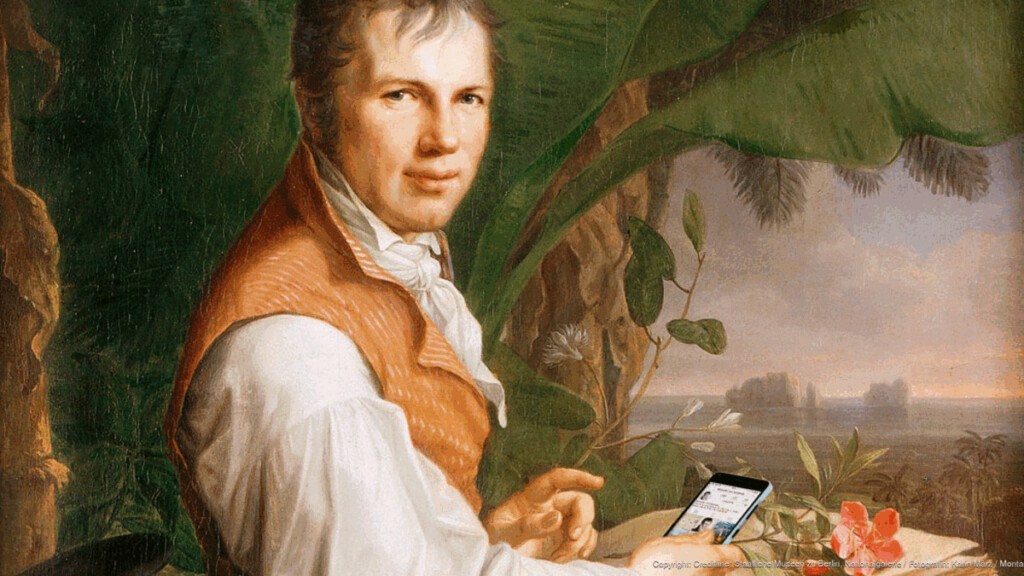
There is a kind of forgetting that is not accidental. It has a logic, a convenience, a structural necessity. The century that industrialized knowledge needed to forget Alexander von Humboldt the way a corporation needs to forget the generalist employee who kept insisting that every department was connected to every other — that what happened in accounting reverberated in engineering, in logistics, in the health of the workers on the floor. Such a person is not wrong. They are simply incompatible with the system that is being built.
Humboldt died in 1859, the same year Darwin published On the Origin of Species, and the coincidence is almost too neat, as if history had arranged a changing of the guard. Darwin’s great insight was singular, bounded, arguable, falsifiable in principle — the kind of idea that a discipline could own, defend, extend, institutionalize. Humboldt’s vision was none of those things. It was a web, a field, a permanent insistence that you could not understand the plant without understanding the altitude, the atmosphere, the ocean current offshore, the human agriculture that had modified the soil for three thousand years. You could not, in other words, understand anything in isolation. And isolation is precisely what the 20th century university was built to produce.
By the time Andrea Wulf published The Invention of Nature in 2015 — the book that most seriously attempted to restore Humboldt to popular consciousness — he had been absent from the general cultural conversation for nearly a century. Not from scientific terminology: the Humboldt Current still moves cold water up the South American coast, the Humboldt penguin still nests on its shores, the name persists in counties and mountain ranges and a university in Berlin. But the man himself, the method, the radical proposition that nature is a single living text that must be read all at once — that had been quietly archived.
What replaced him was the narrative of the solitary genius. Einstein at his chalkboard. Darwin in his study. The heroic individual who isolates one variable, holds everything else constant, and extracts a truth that can be written as an equation or a diagram. This is not a false narrative exactly, but it is a partial one, and its partiality is not innocent. A culture that celebrates only that kind of knowledge will, systematically, underinvest in the knowledge that Humboldt practiced — the knowledge that crosses rivers between disciplines, that reads a forest as an economic system and an economic system as an ecology, that refuses to let the specialist sleep soundly in his narrow bed.
The philosopher of science Thomas Kuhn argued in 1962 that scientific communities do not simply accumulate knowledge — they protect paradigms, and they resist, sometimes violently, the anomalies that paradigms cannot absorb. Humboldt was not an anomaly. He was something rarer and more threatening: a different paradigm entirely, one that the emerging structure of professional science could not institutionalize without dismantling itself. So it did the next best thing. It kept his name on the map and removed his thinking from the syllabus.
And here is the thing that sits at the bottom of all of this, the detail that history has arranged with a cruelty that feels almost deliberate. The man who first described, in systematic scientific terms, the way human deforestation alters local climate, raises temperatures, disrupts rainfall patterns, and begins a process of environmental degradation that compounds across time — he wrote this in Venezuela, in 1800, after observing the destruction around Lake Valencia. He described the mechanism of anthropogenic climate change two hundred and twenty years before the phrase entered the common vocabulary. He was the most famous scientist in the world when he wrote it. And then we forgot him, and spent the next two centuries learning, at extraordinary cost, everything he had already told us.
🌿 Where Science Meets the Soul of the World
Alexander von Humboldt stood at the crossroads of science, philosophy, and art, weaving together the visible and invisible threads of nature into a single, breathing whole. His vision resonates across centuries with other great minds who dared to look beyond their disciplines. Explore these thematically kindred journeys.
Paracelsus: Life and Alchemical Thought
Paracelsus, like Humboldt, refused the narrow boundaries of established knowledge, forging a path that united empirical observation with a profound sense of nature’s hidden forces. His alchemical thought sought the living principles within matter, echoing Humboldt’s conviction that the universe is animated by invisible energies. Both thinkers challenged their contemporaries to see the natural world as an interconnected, sacred totality.
GO TO THE SELECTION: Paracelsus: Life and Alchemical Thought
Giordano Bruno and the Hermetic Tradition
Giordano Bruno‘s vision of an infinite, animated cosmos anticipates the boundless curiosity that drove Humboldt across continents and altitudes. Bruno’s Hermetic tradition placed humanity within a living universe pulsing with correspondences, a cosmological intuition that Humboldt would later ground in rigorous scientific observation. Their shared refusal to accept fixed limits made both men transformative and, in their own eras, deeply controversial.
GO TO THE SELECTION: Giordano Bruno and the Hermetic Tradition
Rudolf Steiner and Anthroposophy: A Guide to Modern Esoteric Thought
Rudolf Steiner‘s anthroposophy emerged partly from a deep engagement with Goethe’s nature philosophy, which itself owed much to the intellectual climate that Humboldt helped shape. Like Humboldt, Steiner believed that the spiritual and the natural could not be truly separated, and that genuine knowledge required both disciplined observation and inner transformation. This parallel makes their legacies complementary pillars of a holistic understanding of the world.
GO TO THE SELECTION: Rudolf Steiner and Anthroposophy: A Guide to Modern Esoteric Thought
Albertus Magnus: Alchemy and Natural Philosophy
Albertus Magnus was among the first Western thinkers to insist that careful study of the natural world was a legitimate path toward higher truth, laying groundwork that figures like Humboldt would later walk with scientific rigor. His synthesis of Aristotelian natural philosophy with medieval theology mirrors Humboldt’s own effort to reconcile empirical data with an almost mystical sense of nature’s unity. Both men remind us that the boundary between science and wonder has always been porous.
GO TO THE SELECTION: Albertus Magnus: Alchemy and Natural Philosophy
Discover Visionary Cinema on Indiecinema
If these explorations of boundary-breaking thought have stirred something in you, Indiecinema streaming is the natural next step. Our curated selection of independent and visionary films carries the same spirit of discovery that drove Humboldt into uncharted territories. Join us and let cinema take you further than you imagined possible.
👉 EXPLORE THE CATALOG: Watch Indie Films in Streaming
A vision curated by a filmmaker, not an algorithm
In this video I explain our vision

