
The Body Before the Mind: Entering a Gothic Cathedral
You step inside and something happens before you know what it is. The cold arrives first — not the ordinary cold of shade or wind, but a specific mineral stillness that enters through the mouth and sits in the chest. Then the light, falling at angles that seem structurally impossible, cutting through colored glass in shafts that do not illuminate so much as interrogate. And then, almost involuntarily, your eyes go up. Not because you decided to look. Because the building decided for you.

This is not a minor detail. This is the entire argument written in stone.
The verticality of Gothic architecture is not decorative. It is not the medieval equivalent of a design choice, a preference for the tall over the wide. When the choir of the abbey church of Saint-Denis was rebuilt under Abbot Suger between 1140 and 1144, inaugurating what we now recognize as the Gothic aesthetic, the intention was not to impress through scale. The intention was to produce a specific state in the body of the person standing inside. Suger himself wrote about it with a directness that sounds almost clinical: the material beauty of the space was meant to transport the perceiving mind from the inferior to the superior, from the sensory to the transcendent. But what he described as theological ascent, we might now recognize as something more physiological. The neck tilts back. The ribcage opens. The breath slows. These are not metaphors for prayer. They are the preparation for it, delivered by the architecture itself before a single word is spoken.
Maurice Merleau-Ponty, in his Phenomenology of Perception published in 1945, argued that the body is not a vessel through which consciousness travels but the very medium of our being in the world. We do not think about space and then occupy it. We are already oriented by it, shaped by it, made to feel certain things before cognition intervenes. A Gothic cathedral is one of the purest demonstrations of this principle ever built. The nave does not wait for your interpretation. It acts on you. The pointed arches direct your gaze upward with the same inevitability that a funnel directs water. The clustered columns, thin and multiple, deny the eye any sense of mass or resistance, creating instead an impression of continuous upward motion, as if the stone itself were ascending. By the time your conscious mind arrives at the thought this is beautiful or this is overwhelming, your nervous system has already received the full message.
There is something almost coercive about this, and it is worth sitting with that word rather than softening it. A man enters a vast interior — he has come perhaps out of obligation, perhaps out of curiosity, perhaps because it was raining outside. He is not seeking transcendence. He is a man with debts and arguments and unfinished sentences still running through his mind. And within thirty seconds of crossing the threshold, something in him has been reorganized. He did not choose it. He was not persuaded. He was simply placed inside a machine designed with extraordinary precision to produce an overwhelming sense of his own smallness followed immediately by a pull toward something larger. The sequence matters. Smallness first, then aspiration. Diminishment as the door to elevation.
Sociologist David Gartman, writing on the cultural politics of architecture, has noted that built space is never neutral, that every structure encodes a set of social and ideological relationships that are then reproduced in the bodies of those who inhabit it. The Gothic cathedral encodes one relationship above all others: the radical insufficiency of the human scale. You are not the measure here. You never were. And the extraordinary thing is that this message, delivered by geometry and weight and light, is received as beautiful rather than threatening. That conversion — from diminishment to wonder — is perhaps the central psychological operation of the entire tradition.
St. Mary of Vezzolano. The Restoration of the Jubé
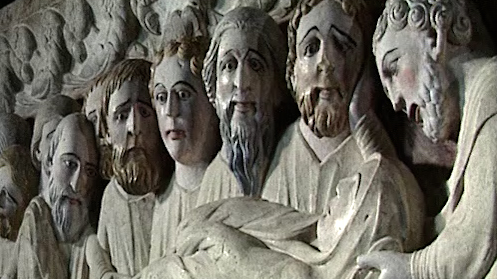
Documentary, by Fedele Aula, Italy, 1998.
In the heart of Monferrato, among silent hills and winding roads, stands the Canonica of Santa Maria di Vezzolano: a place where history, art, and spirituality have intertwined for nearly a thousand years. At the center of the narrative emerges the jubé, an extraordinary medieval rood screen that miraculously survived the dictates of the Counter-Reformation that had ordered its destruction. This rare structure, suspended between liturgical function and visual storytelling, becomes the guiding thread of the documentary: a “stone book” recounting the genealogy of Christ and the Dormitio Virginis, still preserving traces of its original colors.
Through the work of restorers, institutions, and volunteers, the film explores the delicate balance between conservation and enhancement, bringing new life to a work unique in the European landscape. The restoration of the jubé thus becomes not only a technical intervention, but a journey through memory, giving voice once more to a monument that has endured centuries, resisting time and human actions. Through testimonies, evocative imagery, and artistic details, the documentary invites viewers to rediscover Vezzolano as a “magical” place, where every stone tells a story and the past continues to dialogue with the present.
LANGUAGE: Italian
SUBTITLES: English, Spanish, French, German, Portuguese
Building Upward as an Act of Political Theology
Abbot Suger did not want to build a beautiful church. He wanted to build an argument. When he began reconstructing the royal abbey of Saint-Denis around 1137, just north of Paris, he was not thinking primarily about aesthetics or devotion in any simple sense. He was thinking about legitimacy. The Capetian monarchy was still fragile, its authority contested by feudal lords who controlled land, armies, and local loyalty. What Suger understood, with a clarity that most politicians never achieve, is that power requires a visible form — something the eye cannot escape, something that makes the body feel small before it even consults the mind.
The pointed arch, the ribbed vault, the flying buttress: these are usually described in architectural surveys as technical innovations, solutions to structural problems that allowed walls to be thinner and windows to be larger. That is accurate and completely beside the point. What those innovations actually accomplished was the capacity to build taller than anyone had built before without the walls collapsing inward under their own weight. And height, in the medieval theological imagination, was not a neutral spatial dimension. It was a theological claim. God resided above. Heaven was literally upward. To construct a building that pierced the sky was to assert proximity to divine authority — and to assert that the institution inhabiting that building was the hinge between the human and the sacred.
Suger himself wrote about this with a frankness that later centuries would learn to disguise. In his treatise Libellus Alter de Consecratione Ecclesiae Sancti Dionysii, he described how the new luminous spaces of Saint-Denis were meant to transport the worshipper from the material to the immaterial, using the theology of Pseudo-Dionysius the Areopagite, who had argued in the fifth century that physical light was the closest earthly approximation of divine illumination. Suger weaponized this mysticism. Light flooding through stained glass was not decoration. It was a controlled experience designed to produce a specific emotional and cognitive state in the person standing beneath it: awe, smallness, submission. The building was doing political work before a single sermon was preached.
This is what Michel Foucault would later call, in a different context, the architecture of power — the way space is organized to produce particular kinds of subjects, people who know their place because the physical environment has already told them where to stand. The Gothic cathedral was the medieval state’s most legible propaganda, and it was propaganda that did not need to be read. It operated on the body directly. You walked through those doors and the ceiling vaulted away from you at an angle that made your neck crane upward involuntarily. That involuntary movement was the whole point.
By the mid-thirteenth century, the logic Suger had introduced at Saint-Denis had proliferated across northern France and then across Europe. Chartres, begun in earnest after a fire in 1194, reached a nave height of thirty-six meters. Beauvais, begun in 1225, attempted a choir vault of forty-eight meters and partially collapsed in 1284 — which says something important about the relationship between theological ambition and structural reality. These were not buildings designed to human scale. They were designed to make the human scale feel inadequate, provisional, temporary. Historian Georges Duby, in his 1976 study of the age of the cathedrals, argued precisely this: that Gothic architecture represented a concrete materialization of scholastic thought, a theology made stone, a cosmology you could walk inside.
And walking inside it, you were already inside someone else’s argument about the universe. The question of whose argument it was — the Church’s, the monarchy’s, the local bishop’s, the guild of stonemasons who left their marks in the stone and whose names history largely swallowed — is one the building itself refuses to answer cleanly.

Light as Doctrine: The Theology of Stained Glass
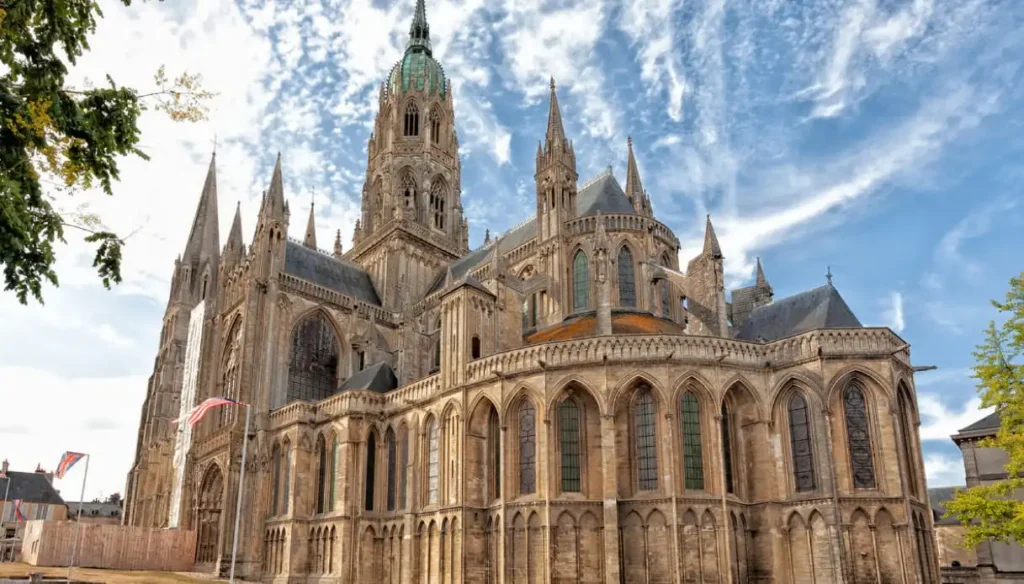
You walk through the western portal and the darkness takes you first. Not the darkness of absence, but the kind that feels deliberate, pressurized, like the building is holding its breath. Then your eyes adjust, and the walls are no longer walls. They are burning. Crimson, cobalt, gold, a green so deep it seems to come from beneath the earth rather than above it — the light does not enter Chartres so much as it erupts through it, and for a moment you are not standing in a building. You are standing inside a argument that has been translated into color.
This was never accidental. The theology behind those windows predates the windows themselves by several centuries, rooted in the writings of a sixth-century Syrian mystic who signed his work with the name of Paul’s Athenian convert, borrowing apostolic authority for ideas that were radically his own. Pseudo-Dionysius the Areopagite, writing around 500 CE, proposed that all of creation is structured as a descending hierarchy of light emanating from a divine source, what he called the Good, the Beautiful, the One. Material beauty was not a distraction from God but a conduit toward him — physical light was a legible trace of divine illumination, and the more brilliantly a thing shone, the closer it stood to its origin. This was not a metaphor. It was a cosmological blueprint, and Abbot Suger of Saint-Denis, who between 1135 and 1144 oversaw the reconstruction of his royal abbey church outside Paris, understood it with the precision of an architect and the appetite of a propagandist.
Suger wrote about his own windows with a fervor that reads less like liturgical commentary and more like a confession of addiction. He described standing beneath the colored glass and feeling himself transported from the inferior to the superior world, carried upward, he said, by analogy. The phrase matters. Analogy, not instruction. The light was not explaining anything to him. It was moving him somewhere his reasoning could not reach on its own. What he built into Saint-Denis, and what spread through France and across Europe over the following century in what historians would later call the Gothic revolution, was an architecture specifically engineered to produce this involuntary elevation. The walls dissolved — structurally dissolved, as flying buttresses transferred the load outward and freed the stone from its ancient duty of enclosure — and in their place came glass. Acres of it. Scripture, saints, martyrdoms, the Tree of Jesse, the Passion rendered in vitreous color that catches and transforms whatever light the northern sky reluctantly offers.
But consider who was actually standing in that nave in 1220. Not the abbot. Not the theologian who had read Dionysius and could trace the lineage of divine light through Neoplatonist philosophy back to Plotinus. The person standing there was likely illiterate, likely exhausted from a life structured entirely around subsistence, likely arriving after a pilgrimage that had taken weeks of walking. They could not read the scenes depicted in the glass. They did not need to. The windows were not a Bible for the illiterate, as later commentators condescendingly framed them. They were not education. They were annihilation of the ordinary perceptual world and its replacement with something so total, so saturated with color and verticality and directed light, that the nervous system simply capitulated. Erwin Panofsky, writing in 1951, described Gothic architecture as the visual equivalent of Scholastic thought — structured, hierarchical, luminous in its logic. But Panofsky was describing the view from the clerestory, so to speak. Below, at ground level, what was happening was closer to what William James in The Varieties of Religious Experience called the noetic quality of mystical states: the sudden, overwhelming conviction that something immense and true has been revealed, arriving not through argument but through the body’s own surrender to what it cannot process any other way.
The Gargoyle’s Honesty: Fear as a Foundation Stone
You are standing in the rain outside a cathedral, neck craned back, and something above you is staring down. Not watching. Staring. Its mouth is open in a grimace that stopped being a scream centuries ago and became something worse — a permanent condition. Stone wings folded against stone haunches. Eyes that do not blink because they were never alive, and yet you cannot shake the feeling that they were carved by someone who had seen exactly this thing, not imagined it. You cannot move. The rain runs into your collar and you cannot move, because you have just recognized the face.
That recognition is not aesthetic. It is not the pleasure of craft or the admiration of medieval stonework. It is something older and more uncomfortable, the sensation of being confronted with a thought you have been successfully avoiding since breakfast, since last Tuesday, since the decade began. The gargoyle is not decorating the cathedral. The gargoyle is confessing something the nave and the rose windows and the soaring pointed arches were carefully constructed to obscure.
Ernest Becker argued, in his 1973 Pulitzer Prize-winning work The Denial of Death, that human civilization in its entirety — its art, its religion, its political systems, its monuments — is fundamentally a neurotic response to one unbearable fact: that we are going to die, and we know it. Becker was drawing on Kierkegaard’s concept of anxiety as the dizziness of freedom, on Freud’s death drive, on Otto Rank’s theory of the artist as someone who constructs an immortality project to outlast the body. But where Becker was most devastating was in his insistence that the grandest structures humanity has ever erected are not celebrations of life. They are elaborate, collective, beautifully engineered defenses against the terror of its ending.
Look at the gargoyle again. Medieval cathedral builders did not place grotesque figures on their structures by accident or whim. The theological rationale offered was functional — gargoyles as waterspouts, chimeras as wards against evil spirits — but the deeper logic is less tidy. The Church understood, in a way that modern institutions have largely forgotten how to admit, that fear was not the opposite of faith. Fear was its precondition. The people who entered Chartres or Notre-Dame de Paris, whose construction spanned from 1163 and consumed the labor and wealth of generations, did not arrive at the portal as philosophers seeking transcendence. They arrived as bodies that ached, as minds that understood plague and famine and the specific randomness of suffering. They arrived already terrified. The gargoyle did not create their terror. It acknowledged it.
This acknowledgment is what makes the grotesque figures of Gothic architecture so different from mere ornamentation. A chimera crouched at the edge of a parapet at Notre-Dame is not beautiful in any conventional sense. It does not reassure. It sits at the precise threshold between the sacred interior and the open sky, between the contained meaning of the liturgy and the vast indifference of the world outside, and it wears an expression that says: yes, you are right to be afraid. The exterior of the building was always meant to be the zone of monsters. You passed through them to reach the light inside. The architecture itself was structured as a passage through acknowledged terror toward something that might, possibly, redeem it.
Becker would have understood this spatial argument immediately. His central claim was not that humans are cowards for fleeing death-awareness, but that the flight itself generates culture. The cathedral is what fear looks like when it has been organized, when communal anxiety has been given stone and height and time. The gargoyle is simply the moment when the builders stopped pretending otherwise, when they let the repressed material cling openly to the edge of the thing they had built to deny it, grinning in the rain above every person who walks underneath and looks up and, just for a moment, cannot look away.
The Architect’s Anonymity and the Myth of Collective Faith
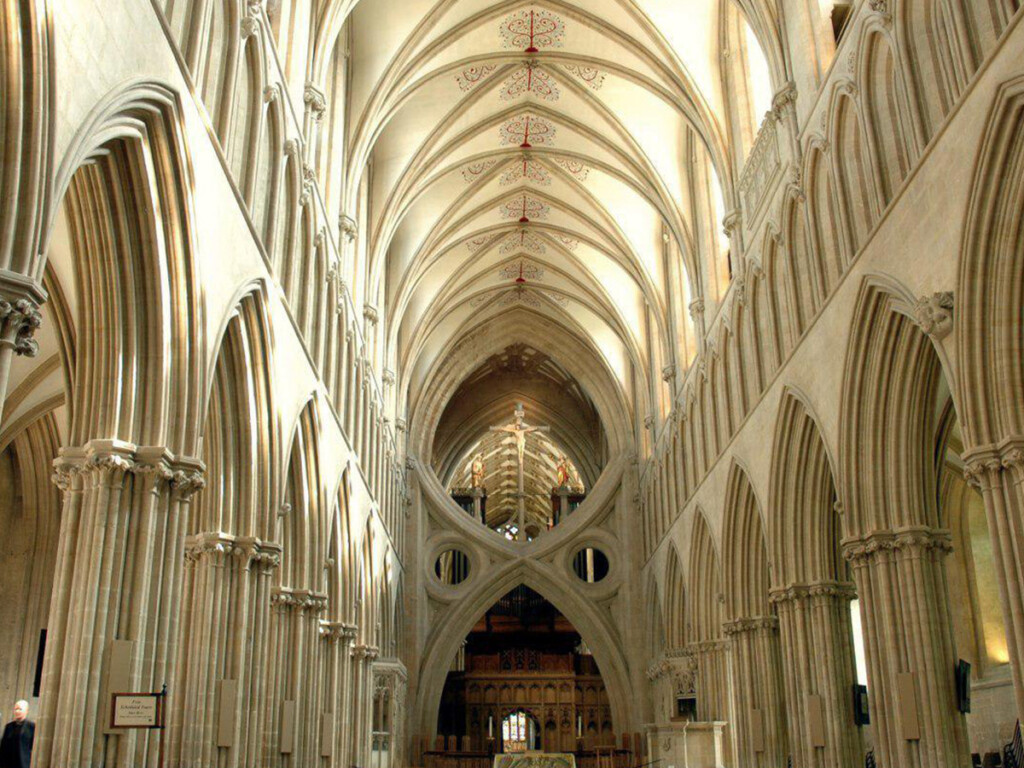
You have heard the story so many times it feels like memory: an entire town rising at dawn, farmers and merchants and mothers carrying stone on their backs toward the sky, united by a single wordless devotion. No foreman’s whip. No contract. Just faith made visible, faith made vertical. It is one of the most seductive myths Western culture has ever told itself about itself, and like all truly effective myths, it contains just enough truth to make the lie invisible.
Georges Duby, whose work on medieval society remains one of the most rigorous dismantlings of romantic medievalism ever written, documented with forensic precision the actual structure of labor in the high Middle Ages. In “The Three Orders: Feudal Society Imagined,” published in 1978, Duby traced how the tripartite division of society — those who pray, those who fight, those who work — was not a neutral description but an ideological instrument, a framework that consecrated exploitation by making it appear cosmically ordained. The man who carried stone to the cathedral did not do so as a free act of devotion. He did so because the social architecture of his world had already decided, before he was born, that this was his function. The sacred and the coercive were not opposites. They were the same gesture, seen from different angles.
Chartres took from roughly 1194 to 1220 to reach its essential form, and the generations of workers who began it died without ever seeing a completed nave. Think about what that actually means — not as a symbol of transcendence, which is how it is always framed, but as a human reality. You pour your labor into something that will not exist until after your death, not because you chose this horizon but because the institution that commands your labor is larger than any individual life and has no particular interest in consulting you about the terms. The cathedral was not finished by those who started it. The vision belonged to bishops and master builders. The bodies belonged to everyone else.
And even among those with relative power, the hierarchies were brutal and intricate. The master builders — the architects in all but name — occupied an ambiguous position that modern romanticism has conveniently blurred. A man directing the construction of a cathedral wall walked somewhere between craftsman and intellectual, between servant and visionary, between someone celebrated and someone utterly disposable. His name was sometimes recorded, more often not, and the romantic insistence on his anonymity as proof of selfless devotion is almost perfectly inverted from the truth: the anonymity was not humility, it was erasure. The institution consumed the individual and called it holiness.
There is a moment — not in any history book but recognizable to anyone who has ever worked inside a large institution animated by a noble stated purpose — where you realize that the mission and the machinery are not the same thing. The mission floats above everyone like incense. The machinery grinds below, unglamorous, unjust, indifferent to the souls inside it. Medieval cathedral construction was among the most ambitious institutional projects in human history, and it operated with all the moral ambiguity that institutional ambition always generates. Episcopal rivalry drove much of it: Abbot Suger at Saint-Denis was not primarily a mystic, he was a political operator who understood that architecture was power, that height was authority made stone, that the bishop who built higher than his neighbor had won an argument that no synod could settle.
The myth of collective anonymous faith endures because it flatters everyone. It flatters the Church, which appears as a vessel for communal love rather than a structure of command. It flatters the modern observer, who gets to feel moved by medieval simplicity without having to reckon with medieval suffering. And it flatters the cathedral itself, allowing it to mean only what we want it to mean, sealing off the harder question of what it cost and who paid.
A vision curated by a filmmaker, not an algorithm
In this video I explain our vision
Ruins, Restorations, and the Lies We Prefer
You have stood in front of Notre-Dame de Paris with your phone raised, certain that the stone under your fingertips carried the cold weight of the thirteenth century. The gargoyles staring down at you from the gallery of chimeras, the sharp needle of the spire cutting the Île-de-la-Cité sky, the brooding logical geometry of the flying buttresses — all of it felt ancient, felt authenticated by centuries of rain and prayer and siege. What you were touching, in almost every detail that struck you as most dramatically, most essentially medieval, was the imagination of a single nineteenth-century architect named Eugène Viollet-le-Duc, a man who loved the Middle Ages the way a novelist loves a character he has invented: completely, and without scruple.
Viollet-le-Duc began his work on Notre-Dame in 1844, alongside Jean-Baptiste-Antoine Lassus, after the cathedral had suffered decades of Revolutionary-era vandalism, neglect, and the kind of slow institutional forgetting that is more destructive than any mob. What he restored was not what had been. What he built was what he believed should have been — a purified, intensified, theoretically perfected version of Gothic architecture distilled from his reading of dozens of different structures across different centuries and regions. The spire he erected between 1859 and 1860 had no authentic precedent at Notre-Dame; the medieval one had been dismantled in 1786. The gallery of chimeras, those grotesque winged creatures that have become the visual signature of the cathedral for millions of tourists and postcard buyers, did not exist in the medieval building in anything like the form he gave them. They were his creatures, his medieval dream made in stone, placed where he decided they belonged in his idea of what a cathedral of that period ought to look like. He documented his philosophy with characteristic confidence in his Dictionnaire raisonné de l’architecture française du XIe au XVIe siècle, published between 1854 and 1868, where he wrote that to restore a building is not to preserve it, repair it, or rebuild it — it is to re-establish it in a complete state that may never have existed at any given moment. He said this openly. Most people who photograph his work have never read the sentence.
This is precisely what Nietzsche identified as the pathology of monumental history in his 1874 essay “On the Uses and Disadvantages of History for Life.” The monumental mode, Nietzsche argued, takes greatness from the past and presents it as continuous, unbroken, available — it smooths the discontinuities, suppresses what is inconvenient, and produces an image of the past that serves the psychological needs of the present rather than the truth of what existed. Monumental history does not falsify by accident or laziness. It falsifies with devotion. Viollet-le-Duc was devoted. He produced cathedrals more coherent, more legible, more symbolically saturated than anything the actual Middle Ages had managed, because the actual Middle Ages were building across centuries, with interrupted funding, changing tastes, structural crises, and the ordinary chaos of institutional life. His restorations at Carcassonne, at Vézelay, at Pierrefonds imposed a unity that history had never produced, and in doing so they became more convincing than the original ruins — more photogenic, more emotionally satisfying, more useful as evidence of a greatness that the nineteenth century needed to believe had once existed and could perhaps exist again.
The lie is not cynical. That is what makes it so difficult to see. You stand before stone that feels ancient because someone loved the idea of antiquity enough to carve it yesterday. The emotion is real. The recognition is real. What is not real is the century you think you are touching, the continuity you think you are inheriting, the direct line you imagine runs from your hand through that cold carved surface back to a stonemason who prayed in Latin and died before the printing press existed.
The Cathedral Inside You: Internalized Verticality and Moral Architecture
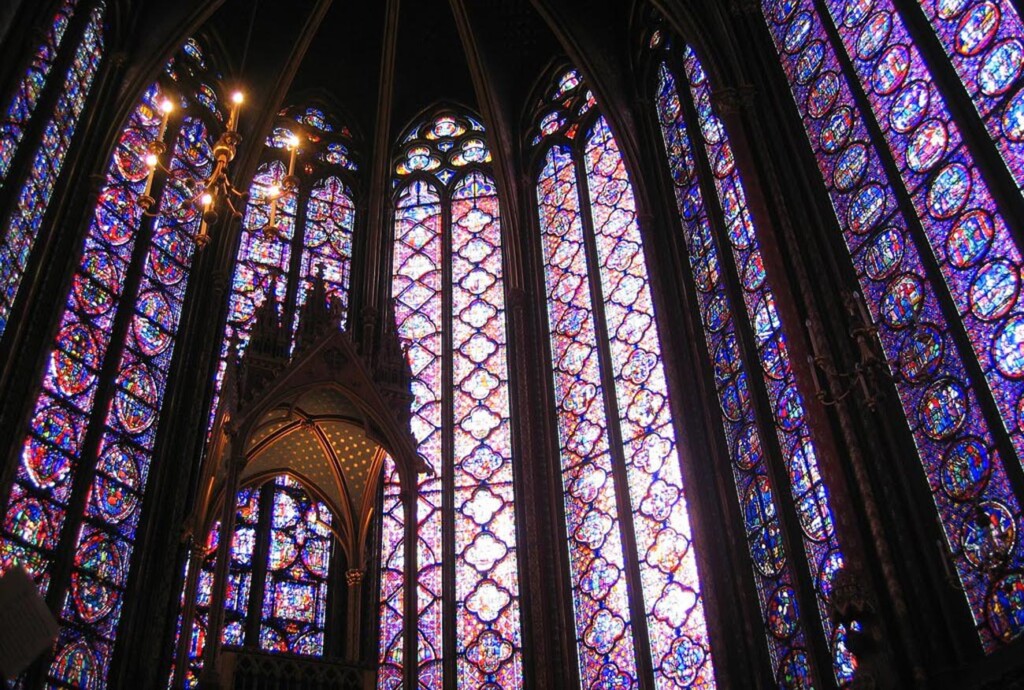
You already know this without knowing you know it. When you describe someone as morally elevated, when you speak of high ideals or low desires, when you feel shame as a sinking and ambition as a rising, you are not using metaphors loosely borrowed from architecture. You are living inside a spatial grammar that was carved into Western consciousness stone by stone, vault by vault, across three centuries of Gothic construction. The cathedral did not merely organize worship. It organized the self.
Michel Foucault argued in Discipline and Punish, published in 1975, that space is never neutral — that the arrangement of bodies in space produces particular kinds of subjects, particular dispositions of the soul. He was writing about prisons and schools and hospitals, but the logic applies with terrifying precision to something far older. The Gothic nave did not only direct the gaze upward toward God. It installed a vertical axis inside the person standing within it, an axis they would carry with them when they left, an internal compass that would never stop pointing in the same direction. Up is good. Down is ruin.
Think of a man standing in judgment, surrounded by stone figures arranged in tiers above him, the damned pulling toward the earth, the saved lifted on wings, Christ at the absolute apex. He stands there long enough, kneels there long enough, confesses there long enough, and the architecture stops being around him. It becomes him. This is not mysticism. It is what Foucault called the production of the subject through spatial dispositifs, the way environments do not merely contain behavior but generate the very categories through which behavior is evaluated. The building thinks through you until you think like the building.
Pierre Bourdieu, in The Logic of Practice from 1980, described how social hierarchies become embodied not as ideas but as physical orientations — postures, gestures, reflexes that encode distinction and worth without conscious thought. He called it hexis, the way class and status and moral standing settle into the body as habitus. The Gothic cathedral is perhaps the most sophisticated hexis-machine Western civilization ever constructed. Every ritual enacted within it, every genuflection, every upward glance at clerestory light, every lowering of the eyes during confession, was training the body to feel hierarchy as natural, as gravitational, as inevitable as falling.
What survived the Reformation, the Enlightenment, and two centuries of declared secularism is not theology. Theology is consciously held and can be consciously abandoned. What survived is the spatial grammar. You feel pride as expansion and shame as collapse. You describe broken people as fallen. You speak of moral degradation as if virtue were a physical altitude being lost. A life well-lived rises. A wasted one sinks. The language of contemporary psychology, of self-help literature, of corporate motivation, of political rhetoric — it is all organized along this invisible vertical axis whose origin most people have entirely forgotten.
A woman sitting in a therapist’s office describes her depression as a weight pressing down, an inability to rise, a sense of being buried. She is not speaking poetically. She is reporting a genuine phenomenological experience. And that experience is structured by a spatial logic she did not choose, that was not discovered by introspection, that predates her birth by seven hundred years. The Gothic builders did not only raise stone. They lowered something permanent into the ground of Western interiority.
Foucault understood that the most effective power is the kind that no longer requires an external enforcer because it has been internalized so completely that the subject enforces it themselves. The cathedral achieved exactly this. It does not need to stand for its architecture to function. You carry the nave. You carry the judgment portal. You carry the light that falls from above and the darkness that pools beneath, and you have been measuring yourself against that invisible elevation every day of your conscious life.
What Burns and What Remains: Notre-Dame, 2019
You were not religious. You had not been inside a church in years, possibly decades. And yet when the spire fell — when that needle of eight-hundred-year-old oak and lead tilted, buckled, and disappeared into the smoke above the Seine on the evening of April 15, 2019 — something tore in you that you did not know was still attached.
This is worth sitting with honestly.
Within twelve hours of the fire, more than a billion euros had been pledged by private donors. The Pinault family offered a hundred million. The Arnault family offered two hundred million. Corporations and governments across Europe announced contributions before the embers were cold. The speed was extraordinary — not the generosity itself, but the reflex, the almost biological urgency, as though the wound needed to be closed before anyone had time to examine what exactly had been injured. Yuval Noah Harari has written about the human capacity to grieve symbolic losses as though they were personal ones, the way shared fictions — nations, religions, civilizations — produce real emotional architecture inside individual bodies. What collapsed into the flames that night was not stone. Stone largely survived. What collapsed was something people had been storing there without knowing it.
The medieval builders who began raising Notre-Dame’s foundations around 1163 under Bishop Maurice de Sully were, in the theological framework of their time, constructing a diagram of the cosmos. The verticality was not aesthetic ambition. It was a claim about the direction of truth. And for eight and a half centuries, through revolution and war and the systematic erosion of every metaphysical certainty those builders held, the structure kept making that claim silently, on behalf of people who no longer fully believed it. This is the function Carl Jung might have recognized immediately: the cathedral as collective psychic container, holding a shape of meaning that individuals could no longer maintain alone. What the burning revealed was how many people had been quietly outsourcing their need for transcendence to a building.
There is a man who watches a woman he has spent years pursuing finally choose a different life, a life without him, and he stands in the street after she has gone and feels not grief for her specifically but for some story he had been telling himself about where everything was heading. The loss is real. What was lost, though, was not her. It was the architecture of forward motion, the sense that all of it — the waiting, the wanting, the belief that meaning accumulates — was going somewhere. Notre-Dame’s burning produced grief of that precise structure, civilizational rather than personal, and the mourning was so intense precisely because the faith it exposed was so rarely spoken aloud.
Emile Durkheim, writing in The Elementary Forms of Religious Life in 1912, argued that the sacred is not a property of objects but a property of collective attention — that what a community consecrates becomes genuinely different from what it ignores, not spiritually but functionally, as a site where social cohesion is produced and stored. Notre-Dame had been doing this work for so long, and for so many millions of people from so many different traditions and none, that its partial destruction triggered a grief that had no proper name. It was not mourning for God. It was mourning for the desire to believe that civilization is a project with a direction, that the things we build outlast us and point toward something worth pointing toward.
The restoration is underway. The spire will be rebuilt to Viollet-le-Duc’s nineteenth-century design, faithful to a version that was itself already a reconstruction, already a longing dressed as permanence. And when it rises again above the Île de la Cité, people will feel something they will call hope, and it will be real, and it will be worth asking — quietly, without needing to answer immediately — what exactly we are building now, and whether what we are building is honest about what it is for.
🏰 Stone, Spirit, and Sacred Symbolism
Gothic cathedrals rise as monumental expressions of medieval faith, philosophy, and artistic ambition. To truly understand their meaning, one must explore the broader cultural and spiritual currents that shaped them — from Romanesque roots to hermetic symbolism carved in stone.
Romanesque Architecture: History and Main Examples
Romanesque architecture laid the essential groundwork from which Gothic style emerged, evolving its heavy stone vaults and rounded arches into soaring vertical cathedrals of light. Understanding this predecessor tradition illuminates why Gothic builders made such radical formal choices. The contrast between the two styles reveals a profound shift in how medieval Europe conceived of sacred space.
GO TO THE SELECTION: Romanesque Architecture: History and Main Examples
Romanesque Art: History and Characteristics
Romanesque art permeated the interiors of early medieval churches with a distinctive visual language of stylized figures, symbolic programs, and narrative relief sculpture. This artistic tradition directly influenced the iconographic schemes that Gothic cathedral builders inherited and transformed. Exploring its history helps decode the symbolic layers embedded in Gothic portals and stained glass windows.
GO TO THE SELECTION: Romanesque Art: History and Characteristics
Fulcanelli: The Mysterious Alchemist of the 20th Century
Fulcanelli, the enigmatic twentieth-century alchemist, famously argued in his work Le Mystère des Cathédrales that Gothic cathedrals encoded hermetic and alchemical wisdom within their sculptural programs. His interpretation reveals a hidden esoteric dimension beneath the overtly Christian symbolism of these sacred buildings. This perspective opens a fascinating parallel reading of cathedral architecture as a book written in stone for initiates.
GO TO THE SELECTION: Fulcanelli: The Mysterious Alchemist of the 20th Century
Vanitas in Art: Symbolism and Meaning
The theme of vanitas — the meditation on the transience of life and the certainty of death — pervades Gothic funerary art, from tomb effigies to carved memento mori in cathedral chapels. This symbolism reflects the medieval theological preoccupation with mortality, salvation, and the passage from earthly time to eternity. Understanding vanitas enriches the reading of Gothic decorative programs as deeply moral and spiritual statements.
GO TO THE SELECTION: Vanitas in Art: Symbolism and Meaning
Discover Sacred Stories on Indiecinema
If the spiritual depths of Gothic cathedrals have stirred your imagination, Indiecinema’s streaming platform offers a curated selection of independent films exploring sacred art, mysticism, and the hidden dimensions of history. Venture beyond the mainstream and find cinema that speaks to the soul.
👉 EXPLORE THE CATALOG: Watch Indie Films in Streaming
A vision curated by a filmmaker, not an algorithm
In this video I explain our vision

