The Mirror That Watches Back
You catch your reflection at the wrong moment. Not when you are alone, composing yourself before leaving the house, adjusting the collar, checking the teeth. The wrong moment is when someone else is already looking at you, and you glance sideways into a mirror and see yourself being seen. For a fraction of a second, something collapses. You are no longer simply a person standing in a room. You are simultaneously the one looking and the thing being looked at, a subject folded back on itself, and the vertigo of that instant is not metaphorical — it is physical, a brief loosening of the ground beneath the pronoun “I.”

Most people recover from this in less than a second. They look away from the mirror, reorient toward the other person, and the world reassembles itself into its familiar grammar of observer and observed. But the painting that Diego Velázquez completed in 1656 refuses that recovery. It locks you inside the vertigo and asks you to live there.
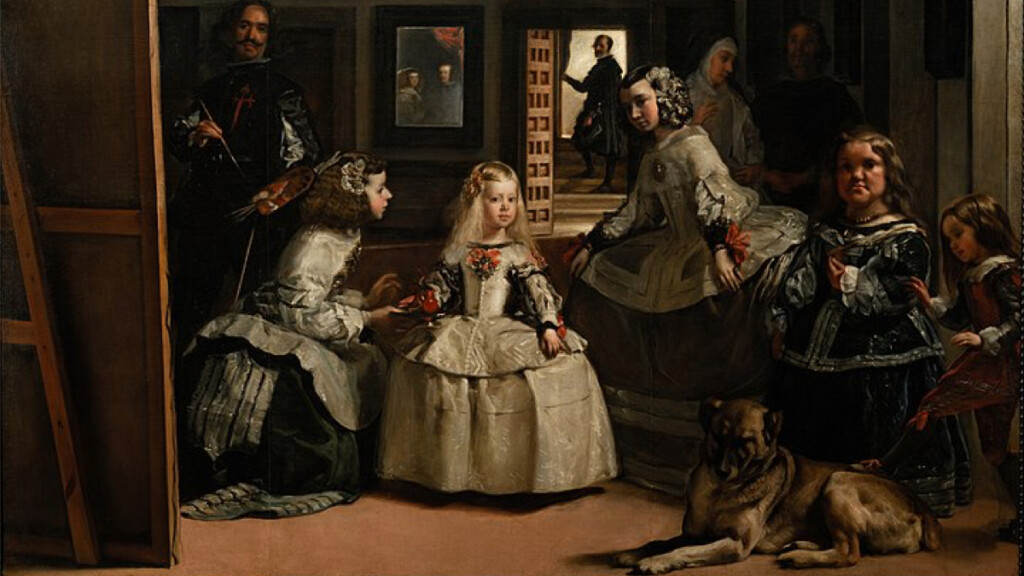
What hangs in Room 12 of the Prado is not merely a masterwork of technical execution, though it is certainly that — an oil on canvas measuring approximately 318 by 276 centimeters, housing eleven human figures, a dog, a shaft of light, and a mirror. What it constructs, with a patience that borders on philosophical aggression, is a trap for the perceiving subject. You approach it as a viewer. You leave it unsure whether viewing is something you were ever actually doing.
Michel Foucault opened The Order of Things in 1966 with an extended meditation on this painting, and what disturbed him most was not the composition itself but what the composition does to the position of the person standing before it. He recognized that Velázquez had engineered a painting that makes the spectator’s presence necessary for the scene to cohere, while simultaneously evacuating any stable place for that spectator to stand. You are required and you are unhoused. The painting needs you there to complete its logic, and yet it offers you nowhere to be.
This is not an accident of historical interpretation. It is the structure of the thing itself. Somewhere in the seventeenth century, in a large studio in the Royal Alcázar of Madrid, a man with extraordinary intelligence decided to paint a painting that would watch back. The figures inside it are not frozen in some moment you are privileged to observe from outside. They are looking at you. They have always been looking at you. The spatial logic of the work places you, the person standing before it, precisely where the royal subjects being painted must have stood — in front of the canvas, facing the artist, occupying the position of the represented. You are not the audience. You are the model.
Jean-Paul Sartre wrote in Being and Nothingness about the experience of being caught looking through a keyhole — that moment when a footstep in the corridor transforms you from a free, invisible consciousness into an object in someone else’s world. Shame, he argued, is the proof of the Other’s existence: you feel it only when you realize you are being constituted as a thing by a gaze that is not your own. What Velázquez’s painting produces in its most attentive viewers is something structurally identical to that shame — not a moral shame, but an ontological one. The sudden awareness that you were never just looking. That looking is always a reciprocal act, and the side you thought you were on may not have been yours to choose.
The mirror at the back of the room glows with reflected light. Two small figures float inside it, luminous and slightly blurred, present and unreachable. Everything in the painting leans toward that small rectangle on the far wall. And if you stay long enough, you begin to understand that the mirror is not showing you something inside the painting. It is showing you something about where you are standing.
The Mirror and the Rascal
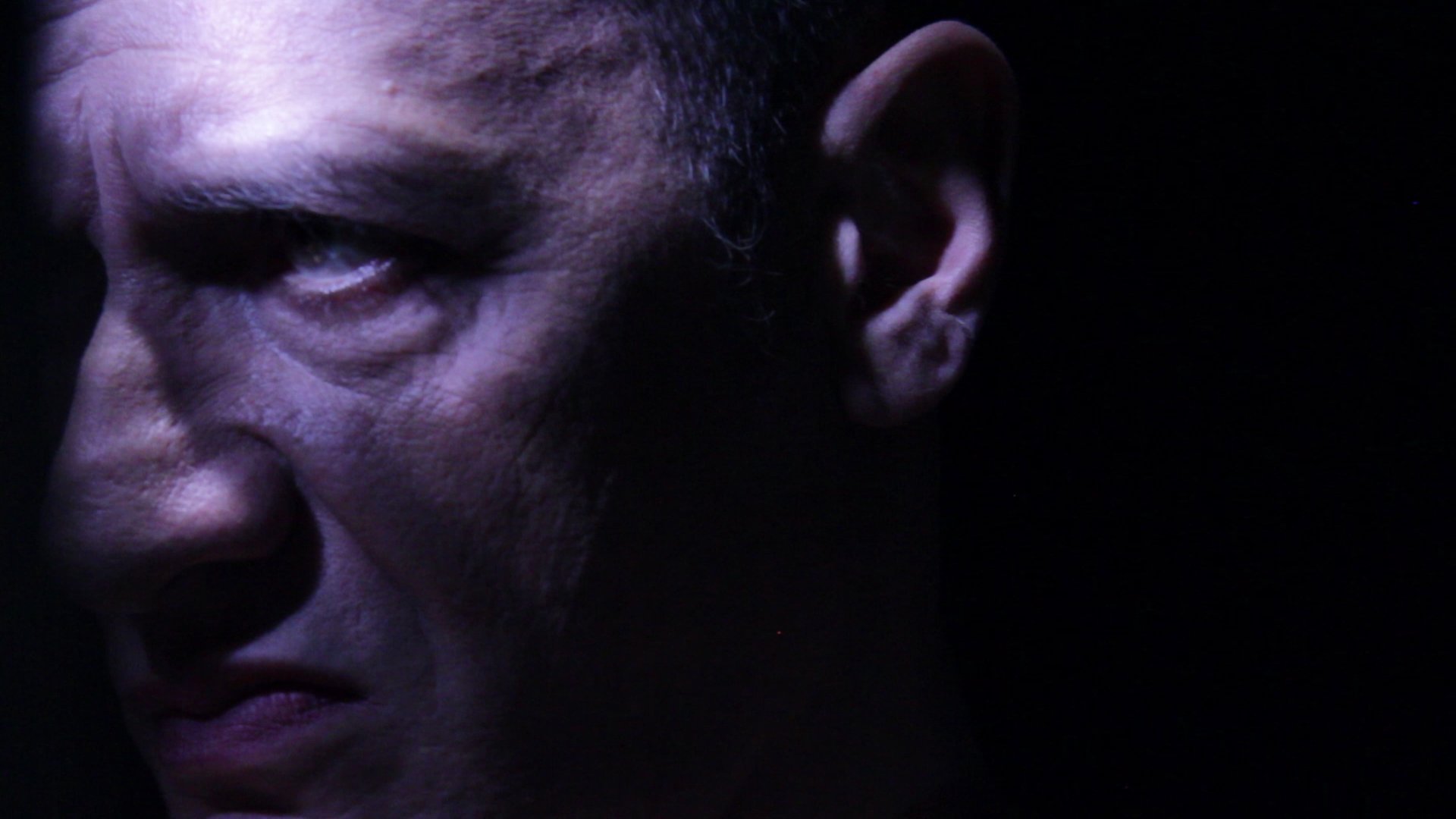
Drama film, by Valerio De Filippis, Italy, 2019.
The mirror and the rascal is an experimental film based on the tragedy "Richard III" by William Shakespeare. It tells the delirium of contemporary power in an author's reinterpretation of cinema, video art and music. The protagonist, Richard Duke of Gloucester, brother of King Edward IV, through a long series of crimes eliminates all the obstacles that stand between him and the throne of England.
Valerio de Filippis, a well-known painter who has been following his research path for a long time, investigating the relationship between light, corporeality and the psyche. The mirror and the rogue and the cinematographic equivalent of Valerio De Filippis' painting, his figurative style is in fact very recognizable looking at his paintings. But cinema is a new way where the artist can also be involved as an actor and performer, with an original mix between acting and singing. Staging the dark side of the human soul, the film is a surreal and disturbing interpretation of a great classic. The director says: "The first suggestion was musical: I was interested in transforming the text of Shakespeare's tragedy Richard III into notes. I love cinema and at a certain point I felt that the time had come to combine research on the image of painting to my love for cinema and music. When the film is finished I realize that I have remained faithful to painting: every frame of the film appears to me like a painting: the same light, the same colors, the same atmosphere ". The mirror and the rascal is a kind of psychoanalytic session that the painter does while hiding behind the mask of Richard III. Behind this ferocious and unscrupulous character we find a path of self-analysis by De Filippis, who is mainly interested in the more violent and turbid aspects. An experimental film in which, with great courage, the author gets involved completely, fragmenting the images in an unconventional montage, which is at the same time a flow of consciousness and spectacle.
LANGUAGE: English
SUBTITLES: Italian
A Room in the Alcázar, 1656
The summer heat inside the Alcázar was not the heat of the open world. It was trapped, rerouted through stone corridors and thick tapestried walls, circulating among bodies that had learned to hold themselves with a particular stillness — a stillness that was not calm but control. To exist inside that palace was to exist inside a system of coordinates so precisely calibrated that every gesture, every position, every accidental meeting of eyes carried weight that could take years to understand and minutes to destroy. You did not wander the Alcázar. You occupied a designated point within it, and the distance between your point and the king’s point was not measured in feet but in the entire grammar of a civilization.
Velázquez had been living inside this grammar for more than three decades by the time he stood before the canvas that would become the painting. He had entered royal service in 1623, summoned to Madrid from Seville at twenty-four years old, already technically accomplished but still carrying the provincial air that the court would spend years silently correcting. Philip IV sat for him that first year, and something in the sitting went well enough that the king continued to sit, again and again, across decades, the two men aging together in a relationship that had no clean name — not friendship, not servitude, something stranger and more interdependent than either. Philip reportedly decreed that no one else would paint his official portrait. This was not a compliment in the way compliments circulate among ordinary people. It was a form of captivity disguised as honor.
By 1656, Velázquez held the title of Aposentador Mayor, a position roughly translating to palace chamberlain, which meant he was responsible for the physical arrangement of the royal household — the furniture, the rooms, the logistics of a court in motion. He was managing the very space he was also painting. This is not a minor biographical detail. It means he understood the Alcázar not as a painter observes a landscape but as an administrator knows a mechanism, intimately and practically, aware of every hinge and every pressure point. He knew who was permitted to enter which room, under what circumstances, at what time of day, accompanied by whom. He knew the social physics of the place with the precision of someone whose professional survival had always depended on that knowledge.
The Spanish Habsburg court of the mid-seventeenth century was arguably the most elaborately codified social environment in European history. The Burgundian ceremonial protocol adopted by Charles V had calcified over a hundred years into something closer to theology than etiquette. The historian John Elliott, in his foundational study of imperial Spain, documented how every aspect of the king’s daily life was governed by written ordinances specifying who could speak to him directly, who could approach without being summoned, who had the right to remain in a room after the king entered it. The Infanta Margarita, the small girl at the center of what would become the painting, was five years old in 1656. She was already a political object, her very existence a negotiation between European dynasties. Her attendants — the meninas, the maids of honor — moved around her according to rules they had absorbed before they could fully articulate them.
Into this world, Velázquez brought a canvas and chose, with full awareness of what he was doing, to paint the act of painting itself. Not a battle, not a mythological scene, not a dynastic portrait designed to project power outward toward posterity. He painted a room. He painted a specific afternoon in a specific place, with specific people arranged in their specific and completely legible positions within a hierarchy that governed every breath they drew inside those walls.

The Painter Turns Around
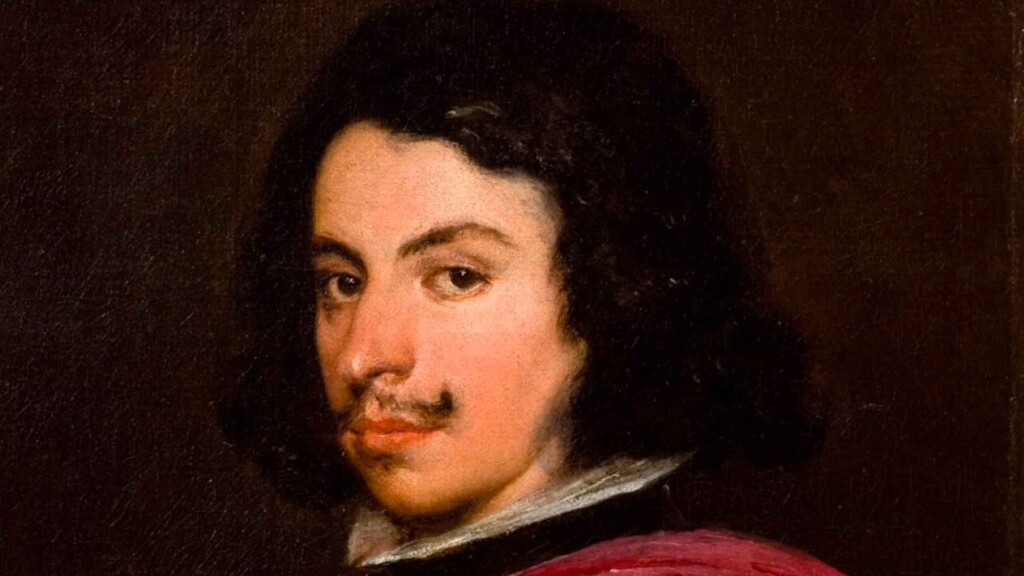
You walk into a room and someone is already looking at you. Not glancing, not noticing — looking, with the full weight of sustained attention, the kind that precedes a verdict. The room is large and dim, its ceiling lost somewhere in shadow above you. Light enters from the right, slanted and particular, touching certain faces and leaving others in a considered obscurity. A girl stands near the center, perhaps five or six years old, her skirts impossibly wide, her expression composed in that unsettling way children sometimes achieve when they understand, without understanding, that they are being observed by the world. Around her: a woman kneeling with a clay vessel, another standing, a dwarf pressing a foot onto the back of a sleeping dog with the casual authority of someone entirely at home in this space. Further back, two more figures, blurred by distance and by paint, barely distinguishable from the darkness they inhabit. And at the far end, a man stands in a doorway, one foot raised, one hand on the frame, caught precisely in the gesture of departure — not leaving, not staying, suspended in that threshold that every social situation contains somewhere within it.
Then there is the man with the palette and the long brush. He is enormous, or rather the canvas beside him is enormous, its back turned to you so that you cannot see what it contains. He is looking at you. He has been looking at you since before you arrived. His gaze does not waver or soften with the courtesy that social life usually imposes on prolonged staring. He simply looks, with the patience of someone who has been doing this for a very long time and has ceased to find it strange.
Michel Foucault opened Les Mots et les Choses in 1966 with a long, almost breathless analysis of this room, this arrangement, this gaze. What he identified was not a painting about a scene but a painting about representation itself — a moment in which the entire apparatus of classical depiction turns around and faces its own mechanism. In classical representation, Foucault argued, there is always an invisible point from which the world is organized: the eye of the sovereign, the position of the observer, the place from which things are named and ordered. What this room does is make that invisible point suddenly, uncomfortably visible. The painter is painting something. The mirror on the far wall reflects two small, indistinct figures — the king and queen, presumably, the people for whom everything in this room is arranged. But they appear only as a faint luminescence in the background, barely more substantial than a rumor. The real and the represented have changed places without announcing it.
Foucault was describing an epistemological rupture, a moment when the classical age’s confidence in its own representational systems begins, silently, to crack. But the lived experience of what he is describing is simpler and more visceral than that. The lived experience is this: you are being watched by someone who is also, simultaneously, you. The painter’s gaze lands where you stand. You are occupying the position of the king, the queen, the subject, the origin — except that you arrived here by accident, by the contingency of walking into this room. You did not ask to be sovereign. You did not consent to being the point around which this entire elaborate construction revolves.
That discomfort is not aesthetic. It is the discomfort of suddenly discovering that you have been assigned a role in someone else’s story, that the room was arranged before your arrival, that the gaze was already waiting. The little Infanta looks at you without curiosity, because she has already understood something you are only beginning to sense.
The Royal Faces in the Mirror
There is a moment — you have perhaps lived it without naming it — when you catch your own reflection somewhere unexpected, a shop window, a phone screen, someone else’s glasses, and for a fraction of a second you do not recognize yourself. Not because the image is distorted, but because the image is true, and truth, when it arrives unannounced, requires a pause before the mind accepts it as belonging to you.
This is the condition of Philip IV and Mariana of Austria inside that painting. They appear in the mirror hung at the back of the room, a blurred smear of pigment, two faces dissolved into light and suggestion. They are not reflected clearly. Velázquez painted them as approximations, almost as rumors of a royal presence rather than its confirmation. And yet they are the King and Queen of the most powerful empire on earth in 1656, masters of territories stretching from the Americas to the Philippines, from Naples to the Low Countries. The sun, it was said, never set on what they owned. Here, they do not even occupy the room.
Jacques Lacan, in his 1949 essay on the mirror stage, described the foundational human drama: the infant perceives its own image for the first time and mistakes the coherence of that reflected form for itself. The mirror gives back a unity that the body does not yet feel from within. This jubilant assumption of an image, Lacan wrote, is also a permanent alienation — you forever confuse yourself with a representation that exists outside you, that belongs to the gaze of the other before it belongs to you. Power does not dissolve this structure. It intensifies it. The more authority a person accumulates, the more they depend on others to reflect it back, and the more catastrophic any gap between the inner experience and the public image becomes.
Think of someone watching surveillance footage of himself from hours earlier — the same jacket, the same walk, the same habitual gesture of touching the back of his neck when uncertain — and being unable, for a strange suspended moment, to accept that this recorded figure is him. Not because he has changed, but because from the outside, the gestures reveal something the inside never felt. The recognition is incomplete. There is always a remainder that the reflection cannot hold.
This is what Velázquez arranges with surgical cruelty. The Infanta Margarita stands in real light, in real space, surrounded by her meninas and her dwarfs and her dog. Diego himself stands there, brush in hand, occupying the room with the solidity of someone who belongs to it through labor. The King and Queen exist only where no one can quite look directly — in the mirror, peripheral, blurred, constituted entirely by the attention of others. They are present because the room is arranged around them, because every figure’s posture acknowledges them, because the painter himself has paused mid-stroke in response to their entrance or their gaze. But they are present the way authority is always present: not in itself, but in the behavior it induces in others.
Michel Foucault, opening The Order of Things in 1966 with his famous analysis of this very painting, noted that the sovereign gaze is simultaneously the organizing principle of the entire composition and the one position from which the composition cannot be seen whole. Power, Foucault argued, occupies the blind spot of its own structure. It arranges everything and sees nothing, because seeing would require standing somewhere, and sovereign power, by definition, cannot admit to standing anywhere in particular. It must appear to come from everywhere at once, which means it can be localized nowhere.
And so two faces dissolve into a smear of light while a seven-year-old girl and a man with a paintbrush take up the solid, irreducible, unapologetic center of the world.
Velázquez’s Calculated Audacity
There is a kind of obedience so precise, so choreographed and total, that it quietly transforms into something else entirely. You have seen this before, even if you did not recognize it in the moment. A woman entering a room full of men who hold power over her professional future, and she greets each of them with a warmth so perfectly calibrated, so immaculate in its execution, that she becomes untouchable. She has performed subordination so fluently that subordination has become her instrument. The deference itself is the dominance. Nobody in the room can say she did anything wrong, and yet she has walked away with something none of them quite understand they gave her.
Velázquez understood this geometry at a cellular level.
Norbert Elias, writing in “The Court Society” in 1969, mapped with surgical precision how the aristocratic world of absolutist Europe functioned as a permanent theater of annihilation. To exist at court was to be perpetually legible to power, which meant that invisibility was never safety — it was simply a slower form of erasure. The painter, the musician, the architect who served a king occupied a position of radical instability: too close to greatness to be ordinary, too dependent to be free. Elias understood that the court was not merely a political institution but a total social machine that metabolized individuals, converting their talents into fuel for the sovereign’s symbolic self-reproduction. Survival required a specific and exhausting skill: performing perfect loyalty while quietly expanding the perimeter of one’s own existence.
This is what Las Meninas is. Not a portrait. Not a domestic scene caught in amber. A performance of loyalty so accomplished that it becomes, irreversibly, an act of self-installation.
Velázquez paints himself into the royal household. He does not sneak in through a back door or argue his way to the threshold. He enters dressed as an artist at work, brush raised, canvas enormous and turned away from the viewer — the very image of devoted service. And yet the space he occupies in the composition is not marginal. He stands at the leftmost edge of the pictorial stage but commands visual attention with the same weight as the Infanta herself, perhaps more, because he is the only figure in the room who meets your eyes without flinching. He is looking back. He has always been looking back.
The Cross of Santiago painted on his chest — red, formal, irreversible — arrived there after his death in 1660. Philip IV, by some accounts personally or by royal order, had it added to the canvas. The story almost destroys itself with irony. A king who could grant or withhold social legitimacy chose, posthumously, to press it like a seal onto the man who had already claimed it through the act of painting. Velázquez spent decades petitioning for the knighthood, a distinction he was denied repeatedly on grounds of blood purity and social origin. He could not inherit nobility. So he painted himself into a situation where someone else would eventually have no choice but to officially confirm what the image had already established as fact.
This is not ambition in any ordinary sense. This is something closer to what the sociologist Pierre Bourdieu called “symbolic capital” — the accumulated weight of prestige, recognition and legitimacy that operates with the force of real material power, and that certain individuals accumulate not by claiming it directly but by positioning themselves within fields of value so strategically that the recognition arrives as though it were inevitable. Velázquez did not ask to be seen as an equal to his subjects. He simply made a painting in which it was already true, and then waited.
The trap was set before anyone arrived to spring it. The powerful stood in front of the canvas and gave him exactly what the canvas required.
A vision curated by a filmmaker, not an algorithm
In this video I explain our vision
What the Canvas Hides

There it stands, its back to you, enormous, indifferent. The canvas Velázquez is painting within the room occupies a third of the left side of the composition, and you cannot see what is on it. You never will. Whatever image is being built stroke by stroke, whatever face or form or scene is accumulating in that moment of creation, has been withheld from you with a kind of absolute calm. It is not hidden dramatically. It is simply turned away, the way a person might turn away not out of hostility but out of the quiet certainty that some things were never meant to be shared.
This is not accident. Velázquez understood exactly what he was doing when he placed that canvas so. He was not forgetting to show us his work. He was making the act of concealment the most visible thing in the room. The painting you are looking at is a painting about a painting you cannot see, and that doubling, that structural gap at the heart of the image, is where the real philosophical weight settles.
Walter Benjamin, writing in 1935 in “The Work of Art in the Age of Mechanical Reproduction,” argued that what an original artwork possesses above all else is its aura, that singular quality of presence rooted in a particular time, a particular place, an unrepeatable here-and-now. But what happens to aura when the original refuses to reveal itself? When the work of art, at the very moment of its creation, turns its face to the wall and shows you only its reverse? Benjamin’s framework assumes that you can, at least in principle, stand before the thing and feel its presence. Las Meninas denies even that. The original hides inside the original. The aura of the invisible canvas becomes, paradoxically, more powerful than any image could be, because your mind fills the absence with something no painter could rival.
There is a moment that lives in the memory of anyone who was present in a small screening room in the early 1970s, when a director, having watched his film rejected, misunderstood, and mutilated by the studio that financed it, took the single existing print and burned it. Not a copy. The only one. What survived was not the film but the accounts of those who had seen it, each account slightly different, each one a portrait of the witness as much as of the work. The film became more itself in destruction than it had been in existence. The absence produced a kind of hyper-presence, the image sharpened by its own impossibility.
This is what the turned canvas does to you. It generates an image in your imagination that is perfectly calibrated to your own psychology, your own desires, your own understanding of power and beauty and royal flesh. Some scholars have argued the canvas shows the King and Queen, whose reflections appear in the mirror on the back wall. Others insist the mirror reflects the very painting you are looking at, folding the entire composition into a loop that has no exit. The debate continues not because the evidence is unclear but because the question cannot be closed. The canvas is turned. That is the only answer Velázquez will give you.
And in that refusal there is something almost aggressive about the gentleness. You stand in the Prado, or you stand in reproduction before a reproduction, and the painter stands in the room with his brush, and behind him the enormous surface holds its silence, and you realize that the most important thing in any work of art might be precisely the part it will not show you. The part that was never made for your eyes. The part that exists only in the moment of making, which is already gone by the time you arrive, which was perhaps always already gone, which perhaps never existed except as the promise of itself, turned away, unreachable, perfectly complete in its refusal.
The Space Between the Eyes
You arrive at a dinner party and for the first twenty minutes everything feels normal. You eat, you talk, you laugh at the right moments. Then something shifts — a glance exchanged across the table that doesn’t include you, a question posed to the room that lands somehow always just beside you — and you begin to understand, with a slow cold clarity, that you were not invited so much as arranged. You are the interesting one. The one who makes the evening work. The guest of honor who is also, in some precise architectural sense, the evening’s furniture.
This is not paranoia. This is geometry.
Erving Goffman spent the better part of his career mapping exactly this kind of space. In The Presentation of Self in Everyday Life, published in 1959, he argued that social interaction is not exchange but performance, and performance requires a division of roles that most participants never consciously negotiate. There is the front stage and the back stage, the performer and the audience, but the truly disturbing insight buried in Goffman’s sociology is this: those roles are not fixed by what you choose to do, but by where you are placed in the room’s invisible geometry. You can be performing without knowing you are performing. You can be the spectacle while believing yourself to be the spectator.
Las Meninas is the diagram of this condition, rendered in oil and shadow with a precision that no sociological treatise has ever quite matched. Stand in front of it long enough and you begin to trace the lines: the painter’s eyes moving outward toward you, or toward whoever stands where you now stand; the Infanta’s gaze slightly off, pitched toward the same vanishing point; the figures in the middle distance caught in their own secondary performances, watching the watching. And then the mirror at the back of the room, that small luminous rectangle, reflecting two faces that belong to the one position in the entire composition that is never occupied on the canvas — the position you are standing in now. The King and Queen of Spain float there as ghosts, as reflections of the absent authority that organizes every gaze in the painting without appearing directly within it.
Power rarely appears directly. This is one of the oldest lessons of political life, and Velázquez knew it the way a man who worked inside the Spanish court for thirty-seven years knows things — not as theory but as atmosphere, as the specific quality of air in a room where everyone is performing for someone who may or may not be present. The triangulation he constructs is not decorative. It is a map. Painter looks outward. Infanta looks outward. Mirror reflects the source of all the looking. And you, standing at the threshold, suddenly occupy the most powerful and most surveilled position simultaneously.
Back at the dinner party, you notice that the questions directed at you are a specific kind. They invite you to perform your particularity, your difference, your edge. Someone wants to see you say the sharp thing. Someone else wants to watch the reaction. You are not in a conversation — you are in a mirror that reflects somebody else’s sense of themselves as a generous, interesting, complex host. Your presence confirms their self-image. Your performance makes them visible to themselves.
Goffman would have recognized it immediately. The front stage is always built for someone else’s benefit, even when you are the one standing on it. The frame of the room — who sits where, who speaks first, who is asked to explain themselves — that frame was constructed before you arrived, and you stepped into it the way Velázquez’s viewer steps into the position of the royal gaze: inheriting a role, feeling its weight settle over your shoulders, only gradually realizing that the eyes in the painting have been watching you long before you started watching them.
You Are Already in the Painting
Stop for a moment and notice what you are doing right now. You are reading, yes, but you are also, somewhere in the back of your awareness, watching yourself read. There is the text, and there is you receiving it, and then there is that third presence — the one that observes the transaction between the two. You have never been able to collapse these three into one. Nobody has. This is not a philosophical curiosity. It is the texture of being human, and it is precisely what that enormous canvas in Madrid has been depicting, without apology or explanation, since 1656.
The painting does not show you a moment. It shows you a condition. The infanta stands in her circle of attendants, the painter looms at his canvas, the mirror throws back two faces from across the room, and the doorway frames a man caught between entering and leaving — and none of them, not a single figure in that space, occupies a position of pure, unobserved selfhood. Everyone is simultaneously looking and being looked at. Everyone is author of some gaze and object of another. The geometry is not compositional elegance. It is a diagram of the trap that consciousness sets for itself every waking hour of every life.
Jean-Paul Sartre, in Being and Nothingness published in 1943, identified what he called the look — le regard — as the mechanism by which another person’s gaze transforms you from subject into object. To be seen, he argued, is to be momentarily dispossessed of yourself. You were freely constructing your world, and then someone’s eyes landed on you, and suddenly you exist as a thing in their world, defined by their interpretation, pinned beneath their perception. The shame you feel when caught doing something you believed was private is not moral guilt. It is the shock of this dispossession, the sudden awareness that you were never entirely your own. Velázquez understood this — or the painting did — because every figure inside that room is experiencing it simultaneously. The painter is caught painting. The infanta is caught being presented. The attendants are caught attending. The royal pair in the mirror are caught watching. And you, standing before the canvas in the Prado or encountering it reproduced on any surface anywhere in the world, are caught looking. Nobody escapes the structure. The painting has no outside.
This is why Las Meninas does not age. It is not a document of the Spanish court. It is not even primarily a document of Velázquez’s virtuosity, though that virtuosity is staggering and undeniable. It is a permanent description of what it means to be a conscious creature who can never fully coincide with itself — who is always, as Sartre might have said, a being-for-others as much as a being-for-itself, and who cannot finally separate the two. You do not look at this painting and then return to your life. You look at it and recognize that your life has always had this structure: you are the one holding the brush, the one being rendered, and the one observing the rendering, all at once, without resolution, without the possibility of stepping outside the frame to see which role is the real one.
Whether Velázquez calculated all of this with the cold precision of a theorist, or whether his hand moved toward something his conscious mind had not yet formulated — whether the painting knew more than the painter — is a question the canvas itself refuses to answer, holding the ambiguity with the same serene confidence with which it has held everything else for nearly four centuries, asking nothing from you except that you remain exactly where you already are: inside it.
🪞 Mirrors, Gazes, and the Mysteries of Representation
Velázquez’s Las Meninas has fascinated philosophers, artists, and theorists for centuries, raising fundamental questions about the gaze, the observer, and the nature of painted reality. These related articles explore the intellectual and artistic territories that illuminate the painting’s deepest layers of meaning.
Jacques Lacan and the Mirror Stage
Jacques Lacan‘s theory of the Mirror Stage offers one of the most compelling philosophical keys to unlocking Las Meninas. The painting’s famous mirror in the background, reflecting the royal couple, becomes a site of identity construction and visual desire that Lacan’s framework helps decode. Understanding the Mirror Stage transforms the way we perceive every gaze depicted in Velázquez’s masterpiece.
GO TO THE SELECTION: Jacques Lacan and the Mirror Stage
Light in Painting: History and Symbolism
Light in painting is never merely an optical phenomenon — it carries symbolic, spiritual, and compositional weight that shapes the viewer’s entire experience. In Las Meninas, the dramatic contrast between illuminated and shadowed figures creates a theatrical staging that connects to centuries of European pictorial tradition. This article traces how painters from the Renaissance onward have used light as a language of meaning.
GO TO THE SELECTION: Light in Painting: History and Symbolism
Erwin Panofsky: Life and Iconology
Erwin Panofsky‘s method of iconological analysis provides an essential toolkit for reading the layers of meaning embedded in a work like Las Meninas. Moving beyond surface description, iconology asks what symbolic, cultural, and theological codes a painting encodes for its historical audience. Panofsky’s approach remains indispensable for anyone seeking to interpret Velázquez’s complex visual program.
GO TO THE SELECTION: Erwin Panofsky: Life and Iconology
Caravaggio: Life and Works
Caravaggio and Velázquez share a profound commitment to depicting reality with unflinching directness, redefining how painting could capture the human figure in real space and light. Both artists worked within the tension between court patronage and personal artistic vision, navigating the demands of power while pursuing radical pictorial innovation. Exploring Caravaggio‘s life and works deepens our understanding of the Baroque context from which Las Meninas emerged.
GO TO THE SELECTION: Caravaggio: Life and Works
Discover Independent Cinema on Indiecinema
If Velázquez’s meditation on vision, representation, and reality has stirred something in you, independent cinema explores these same questions through moving images and unforgettable stories. On Indiecinema streaming you will find a curated selection of films that challenge perception and expand your inner world — come and discover them.
👉 EXPLORE THE CATALOG: Watch Indie Films in Streaming
A vision curated by a filmmaker, not an algorithm
In this video I explain our vision