
The Tenement Stairwell as a Stage
The smell hits you before the sound does. Boiled cabbage seeping through a door that never quite fits its frame, the wood swollen with decades of steam and argument. A child sits three steps from the landing, knees pulled to chest, watching two adults on the floor above conduct their war in lowered voices that carry perfectly through plaster walls thin as paper. The child does not move. The child has learned that stillness is a kind of invisibility, and invisibility, in a building like this, is the only privacy available.

This was the Bronx in the 1920s. Not a metaphor for poverty, not a literary device, not a social condition to be analyzed from a comfortable distance. It was the specific gravity of a specific world: the iron railing worn smooth by ten thousand hands, the single bulb casting its yellow indifference down a stairwell that smelled of other people’s meals, the sounds of five languages bleeding through five doors on a single floor. Will Eisner was born into this architecture in 1917, and he spent the better part of sixty years finding ways to make ink remember what plaster once absorbed.
What Eisner understood, early and viscerally, was something that most artists spend careers learning to articulate: that physical space is never neutral. The stairwell is not merely a passage between floors. It is the place where the family’s private theater becomes briefly, uncomfortably public. Where a child overhears the rent being negotiated, the marriage being questioned, the shame of a brother’s failure being distributed in hushed, precise increments. Gaston Bachelard wrote in 1958 in “The Poetics of Space” that the house is not an inert container but a lived body, that its corners and thresholds carry psychic weight. Eisner did not need Bachelard to tell him this. He had grown up inside the proof.
His family moved repeatedly across the immigrant geography of New York, from the Bronx to Brooklyn to the Lower East Side, following the economics of survival with the practiced urgency of people who understood that home was a temporary arrangement. This constant displacement did not produce nostalgia in Eisner — or rather, it produced a kind of anti-nostalgia, a sharpened eye for the world as it actually was rather than as sentiment would later reconstruct it. When he returned to these streets in his graphic novels, most decisively in “A Contract with God” published in 1978 and in “The Building” in 1987, he was not romanticizing. He was testifying.
The distinction matters. Testimony is accountable in ways that nostalgia is not. Testimony names names, holds addresses, notices the particular way a woman grips a handrail when she is trying not to cry in a public space. Eisner’s tenements are populated by figures who sweat and deceive and grieve with the specificity of people who have been watched carefully over a long time. The child on the stairwell who watches the adults argue two floors above is not a symbol of urban innocence lost. He is a witness in training, learning the grammar of human desperation through the only classroom available to him.
What Eisner brought to the page was not invention but retrieval. The distinction is worth holding. Invention requires a creator standing outside a world, constructing it piece by piece. Retrieval requires someone who was inside it, who carries its weight in the body, and who has developed the technical means to deposit that weight somewhere a reader can feel it. The panel borders that would become his signature, the gutters between images that he theorized so carefully in “Comics and Sequential Art” published in 1985, were not aesthetic choices in the academic sense. They were structural solutions to the problem of how to hold time still long enough for the truth in it to become visible.
The stairwell is still there. Eisner just gave it the walls it always deserved.
Slow Life
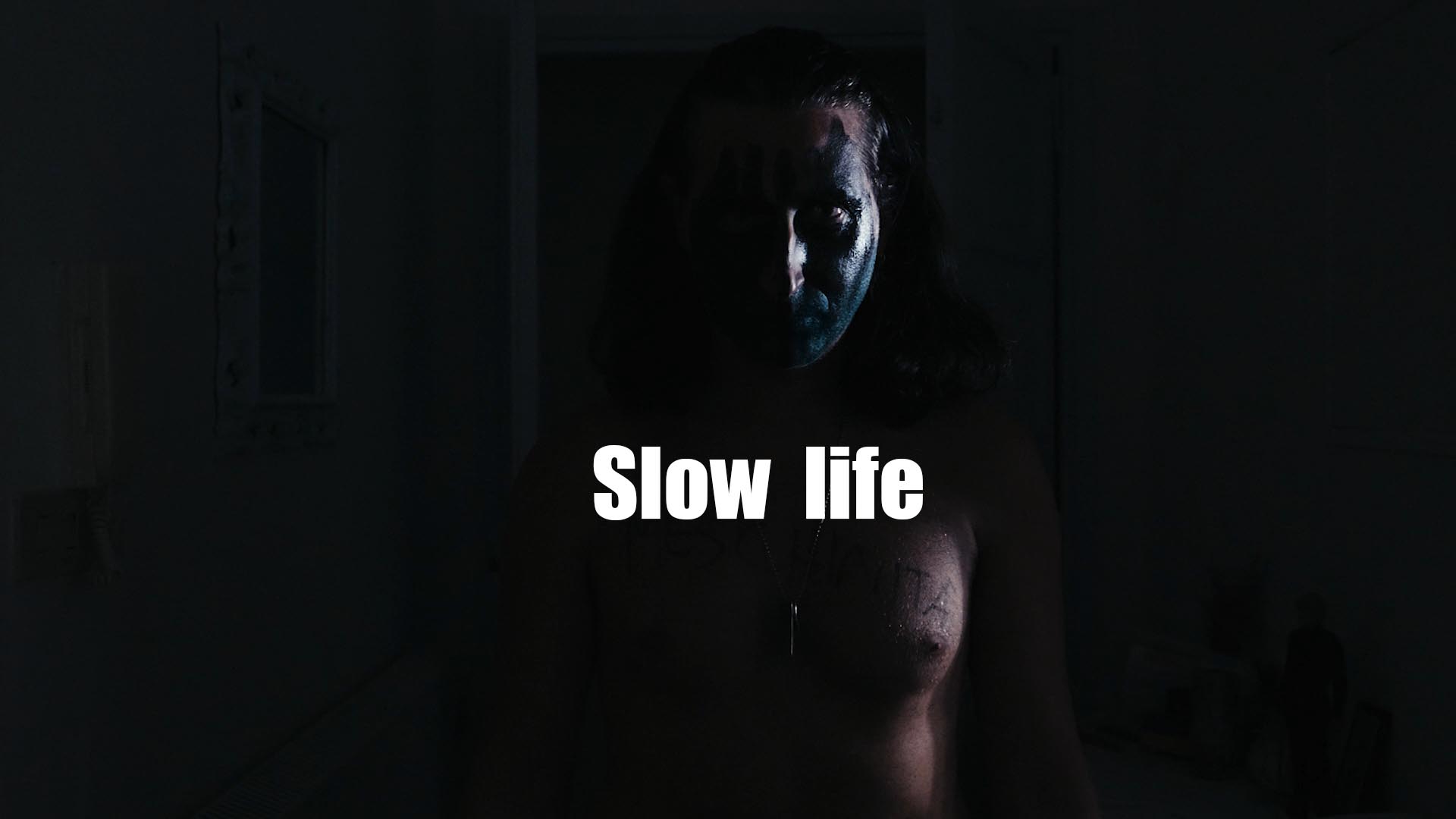
Drama, comedy, thriller, by Fabio Del Greco, Italy, 2021.
Lino Stella takes a period of vacation from his alienating job to devote himself to relaxation and his passion: drawing comics. But he did not foresee certain disturbing elements: the intrusive administrator of the building where he lives, the postman who delivers crazy fines and tax bills, an overbearing security guard, a very enterprising real estate agent, the old lady downstairs who raises the feline colony of the condominium. These characters will make his vacation hell.
Food for thought
The larger a social group is, the more rules and bureaucracy are needed, which often do not respect the individual. You have to learn to live with annoying people, but sometimes the social pressure and arrogance can become intolerable. The only laws that always come to our aid are the laws of Nature.
LANGUAGE: Italian
SUBTITLES: English, Spanish, French, German, Portuguese
Dropsie Avenue and the Grammar of Survival
The hallway smelled of cabbage and wet wool. You learned that early, living in those buildings — that smell was not incidental, it was structural, as permanent as the plaster and as informative as any sign. Will Eisner grew up inside that particular grammar, moving between Brooklyn and the Bronx in the 1920s and 30s, in tenement corridors where the economic facts of a family’s week were legible in everything: the thickness of a coat, the angle of a man’s shoulders coming home, the way a woman’s hand rested on a railing as though the railing were the only solid thing left.
Irving Howe, reconstructing that world in World of Our Fathers in 1976, described the Jewish immigrant neighborhoods of New York not as communities defined by tradition alone but as pressure systems — places where the desire for assimilation and the weight of a barely survived Europe collided daily in the body language of people trying to become something new without quite knowing what that meant. Howe’s central argument was that this generation lived inside a historical seam, between the Old World they had fled and the American promise that remained permanently conditional. The emotional texture of that seam — anxious, striving, alternately funny and catastrophic — was precisely what Eisner absorbed before he ever picked up a pen.
His father, Shmuel Eisner, had come from Austria-Hungary and worked sporadically as a scene painter and decorator, a trade that kept beauty at arm’s length from solvency. The family moved frequently, chasing cheaper rent, and Eisner would later describe those relocations not as disruptions but as an education in reading spaces — what a room’s arrangement said about its occupants, what a threshold meant when it was crossed reluctantly. Poverty here was not atmosphere. It was a precise and demanding teacher.
What scarcity does to perception is something the comfortable rarely understand from the inside. When nothing can be wasted, observation becomes a form of survival. The child who watches a neighbor’s expression shift at the mention of rent has already developed a finer instrument than any art school can offer. Eisner’s draftsmanship — that quality of his figures that makes them feel caught rather than posed, as though the pen arrived a half-second before the subject could compose themselves — traces directly back to this training. He drew people who could not afford the luxury of a neutral face.
On the street outside one of those Bronx buildings, a man adjusts his hat before entering — not for vanity, but because the hat is the last piece of the self he can control before facing whatever is waiting inside. That gesture, nearly invisible, became a recurring figure in Eisner’s visual vocabulary. The hat, the coat, the posture of someone who has rehearsed dignity so many times it has become indistinguishable from dignity itself. He understood, from childhood, that the performance of respectability was not hypocrisy in those neighborhoods. It was a survival technology.
The neighborhood itself — which he would eventually mythologize as Dropsie Avenue, a composite terrain that appeared across several of his later graphic novels — was never nostalgic in his rendering. It was geological. Buildings aged, families rose and collapsed, the street absorbed and expelled its inhabitants across decades with the indifference of weather. What Eisner saw, growing up inside it, was that place was not backdrop but protagonist. The stoop, the alley, the fire escape were not where life happened to occur — they were active conditions shaping what feelings were even possible. Henri Lefebvre would later theorize this in The Production of Space in 1974, arguing that social space is not a container but a product, continuously shaped by and shaping human relations. Eisner had no need of the theory. He had the Bronx.

The Spirit and the Architecture of Desire
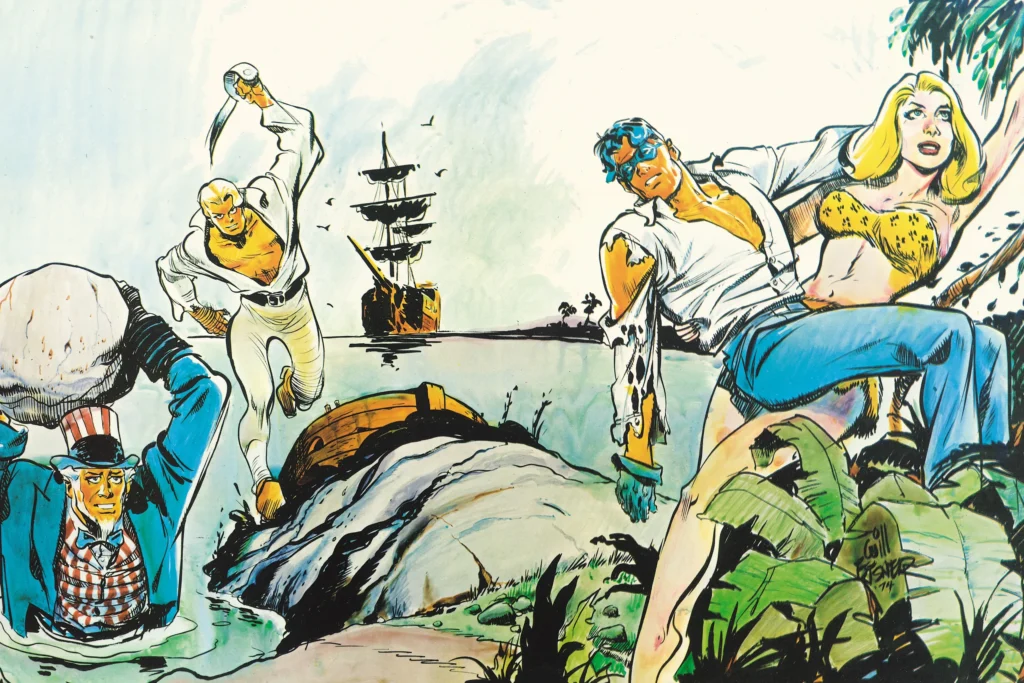
Six hundred thousand people opened their Sunday newspapers and turned, almost without thinking, to the same sixteen pages. Not for the news, which was already old by the time it arrived, and not for the comics section in the broader sense, but for something more specific and harder to name — a weekly appointment with a city that felt more real than their own. The Spirit ran from 1940 to 1952, twelve years of Sunday supplements, and the man at the center of it, Denny Colt, the masked detective risen from false death, was almost systematically the least interesting thing in the frame.
This was the trap Eisner set for himself and then solved with something approaching genius. He had a hero and he buried him. Colt moved through Central City the way a tourist moves through a foreign country — present, observant, occasionally decisive, but never truly belonging. The city absorbed him. The rain absorbed him. The women who passed through his cases — Plaster of Paris, Sand Saref, P’Gell — were more vivid, more morally complex, more architecturally present than he was. They had desires that didn’t resolve. He had a mask and a hat.
Roland Barthes, writing in Camera Lucida in 1980, described the punctum as the detail in a photograph that wounds you — not the element you were supposed to look at, not the staged subject, but the thing in the corner that catches and will not release. It is never the official content of the image. It is what leaks through the composition’s intention. Barthes found it in a strap, a bad tooth, the off-center gaze of a child. The punctum doesn’t explain itself. It just lands, and something opens.
Eisner’s pages worked this way before Barthes had language for it. The Spirit stood in the foreground, and behind him, barely lit, a woman watched from a second-floor window with an expression that suggested she had already decided something irreversible. You registered the detective, but you felt the woman. Or there was a drunk at the edge of the panel, head down, holding a bottle with both hands like a prayer, while the main action — a chase, a confrontation, a villain’s monologue — occupied the center. The drunk was incidental to the plot and essential to the truth. He was the punctum. He was what the story was actually about.
Rain fell in Eisner’s Central City as something other than weather. It fell with the weight of moral condition — the way it soaks through the clothing of the poor faster than the rich, the way it makes every corner look like the same corner, the way it gives the night a surface that reflects things back distorted. He understood what few cartoonists and fewer filmmakers had yet articulated: that atmosphere is not decoration but argument. The environment isn’t background. It is the real character, and everything human moving through it is a temporary annotation.
The city itself was built from accumulation — fire escapes, pavement cracks, the geometry of alleyways, windows that gave onto other windows in an infinite recession of private lives. Eisner drew architecture the way a novelist uses sentence rhythm: not to describe space but to produce it. You felt the verticality of the city as a kind of pressure, the way tall buildings make the street feel like a channel, a canyon, something you are moving through rather than choosing.
What Eisner understood, and what kept six hundred thousand readers returning every Sunday for twelve years, was that desire doesn’t live in the protagonist. It lives in everything the protagonist cannot fully see — in the wound at the edge of the frame, in the detail that was never meant to carry the weight it ends up carrying, in the city that continues after the hero has gone home.
What Sequential Art Actually Means
You are already doing it before you notice you are doing it. Your eye moves from one panel to the next and somewhere in that transit — in the white gutter between two drawn frames — your mind assembles a man falling, a door slamming, a year passing. Nobody drew any of that. You did. And the person who understood this most clearly, decades before cognitive science had a vocabulary for it, was Will Eisner.
He called it sequential art. Not comics, not cartoons, not graphic narrative — sequential art. The term sounds clinical until you press on it and realize it is a philosophical claim dressed as a descriptor. Sequence implies time, and time in this context is not chronological but phenomenological: it is the time of the body moving through space, the time of the eye crossing a threshold. Eisner was not naming a medium. He was arguing that a specific kind of attention exists, one that is neither purely literary nor purely visual but something anterior to both, something that precedes the separation.
Scott McCloud extended this framework in 1993, mapping the types of transitions between panels — moment to moment, action to action, subject to subject — and identifying the gutter as the site of what he called closure, the reader’s cognitive completion of implied action. The work is meticulous and generous, and it brought Eisner’s intuition into a systematic form that educators and artists could use. But McCloud’s model, for all its precision, remains essentially cognitive. It describes what the mind does. It does not quite reach what the body already knows.
Maurice Merleau-Ponty spent much of his philosophical life arguing that perception is not something that happens inside a mind looking out at the world through sensory windows. In the “Phenomenology of Perception,” published in 1945, he insists that the body is the original subject of experience — that we know space because we inhabit it, that depth is not inferred but felt, that understanding precedes and exceeds conceptual articulation. When you read a sequence of images and your chest tightens before your brain has processed why, that is not metaphor. That is Merleau-Ponty’s point made visceral.
Eisner understood this without naming it. In “Comics and Sequential Art,” published in 1985 and drawn from his teaching at the School of Visual Arts in New York, he returns repeatedly to what he calls the interval — the blank space, the pause, the beat between images. He does not treat it as absence. He treats it as where the meaning lives. The reader does not passively receive a story; the reader’s body crosses the interval and, in crossing it, completes the gesture that the artist began. This is a collaborative act at the level of perception itself, not at the level of interpretation.
Think about what this means for how a page is constructed. Eisner’s panel borders are not neutral containers. They are instructions to the body — how long to pause, how fast to move, whether to brace for something or release. A narrow panel compresses time. A wide one stretches it. A borderless image bleeds into the reader’s space, refusing the containment that signals fiction. These are not stylistic choices. They are phenomenological operations.
What Eisner was doing, in practice, long before he theorized it, was designing a machine for activating the reader’s unconscious movement through time. The sequence creates not just story but the physical sensation of inhabiting a duration. You do not read a passage of Eisner’s work and then feel something. You feel something as you read, inside the act itself, in the transit between what was shown and what was implied. The interval is not where meaning is stored. It is where meaning is manufactured, by you, with your body, in the fraction of a second that your eye crosses the white gutter and arrives, already changed, on the other side.
The Contract with the Reader
The rain falls on Dropsie Avenue the way it only falls in memory — too heavy, too deliberate, as though the weather itself has been asked to perform a function. A man stands outside a tenement door. He has just buried his daughter. He does not go inside immediately. He stands in the rain and he lets it happen to him, and somewhere in that pause between the street and the threshold is the entire architecture of what follows.
Will Eisner drew that scene in 1978, and what he published was called, for the first time in the public history of the medium, a graphic novel. The designation was not casual. It was a claim, a legal and aesthetic assertion that this object in your hands belonged to a different category than what had come before — that it demanded a different kind of attention, a different posture from the reader. The contract was announced in the title before a single page was turned.
But the deeper contract was not with the market. It was with grief itself.
Eisner’s daughter Alice died of leukemia at sixteen. He spoke of this with the directness of someone who had learned that euphemism is a form of cowardice. The book that became A Contract with God was drawn in the aftermath of that death, and Freud’s distinction, made in 1917 in Mourning and Melancholia, becomes almost unbearably precise here. Freud separated mourning — the finite, goal-directed work of losing someone, the gradual withdrawal of energy from the lost object — from melancholia, which refuses that withdrawal, which incorporates the lost person into the structure of the self, which becomes, in Freud’s word, a kind of dwelling. Mourning ends. Melancholia builds.
What Eisner built was not a memorial. It was a tenement. The four stories collected in that first volume — the broken covenant with God, the brutal superintendent, the singer traded between men, the children at the edge of becoming — share a geography more than a plot. Dropsie Avenue is the melancholic object, the place that cannot be released because it contains too much of what cannot be said directly. The Bronx of Eisner’s childhood becomes the form that grief takes when it cannot find adequate language. He did not write about Alice. He wrote around her absence, and the shape of that absence is a neighborhood.
This is what formal invention actually looks like from the inside. It does not feel like innovation. It feels like necessity. The page layouts in A Contract with God are not experimental for the pleasure of experimentation — they are responsive to emotional states that conventional panel grids could not hold. Rain does not stay inside boxes. Crowds blur into each other. A man’s face in one panel seems to be answering a question asked three pages earlier. The form is porous because grief is porous, because the past keeps leaking into the present whether you have given it permission or not.
Eisner was fifty-one when he published the book. He had spent decades making work that disappeared — consumed weekly, filed away, reprinted cheaply, forgotten. The graphic novel designation was also a demand for permanence. But permanence for whom? The reader who encounters A Contract with God for the first time does not meet Eisner’s daughter. They meet the structure her death made possible. They meet a form that exists because something had to hold what could not be spoken.
Freud wrote that the melancholic does not know what has been lost, only that something has been. Eisner knew exactly what he had lost. What he did not know — what perhaps no one can know in advance — is what that loss would demand of the page, what new grammar it would require, what contract it would force him to sign in the dark before anyone agreed to witness it.
A vision curated by a filmmaker, not an algorithm
In this video I explain our vision
The Industry He Built and the Trap It Set

The office smells of ink and deadline. You are twenty years old, you have a partner named Jerry Iger, and together you have just incorporated a studio whose entire purpose is to feed the beast. The year is 1936, and the beast is hungry — pulp publishers need content, lots of it, fast, at prices that make margin possible only through volume. Eisner & Iger does not make art. It makes product, and it makes it the way Ford made cars: divided labor, specialized hands, each artist assigned a function in a chain that produces pages the way a press produces paper.
The studio would employ, at various points, artists who would go on to define the medium — Jack Kirby among them, a young man from the Lower East Side drawing action sequences for wages that left no room for signature. The logic was industrial in the most precise sense: one artist pencils, another inks, another letters, and at the end of the chain a page exists that belongs to no single person. Eisner ran this operation with genuine efficiency and genuine intelligence, and that combination is exactly where the trouble begins.
Walter Benjamin, writing in 1935, described what happens to a work of art when it enters the age of its mechanical reproducibility. The aura, he argued — that singular presence, the here and now of an original — dissolves under the conditions of mass production. What replaces it is not nothing, but something structurally different: a copy that circulates without a source, an image that belongs to no moment and therefore to every moment. Benjamin was not simply mourning this loss. He was mapping a transformation that carried political consequences, because art stripped of aura becomes available for mobilization in ways that auratic art resists.
Eisner knew nothing of Benjamin’s essay, almost certainly. But he was living its argument from the inside. The pages produced by Eisner & Iger had no aura by design. They were manufactured to be read once, discarded, replaced by next week’s installment. The pulp paper they were printed on was itself a statement about intended lifespan. And the man who managed this factory — who understood its economics, who negotiated contracts with publishers who viewed the content as interchangeable as newsprint — was simultaneously developing, somewhere in the back of his mind, a conviction that this medium could carry something that mattered.
The contradiction is not incidental. It is generative. There is a specific kind of knowledge that only comes from having built the machinery you later want to escape. Eisner spent years understanding exactly how comics were treated as disposable product, understanding it from the inside, from the position of the one setting the terms of disposal. That intimacy with the industrial logic of the form gave his later theoretical work — Comics and Sequential Art, published in 1985, the book that attempted to establish a formal grammar for a medium still largely dismissed — a groundedness that purely aesthetic manifestos rarely achieve. He was not arguing for the dignity of comics from a position of innocence. He was arguing for it from a position of complicity.
There is a man, late in his career, sitting across from a young student at the School of Visual Arts in New York, where Eisner taught for decades. The student asks whether comics can be literature. Eisner pauses before answering — not the pause of uncertainty but the pause of someone deciding how much of the real answer to give. What he knows, and what the student cannot yet know, is that the question itself was shaped by decades of industrial production that trained everyone, readers and creators alike, to expect disposability. The factory set the expectation. Dismantling that expectation required someone who had run the factory, who understood from the inside why the expectation existed and how deeply it had been built into the medium’s DNA before anyone thought to ask whether it had to be that way.
Late Work, Long Memory
There is a particular kind of work that an old man does when he knows time is short and the lies are still circulating. Not the work of legacy-building or retrospective satisfaction, but something closer to testimony under pressure — the urgency of someone who has watched falsifications harden into received truth and cannot leave them standing. In the last two decades of his life, Will Eisner produced three books that belong to this category entirely, and they are unlike anything else in the history of the medium he helped invent.
“To the Heart of the Storm,” published in 1991, moves through memory the way memory actually moves — not chronologically but by association, by the sudden return of a face or a humiliation, by the logic of wounds rather than calendars. Eisner drew his own family’s immigration story, the casual anti-Semitism of Depression-era New York, the specific texture of being perceived as foreign in a country that had promised otherwise. A young man on a train, heading toward military service, lets the journey pull him backward through decades of accumulated slights and structural exclusions. The genius of the book is structural: the frame of wartime travel contains a lifetime of evidence, and by the time the reader reaches the present tense of the narrative, they understand that the young man is not going to war against something external. He has been at war his entire life, on his own streets.
Hannah Arendt, writing in “The Origins of Totalitarianism” in 1951, identified something that most people find deeply uncomfortable: that the bureaucratization of prejudice is not an aberration of civilization but one of its possible expressions. Hatred, she argued, does not require monsters. It requires paperwork, categories, the slow normalization of exclusion until it becomes administrative procedure. What Eisner understood, and what his late work demonstrates with almost painful clarity, is that this normalization leaves traces in faces — in the way a landlord looks at a name on a rental application, in the way a schoolteacher’s voice changes when addressing certain children. Arendt gave us the mechanism. Eisner gave us the texture of living inside it.
“Fagin the Jew,” published in 2003, is an act of direct confrontation with literary history. Eisner took Dickens’s most visually codified villain — a character whose name had become shorthand for a type, whose physical description drew from the most degraded antisemitic iconography — and insisted on restoring interiority. He gave Fagin a childhood, an economic logic, a social position produced by the same English society that condemned him. This was not rehabilitation in the sentimental sense. It was an argument about how fiction manufactures permission for contempt, and how the images literature produces outlive the intentions, or the complexities, of their creators.
Then “The Plot,” completed in 2005, the year Eisner died, confronted perhaps the most consequential forgery in modern history: the Protocols of the Elders of Zion. Eisner traced the document’s fabrication by the Tsarist secret police, its exposure as plagiarism, its global circulation despite refutation, its continued publication and use across more than a century. What he showed, with the methodical patience of someone who had spent sixty years thinking about how images carry meaning, is that the truth of a forgery’s falseness is almost irrelevant to its power. The Protocols were debunked comprehensively by 1921. They are still in print in dozens of countries today. The lie travels faster than the correction, and it travels in pictures, in rhetorical shortcuts, in the satisfying coherence of a narrative that explains suffering by assigning blame.
Eisner understood something Arendt had located theoretically: that the face on the page — drawn, caricatured, repeated until it becomes a symbol — is the precise mechanism by which abstraction becomes actionable. He spent his last years drawing faces back into the places where they had been erased or distorted, insisting on the particular against the categorical, one lined jaw at a time.
The Award That Bears His Name and the Question It Cannot Answer
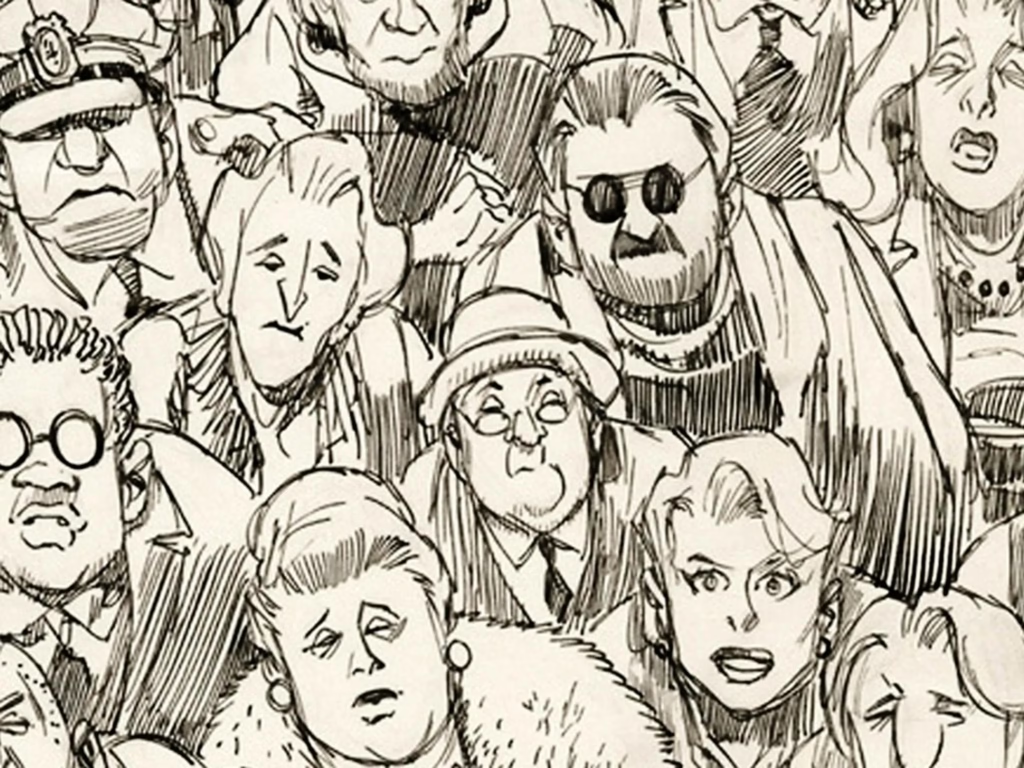
The trophy exists. It sits on shelves in studios from Manhattan to Tokyo, a physical object made of metal and intention, awarded each year at a convention in San Diego to the best that comics has produced. It carries a man’s name. It has carried that name since 1988, which is to say it has existed for longer than most of the artists who now receive it have been alive. And the man whose name it carries spent the better part of his working life being told, in ways both explicit and ambient, that what he made did not qualify as art, that the medium he had chosen was a delivery system for disposable entertainment, that the question of its merit was not even interesting enough to debate.
This is the structure of legitimation. Pierre Bourdieu, in The Rules of Art, published in French in 1992, spent considerable effort mapping how cultural fields absorb the very energies that once threatened them. The rebel, the innovator, the figure who forced a field to expand its boundaries — once dead, or old enough to be safely historical, that figure becomes the field’s founding myth. The institution does not honor the disruption. It honors the outcome of the disruption, which is the institution itself. The award named for Eisner does not celebrate a man who fought to be taken seriously. It celebrates the fact that the fight was won, by someone, at some point, well before the ceremony began.
Eisner was forty-one years old in 1958 when he formally left The Spirit and turned his attention to educational and commercial comics work, a decision that biographers have sometimes read as retreat but which reads more accurately as pragmatism under pressure. The cultural field had no place for him as an artist, so he found the places that would take him. He returned, unmistakably and irrevocably, with A Contract with God in 1978, a work he self-identified as a graphic novel — a term he did not invent but which he deployed with such conviction that it adhered to him permanently. He was sixty-one. The recognition that followed was real, but it was also slow, partial, and never quite proportionate to what he had built over five decades.
There is something almost structurally cruel about the canonization process that Bourdieu describes, because it requires the work of misrecognition to be completed before the recognition can begin. The field must first fail to see what it is looking at, must route the innovator through decades of marginalization or commercial compromise, and only then — when the cost to the innovator can no longer be reversed — does it organize itself around his name. The Eisner Award is, among other things, a very elegant form of retroactive apology.
Whether Eisner himself would have recognized his reflection in that institution is a question without a clean answer. He was, by every account, a man who took pleasure in craft and teaching and the company of younger artists who came to him for guidance. He taught at the School of Visual Arts in New York for years. He gave interviews generously. He did not perform bitterness. But performance and feeling are different things, and the gap between them is where biography becomes speculation and speculation becomes honest.
What can be said with precision is this: the medium he spent his life defending now defends itself partly through the authority of his name, and that name now opens doors for artists who will never know what it cost to build those doors, who will receive the prize and feel the weight of the trophy and perhaps not pause to consider that the man it honors once had to argue, in public, with patience and without guarantee of success, for the simple proposition that what he made was worth taking seriously. That argument is over. The trophy proves it. Eisner won.
🎨 Art, Comics, and the Language of Visual Storytelling
Will Eisner pioneered the graphic novel as a serious artistic form, blending cinematic composition with literary depth to transform sequential art into a vehicle for humanist storytelling. His work sits at the crossroads of visual culture, urban mythology, and the philosophy of narrative — themes that resonate across many disciplines explored here on Infinite Maze.
Umberto Eco: Life and Works
Umberto Eco was one of the first intellectuals to take popular and visual narrative forms seriously as objects of semiotic and cultural analysis. His engagement with comics, mass media, and the aesthetics of seriality makes him a natural companion to Eisner’s project of elevating sequential art to literary dignity. Reading Eco alongside Eisner reveals how meaning is constructed through signs, images, and the interplay of word and picture.
GO TO THE SELECTION: Umberto Eco: Life and Works
Keith Haring: Life and Works
Keith Haring emerged from the New York underground to create a visual language that was at once accessible, politically charged, and deeply influenced by the rhythm of street life — much like Eisner’s Spirit strips captured the pulse of urban America. Both artists believed that art could speak directly to ordinary people without sacrificing complexity or emotional power. Their parallel careers demonstrate how popular visual art can carry profound humanist and social meaning.
GO TO THE SELECTION: Keith Haring: Life and Works
Jean-Michel Basquiat: Life and Works
Jean-Michel Basquiat, like Eisner, used the raw materials of city life — its faces, its margins, its overlooked stories — to build a visual mythology of extraordinary intensity. Where Eisner drew the tenements and alleyways of Spirit City, Basquiat mapped the wounds and energies of New York onto canvas with text and image intertwined. Together they represent two great vernacular artists who transformed the urban experience into lasting art.
GO TO THE SELECTION: Jean-Michel Basquiat: Life and Works
Ernst Gombrich: Life and Works
Ernst Gombrich devoted his life to understanding how visual representation works and how images communicate across cultures and centuries, questions that lie at the very heart of Eisner’s theoretical writings on comics and graphic storytelling. Eisner’s foundational texts on sequential art echo Gombrich’s inquiry into the beholder’s share — the active role of the reader in constructing meaning from visual cues. Exploring both thinkers together offers a rich framework for understanding why drawn images can move us as deeply as any novel or film.
GO TO THE SELECTION: Ernst Gombrich: Life and Works
Discover the Art of Independent Cinema on Indiecinema
If Will Eisner’s vision of storytelling as a form of human truth resonates with you, Indiecinema’s streaming platform is the next step on your journey — a curated space where independent cinema pushes the boundaries of narrative, image, and meaning just as Eisner once did on the printed page. Explore our collection and find films that challenge, move, and inspire.
👉 EXPLORE THE CATALOG: Watch Indie Films in Streaming
A vision curated by a filmmaker, not an algorithm
In this video I explain our vision

