
The Moment Before You Name It
You are alone in the house and you hear it — a sound from the room above you, slow and deliberate, like weight shifting on old floorboards. You know the house is empty. You checked. You stood at the bottom of the stairs and you listened, and now you are listening again, and the sound has stopped, which is somehow worse than if it had continued. Your mind moves instantly, automatically, toward the rational: the pipes, the settling of timber in cold air, a branch against the window you forgot was there. But something in you — something older than your vocabulary for it — does not move. It stays very still. It holds two explanations at once and refuses to choose between them, because choosing means committing, and committing means either terror or embarrassment, and neither feels survivable in this particular moment.

That pause. That exact suspension. That is where literature has always lived at its most electric.
Not in the monster revealed. Not in the ghost confirmed or the hallucination diagnosed. In the gap between those two destinations, in the seconds or pages where you cannot yet tell which world you are standing in — the one governed by natural law or the one where natural law has quietly, irrevocably cracked. The hesitation itself is the experience, and most of us have felt it not in haunted houses but in the ordinary fissures of daily life: in a face that holds your gaze a moment too long on a crowded train, something in the angle of the eyes that doesn’t match the rest of the expression. In a dream you wake from certain was a memory. In the way someone who should not know your name says it anyway, casually, without noticing what they’ve done.
The human nervous system does something remarkable in these moments. It does not immediately resolve. It holds the ambiguity in a kind of active tension, running two programs simultaneously — the one that explains and the one that fears — and the discomfort of that doubleness is not a malfunction. It is, in fact, a very precise cognitive state, one that philosophers of mind and phenomenologists have spent considerable effort trying to describe. Edmund Husserl’s work on the structure of experience insisted that consciousness is always already interpretive, always reaching forward to stabilize and categorize the data it receives. The moment when that forward reach fails, when the category does not arrive — that is not blankness. It is a kind of white noise made of meaning, all possible meanings running at once.
What literature discovered, long before theory arrived to name it, is that this state is not merely the prelude to a story. It is the story. The fear of the thing in the room above you is not the same as knowing there is a thing in the room above you. It is richer, stranger, more philosophically uncomfortable than either the relief of the rational explanation or the resolution of confirmed horror. It occupies a register of experience that neither realism nor pure fantasy can touch, because realism insists on the explicable and fantasy licenses the inexplicable, but this — this trembling middle ground — insists on both at once and will not let you off the hook.
Writers have always known this. Readers have always felt it. But the theoretical architecture to describe precisely what is happening in that moment — why the hesitation is not a weakness of the text but its structural engine, its load-bearing wall — that took longer to arrive. And when it arrived, it came not from a novelist or a poet but from a structuralist working in the cold light of linguistic analysis, trying to map a country that everyone had visited but nobody had properly surveyed.
Venetian Arcanum
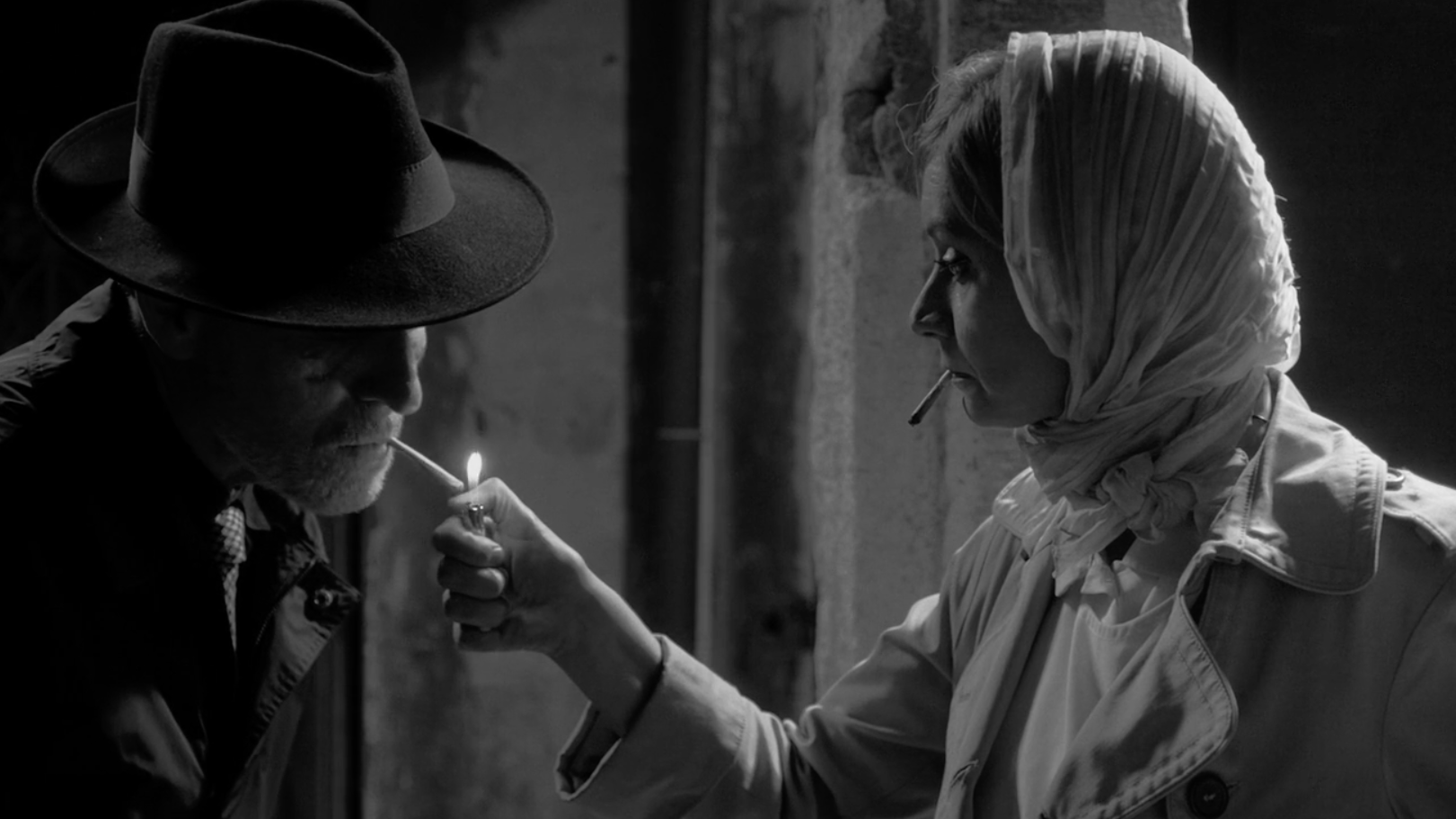
Thriller, by Serge Turgeon, Italy, 2025.
In Venice, a mysterious presence appears once every century or two, haunting the canals and hidden corners of the city. Driven by a sense of destiny, a woman decides to search for it. Following its elusive traces, she is drawn deeper and deeper into the city’s arcane secrets. Reality and myth begin to blur, and Venice itself transforms into a labyrinth of dangers.
LANGUAGE: Italian
SUBTITLES: English
Todorov’s Threshold: The Hesitation as Genre
There is a moment you have surely experienced, arriving home after dark to find a window you know you closed standing open. The curtain moves. You stand in the doorway with your keys still in your hand, and for exactly that suspended interval, you do not know whether someone has been inside, whether the latch is simply faulty, whether you misremember closing it at all, or whether something else entirely — something without a rational category — has happened. That interval, that precise and uncomfortable not-yet-knowing, is where Tzvetan Todorov plants his flag.
In 1970, the Bulgarian-French theorist published what would become one of the most consequential works of structuralist literary theory of the twentieth century. His argument was deceptively simple and, once understood, almost impossible to unsee. The fantastic, Todorov insisted, is not a quality of events. It is a quality of hesitation. It exists in the duration of uncertainty itself, in the moment before the mind resolves what it has encountered into one of two adjacent but fundamentally different categories. The fantastic is not the ghost. It is the not-yet-knowing whether there is a ghost.
His tripartite schema divides the territory with a kind of geometric precision that literary critics both admired and contested. On one side sits the uncanny — those narratives in which events that initially appear supernatural are ultimately explained by rational means. The terror was a fever dream, the apparition a fraud, the voice an echo, the shadow a man. The unease was real, but the world remained intact. On the other side lies the marvelous — narratives in which supernatural events are accepted as simply belonging to the rules of that fictional world, where dragons exist as horses do, where magic operates as physics does. No one hesitates in a fairy tale, because hesitation would be absurd. Between these two territories, narrow and unstable as a ridge between two valleys, sits the fantastic proper, defined by its absolute refusal to resolve.
What Todorov understood — and what makes his framework feel less like literary taxonomy and more like phenomenology — is that this hesitation is not primarily a structural device. It is an experience. It happens to the reader, yes, but it happens first to the character, and Todorov was careful to insist that the two experiences must be aligned. The reader must identify with the character sufficiently to share their uncertainty. The moment that identification breaks — the moment we know more than the protagonist, or the moment the narrative voice winks at us conspiratorially — the fantastic collapses into something else, usually either horror or comedy.
Think again of that open window. If you laugh immediately at yourself for the brief spike of fear, you have retroactively resolved the moment into the uncanny. If you call someone into the room and they confirm a presence you cannot explain and both of you simply accept it and sit down to dinner, you have entered the marvelous. But if you stand there — genuinely, uncomfortably, not performing uncertainty but living it — refusing the rational explanation because it does not quite satisfy, refusing the supernatural explanation because you are not that kind of person, or because you are afraid to be, then you are inside Todorov’s fantastic. You are the reader and the protagonist simultaneously, suspended in a genre made entirely of suspension.
What is philosophically radical about this position, and what distinguishes it sharply from earlier theories of the supernatural in literature, is that Todorov refuses to locate meaning in resolution. The fantastic is not a riddle waiting to be solved. Its value, its aesthetic and existential function, exists precisely in the duration of not-knowing. The moment you know, the genre ends. This is why the fantastic, as Todorov defines it, is among the most fragile of literary modes — and among the most honest about what it means to encounter the genuinely inexplicable.

The Governess and the Ghost: What the Text Refuses to Confirm
You are standing at the end of a long corridor. The light at the far end is wrong — not dark, not bright, but somehow both at once, as if the air itself cannot decide what it is holding. And there, at the threshold where the hallway turns, is a figure. You know, with absolute certainty, that you locked the door. You know, with equal certainty, that what you are seeing cannot be there. And yet your hands have already gone cold before your mind has caught up with what your body already understands.
This is the geometry of Henry James’s governess in 1898, a young woman sent to manage two children in a remote English estate, who begins to see figures that no one else will confirm. A man on a tower. A woman at a window. Faces that press themselves against glass and then are gone. James constructs the novel with a precision that feels almost surgical in its cruelty: every detail that might confirm the supernatural is immediately shadowed by a detail that might explain it away. The children are evasive in ways that could be manipulative or innocent. The housekeeper’s silences could be complicity or discretion. The governess herself could be a woman of extraordinary perception or a woman quietly losing her hold on the real.
Todorov, writing in his 1970 Introduction à la littérature fantastique, chose this text as one of his paradigmatic cases precisely because it does not resolve. He identified what he called the hesitation — the moment in which neither the character nor the reader can settle on a rational or supernatural explanation — as the structural heart of the fantastic genre. Not a mood, not an atmosphere, but an architectural principle. The text is built to refuse you. Every corridor leads to another corridor. Every door, when finally opened, reveals only the question of whether it was ever locked.
What makes this unbearable in a way that goes beyond hermeneutics is that the governess is not an unreliable narrator in the simple, reassuring sense that contemporary readers like to deploy. We cannot simply decide she is mad and return to solid ground. Madness would be a resolution. Madness would close the corridor. What James constructs instead is something closer to what the philosopher Gaston Bachelard described in his 1958 Poetics of Space as the phenomenology of inhabited uncertainty — the house not as architecture but as the body of our own interior life made external, where rooms hold feelings that cannot be named and thresholds become the borders of the self.
There is a moment — a woman walking toward a mirror at the end of a darkened hallway, candle in hand, seeing her own reflection approach her from the opposite direction, and then, for one suspended second, not being entirely certain that what she sees is herself. The reflection moves at the wrong speed. Or perhaps the right speed, and she is the one who has slowed. The terror in that instant is not that something else is there. It is that she cannot be sure she is not the something else. This is what James does to the governess, and what the governess does to us. She may be the haunting. The children she believes she is protecting may be the only rational minds in the house.
Todorov’s insight was that this uncertainty is not a failure of the text to commit. It is the text’s deepest commitment. The fantastic, for him, exists in that narrow, almost uninhabitable band between the uncanny — where everything strange turns out to have a natural explanation — and the marvelous, where the supernatural is simply accepted as real. To remain in the fantastic, the text must refuse both exits simultaneously. It must hold you in the corridor.
Why the Explanation Kills It
There is a moment when you hold something in your hands that cannot exist and you look at it anyway. Not with terror. Not with relief. With a kind of suspended attention that feels almost like holding your breath underwater, where the pressure is equal on all sides and you are not yet deciding anything. That moment is the fantastic. And the moment you decide — either that there is an explanation, or that there is no need for one — it dies.
Todorov understood this with the precision of a surgeon who has identified exactly which organ keeps the patient alive. In his 1970 structural analysis of the genre, he placed the fantastic at the hinge between two adjacent territories: the uncanny, where the strange is ultimately reducible to rational causes, and the marvelous, where the supernatural is accepted as a new, permanent law of the world. Neither territory is the fantastic. The fantastic is only the hesitation itself, the duration of the question before an answer settles in. This is not a vague definition dressed as rigor. It is a genuinely violent one, because it strips the fantastic of almost everything we sentimentally attach to it — the atmosphere, the dread, the wonder — and leaves only the epistemological razor’s edge.
Freud, writing in 1919, was doing something adjacent but crucially different. In “Das Unheimliche,” his essay on the uncanny, he located the disturbing quality of certain experiences not in the presence of the unknown but in the return of something once known and then suppressed. The uncanny, for Freud, is the familiar made strange through repression — the German word itself, heimlich, meaning both “homely” and “hidden,” carries the contradiction in its own etymology. What unsettles is not the encounter with pure impossibility but the recognition of something that was never supposed to surface again. Where Todorov requires you to sustain genuine not-knowing, Freud requires you to have known something once. The uncanny depends on a prior certainty that returns. The fantastic depends on certainty never arriving at all.
Think of a man who receives a letter from his dead wife. Not a forged letter, not one written before her death and delayed in the post. A letter that was written after. He reads it, recognizes the handwriting, reads it again. He does not scream. He does not weep with joy at her supernatural survival. He sits at the kitchen table and stares at the window for a very long time. Throughout everything that follows — every conversation, every sleepless hour, every moment of almost reaching a decision — he inhabits neither grief nor belief. He inhabits the space between them, and it is a space that has no name in ordinary emotional vocabulary. He mourns and does not mourn simultaneously. He accepts and refuses simultaneously. The letter sits on the table. He does not throw it away.
This is the fantastic as lived condition, not as genre label. What makes it structurally unbearable is precisely what Todorov identified as its defining requirement: the refusal to collapse. The moment the man decides his wife is somehow alive, he enters the marvelous — a world where the dead write letters and we adjust our cosmology accordingly. The moment he decides he was deceived, or that grief has fractured his perception, he enters the uncanny — a world explicable through psychology, through the mechanisms of loss and projection. Either resolution is a kind of relief. Either resolution murders the experience.
The explanation kills it not because it is wrong but because it is final. And finality, in the fantastic, is the only true catastrophe. The man at the table is not afraid of ghosts. He is afraid of the morning when he will no longer be able to avoid knowing what to think.
The Social Contract of the Real
You see something. You are certain of it. And then the moment you open your mouth to describe it, you watch the person across from you perform a very specific kind of stillness — the kind that is not listening but waiting, waiting for the moment they can reclassify you. Not what you saw, not whether it was possible, but you. Your reliability. Your stability. The thing you witnessed becomes secondary almost immediately to the question of your mental hygiene.
This is not a problem of evidence. It is a problem of jurisdiction.
Michel Foucault spent years tracing the precise historical moment when Western modernity decided that certain kinds of experience were not simply wrong but symptomatic. In “Madness and Civilization,” published in 1961, he demonstrated that the great confinement of the seventeenth century was not primarily a medical event but a social one — a drawing of borders around what counted as rational participation in shared reality. What fell outside those borders was not refuted. It was quarantined. The mad person was not argued with. They were removed from the conversation entirely, relocated to a space where their testimony carried no weight, where what they saw or felt or knew could be administratively voided. The asylum was not a place of treatment in its origins. It was a place of epistemological exile.
What the fantastic does — and what Todorov sensed but did not fully pursue — is reactivate that exile as a literary event. Roger Caillois, whose 1965 anthology “Au coeur du fantastique” remains one of the most rigorous attempts to think the genre philosophically rather than merely cataloguing it, understood this with unusual clarity. For Caillois, the fantastic is not a flight from reality but a rupture within it, a crack that appears in the surface of the consensus world and through which something structurally incompatible with that consensus briefly becomes visible. It is not escapism. It is, if anything, the opposite: a confrontation with exactly what the organized social world has agreed to exclude.
The woman who cannot explain what she saw without being immediately reclassified as unstable is not a gothic trope. She is a precise social mechanism made visible. She experienced something that fell outside the categories her community recognizes as admissible. And the community’s response is not to examine the categories. It is to examine her. The question is never “what if the categories are incomplete?” The question is always “what is wrong with the person reporting the anomaly?” This is Foucault’s partition functioning in real time, not in an asylum, but in a kitchen, in a conversation with a husband, in the careful tone of a doctor who has already decided.
Caillois argued that the fantastic flourishes precisely at the boundary between two kinds of order — the natural and the supernatural, yes, but more fundamentally between what a given culture has ratified as real and what it has agreed to forget. The genre does not invent its monsters. It remembers what rationalism suppressed. Every haunted house is, at some level, a house where the official account of things does not hold. Every inexplicable apparition is an experience that the dominant epistemology cannot metabolize without destroying either itself or the witness.
Todorov’s hesitation, the famous uncertainty he placed at the heart of the fantastic, is therefore not merely a narratological mechanism. It is a cultural wound. The reader who hesitates alongside the character is not simply suspended between two explanations. They are being made to feel, however briefly, what it costs to know something that the social contract of the real does not permit you to know. The fantastic does not ask whether ghosts exist. It asks who gets to decide what exists, and what happens to those who see differently.
A vision curated by a filmmaker, not an algorithm
In this video I explain our vision
Narrative Voices That Cannot Be Trusted

You have told this story before. You are certain of it. And yet, listening to yourself repeat it now, you notice the edges have shifted — a detail that was peripheral has become central, a face that was present has quietly disappeared. You cannot say whether the first version was truer or whether this one is. Both feel honest. Both feel like yours.
This is not a failure of memory. This is what it feels like to be inside a narrative that refuses to anchor itself to a single authoritative version of events. The man in the story — the one who sits across a table and recounts, with absolute conviction, what happened in that house on that night — tells the same sequence of events twice across the course of the film. The camera watches him with identical patience both times. The lighting does not change to signal which version deserves belief. The framing offers no privileged angle, no subtle editorial nudge toward truth. Both accounts are equally lit, equally plausible, equally devastating in their implications. And they cannot both be true. But the camera, like a genuinely literary text, refuses to adjudicate. It witnesses. It does not judge.
Wayne Booth, in his landmark 1961 work The Rhetoric of Fiction, introduced the concept of the implied author precisely to account for the distance between the voice that narrates and the intelligence that shapes the narrative. The narrator speaks. The implied author arranges. And when those two forces pull in different directions, when the narrator insists on one thing while the structure of the text quietly suggests another, the reader is left suspended in a peculiar kind of vertigo. This is not confusion. This is the formal mechanism of unreliability made conscious — a gap engineered not through carelessness but through extraordinary craft. Booth understood that trust in a narrator is never automatic; it is always constructed, always conditional, always subject to withdrawal.
Todorov, working in the same intellectual atmosphere of French structuralism, recognized that the fantastic depends entirely on this gap. The hesitation he identifies as the genre’s defining feature is not merely a hesitation about supernatural events; it is a hesitation about testimony itself. We do not know whether the ghost is real. But more fundamentally, we do not know whether the person telling us about the ghost can be believed. These two uncertainties reinforce each other, multiply each other, and together they produce a texture of reading that is unlike anything available in realism or pure fantasy, where the narrator’s reliability is either assumed or irrelevant.
Roland Barthes arrived at something adjacent from a different direction. His 1968 essay The Death of the Author dismantled the notion that meaning flows from an originating consciousness into a passive text waiting to transmit it. Once the author recedes, the text opens into multiplicity. No single reading is authorized. No interpretation carries the seal of the one who wrote it. In the fantastic, this dispersal of authority is not a theoretical proposition but a lived formal experience. The text genuinely does not know which of its meanings is correct. It holds contradiction without resolving it, and in holding contradiction it produces the specific unease that Todorov spent his career trying to name precisely.
The man across the table finishes his second version of the story. His eyes are steady. His hands are still. He is not performing uncertainty — he is offering it as the only honest form his account can take. And you realize, watching him, that you have no instrument to measure the distance between what he experienced and what he is saying. Neither does the camera. Neither does the text that scripts his words. The gap between what is written and what is authorized turns out to be not a flaw in the narrative machinery but the machinery itself, running exactly as designed.
Gender, Madness, and the Permission to Doubt
There is a woman in a vast house who sees something move at the edge of the frame. A shadow at the end of a corridor, a shape that reconfigures itself in the peripheral vision and is gone before she can name it. She tells the people around her. They exchange glances above her head, the way adults do when a child has said something embarrassing, and within hours someone has been called, something administered, a room quietly locked. What she experienced — the hesitation, the not-knowing, the genuine epistemological suspension between two possible explanations — is reclassified before it can even complete itself. It becomes symptom. It becomes evidence not of an ambiguous world but of an ambiguous mind. The fantastic, in her case, never gets to happen. It is sedated on arrival.
Todorov’s reader, the one he requires to sustain the genre, is never described in gendered terms. He appears as a neutral consciousness, a transparent vessel for uncertainty, someone whose doubt about what just happened can exist in its pure philosophical form without social interference. But neutrality, as Sandra Gilbert and Susan Gubar demonstrated with devastating precision in their 1979 study of nineteenth-century women’s writing, is itself a political position. When they mapped the architecture of female literary experience — the madwoman in the attic, the hysteric in the Gothic novel, the woman whose perception of the uncanny is immediately absorbed into a clinical narrative controlled by men — they were describing exactly the structural condition that makes Todorov’s ideal reader impossible for half of the population throughout most of recorded history.
The hesitation Todorov identifies as the formal essence of the fantastic is a luxury. It requires that your doubt be treated as doubt, that the people around you allow the question to remain open long enough for it to do its literary and psychological work. A man who sees the inexplicable is, in the cultural imagination that produced the fantastic novel, an explorer of the real. A woman who sees the same thing is exhibiting symptoms. The same event, experienced in two bodies, produces two entirely different genre classifications. For him, the fantastic. For her, the case study.
This is not a marginal distortion. It is structural. The Gothic tradition, which is the soil in which Todorov’s theory grows, is saturated with the figure of the woman whose testimony about her own experience is transferred immediately into a medical or juridical framework that strips her of interpretive authority. She reports the ghost; she is given bromides. She describes the voice she heard in the locked room; she is removed from the room and placed in another. The epistemological adventure that the male narrator is permitted to undertake at leisure — weighing natural against supernatural, rational against irrational — is denied to her at the level of social reality before it can ever become a narrative question. Foucault, in his genealogy of madness published in 1961, showed how the category of mental illness was never innocent of power, never a neutral diagnostic tool, but a mechanism for the administration of certain kinds of subjectivity. What he did not fully pursue is how thoroughly that mechanism was gendered, how the fantastic as an experience of reality was almost exclusively a male prerogative because women’s uncertain perceptions were historically its primary clinical casualties.
You see it in the specific texture of these stories. The husband who monitors, who reassures, who slowly and with great tenderness removes every possible instrument of his wife’s independent encounter with the ambiguous. The doctor who arrives with his notebook and his certainties. The rational male world closing in around a woman’s hesitation like a fist around a moth, not to protect the uncertainty but to extinguish it. What Todorov calls the condition of the fantastic — the maintained suspension of judgment — requires a social permission that was structurally, legally, and medically withheld from women for centuries. The genre took for granted a freedom that was never universally distributed.
The Fantastic as Epistemic Crisis
What Todorov identified as hesitation was never really about whether the ghost is real. It was about something far more unsettling: the moment when the entire framework through which you have organized your experience of the world becomes insufficient, and you stand at the threshold not of a supernatural event but of a cognitive collapse.
Thomas Kuhn, writing in 1962, described the structure of scientific revolutions as a process in which anomalies accumulate silently within a paradigm until the paradigm can no longer absorb them without cracking. The shift, when it comes, is not gradual. It is rupture. What Kuhn called the pre-revolutionary moment — that period of mounting dissonance before the old model surrenders — looks structurally identical to Todorov’s hesitation. The scientist who cannot yet abandon Newtonian mechanics but cannot explain what she is seeing occupies the same existential position as the person who watches a dead woman walk through a door and does not know which category to reach for. The anomaly does not disprove the paradigm immediately. It simply sits there, unabsorbed, producing a specific kind of dread that has no name in the existing vocabulary.
Wittgenstein, in the Philosophical Investigations, argued that what we call reality is not a collection of facts but a form of life — a shared practice of responding to the world in certain ways, a set of agreements so deep they precede language itself. We do not decide to believe that the floor will hold us when we walk across it. We simply walk. The fantastic event is precisely the one that attacks this pre-reflective layer. It does not offer you an alternative belief to consider. It dismantles the grammar through which belief operates at all. This is why the person who experiences it cannot simply update their worldview the way they might revise an opinion about politics or art. The event reaches further down than opinions go.
A man walks into a room where his recently buried father is sitting at a table reading a newspaper. The room is ordinary. The light is ordinary. The father looks up and says something mild, something domestic, about the weather or the time. And the man does not scream or run. He sits down. He answers. And the conversation proceeds in a register of absolute normalcy while something underneath it tears slowly open. This is not horror in the cinematic sense. It is the experience of two incompatible forms of life occupying the same moment, neither canceling the other out, both insisting on their reality with equal and irreconcilable force.
Todorov’s theoretical contribution, read through Kuhn and Wittgenstein, is not merely a classification system for literary genres. It is a map of the moments when culture fails to contain experience. Every society has its outer limit — the event it cannot metabolize, the testimony it cannot file anywhere without the whole filing system groaning. The fantastic is literature’s way of standing at that limit and refusing to step back from it in either direction, refusing the comfort of the natural explanation and the comfort of the supernatural one, holding the pressure without release.
What this produces in the person who does not resolve the hesitation — who lives inside it, indefinitely — is something the clinical literature has tried to name with varying degrees of inadequacy. It is not psychosis, not delusion, not simple grief. It is the condition of someone whose form of life has been interrupted at the root and who continues to move through the world performing the gestures of a person whose form of life remains intact. The fantastic, as Todorov understood it in its purest form, is not a literary mode that entertains us with ambiguity. It is the precise textual encoding of what it feels like to be a human being at the exact moment when what you know and what you have just seen cannot both be true, and neither one will yield.
🌀 Between Reality and the Uncanny: Literature and the Limits of Knowledge
Tzvetan Todorov’s theory of the fantastic explores the fragile threshold where rational explanation meets irreducible strangeness, placing literature at the very edge of human understanding. The articles below trace connected paths through narrative ambiguity, the labyrinthine nature of fiction, and the philosophical questions that arise when meaning itself becomes uncertain.
Calvino’s If on a Winter’s Night a Traveler: Analysis
Calvino’s ‘If on a Winter’s Night a Traveler’ is one of the purest literary explorations of narrative instability, placing the reader inside a story that perpetually undoes itself. This metafictional experiment resonates deeply with Todorov’s concept of hesitation, as the text refuses to settle into a stable reality. The novel becomes a labyrinth in which interpretation is endlessly deferred, making it an ideal companion to any study of the fantastic.
GO TO THE SELECTION: Calvino’s If on a Winter’s Night a Traveler: Analysis
Calvino’s Invisible Cities: Meaning and Analysis
Calvino’s ‘Invisible Cities’ constructs a world suspended between memory, desire, and pure imagination, where each city Marco Polo describes may or may not exist beyond the telling. This ambiguity places the work in close dialogue with Todorov’s framework, in which the reader can never be entirely sure whether the marvels described belong to reality or to dream. The book demonstrates how literary space can become a philosophical territory where certainty dissolves into wonder.
GO TO THE SELECTION: Calvino’s Invisible Cities: Meaning and Analysis
Stream of Consciousness in Literature and Cinema
The stream of consciousness technique in literature and cinema shares with the fantastic a deep suspicion of fixed, reliable perception. By immersing the reader or viewer in the unfiltered flow of a character’s mind, these works question whether any single account of reality can be trusted. This radical subjectivity parallels Todorov’s insistence that the fantastic depends on the instability of the narrative voice and the reader’s inability to resolve what is truly happening.
GO TO THE SELECTION: Stream of Consciousness in Literature and Cinema
Poetry as a Form of Knowledge: History and Theory
The question of whether poetry constitutes a genuine form of knowledge has occupied philosophers and critics from Plato to the present, and it intersects directly with the theoretical concerns raised by the fantastic. If literature can access truths unavailable to rational discourse, then the uncanny and the supernatural may function as epistemological modes rather than mere entertainments. Examining poetry as knowledge deepens our understanding of why Todorov places the fantastic at the boundary between what can and cannot be said.
GO TO THE SELECTION: Poetry as a Form of Knowledge: History and Theory
Discover the Cinema of the Uncanny on Indiecinema
If the boundaries of reality fascinate you on the page, independent cinema takes you even further into that threshold. On Indiecinema you will find a carefully curated selection of films that explore ambiguity, the uncanny, and the limits of human perception — works that Todorov himself might have recognized as the fantastic made visible.
👉 EXPLORE THE CATALOG: Watch Indie Films in Streaming
A vision curated by a filmmaker, not an algorithm
In this video I explain our vision

