
The Moment Before the Word
You are standing in a kitchen at three in the morning and something is wrong, but not in any way you can explain. The lights are too bright. The refrigerator hums like it always does. You have poured a glass of water you do not want. And there is something inside you — not grief exactly, not fear, not longing, though it borrows from all three — that keeps sliding away from whatever word you reach for. You try “sad” and it does not fit. You try “empty” and that is worse, because you are not empty, you are full of something that has no name yet. You stand there in the fluorescent stillness, holding a glass, failing at language, and the failure itself feels like the most honest thing you have done all day.

This is not a personal weakness. This is not a gap in your vocabulary or a sign that you have not read enough or felt deeply enough. This is the edge of something structural — the place where the architecture of ordinary language simply ends, where its tools, built for transaction and description and argument, reach the limit of what they were designed to do. Philosophers have named this limit in many ways and from many directions, but the experience of it is always the same: you are standing somewhere real, holding something real, and the words keep missing.
Ludwig Wittgenstein spent the better part of his intellectual life circling this problem. In the Tractatus Logico-Philosophicus, written in 1921, he drew the boundary with surgical precision: the world is everything that is the case, propositions picture facts, and whatever cannot be pictured in that logical space cannot be said — it can only be shown. What is left outside the boundary is not nothing. It is, in his own terms, the mystical. The things that matter most — ethical weight, aesthetic truth, the particular texture of a lived moment — these do not submit to propositional form. They press against the walls of language from the inside.
But Wittgenstein’s boundary, however precise, describes a problem. Poetry is the oldest known attempt at a solution, or rather, at something better than a solution — a practice that does not try to cross the boundary so much as it inhabits it. To say that poetry communicates what ordinary language cannot is already to say too little, and already to frame it wrong. Poetry does not translate ineffable experience into words. It constructs, within language itself, a kind of knowledge that propositions structurally exclude.
When you are standing in that kitchen, the failure you are feeling is not the absence of the right word. It is the presence of a form of knowing — embodied, temporal, saturated with association and contradiction — that the subject-verb-object structure of a sentence was never built to carry. You know something. You just cannot say it propositionally. And this is precisely where poetry has always lived: not as decoration added to knowledge, not as emotional coloring applied over facts, but as a cognitive mode in its own right, older than philosophy, older than prose, older than the alphabet itself.
The earliest oral traditions that scholars have reconstructed — the Vedic hymns composed no later than 1500 BCE, the Homeric poems shaped across centuries of performance before they were ever fixed in writing — were not art in any modern sense. They were epistemological instruments. They organized what a culture knew about time, death, the divine, the body, and the relationship between human beings. They stored that knowledge in forms that the speaking body could carry and transmit, precisely because the knowledge itself was inseparable from the form.
You are still standing in the kitchen. The water is getting warm.
The Lost Poet
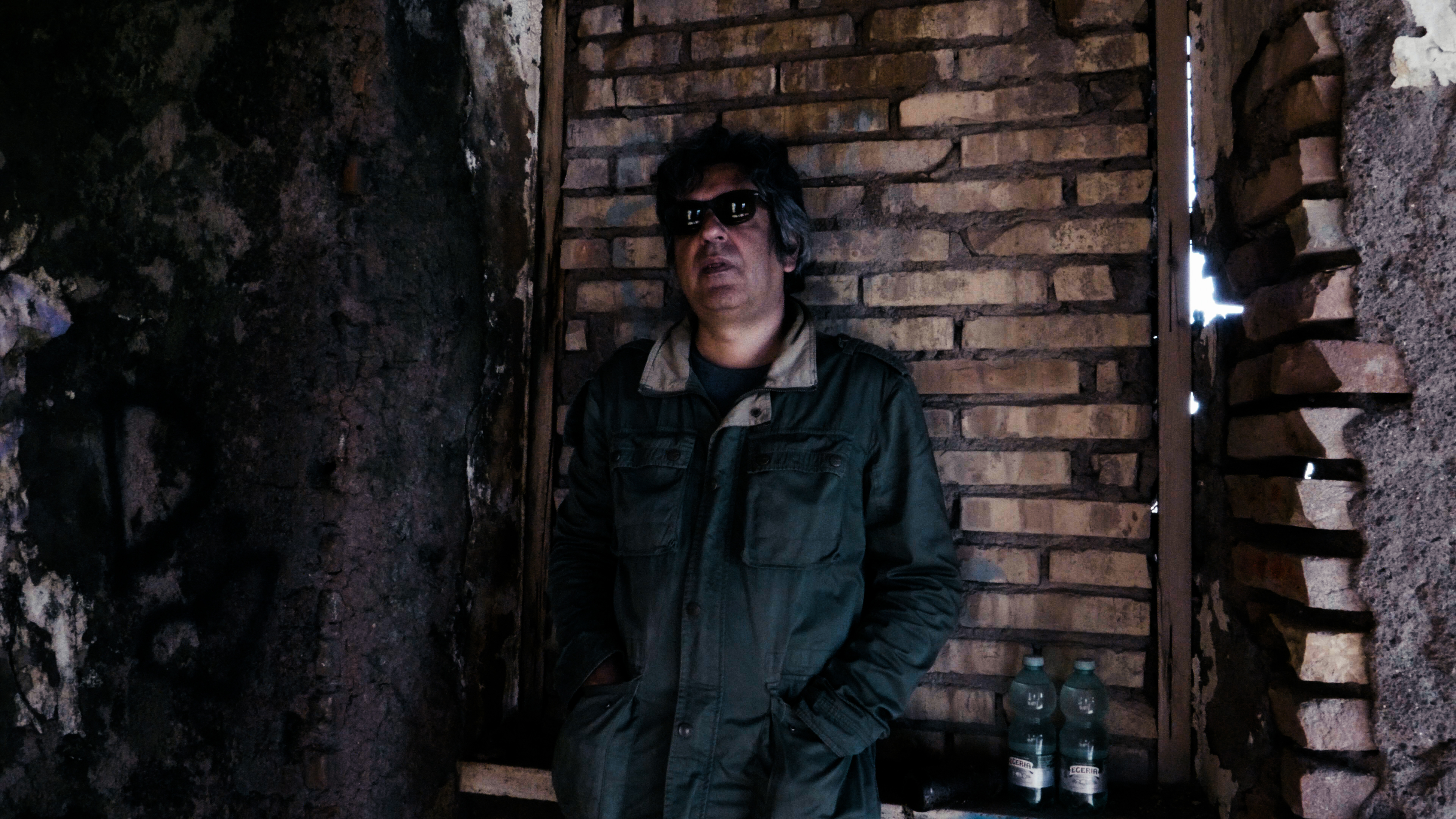
Drama, by Fabio Del Greco, Italy, 2024.
Dante Mezzadri wants to see an old friend, nicknamed the Iguana, whom he has lost sight of for many years, and who has managed to turn their shared youthful passion for poetry into a job, becoming a famous writer and poet. The man escapes from his bourgeois life and his wife to live homeless on the Roman coast, printing and trying to sell his poetry collections. At night he sleeps in a park of old carnival floats, inside a papier-mâché tank, and waits for the opportunity to meet his old friend, who however never shows up for appointments in the places they frequented when they were young, now in ruins. Dante's poetry books do not interest anyone and to support himself he is forced to "change product": he starts selling the infamous "cannibal pill" on behalf of young drug dealers, a new drug that sells like hot cakes and causes sensory and consumerist ecstasy. However, he realizes that this powerful drug is very dangerous for those who take it, he comes into conflict with his ethical conscience and throws all the pills into the sea. However, the dealers want to collect their money.
Shot over a period of 2 years, the film is a reflection on the cultural and artistic rubble of the society in which the protagonist lives, in an increasingly mechanized, consumerist and arid world. Dante Mezzadri is yet another human being who has renounced his inspiration and his creativity, but unlike many he is not willing to give his life to a system that distances him from his true identity. The physical world around him, however, seems constructed in such a way that it seems impossible to escape from this "invisible cage". The enthusiasm of the people he meets is ignited only by sensory gratification, by unreal visions of personal affirmation and success, by "metaverses" that offer an escape into an illusory and destructive reality. The poet's house on the coast, where he met with his friends as a young man, is just a pile of abandoned rubble. What happened to all those who wanted to become poets and ended up becoming something else? Are there internal forces with which that house can be "rebuilt"?
LANGUAGE: Italian
SUBTITLES: English, Spanish, French, German, Portuguese
What the Philosophers Called a Lesser Thing
There is a moment when language fails in the ordinary sense and something else takes over. Your father is dying. The machines make their sounds, the fluorescent light does its indifferent work, and you are standing there with everything you were supposed to say already dissolved. What comes to you, unbidden, is a line you memorized as a boy and never thought about again. It arrives complete, with a weight and precision that nothing you could have constructed in that moment would have matched. You do not choose it. It chooses the moment, and the moment accepts it.
This is not comfort. This is cognition.
Plato understood this, which is precisely why he feared it. The expulsion of the poets from the Republic, laid out with surgical deliberateness around 380 BCE, was not the act of a man who thought poetry was trivial. It was the act of a man who knew it was dangerous. In Book X, he places the poet at three removes from truth — the craftsman imitates the ideal form, the poet imitates the craftsman’s object — and the logical structure seems airtight until you notice what it requires him to assume: that truth is singular, hierarchical, and accessible only through a specific kind of reasoning. The entire argument is a prior commitment dressed as a conclusion. Poetry must be lesser because the system Plato is building requires a single corridor to knowledge, and the poets are standing in a different room, producing something that the system cannot account for and therefore must delegitimize.
This is what Michel Foucault would later call a regime of truth — not the discovery of what knowledge is, but the enforcement of which knowledge counts. The Republic is not a philosophical treatise that happens to exclude poetry. It is a blueprint for epistemic authority, and the exclusion of poetry is load-bearing architecture. Remove it and the whole structure of who gets to speak truth, and on what grounds, begins to shift.
The Cartesian codification of the seventeenth century completed what Plato had begun. René Descartes, writing the Meditations in 1641, reduced legitimate knowledge to what could be verified through the clear and distinct perception of the rational mind. The cogito is not just a philosophical move. It is a jurisdiction claim. It defines the territory of the knowable and places its border at the edge of what can be doubted, measured, and confirmed. Everything that operates through image, emotion, rhythm, and ambiguity — everything that works the way a line of verse works when it meets a dying man’s bedside — falls outside that border by definition. Not because it has been tested and found wanting. Because it has been classified in advance as a different category of experience, one that does not qualify for the title of knowledge at all.
What is remarkable, and what is rarely stated plainly, is that this was a political decision. Not political in the narrow sense of parties and elections, but political in the deeper sense of the organization of power over what is allowed to count as real. When the Cartesian model became the template for what European universities would teach, what scientific institutions would fund, and what courts and governments would accept as evidence, the demotion of poetry was no longer a philosophical position. It was an administrative fact. Aristotle had at least granted poetry a cognitive function in the Poetics, arguing that it reveals universal truths through particular imitations — a more generous epistemology than the one that eventually won. What won was not the most accurate description of how human beings actually come to know things. It was the description most useful to institutions that needed a single, controllable pathway to authority.
And so the man at his father’s bedside is left with a line of verse that does exactly what no verified proposition could do in that moment, and no framework inherited from the dominant tradition gives him permission to call that knowing.

The Aristotelian Counterargument Nobody Teaches
You memorized it at fifteen because the teacher required it. You did not understand it then — or rather, you understood it the way you understand a password: as a sequence of sounds that opens something without revealing what is inside. Decades pass. You are standing in a kitchen, or waiting for a train, or watching light move across a wall in a particular way you have never quite been able to name, and the lines surface on their own, unbidden, arriving before thought has time to arrange itself. And for the first time you realize: this poem has been inside you all along, not as a memory but as a lens. It has been quietly bending the light through which you see certain things — loss, beauty, time passing through an afternoon. It did not illustrate something you already knew. It built the architecture through which knowing became possible.
This is precisely what Aristotle was pointing at, in a claim so inconvenient to the Western intellectual tradition that it is routinely buried beneath the safer version of his thought. In the Poetics, written in the fourth century BCE, he argues that poetry is more philosophical than history, and more serious. History tells you what Alcibiades did. Poetry tells you what a person of a certain kind would do — what human beings do, structurally, when they are caught between ambition and fate, between love and obligation, between the story they tell about themselves and the story that is actually unfolding. Poetry speaks in universals. History speaks in particulars. And for Aristotle, the universal is where genuine knowledge lives.
This argument has survived in syllabuses as a footnote about mimesis, defanged and made safe by centuries of commentators who reduced it to a theory of representation. But what Aristotle was actually saying is far more destabilizing: the fictional, the invented, the made thing, carries epistemic weight that the factual record cannot. The truth of the particular event — the battle, the date, the name — does not penetrate the structure of human experience the way the truth of the probable pattern does. Poetry does not decorate knowledge. It performs a kind of knowing that discursive prose cannot execute.
Hans-Georg Gadamer spent much of Truth and Method, published in 1960, recovering precisely this claim from the margins where modernity had left it. Gadamer’s argument moves against the assumption — deeply embedded in post-Enlightenment thinking — that aesthetic experience is a kind of pleasant interlude, subjectively meaningful but epistemologically inert. Against this, he insists that the encounter with a work of art constitutes what he calls ontological disclosure: not illustration of a truth that exists elsewhere, not decoration applied to a pre-formed reality, but genuine participation in a mode of being that transforms the one who enters it. The artwork does not show you something. It changes what you are capable of seeing.
Gadamer uses the word Spiel — play — deliberately. The work of art plays with you as much as you play with it. You do not stand outside it as a subject examining an object. You are drawn into its movement, and you emerge from that movement altered in ways that cannot be fully accounted for in the language of analysis. This is not mysticism. It is a precise philosophical claim about how understanding works: not as the application of a pre-existing framework to new material, but as a transformation of the framework itself through encounter with what resists it.
The poem you memorized at fifteen was not waiting for you to grow up and understand it correctly. It was already working. It was already doing what Gadamer describes — reorganizing, slowly, the perceptual categories through which you would eventually feel that afternoon light, that particular quality of loss, as something almost unbearably recognizable.
Language That Knows Before You Do
There is a particular silence that fills a room when you begin moving a dead person’s things. Not the silence of absence — that comes later — but something more specific: the silence of objects that no longer know their purpose. A coat on a hook. A half-finished tube of hand cream with the cap replaced carefully, as though there were still tomorrow. You pick something up and your hands understand before your mind has formed a single sentence. The knowledge arrives in the body first, as a kind of pressure behind the sternum, and only much later — days, sometimes years — does language catch up with what the fingers already knew.
This is not metaphor. This is how certain knowledge actually moves.
Martin Heidegger spent the better part of his philosophical life arguing that language is not a tool we use to describe a world that already exists independently of it. Language, he insisted, is the house of Being — the dwelling in which human existence unfolds, not the label we attach afterward. In his essays on Hölderlin, written and revised across several decades in the middle of the twentieth century, he kept returning to one insistence: the poet does not ornament reality with beautiful words. The poet names what is, and in naming it, allows it to appear. Before the poem, the thing was present but unseen. The poem does not represent the threshold between presence and absence. It is the threshold.
Gaston Bachelard arrived at something adjacent from a different direction. In 1958, he published a study of inhabited space that reads less like philosophy than like phenomenology with its coat off. He was interested in corners, in the way a childhood attic organizes memory, in the geometries of inside and outside that the body internalizes long before conscious thought begins its work. His argument — gentle but structurally radical — was that the poetic image does not illustrate experience. It precedes it. The image reaches the reader’s nervous system before reasoning has had time to frame a question. There is, he wrote, a poetic cogito that is prior to the Cartesian one: first the image reverberates, and only then does the self that receives it know itself to be present.
Watch what happens to the geometry of a room when grief enters it. This is not a figure of speech. The corners change. The distances between furniture become negotiable. A woman standing in the kitchen of someone who no longer exists finds herself unable to use the word kitchen for what the room now is. The spatial grammar of the place has been rewritten, and her body is reading the new grammar while her conscious mind is still insisting that nothing has fundamentally changed. She opens a drawer and closes it. Opens it again. The objects in it arrange themselves into a kind of sentence she is not yet equipped to parse.
Poetic language operates in exactly this register. It encodes knowledge about time and loss and embodiment and mortality that the discursive intellect processes too slowly, arrives at too late, formulates with too much scaffolding. When Hölderlin writes about the gods having departed and the earth remaining in their absence, he is not making a theological claim that can be verified or refuted. He is recording a structural experience of deprivation so fundamental that only the form of the poem — its rhythms, its silences, its refusals to resolve — can hold it without distortion. Heidegger understood that what Hölderlin was doing was essentially diagnostic: mapping a condition of human being that philosophy could point toward but not enter.
The body that sorts through the objects of the dead already knows this. The hands moving through folded clothes are already reading what the mind will spend months trying to articulate. The poem is not the record of that knowledge. It is the knowledge itself, in the only form that does not betray it by arriving too early.
The Oral Traditions and What Was Destroyed
You press play, and what comes out of the speakers is not quite sound and not quite silence. It is a voice recorded decades ago, an old man speaking — or singing, the distinction collapses — in a language that has no living speakers left. You do not understand a word. You will never understand a word. And yet something in the cadence reaches you before meaning could, the way a hand on your shoulder reaches you before you turn to see whose it is. What you are hearing is the last known poem in that tongue. After the recording ends, the language is over. Not dormant. Over.
Walter Ong, writing in 1982, made a claim that still disturbs anyone who reads it carefully: that writing is a technology, and like all technologies it restructures consciousness. Orality and Literacy is not a nostalgic book — Ong was too rigorous for nostalgia — but it insists that oral cultures do not simply possess less information than literate ones. They possess differently organised minds, differently distributed knowledge, differently embodied relationships to time and to truth. The spoken word exists only in the present tense of its utterance. It cannot be stored without being transformed. To remember something in an oral culture is not to retrieve it; it is to recreate it, and that recreation is itself an act of knowledge.
Jan Vansina spent decades making the case that oral traditions constitute historical evidence of the first order, not inferior substitutes for documents but autonomous epistemological systems with their own standards of verification, transmission, and critique. His work on the kingdoms of central Africa demonstrated that oral testimony, when subjected to rigorous comparative analysis, could reconstruct political histories across centuries with a precision that embarrassed those who had dismissed it as folklore. The contempt with which European colonial administrations treated oral knowledge was never innocent. It was structural. It cleared the ground.
The griots of West Africa were not entertainers in the sense that word has been flattened to mean. They were living archives, genealogists, diplomats, historians, moral arbiters. Their training took years. Their knowledge was irreplaceable in the literal sense: if a griot died without passing on what he carried, that knowledge died with him. Amid the disruptions of colonisation, many did. What was destroyed in the forced imposition of written administrative culture on oral societies was not primitive expression waiting to be upgraded. It was a complete epistemological infrastructure, gone.
The Homeric tradition understood this intuitively, even if the Greeks would not have phrased it that way. The formulas, the epithets, the repeated lines — wine-dark sea, rosy-fingered dawn — were not poetic laziness or decorative habit. They were mnemonic technology, modular units that allowed the singer to reconstruct an epic of ten thousand lines in real time while maintaining the freedom to adapt it to the audience, the occasion, the political moment. Milman Parry’s fieldwork in Yugoslavia in the 1930s, listening to living oral poets compose in real time, revealed that what looked like rigidity was in fact a flexible cognitive architecture, a way of thinking that could only exist in performance.
The Aboriginal songlines of Australia extend this further than most Western epistemologies are comfortable following. They are simultaneously navigational maps, cosmological accounts, legal records, and ecological guides. To sing the songline correctly is not to describe the country — it is to know it, to move through it, to maintain it. The song and the land are not related metaphorically. They are the same thing rendered in different registers. When those songs were suppressed, when children were taken from the country their families’ voices had maintained for sixty thousand years, the land itself began to lose its custodians in ways that were not only cultural but material.
The silence after that recording is not the silence of absence. It is the silence of something that was taken.
A vision curated by a filmmaker, not an algorithm
In this video I explain our vision
The Twentieth Century Turns It Into a Museum Piece
There is a particular kind of silence that falls in a lecture hall when someone reads Paul Celan aloud. Not the silence of attention, but the silence of transcription. Pens move. Laptops click. The voice at the front of the room says “death is a master from Germany” and somewhere in the third row a student underlines the phrase, draws an arrow toward the margin, writes “Germanic guilt motif?” The poem, which was built from ash and nightmare, from a language the murderers also spoke, becomes a data point. It enters the grid of interpretation. It is preserved and simultaneously killed.
This is not a failure of individuals. It is the completion of a structural project that began with the best intentions, as these projects always do.
In 1919, T.S. Eliot published what would become one of the most influential critical arguments of the twentieth century, claiming that poetry was not the expression of personality but an escape from it, that the poet’s mind was a catalyst that transformed experience into art without itself being changed. The essay was brilliant and, in the particular way that brilliant ideas become orthodoxies, catastrophic in its consequences. What Eliot intended as a corrective to romantic excess became a license for depersonalization, for treating the poem as an autonomous object severed from the body that made it, from the historical conditions that demanded it, from the reader who might need it to survive a particular Tuesday.
Cleanth Brooks and the New Critics took this logic to its institutional conclusion. By the 1940s and 1950s, the doctrine of the “heresy of paraphrase” had consecrated the poem as untranslatable, self-referential, a verbal icon sealed inside its own formal perfection. You could not say what a poem “meant” in prose without betraying it. You could only demonstrate the productive tensions within its language, the irony, the ambiguity, the paradox. This was aesthetically sophisticated and epistemologically disabling. If the poem cannot be paraphrased, it cannot be used. If it cannot be used, it cannot be known in any sense that matters outside the seminar room. The poem becomes a sacred object that must not be touched with bare hands.
Pierre Bourdieu, writing in The Rules of Art in 1992, gave this process its sociological name. Cultural consecration, he argued, is never innocent. The institution that elevates a work also domesticates it, strips it of the antagonistic charge it carried in the world, converts transgression into heritage. The avant-garde becomes the curriculum. The scandal becomes the syllabus. What survives the process is the form without the force, the monument without the wound. And the academic field, with its mechanisms of credentialing and citation and interpretive authority, is precisely the machine that performs this transformation at scale, continuously, with great professional rigor.
The violence of this is specific. It is not the violence of censorship, which at least acknowledges that a text has power worth suppressing. It is the violence of neutralization, which insists that the text has only the kind of power that trained specialists are equipped to measure. Celan’s “Todesfuge” was written by a survivor about extermination. It was written in the language of the executioners as an act of impossible, necessary witness. When it enters the lecture hall and becomes the object of a discussion about apostrophe and anaphora, something real is taken from the world. Not the poem itself, which stubbornly persists, but the permission to encounter it as knowledge rather than as artifact, as something that might reorganize what you know about history, language, complicity, survival.
What the twentieth century accomplished, in its institutional generosity toward poetry, was the construction of a space where poetry could be enormously respected and almost entirely harmless. The museum was built with genuine love. That changes nothing about what a museum does.
When the Poem Knows What the Report Cannot Say
There is a moment — you have probably witnessed something like it — when someone who has lived through an unsurvivable thing is asked to describe what happened. They open their mouth. The chronology collapses. The sentences dissolve before they reach their object. And then, almost involuntarily, something rhythmic begins to emerge from the rubble of their speech. Not explanation. Not narrative. A cadence. The rhythm itself carrying what the words, arranged logically, could not hold.
This is not a failure of articulation. This is articulation operating at the limit of what sequential language can bear.
Paul Celan wrote “Todesfuge” in 1944 or 1945 — the exact date is disputed, which is itself significant, because the poem exists at the threshold between the event and its aftermath, in that impossible zone where documentation had either been destroyed, weaponized, or made complicit in the very machinery it might describe. The Nazi bureaucratic archive was meticulous. The reports existed. The numbers existed. And yet the knowledge of what had happened — the phenomenological truth of it, the texture of death administered as labor, of music played over graves still being dug — none of that lived inside the reports. Celan’s fugal structure, the repetitions that accumulate like breath denied and returned, the black milk drunk at morning and at noon and at evening and at night, performed what no testimony could deliver linearly: the experience of time made circular by terror, of beauty converted into instrument of annihilation. Theodor Adorno, who initially declared that writing poetry after Auschwitz was barbaric, later revised this in “Negative Dialectics” (1966), acknowledging that the very suffering that made art seem obscene also demanded forms that documentary language could not supply. The poem was not decoration applied to atrocity. The poem was the only epistemological tool adequate to a knowledge that shattered the containers of conventional discourse.
A different form of epistemological necessity produced a different kind of knowing in Harlem in the 1920s. The cultural explosion that gathered Langston Hughes, Zora Neale Hurston, Countee Cullen, and Claude McKay was not merely an artistic movement. It was a counteroffensive against a specific regime of knowledge production. Scientific racism in that period was institutional, peer-reviewed, and numerically decorated. Eugenicists published in respectable journals. The poems of the Harlem Renaissance did not refute these claims by producing counter-data. They did something more devastating: they demonstrated, from inside a living consciousness, the irreducible complexity and historical depth of Black interiority that the taxonomic project of racism could not perceive by design, because perceiving it would have destroyed the taxonomy. The poem knew what the study could not, because the study’s methodology excluded the very thing that needed to be known.
Adrienne Rich arrived at a similar epistemological threshold from a different direction. When “Diving into the Wreck” was published in 1973, the academic vocabulary for gendered consciousness was embryonic and largely borrowed from frameworks built without women’s experience at their center. Rich went down alone, with a book of myths, with a camera, with a knife. The wreck she was documenting was not a metaphor to be decoded — it was the accumulated structure of a consciousness shaped by erasure, and the poem mapped it before the maps existed in any other form. Feminist theory would spend the following two decades building conceptual architecture to describe what the poem had already explored as lived terrain. Sandra Harding’s epistemological work on standpoint theory in the 1980s, Nancy Hartsock’s feminist materialism — these arrived after. The poem arrived first, not as hypothesis but as knowledge already achieved through formal enactment.
This is the pattern that repeats: poetry does not illustrate what other disciplines have already established. It enters territory before the roads exist, and sometimes the roads are never built, because the territory can only be inhabited this way.
The Reader Who Does Not Know They Are Knowing
It is three in the morning again, and you are standing in the kitchen not because you are hungry but because lying down feels like a form of surrender to thoughts that have not finished with you yet. You have been here before in this section, or somewhere like it, and the difference now is that earlier today — or yesterday, time has dissolved — you read something. A single stanza. You did not choose it therapeutically or with any intention of being helped. You stumbled into it the way you stumble into a conversation that turns out to matter. And something in the body, somewhere below the sternum, settled. Not resolved. Settled. The way sediment settles in water that has stopped being disturbed.
Months of analysis had not done this. Conversations, journals, the careful rational accounting of what had gone wrong and why — none of it had reached whatever that place is. And you are standing in the kitchen wondering, with a kind of unsettled gratitude, what exactly just happened to you.
Mark Johnson‘s argument in The Meaning of the Body, published in 2007, is that meaning is not a cognitive event that subsequently gets expressed in language or gesture. Meaning is bodily from its origin. The schemas we use to understand abstract concepts — containment, balance, force, path — are derived from physical experience before they are ever recruited by thought. When you understand an argument as having “weight,” you are not using a dead metaphor. You are activating the same neural substrate that learned, as an infant, what it meant to hold something heavy. Johnson, building on the earlier work he developed with George Lakoff in Philosophy in the Flesh, insists that the mind was never the ghostly rational apparatus Descartes needed it to be. It is flesh thinking, always.
Poetry knows this. It has always known it, which is why it was never merely decorative. The metrical line is not an ornament applied to meaning after the meaning has been made. Reuven Tsur, whose cognitive poetics project spans decades of precise and often counterintuitive scholarship, has demonstrated through rigorous phonological and psychological analysis that metrical patterns encode information neurologically — that the tension between the abstract metrical schema and the actual speech rhythm of a line creates a kind of perceptual oscillation in the listener or reader, a low-level cognitive event that is distinct from semantic processing but inseparable from it. You do not hear the iambic and then think about death. The rhythm and the thought arrive together, as one compound event, and the body registers the complexity before the mind has named it.
This is why the line you read did what months of analysis could not. The analysis was addressing a part of you that was already exhausted by being addressed. The poem reached somewhere else. It used sound as meaning, used the physical sensation of stressed and unstressed syllables as a kind of argument that the nervous system could accept because it bypassed the part of you that had learned to be defensive. Tsur calls this the “aesthetic quality” of poetic experience — but what he is really describing is a form of knowing that is older than propositional thought, that was present in human cognition before writing, before systematic philosophy, before the institutions we built to house and legitimate knowledge.
And this is the question you are left with at three in the morning, standing in the kitchen with the strange calm of someone who has been told something true without being able to say exactly what it was: what does it mean that the oldest technology for preserving human knowledge is still the one the body trusts most when certainty fails, when argument has worn itself out, when the mind at last stops performing its competence and becomes, briefly, willing to be reached?
🖊️ Language, Memory, and the Poetics of Thought
Poetry has always stood at the crossroads of knowledge and experience, weaving together the philosophical, the historical, and the deeply human. To understand poetry as a form of knowledge is to trace its roots through memory, rhetoric, literature, and the life of the mind. These neighboring explorations illuminate the terrain from which poetic thought emerges.
Montaigne’s Essays: Guide to Reading
Montaigne's Essays represent one of the most radical experiments in writing as a form of self-knowledge, blending personal reflection with philosophical inquiry in a form that feels unmistakably poetic. His willingness to treat language itself as a tool for thinking—rather than merely for communicating—anticipates many modern theories of poetry. Reading the Essays alongside poetic theory reveals how closely literature and philosophy have always breathed together.
GO TO THE SELECTION: Montaigne’s Essays: Guide to Reading
Paul Ricœur: Life and Philosophy of Memory
Paul Ricœur‘s philosophy of memory offers a profound framework for understanding how narrative and poetic language preserve and transform human experience across time. His work on the intersection of time, narrative, and identity deeply resonates with theories that position poetry as a privileged form of knowledge about the past and the self. Ricœur’s thought illuminates why poetry is not mere ornament but an essential mode of historical and existential understanding.
GO TO THE SELECTION: Paul Ricœur: Life and Philosophy of Memory
American Transcendentalism: History and Thought
American Transcendentalism placed poetry and philosophical vision at the very heart of its intellectual project, treating the natural world as a text to be read through intuition and lyrical language. Emerson, Thoreau, and their circle believed that poetic perception could access truths inaccessible to rational analysis alone. This movement remains a foundational chapter in the history of poetry understood as a legitimate and sovereign form of knowledge.
GO TO THE SELECTION: American Transcendentalism: History and Thought
Octavio Paz: Life and Thought
Octavio Paz stands as one of the twentieth century’s most compelling voices on the relationship between poetry, thought, and cultural identity, arguing throughout his essays and verse that poetry is an act of knowing as much as of feeling. His theoretical writings, particularly in ‘The Bow and the Lyre,’ construct a rigorous poetics grounded in history, mythology, and philosophy. Paz bridges the traditions of Spanish-language literature and universal poetic theory with rare intellectual depth.
GO TO THE SELECTION: Octavio Paz: Life and Thought
Discover Cinema That Thinks Like a Poem
If poetry teaches us that knowledge can be felt as much as reasoned, cinema at its most daring does exactly the same. On Indiecinema streaming you will find a curated selection of independent and avant-garde films that treat the moving image as a form of poetic thought—stories that ask questions rather than deliver answers. Dive in and let the films speak where words leave off.
👉 EXPLORE THE CATALOG: Watch Indie Films in Streaming
A vision curated by a filmmaker, not an algorithm
In this video I explain our vision

