
The Smell of Mold and the Weight of the Unknown
There is a moment, and you have lived it, when you descend into a basement or open a door that has been closed too long, and something stops you before your mind can name what it is. Not a sound. Not a figure. A smell, perhaps, or the quality of the darkness, or the way the air feels thicker than air should feel, as if the space itself has been occupied by something that has since withdrawn but left a residue of its having been there. Your hand stays on the doorframe. Your body knows before you do. And the worst part is not fear, exactly. The worst part is the sudden, vertiginous sense that the familiar geometry of your world has a seam running through it, and that on the other side of that seam there is something for which you have no category, no language, no inherited framework capable of receiving it.

Howard Phillips Lovecraft spent his entire literary life trying to write that moment accurately. Not to resolve it. Not to explain it away or transform it into something navigable. He wanted to hold that precise threshold open, to prevent the reader from crossing back into comfort, because he believed, with a conviction that was less aesthetic preference than existential diagnosis, that the threshold was the truth. That the seam was always there. That most of human culture was an elaborate collective effort not to notice it.
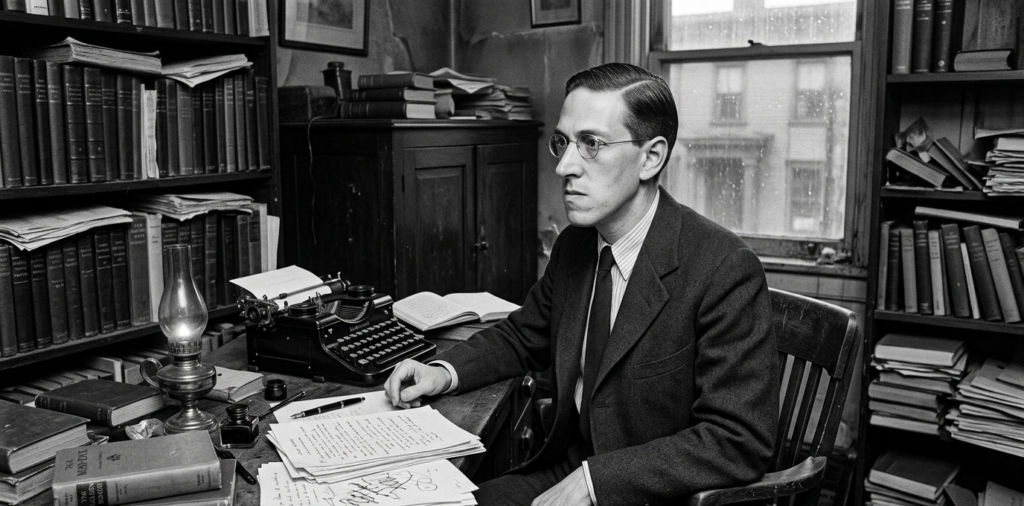
Born in Providence, Rhode Island in 1890, Lovecraft lived a life so compressed by anxiety, poverty, physical frailty, and social failure that his biography reads like a document of the very alienation his fiction explored. He published almost exclusively in pulp magazines, most prominently Weird Tales, earning so little that he died in 1937 at the age of forty-six, alone, in genuine destitution, his body worn through by intestinal cancer he had refused to treat adequately partly because he could not afford to. He left behind a body of work — novellas, short stories, essays, and an extraordinary volume of correspondence estimated at over one hundred thousand letters — that was largely ignored during his lifetime and has since become one of the most philosophically generative legacies in American letters.
What Lovecraft understood, and what the literary establishment of his time was entirely unwilling to credit him for, was that horror as a mode of experience is not about danger. Danger is manageable. Danger implies that you understand the rules of engagement, that you know what threatens you and can orient yourself in relation to it. What Lovecraft was describing was something categorically different, something closer to what the philosopher Edmund Burke identified in 1757 in his Enquiry into the Origin of Our Ideas of the Sublime and Beautiful as the experience of the sublime: the encounter with something so vast, so disproportionate to the scale of human comprehension, that the mind’s first response is a kind of dissolution. Burke called it astonishment, which he defined as that state of mind in which all its motions are suspended, with some degree of horror. Lovecraft took that insight and pushed it to its logical terminus, stripping away the eighteenth-century gentleman’s reassurance that the sublime, however overwhelming, ultimately confirms the dignity of the human perceiver. In Lovecraft’s universe, there is no such confirmation. The encounter does not ennoble you. It simply reveals how wrong you were to have ever felt at home.
This is not a literary genre. This is a psychological state you already inhabit in the basement with your hand on the doorframe. Lovecraft did not invent cosmic horror. He diagnosed it, named it with obsessive precision, and refused the consolation of the door swinging open to reveal nothing more than a burst pipe or a forgotten box.
Providence, 1890: A Child Who Should Not Have Survived
There is a house in Providence, Rhode Island, that never quite lets you leave. You can walk out the front door, cross the threshold into the ordinary morning light, feel the pavement solid under your feet — and still be inside it. The rooms follow you. The angles of the ceilings persist behind your eyes. This is not metaphor. This is what a childhood structured around disappearance actually does to the architecture of a mind.
Howard Phillips Lovecraft was born on August 20, 1890, into a family already quietly coming apart at the seams. His father, Winfield Scott Lovecraft, was a traveling salesman, a man whose absences were so frequent they had almost normalized themselves into a kind of permanent condition. Then, in 1893, the absences became official. Winfield was institutionalized at Butler Hospital in Providence, suffering from what the medical records of the time described as a general paralysis of the insane — almost certainly the tertiary stage of syphilis, though this was carefully elided in the family’s telling of it. He would remain there until his death in 1898. Howard was three years old when his father vanished into that institution, and five when the vanishing became permanent. He would later claim not to remember his father at all. Whether this was truth or its own kind of haunting is impossible to say.
What remained was the house, and his mother Sarah, and the slow accumulation of dread that accretes around a child when the adults nearby are themselves terrified. Sarah Lovecraft was not a cruel woman, but she was a damaged one, and her damage expressed itself in ways that a small, hyperintelligent boy could absorb without ever being able to name. She told him repeatedly that he was ugly. She dressed him in girl’s clothing well past the age when this was conventional even for the era. She suffered what contemporaries described as nervous episodes, and would eventually be institutionalized herself, at the same Butler Hospital that had swallowed his father, in 1919. She died there two years later. Freud, writing in that same year of 1919, published his essay on the uncanny — Das Unheimliche — and offered a word that cuts precisely to the center of what Lovecraft’s childhood was: heimlich, meaning familiar, homely, belonging to the domestic sphere, and its shadow-twin, unheimlich, the uncanny, which is not the opposite of the familiar but its corruption. The uncanny is what happens when the home reveals itself to be the source of the dread rather than its shelter. It is the return of something that should have remained hidden, rising from inside the walls rather than approaching from outside them.
Lovecraft’s body participated in this collapse. He suffered a series of nervous breakdowns severe enough to interrupt his schooling repeatedly. A near-fatal illness in childhood left him physically weakened and prone to what he described as complete nervous prostration. He could not complete a formal education. He spent years effectively confined to his grandfather’s house on Angell Street, reading voraciously, writing poetry that almost no one read, moving through rooms that were themselves a kind of inheritance of anxiety. His grandfather Whipple Van Buren Phillips, the one figure of genuine stability in these years, died in 1904, and the family’s financial situation collapsed so dramatically afterward that they were forced to leave the Angell Street house entirely. Lovecraft described this loss in terms that suggested not merely grief but something closer to ontological rupture — as though the house had been the organizing principle of reality itself, and without it, reality became negotiable.
This is where the haunted spaces in his fiction come from. Not from imagination, strictly speaking, but from memory — from the specific texture of rooms that were supposed to mean safety and instead meant the particular silence of something unspeakable being very carefully not said.

What the Fishermen Pulled Up from the Water
There is a town on the coast where something is wrong with the people’s faces. Not wrong in the way a scar is wrong, or a deformity you can name and categorize. Wrong in the way a reflection is wrong when it moves a half-second after you do. The eyes are set too wide. The skin has a quality to it, like something dried incorrectly after being wet for too long. The old men of the town barely speak, and when they do, the vowels come out shaped by a mouth that has been practicing other sounds in private. You walk through the main street and you understand, before you can articulate it, that whatever civilization means, it did not fully arrive here.
Lovecraft built Innsmouth out of this sensation in 1931, and the novella that emerged — “The Shadow Over Innsmouth” — is not a horror story in the conventional sense. It is a genealogical nightmare. The protagonist does not merely discover that the town is strange. He discovers that the strangeness is in him, that the wrong thing in the faces of the townspeople is also in his own blood, waiting with geological patience to express itself. He ends the story not fleeing from the horror but moving toward it, into the water, into the deep, where his inherited nature is calling him home.
Edmund Burke, writing in 1757 in his Philosophical Enquiry into the Origin of Our Ideas of the Sublime and Beautiful, made a distinction that reorganized aesthetic philosophy for a century. The beautiful calms, rounds, softens, invites approach. The sublime terrifies, but it terrifies at a safe distance — the cliff seen from the road, the storm watched from the window. The crucial mechanism of the sublime is separation. You feel the overwhelming power of something that could destroy you, and that feeling is pleasurable precisely because it cannot reach you. The abyss does not have your address.
Lovecraft was doing something Burke’s framework simply had no room for. In Innsmouth, the abyss is your grandmother. The terror has your blood type. There is no window to stand behind, because the storm is not outside the house. It is in the architecture of your own face, in the way your children will look, in the pull you feel toward deep water that you have always attributed to something innocent like melancholy or longing.
Think of a man who dives below the surface of a Norwegian fjord and finds something resting on the seabed that should not exist at geological scales, something that the water has been keeping for longer than his civilization has had a word for time. He surfaces. He cannot explain what he saw to the people onshore. Not because language fails him, but because the categories that language depends on — the division between living and dead, between old and new, between creature and landscape — do not apply to what was down there. He goes back. Of course he goes back.
Or think of an isolated coastal community where the elders know something the younger generation is only beginning to suspect, where the festival calendar and the marriage customs and the small daily rituals are all oriented around an agreement made before anyone currently living was born, an agreement with something that lives below the water and wants, in its vast non-human way, something in return. The horror here is not the monster. The horror is the community. The horror is that people organized their entire social life around accommodation with the unthinkable, and called it tradition.
Cthulhu, described in 1928 in “The Call of Cthulhu,” is not a villain. Lovecraft is precise about this, almost insistently so. Cthulhu does not want to harm humanity any more than a man wants to harm the microorganisms he breathes in on a winter morning. The indifference is the point. Burke’s sublime required an implicit subject — a human consciousness threatened but ultimately preserved, enlarged even by the encounter. Lovecraft removed the preservation. He removed the enlargement. What remains when you take those away is not the sublime.
The Racism That Cannot Be Footnoted Away
There is a letter he wrote in 1924, after moving to New York, in which he described the streets of the city as a biological catastrophe. Not a cultural shock, not an aesthetic displeasure — a catastrophe of flesh and blood. He catalogued the faces he saw on the subway with the precision of a man performing a diagnosis, and what he concluded was that the white race was drowning in a tide of something subhuman, something that walked upright but belonged to a different order of being entirely. He was not venting. He was theorizing.
This is the detail that cannot be filed away as biographical context, as the unfortunate prejudice of a man who was otherwise a genius, as the shadow that falls behind the monument. Because the monster he spent his entire literary life constructing — the thing that cannot be named, the shape that reason dissolves before, the ancient horror that reduces the civilized mind to gibbering ruin — was not separate from his terror of Black and brown and immigrant bodies. It was the same terror. The same structure. The same act of perception wearing different clothes.
In 1912, he wrote a poem titled “On the Creation of Niggers.” It is not ambiguous. It is not metaphorical. It describes Black people as creatures positioned between humans and animals, fashioned by a god who lacked the material to complete a proper man. The poem is short, ugly, and perfectly legible. It says exactly what it means, and what it means is that some bodies are not fully human. Once you have read it, you cannot read his fiction the same way, because the fiction is doing the same work with more elegant machinery.
Toni Morrison, in Playing in the Dark, published in 1992, made the argument that American literary imagination had always required the Black presence as its constitutive darkness — that the white self in American literature is constructed precisely against the backdrop of what it refuses to see as itself. The Africanist presence, she called it: not a theme, not a subject, but a structural necessity, the shadow that gives the figure its shape. Lovecraft is almost a pure demonstration of this thesis. His cosmic indifference, his vast ancient evil, his creatures who predate human civilization and mock its pretensions — they are the philosophical formalization of what he already believed about the people he passed on the street.
Frantz Fanon, writing in Black Skin, White Masks in 1952, described the phenomenology of being perceived as monstrous — the way the colonized body is apprehended by the colonizing gaze not as a person but as a category of threat, a disruption in the order of the knowable. What Fanon mapped was the psychic structure of racism: it does not encounter an Other and find it threatening. It constructs the Other as threatening in order to maintain a self that would otherwise have no coherent boundary. Lovecraft’s letters reveal this mechanism with almost clinical transparency. The immigrant, the non-white body, the Jew — they are described in the same register as Cthulhu: ancient, incomprehensible, corrosive to everything civilized thought had built.
The convenient argument is that the horror was genuine even if the politics were repugnant — that the art transcends the ideology. But this requires you to believe that a writer who experienced ethnic diversity as a literal biological threat was somehow producing, in his fiction, a metaphysically neutral terror. The unknowable monster was not unknowable to Lovecraft. He knew exactly what face it wore. He had described it in letters, in poems, in the breathless disgust of a man who believed civilization was a thin membrane stretched over an abyss that looked, to him, remarkably like the people he refused to sit next to on the train.
The Geometry of Things That Should Not Exist
There is a particular kind of vertigo that arrives not from height but from grammar. You are reading a sentence that seems to be describing something, following its clauses with the usual cognitive trust you extend to language, and then somewhere in the middle you realize the sentence has been describing the impossibility of description all along. The architecture bends inward. The angles refuse to resolve. You are left holding words that point at their own inadequacy like a compass spinning at the magnetic pole.
This is the texture of Lovecraft’s mature prose, and it is stranger than it first appears. Between 1917 and 1935, across roughly sixty stories and novellas, he developed something that has no precise literary precedent: a systematic rhetoric of epistemological collapse. Not horror in the sense of dread toward a known thing, but horror as the sensation of cognition failing in real time, the reader experiencing alongside the narrator the moment when the categories of perception simply stop working.
Wittgenstein, in the final proposition of the Tractatus Logico-Philosophicus, published in 1921, wrote that whereof one cannot speak, thereof one must be silent. It is one of the most famous sentences in modern philosophy, and it amounts to a kind of intellectual hygiene: where language ends, stop. Lovecraft’s entire enterprise was the compulsive refusal of that instruction. He spent thousands of words describing what he had already insisted could not be described. He was not ignorant of the contradiction. He weaponized it.
The sunken city of R’lyeh, as rendered in the 1928 story that became the axis of his mythology, is built from what he called non-Euclidean geometry, angles that are simultaneously acute and obtuse, surfaces that curve in directions that have no name, structures that appear to recede when approached. The narrator stands before a doorway and cannot determine whether it opens inward or outward or in some third direction that the human visual cortex simply has no apparatus to register. This is not vagueness. It is precision aimed at the boundaries of the possible. Lovecraft understood, with something like mathematical intuition, that the most terrifying thing is not the monster but the moment the coordinate system fails.
By the time he wrote At the Mountains of Madness in 1931, he had refined this to something almost clinical. The Antarctic city of the Elder Things is described in exhaustive architectural detail, measurements given, proportions noted, materials catalogued, and yet the cumulative effect of all that specificity is disorientation rather than clarity. The more precisely he describes, the less you can hold in your mind. This is a deliberate inversion of how descriptive prose normally functions. Usually, detail accumulates into image. Here, detail accumulates into vertigo.
There is a figure who walks through a wall in a direction that has no name. There are bas-reliefs depicting evolutionary histories that predate the conditions necessary for evolution. There is a creature whose size is described in feet and whose form is described in the vocabulary of marine biology and sacred architecture simultaneously, and the effect is not that you picture it but that you feel the failure to picture it as a kind of pressure behind the eyes. That pressure is Lovecraft’s actual subject. Not Cthulhu. Not the Old Ones. The pressure itself, which is what remains when language has done everything it can and the thing still refuses to fit inside a human mind.
A vision curated by a filmmaker, not an algorithm
In this video I explain our vision
Failure, Poverty, and the Pulp Machine

The apartment on Flatbush Avenue was never going to work. You can feel it in the geometry of the situation: a man who considered himself a displaced eighteenth-century gentleman, who wrote letters by candlelight and addressed his correspondents as though posting dispatches from a lost civilization, sharing a Brooklyn flat with a Ukrainian-Jewish hat manufacturer who ran her own business, paid the rent, and moved through the world with the practical confidence he had never once possessed. Sonia Greene loved him, genuinely and with open eyes. That was almost the cruelest part. The marriage did not collapse from indifference but from the weight of structural incompatibility so complete it approached the absurd. He could not find steady work in New York. He could not tolerate the city’s crowds, its immigrant faces, its noise, its absolute indifference to the kind of man he imagined himself to be. By 1926 he was back in Providence, in the house on Barnes Street, returning to his aunts and to the slow, steady narrowing of his life.
Georg Simmel, writing in his Soziologie in 1908, made an argument that most people still resist because it removes the comfortable distance between poverty and the poor. Poverty, he insisted, is not a quantity. It is a relationship. The poor person is not simply someone with less money than others but someone who has been assigned a specific social position by the act of receiving assistance or by being visibly excluded from exchange. Poverty is constituted by the gaze and the structure, not by the bank balance alone. What this means in practice is that the shame, the invisibility, the particular way a person begins to disappear from social life, are not symptoms of poverty but its actual substance. Lovecraft never received public assistance in any formal sense, but he inhabited that relational position with painful precision. He existed at the margins of every economy that touched him: the literary economy, the social economy, the economy of masculine self-sufficiency that his era treated as a basic requirement for personhood.
Weird Tales paid half a cent per word. Not half a dollar. Half a cent. He wrote “The Call of Cthulhu” in that condition, and “The Shadow over Innsmouth,” and “At the Mountains of Madness,” the latter rejected by the magazine that was his primary market. He revised other people’s work for fees that barely covered postage. He ate irregularly, lost weight he could not afford to lose, wore a suit that was increasingly a costume of respectability rather than an expression of it. The letters he wrote during these years — and he wrote thousands of them, an epistolary output that is itself a kind of monument — carry the particular exhaustion of someone who has decided that intellectual life is the only domain where he cannot be dispossessed. Everything else had already been taken by a world he was constitutionally unable to negotiate.
This is where Simmel’s insight cuts deepest. The paranoia that runs through Lovecraft’s fiction, that sense of ancient forces indifferent to human meaning, of bloodlines corrupted by unseen contamination, of cosmic entities that render human aspiration grotesque and small, is not simply temperament or ideology. It is the phenomenology of structural exclusion rendered as cosmology. When you have spent years being made invisible by economic systems you cannot enter, when the world repeatedly demonstrates that your conception of yourself has no market value, the imagination reaches for a framework large enough to contain that humiliation. Lovecraft found one. He made the indifference universal, made it the nature of the universe itself, stripped it of the personal sting by elevating it to metaphysics. The horror was not that he was failing. The horror was that nothing was watching him fail.
He died in March 1937, in Jane Brown Memorial Hospital in Providence, of intestinal cancer and nephritis, forty-six years old, in debt, largely unpublished in any form that would have recognized his ambitions.
The Dreamers Who Came After
There is a teenager somewhere right now, probably in a bedroom lit by a single lamp, reading about the colour out of space and feeling for the first time that language can do something to the nervous system that nothing else can. They do not know, or perhaps vaguely know and have set aside, that the man who wrote those sentences believed their existence to be a biological catastrophe. This is the inheritance. This is the knot that no amount of critical sophistication has ever fully untied.
Stephen King has said, in the plainest possible terms, that without Lovecraft there is no modern horror as a literary form worth discussing. Not as influence but as foundation. King’s own admission places Lovecraft somewhere between a structural engineer and a god — the man who taught a genre to stop explaining its monsters and start letting them breathe at the edge of comprehension. The debt is not metaphorical. It runs through the architecture of dread that King has spent fifty years constructing, through every scene where a character senses that the universe is indifferent and hostile in ways that precede language. That transmission happened, and it happened across the twentieth century like a slow flood nobody noticed until the furniture was floating.
By the 1970s the mythos had already escaped its creator and become something closer to a shared hallucination. Games, films, comics, novels, role-playing systems that sold millions of copies and drew millions of players into the cosmology of a Providence recluse who died in 1937 with almost nothing to his name. The academic reclamation arrived with the kind of meticulous fury that Lovecraft himself might have found baffling — S.T. Joshi’s biographical and critical work establishing him as a serious literary figure, not merely a pulp curiosity, tracing the philosophical coherence underneath the purple prose, the way cosmic indifferentism was not simply a mood but a genuine metaphysical position Lovecraft had reasoned his way into over decades. Joshi did not sanitize. He documented the racism with the same archival precision he brought to the aesthetics. The result was a portrait of a man whose ideas were unified in ways that made the separation of genius from pathology almost structurally impossible.
Hannah Arendt, writing about the trial of Adolf Eichmann in 1963, introduced a phrase that has since been catastrophically misunderstood. The banality of evil was never a claim that evil is ordinary in its effects. It was an observation about mechanism — about how ideological frameworks become so thoroughly absorbed into the texture of a person’s thinking that they cease to feel like ideology at all and begin to feel like perception, like simple clarity about the world. Lovecraft’s racism was not the snarling kind that announces itself. It was the kind that believed itself to be scientific observation, aesthetic sensitivity, civilizational concern. It was woven into the same cognitive fabric that produced the imagery of vast indifferent cosmos, the horror of the unknown, the sublime terror of scales beyond human measure. You cannot surgically separate the sensibility from its foundations without losing the patient on the table.
And yet the work survives. More than survives — proliferates, mutates, gets translated into languages Lovecraft would have associated with degeneracy, gets read by the descendants of people he explicitly catalogued as threats to civilization. There is something almost cosmically ironic about this, and the irony is not comfortable. Loving Lovecraft as a reader who belongs to any of the groups he despised is not a simple act of reclamation. It is something stranger and more troubling — it is the experience of recognizing that beauty and malevolence can share a nervous system so completely that extracting one leaves you holding the other, wondering which one you wanted all along, and whether that question has an answer that doesn’t implicate you in something you would rather not name.
The Thing in the Archive

It is two in the morning and you are still there. The screen glows, the tabs multiply, and somewhere in the architecture of the search you have lost the original question. You came looking for something specific — a date, a name, a fact that would complete a thought — and instead you have descended through layers of document and counter-document until the thing you were reaching for has dissolved into its own context. The archive does not answer. It proliferates. Every source opens into three more, every certainty brackets itself with qualifications, and at some point you become aware, with a quiet and slightly nauseating clarity, that the map is not getting more detailed. It is getting larger. The territory is not shrinking. It is expanding faster than you can follow it.
This is what Lovecraft actually knew. Strip away the racism, the hysteria, the personal catastrophes calcified into ideology, the tentacles and the Gothic dressing, and what remains is this: a man who looked at human cognition and found it structurally insufficient. Not temporarily insufficient, not insufficient pending further research, but constitutively, irremediably outmatched by the scale of what exists. The horror in his work is never really about the monsters. It is about the moment before the monster, when the character realizes that the category of monster does not apply, that nothing in their inherited vocabulary applies, that they are standing at the edge of something for which no edge exists.
Thomas Nagel, writing in 1974, posed a question that philosophers have been unsuccessfully answering ever since: what is it like to be a bat? His point was not whimsical. It was devastating. The bat navigates through sonar, through a form of perception so structurally alien to human experience that no amount of behavioral or neurological description brings us any closer to the inside of it. We can know everything about how echolocation works and still know nothing about what it is like to experience the world that way. Nagel called this the subjective character of experience, and his argument was that consciousness cannot be reduced to third-person description precisely because it is always already somewhere, always already a perspective, and some perspectives are simply inaccessible to others. Not difficult. Inaccessible. The gap is not a gap in knowledge. It is a gap in the structure of knowing itself.
Lovecraft’s narrators go insane at the moment they reach that gap. They do not go insane because they see something ugly. They go insane because they see something that their perceptual and conceptual apparatus cannot process, and the apparatus, rather than expanding, collapses. What shatters them is not content but form — or rather the absence of form, the encounter with something that has no form their minds can impose upon it. This is not fantasy. This is phenomenology. This is a literary report on the limits of what Nagel was describing analytically, the moment when the subjective character of another kind of existence becomes so radically foreign that contact with it is not understanding but dissolution.
The question that remains — that cannot be closed — is whether those limits are fixed or merely current. Whether the darkness surrounding the small, flickering light of human knowledge is a permanent condition or a historical one. Lovecraft believed it was permanent, and that belief was inseparable from his conviction that some beings were constitutionally closer to the light than others, a conviction that was wrong and that did damage. But the observation underneath it, the observation that the light is small and the dark is vast and the pressure at the edges is real, that is not wrong. You feel it at two in the morning, tabs open, the original question gone, the archive breathing around you like something that was there long before you arrived and will be there long after the screen goes dark.
🌀 The Abyss Stares Back: Darkness, Cosmos, and Dread
H.P. Lovecraft’s universe is a labyrinth of cosmic horror, where the unknown dissolves the boundaries of reason and identity. His work resonates deeply with other thinkers and writers who confronted the void — through philosophy, poetry, and esoteric imagination. These articles trace the dark corridors that connect Lovecraft’s vision to the broader landscape of Western thought.
The Philosopher’s Stone: Esoteric Meaning
The Philosopher’s Stone is perhaps the most resonant symbol in Western esotericism, a key to transformation that haunted not only alchemists but writers of the uncanny like Lovecraft. For Lovecraft, forbidden knowledge operates much as the Stone does — a power that promises transcendence but delivers madness and ruin. The pursuit of ultimate secrets in both alchemy and Lovecraftian fiction reveals a shared terror of what lies beyond the veil of human understanding.
GO TO THE SELECTION: The Philosopher’s Stone: Esoteric Meaning
The Corpus Hermeticum: Guide to Esoteric Reading
The Corpus Hermeticum is a foundational text of esoteric tradition, weaving together cosmology, gnosis, and the nature of a hidden divine order that humanity can barely glimpse. Lovecraft, though materialist in his worldview, drew on a similar architecture of unknowable cosmic hierarchies and ancient, indifferent forces that echo Hermetic conceptions of the universe. Reading both together reveals how the horror of the infinite has always lurked at the edge of spiritual seeking.
GO TO THE SELECTION: The Corpus Hermeticum: Guide to Esoteric Reading
Aleister Crowley: the Great Beast and the Religion of Will
Aleister Crowley, like Lovecraft, inhabited a world where ancient, terrifying forces could be summoned and rarely controlled — a shared cultural obsession with the occult that defined the early twentieth century. While Crowley embraced these forces as a path to personal apotheosis, Lovecraft rendered them as annihilating and indifferent, stripping away any romantic promise. Their contrasting responses to the same esoteric imagination make for a profound meditation on power, madness, and the limits of the human will.
GO TO THE SELECTION: Aleister Crowley: the Great Beast and the Religion of Will
Giordano Bruno and the Hermetic Tradition
Giordano Bruno‘s engagement with the Hermetic tradition and his vision of an infinite, decentralized universe prefigures the existential vertigo at the core of Lovecraft’s cosmicism. Bruno’s cosmos — vast, plural, and ultimately indifferent to human centrality — is philosophically kindred to the cold, alien infinities that populate Lovecraft’s fiction. Both figures paid a price for gazing into the abyss: Bruno with his life, Lovecraft with an art shaped entirely by dread.
GO TO THE SELECTION: Giordano Bruno and the Hermetic Tradition
Explore the Darkness on Indiecinema
If these shadowed corridors of thought have stirred something in you, Indiecinema is your next destination. Our streaming platform gathers the most visionary, challenging, and independent films that cinema has to offer — works that, like Lovecraft’s best pages, dare to look beyond the comfortable and into the unknown. Discover them now on Indiecinema.
👉 EXPLORE THE CATALOG: Watch Indie Films in Streaming
A vision curated by a filmmaker, not an algorithm
In this video I explain our vision

