
The Bonfire You Were Never Told About
There is a moment most people recognize, even if they have never named it. You are in a room — a conference room, a faculty office, a dinner table that doubles as a courtroom — and you say something that crosses an invisible line. You do not know the line was there until you have already stepped over it. The air changes. Someone clears their throat. Another person looks at their hands. The most senior person in the room does not raise their voice, because they do not need to. They simply redirect the conversation, and the redirection is so smooth, so practiced, that within two minutes everyone in the room has forgotten what you said. Not because it was wrong. Because it was dangerous to the architecture of the room itself. You leave wondering whether you imagined it. You probably do not bring it up again. The silencing worked precisely because it left no marks.

This is how erasure actually operates. Not with flames, not always. Though sometimes with flames.
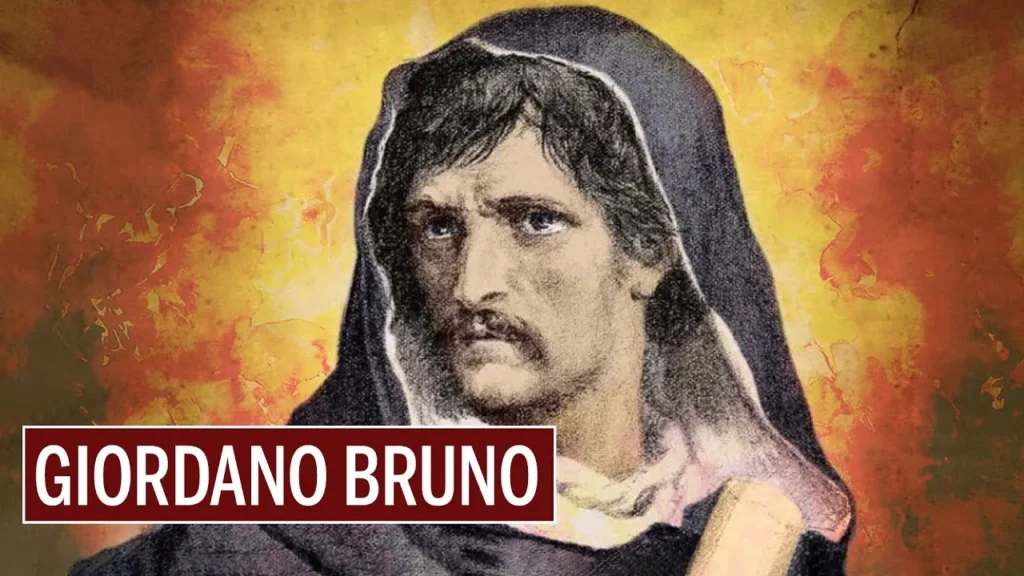
On the morning of February 17, 1600, in the Campo de’ Fiori in Rome, a man was led out into a square that was already crowded. He had spent eight years in the prisons of the Inquisition. He had been offered, repeatedly, the chance to recant — to say that what he thought, he no longer thought, to perform the small social lie that institutions have always accepted as the price of survival. He refused. The accounts of that morning record that when the sentence was read to him, he looked at his judges and told them that perhaps they pronounced this sentence with greater fear than he received it. They burned him. Then, with the specific thoroughness that only institutions truly committed to erasure ever achieve, they burned his books, suppressed his manuscripts, and ensured that for the better part of three centuries, the name Giordano Bruno would appear in history primarily as a footnote to the history of astronomy, reduced to a man who believed the earth moved around the sun, which is almost entirely beside the point.
What Bruno actually was, and what he actually believed, is a story the official version of Western intellectual history has never been entirely comfortable telling. He was a philosopher, yes, and a former Dominican friar, born in Nola near Naples in 1548. He was also something stranger and more difficult to categorize — a magician in the Renaissance sense of the word, an initiate of a tradition that predated Christianity and refused to be absorbed by it, a mind so thoroughly saturated in Hermetic thought that his cosmology, his ethics, his theory of memory, and his understanding of the divine were all branches of a single root that the Church recognized, correctly, as incompatible with its own claims to exclusive mediation between humanity and God.
Frances Yates, the historian whose 1964 work Giordano Bruno and the Hermetic Tradition remains the most consequential act of intellectual archaeology performed on Bruno’s legacy in the twentieth century, spent her career arguing that the standard narrative of the Scientific Revolution had systematically misread its own origins. The men who remade the European understanding of the cosmos were not simply rationalists breaking free from superstition. They were, many of them, deeply embedded in a tradition that was at once ancient, magical, and radically different from the institutional Christianity that surrounded them. Bruno was not a martyr to science. He was something the history of science found it convenient not to see.
That convenience has consequences. The room redirects the conversation. Everyone looks at their hands. And the thing that was said — the thing that was true, that was dangerous precisely because of its truth — disappears into the silence where inconvenient ideas are sent to die.
Memory as a Machine for Power
There is a man sitting in a library, surrounded by books he is not allowed to read. He has memorized their spines, their binding colors, the approximate weight of each volume in his hands. He does not need to open them anymore. Something has already passed from the page into him, reorganized itself behind his eyes, become architecture. The librarians find this unsettling in ways they cannot quite name.
What Bruno built was not a system for remembering things. That framing — the mnemonic trick, the useful technique — is precisely the misreading that has followed his work for four centuries, flattening something seismic into something merely clever. The Art of Memory, as Bruno practiced and theorized it in works like De Umbris Idearum in 1582 and the Ars Memoriae that followed, was nothing less than a cosmological technology. Its premise was that the human mind, properly trained, could become a mirror of the infinite universe — not a reflection in the passive sense, but a structural analogue. You did not memorize facts. You reorganized your own interior so that it corresponded to the organization of reality itself.
Frances Yates, in her landmark 1966 study Giordano Bruno and the Hermetic Tradition, traced this back to the memory theaters of classical antiquity, to Cicero’s Ad Herennium and its technique of placing images in imagined spaces. But Bruno radicalized what he inherited. Where the classical tradition used memory as a tool for rhetoric — for convincing others — Bruno turned it inward and upward, toward an almost mystical alignment with the cosmic order. The images he prescribed were not neutral placeholders. They were charged with Hermetic symbolism, drawn from the Neoplatonic tradition, seeded with the kind of energetic correspondences that Marsilio Ficino had mapped in the Theologia Platonica a century earlier. You were not filing information. You were restructuring your soul.
This is where the political danger begins, and it is not metaphorical. A person who has internalized the structure of the cosmos no longer requires an intermediary to interpret that cosmos for them. The Church, in 1582, was not merely an institution of faith. It was an epistemological authority — the body that determined what could be known, how it could be known, and by whom. The priest stood between the divine and the layperson as a necessary translator. The theologian stood between scripture and interpretation. The entire hierarchy depended on a certain managed opacity, on the idea that truth was not something you could simply arrive at yourself. Bruno’s memory system was an assault on that opacity from within the skull. It proposed that the individual mind, by aligning itself with the infinite, could become its own authority.
Michel Foucault, writing about the relationship between knowledge and power in Discipline and Punish in 1975, described how institutions regulate what counts as legitimate knowledge precisely because knowledge is inseparable from the capacity to act. Bruno would not have used Foucault’s vocabulary, but he understood the mechanism viscerally. A man who has memorized the architecture of reality — who has, in the Hermetic sense, become a microcosm of the macrocosm — does not need to ask permission before thinking. He does not need to wait for the Council to convene, for the bishop to issue a ruling, for the Index to be consulted. He carries his own tribunal inside him.
There is a scene that has stayed with many who have encountered it, in which a man is asked to recant what he knows to be true and finds, to his own surprise, that he cannot. Not because of courage in the theatrical sense. But because the knowledge has become so thoroughly fused with his interior structure that recanting it would require dismantling himself. He does not know where the idea ends and he begins.
That is precisely what Bruno’s system was designed to produce.

Hermes Before Christ
There is a particular kind of longing that makes people reach backward through time, convinced that whatever they have lost must once have existed in a purer form. It is not nostalgia exactly — nostalgia is personal, small, domestic. This is something more ambitious and more dangerous: the belief that somewhere behind all current corruption there was an original wisdom, a first knowledge, a moment before the fall into confusion. That longing is as human as hunger, and it shaped one of the strangest intellectual episodes in European history.
In 1463, a monk arrived in Florence carrying a Greek manuscript. He brought it to Cosimo de’ Medici, who at that moment had commissioned Marsilio Ficino to begin translating the complete works of Plato — the great project that would anchor the Florentine Academy and help define what we still call the Renaissance. But Cosimo, already old and feeling death approaching, asked Ficino to set Plato aside. What the monk had brought mattered more urgently. It was a collection of texts attributed to Hermes Trismegistus, the Thrice-Great Hermes, a figure believed to be an ancient Egyptian sage of almost incomprehensible antiquity. Ficino translated the Corpus Hermeticum within a few months. Cosimo died shortly after, having apparently read it. The document he took to his grave was considered older than Moses.
This is not a marginal footnote in intellectual history. What Ficino released into Renaissance Europe was a theological earthquake, quiet at first, then enormous. The texts presented themselves as the direct teachings of a primordial philosopher-priest who had somehow grasped the structure of the cosmos, the nature of the divine, the relationship between mind and matter, before any of the revealed religions had spoken their first word. The Renaissance scholars who encountered them experienced something close to vertigo. Here, they believed, was the prisca theologia — the original theology, the ancient wisdom that lay beneath and behind all subsequent religious traditions, the source from which Moses and Plato and Christ had all drawn without acknowledging it.
The chronology seemed airtight to them. The Greek scholars who authenticated the texts placed their composition in an era of Egyptian antiquity that preceded Greek philosophy by millennia. Pico della Mirandola, working in that same Florentine atmosphere charged with new possibility, built his entire syncretist vision on this foundation — the idea that all wisdom traditions, Platonic, Kabbalistic, Christian, Hermetic, were rivers flowing from a single hidden spring. Frances Yates, whose 1964 study Giordano Bruno and the Hermetic Tradition remains the central scholarly reckoning with this material, argued that the Hermetic vision was not merely a philosophical curiosity but the animating intellectual force behind the entire magical and scientific reformation of the sixteenth century. The magus who understood the cosmos could operate within it, could pull on its hidden sympathies, could become something more than a passive observer of God’s creation.
It was only in 1614 that the Swiss philologist Isaac Casaubon demonstrated, through careful linguistic analysis, that the Hermetic texts were not ancient Egyptian at all. Their vocabulary, their conceptual structures, their very syntax placed them firmly in the first to third centuries of the common era — products of the Hellenistic world, contemporary with early Christianity rather than ancestral to it. The prisca theologia had been a magnificent fiction, a text speaking in the voice of primordial authority that had actually been composed in Alexandria while Paul was writing his letters.
But Giordano Bruno died in 1600, fourteen years before Casaubon published his findings. Bruno lived and thought and was burned inside the belief that Hermes Trismegistus was real, that Egypt had once possessed a living cosmic religion, and that the recovery of that tradition was not scholarship but resurrection.
The Universe Has No Center, and That Is the Problem
There is a moment, familiar to anyone who has ever looked at an organizational chart and felt a quiet vertigo, when you realize that every hierarchy is a cosmology in miniature. The chart radiates outward from a single box at the top, and everything below it derives its meaning, its legitimacy, its very reason for existing, from proximity to that center. Remove the center, and it is not simply that the chart becomes unreadable. It is that every position within it loses the ground beneath its feet.
Bruno understood this with a clarity that was almost reckless. When he argued, across the dialogues he composed in London in the 1580s and in the Latin poems that followed, that the universe is infinite and contains innumerable worlds, he was not primarily making an astronomical claim. He was dismantling an architecture. The Aristotelian-Ptolemaic cosmos that medieval theology had absorbed and consecrated was not merely a picture of the sky. It was a political diagram. At its outermost rim sat the Primum Mobile, the first mover, which theologians had long identified with God. At its center sat the Earth. Between these two fixed poles, every sphere had its ordained place, every thing its proper motion, every institution its cosmic warrant. The pope was not merely a powerful man. He was the earthly analogue of a cosmological necessity.
Bruno read Copernicus and saw something that Copernicus himself had perhaps not fully intended. The heliocentric model moved the Earth from the center, yes, but it preserved the center — it simply reassigned it to the sun. For Bruno, this was not nearly enough. In his cosmological vision, there is no center at all. Every point in the infinite universe is equally central and equally peripheral. Every star is a sun. Every sun potentially warms worlds of its own. The Earth is not humbled by being displaced from the middle; it is liberated into equality with everything else. And this is precisely what made the proposition so dangerous, far more dangerous than heliocentrism alone.
Hannah Arendt, writing in The Human Condition in 1958, observed that the modern loss of a geocentric world deprived human beings of a stable point from which to measure and orient themselves, a loss she traced to consequences far beyond astronomy. But Bruno had already lived that loss as a liberation rather than a catastrophe, and it was this — the insistence on calling rootlessness a form of freedom — that the institutional mind found intolerable. The Inquisition, it should be said plainly, was not confused about what Bruno was doing. Its theologians were sophisticated men. They read the cosmological arguments and they understood immediately that infinity, in the sense Bruno meant it, is structurally incompatible with singular authority. If there is no edge, there is no throne room at the edge. If every world is real, then this world’s hierarchies are merely local arrangements, contingent, revisable, not written into the fabric of being.
The charges against Bruno at his trial included the denial of Christ’s divinity, the transmigration of souls, and the existence of multiple worlds. Historians of the period, including Luigi Firpo whose meticulous reconstruction of the trial documents published in 1993 remains the essential reference, have shown that the Inquisition returned to the cosmological questions with a persistence that suggests they were not peripheral. They were, in fact, the hinge. An infinite universe populated by innumerable worlds is a universe that has no need of a single mediating institution to stand between humanity and God, because there is no single humanity and the God Bruno described, following the Hermetic and Neoplatonic currents that fed his thought, is not a sovereign but a presence — immanent, diffuse, impossible to monopolize.
Someone in that tribunal room knew, with the instinct that power always has for its own dissolution, exactly what was at stake.
What the Magus Knew That the Scientist Forgot

There is a particular kind of forgetting that does not feel like loss. It feels like progress. The room gets cleaner, the instruments more precise, the results more reproducible, and nobody notices what was swept out with the dirt — because what was swept out looked, from a certain angle, exactly like dirt.
Bruno stood at the precise historical seam where two worlds were tearing apart from each other, and he refused to choose. He believed that the universe was alive — not metaphorically, not poetically, but structurally, constitutively alive. Every particle of matter carried within it something like interiority, something like appetite. The magus, in this framework, was not a fraud pretending to power he did not have. He was a technician of a different kind, someone who had learned to read the sympathies and antipathies woven into the fabric of things, to work with the grain of a world that pushed back, responded, desired. This was not superstition dressed in Latin. It was a rigorous, internally consistent cosmology that took seriously what mechanical philosophy would spend three centuries systematically erasing: the possibility that matter is not inert.
Frances Yates argued something that the academic establishment received with considerable unease when Giordano Bruno and the Hermetic Tradition appeared in 1964. Her claim was not merely biographical or historical. It was epistemological and, in its implications, genuinely destabilizing. She proposed that the Hermetic magical tradition — the animist, neo-Platonic current that flowed from Ficino through Pico della Mirandola and into Bruno — was not a detour away from the scientific revolution but one of its preconditions. The magus who believed he could act upon nature, who believed nature was penetrable and manipulable by human intelligence, who believed the cosmos was not a sealed clockwork indifferent to human intention but a relational field — that magus prepared the psychological and conceptual ground on which the experimentalist would later stand. Yates did not romanticize this. She traced it coldly, archivally, through the transmission of texts and the formation of intellectual networks across fifteenth and sixteenth century Europe. But the conclusion was uncomfortable: what we call the birth of science was partly a birth from magic, not a birth against it.
What happened next is the part that interests a philosopher of knowledge more than a historian of science. When the mechanical worldview consolidated — when Descartes cleaved mind from matter with surgical finality, when Newton’s laws described a universe that ran without remainder on mathematical rails — the animist inheritance did not simply retire gracefully. It was actively expelled. Banished. Declared not merely wrong but illegitimate, pre-rational, the embarrassing childhood of a humanity now grown into method. The exorcism was total and it was, in a specific sense, epistemologically violent, because it did not simply reject certain claims. It redrew the boundary of what counted as a claim at all. Questions about the interiority of matter, about the relational texture of natural phenomena, about what it might mean for the universe to be responsive rather than merely mechanical — these were not answered. They were reclassified as non-questions, mysticism, noise.
What the magus knew, and what the scientist forgot by structural necessity, was that the observer is never outside the system. Bruno’s universe did not permit the view from nowhere. You were always inside it, always implicated, always part of what you were attempting to describe. The Hermetic practitioner worked with that implication rather than trying to neutralize it. The genius of the mechanical method was precisely its evacuation of the subject — but that evacuation had a price, and the price was a cosmos that became, philosophically, a machine. Magnificent, predictable, and utterly unable to account for the fact that someone was watching it, wanting something from it, finding it, against all mechanical expectation, beautiful.
A vision curated by a filmmaker, not an algorithm
In this video I explain our vision
The Informer in Every Room
There is a particular kind of exhaustion that comes not from labor but from vigilance. The exhaustion of a man who has slept in seventeen cities in twelve years, who has learned to read a room before he reads a book, who knows that the wrong sentence spoken to the wrong person over supper can end everything. Bruno carried this exhaustion across Geneva, Toulouse, Paris, London, Wittenberg, Prague, Helmstedt, Frankfurt — a circuit of courts and universities and printing houses that traces, on any map of sixteenth-century Europe, the precise outline of a mind too large and too restless for any single jurisdiction to contain. He was not fleeing in any simple sense. He was lecturing, publishing, arguing, provoking. He was doing the one thing a man in his position could not afford to do and could not stop doing.
The sociologist Erving Goffman, writing in Stigma in 1963, described the social performance required of those who carry what he called a “discredited identity” — the constant management of information, the calibration of disclosure, the exhausting labor of deciding what to reveal and to whom. Bruno had no such luxury of calibration. His ideas were already in print. The infinite universe, the plurality of worlds, the identification of God with nature rather than above it — these were not private heresies whispered in confidence. They were published arguments, circulated, debated, admired and condemned in the same breath across the learned courts of Europe. A man cannot hide what he has already declared from a podium.
What he could not anticipate, or perhaps chose not to, was Giovanni Mocenigo. The Venetian nobleman had invited Bruno to his household in 1591 ostensibly to be taught the art of memory, that ancient mnemonic discipline Bruno had systematized into something approaching a cosmic philosophy. Mocenigo was ambitious and disappointed — a man who believed he had purchased access to secret knowledge and received instead a lecturer who would not be contained. When Bruno announced his intention to leave Venice for Frankfurt, Mocenigo denounced him to the Inquisition. The denunciation was dated May 23, 1592. The letter was methodical, almost administrative in its inventory of heresies. Bruno had said that Christ was a magician. That Moses was a sorcerer. That the soul transmigrated. That there were infinite worlds. Mocenigo had been taking notes.
There is a scene that returns across different lives and different centuries: a man is sitting at a table with someone he trusts, speaking freely, and somewhere in the room or directly across from him, someone is composing, mentally or literally, the document that will destroy him. Hannah Arendt, analyzing the mechanics of totalitarian systems in The Origins of Totalitarianism, identified the informer not as a marginal figure of betrayal but as a structural necessity — the institution requires witnesses, requires the translation of private speech into official record. The informer is not an aberration. The informer is the mechanism. Mocenigo was not a monster. He was a room with ears that had been given a pen.
The eight years of the Roman Inquisition trial that followed are largely lost to us — the records were burned or dispersed, and what survives are fragments, testimonies, reconstructed chronologies. What we know is that Bruno recanted portions of his thought, then withdrew his recantations, then offered partial accommodations that satisfied no one. He was not being tried for the truth or falsehood of his ideas. He was being asked to perform submission, to let the institution write over his mouth with its own language. This is what institutions have always wanted from dangerous thinkers — not silence, which would leave the ideas intact and martyrdom fresh, but collaboration, retraction, the spectacle of the mind turning against itself. And Bruno, stubbornly, cosmically, refused to become that spectacle.
The Heresy Was Not Theological
What the Inquisition could not afford to say out loud was this: we do not burn you for what you believe about Christ. We burn you because you have made us unnecessary.
The charges drawn up against Bruno over those eight years of Venetian and Roman imprisonment were theologically meticulous — denial of transubstantiation, rejection of Christ’s divinity in its orthodox form, contempt for the perpetual virginity of Mary. These were the formal instruments of the sentence, the bureaucratic language of destruction. But bureaucratic language is always a translation, and something is always lost in translation. What the documents cannot say is what the documents are protecting. And what they were protecting was not doctrine. It was mediation itself.
The philosopher Giorgio Agamben, working through the long history of what he calls the oikonomia — the theological machinery by which power administers itself — identifies the central function of institutional religion not as belief but as management. Management of access. Management of the threshold between the human and what lies beyond it. The priest does not merely interpret the divine; he controls the passage toward it. Remove that passage, declare it structurally unnecessary, and the entire architecture of authority dissolves. This is not a theological crisis. It is a political one, dressed in the vocabulary of salvation.
Bruno’s actual heresy was cosmological before it was theological. When he argued, with a precision that owes everything to his Hermetic inheritance and to the Neoplatonic current running from Plotinus through Ficino and Pico, that the divine does not reside above the world but saturates it — that every particle of matter carries within it a principle of life, of soul, of the infinite — he was not simply contradicting Aquinas. He was making the priest redundant. He was making the church building redundant. He was making every hierarchy that positions itself between the human being and the real structurally superfluous.
There is a scene that surfaces in memory, perhaps in someone’s recollection of a conversation overheard in a village square, perhaps in the testimony of a man who watched his neighbor stopped at the church door and told he could not enter without first confessing, without first paying, without first submitting. The man turns away. He looks at the sky, at the stones beneath his feet, at the particular quality of late afternoon light falling through the trees. And something in him understands — not as a thought but as a sensation in the body — that what he was being denied access to was already here. Was always already here. That the gatekeeper was guarding a gate that stood in an open field.
This is the understanding Bruno formalized. Not invented — formalized. The Hermetic tradition he inhabited had been saying it for centuries, drawing on sources that predated Christianity and would outlast it. The Corpus Hermeticum, those texts attributed to the mythical Thoth-Hermes that Ficino translated at Cosimo de’ Medici’s urgent request in 1463, insists repeatedly on the living quality of matter, on the cosmos as a single breathing organism whose parts are not separated from the divine but are expressions of it. Bruno took this further than anyone in his century dared. He took it all the way to infinity, to the plurality of worlds, to a universe without center and without edge — and in doing so, he took it all the way to a universe without a throne room. Without a place where power could install itself and claim it was speaking for something unreachable.
What cannot be tolerated is not the wrong answer. What cannot be tolerated is the suggestion that the question itself — who speaks for the divine, who owns the passage to the real — was always a fabrication designed to serve those who asked it.
Infinite Worlds, Finite Fires
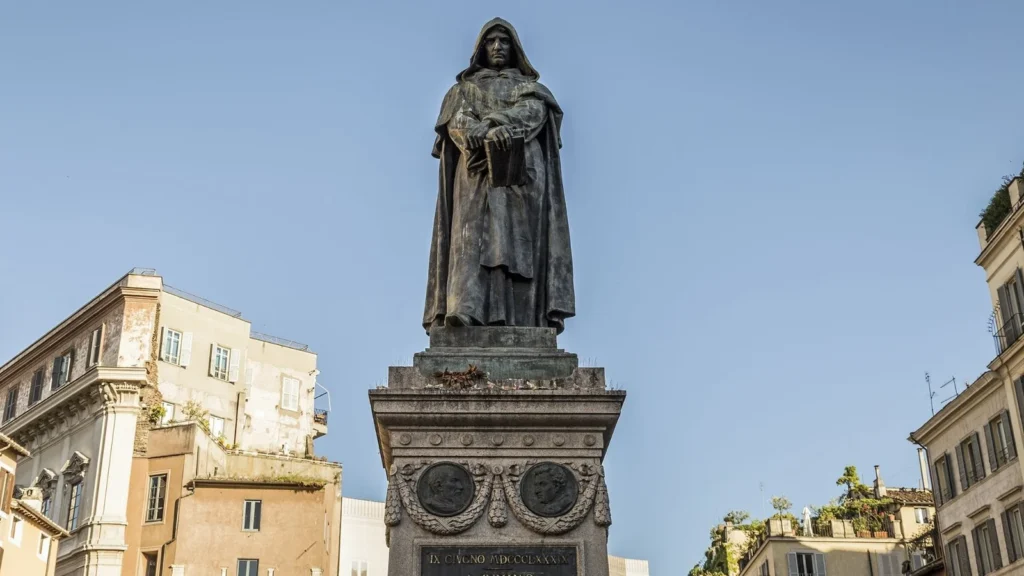
There is a statue in Rome that almost no one stops to think about. They photograph it, they walk past it, they buy coffee nearby and consult their phones. The figure stands hooded and slightly bent, facing the Vatican with what guidebooks invariably describe as defiance, and the square around it fills each morning with the noise of a market — artichokes, cut flowers, the smell of frying things from somewhere just out of sight. Campo de’ Fiori. The field of flowers. It was here, in February 1600, that Giordano Bruno was burned alive, and it is here, in 1889, that the Italian state chose to erect a monument to him, three centuries after the fact, at the precise moment when the newly unified Italy needed ammunition in its war against papal authority. The timing was not incidental. It was the entire point.
The secular appropriation of Bruno’s memory by the Risorgimento’s intellectual inheritors was not a rescue. It was a recasting. The freethinkers and anticlerical liberals who championed the statue’s construction — amid fierce Vatican protest that called it a deliberate provocation — were not interested in Bruno’s Hermeticism, his planetary souls, his infinite universe animated by a divine principle that made orthodox theology structurally impossible. They were interested in a martyr. And a martyr is useful precisely because they have already been reduced to silence. You can say anything on their behalf. You can inscribe whatever you need onto the bronze plinth and let the dead figure stand above it, unable to object.
Walter Benjamin understood this mechanism with a clarity that still cuts. In his theses on the philosophy of history, written in 1940 and published posthumously, he argued that every image of the past that is not recognized by the present as one of its own concerns threatens to disappear irretrievably. But the inverse is equally true and more insidious: every image of the past that is recognized too eagerly, that is seized and institutionalized and planted in a public square, disappears in a different way. It is not erased. It is domesticated. The statue becomes the thought. The monument replaces the danger. People who cannot name a single cosmological argument Bruno made can tell you he died for science, which is the kind of sentence that makes everyone feel edified and costs nothing.
Bruno did not die for science in any sense that Francis Bacon or Galileo would have recognized. He died for a vision of reality in which the universe had no center and therefore no fixed hierarchy, in which every world was as divine as every other, in which the human soul was not a peculiarity requiring redemption but a participant in an infinite living intelligence. This is not a thesis that becomes safe once the Church loses political power. It remains, in its full form, as destabilizing under secular rationalism as it was under papal authority, because it refuses the mechanical universe that secular rationalism requires just as firmly as it refused divine Providence. Bruno’s cosmos needs neither pope nor physicist to authorize its order. It simply breathes.
And so the monument is not, in the end, a contradiction of the burning. It is its continuation by other means. The fire in 1600 prevented Bruno from speaking further. The statue in 1889 ensures that what speaks in his name is stone, which cannot be cross-examined, cannot surprise anyone, cannot proliferate into directions that make its custodians uncomfortable. There is something almost elegant about this. The Church that condemned him and the state that commemorated him arrive, across three centuries of apparent opposition, at precisely the same result: a Bruno who cannot think any further thoughts, whose radicalism has been safely converted into heritage, whose infinite worlds have been reduced to the dimensions of a plinth in a Roman square where someone is always, just nearby, selling flowers.
🔥 The Flame That Would Not Be Extinguished
Giordano Bruno’s life and thought stand at the crossroads of Renaissance magic, Hermetic philosophy, and the relentless pursuit of cosmic truth. His vision of an infinite universe populated by countless worlds resonates across centuries with all those who dared to challenge orthodoxy and reimagine reality from its foundations. These related articles trace the same burning thread through mystics, rebels, and visionaries who refused the boundaries imposed upon the human spirit.
Aleister Crowley: the Great Beast and the Religion of Will
Like Bruno, Aleister Crowley built an entire philosophical and magical system around the sovereignty of the individual will, drawing deeply from Hermetic and Neoplatonic sources. His confrontational life and esoteric writings place him squarely in the lineage of those who sought to pierce the veil of consensus reality. Understanding Crowley illuminates the shadow side of the very Hermetic tradition Bruno helped transmit to the modern world.
GO TO THE SELECTION: Aleister Crowley: the Great Beast and the Religion of Will
Helena Blavatsky and Theosophy: the Woman Who Revolutionized Esoteric Thought
Helena Blavatsky‘s Theosophy represents one of the most ambitious modern attempts to revive the ancient Hermetic synthesis that Giordano Bruno championed during the Renaissance. Her monumental works drew on the same Neoplatonic, Gnostic, and Hermetic currents that shaped Bruno’s cosmology and mnemonic art. Exploring Blavatsky’s legacy is essential for anyone tracing the hidden thread that connects Renaissance magic to contemporary esoteric thought.
GO TO THE SELECTION: Helena Blavatsky and Theosophy: the Woman Who Revolutionized Esoteric Thought
The Great Tartaria: the Civilization Erased from the Maps of History
The suppression of Giordano Bruno mirrors a broader historical pattern in which entire civilizations, paradigms, and bodies of knowledge are deliberately erased from official memory. The thesis of the Great Tartaria explores how history itself can be rewritten to eliminate inconvenient truths, echoing the Inquisition’s attempt to extinguish Bruno’s infinite universe from the record. Both stories invite us to question the maps we have inherited and the hands that drew them.
GO TO THE SELECTION: The Great Tartaria: the Civilization Erased from the Maps of History
Pyotr Ouspensky: the Mathematician Who Sought the Fourth Dimension of Spirit
Pyotr Ouspensky‘s obsessive search for higher dimensions of consciousness and hidden cosmic order places him in direct philosophical kinship with Bruno’s vision of an infinite, living universe. Like Bruno, Ouspensky believed that ordinary perception conceals a deeper structure of reality accessible only through rigorous inner work and expanded thinking. His mathematical mysticism offers a modern mirror to the Renaissance mage who died rather than renounce his boundless cosmos.
GO TO THE SELECTION: Pyotr Ouspensky: the Mathematician Who Sought the Fourth Dimension of Spirit
Explore the Visionaries of the Infinite on Indiecinema
If these ideas have ignited your curiosity, Indiecinema is the streaming platform where independent cinema meets the depth of esoteric, philosophical, and countercultural thought. Discover documentaries, essays, and films that dare to go beyond the mainstream and illuminate the hidden history of the human spirit. Join us and keep exploring the infinite maze of ideas that shape who we are.
👉 EXPLORE THE CATALOG: Watch Indie Films in Streaming
A vision curated by a filmmaker, not an algorithm
In this video I explain our vision

