
The Man Who Refused the Part
There is a moment at the family table — you have been there, you know it — when someone asks you a question that is not really a question. It arrives dressed as concern, wrapped in the syntax of care, but underneath it is a command: confirm that you are still the person we decided you were. The roast is passed, the wine poured, and you watch yourself perform the answer before you have even thought it. Something in your chest tightens, not with anger exactly, but with the specific exhaustion of a person who has been playing a role so long the costume has started to fuse with the skin. You smile. You answer correctly. The table relaxes. And somewhere underneath the performance, a voice that belongs to no one they would recognize simply watches, waiting.

Most people live their entire lives inside that moment. The sociologist Erving Goffman spent decades mapping it with surgical precision — in his 1956 work “The Presentation of Self in Everyday Life” he argued that social life is fundamentally theatrical, that every interaction demands a performance calibrated to what the audience requires, and that the self presented publicly is almost never the self that exists privately. What Goffman described clinically, most people feel as a low and continuous hum of inauthenticity, the sense that they are perpetually auditioning for a role they did not choose in a play they did not write.
Edward Alexander Crowley was born in 1875 into a family that had already written the script in full. His parents were Plymouth Brethren, a severe Protestant sect that understood the world as a battlefield between salvation and damnation, and they raised their son inside that architecture of absolute moral surveillance. His father died when Crowley was eleven, and his mother, who called him the Great Beast from the Book of Revelation — meant as an accusation — could not have known she was handing him the costume he would wear for the rest of his life. He took the insult and made it his signature. That is not the move of a disturbed child. That is the move of someone who understood, very early, that if the world is going to project a monster onto you regardless of what you do, you might as well step fully into the projection and make it yours.
What Crowley refused was not decency or morality in any simple sense. What he refused was the external authority that claimed the right to define the terms of a human life. This is the distinction that his critics — and they were many, and often vicious — almost universally failed to make. The British press called him the wickedest man in the world. His name became a shorthand for corruption and occult excess, a convenient symbol that allowed respectable society to locate all its anxieties about transgression in a single flamboyant body. But symbols are chosen, not created. Society needed Crowley to be what it said he was precisely because what he was actually doing was more disturbing than wickedness: he was demonstrating, with theatrical and deliberate excess, that the social contract demanding the surrender of individual will in exchange for belonging is a contract one can refuse to sign.
He paid the full price for that refusal. He died in a boarding house in Hastings in 1947, largely destitute, his reputation so thoroughly demolished that serious engagement with his ideas would not begin for decades. There is something instructive in that price, not as a cautionary tale — that reading is too comfortable — but as evidence of how seriously a society takes the threat of someone who will not perform on command. The violence of the reaction tells you something about the depth of the wound.
Because the person at the dinner table, passing the roast, answering correctly, feels something they cannot quite name when they hear about someone who looked at the script and set it on fire. Not admiration necessarily. Something older and less comfortable than admiration.
Victorian Hell and the Making of a Heretic
There is a particular kind of silence that only religious households know. Not the silence of peace, but the silence of surveillance — the kind where every room feels observed, where the walls themselves seem to take notes. Edward Crowley, wool merchant and Plymouth Brethren preacher, built exactly this kind of silence around his son. The boy born in Leamington Spa on October 12, 1875 entered a world where the Bible was not metaphor but verdict, where pleasure was a category of sin, and where the love of a father was indistinguishable from the love of a God who required total submission as proof of devotion.
The Plymouth Brethren were not mainstream Anglicans performing Sunday theater. They were fundamentalists of genuine conviction, separatists who had withdrawn from institutional Christianity to live inside scripture with a literalism that had no exits. In that house, the Revelation of John was not poetry. It was a schedule. The Beast of the Apocalypse was not symbol but enemy, as real as the neighbors, as present as weather. When Crowley as a child began to resist, began to question, began to enjoy the things he was told would destroy him, his mother gave him the name that would define his public life and that he would eventually wear like a crown: the Great Beast, 666. She meant it as condemnation. He would spend the next seven decades converting it into identity.
His father died in 1887. Crowley was eleven years old. What happens to a child whose first and only model of masculine authority disappears before adolescence can be fully formulated is something Erik Erikson spent much of his career trying to map — the developmental rupture that forces identity to construct itself from wound rather than inheritance. But this was not merely personal psychology. It was also a cultural condition. Victorian England in the late 1880s was an empire operating at maximum ideological pressure, its morality functioning precisely as Michel Foucault would later describe power: not as repression from above but as discipline distributed through every social surface, internalized until subjects police themselves. The empire needed obedient bodies. Religion was the most efficient technology for producing them.
This was the England that Nietzsche had diagnosed from across the Channel with surgical contempt. When he wrote in 1882 that God was dead and that we had killed him, he was not celebrating atheism as liberation. He was announcing a catastrophe — that the entire structure of Western meaning had been built on a foundation that had quietly collapsed, and that no one yet knew what to do with the rubble. Nietzsche’s specific critique of English morality was withering: he saw it as Christianity with the metaphysics removed, the same resentment and slave morality dressed in secular clothes, the herd calling its timidity virtue. The English, he wrote in Twilight of the Idols, congratulated themselves for having emancipated themselves from God while keeping his shadow intact in every social institution. Crowley read Nietzsche. He read him the way a man who has been imprisoned reads a text that names his prison for the first time.
But here is the trap that most accounts of Crowley miss entirely. The monster the press would later construct — the wickedest man in the world, the Satanist, the corrupter of youth — was not a rebellion against Victorian England. It was Victorian England’s logic carried to its conclusion. A culture that defines identity through opposition to sin produces, inevitably, individuals who seek identity through the embrace of it. A theology that makes the Beast the supreme transgressor guarantees that the most transgressive personality in the room will reach for the Beast’s crown. The world that raised Crowley did not accidentally create him. It created him with the same systematic precision with which it created the missionaries, the administrators, the wives who never spoke. He was the shadow the system needed to cast in order to define its own light.
The silence of that childhood house was not just repression. It was the first draft of everything that came after.

Thelema: Will as Sacred Architecture
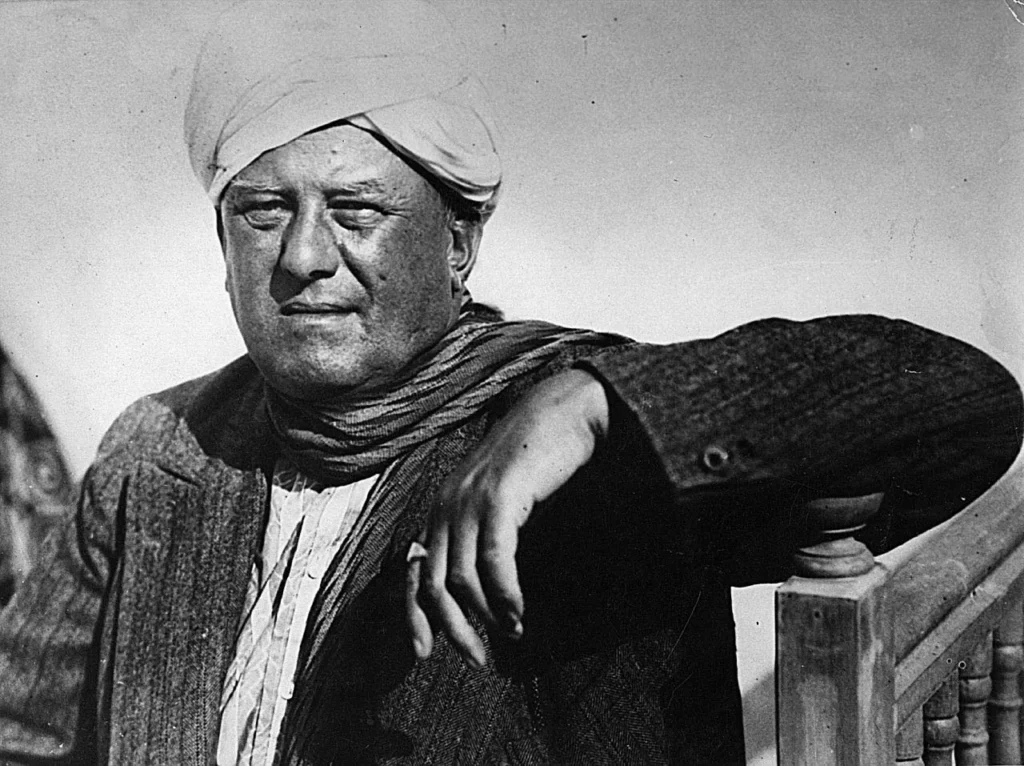
There is a moment most people have experienced at least once, usually in a season of exhaustion so complete that the performance of selfhood finally breaks down. You are sitting somewhere ordinary — a kitchen, a train compartment, a rented room in a city that is not yours — and the noise that normally fills the interior of a life simply stops. Not peace, exactly. More like the sudden awareness that everything you have been pursuing, every ambition and obligation and curated identity, belongs to a script you never agreed to read. And in that silence, something else is briefly audible. Something that does not argue or console. Something that simply insists.
A man sits in a Cairo hotel room in the spring of 1904 with his young wife, who has been entering states of altered attention that neither of them can explain. She speaks in a voice that does not sound like hers. She tells him to listen. For three consecutive days, at precisely noon, he sits in a chair and receives dictation from something that calls itself Aiwass, the minister of Hoor-Paar-Kraat. What emerges is 220 verses organized into three chapters, attributed to three Egyptian deities — Nuit, Hadit, Ra-Hoor-Khuit — and a sentence that will fracture the next century’s understanding of what spiritual law can mean. Do what thou wilt shall be the whole of the Law. Love is the law, love under will.
William James, writing in The Varieties of Religious Experience in 1902, two years before Cairo, described the conversion experience not as a theological transaction but as a psychological rupture in which a divided self briefly achieves unity. James was careful to treat the content of religious experience as secondary to its function: what mattered was not whether the vision was objectively real but whether it reorganized the subject from the inside out. He called the deeper self that broke through in these moments the subliminal consciousness, and he noted that its interventions were invariably felt as coming from outside, even when the subject later understood them as internal. The Cairo Working fits this template so precisely that it almost seems designed to illustrate it, except that Crowley would have resented the reduction. He did not believe he was receiving a projection of his own unconscious. He believed he was receiving cosmic legislation.
The distinction matters enormously, because The Book of the Law is not a philosophy of liberation in any contemporary therapeutic sense. It is not telling you to follow your pleasures or dismantle your inhibitions in the name of authenticity. The foundational error of nearly every popular reading of Thelema is to collapse True Will into desire, to hear the commandment as permission. But the True Will in Crowley’s system is not what you want. It is what you are. It is the trajectory built into your nature as a singular expression of a universe that is itself will in motion. Every star has its orbit, every soul its law. To deviate from it is not freedom but cosmic mistranslation.
This is a structure closer to Spinoza than to Nietzsche, closer to the Stoic logos than to romantic individualism. The person who heard something beneath the noise of their conditioning and could not unhear it — they were not liberated into infinite possibility. They were returned to necessity. Not the necessity of social obligation or psychological compulsion, but something more precise and more demanding: the necessity of being exactly what one is, without substitution.
Crowley organized this revelation into a system he called Thelema, from the Greek for will, and he spent the remaining decades of his life constructing the architecture to support it — rituals, grades, commentaries, magical orders, a new calendar beginning in 1904 as Year One of the new aeon. He was building a religion, with all the institutional scaffolding that implies. The question he never quite answered, the one that haunts every sacred architecture built around a single axis of individual sovereignty, is who adjudicates the True Will when it looks suspiciously like the will to dominate.
The Beast the Press Needed

There is a man sitting alone at a café table in a Sicilian village, reading. He has been there every morning for weeks. Nobody speaks to him directly. Nobody needs to. The grocer begins taking longer to serve him. The landlord suddenly remembers a prior commitment. Children who used to run past his window are redirected down another street. No violence, no confrontation, nothing so clean as an accusation. Just the slow, consensual withdrawal of ordinary life until the air around him becomes unbreathable. He leaves eventually. Everyone will say he chose to go.
This is how the early twentieth century handled Aleister Crowley, though it dressed the process in headlines rather than silence.
The John Bull campaigns of 1923 require a specific kind of attention, because they were not reporting on Crowley so much as manufacturing a particular figure the cultural moment desperately required. The British tabloid, under the editorial direction of Horatio Bottomley, ran a series of exposés that crystallized around the phrase that would follow Crowley for the rest of his life: the wickedest man in the world. The timing was not incidental. Europe was still metabolizing the catastrophe of the First World War. The old moral architecture had been shelled into rubble. Something had to be identified as the source of the rot, and it needed to be a person, not a system, not a century of industrial rationalism, not the empires that had sent twenty million people to die in the mud. A magician in Sicily would do perfectly.
Michel Foucault, writing in Discipline and Punish in 1975, articulated what was already operationally true in 1923: that power does not primarily repress but produces, and that the production of the deviant subject serves a normalizing function for the social body. The discourse around Crowley was not aimed at him. It was aimed at everyone reading John Bull on the morning train, reassuring them of what they were not. Every detail of Thelema, every ritual at the Abbey of Thelema in Cefalù, every rumor of drug use and sexual ceremony became raw material for the construction of an exterior against which the interior of respectability could measure and congratulate itself.
The expulsion from Sicily came in 1923, technically ordered by Mussolini’s new fascist government, though the diplomatic pressure from Britain had made it a near-inevitability. Crowley was physically removed from the country, his small community of disciples dispersed, the Abbey’s walls — painted with murals he had spent years creating — eventually whitewashed over by the authorities as though even the images needed to be punished. He took the expulsion as a badge. He perhaps did not fully understand that the badge was also a cage.
The libel trial of 1934 revealed the mechanism with particular clarity. Crowley sued Nina Hamnett for suggesting in her memoirs that he practiced black magic. He lost. The jury returned a verdict against him after less than an hour’s deliberation, and the presiding judge, Mr. Justice Swift, issued remarks that had nothing to do with evidence and everything to do with the culturally settled nature of Crowley’s monstrosity. By that point he had become what Foucault might have called a discursive object, something whose meaning was produced not by what he actually did but by the accumulated weight of what had been said about him. The trial was not a legal proceeding. It was a ratification.
Stanley Cohen, whose Folk Devils and Moral Panics would appear in 1972, identified the structural role of the folk devil as a figure who condenses diffuse social anxiety into a legible enemy. The early twentieth century had accumulated an extraordinary quantity of diffuse anxiety: urbanization, sexual liberalization, the collapse of Victorian certainty, the first tremors of what would become the psychedelic counterculture. Crowley absorbed it. He was not destroyed by the press. He was used by it, which is in some respects a more complete form of violation, because it leaves the subject standing while emptying them of any meaning they chose for themselves.
The man is still sitting at the café table. He thinks he is being persecuted for what he believes.
Magick, Consciousness, and the Cartography of the Self
There is a moment most people recognize but rarely speak aloud: you are sitting in a room you know intimately, surrounded by objects that belong to your life, and you feel with sudden and terrible clarity that you do not know who is inhabiting the body in the chair. Not a crisis, not a breakdown. Something quieter and more unsettling than either. The furniture is real. The hands are yours. But the self that should be standing behind the eyes is nowhere you can locate it.
A man prepares himself in a basement room, alone. He arranges objects on a table with a precision that looks religious but claims nothing. He writes something in a notebook, then tears the page out and burns it. He stands in front of a mirror for a long time without moving. Whatever is happening in that room is not performance, because there is no audience. It is closer to surgery — the kind performed on a patient who is also the surgeon.
This is, stripped of its theatrical excess, what Crowley’s system actually demands. Magick in Theory and Practice, published in 1929, is not an occult manual in any casual sense of the word. It is a phenomenological document, one of the most rigorous attempts in Western modernity to systematize the conditions under which a human being can encounter the architecture of their own unconscious as lived experience rather than interpreted text. Crowley defines Magick — deliberately misspelled to distinguish it from stage illusion — as “the Science and Art of causing Change to occur in conformity with Will.” The definition sounds grandiose until you recognize that the primary theater of operations is always the self. The external world is secondary. The practitioner is both laboratory and experiment.
The grades of the A∴A∴, the magical order Crowley founded in 1907, trace a map that is almost embarrassingly close to what Jung would later call individuation. The aspirant moves through stages of self-confrontation, shadow integration, and ego dissolution that Jung described in systematic form only in 1944 in Psychology and Alchemy, though his early formulations appear in the 1916 essay on transcendent function. The resemblance is not coincidental — both men were drawing maps of the same territory, the psyche’s hidden architecture — but Crowley’s system places the body inside the process in a way Jung’s model never quite managed. The rituals are somatic events. They are designed to produce real physiological states, disruptions of habitual perception that force the organism to encounter what it normally manages to avoid.
William Reich, who by 1933 had developed his concept of character armor in Character Analysis, understood this dimension with clinical precision. He argued that neurotic patterns are not merely psychological but are literally inscribed in the musculature, in the held breath, in the rigidity of posture. The character is a physical fortress, constructed against unbearable experience. What Crowley’s ritual practice demands — the prolonged postures, the breathing techniques drawn from yogic tradition, the deliberately induced stress states — amounts to an assault on exactly this fortress. Not metaphorically. Physiologically. The body is the site of the operation because the body is where the defenses live.
The Qabalah, which provides the structural skeleton of Crowley’s system, functions as a cartographic tool. Its ten sephiroth and twenty-two paths are not theological claims. They are coordinates for mapping states of consciousness onto a structure that allows navigation. Without a map, the interior journey produces only chaos; the practitioner cannot distinguish genuine transformation from psychotic dissolution. The map does not make the territory safe. It makes it traversable.
What remains after the pantomime is removed — the robes, the Latin, the theatrical naming of demons — is something that deserves to be taken seriously precisely because it refuses the comfort of pure theory. Freud could write about the unconscious. Jung could diagram it. Only Crowley built a gymnasium for encountering it, and walked in first.
A vision curated by a filmmaker, not an algorithm
In this video I explain our vision
The Inheritance No One Wants to Claim
There is a storage unit somewhere outside a mid-sized American city, rented by a man who inherited it from his uncle, who inherited it from someone else, and inside there are boxes he has never opened. He knows, vaguely, what is in them. He has been told they contain books, notebooks, objects whose purpose he cannot name. He pays the monthly fee. He does not go back. The inheritance sits there accruing dust and cost, which is perhaps the most honest relationship most people have with dangerous ideas.
Kenneth Grant understood the weight of those boxes better than almost anyone. Crowley’s most devoted and most troubling successor, Grant spent decades after the master’s death in 1947 elaborating the system into territories Crowley himself might have found excessive — the Typhonian Trilogies, nine volumes published between 1972 and 2002, mapping a magical universe that bled into H.P. Lovecraft‘s mythos, into Tantrism, into extraterrestrial gnosis. Whether Grant was a visionary extending a genuine current or a brilliant paranoid constructing an elaborate private mythology, the question itself is Crowleyan: it cannot be answered from outside the system, and entering the system to answer it changes the questioner irrevocably. That is not a metaphor. That is the epistemological trap Crowley built into Thelema from the beginning.
Jack Parsons encountered it differently. Rocket engineer, co-founder of the Jet Propulsion Laboratory, man whose calculations helped send the first American satellites into orbit — Parsons spent the 1940s performing Crowley’s Babalon Working in the California desert alongside L. Ron Hubbard, attempting to incarnate a magical child in the aethyr. He died in a laboratory explosion in 1952 at thirty-seven. The official account is accident. The life that preceded it was anything but. Parsons is the figure who most nakedly demonstrates the specific gravity of Thelema when taken seriously: it does not separate the laboratory from the ritual room, the scientific mind from the ecstatic body. It insists they are the same project. The culture that inherited his rocket science quietly buried his magical diaries.
Then came the 1960s, and the culture stopped burying things, or believed it had. Crowley’s face appeared on the cover of Sgt. Pepper in 1967, positioned among the company of the beloved dead, which was either the most significant act of cultural canonization in the twentieth century or a graphic designer’s whim — the two possibilities are not as far apart as they seem. Jimmy Page bought Boleskine House on the shores of Loch Ness, Crowley’s former residence, and spent years collecting the man’s manuscripts, paintings, and instruments, understanding instinctively that the work was not separable from the objects, that magical transmission moves through material things. The OTO, legally reconstituted under Grady McMurtry in 1977, now operates in dozens of countries, publishing, initiating, maintaining the structure Crowley built for an idea that was never meant to become an institution.
And then there is what happened to the idea once the institution became optional. The Law of Attraction, The Secret, the entire architecture of manifestation culture that generates billions annually from the premise that focused desire reshapes reality — all of it is Thelema with the teeth removed, the darkness edited out, the cost hidden in fine print. Do what thou wilt, sold as a subscription. The True Will rebranded as personal branding. Crowley spent his inheritance, destroyed his health, was declared a public menace, died in a boarding house in Hastings with almost nothing, because he understood that if the idea was real it would cost everything, and if it cost nothing it was not the idea. The industry that sells his conclusions without his premises is not a corruption of his work. It is the most precise possible demonstration of everything his work was warning against.
Somewhere a man is still paying rent on a storage unit he never visits. The boxes inside contain something he cannot name. He suspects, in the way that serious suspicion operates below language, that opening them would require him to become someone he has not yet decided to be.
What does it mean to take will seriously — not as affirmation, not as lifestyle, but as the one thing that cannot be outsourced, cannot be coached, cannot be streamed, and that the entire architecture of contemporary culture exists, with extraordinary precision, to prevent you from ever locating?
🐍 Occult Masters and the Forbidden Paths of Spirit
Aleister Crowley did not emerge from a void — he was part of a wider current of Western esoteric seekers who challenged religion, science, and morality to reshape humanity’s understanding of the sacred. From Theosophists to Gurdjieffian masters, the late 19th and early 20th centuries produced a constellation of visionaries, heretics, and prophets who left lasting marks on spiritual culture. These articles explore the labyrinth of occult thought that surrounded and shaped the world Crowley inhabited.
George Gurdjieff: the Master Who Broke His Disciples to Wake Them Up
George Gurdjieff, like Crowley, believed that ordinary human beings are asleep — enslaved by habit, personality, and unconscious impulse — and that only radical shock and self-overcoming could awaken the true will. His methods were deliberately confrontational, designed to shatter the false self and expose the raw material of genuine inner transformation. The parallels with Crowley’s Thelemic doctrine of ruthless self-discovery make Gurdjieff an essential companion figure in any study of early 20th-century esoteric radicalism.
GO TO THE SELECTION: George Gurdjieff: the Master Who Broke His Disciples to Wake Them Up
Helena Blavatsky and Theosophy: the Woman Who Revolutionized Esoteric Thought
Helena Blavatsky laid the philosophical groundwork upon which much of Crowley’s magical universe was built, synthesizing Eastern cosmology, Western Hermeticism, and occult science into a vast system that influenced an entire generation of seekers. Crowley both absorbed and rebelled against Theosophical ideas, finding in Blavatsky a predecessor he could both honor and desecrate. Understanding Theosophy is essential to grasping the intellectual and spiritual atmosphere that produced the Great Beast.
GO TO THE SELECTION: Helena Blavatsky and Theosophy: the Woman Who Revolutionized Esoteric Thought
Esoteric Movies to Watch
The world of esoteric cinema has long been fascinated by figures like Crowley — men and women who pursued hidden knowledge at the edge of madness and transcendence. This curated selection of esoteric films explores the same forbidden territories: ritual, initiation, the shadow self, and the terrifying beauty of genuine spiritual transformation. It is the perfect visual complement to any deep dive into the life and mythology of Aleister Crowley.
GO TO THE SELECTION: Esoteric Movies to Watch
Universal Consciousness
Crowley’s concept of the True Will was, in many ways, a radical reformulation of the ancient mystical idea that individual consciousness is an expression of a universal, divine intelligence. The notion of Universal Consciousness runs beneath much of Western occultism as its deepest current, connecting Crowley’s Thelema to Buddhist non-self, Theosophical cosmology, and Jungian depth psychology. Exploring this concept reveals the metaphysical scaffold hidden beneath Crowley’s provocative theatrical mysticism.
GO TO THE SELECTION: Universal Consciousness
Discover the Hidden Worlds of Independent Cinema
If these forbidden paths of esoteric thought have ignited your curiosity, Indiecinema is the streaming platform where that fire finds its images. From visionary documentaries to bold independent films exploring consciousness, spirituality, and the occult, Indiecinema offers a curated universe for those who refuse to watch passively. Enter the maze — and stream differently.
👉 EXPLORE THE CATALOG: Watch Indie Films in Streaming
A vision curated by a filmmaker, not an algorithm
In this video I explain our vision

