
The Walk You Didn’t Choose
You leave the house at the same time, take the same turn at the corner where the pharmacy replaced the bookshop three years ago, and your feet already know the rest. You don’t decide the route. The route decides you. There is a groove worn into the city at the exact coordinates of your daily passage, invisible but as real as asphalt, and you move along it the way water moves along a channel — not freely, but efficiently, shaped by walls you stopped noticing long ago.

The storefront sequence is so familiar it has become a kind of grammar. The laundromat, the shuttered travel agency, the halal butcher with the handwritten sign, the construction hoarding that has been promising luxury apartments for two years. You read this sentence every morning without knowing you’re reading it, and it tells you something about your place in the city before you’ve had a single conscious thought. It tells you which part of town this is, what kind of person walks here, what kind of person you must be to be walking here now, at this hour, in this direction.
This is not metaphor. This is the actual mechanics of how urban space operates on consciousness. Guy Debord understood it with a clarity that bordered on fury. In 1958, writing in the Internationale Situationniste, he defined psychogeography as the study of the specific effects of the geographical environment, consciously organized or not, on the emotions and behavior of individuals. That phrase — consciously organized or not — is where the teeth are. Because most of what the city does to you, it does without declaring any intention. The angle of a street, the placement of a pedestrian crossing, the decision to put a park here and a parking structure there — these are not neutral choices. They are arguments made in concrete and steel about who moves, where, how fast, with what purpose, toward what end.
Henri Lefebvre, whose 1974 work The Production of Space remains one of the most rigorous dissections of this problem, insisted that space is not a container in which social life happens. Space is itself a social product, saturated with power relations, historical sediment, and ideological pressure. When you walk your commute, you are not passing through empty geography. You are moving through a political document. Every decision about where the bus stop stands, where the sidewalk narrows, where the crosswalk was never installed — these are arguments about whose time matters, whose body the city was built to carry.
You feel this in your body more than your mind. There is a particular tiredness that sets in not from distance but from repetition, from the sensation that the path was already complete before you stepped onto it. A man stands in a long hallway lined with identical doors, running his hand along the wall as though searching for a variation that isn’t there. He is not lost. That’s the problem. He knows exactly where he is, and the knowing has become its own kind of trap. The corridor goes where it goes. His feet understand this. His face does not argue.
The city’s genius, if you can call it that, is that it disguises compulsion as habit and habit as preference. You take this route because it’s the fastest, you tell yourself. But fastest according to what calculation, and who ran the numbers, and when, and in whose interest? The street grid of Lower Manhattan was not drawn with your commute in mind. Haussmann’s boulevards, sliced through Paris between 1853 and 1870, were explicitly designed to prevent barricades and ease the movement of troops. The city remembers its intentions long after you’ve forgotten to ask what they were.
And so you walk. The pharmacy where the bookshop used to be. The construction hoarding. The same fatigue arriving at the same corner, punctual as weather.
Venetian Arcanum
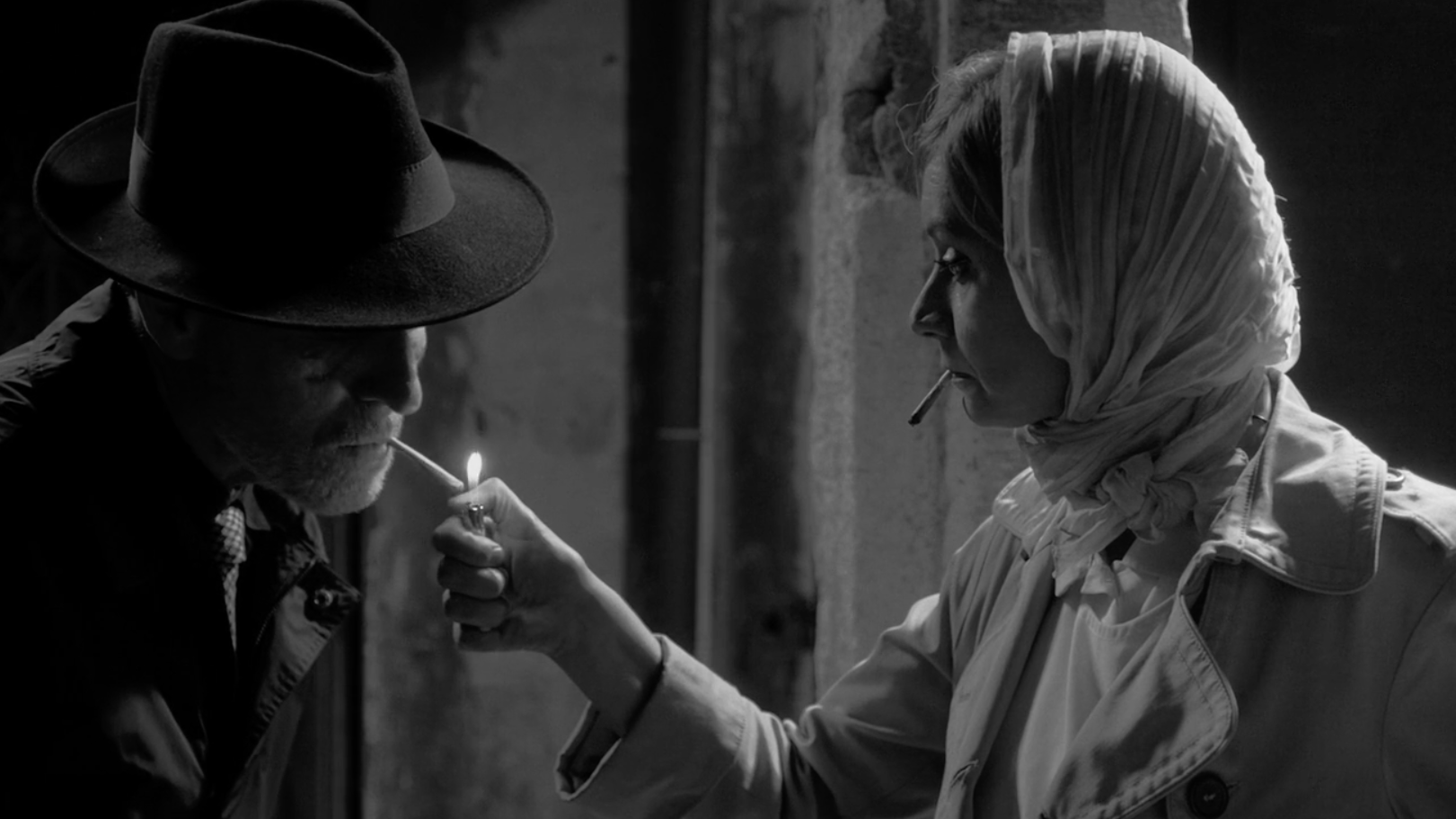
Thriller, by Serge Turgeon, Italy, 2025.
In Venice, a mysterious presence appears once every century or two, haunting the canals and hidden corners of the city. Driven by a sense of destiny, a woman decides to search for it. Following its elusive traces, she is drawn deeper and deeper into the city’s arcane secrets. Reality and myth begin to blur, and Venice itself transforms into a labyrinth of dangers.
LANGUAGE: Italian
SUBTITLES: English
The Dérive and the Drift of Consciousness
You leave the apartment without a destination. Not because you have nowhere to go, but because you have decided, for once, to refuse the invisible rails that every city lays beneath your feet. The errand, the commute, the familiar shortcut — all of it suspended. Within three blocks, you feel it: a mild disorientation that is not quite anxiety, something closer to the sensation of hearing your own name spoken in a crowded room. The city, stripped of its purpose, becomes suddenly strange. You have not gone anywhere new. You have simply stopped obeying.
This is what Guy Debord was reaching toward in 1958 when, writing in the journal Internationale Situationniste, he formalized what the Situationists called the dérive — a word that carries in French the double meaning of drift and deviation, of something that has slipped its mooring. The dérive was not a recreational walk. It was not urban tourism or the romantic wandering of a flâneur. It was a deliberate rupture in the behavioral contract between a person and the city built to manage them, a counter-attack disguised as a stroll.
To understand why such a gesture carried genuine weight in 1958, you have to hold in mind what Paris actually was at that moment. The city had survived occupation, collaboration, liberation, and the particular shame that follows all three. It was also, beneath the surface of reconstruction and modernization, still living inside the skeleton of Baron Haussmann’s nineteenth-century surgery. Between 1853 and 1870, under the direction of Napoleon III, Haussmann had eviscerated medieval Paris, driving his grand boulevards through working-class neighborhoods with the explicit goal of creating streets too wide for barricades and sightlines long enough for artillery. The architectural historian Sigfried Giedion noted in Space, Time and Architecture, published in 1941, how Haussmann’s urbanism encoded military logic into civic form — not as conspiracy, but as the natural grammar of a state that had learned to fear its own population gathered in narrow streets.
By the postwar decade, that grammar had been updated, not abandoned. Le Corbusier’s modernist planning ideology — the towers, the zoning, the separation of functions, the rational city as machine for living — was reshaping the periphery of Paris and dozens of other European cities. The urban theorist Henri Lefebvre, who was thinking alongside and often against the Situationists during this period, would argue in The Production of Space, published in 1974, that what appeared as planning rationality was in fact the production of abstract space: space organized not around lived human experience but around the requirements of capital circulation, administration, and legibility to power. The city was being made readable — to planners, to developers, to the state — by being made less livable, less complex, less capable of surprise.
The dérive was a refusal of that readability. Debord described it as a technique for studying the psychogeographical effects of the urban environment, the way that specific architectural arrangements, spatial transitions, and ambient atmospheres exert what he called a precise action on the emotions and behavior of individuals. This was not metaphor. The Situationists were proposing something closer to an empirical claim: that the city acts on the body with the specificity of a drug, and that most people move through it in a state of narcoleptic compliance, following paths that were designed to produce exactly the compliance they mistake for free movement.
There is a man who has lived in the same neighborhood for eleven years and has walked the same route to the same market every Saturday morning. One day, through nothing more deliberate than a wrong turn, he finds himself in a courtyard he has never seen — a different quality of light, a different pressure in the air, an inexplicable sensation that something here has been waiting. He stands there for a long time. He is not lost. He has, briefly, arrived somewhere the city never planned for him to be.

What the City Is Actually Saying
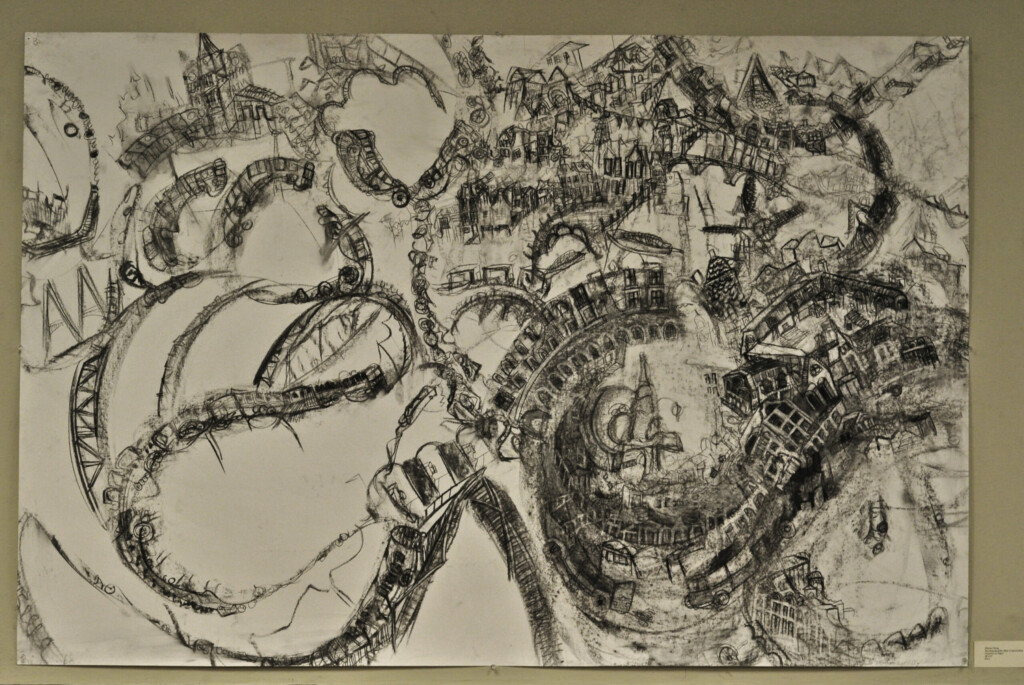
You have been walking for forty minutes and you no longer know where you are, which means, for the first time tonight, you are actually somewhere. The grid of the map you memorized before leaving the hotel has dissolved in the rain and the wrong turns, and what remains is the city itself — not the representation of it, but the thing. A narrow street bends away from you at an angle that feels almost apologetic, the buildings leaning inward at the upper floors as if sharing a secret, and without deciding to, you slow down. You don’t know why. The body knows before the mind does.
This is precisely what Guy Debord was trying to name in 1955, when he wrote that geography, as it had always been practiced, was a lie of omission. In his “Introduction to a Critique of Urban Geography,” he insisted that the emotional climate of a neighborhood — what he called the ambient atmosphere, the affective charge of a district — was as real and as structuring as any zoning law or traffic pattern. The city was not a neutral container for human activity. It was an argument. It was making claims on you, shaping your mood, accelerating or decelerating your pulse, and the discipline that studied cities had decided, politely and systematically, to ignore all of that.
So you stand at the bend in the street and you feel the argument. The pale yellow of a lit window three floors above you suggests habitation without invitation. The cobblestones are uneven in a way that forces you to look down, to attend to where you place your weight, which means you are less a viewer of this place than a participant in it, a body negotiating a surface. Henri Lefebvre, writing nearly two decades after Debord, would insist in “The Production of Space” in 1974 that space is never simply there, never given, never innocent. It is produced — by labor, by power, by the accumulated decisions of people who mostly wanted to keep other people in their place. The space you move through has a politics even when it looks like architecture.
And the architecture, tonight, is speaking in a register just below language. A doorway sealed with metal sheeting tells you something ended here and did not reopen. A church facade too large for the street it anchors creates a kind of gravitational pull that has nothing to do with faith and everything to do with proportion, with the way scale produces awe or anxiety almost chemically. You find yourself crossing to the other side of the street not because of traffic but because of something in the quality of the shadow on one pavement versus the other. You obey this instruction without having received it consciously.
Debord’s psychogeography was the study of exactly this obedience. The derive — the drift, the unplanned traversal of urban space, following the pulls and resistances of the environment rather than any predetermined route — was not a romantic wandering. It was a diagnostic tool. It asked: what is this city actually doing to the people inside it, and who benefits from what it does? Because the emotional states produced by built environments do not arise naturally. They are engineered, sometimes deliberately and sometimes through the sedimented habits of centuries of class interest, colonial administration, and market logic.
You turn a corner and the street opens without warning into a square that feels like an exhaled breath. The pressure you didn’t know you were carrying lifts slightly. There are a few figures at a distance, pigeons, a fountain that isn’t running. You did not choose to feel relieved. The space chose it for you, offered it as a kind of gift, and you accepted without negotiating the terms. The city is always doing this — handing you emotions as if they were your own, as if you arrived with them.
Spectacle as Architecture
You are standing in the center of an atrium so large it has its own weather. The light falls from a glass ceiling forty meters above, diffused and sourceless, the kind of light that belongs to no particular hour. Around you, levels of walkways spiral upward, each one lined with storefronts that sell the same twelve categories of thing in slightly different arrangements. There is the faint smell of something baked, engineered to travel exactly this far and no further. You came here for a reason. You are almost certain of it. But standing in the geometric center of this space, you realize the reason has dissolved, and what remains is only the sensation that you were supposed to arrive. That the arriving was the point.
Debord understood this before the architecture fully existed to prove him right. In 1967, when he published “The Society of the Spectacle,” the great enclosed malls were only beginning their spread across the American suburban grid, and European city centers were still being quietly reorganized along the same principles. His argument was not primarily about images, though everyone quotes it that way. It was about the reorganization of lived experience into something that could be watched rather than inhabited. The spectacle, for Debord, was not a collection of screens. It was a social relationship between people, mediated by images — and, crucially, by space. Space built to produce a particular kind of subject: one who circulates, pauses, desires, purchases, and circulates again, mistaking this loop for freedom.
The atrium does not coerce you. That is its genius and its violence. Henri Lefebvre, whose thinking ran parallel to and sometimes ahead of Debord’s, wrote in “The Production of Space” (1974) that conceived space — space planned by architects, economists, and urban managers — always carries within it a politics of the body. It tells bodies how to move, where to slow down, where the rhythm of walking should shift into the rhythm of looking. The atrium produces exactly this: a body that performs the act of being present in a city without the city making any demands of it. No weather, no contingency, no stranger whose path intersects yours with actual consequence.
Walter Benjamin saw something of this coming when he walked the Paris arcades in the 1930s and wrote about the flâneur as a figure already becoming obsolete — the person who moved through commercial space as an act of reading, of decipherment, of genuine encounter with the social text of the street. The arcade seduced and also revealed. But the spaces that came after — the mall, the pedestrianized boulevard designed for retail, the civic plaza surrounded by chain restaurants and managed vegetation — these no longer seduce. They simply absorb. They produce a subject who is always almost somewhere, always almost doing something, suspended in a permanent present tense that is indistinguishable from waiting.
The woman in the atrium eventually moves. Not because she has remembered her reason, but because standing still in these spaces triggers a low social anxiety, the feeling of being watched without performing correctly. She walks toward a window display. She looks at things she does not want. The architecture has already won, not by forcing her toward consumption but by making movement-toward-consumption the only legible behavior available. Every other posture — sitting, pausing, simply existing without orientation toward a product — is subtly illegible here, slightly wrong in a way the space itself never announces.
This is what Debord meant when he said the spectacle was not something added to the real world but was itself the real world, become spectacle. The city was not built and then decorated with commercial logic. The commercial logic was the blueprint. The streets, the sightlines, the placement of benches and the strategic absence of them — all of it is argument, made in concrete and glass, about what a human being is for.
The Map That Erases the Territory
There is a particular kind of vertigo that has nothing to do with height. You walk through a block you knew once — or that someone who raised you knew, which amounts to the same thing in the body — and the geometry is clean, the sightlines unobstructed, the surfaces new. And yet something presses against your sternum from the inside, a weight without an object, a grief without a corpse to point to. The buildings are there. The street is there. What is absent is the friction, the accumulated resistance of a place that was once lived rather than administered.
This is not nostalgia, which is always partly a lie we tell ourselves about a past that never quite existed as we remember it. This is something older and less comfortable: the body’s refusal to accept that space is neutral.
Le Corbusier understood space as neutral — or rather, he understood it as a problem to be solved, a disorder to be rationalized. His Plan Voisin, proposed in 1925, called for the demolition of most of central Paris north of the Seine and its replacement with eighteen uniform cruciform towers set in open green space, the street grid below dissolved into controlled pedestrian and vehicular flows. He called what he would destroy the tangle. He was not wrong that it was tangled. He was catastrophically wrong about what the tangle contained. What he read as chaos was density of use, overlap of function, the sediment of generations making and remaking the same few square meters according to need rather than according to diagram. When you plan from above — and Le Corbusier almost always drew his cities from above, from the perspective of a god or a pilot — you see pattern and obstruction. You do not see the woman who has bought bread from the same doorway for thirty years, or the particular angle of afternoon light that makes a certain corner the place where teenagers have always gathered without ever deciding to.
Robert Moses never read Le Corbusier particularly carefully, but he shared the fundamental epistemology: that the city is a circulation problem, and that whatever impedes circulation is, by definition, waste. Between the 1930s and the 1960s, he displaced an estimated half million people in New York City alone, routing expressways through the South Bronx and East Tremont with a logic that was impeccable on paper and devastating on the ground. The Cross Bronx Expressway did not merely destroy buildings. It destroyed the connective tissue of neighborhoods — the informal networks, the corner economies, the spatial memory that made a community legible to itself.
Michel de Certeau, writing in 1980, made the distinction that planners have always refused to make: between the map and the walked path. The map is the city as seen from above, complete, simultaneous, totalized. The walked path is the city as it is actually inhabited — sequential, partial, shot through with habit and association and bodily memory that no diagram can capture. The map is always a reduction, but it presents itself as a representation. It claims to show you the territory. What it actually shows you is the territory minus everything that cannot be quantified, which is to say, minus most of what makes it a place rather than a location.
What the planner erases is precisely what de Certeau called “spatial stories” — the narratives that ordinary walkers generate simply by moving through the city according to their own logic rather than the logic imposed from above. Every detour is a sentence. Every habitual shortcut is a paragraph of lived experience that no blueprint records and no demolition order mentions.
You stand on the clean block and your chest knows something your eyes cannot confirm. The map won. The territory is gone. But the body keeps walking the path that used to be there, tracing an absence that has no official name.
A vision curated by a filmmaker, not an algorithm
In this video I explain our vision
Zones of Intensity and Dead Zones
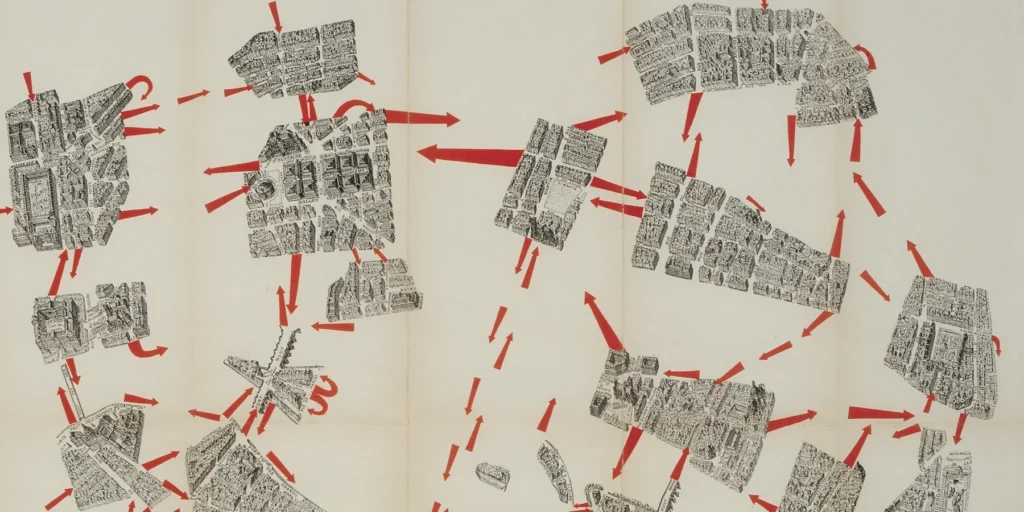
You cross three streets and something shifts. Not your mood exactly — something more primitive than that, something below the threshold of decision or interpretation. The grief that was sitting in your chest two blocks ago has loosened, become strange, almost historical, as though it belonged to someone you used to be. Then half a block further and it returns, sharpened, clarified by the brief absence. Nothing visible has changed. The architecture is more or less continuous. The noise level is similar. There is no rational explanation for why the corner of these two particular streets should feel like a held breath, or why the alley beyond it carries the psychic temperature of an old argument you never finished.
The Situationists had a name for this. They called them unités d’ambiance — units of atmosphere, microzones of radically different psychic temperature embedded in the urban fabric like fault lines. These were not neighborhoods in the administrative sense, not districts or quartiers as the planners understood them. They were something far more precise and far more unstable: pockets of lived intensity, zones where the emotional sediment of years of human use had crystallized into something almost geological. Guy Debord argued in his 1955 essay “Introduction to a Critique of Urban Geography” that these zones existed in direct contradiction to the official map of the city — that the real city was always plural, always secretly at war with its own representation. The map says here is a commercial zone, here is a residential area. The body says something entirely different.
Walter Benjamin understood this before the Situationists gave it a name. His Arcades Project, that enormous unfinished labor that consumed the last thirteen years of his life and was left incomplete at his death in 1940, was precisely an archaeology of emotional sediment — an attempt to excavate what cities store in their glass and iron and plaster, the desires and dreams and abandoned futures that accumulate in the surfaces of things. The Parisian arcades he obsessively catalogued were not merely shopping passages. They were, in Benjamin’s reading, unconscious spaces, places where the nineteenth century had deposited its fantasies about progress, luxury, and collective life, and where those fantasies had slowly curdled into something melancholic and strange. To walk through an arcade was to walk through time folded back on itself. The commodity on display was also a ruin in the making.
There is a moment — in a basement apartment, somewhere in a city that could be any city — when a man sits surrounded by objects that belonged to a person now dead. He is not exactly grieving. He is doing something more complicated: he is reading the room. The room is speaking in a frequency he has no language for, pressing against him with the accumulated weight of habitual presence. This is what Benjamin called the Denkbild, the thought-image — the point where the material world and the interior world become momentarily indistinguishable. The apartment is not a container for grief. It is the grief, distributed across surfaces.
The planners and the economists cannot see any of this because they are not looking for it. Their instruments measure footfall and property value and traffic density. They have no instrument for the way a particular street corner holds a specific emotional charge for thousands of people simultaneously, none of whom would be able to explain it if asked. Henri Lefebvre, whose 1974 work “The Production of Space” runs parallel to and in constant dialogue with the Situationist project, argued that abstract space — the space of capital and planning — systematically destroys the lived intensities that accumulate in what he called “representational space,” the space of bodies and symbols and unconscious geography. Every act of urban rationalization is also, quietly, an act of psychic erasure.
The dead zones are not empty. They are the places where the erasure has already happened, where the emotional sediment has been scraped clean and replaced with something that functions perfectly and feels like nothing at all.
Détournement of the Street
There is a bench near the train station that is technically public. You know the kind — slatted, bolted to concrete, positioned at an angle that makes prolonged sitting uncomfortable by design. Someone is sitting on it at twenty past eleven at night. They are not waiting for a train. They are simply there, in the way that cities used to permit people to simply be there, and within minutes a security guard materializes with the particular posture of institutional authority — not aggressive, almost apologetic, but absolutely firm. The message is not spoken so much as administered. Move along. You cannot be here like this.
What just happened has almost nothing to do with safety or public order and almost everything to do with a very old project of spatial discipline. Michel Foucault, writing in Discipline and Punish in 1975, described how modern power does not primarily operate through spectacle or violence but through the organization of bodies in space — their positioning, their circulation, their permitted rhythms. The prison, the school, the hospital, the factory: each is an architecture of behavioral production. The city, in this reading, is the largest such architecture ever constructed. Streets do not merely connect places. They sort people, assign velocities, prescribe postures. You walk briskly or you arouse suspicion. You move with purpose or your presence becomes illegible — and illegibility, in administered space, is treated as a malfunction to be corrected.
The bench with its anti-sleeping armrests, the sprinkler that activates at three in the morning in the park doorway, the ordinance that prohibits sitting on the pavement outside the station — these are not incidental design choices. They are a coherent spatial grammar written against any body that might linger without consuming. David Harvey, in his 2008 essay The Right to the City, argues that urban space has undergone a systematic enclosure over the past half-century, a privatization of what were once genuinely collective resources. The street was, historically, a commons — a place of assembly, of idleness, of unauthorized encounter. What we have now, Harvey insists, is a selective simulation of publicness that functions to exclude those who cannot or will not perform the correct economic role within it. The right to the city, in his formulation, is not a right to visit it as a consumer but to inhabit it as a subject — to shape it, modify it, appropriate it according to collective need rather than capital’s logic.
And so the person on the bench, moved along without ceremony, has performed something without intending to. Their refusal to circulate — their insistence on simply remaining — has forced the machinery of spatial governance to reveal itself. This is the accidental détournement of the ordinary. Guy Debord and the Situationists understood this dynamic, even if they imagined it as a more conscious and theatrical intervention. But the political charge of refusing the designated path does not require an ideological framework to exist. It exists the moment a body occupies space in a way the city has not authorized, and the city responds. The response is the confession. The guard who asks you to move, the ordinance that expires at dusk, the architecture that makes lying down physically impossible — each one is the city admitting that its publicness was always conditional, always a performance staged for particular kinds of people moving in particular kinds of ways.
Taking the long way home is not merely poetic. Walking through a neighborhood you were not routed through, sitting longer than the city considers productive, choosing stillness over circulation — these are the small gestures through which space is either surrendered entirely or, however briefly, reclaimed. Not reclaimed as triumph. Reclaimed as reminder: that the street was built with your taxes, your labor, your presence, and that someone decided at some point — quietly, through zoning codes and design briefs and security contracts — that it no longer quite belonged to you.
You Are Already Living Inside the Argument
Think about the route you took this morning. Not the route you chose — the route you took. There is a difference, and the distance between those two words is where everything interesting lives. You probably moved through at least four or five decision points where your body turned before your mind had registered the question. Left at the pharmacy. Right before the underpass. The longer way around that feels shorter because it is familiar, because familiarity has long since colonized your sense of distance and replaced it with something warmer and more treacherous: the feeling of belonging.
This is not a minor quirk of habit. It is the entire structure of your relationship to the space you inhabit. Henri Lefebvre argued in The Production of Space, published in 1974, that space is never neutral, never simply there — it is produced, ideologically shaped, inscribed with the interests of those who designed it before you arrived to live inside it. The city is not a container for your life. It is an argument about how your life should be conducted, and you have been agreeing to its terms every morning without a single moment of conscious negotiation.
Someone once stood in a vast open plaza, surrounded by monumental architecture, and felt — not freedom, not elevation — but a precise and engineered smallness. The proportions were not accidental. The widths of the avenues, the heights of the facades, the distances between benches that were too far apart to encourage lingering — all of it calculated to produce movement, throughput, the managed flow of bodies that do not gather, do not pause long enough to become a crowd with a collective thought. He stood there and understood, without being able to articulate it yet, that the space itself was an instruction he had been obeying without having read it.
And then there is the other kind of moment: a street so narrow it forces your shoulder almost against the wall, a courtyard stumbled upon by accident where the acoustics change and the city noise drops away and something in your chest releases without you having commanded it to. Guy Debord and the Situationists called the force that pulls you through these spaces the derive — the drift — and what they were naming was the experience of letting the emotional logic of the city surface instead of suppressing it beneath the functional logic of destination. They were not describing a leisure activity. They were describing an act of epistemological resistance. To drift was to refuse the city’s own account of itself.
You may never have drifted in that technical sense. But you have almost certainly felt the gravity of a particular street at a particular hour, the way certain corners carry a pressure that has nothing to do with traffic and everything to do with what has accumulated there — economically, historically, emotionally — over decades you did not witness but are nonetheless inheriting. That accumulation is what psychogeography was always trying to name. Not the map. The weight beneath the map.
The question that has been building through everything written here is not whether the city shapes you — it does, measurably, structurally, in ways that neuroscience and urban sociology have spent fifty years documenting — but whether you have ever, even once, paused at a familiar intersection and asked why you are turning the way you are turning. Not what you will find if you turn the other way. Just why. Why this path, why this rhythm, why this invisible groove worn into your daily movement by repetition and compliance and the quiet, persistent instruction of a space that was never designed with your freedom as its primary concern.
Tomorrow morning the route is waiting. The familiar turn is already pulling at you before you are fully awake, before you have had the chance to become the kind of person who might, for no practical reason whatsoever, go a different way.
🗺️ Wandering the Urban Labyrinth: City, Mind, and Space
Situationist psychogeography reimagines the city not as a neutral backdrop but as a living, charged field that shapes consciousness and desire. From the philosophy of urban life to the mythology of the maze, these articles trace the deep connections between space, perception, and human experience. Drift through these related explorations to understand how thinkers, artists, and wanderers have mapped the invisible architecture of the modern metropolis.
Georg Simmel and the Metropolis: The Metropolis and Mental Life
Georg Simmel‘s foundational essay on metropolitan life explored how the relentless stimulation of the modern city produces a protective ‘blasé attitude’ in its inhabitants — a psychic numbness that the Situationists would later seek to dissolve through the practice of the dérive. Simmel saw the metropolis as a battlefield between individual subjectivity and the crushing anonymity of urban crowds, prefiguring much of what Debord and the SI would theorize decades later. Reading Simmel alongside psychogeography reveals how deeply the question of urban experience is embedded in the sociological imagination.
GO TO THE SELECTION: Georg Simmel and the Metropolis: The Metropolis and Mental Life
Philosophy of the City: History and Theory
The philosophy of the city is a long and layered tradition that provides the theoretical soil from which Situationist thought grew, drawing on everything from ancient conceptions of the polis to Enlightenment urban planning and modernist critiques of space. This article traces how thinkers across centuries have grappled with the relationship between built environments and the life of the mind, asking whether cities liberate or constrain the human spirit. Understanding this history is essential for grasping why psychogeography emerged as a radical intervention into how we inhabit and experience urban space.
GO TO THE SELECTION: Philosophy of the City: History and Theory
The Labyrinth of Knossos: History and Myth of the Minotaur
The labyrinth of Knossos stands as one of civilization’s most enduring spatial myths, encoding in stone and legend the idea that certain spaces are designed to disorient, trap, and transform those who wander through them. The Situationists were acutely aware of this mythological resonance, treating the modern city as a contemporary labyrinth in which the dérive could function as a thread of Ariadne — a practice of conscious navigation against the grain of spectacle. Exploring the Minoan myth alongside psychogeography illuminates the ancient roots of the idea that space itself carries meaning, danger, and the possibility of liberation.
GO TO THE SELECTION: The Labyrinth of Knossos: History and Myth of the Minotaur
Karl Marx and Alienation: Economic and Philosophical Manuscripts
Marx’s concept of alienation, developed in the Economic and Philosophical Manuscripts, describes the estrangement of the worker from the products of labor, from other human beings, and from the sensuous world itself — a condition that the Situationists translated directly onto the terrain of the city. For Debord and his colleagues, the spectacular urbanism of postwar capitalism was alienation made architectural, a geography engineered to produce passive consumers rather than active, desiring subjects. Reconnecting psychogeography to Marxist alienation theory reveals the political urgency behind what might otherwise seem like mere urban wandering.
GO TO THE SELECTION: Karl Marx and Alienation: Economic and Philosophical Manuscripts
Discover Cinema That Remaps the World
If psychogeography has taught you to see the city as a living text full of hidden meanings and unexpected passages, then Indiecinema is your ideal streaming companion. On Indiecinema you will find independent and avant-garde films that share this restless spirit — works that transform familiar spaces into territories of wonder, resistance, and discovery. Start your cinematic dérive today and let independent cinema take you somewhere the map has never shown.
👉 EXPLORE THE CATALOG: Watch Indie Films in Streaming
A vision curated by a filmmaker, not an algorithm
In this video I explain our vision

