
The Corridor You Cannot Leave
You know the feeling. You have walked this corridor before — not once, not twice, but so many times that your feet have memorized its length without your mind ever registering the exit. The fluorescent light hums at the same frequency every morning. The same faces appear at the same desks. You make decisions — which project to pursue, which email to answer first, which meeting to endure — and yet the sum of all these choices produces no movement. You are not standing still. You are moving constantly, purposefully even, and that is precisely what makes it unbearable. Because stillness you could name. You could diagnose it, resist it, escape it. But this — this perpetual motion that returns you always to the same point — has no name you were ever given.

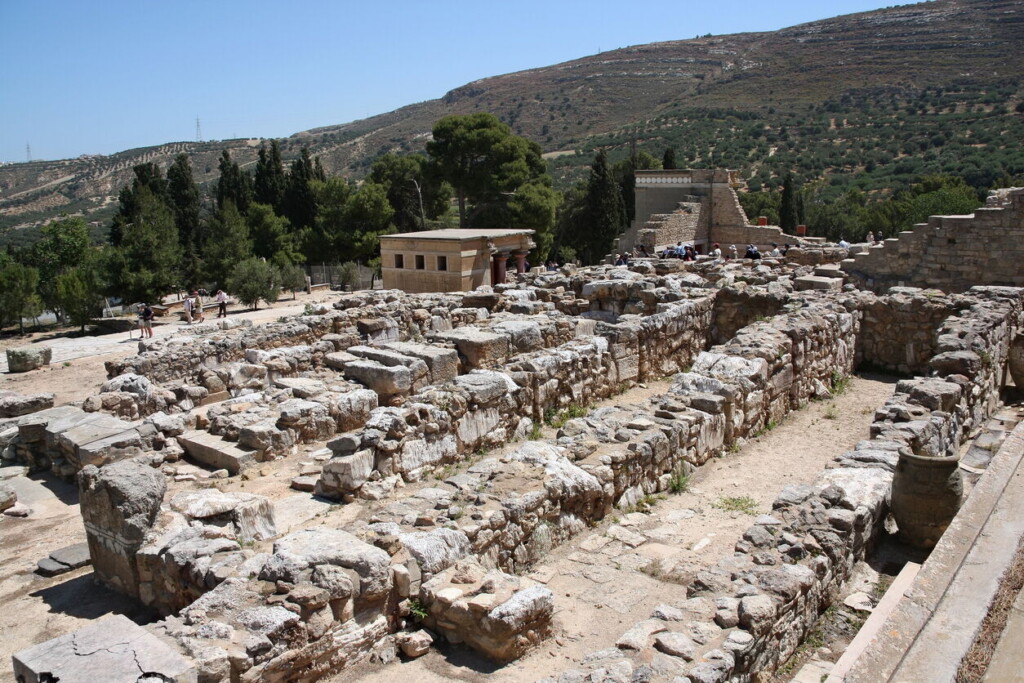
The labyrinth was not invented as a prison. That is the first thing history gets wrong, or rather, the first thing we get wrong about history. When the Minoan civilization was building its palace complex at Knossos on the northern coast of Crete somewhere around 1900 BCE, they were not designing a cage. They were designing a world. Archaeologists who excavated the site beginning in 1900 under Arthur Evans found a structure of extraordinary complexity — over a thousand rooms, multi-storied wings, light wells that fed natural illumination deep into the interior, storage magazines holding enormous ceramic vessels called pithoi, some of them still intact after three and a half millennia. It was not a dungeon. It was the administrative, religious and economic heart of a civilization so sophisticated it had running water and flush toilets when most of Europe was living in what we would politely call proximity to nature.
And yet the Greeks, looking back at this place centuries later, saw only the maze. They felt in their bones something that the architecture transmitted to them across the ruins: the sensation of a space designed so that you could always be moving and never be leaving.
Sigmund Freud, in a letter to Wilhelm Fliess in 1897, described the structure of the unconscious as a labyrinth — not in those precise words, but the metaphor is insistent in his thinking throughout the period when he was developing what would become The Interpretation of Dreams. The mind, for Freud, was not a room you could enter and exit. It was a system of corridors where every apparent exit leads to another corridor. The architecture of repression is not a wall. It is a passage that curves so gradually you never notice it bending back on itself. You think you are moving forward. The geometry disagrees.
This is what Knossos gave the ancient imagination: not the fact of imprisonment but the topology of it. The genius of the labyrinth as a cultural form is that it never shows you the wall. A wall is honest. A wall says: here is the limit, here is where your freedom ends. The labyrinth says something far more corrosive. It says: keep going. It says: the exit exists. It says: you simply have not found it yet. And so you do not rebel against your confinement. You participate in it. You navigate it with increasing expertise. You learn the corridors so well you begin to mistake fluency for freedom.
There is a man who has memorized every street in his city and cannot leave it. Not because the roads stop at the city limits — they do not — but because the map in his head has no territory beyond the boundary. The labyrinth is not the city. The labyrinth is the map. It is the cognitive and emotional architecture that makes the familiar feel like the only possible real. Knossos understood this before psychology had a language for it. The myth understood it before the archaeology could prove the building ever existed.
Venetian Arcanum
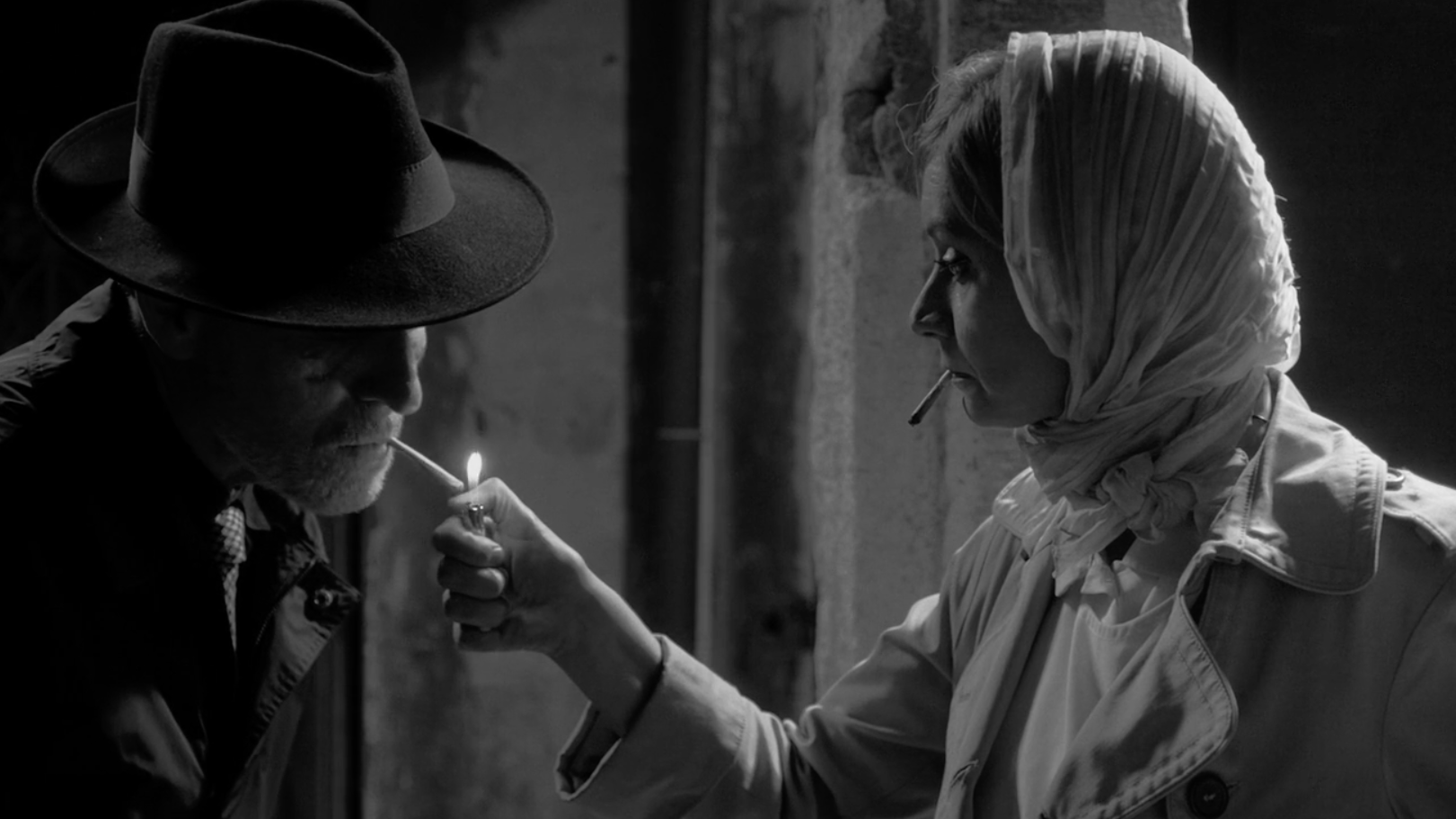
Thriller, by Serge Turgeon, Italy, 2025.
In Venice, a mysterious presence appears once every century or two, haunting the canals and hidden corners of the city. Driven by a sense of destiny, a woman decides to search for it. Following its elusive traces, she is drawn deeper and deeper into the city’s arcane secrets. Reality and myth begin to blur, and Venice itself transforms into a labyrinth of dangers.
LANGUAGE: Italian
SUBTITLES: English
Crete Before the Myth: What the Ground Actually Held
Before the myth arrived, the ground held something stranger and more specific than any legend. On the northern coast of Crete, roughly three kilometers inland from what is now Heraklion, people had been building continuously for thousands of years — not in some primitive, groping way, but with a sophistication that still unsettles our sense of historical progress. By around 2000 BCE, what archaeologists would eventually call the Minoan civilization had reached its first palatial peak, constructing administrative centers of labyrinthine complexity that stored grain, olive oil, and textile goods in quantities that implied coordinated regional economies, not tribal subsistence. The palace at Knossos alone, at its height around 1700 to 1450 BCE, covered roughly 22,000 square meters across multiple stories, containing hundreds of rooms, drainage systems of fired clay, light wells designed with enough architectural precision to suggest a conscious aesthetic of interior illumination. These were not people fumbling through bronze. These were people who knew exactly what they were doing.
The frescoes tell you this in a different register. On the plaster walls of Knossos, figures move in a language of color and proportion that feels almost disconcertingly alive: young men and women with dark hair and narrow waists, caught in the suspended moment of vaulting over the back of a charging bull. The ritual — if ritual is even the right word, which is already an argument — appears across multiple surfaces, multiple centuries, with enough consistency to suggest it was not decorative fantasy but something practiced, something real and physical that bodies underwent. Linear A, the writing system the Minoans used and which remains undeciphered, covered clay tablets that recorded agricultural inventories and economic transactions. This was a bureaucratic civilization, a mercantile one, a civilization that traded with Egypt and the Levant and left its pottery in contexts across the eastern Mediterranean. It was not waiting for the Greeks to give it meaning.
Then, in 1900, Arthur Evans arrived with money, institutional authority, and an imagination so powerful it became indistinguishable from evidence. Evans was a remarkable archaeologist by any measure — the excavations he funded and directed at Knossos between 1900 and 1935 brought an entire vanished world back into visibility, and the four volumes of his monumental The Palace of Minos, published between 1921 and 1935, remain foundational documents. But Evans did not simply excavate. He reconstructed. He poured reinforced concrete into three-thousand-year-old foundations. He commissioned paintings of frescoes based on fragments so small that the original compositions were largely invented. He rebuilt columns, repainted surfaces, and in doing so created a version of Knossos that was part archaeological site and part Victorian imagination of what a sophisticated ancient civilization ought to look like. The distinction between what the ground held and what Evans decided it must have held was never clearly marked.
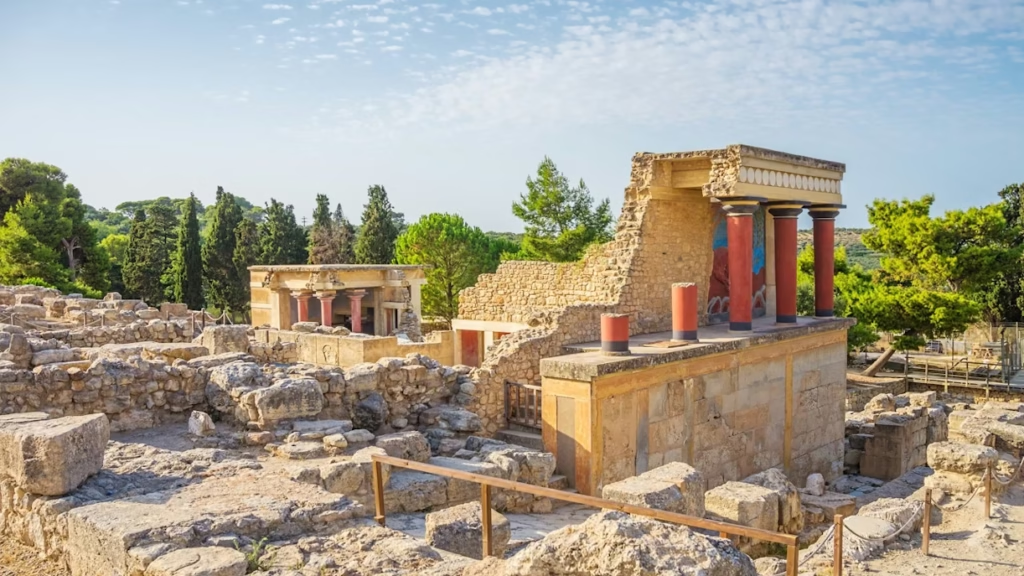
This is not a minor footnote. When you walk through Knossos today, you are walking through a site where the layers of interpretation are physically load-bearing. The concrete Evans poured holds up structures he imagined. The vivid blue and terracotta of reconstructed columns exists because he decided, based on surviving fragments and an aesthetic intuition shaped by his own cultural moment, that this was the appropriate palette for Minoan grandeur. His instinct that this was the source civilization of the Minotaur myth — that the bull iconography, the labyrinthine palace plan, the memory of Cretan power in Greek legend all pointed toward a historical kernel — may well be correct. But the manner in which he built that argument, literally and physically into the site itself, was already an act of narrative imposition dressed as science.
The labyrinth, it turns out, has always been partly a story told by whoever holds the tools.

The Monster at the Center
There is a room in your house, or in someone’s house close to you, where certain things happen that nobody discusses. Not because they are illegal, not even because they are particularly shameful in any absolute moral sense, but because they belong to a register of the self that has no place at the dinner table, no language in polite conversation, no representation in the version of yourself you have agreed to perform for others. You know the room. You may live in it sometimes, briefly, before closing the door behind you and returning to the corridor where you are recognizable again.
This is not a metaphor that was invented recently. It is one of the oldest architectural facts of human civilization.
The creature born under the hill of Knossos did not arrive through violence or war or ordinary moral failure. It arrived through something far more unsettling: desire that exceeded its permitted boundaries. A queen consumed by a longing she did not choose, a bull of impossible whiteness sent as a sign and kept instead of sacrificed, a craftsman commissioned to build a wooden disguise so that the boundary between human and animal could be crossed in the dark. What emerged from that crossing was neither fully one thing nor the other. It was the offspring of transgression itself, and it wore that origin in its body, permanently, with no possibility of concealment or correction.
Carl Jung spent decades trying to articulate what civilizations do with the parts of themselves they cannot integrate. In “The Archetypes and the Collective Unconscious,” published in 1959, he described the Shadow not as an aberration but as a structural necessity of the psyche, the repository of everything the conscious self has decided it cannot afford to be. The Shadow does not disappear when you refuse to acknowledge it. It becomes, if anything, more powerful in proportion to how thoroughly it is denied. What you will not look at directly begins to look at you from the edges.
The labyrinth, then, was not a prison in the conventional sense. Prisons are built to contain criminals, people who have violated the social contract and whose containment restores the fiction of collective innocence. The labyrinth was built to contain something that the civilization itself had produced, that the civilization could not destroy without confronting its own role in the creation, and that the civilization could not release without shattering the image it had of itself. So it did the only thing available to a society that has run out of honest options: it built walls complex enough that no one could find the center, and it fed the thing regularly so that it would not die, and it called this architecture order.
René Girard, writing in “The Scapegoat” in 1982, described with clinical precision how communities stabilize themselves through the expulsion of a chosen victim, the figure onto whom collective anxiety and guilt are projected and then ritually eliminated. But the Minotaur complicates Girard’s schema in an interesting way, because the Minotaur is never eliminated. It is maintained. The tribute of fourteen young Athenians every nine years is not punishment of the creature. It is payment to it. It is the civilization acknowledging, in the only currency available, that what is locked at the center has a legitimate claim on resources, on nourishment, on continued existence. The scapegoat is cast out. The Minotaur is fed.
The man watching something on a screen in a locked room at two in the morning is not watching it because he has forgotten who he is. He is watching it precisely because he knows, with great exactitude, who he has agreed to be everywhere else. The screen is the labyrinth. The thing he is watching is the creature he built the walls to contain. And the ritual repetition of it, night after night, is the tribute.
Children Of A Darker Dawn
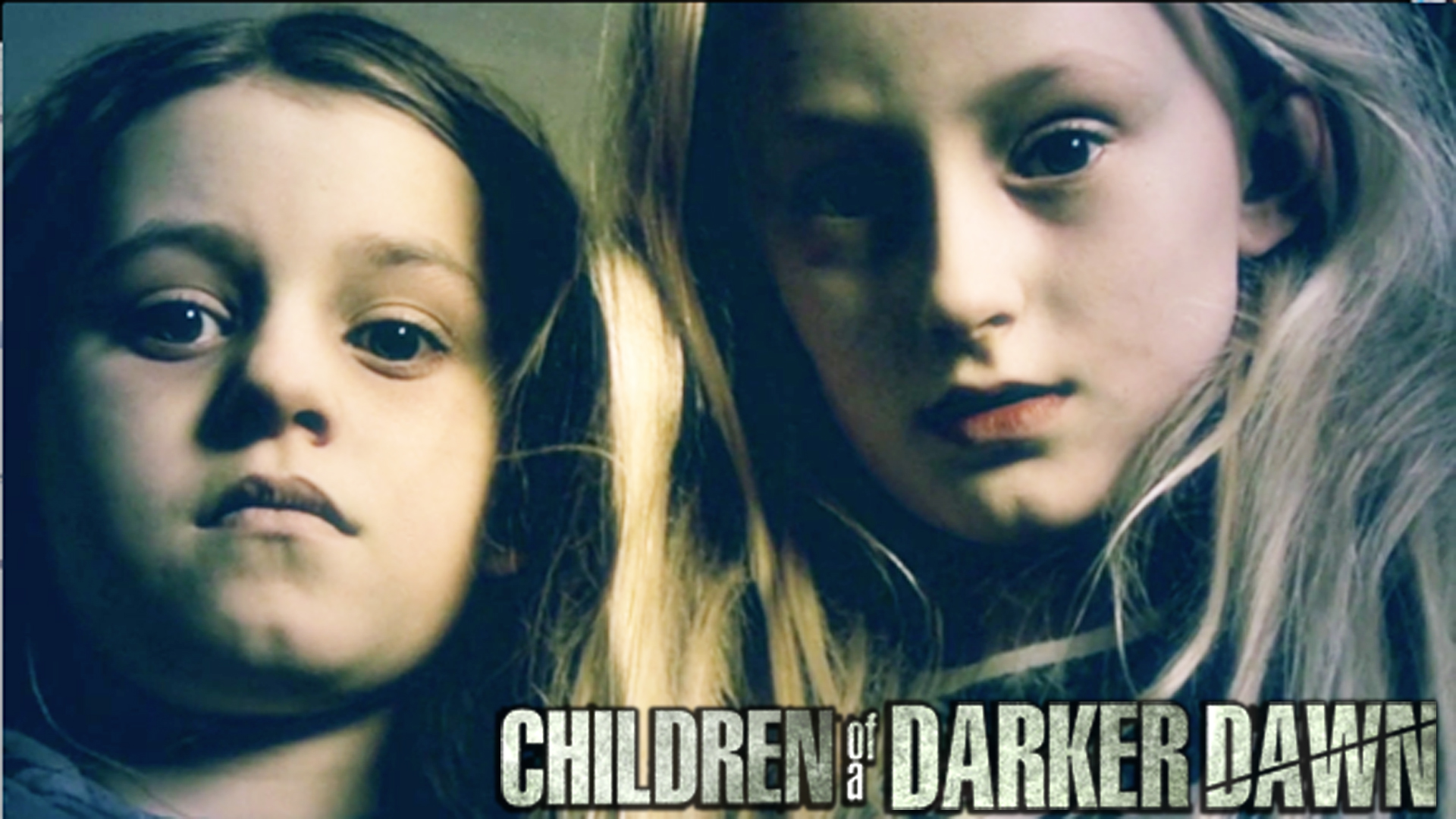
Drama, horror, sci-fi, by Jason Figgis, United States, 2012.
In a post-apocalyptic Ireland, a pandemic has wiped out the adult population, struck down by a mutant strain of flu that turns them paranoid and violent before killing them. Nine months later, the surviving children wander through abandoned buildings in search of food and shelter. Among them are Evie and her younger sister Fran, trying to survive while avoiding potentially dangerous groups of kids. Their only comfort is The Railway Children, the book their mother used to read to them. The arrival of Alice, a girl who has escaped from a gang led by her sister Kate, changes their path. After being betrayed by the gang, Evie decides to confront them, triggering a series of events that will lead to tensions and conflicts within the group.
The film, directed by Jason Figgis with limited resources but great sensitivity, is a post-apocalyptic drama that goes beyond horror, focusing on grief and the emotional fragility of its characters. The tone is somber, marked by melancholy, disturbing flashbacks, and unstable relationships. Though it recalls films like 28 Days Later, The Road, or Lord of the Flies, Children of a Darker Dawn finds its own voice through strong character development and powerful performances from its young cast.
LANGUAGE: English
SUBTITLES: Spanish, French, German, Portuguese
Daedalus and the Ethics of the Architect
You designed the corridor. You chose the angle of the turn, the height of the ceiling, the way one passage folds back on another so that someone moving through it loses all sense of direction within three steps. You knew exactly what you were doing. The geometry was flawless, the intention precise: a space that does not confine through bars or locks but through the very logic of its own architecture. And then one morning you are inside it, and the exit you knew existed, the exit you built, refuses to present itself.
This is not a nightmare. This is the condition of the technician who serves power without asking what power is for.
Daedalus is perhaps the most unsettling figure in the entire Minoan mythology precisely because he is not a monster and not a hero. He is a craftsman. He is the person who, when a king asks him to build something that should not exist, asks only the technical questions. How large? How deep? How impossible to escape? He builds the Labyrinth not because he believes in the Minotaur’s necessity, not because he worships the dark logic of human sacrifice, but because the problem is elegant and his hands know how to solve elegant problems. Minos gives him the commission and Daedalus gives him the solution, and somewhere in that transaction the ethical question simply never comes up.
Hannah Arendt, watching Adolf Eichmann in a Jerusalem courtroom in 1961 and publishing her account of what she saw in 1963, arrived at a conclusion that scandalized her contemporaries precisely because it refused the comfort of monstrosity. Eichmann was not a fanatic. He was not driven by pathological hatred. He was, in her words, terrifyingly normal — a man who had organized the deportation of millions because organization was what he did, because the problem had been handed to him as a logistical challenge and he had solved it with professional competence. The banality of evil, for Arendt, was not a diminishment of evil’s horror but an intensification of it: the realization that catastrophe does not require a demon, only a technician who has stopped asking why.
Daedalus stopped asking why. Or perhaps he never started. The ancient sources are ambiguous on his psychology in the way that matters most — they do not record whether he hesitated, whether he looked at the plans and felt anything other than the satisfaction of a problem solved. What they record is the result: a structure so perfectly designed that even its creator, when imprisoned inside it by the same king who commissioned it, could not find the exit by walking. He had to find it by flying, by leaving the logic of the corridors entirely and ascending above the system he had made. Icarus, his son, died trying.
There is something in the architecture of complicity that the Daedalus myth understands before political philosophy had the vocabulary to name it. The person who builds the cage is not standing outside it watching the prisoner. They are, from the moment of construction, already inside — bound to the structure by knowledge, by authorship, by the impossibility of pretending the design was someone else’s idea. The Labyrinth belongs to Daedalus in a way it never belongs to Minos. The king commissioned it. The craftsman made it real.
Zygmunt Bauman, in Modernity and the Holocaust published in 1989, argued that the industrial murder of the twentieth century was not an aberration from modern civilization but a product of it — specifically a product of the bureaucratic and technical rationality that separates the act of doing from the question of what is being done. Daedalus is Bauman’s figure avant la lettre: the specialist so absorbed in the integrity of his own discipline that the purpose of the work becomes someone else’s moral problem.
He walks the corridor again. The turn is exactly where he put it.
Theseus: The Hero as Political Instrument
There is a particular kind of man who enters a dangerous place only because someone else has already mapped it for him. He carries the thread without understanding what the thread is. He walks the corridors with a confidence that belongs entirely to the knowledge of another person, and when he emerges into the light, blinking and victorious, he believes — genuinely, completely — that the courage was his own.
This is not a metaphor. This is Theseus, and the story Athens told about him for centuries was not a story about heroism. It was a story about power, and about what power does to the memory of how it was obtained.
Walter Burkert, in his landmark 1979 study of the structures underlying Greek mythology, was precise about this: myths do not emerge from the imagination of poets. They emerge from the political and social conditions that need them. The Theseus myth — the Athenian prince who sails to Crete, defeats the tribute, and kills the monster — crystallized during the period of Athenian imperial expansion in the fifth century BCE, precisely when Athens was extending its dominance over the Aegean and needed a founding narrative to justify that dominance. The Minotaur was not simply a monster to be killed. The Minotaur was Crete. The labyrinth was the complexity of a civilization that predated Athens by centuries. And Theseus was the instrument through which Athens could tell itself that what it had displaced was monstrous, and that its own arrival was liberation.
Adrienne Mayor’s work on myth as compressed historical memory offers a parallel lens. Myths, she argues, preserve actual events and geographies in distorted but traceable form — they are not inventions from nothing but transformations of something real. If that is true of the Theseus myth, then what we are looking at is the memory of a genuine political conflict between mainland Greek culture and Minoan Crete, translated into the language of heroic victory. The tribute of fourteen young Athenians sent periodically to Knossos may preserve the memory of genuine Cretan economic and political dominance over the Aegean — a dominance that ended, and that the Greeks needed to reframe as rescue rather than reversal of fortune.
But the deepest dishonesty in the myth is not political. It is personal. Ariadne gives Theseus the thread. Without the thread, there is no navigation, no return, no survival. The labyrinth is not defeated by strength or courage — it is defeated by knowledge, and the knowledge belongs entirely to her. She is the daughter of Minos, raised within the culture that built the labyrinth. She understands its logic from the inside. When she hands Theseus the ball of thread, she is handing him her own comprehension of a world he cannot read.
And he takes it. He uses it. He walks the labyrinth on the strength of her understanding, kills what needs to be killed, and follows the thread back out into the world she has made navigable for him. Then he leaves her on the island of Naxos while she sleeps, and sails on without her.
What gets abandoned on Naxos is not a woman. What gets abandoned is the acknowledgment that he could not have done any of it alone. The thread must disappear from the story because the thread is the proof that the hero was never really navigating — he was being guided, at every step, by someone whose knowledge he could use but never quite bring himself to understand.
The labyrinth was not conquered by Theseus. It was decoded by Ariadne and walked by a man who carried the decoding in his hand without ever grasping what it meant. The monster dies. The woman is left sleeping on a shore. And Athens builds a civilization on the story of the man who held the thread.
A vision curated by a filmmaker, not an algorithm
In this video I explain our vision
The Labyrinth as Western Thought’s Favorite Structure

You know the feeling. You have been in that corridor before — not this exact one, but one structurally identical to it. The form letter says to bring document A to obtain document B, and document B is required to request the release of document A. You stand there, holding both pieces of paper, neither of which is yet in your possession, and the clerk behind the desk looks at you with an expression that is not unkind, merely final, as if the architecture of the situation predates both of you and will outlast you both. You take a number. You sit down. You wait to be told where to go next.
This is not a malfunction. This is the preferred operating condition of Western institutional thought, and the labyrinth of Knossos was not its origin — it was its first honest self-portrait.
Umberto Eco, in his 1984 semiotic taxonomy, distinguished three types of labyrinths: the classical unicursal structure with a single path leading inevitably to the center, the multicursal maze of choices and dead ends, and what he called the net or rhizome — an unlimited, centerless structure in which every point connects to every other and the very notion of an exit becomes philosophically incoherent. Western culture, Eco observed, has always claimed to be building the first type while actually constructing the third. It announces a center. It promises an exit. It delivers movement without arrival.
Dante knew this, even if he would not have framed it that way. His Hell is geometrically precise — nine circles, each with its own logic, its own population, its own moral grammar — and yet the pilgrim never stops feeling that he might be lost. The precision is the trap. The more clearly a system is organized, the more total its enclosure becomes. You cannot argue with a circle. You can only descend.
Michel Foucault, writing in 1975, showed that the panopticon Jeremy Bentham designed in 1787 was not primarily a building — it was a proposition about how power reorganizes itself once it no longer needs to be visibly present. The prisoner behaves as if watched because the architecture makes the watcher’s presence structurally plausible at all times. The labyrinth works by the same principle: you do not need walls if you have corridors. You do not need guards if you have forms. The system keeps you moving not by force but by the persistent implication that the next room will be different, that the next door opens onto something other than another corridor.
There is a man navigating an institutional building — a ministry, a hospital, an archive, it doesn’t matter which — who has been told, gently and repeatedly, that his case is being processed. He has learned to interpret each new office as evidence of progress. The fact that he has never returned to the same room twice feels like forward motion. He does not notice, or refuses to notice, that forward and circular are indistinguishable from inside a sufficiently large ring. He carries his documents in a folder that has grown thick with correspondence, each letter referencing a previous letter, the whole stack forming a kind of paper labyrinth nested inside the architectural one.
Borges placed his infinite library at the center of a universe that had no center, and the librarians who spent their lives searching for the book that explained all other books died without finding it, having walked corridors so similar to one another that beauty and madness became the same response. The library was not cruel. It was, in Borges’s vision, total — which is a different and more interesting thing. Cruelty implies an exit that is being withheld. Totality implies there was never one to begin with.
What the labyrinth of Knossos gave Western thought was not a monster at the center. It was permission to build structures that feel purposeful precisely because they never resolve — and to call that architecture reason.
What Gets Fed to the Minotaur
The ships arrive every nine years. That detail passes quickly in most retellings, absorbed into the larger drama of heroes and monsters, but if you hold it still for a moment it becomes unbearable. Fourteen young people — seven men, seven women — chosen from Athens, loaded onto a vessel with black sails, and delivered to Crete as living payment for a debt the city owed but could not name without shame. Not soldiers. Not criminals. Not volunteers, at least not in any meaningful sense of the word. Young people selected, by lot or by circumstance, to disappear into a structure no one could navigate and nothing came back from.
Think about what that selection ceremony looked like. Someone drew names. Someone watched their child’s name emerge from a vessel, and felt the floor dissolve beneath them, and then — this is the part that destroys you — accepted it. The city accepted it. Because what was the alternative? Open war with Minos? The memory of what happened last time, the fleet burned, the siege, the humiliation? Better fourteen than thousands. The mathematics of sacrifice are always presented as rational, always dressed in the language of necessity, always administered by people who are confident their own children’s names will not be drawn.
Zygmunt Bauman, writing in 2004, used the phrase “wasted lives” to describe something modern societies prefer not to examine directly: the human beings that the system produces as surplus, as collateral, as the acceptable cost of keeping everything else running. He was talking about refugees, about the structurally unemployed, about entire demographic cohorts discarded when the economic machinery no longer required their particular form of labor. But the logic he identified is not modern. The tribute to the Minotaur is its oldest surviving diagram. A society decides, collectively and without admitting the decision, that certain lives exist to absorb the costs that everyone else refuses to pay. The mechanism changes. The tribute continues.
You have seen a version of this. A generation that was handed the invoice for crises manufactured long before they were old enough to vote — financial collapses built from instruments they never understood, austerity programs that landed hardest on institutions that were supposed to prepare them for a future that kept receding. The debt, the precarity, the housing they cannot reach, the pensions being renegotiated in real time, the climate they will inherit in the shape of ruins. Every nine years the ships come, and nobody calls it tribute, and the black sails are invisible because they have always been the only sails anyone has ever known.
There is a man watching from a hillside — not a hero, not a king, just someone who has been watching the harbor long enough to understand what the departures mean. He does not intervene. He is not monstrous. He has simply made the calculation that everyone around him has made, the one that begins with the phrase “there is nothing I can do” and ends with him turning back toward the city where the agora is open and the wine is cold and the conversation tonight will not be about the ships. This is what Bauman meant when he argued that modern violence is most effective when it is invisible — not concealed, but normalized into the texture of ordinary life until it requires no concealment at all.
The Minotaur does not need to be seen to function. It only needs to be fed. The labyrinth is not a prison for the monster but a management system for the tribute — a structure so complex that the transaction can occur without anyone having to watch it happen, without anyone having to hold the name of what they are doing in their mouths long enough to taste it.
The ships are already loaded. The names have already been drawn.
The Thread That Does Not Lead Out
You follow the thread because someone handed it to you, and that felt like love, and love felt like direction, and direction felt like the opposite of being lost. This is the part no one examines carefully enough. Not the monster. Not the hero. The thread.
Think about what it actually does, mechanically, materially. It does not illuminate the labyrinth. It does not dissolve the walls or reveal the architecture. It does not give you a map. It gives you a line back to the hand that holds the other end. And that hand is waiting at the entrance — not at the exit, because in a structure with no true exit, those are the same threshold wearing different names. Theseus follows the thread and returns to Ariadne, which means he returns to the beginning, which means the labyrinth has not been escaped. It has been traversed and then abandoned in place, intact, ready for the next body.
Jacques Lacan, in the dense and deliberately difficult architecture of his Écrits, published in 1966 after decades of seminars that rewired how an entire generation understood the unconscious, argued that desire is never desire for a thing. Desire is desire for the desire of the Other. You do not want the object. You want to be wanted by the one who seems to know what wanting means. The thread, then, is not a tool of navigation. It is the material form of that structure. It is the umbilical logic of desire itself, which always leads you back to the one who gave you the sense that you were going somewhere.
You have followed this thread. Perhaps you called it a relationship, and you organized years around its tension, its slack, its sudden pulls. You moved through rooms of yourself you had never entered, convinced that the courage to enter them came from the connection, from the fact that someone was waiting. And then you arrived, one ordinary morning, at something that felt unmistakably like the entrance. The same arguments. The same fear. The same particular quality of silence before certain words are said. You were not at the center of anything new. You were back at the beginning, holding your end of something that had never actually moved.
Or perhaps the thread was a career, a vocation, a system of belief so internally coherent that following it felt indistinguishable from thinking freely. Every door it opened led to a corridor that led to a room that contained, always, the same altar. The ideology that promises liberation and delivers an infinitely refined obedience. The spiritual practice that deepens your interiority until your interiority is indistinguishable from the practice itself. The professional identity so total that the self it was supposed to serve has long since become its instrument.
Daedalus built the labyrinth to contain something the king could not look at directly. But Daedalus was also imprisoned in it afterward, which is the detail the myth whispers rather than announces. The architect is also a prisoner of his own design. This is not irony. This is structural. The one who builds the system by which others are contained is contained by his own capacity to build systems. There is no outside position. There is no vantage point from which the whole labyrinth is visible, because visibility itself is one of the things the labyrinth regulates.
The thread does not lead out. It leads back. And the remarkable, almost unbearable thing is that knowing this changes almost nothing about the texture of following it, about the way your hand tightens around it in the dark, about the way it still feels, in the corridors of whatever labyrinth you are currently navigating, like the most solid thing in the world.
🌀 Myths, Labyrinths, and the Depths of Memory
The myth of the Labyrinth of Knossos is not merely an archaeological curiosity — it is a living structure of the human imagination, resonating across philosophy, depth psychology, and cultural memory. These related articles trace the threads that connect ancient myth to the modern mind, exploring how symbols of confusion, power, and transformation continue to shape our understanding of the world.
Jan Assmann and Cultural Memory
Jan Assmann‘s theory of cultural memory explores how ancient civilizations encode their foundational myths into collective identity across generations. The myth of the Minotaur and the Labyrinth is precisely the kind of narrative that cultural memory preserves — not as historical fact, but as symbolic truth. Assmann’s framework helps us understand why the legend of Knossos still holds such powerful meaning millennia after its origins.
GO TO THE SELECTION: Jan Assmann and Cultural Memory
Jungian Individuation and the Great Work
Carl Jung saw the alchemical process of individuation as a journey through darkness, confusion, and transformation — a symbolic labyrinth in its own right. His reading of the Great Work as an inner psychological voyage closely parallels the myth of Theseus descending into the maze to confront the monstrous Minotaur within. This article illuminates how Jungian thought transforms ancient myth into a map of the unconscious soul.
GO TO THE SELECTION: Jungian Individuation and the Great Work
Jacques Lacan and the Mirror Stage
Jacques Lacan‘s theory of the Mirror Stage introduces the idea that identity is formed through a fundamental misrecognition — a moment of disorientation not unlike entering a labyrinth and encountering a distorted reflection of oneself. The Minotaur, half-man and half-beast, embodies precisely this fractured selfhood that Lacanian psychoanalysis seeks to unravel. Reading Lacan alongside the myth of Knossos reveals the uncanny psychological depth hidden within ancient Greek legend.
GO TO THE SELECTION: Jacques Lacan and the Mirror Stage
The Philosopher’s Stone: Esoteric Meaning
The Philosopher’s Stone in hermetic and alchemical tradition represents the hidden center of a transformative journey — a secret prize concealed at the heart of a symbolic maze. Much like the Labyrinth of Knossos conceals the Minotaur as both monster and mystery, esoteric tradition hides its greatest truths behind layers of symbolic confusion. This article explores how the quest for the Stone mirrors the mythic structure of descent, confrontation, and return.
GO TO THE SELECTION: The Philosopher’s Stone: Esoteric Meaning
Explore the Depths on Indiecinema
If the myth of the Labyrinth has awakened your sense of wonder and your hunger for stories that dare to go deeper, Indiecinema is your streaming destination. Discover independent films that explore myth, memory, psychology, and the hidden structures of human experience — cinema as a labyrinth worth getting lost in.
👉 EXPLORE THE CATALOG: Watch Indie Films in Streaming
A vision curated by a filmmaker, not an algorithm
In this video I explain our vision

