The Man Who Walks Without Destination
You leave the house without a reason. Not to buy anything, not to meet anyone, not to arrive somewhere by a specific time. You simply begin walking, and the city opens in front of you the way a sentence opens when you haven’t yet decided how it ends. For a few minutes, perhaps even for half an hour, there is something that feels almost like freedom — the particular looseness in the shoulders, the eyes that move without searching, the mind that drifts along walls and windows and the faces of strangers without needing to extract anything useful from them.

And then it arrives. That small, insistent pressure behind the sternum. The feeling that you should be doing something. That this — this walking, this looking, this being nowhere in particular — is a kind of theft. That somewhere, someone is working, producing, optimizing, and you are here watching pigeons on a cornice as though that constituted a legitimate use of a Tuesday afternoon.
You have internalized a judge. You didn’t elect him, and you can’t quite see his face, but he is always present on the corner of the street where you’ve stopped for no reason, arms crossed, waiting for you to justify yourself. The twenty-first century city is not built for the person who walks without destination. It is built for vectors — human bodies moving efficiently between points of economic significance. The café you pass exists to be entered, consumed within, and exited. The park bench exists as a temporary recovery station between productive episodes. Even leisure has been colonized by purpose: you walk to reach your step count, you rest to improve your sleep metrics, you pause to take a photograph that will prove, retroactively, that the pause had value.
This is not a new anxiety, but it has sharpened into something almost surgical. The suspicion directed at purposeless movement has deep roots — the vagrant, the idler, the loiterer have always disturbed the social order, precisely because their bodies refuse to participate in the agreed-upon fiction that all movement must convert into something. A person standing still on a street corner in the wrong neighborhood still gets approached by police in cities across Europe and America, still triggers the ambient alarm in those who pass, still represents something that the organized city cannot quite metabolize. The body that moves without an errand is, in a quiet and persistent way, a body that refuses.
There is a specific texture to walking a city with fully open attention — not the practiced tourist gaze cataloguing monuments, not the commuter’s forward-locked tunnel vision, but something softer and more dangerous than both. You notice the way a building from the 1930s sits uncomfortably beside one from 2019, wearing the expression of someone who has had to make peace with a terrible neighbor. You notice the woman at the upstairs window who is doing nothing, just looking out, and for a moment you are both citizens of the same invisible republic. You notice that the street changes character within twenty meters — warmer, then colder, then warmer again — and that this has nothing to do with temperature.
This kind of noticing is not valued. It produces nothing, sells nothing, reports nothing. It cannot be entered into a spreadsheet or converted into a performance review. It is, by almost every measurable standard of contemporary life, a waste. And yet something in you recognizes it as the opposite of waste — as, in fact, one of the very few activities that feels genuinely awake rather than performed.
That tension is ancient. It was felt on the boulevards of Paris in the middle of the nineteenth century, when a new kind of city was being built around the premise that movement means progress, and a certain kind of man began walking those boulevards for the sole purpose of feeling everything they contained.
Baudelaire’s Paris and the Birth of the Stroller
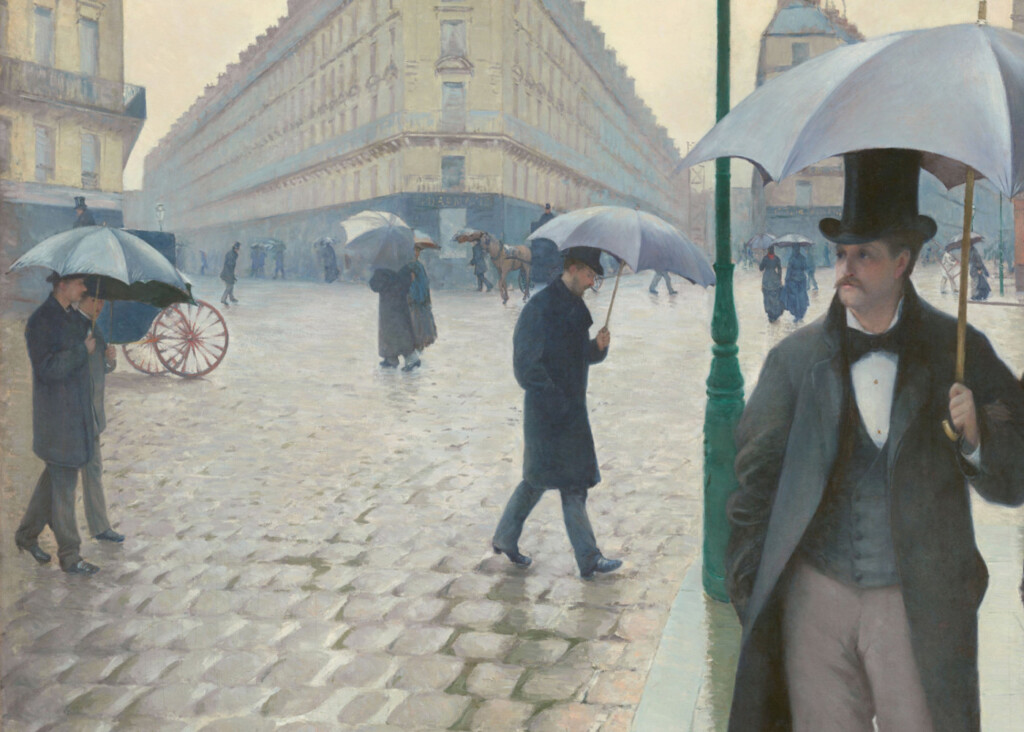
You have walked a city that was being erased while you walked it. Not metaphorically — literally. The scaffolding was up before the dust of demolition had settled, the new boulevard already plotted over the rubble of streets that had existed for four centuries. This is what Paris was between 1853 and 1870, when Georges-Eugène Haussmann, under Napoleon III’s imperial mandate, performed something that can only be called surgery without anesthesia on a living city. Approximately 20,000 buildings were demolished. Some 350,000 people were displaced from the medieval heart of the city, pushed outward to peripheral arrondissements while the grand arteries — the Grands Boulevards, the rue de Rivoli, the Avenue de l’Opéra — were driven through what had been a warren of alleys, courtyards, and accumulated human density. The city was opened up. Light entered. And so did sight lines.
This is not incidental. The wide boulevard is a political instrument as much as an urban one. The narrow medieval streets of Paris had been barricade country — in 1830, in 1832, in 1848, insurgents had turned the city’s own geography against the state. Haussmann’s new avenues made barricades structurally impossible and cavalry charges structurally efficient. The city was redesigned for spectacle and for surveillance in the same gesture. To see and to be seen, to consume the city as visual pleasure, was also to be legible, countable, exposed. The crowd that flows along the boulevard is simultaneously liberated and monitored.
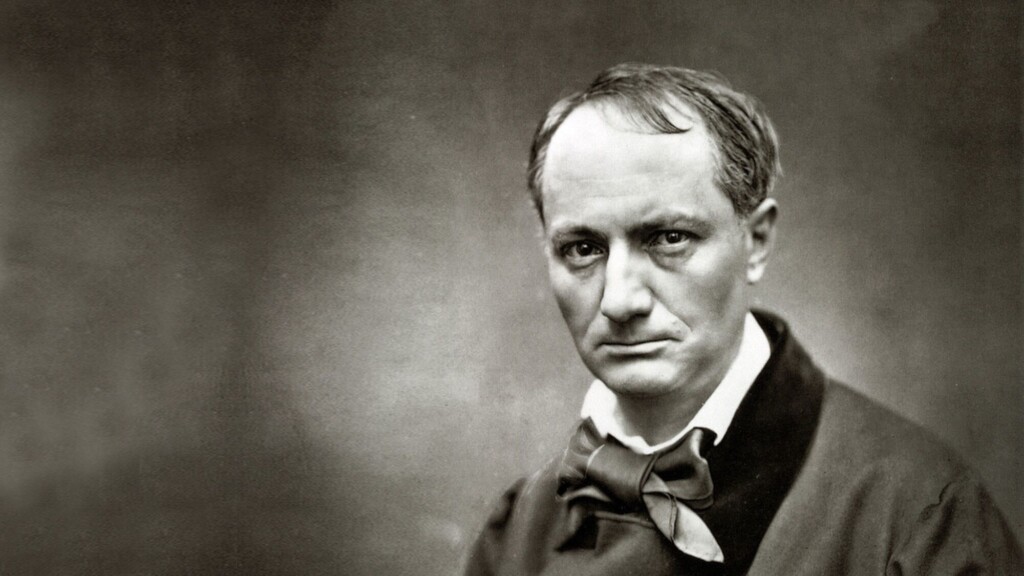
It is precisely into this wound that Charles Baudelaire steps, and from it he extracts a figure. In 1863, in his essay published across multiple issues of Le Figaro and later collected under the title “The Painter of Modern Life,” Baudelaire constructs what remains the most precise portrait of the flâneur ever written, though he does so obliquely, through the mask of describing the artist Constantin Guys. The essay is technically art criticism. It is actually a phenomenology of urban consciousness. Baudelaire describes a man who rises late, who plunges into the crowd as into a river, who makes his home in the multitude the way others make their home in four walls and a roof. “His passion and his profession is to merge with the crowd,” Baudelaire writes — and that merging is not passive dissolution but an act of radical attentiveness. The flâneur does not lose himself. He multiplies himself. Every face in the crowd is a text, every gesture a fragment of a story whose full arc he will never know and does not need to know.
What Baudelaire understood, and what makes this figure so disturbing beneath its aesthetic elegance, is that the flâneur is a product of the very transformation he observes. He could not exist in the old Paris. The medieval city did not permit this kind of watching — it was too dense, too intimate, too organized around communal life and the fixed social role. The new Paris, cracked open by Haussmann’s demolitions, produces the conditions for a new kind of subjectivity: the self that defines itself through perception rather than through belonging. The flâneur has no guild, no neighborhood, no fixed social body. He has only his gaze, and the city as the infinite material for that gaze.
This is a freedom, but it is also a symptom. Baudelaire was not naïve about what he was describing. The same modernity that granted this liberated, aestheticized consciousness also produced the commodity, the department store, the newspaper that flattened experience into spectacle for mass consumption. The flâneur walks through a city that is simultaneously a museum of human life and a marketplace. He is a connoisseur of what is also, quietly, for sale. The boulevard was designed to be walked by people who would also stop and buy. Beauty and commerce had been given the same address, and Baudelaire knew it. That knowledge lives inside the essay like a stone inside a fruit.

The Arcade as the Last Dreamworld
There is a particular kind of stillness that inhabits covered galleries in the early afternoon, when the light filters down through iron-ribbed glass and falls on things arranged to be desired. You have felt it, perhaps without naming it. The shoes in the window are not quite real. The amber light on the leather, the slight angle of the display, the way nothing moves — it produces a suspension of ordinary time, a soft arrest of the will. You are not shopping. You are dreaming with your eyes open, and the dream has been architected for you with extraordinary care.
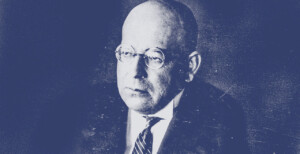
Walter Benjamin spent thirteen years trying to understand this feeling. The Arcades Project, that vast unfinished monument assembled from 1927 until his death fleeing the Gestapo at the Spanish border in September 1940, is in one sense an enormous cabinet of quotations, observations, and theoretical fragments arranged around the Parisian passages — those glass-covered commercial galleries that erupted across the city in the first decades of the nineteenth century and reached their peak around the 1850s before Haussmann’s renovations began rendering them obsolete. But Benjamin was not writing architectural history. He was performing an archaeology of desire itself, excavating the precise mechanism by which the new capitalist order had learned to colonize not bodies but dreams.
The passages were, in his reading, dreamworlds — spaces where the commodity presented itself not as a thing to be used but as a promise to be contemplated. Marx had already identified what he called the fetish character of commodities in Capital in 1867, that strange process by which human labor disappears from objects and they appear to possess their value intrinsically, as if by magic. Benjamin took this further and made it spatial. The arcade was the place where the fetish could be worshipped in comfort, protected from rain, bathed in the new miracle of gaslight and later electricity, transformed into something resembling an interior even as it remained a street. The flâneur moved through this space as through a furnished mind — and the furnishings were not his own.
A man stops before a display of pocket watches. He has no intention of buying one. He stands long enough that his own reflection ghosts across the glass, superimposed on the objects behind it, so that for a moment his face floats among the watches like something for sale. He does not notice this. Or rather, he notices it and does not find it strange. This is exactly the moment Benjamin called a dialectical image — not a metaphor but an actual perceptual event in which historical time collapses into a single frozen glance. The past that produced those objects, the labor and the accumulation and the system of desire that arranged them in that window, collides with the present body of the man standing there, and for an instant the whole architecture of modernity is visible, compressed into the surface of the glass. Then it passes. He moves on. The trance resumes.
Benjamin borrowed from the Surrealists the conviction that modernity’s true contents were not in its official monuments but in its thresholds, its transitional spaces, its forgotten interiors. Louis Aragon‘s 1926 novel Le Paysan de Paris had already wandered the Passage de l’Opéra with a hallucinatory attention that Benjamin recognized immediately as something more than literary experiment — it was a method of reading the city as unconscious. What the arcade revealed, to anyone willing to stand still long enough, was that capitalism had not simply organized production. It had organized perception. It had built physical spaces whose entire logic was the manufacture of longing, and it had invited the stroller inside and called it freedom.
The man with his face reflected in the watch-shop window is not passive. He is the unwitting protagonist of a system that requires his gaze in order to complete itself, that cannot function without the desiring subject who stands before it and dreams.
Seeing Without Being Seen: The Privilege Hidden in the Stroll
You know this without having been told. You have felt it in your legs, in the specific tension that enters the calves when the street empties and the footsteps behind you refuse to fade. A woman walking alone at dusk does not stroll. She calculates. Her eyes do not drift toward shop windows out of idle curiosity — they work the reflections, using the glass to monitor what is happening behind her without the vulnerability of turning around. Her pace is not the pace of someone surrendering to the city’s rhythm. It is a pace that has already mapped three possible routes home, that knows which bars still have people inside, that registers the distance between streetlamps not as atmosphere but as risk assessment. This is not paranoia. This is a completely rational response to a city that was never designed with her freedom of movement as a central concern.
The figure of the flâneur, as it crystallized through the nineteenth century and then through Benjamin’s philosophical rehabilitation of it in the 1930s, was never a neutral abstraction. It was a specific body moving through a specific city with a specific set of permissions. Male, bourgeois, almost invariably white, and possessed of enough leisure time to make purposeless wandering a viable mode of existence. The freedom to observe without being observed, to move through the crowd as an invisible intelligence gathering impressions — this was not a universal human capacity that certain people happened to exercise. It was a structural privilege wearing the costume of an aesthetic disposition.
Janet Wolff named this with surgical precision in her 1985 essay “The Invisible Flâneuse,” published in Theory, Culture and Society, arguing that the very concept of the flâneur is constituted by a gendered mobility that the nineteenth century made structurally unavailable to women. The public sphere of the arcade, the boulevard, the café — these were spaces that a woman could enter only under conditions that immediately marked her. An unaccompanied woman in those spaces was not invisible. She was conspicuous in the most dangerous possible way: she was readable as sexually available, as socially deviant, as a woman who had stepped outside the protected enclosure of respectability. The male flâneur’s invisibility was purchased directly at the cost of the female body’s hypervisibility. He could dissolve into the crowd. She became, by the simple act of walking alone, a spectacle requiring interpretation.
This is not a historical curiosity. Watch what happens when a woman slows down in a public space without apparent purpose — without a destination legible to the people around her. The drift that Baudelaire romanticized, that Benjamin theorized as a form of resistance to commodity culture, immediately transforms her into an object of surveillance rather than its subject. She is not reading the city. The city is reading her. Every man who passes performs a quick, largely unconscious calculation about what her presence means, what it signals, what it invites. The gaze flows in exactly the wrong direction.
This asymmetry was built into the urban architecture itself. Baron Haussmann’s reconstruction of Paris between 1853 and 1870 — the same transformation that created the broad boulevards Benjamin would later read as the infrastructure of the flâneur’s world — simultaneously consolidated the separation between public and domestic space in ways that had precise consequences for women’s freedom of movement. The grand redesign was not ideologically neutral. The open, legible city was open and legible in ways that served some bodies and exposed others.
What Wolff understood, and what has been slow to penetrate discussions of flânerie even in their most theoretically sophisticated forms, is that the capacity to see without being seen is not an individual talent. It is a social allocation. And like most social allocations, it arrives pre-distributed along lines that the people who benefit from it rarely feel the need to examine.
The Crowd as Mirror and Abyss
There is a man on a Tuesday afternoon in any large city you care to name — Berlin, São Paulo, Osaka, it makes no difference — who has nowhere particular to be and chooses, with a deliberateness that looks like idleness, to follow a stranger. Not the same stranger all day. He picks one at a corner, watches the rhythm of their walk, the particular way they hold a bag or check a phone, and then simply goes where they go. For an hour, sometimes two. He is not dangerous. He is hungry in a way he cannot name, hungry to slip out of the container of himself and pour into someone else’s life, even briefly, even without understanding anything about it. He will never speak to any of them. That is not the point. The point is the dissolving.
Baudelaire called it a holy prostitution of the soul — the crowd as a kind of baptism, immersion in the mass as a form of mystical union. He meant it seriously, and the ecstasy he described was real: the sensation of multiplying yourself through contact with strangers, of trading the single, bounded self for a temporary plurality. The crowd, in this reading, is not an obstacle to experience but its highest medium, a bath of electric energy that the flâneur enters voluntarily and exits, supposedly, intact.
But Walter Benjamin, reading Poe’s 1840 story about an old man who cannot stop moving through London’s streets — who dies, in a sense, the moment the crowd thins — understood something darker in the same image. The man Poe describes is not liberated by the crowd. He is held by it. Remove the throng and he collapses, because outside of it he has no interior to return to. Benjamin recognized in this figure not the sovereign observer but the addict, the one for whom immersion has become the only alternative to confronting an emptiness that has grown too large to face directly. The flâneur’s freedom, pressed hard enough, reveals itself as a flight path — elegant, theorized, aestheticized, but flight nonetheless.
This is where Georg Simmel arrives with the precision of a scalpel. In his 1903 essay on metropolitan life and the psyche, Simmel identified what he called the blasé attitude not as cultural sophistication but as neurological self-defense. The city, he argued, bombards the urban nervous system with more stimuli per minute than any previous human environment had demanded. The mind adapts by flattening its responses, by coating itself in a thin layer of apparent indifference that protects the interior from being shattered by the sheer volume of sensation. The blasé attitude is not coldness. It is the scar tissue that forms over a wound kept permanently open. The flâneur, who reads this same indifference in himself as aesthetic distance, as philosophical detachment, has simply given a more flattering name to the same wound.
The man following strangers on a Tuesday afternoon is not exempt from Simmel’s diagnosis. His hunger to dissolve — which he might experience as openness, as radical empathy, as the Baudelairean soul making itself porous — is also a refusal of the self’s solidity, a preference for borrowed interiority over the labor of constructing his own. What looks like abundance, a soul large enough to absorb other lives, can equally be read as a deficit, a self so uncertain of its own substance that it requires constant infusion from elsewhere to feel real. The crowd as mirror shows you multiplied, reflected, validated by sheer mass. The crowd as abyss offers something more vertiginous: the possibility that there was never much there to dissolve in the first place, and that the city, with its infinite supply of strangers, is simply the most sophisticated mechanism ever devised for not having to find out.
A vision curated by a filmmaker, not an algorithm
In this video I explain our vision
Capitalism Swallows the Drift

You have seen it happen in real time. Someone stops in front of a crumbling wall — plaster peeling away in layers that reveal three decades of paint underneath, ochre then green then the original grey cement — and they do not look at it. They frame it. The phone rises, the angle is adjusted, the light is checked, and within forty seconds the wall has been transformed into content: tagged, filtered, captioned with something about decay and beauty, about the poetry of forgotten places. The wall has not been seen. It has been harvested.
This is what absorption looks like when it is complete. The gesture of the flâneur — that deliberate, unproductive attention to the city’s margins and textures — has been so thoroughly metabolized by the logic of spectacle that it now reproduces that logic with perfect efficiency. The wanderer who once escaped the economy of purposeful movement has become one of its most productive agents, generating aesthetic surplus value from every cracked facade and overgrown lot. Walter Benjamin understood something essential when he noted that the arcade was not simply a place to shop but a dreamworld, a phantasmagoria in which capitalism presented itself as nature — eternal, inevitable, beautiful. What he could not have fully anticipated was how seamlessly that dreamworld would migrate from iron and glass into the pocket-sized screen, and how eagerly people would volunteer to maintain it.
The shopping mall arrived as the arcade’s lobotomized descendant: the same principle of controlled drift, the same promise of pleasurable wandering, but stripped of every ambiguity. No rain, no beggars, no unexpected turns. The flâneur’s productive disorientation was replaced by a circuit designed by behavioral economists and retail architects who had studied foot traffic patterns with the precision of military strategists. You could still wander, technically. But the wandering had been engineered to terminate at a cash register. The aimlessness was a managed illusion.
Guy Debord saw the mechanism with surgical clarity. In 1956, articulating the theory of the dérive alongside the broader Situationist project, he proposed something that was explicitly a political weapon forged from the raw material of flânerie. The drift was not aesthetic pleasure but psychogeographic investigation — a method of mapping how the city’s spatial organization colonized desire and movement, channeling bodies into predetermined circuits of consumption and compliance. The dérive was Baudelaire’s wandering turned against itself, against the system that had co-opted it. Debord and the Situationists understood that the city was not a neutral stage but an argument, and that to walk against its grain was to refuse that argument.
Within two decades, the refusal had been repackaged. Urban exploration became a subculture with its own magazines, forums, and aesthetic conventions. The abandoned factory, the derelict hospital, the forgotten infrastructure of industrial capitalism — all of it became a genre, with lighting techniques and composition rules and a recognizable visual language that any editor could identify at a glance. Then the Instagram account. Then the walking app that translates the aimless stroll into a scored experience, awarding points for distance covered, suggesting “hidden gems” based on your data profile, turning Debord’s psychogeography into a gamified product with a subscription tier.
There is something almost admirable in the speed of it. The system does not suppress alternatives — it digests them. It takes the posture of resistance and returns it as lifestyle, strips the practice of its friction and sells the remainder as identity. The person photographing the crumbling wall may genuinely feel something in front of it: some real aesthetic tremor, some authentic encounter with time and entropy. That feeling is not false. But the moment it passes through the phone and into the platform, it enters a circuit where the feeling is not the point. The feeling is the product. And you, standing there with your arm extended, are the unpaid labor that produces it.
Benjamin at the Border: When the Walk Has No Return
There is a moment when the road simply ends. Not because you have arrived somewhere, but because a man in a uniform is standing at a gate and the gate is closed and your papers are not the right papers and the country on the other side has just changed its mind about letting people like you through. You have been walking for hours, or days, through mountain passes that were not designed for a man of fifty-eight with a heart condition and a leather briefcase that he refused to abandon even when the path became steep enough to make the others stop and look back at him with something between admiration and pity.
This is what happened in September 1940, in the last days of a particular kind of world. A man crossed the Pyrenees on foot, carrying with him a manuscript he had been writing for over a decade — a text he called his Arcades Project, a vast, unfinished constellation of fragments about Paris, about modernity, about the figure of the stroller who moves through the city without purpose, belonging everywhere and nowhere. He made it to Portbou. He was stopped at the Spanish border. The following morning, he was dead from a morphine overdose. The manuscript was never found. The man was Walter Benjamin.
What is almost unbearable about this is not the tragedy of an individual life cut short — history is full of those, and history is pitiless in its arithmetic. What is unbearable is the precise, structural irony of who this man was and what he had spent his intellectual life describing. Benjamin had taken the figure of the flâneur — Baudelaire’s anonymous walker, Charles Baudelaire himself moving through Haussmann’s rebuilt Paris in the 1860s, watching the city transform around him with the cool detachment of a man who belongs to the street and therefore to no one — and he had analyzed it with the rigor of someone who understood it from the inside. In his essay on Baudelaire, published in fragments and never completed to his satisfaction, Benjamin had written about the flâneur as a figure who converts the city into an interior, who reads the crowd the way a detective reads a scene. The freedom to walk without destination, to observe without being observed, to exist in public space as a sovereign and invisible presence — Benjamin understood all of this as something that only became possible under very specific historical conditions. It required leisure. It required a certain invisibility granted by class or gender or race. It required, above all, a state that permitted your movement.
The philosopher Hannah Arendt, who had known Benjamin and who would later carry some of his manuscripts to safety — though not the Arcades, which disappeared — wrote in The Origins of Totalitarianism, published in 1951, about what she called the right to have rights. Her argument was precise and devastating: rights are not natural. They do not exist in the abstract. They exist only insofar as a political community recognizes and protects them. When you are stripped of citizenship, when you become stateless — as Benjamin had become, his German citizenship revoked by the Nazi state in 1939 — you fall through the floor of civilization into a space where no rights apply, because there is no longer any body politic obligated to enforce them.
Benjamin at Portbou was not a symbol. He was a man who could not cross a border. The flâneur, that elegant, leisured figure drifting through the arcades of Paris with his hands behind his back and his eyes half-closed in practiced detachment, had always been, without knowing it, a figure of extraordinary privilege. The freedom to move through space without being stopped is not freedom in the philosophical sense. It is a permission granted by institutions that can revoke it at any moment.
What the City Knows That You Have Forgotten
There is a particular kind of exhaustion that arrives not from having done too much but from having been directed too much. You know the feeling: you have followed the blue line all day, the phone vibrating softly each time you were about to make a wrong turn, and by evening you cannot quite remember what you passed, what you noticed, what surprised you. The city happened to you like a conveyor belt. You arrived at your destination having traveled nowhere.
Rebecca Solnit, writing in Wanderlust in 2000, before the smartphone had finished colonizing the pocket and the mind, observed that the human body walks at roughly three miles per hour, and that this is also, not coincidentally, the pace at which certain kinds of thought become possible. Not the thought of problem-solving or optimization, but the lateral, associative, digressive thought that connects unlike things — the thought that does not know where it is going and finds something precisely because of that. The mind that moves faster, she argued, begins to lose that particular faculty. It processes rather than perceives. What algorithmic routing has done, then, is not merely reroute the feet but interrupt a cognitive rhythm that is older than cities, older than writing, older than almost everything we have decided to call culture.
Baudelaire felt the city as a wound that was also an ecstasy. Benjamin felt it as an archive on the verge of destruction, every arcade a reliquary of a capitalism that was already eating itself. What they shared, beneath the considerable differences in temperament and century, was the conviction that moving through urban space without agenda was not laziness but a form of radical attention — attention that refused the logic of the destination, that treated the detour not as a failure of efficiency but as the point itself. The flâneur’s famous idleness was always a political act wearing the costume of a stroll.
And yet the question that presses now is whether that act remains possible, or whether the infrastructure of modern movement has made it structurally unavailable. When every surface is a potential advertisement, when the phone in your pocket is learning your patterns faster than you can unlearn them, when even the decision to wander without a map is itself capturable as data and converted into a preference profile, the city has become something the nineteenth century could not have imagined: a space that watches you watching it. The flâneur’s gaze was always asymmetrical — he saw without being fully seen, moved through the crowd as an observer who retained the privilege of invisibility. That asymmetry has now reversed. You are the observed. The city, or rather the corporate architecture built into it, knows your routes before you walk them.
There is a man who walks every morning through a city he has lived in for thirty years, and he still takes streets he has not taken before, still finds a courtyard, a painted door, a flight of stairs leading nowhere that he cannot explain having missed for three decades. He is not doing anything. He has no theory of walking. He is simply moving at three miles per hour, and his mind is doing what minds do at that pace: making connections that have no immediate use, noticing what has no name yet, arriving at thoughts that could not have been thought sitting still. Whether this constitutes resistance, or nostalgia, or something that predates both those categories entirely, he could not tell you.
Perhaps what we call flânerie was never really about the city, or the crowd, or even modernity in its specifically Parisian form. Perhaps the city was simply the occasion — the latest and most elaborate occasion — for something the body has always known how to do when left alone long enough to remember: move through the world at the pace of a mind that is still, in some inarticulate and stubborn way, trying to understand where it is.
🚶 Wandering Minds: The City, Space, and Modern Experience
The figure of the flâneur — that detached yet intensely perceptive wanderer of urban streets — opens onto a vast intellectual landscape connecting philosophy, sociology, and the lived experience of modernity. From Baudelaire’s poetic strolls through Paris to Benjamin’s labyrinthine arcades, these articles trace the hidden corridors of thought that illuminate the city as a space of meaning, myth, and identity.
Georg Simmel and the Metropolis: The Metropolis and Mental Life
Georg Simmel‘s landmark essay ‘The Metropolis and Mental Life‘ is perhaps the most direct intellectual companion to the figure of the flâneur, analyzing how the overwhelming stimuli of the modern city force the urban individual into a posture of detached, blasé observation. Simmel’s metropolitan type — overstimulated, calculating, and emotionally withdrawn — is the sociological twin of Benjamin’s wanderer through the arcades. Understanding Simmel is essential to grasping why the flâneur is not merely a romantic figure but a symptom of modernity itself.
GO TO THE SELECTION: Georg Simmel and the Metropolis: The Metropolis and Mental Life
Situationist Psychogeography: The City as Lived Space
The Situationist International radicalized the tradition of urban wandering by transforming it into a political and aesthetic practice: the dérive, or unplanned drift through city streets, was their answer to the spectacle of late capitalism. Psychogeography, as theorized by Guy Debord and his collaborators, shares deep roots with Benjamin’s method of reading the city as a layered text of desire, power, and memory. This article offers an indispensable map of how avant-garde thinkers reimagined the street as a site of resistance and revelation.
GO TO THE SELECTION: Situationist Psychogeography: The City as Lived Space
Philosophy of the City: History and Theory
The philosophy of the city provides the broader theoretical framework within which the flâneur operates, tracing how thinkers from antiquity to postmodernity have understood urban space as a crucible of human self-formation. The city is never merely a backdrop in this tradition but an active participant in shaping perception, social relations, and the very texture of subjectivity. This article contextualizes Benjamin’s and Baudelaire’s contributions within a rich and ongoing philosophical conversation about what it means to inhabit shared space.
GO TO THE SELECTION: Philosophy of the City: History and Theory
Calvino’s Invisible Cities: Meaning and Analysis
Calvino’s ‘Invisible Cities’ is one of the most luminous literary crystallizations of the flâneur’s mode of attention, presenting a series of imaginary urban spaces that dissolve the boundary between geography and dream, fact and desire. Like Benjamin’s arcades, Calvino’s cities are never simply places but states of mind, each one a different way of experiencing time, memory, and the gaze of the wanderer. Reading this article alongside the study of Baudelaire and Benjamin reveals how the literary imagination has continued to inhabit and transform the tradition of urban poetics.
GO TO THE SELECTION: Calvino’s Invisible Cities: Meaning and Analysis
Discover the Cinema of Those Who Dare to Wander
If these ideas about drifting, seeing, and the poetic life of cities stir something in you, Indiecinema is the streaming platform where that restless spirit finds its screen. Explore our curated selection of independent and art-house films that bring the flâneur’s gaze to life — works that walk the margins, linger in unexpected places, and remind you that the most profound journeys are often the ones taken without a map.
👉 EXPLORE THE CATALOG: Watch Indie Films in Streaming
A vision curated by a filmmaker, not an algorithm
In this video I explain our vision