
The Man Who Could Not Look Away
You know the feeling. It’s past midnight and you’re still scrolling — not reading, not watching, just moving through images with the mechanical compulsion of someone who has forgotten why they started. A photograph of a wildfire bleeds into an advertisement for running shoes bleeds into a medieval woodcut someone posted as a joke bleeds into a satellite image of a flooded city bleeds into the face of a goddess from some temple you’ll never visit. The images don’t accumulate into meaning. They accumulate into a kind of pressure behind the eyes, a sensation that the world is simultaneously too full and somehow incomplete, that every image is pointing toward something just outside the frame of your attention. You close the screen. The pressure remains.

This is not a modern pathology. Or rather, it is modern in its technology and utterly ancient in its structure. There was a man who lived inside this sensation as a permanent condition of his existence, who turned it into the most unclassifiable intellectual project of his era, and who eventually could not distinguish between the intensity of his research and the onset of madness. His name was Aby Warburg, and he was born in Hamburg in 1866 into a family whose wealth was so thoroughly established that it had become, like all inherited wealth, a kind of gravity — invisible, total, pulling everything toward a predetermined orbit.
The deal he struck with his younger brother Max was simple in its terms and staggering in its implications. Aby, as the eldest son, held the traditional right to inherit leadership of the Warburg banking house. He did not want it. What he wanted was books — not a gentleman’s library arranged for decoration, but a working instrument, a machine for thinking, something that would grow without limit according to its own internal logic. The agreement, made in childhood and honored for decades, was this: Max would take the bank, and in exchange, Aby would have the right to buy whatever books he needed, for as long as he needed them. Max Warburg went on to become one of the most powerful financiers in Germany, advising governments and navigating the catastrophes of two world wars. Aby went on to build a library in Hamburg that would eventually contain sixty-five thousand volumes arranged not alphabetically or by subject but by what Warburg called the law of the good neighbor — the principle that the book you need is always the one sitting next to the book you were looking for, that knowledge moves by proximity and contamination rather than by category.
This is already a theory of how the mind works, encoded in furniture. But to understand why Warburg needed such a machine, you have to understand what he was trying to think about, and to understand that you have to return to the sensation you felt at midnight, staring at those images. Because what Warburg saw — what he could not stop seeing — was that images do not die. They migrate. They shed their original contexts like a snake sheds skin and reappear centuries later in completely different bodies, carrying the same charge, the same gesture, the same emotional voltage. The nymph with her hair streaming in the wind, carved on a Roman sarcophagus in the first century, turns up again in a Florentine fresco in the fifteenth, turns up again in an advertisement in the twentieth, turns up again on your screen at midnight, and something in your nervous system responds before your intellect has time to intervene.
Warburg called this survival of images the Nachleben — the afterlife. He spent his entire adult existence trying to understand what it meant that human beings cannot stop recycling their gestures of ecstasy and grief across thousands of years, as if the body remembers what the mind has long since forgotten.
Trench
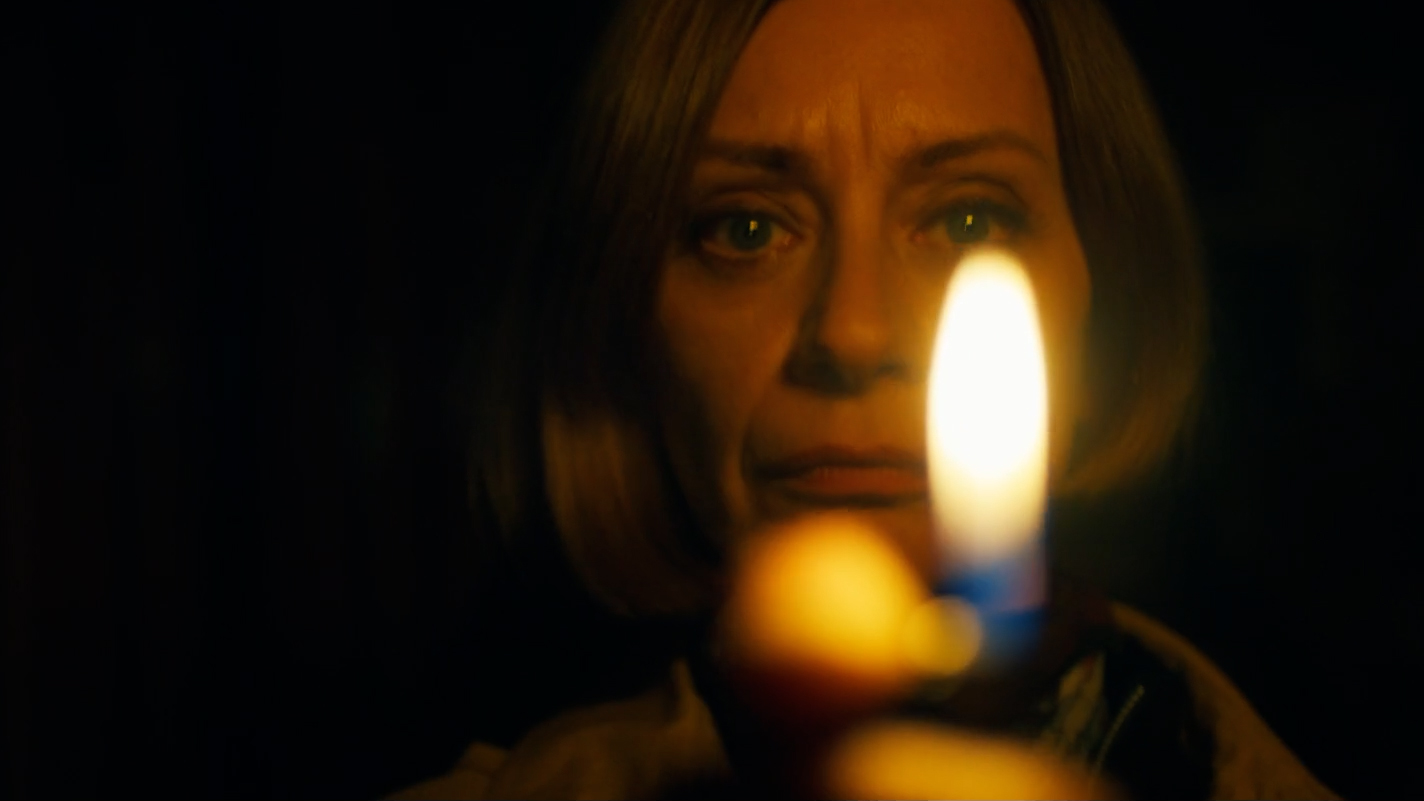
Thriller, Mystery, by Serge Turgeon, Italy, 2023.
In Venice, an art historian realizes that her brilliant mind will not be enough to solve the mystery surrounding the disappearance of an unknown woman. In addition to regaining trust in her intuition and her heart, she will need the help of a series of colorful characters from her community.
The idea behind Trench is to tell, through a detective story, the journey of an intellectual woman who suffered while growing up in a working-class district of Venice, where she never felt truly valued. In order to solve a mystery, she must face danger and rely on the help of the “non-intellectual” members of her community, rediscovering along the way her resourcefulness, her Venetian identity, and her true self.
LANGUAGE: Italian
SUBTITLES: English, Spanish, French, German, Portuguese
Images That Do Not Die
There is a gesture you have seen a thousand times without knowing its age. A woman’s hair loose and streaming behind her, caught mid-motion, fabric pressed flat against her body by forward movement, arms slightly extended as though the air itself needed to be parted. You have seen it in a Renaissance fresco, in a fashion photograph, in the frame of a film where a figure runs through a field at dusk toward something or away from something — the direction is almost irrelevant. The gesture carries its own emotional charge independent of any specific narrative. It arrives already loaded, already ancient, already screaming something that has no single word.
Aby Warburg called these recurring configurations Pathosformeln — pathos formulas — and the name is one of the most precise coinages in the history of thought. Not symbols, not quotations, not allegories. Formulas in the chemical sense: stable compounds of emotional energy that survive the dissolution of the cultures that first synthesized them. When Domenico Ghirlandaio painted a servant girl in 1486 in the Tornabuoni Chapel in Santa Maria Novella, her hair and robes animated by a wind that has no meteorological source, he was not imitating a classical relief. He was receiving a transmission. Something crossed the centuries not as a citation but as a living nervous impulse, the way a reflex arrives in the body before the mind has time to interpret it.
Warburg spent the better part of his intellectual life tracking these transmissions. His central concept was the Nachleben der Antike — the afterlife of antiquity — and the word Nachleben is worth sitting with. Not revival, not renaissance, not influence. Afterlife. The implication is that the ancient world did not end. It continued, underground, dormant in images the way a virus remains dormant in tissue, capable of reactivation under the right conditions of historical pressure. A grieving figure with torn hair carved on a Roman sarcophagus in the second century does not stop existing when the sarcophagus is buried. It waits. It resurfaces in a Florentine painting, then in a woodcut, then in a film still of a woman collapsing on a hospital floor, and each time it surfaces it carries the same charge, the same vocabulary of extremity, the same formal encoding of a body at the edge of what it can endure.
Walter Benjamin, who read Warburg with the intensity of someone recognizing a buried twin, developed a concept that amplifies this to a historical scale. The dialectical image, as Benjamin elaborated it in the notebooks that became the Arcades Project, is not a metaphor. It is the moment when a fragment of the past suddenly constellates with a fragment of the present, creating a flash of recognition that is also an interruption. History, for Benjamin, does not flow. It accumulates, sediments, and then erupts. The present does not inherit the past in an orderly procession. It is ambushed by it. You are walking forward and something from two thousand years ago lands on your shoulder without asking permission.
What Warburg understood, and what makes him disturbing even now, is that images are not passive containers of meaning. They are agents. They carry emotional programs that operate below the threshold of conscious interpretation. You respond to the streaming hair before you have decided to respond to it. The Pathosformel reaches the nervous system before it reaches the intellect, which is precisely why it has survived every change of religion, every shift of cosmology, every cultural revolution that believed it was starting from zero. It does not need your belief. It does not require that you know its genealogy. It works regardless, the way gravity works regardless of whether you have read Newton.
Warburg mapped these survivals not to demonstrate erudition but because he understood, with something close to dread, that the images shaping human emotional life are not ours. They are older than us. They came before us. And they will be here after we are done using them.

Pueblo, New Mexico, 1895
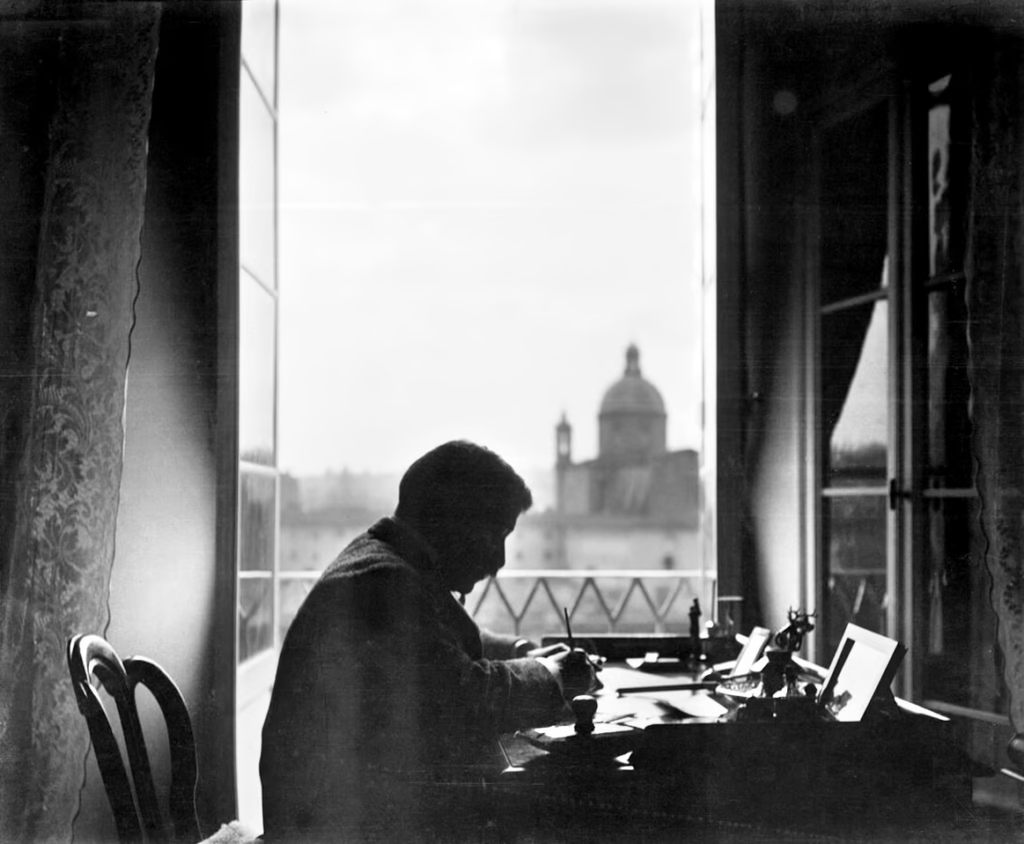
He traveled there by train, mostly, and then by horse, and then on foot across terrain that had no interest in accommodating him. The year was 1895, and Aby Warburg was thirty years old, already restless with the suspicion that the Renaissance he loved so carefully was not the story Europe had decided to tell about itself. He arrived in New Mexico not as an anthropologist with a methodology but as a man who needed to see something he could not yet name.
What he saw among the Hopi people shattered the comfortable vocabulary he had brought with him. There was a ceremony — a ritual of rain-summoning that had been performed for centuries before any European had a word for the continent it was performed on — in which men danced with live rattlesnakes held between their teeth. Not symbolic snakes. Not representations of serpents in stone or pigment. Actual rattlesnakes, venomous, coiled against the mouths of men who moved in controlled, deliberate patterns through dust and drumbeat, speaking through their bodies to forces that did not speak back in any language Warburg had studied. He watched this and did not flinch into the language of savagery that his era would have offered him freely. He understood, with a precision that was almost violent in its clarity, that he was watching the same thing he had spent years studying in Florentine painting.
This is the insight that most intellectual histories still manage to miss, either out of comfort or cowardice. Warburg did not see primitivism in the desert and civilization in the Uffizi. He saw, in both places, the same fundamental human confrontation: the encounter with forces that exceed the self, forces that could destroy, that could withhold rain and life and meaning, and the extraordinary, fragile, improbable act of constructing a symbolic form capable of holding that terror at a distance long enough to think. The snake in the mouth and the nymph with flowing hair in the fresco were not opposites on an evolutionary scale. They were the same gesture, attempted in different material, toward the same impossible goal.
He called this space the Denkraum. The thinking-space. The buffer zone between instinct and response, between the raw terror of being alive in a world that offers no guarantees and the human capacity to insert something — an image, a gesture, a ritual, a painted figure in motion — between the stimulus and the reaction. Ernst Cassirer, working independently on similar terrain in his 1944 work “An Essay on Man,” would later frame the human animal as precisely this: the creature that cannot respond to its environment directly but must pass all experience through the mediating fabric of symbolic forms. Warburg had arrived at this understanding not through philosophy but through watching men hold snakes in their teeth in a New Mexico afternoon.
The Denkraum is not a comfort. This is essential to understand. It is not the triumph of reason over fear. It is the maintenance of a space — precarious, always threatened, never guaranteed — in which the terror is present but not overwhelming, in which the human being is afraid but not yet annihilated by the fear. Ritual holds that space open. Art holds that space open. The snake dancer and Botticelli’s Primavera are both engaged in this act of structural defiance against the collapse of meaning into raw sensation.
Warburg returned to Hamburg changed, carrying something he could not yet fully articulate, something that would take decades to work itself into a form. The images he had photographed among the Hopi he kept for thirty years, returning to them repeatedly, placing them in conversation with images from antiquity as though the conversation had never been interrupted by the centuries between them. He knew, somewhere beneath the level of academic argument, that what he had witnessed in the desert was not the past. It was the ground.
The Breakdown as Method
There is a particular kind of silence that follows a war — not peace, but something closer to the absence of language itself. The words that once organized the world into meaning have been used to justify artillery barrages, to sign death warrants, to write letters home that arrived after the body. Warburg emerged from the years of World War One not broken in any ordinary sense but epistemologically shattered. The thing he had spent his life building — the idea that symbolic thinking could hold human violence at a civilized distance, that the Denkraum, the thinking space between impulse and image, was a real and durable achievement of culture — had been tested against industrial slaughter and had failed. Not as a theory. As a lived fact.
He had watched educated men, men who knew their Botticelli and their Ovid, send other men into mustard gas. The nymphs of the Florentine Renaissance had marched into the trenches alongside everyone else. By 1918 he was collecting German war stamps, obsessively, reading in their mythological imagery the evidence that astral fatalism and magical thinking had not been overcome by modernity but merely dressed in new uniforms. The archive was consuming him. He could no longer tell whether he was studying the survival of pagan antiquity or being survived by it, whether he was the scholar or the specimen.
Nietzsche had written in The Birth of Tragedy, published in 1872, that the Apollonian world of form and measure was never a conquest over the Dionysian. It was a surface. A crust, thin and constantly threatened by the volcanic pressure beneath it. What Warburg had called the Denkraum — that interval of reflection between animal fear and symbolic response — was precisely this Apollonian membrane. And in 1921, it broke in him.
He was committed to Ludwig Binswanger’s sanatorium at Kreuzlingen, in Switzerland, where he would remain for years. Binswanger was not an ordinary psychiatrist. He was developing what he called Daseinsanalyse, an existential approach to mental illness that took the patient’s world-experience seriously as a philosophical problem rather than merely a symptom cluster. In this place, among men trying to reassemble their inner architecture, Warburg did something extraordinary. He did not surrender the images. He kept working, kept thinking, kept writing. As if to stop engaging with the symbolic world would have been to admit that it had won.
Then, in April 1923, he asked Binswanger for permission to deliver a lecture to the sanatorium’s staff and patients. The subject was the snake ritual of the Hopi people of the American Southwest, whom he had visited in New Mexico in 1895 and 1896. He stood before that small audience and spoke for over an hour about lightning, about serpents carried in the mouths of dancers, about the attempt to negotiate with the forces of nature through the body itself. He argued that the Hopi ritual was not primitive superstition but a form of the same symbolic thinking he had traced through Florentine painting — an attempt to transform the terror of uncontrolled nature into something that could be handled, processed, made human.
The lecture was a performance of recovery. It was also a confession. He had gone to that edge where the images stop being objects of study and begin to speak back. Where the Maenad is not a marble relief but something moving in the peripheral vision of your worst nights. Where the serpent is not a symbol of fertility or danger but the anxiety itself, the original one, the one that precedes all language. He had stood inside the Dionysian pressure that Nietzsche described and returned from it carrying notes. The lecture said: I am still capable of Apollonian distance. Look. Watch me hold the serpent at arm’s length and analyze it.
But the arm was still trembling.
The Mnemosyne Atlas
There is a room somewhere in your memory — not a physical room, but the interior architecture of an obsession — where images have been accumulating for years without your permission. A face from a magazine clipping that resembles someone you lost. A posture caught in a photograph that echoes a gesture you saw in a church fresco on a childhood trip you barely remember taking. A curve of drapery, a raised arm, an expression of grief so ancient it feels personal. You did not choose these images. They chose you, or rather, they recognized something in you that you had not yet named.
This is where Warburg was living in the final years of his life, except he had made the room visible.
Beginning in 1924, after his return from Kreuzlingen and the psychiatric confinement that had interrupted his work for years, he began covering large black cloth panels with photographs, reproductions, newspaper cuttings, astrological diagrams, postage stamps, and images torn from the margins of disciplines that had never been expected to speak to one another. Sixty-three panels eventually. Nearly a thousand images in total. He called the project the Mnemosyne Atlas — Mnemosyne being the goddess of memory and the mother of the Muses, the figure in whose body all time is held simultaneously. He was building an atlas not of geography but of gesture, a map not of places but of the recurring movements through which human beings have expressed terror, ecstasy, mourning, and victory across three thousand years.
He never finished it. He died in 1929, and the panels were dismantled, the images scattered, reconstructed later only through photographs taken in his studio. What survives is a ghost of the argument, and the argument was this: that meaning does not live in single images but in the electric charge produced when images are placed in proximity to each other. That a Renaissance nymph running with wind-filled drapery and a contemporary photograph of a woman crossing a street in a hurry belong to the same sentence. That the sentence cannot be written in words.
Eisenstein had arrived at something adjacent from another direction. His theory of montage, articulated through the 1920s, held that two images placed together do not simply add up to their sum — they collide, and the collision produces a third thing that existed in neither image alone. Intellectual montage, he called it, and he meant it literally: the juxtaposition was a form of thought, not illustration. Warburg would not have needed the theory explained to him. He had been practicing it on cloth panels in a Hamburg library while Eisenstein was still writing the manifestos. The difference is that Eisenstein’s collisions unfold in time, one cut following another in a sequence the viewer cannot stop or reverse. Warburg’s panels were meant to be apprehended spatially, the eye moving across them in any direction, making its own paths, finding its own voltages.
What is remarkable — and genuinely disorienting if you let yourself feel it — is that we now live inside a version of this every hour of every day. Every screen you open performs a crude, unconscious Mnemosyne Atlas. A news photograph of a refugee pressing against a border fence sits algorithmically adjacent to an advertisement for resort wear, which sits beside a medieval illumination someone posted for aesthetic pleasure, which sits beside a child’s birthday video, which sits beside a satellite image of a burning forest. The juxtapositions are not curated by a mind seeking meaning. They are generated by systems seeking engagement. But the effect on the nervous system is structurally identical to what Warburg was producing deliberately: the forced cohabitation of images from incompatible temporalities, creating resonances nobody authorized and nobody fully understands.
Warburg called this the Nachleben, the afterlife of antiquity — the way ancient pathos formulas survive not in texts but in the body’s visual vocabulary, erupting unexpectedly into the present. He could not have imagined the mechanism we have built to accelerate that eruption beyond any capacity for reflection.
A vision curated by a filmmaker, not an algorithm
In this video I explain our vision
What the Warburg Library Knew

You have been inside a library that defeated you. Not because it lacked what you needed, but because it was organized according to a logic you could not immediately decode — and then, slowly, you realized the logic was not absence but excess, not disorder but a different order entirely, one that required you to slow down and let the shelves think alongside you. Most libraries are built for retrieval. This one was built for encounter.
The sixty thousand volumes that Aby Warburg assembled in Hamburg over decades were arranged according to what he called the principle of the “good neighbor” — the conviction that every book, placed correctly, would find itself next to the book it most needed to accidentally meet. Not alphabetically. Not by discipline. Not by period or language or genre. By affinity, by resonance, by the kind of proximity that generates friction and light. A text on astrology in ancient Mesopotamia sat beside a Renaissance treatise on political symbolism sat beside a study of Greek tragedy sat beside an anthropological account of Pueblo ritual dances in New Mexico. The reader who reached for one would inevitably brush the spine of another, and that brushing was not accidental. It was the entire point.
Warburg understood something that academic institutions have spent the better part of a century working to forget: that thought does not respect the borders drawn around it by administrative convenience. Disciplines are organizational fictions, useful for budgets and faculty appointments, catastrophic for understanding. Aby Warburg himself was a man who could not be filed. He was not an art historian in any recognizable sense, not a classicist, not an anthropologist, not a psychologist, though he read deeply and seriously in all of these. Ernst Cassirer, whose philosophy of symbolic forms owes an acknowledged debt to Warburg’s archive of images and ideas, described the library as something closer to a mind made physical than a collection made accessible. When Cassirer first entered it, he reportedly said he did not know whether he would emerge, whether any single researcher could absorb and survive what was contained there. That is not hyperbole. That is a precise description of what genuine interdisciplinary thought feels like to someone trained to stay inside their lane.
The library emigrated in December 1933, two months after Hitler came to power, packed onto two steamboats that crossed the North Sea in winter carrying books, photographs, and the institutional memory of an entire intellectual project. It was an act of rescue that required considerable logistical courage and the financial support of the Warburg family, who understood that what was being transported was not property but a way of thinking. It arrived in London and eventually became the Warburg Institute at the University of London, where it still exists, still organized according to its founding principle of productive adjacency, still quietly insisting that the reader who arrives with a specific question will leave with a different, better, more disturbing one.
What was saved on those two boats was not merely a collection. It was an argument about how knowledge coheres — or rather, how it coheres only when it is not artificially separated. Georges Didi-Huberman, whose engagement with Warburg’s methods spans multiple books including the landmark “Devant le temps” published in 2000, has argued that Warburg’s library enacts a form of anachronism that institutional history finds threatening: it treats time as layered and survivable rather than linear and superseded. The past does not precede the present in the library’s logic. It haunts it, inhabits it, breaks through it at unpredictable moments.
Academic institutions have been dismantling this architecture since the moment it became inconvenient. Departmental walls were not built to protect disciplines. They were built to protect budgets, to simplify hiring, to make legible to administrators what is fundamentally illegible: the way a mind actually moves when it is left alone with what it genuinely needs to find.
Survival of the Gestures
There is a moment, recurring and unremarkable, when a politician raises both arms above his head after a victory, fists clenched or palms open toward the crowd, the body arched slightly backward in an attitude of triumph that feels spontaneous, natural, inevitable. It is none of those things. That gesture is older than the republic that elected him, older than the nation that cheers, older than any ideology he claims to represent. It was carved into Roman marble, painted onto Greek amphorae, pressed into the wax seals of medieval kings. The body does not invent its exultations. It inherits them.
This is what Warburg meant by Nachleben, the afterlife or survival of antiquity, and it was far stranger and more unsettling than any straightforward theory of influence. Influence implies conscious borrowing, a lineage of decisions. Nachleben implies something more viral, more involuntary. The gestures survive because they are charged, because they carry within their formal structure an emotional intensity that culture cannot simply decide to discard. They travel forward through time not as quotations but as energies, latent and ready to discharge into new bodies, new contexts, new political or commercial or devotional purposes without anyone necessarily noticing the transmission has occurred.
Georges Didi-Huberman, who has spent more than three decades working in the excavation of what Warburg left behind, understood this with a precision that transformed the terms of art history entirely. In his 2000 work Devant le temps, he argued that images are not representations of history but its survivors. They do not depict the past; they outlast it. A civilization dies, its institutions crumble, its language mutates or disappears, but the images it generated continue moving through time like slow viruses, carrying their original energetic payload into bodies and minds that have no conscious relationship to the source. The image does not remember. It transmits.
You have seen this transmission without knowing it. When grief goes viral, when footage spreads of a mother collapsing over the body of a child, the pose she assumes, the way the torso folds, the angle of the arms, the tilt of the head, reproduces with uncanny precision the formal vocabulary carved into Greek funerary stelae in the fifth century before the common era. No one taught her that posture. It arose from the same depth from which it arose then, from the body’s attempt to make legible an emotion that language cannot contain. But the form that emerges is ancient. The Pathosformel, Warburg’s term for these charged gestural formulas of passion, does not belong to any single culture. It is something culture keeps rediscovering because the body keeps offering it, and the body offers it because the form works, because it communicates suffering across every distance.
Advertising understands this intuitively, without theorizing it. The compositional grammar of a fragrance campaign, the supplicant tilt of the model’s neck, the light descending from above onto upturned skin, the quality of rapt surrender in the expression, replicates almost exactly the devotional architecture of an Annunciation. The sacred is being sold. But more precisely, the affective structure that made the sacred image convincing, the feeling of being addressed by something greater, of the body opening toward a force that descends from outside it, is being recycled to create desire for a product. The image survives its own secularization. It carries its charge forward into a different economy of longing.
Warburg sensed that this survival was not triumphant but dangerous. The same formal energies that once organized religious awe can organize mass hysteria. The gesture of the outstretched arm that welcomed a god can, with almost no modification, welcome a dictator. The Pathosformel is morally indifferent. It does not care what fills it.
The Unfinished Plate
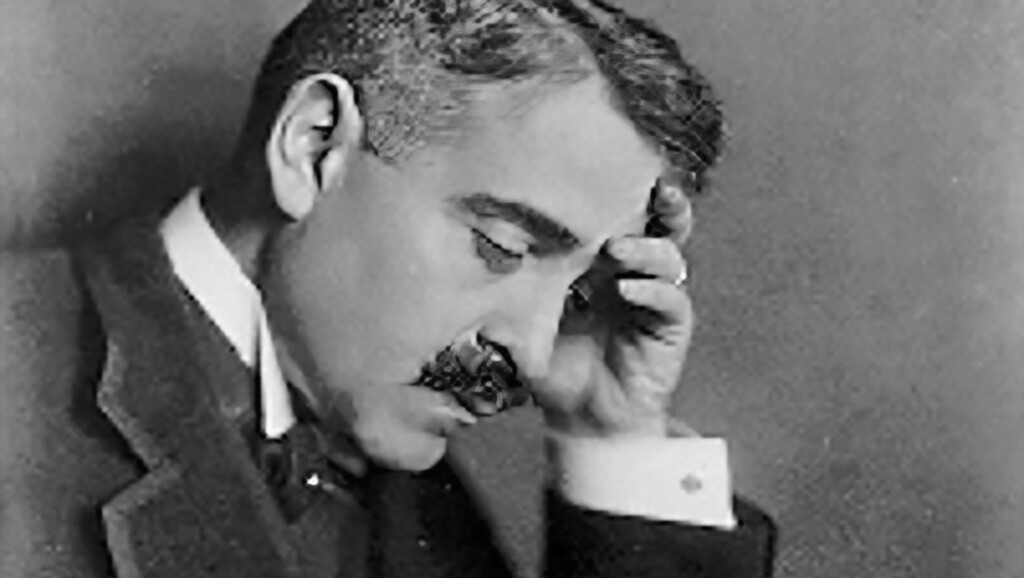
There is a photograph of him near the end — not posed, not official — just a man at a table surrounded by images pinned to dark cloth, his eyes carrying the particular exhaustion of someone who has been chasing something just slightly faster than himself for decades. The black panels stretch around him like a second skin for the room. He moves a photograph of a Greek frieze next to an advertisement clipped from a newspaper, then unpins it, then pins it somewhere else. He is not decorating. He is listening.
Aby Warburg died in October 1929, sixty-three years old, with Mnemosyne Atlas unfinished. The sixty-three panels he had assembled across years of obsessive labor were not a conclusion. They were a question held in suspension, a syntax without a final sentence. Weeks after his death, the financial architecture of the Western world collapsed. He did not see it, but one suspects he would not have been surprised. He had spent his entire intellectual life arguing that catastrophe is not an interruption of civilization but its secret rhythm, the bass note beneath the melody that polite culture pretends not to hear.
The panels themselves are almost unbearable to look at once you understand what they are doing. A maenadic figure from a Roman sarcophagus appears next to a photograph of a young woman at a golf course in 1920s America, her hair lifting in the wind, her posture caught in the same arc of abandoned movement. Warburg did not caption this. He did not explain it. The juxtaposition was the argument. Ernst Cassirer, who knew him well and whose Philosophy of Symbolic Forms owes something unacknowledged to Warburg’s restlessness, spoke of the image as a mode of mythical thinking that precedes language and outlasts it. But Warburg went further and darker: the image does not just think, it remembers, and what it remembers is not beauty — it is the violence that beauty was invented to contain.
Georges Didi-Huberman, who has written more carefully about the Atlas than almost anyone, argues that Warburg’s method was not iconography but something closer to seismology — reading the tremors in images the way a scientist reads the shaking of ground that has not yet broken open. The Pathosformeln, those recurring formulas of passion and extremity, are fault lines. They tell you where the pressure has been building for centuries. And pressure, as any geologist or any honest psychologist will confirm, does not dissipate because you refuse to look at it.
The question Warburg’s unfinished work leaves in the air is not academic. It presses against the ordinary texture of a day. When you look at the face of someone you love and feel, without warning, a grief that seems older than your relationship with them, you are perhaps touching one of his fault lines. When a piece of music undoes you for reasons you cannot explain with the events of your own life, when an image on a screen produces a dread that your rational mind cannot locate in the content — Warburg would say you are not malfunctioning. You are receiving. You are the latest body through which something much older is passing, a charge that has moved through a Florentine painting and a Greek vase and a tabloid photograph and now through you, without asking permission and without announcing its name.
He pinned and unpinned those images because he understood that the constellation was never final, that the meaning shifted when you moved the elements, that history was not a line but a field of forces still in motion. The Atlas was unfinished because it could not be finished. Not because he ran out of time, though he did, but because the argument it was making is the kind that does not resolve — it only deepens, the way a wound deepens your knowledge of your own body, the way every image you have ever been moved by is still open inside you, still asking something you have not yet answered.
🌀 Memory, Image, and the Symbolic Mind
Aby Warburg’s thought weaves together art history, myth, memory, and the uncanny survival of ancient images across centuries. The articles gathered here trace the intellectual currents that run deepest in his work: the philosophy of cultural memory, the symbolic language of iconology, the persistence of mythic forms, and the Nietzschean tension between Apollonian order and Dionysian chaos. Together they map the labyrinthine world Warburg spent his life navigating.
Erwin Panofsky: Life and Iconology
Erwin Panofsky was one of the thinkers most profoundly shaped by Warburg’s legacy, transforming the Hamburg scholar’s intuitions about the afterlife of images into a rigorous method of iconological analysis. Panofsky’s three levels of meaning — pre-iconographic, iconographic, and iconological — owe their deepest ambition to Warburg’s vision of art as a seismograph of collective psychological energies. Understanding Panofsky is therefore indispensable for grasping what Warburg’s Mnemosyne Atlas was truly attempting to accomplish.
GO TO THE SELECTION: Erwin Panofsky: Life and Iconology
Jan Assmann and Cultural Memory
Jan Assmann’s theory of cultural memory provides one of the most powerful contemporary frameworks for understanding what Warburg called Nachleben — the survival and reactivation of ancient images and gestures across millennia. Assmann distinguishes between communicative and cultural memory, showing how symbolic forms crystallize collective experience and carry it forward through time. His work is a direct heir to the intellectual climate that Warburg helped create in early twentieth-century Hamburg.
GO TO THE SELECTION: Jan Assmann and Cultural Memory
Friedrich Nietzsche and Memory: On the Uses and Disadvantages of History
Nietzsche’s meditation on the uses and disadvantages of history for life stands as one of the key philosophical provocations behind Warburg’s entire project. Warburg was haunted by the question of whether the memory of antiquity was a liberating resource or a paralyzing burden for modern humanity, a tension that runs through every panel of the Mnemosyne Atlas. Reading Nietzsche alongside Warburg reveals the existential stakes hidden beneath the art-historical surface of Warburg’s scholarship.
GO TO THE SELECTION: Friedrich Nietzsche and Memory: On the Uses and Disadvantages of History
Eco’s The Name of the Rose: Meaning and Analysis
Umberto Eco‘s The Name of the Rose offers a narrative labyrinth that resonates strikingly with Warburg’s own intellectual architecture, in which knowledge is preserved in hidden libraries and images carry dangerous, uncontrollable power. Eco, deeply versed in semiotics and the history of signs, shared with Warburg a fascination for the way symbols migrate, mutate, and resurface in unexpected historical moments. The novel can be read as an imaginative exploration of the very dynamics of cultural memory that Warburg theorized.
GO TO THE SELECTION: Eco’s The Name of the Rose: Meaning and Analysis
Discover Cinema That Thinks in Images
If Warburg’s world of surviving symbols and living images has sparked your curiosity, Indiecinema streaming is where that curiosity can go further. Explore our curated selection of independent and art-house films that think visually, historically, and mythically — the cinema that Warburg himself might have studied with the same passionate intensity he brought to Botticelli and Ghirlandaio.
👉 EXPLORE THE CATALOG: Watch Indie Films in Streaming
A vision curated by a filmmaker, not an algorithm
In this video I explain our vision

