
The Library That Burns
You have stood in a library — not a small one, but one of those vast, cathedral-like repositories where the shelves extend beyond what a single glance can absorb — and you have felt, beneath the reverence, something closer to vertigo. The books around you represent a quantity of thought that no single human life could exhaust, and this recognition arrives not as inspiration but as a quiet, almost nauseating panic. You will never read most of these. You will never even know most of their titles. And somewhere in the arrangement of those spines, in the card catalogues and digital indexes and archival systems, a decision has already been made about what is findable and what is not, what is shelved at eye level and what is buried in a basement annex, what is catalogued under an obvious heading and what has been deliberately assigned a classification so obscure that only someone who already knows where to look will ever find it. The library does not merely contain knowledge. It administers it.

This is the sensation that lives at the center of a novel published in Italian in 1980, a book that sold over fifty million copies across the world and became one of the most intellectually dense bestsellers of the twentieth century — a paradox that Umberto Eco himself would have appreciated, since the book is partly about the impossibility of separating popularity from distortion. Eco was not simply a novelist. He was a semiotician, a professor of communications at the University of Bologna, a theorist of signs whose academic work, from A Theory of Semiotics in 1976 to his foundational Lector in Fabula, had spent decades arguing that meaning is never fixed, never purely intended by its author, never received cleanly by its reader. It drifts, it accumulates, it mutates through context. And so when he constructed a medieval murder mystery set inside a labyrinthine monastery library, he was not decorating an intellectual thesis with a narrative wrapper. He was building, architecturally, a structure that enacts the very problem it describes.
The library in the novel is a maze. Its rooms are arranged so that a reader without a guide cannot find their way through it, cannot predict which corridors loop back into themselves, which doors are locked, which passages lead to blind walls. The knowledge it contains is not organized for access. It is organized for concealment. And this is presented not as an aberration but as a principle — the governing philosophy of those who control it. To know which books exist, you must already possess a knowledge that only proximity to power can grant you. The library enforces its own prerequisites. It is a bureaucracy of the sacred.
Michel Foucault, whose Discipline and Punish appeared just five years before Eco’s novel, had argued that knowledge and power are not separate systems that occasionally intersect but a single formation — what he called the power-knowledge nexus. To control what can be known is to control what can be thought, and to control what can be thought is to control what can be done. This was not a new insight in 1975 or 1980. Plato banished the poets. The Index Librorum Prohibitorum, the Catholic Church’s official list of forbidden books, operated continuously from 1559 to 1966. Four hundred and seven years of institutional prohibition, four centuries of deciding which thoughts required suppression before they could spread. The library in Eco’s novel is medieval in its setting but not at all distant in its logic.
What Eco understood, and what the novel makes viscerally legible, is that the labyrinth is not a failure of organization. It is the point. The confusion is the design. And when a library burns at the end, when all those irreplaceable volumes are consumed, the question the novel leaves smoking in the air is not who set the fire, but who decided, long before that night, that certain knowledge was too dangerous to be read.
Venetian Arcanum
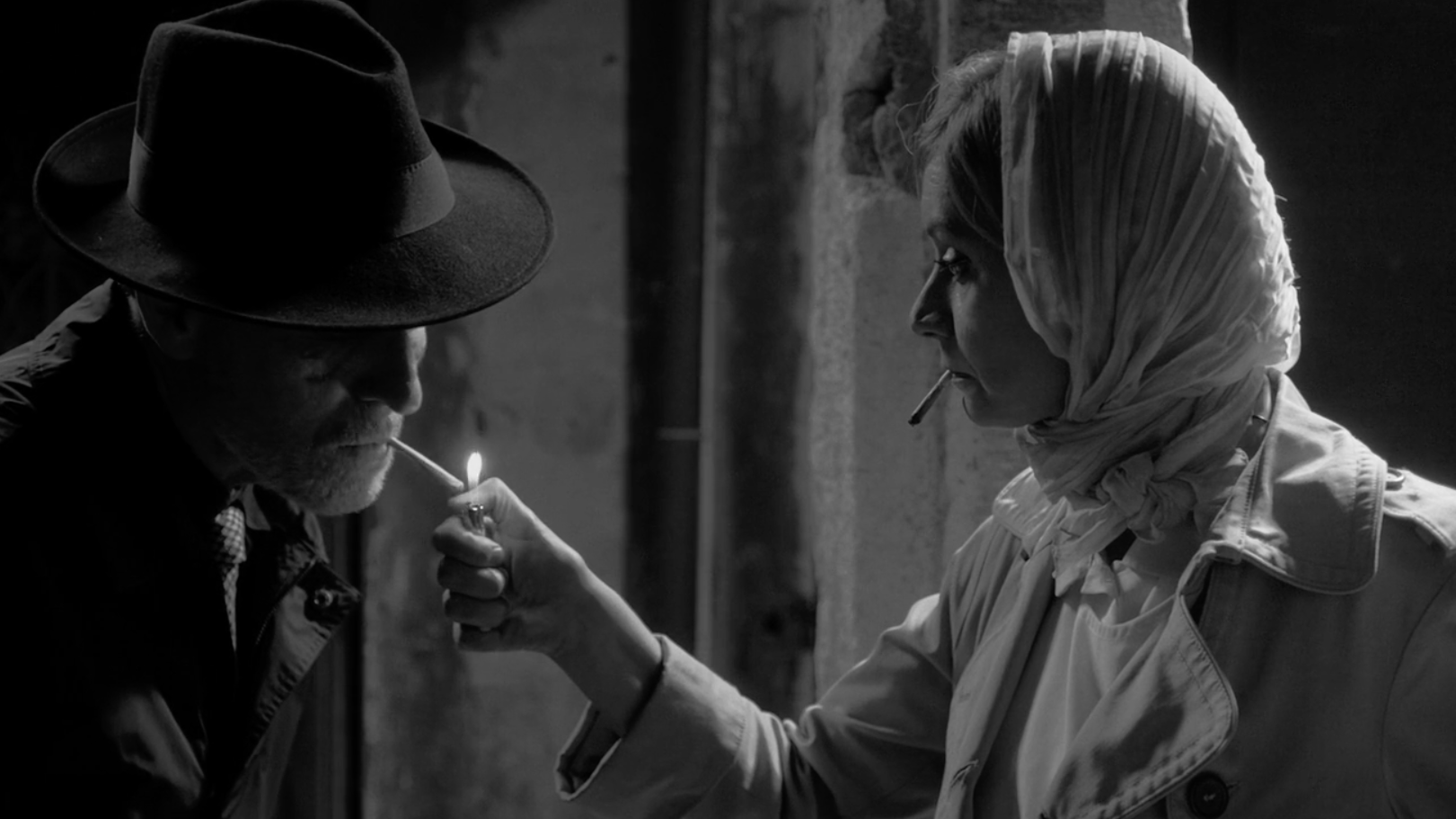
Thriller, by Serge Turgeon, Italy, 2025.
In Venice, a mysterious presence appears once every century or two, haunting the canals and hidden corners of the city. Driven by a sense of destiny, a woman decides to search for it. Following its elusive traces, she is drawn deeper and deeper into the city’s arcane secrets. Reality and myth begin to blur, and Venice itself transforms into a labyrinth of dangers.
LANGUAGE: Italian
SUBTITLES: English
The Medieval Mind as Mirror
You open a book set in 1327 and you think you are escaping. That is the first trap. The parchment smell, the Benedictine walls, the theological disputes about poverty and apostolic legitimacy — all of it suggests a world so remote from yours that you can breathe inside it without being implicated. This is precisely the mechanism Eco understood better than almost anyone writing fiction in the twentieth century: the past is not a refuge. It is a lens ground to a particular prescription, designed to show you your own face with a clarity the present cannot afford.
Eco had spent decades studying how signs deceive before he ever wrote a novel. His 1962 Opera aperta — the work that made his academic reputation — argued that meaning is never fixed, never owned by its author, always plural and generative. The open work does not deliver a message. It creates a field of possible meanings, and what you find in it reveals the structure of your own perception as much as anything intrinsic to the text. When he finally turned to fiction, twenty years later, he did not abandon that theory. He built a novel that is itself an open work, and placed it in a century so dense with ideological warfare, epistemological panic and institutional violence that every reader willing to look would find their own era reproduced in miniature with almost surgical precision.
The fourteenth century he chose was not arbitrary. It was the century of the Great Schism’s tremors, of the Inquisition operating as a fully systematized bureaucratic instrument of thought control, of Franciscan radicals being burned for the position that Christ owned nothing. It was a century in which the question of who controls knowledge was answered with fire. The library at the center of the novel is not a metaphor you need to decode. It is a map of every institution that has ever survived by controlling what its subjects are permitted to know, permitted to question, permitted to laugh at.
And laughter is where the architecture of the novel reveals its deepest argument. Jorge of Burgos — the ancient, blind monk who haunts the corridors of power with the authority of absolute certainty — does not simply dislike comedy. He fears it with the precise, logical terror of someone who understands exactly what it threatens. In Mikhail Bakhtin’s Rabelais and His World, published in 1965 after years of Soviet suppression of the manuscript itself, the carnivalesque is described not as harmless release but as a genuinely revolutionary force. Carnival laughter in the medieval tradition was the temporary suspension of hierarchy, the moment when the body reasserted its rights against the spirit, when the king became a fool and the fool spoke truth. Bakhtin argued that this laughter carried a philosophical charge: it relativized the absolute, it made the sacred provisional, it revealed that all authority is performed rather than inherent.
Jorge knows this. His fear is not irrational — it is perfectly rational. The lost second book of Aristotle’s Poetics, which he has poisoned and hidden, represents precisely the possibility that laughter might receive philosophical legitimacy, might be elevated from base impulse to cognitive instrument. If Aristotle, the supreme authority of medieval scholastic thought, endorsed comedy as a form of truth-telling, then the entire architecture of terror built on the distinction between the sacred and the laughable collapses. Authority survives not through violence alone but through the management of what can be taken seriously. Make something laughable and you have already weakened it. Give laughter a theoretical foundation and you have built a weapon.
This is not a medieval problem. You have lived inside this structure. You know the meetings where certain questions cannot be asked without someone smiling a particular smile that removes you from the category of serious people.

The Name of the Forbidden Book
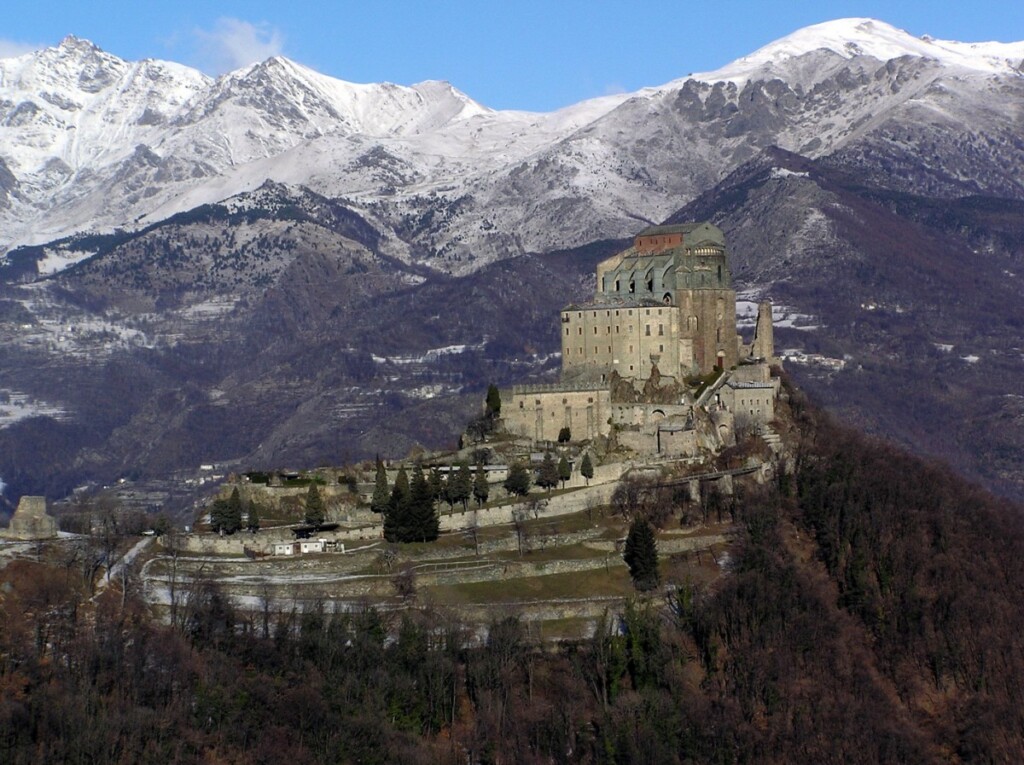
There is a moment when you realize the thing being protected is not the people but the idea that people need protecting. It arrives quietly, dressed in the robes of concern, speaking in the cadences of wisdom. It says: this is not for you. Not yet. Perhaps not ever.
The lost second book of Aristotle’s Poetics — the treatise on comedy — functions in Eco’s novel not as a MacGuffin, not as a mere plot device, but as the novel’s actual beating heart. What Aristotle argued in the first book, the one that survived, is well documented: tragedy purifies through pity and fear, catharsis working on the soul like a medicine on a wound. The second book, by most scholarly accounts, addressed comedy with equivalent seriousness — laughter as a cognitive act, ridicule as a legitimate instrument of truth-telling, the low and the absurd as worthy of philosophical attention. That this book vanished, whether by accident or design, is one of intellectual history’s most consequential silences.
Jorge of Burgos, the blind monk who guards the text, has not hidden it out of cruelty. This is what makes him so devastatingly recognizable. He has hidden it out of conviction. He believes, with the full weight of his theological architecture, that if the authority of Aristotle were to legitimate laughter — if the greatest philosopher of the Western tradition were to sanctionize the comic mode as epistemologically valid — then the instruments of fear that the Church uses to maintain order would be corroded beyond repair. Fear of God, fear of sin, fear of death: these are not incidental tools. They are the scaffolding. Comedy, in this reading, is not merely irreverent. It is structurally subversive.
Think of a man sitting alone in a room, feeding pages into a fire. Not documents of crime, not evidence of wrongdoing in any ordinary sense. Pages of testimony, of witness accounts, of things that happened and were recorded with painstaking care. He burns them because he has decided — genuinely, without malice, perhaps with something that resembles grief — that the people who might read them are not ready. That the truth would destabilize rather than liberate. That he is performing an act of mercy. His face in the firelight is not the face of a villain. It is the face of someone who loves, in the particular way that power always loves: from above, at a safe distance, with complete certainty about what is good for others.
Michel Foucault spent much of his career mapping precisely this structure — the way knowledge and power are not separate domains but the same domain operating under different names. In Discipline and Punish, published in 1975, he showed how the management of what people are allowed to know is always also the management of who people are allowed to become. The forbidden text is never just a text. It is a horizon. To withhold it is to withhold a mode of perceiving, a way of standing in relation to the world that the powerful have decided is inadmissible.
What Jorge fears is not heresy in the conventional sense. He fears joy without consequence. He fears the laughter that does not lead anywhere solemn, that does not conclude in repentance or instruction. Aristotle’s comedy, as he imagines it, would give philosophical permission to a way of seeing that requires no authority to validate it, no hierarchy to mediate it, no fear to motivate it. And a person who can laugh at the sacred without trembling is a person who has, in some fundamental way, stepped outside the jurisdiction of those who govern through trembling.
The book burns. The library burns with it. And somewhere in that fire is not just parchment but an entire cognitive possibility — a way of being human that was decided, by one man’s certainty, to be too dangerous to survive.
William of Baskerville and the Failure of Reason
There is a moment when you realize you have been right for entirely the wrong reasons, and the sensation is not triumph — it is vertigo. You solved the equation, the answer matches, and somewhere in the working-out you discover that the method was corrupt from the beginning. The conclusion stands. The path that led there was a hallucination.
William of Baskerville is perhaps the most devastatingly honest portrait of the rational mind in twentieth-century European fiction precisely because Eco refuses to let him off the hook. William is brilliant, methodical, generous in his intelligence. He reads traces the way a musician reads a score — a pattern of hoofprints in the snow becomes a horse’s name, a smear of ink becomes a motive, a sequence of deaths becomes a calendar. He reasons. He reasons magnificently. And at the end he is forced to confess, with the ruins still warm around him, that he reached the truth by pursuing a design that never existed. There was no architect. He had been solving a puzzle that no one had set.
Eco had spent years before writing the novel excavating Charles Sanders Peirce’s concept of abduction — that third mode of inference, distinct from deduction and induction, which Peirce first articulated in his 1878 essay “Deduction, Induction, and Hypothesis” and refined obsessively for decades afterward. Abduction is the logic of the detective, the diagnostician, the scientist proposing a hypothesis: you observe an effect, you construct the most plausible cause, you proceed as if that cause were real. It is, Peirce admitted, the only form of reasoning that generates new knowledge. It is also the only form that can be systematically, elegantly, convincingly wrong. In his 1984 essay collection Semiotics and the Philosophy of Language, Eco formalized what the novel had already dramatized: abductive reasoning is constitutively uncertain. Its power and its fragility are the same muscle.
What makes William’s failure so philosophically precise is that it is not the failure of a bad reasoner. A bad reasoner fails messily, visibly, with gaps you can point to. William fails at the summit of his competence. He constructs a theory of such internal coherence that it becomes self-confirming — each new piece of evidence is absorbed into the structure, made to fit, made to speak the language the theory has already decided it must speak. The library’s organization, the sequence of victims, the pattern of texts — it all coheres. It coheres because he made it cohere. The world, indifferent, had produced these deaths through a logic so simple and accidental that no sophisticated mind would have considered it first.
There is a scene — not from a film but from what feels like a recurring nightmare of the intelligent — where a man stands in a room full of evidence he has correctly assembled, watching the actual truth walk past him because it does not look like a theory. He had solved it. The killer stands revealed. The mechanism is exposed. And then, in a moment that lands like a door closing forever, he understands that what he uncovered is real but what produced it was not design, not intention, not the meaningful architecture he spent years reading into the dark. He solved a crime that was, at its root, a coincidence wearing the costume of a conspiracy. The solution does not liberate him. It empties the world.
This is what Eco means when William says, devastatingly, that he arrived at the truth through an accumulation of errors. Not a false modesty. A philosophical confession. Reason works. Reason produces results. And this working, this production of results, tells us almost nothing about whether the world is structured in a way that rewards or even tolerates rational inquiry. The map is coherent. The territory was never consulted.
The Inquisition as Bureaucratic Logic
There is a moment in an interrogation room — not a dungeon, not a torture chamber, but a clean, well-lit room with a table and two chairs — where a man in a grey suit opens a folder, glances at it briefly, and says in a tone of perfect administrative calm: “We already know everything. This is just a formality.” He is not threatening you. He is not even particularly interested in you. That is the horror. You are a case number moving through a procedure, and the procedure will arrive at its conclusion regardless of what you say, because what you say was never the point.
This is Bernardo Gui. Not the Bernardo Gui of popular imagination, the sadist who delights in suffering, but the real one Umberto Eco constructed with such forensic precision: a man who functions correctly. He is not malfunctioning when he condemns the innocent. He is operating exactly as designed. His logic is internally coherent, his procedures are legitimate within their own epistemological universe, and his cruelty is entirely incidental to his purpose. He does not need to enjoy what he does. Enjoyment would, in fact, compromise his efficiency.
Hannah Arendt watched Adolf Eichmann in a Jerusalem courtroom in 1961 and wrote something that still makes people deeply uncomfortable: that he was not a monster. He was a bureaucrat. He used the language of procedure, of orders followed, of functions fulfilled. In Eichmann in Jerusalem, published in 1963, she coined the phrase “banality of evil” precisely to name this mechanism — the way that systematic destruction of human beings does not require hatred or malice, only competence and compliance. The evil is not in the man. It is in the architecture that holds him. Bernardo Gui is Eichmann in a Dominican habit, and Eco knew exactly what he was doing.
Foucault, writing in Discipline and Punish in 1975, traced the historical evolution of punishment away from spectacle and toward something far more insidious: the internalization of control, the examination, the record, the file. The Inquisition, he argued, was not an aberration but a prototype. It invented the modern interrogation. It pioneered the idea that truth could be extracted through procedure, that confession was the gold standard of guilt, that the subject’s own voice, turned against itself under institutional pressure, was the most perfect instrument of condemnation. What Gui does in the novel is not medieval. It is the structure of every HR investigation, every disciplinary hearing, every “just a formality” that is never just a formality.
What makes Eco’s portrayal so exact is that Bernardo never raises his voice. He does not need to. The architecture of the Inquisition raises it for him. The accused arrives already diminished, already within a system that has decided the categories of guilt in advance. The only question is which category applies. When a young man sits across from Gui and is asked to explain his connection to the dead, the question is not an inquiry. It is a net, and the mesh is fine enough to catch anything. Innocence is not a category the procedure recognizes, only unproven guilt, which is itself a form of suspicion requiring further examination.
You have been in that room. Perhaps not with stakes so absolute, perhaps not with a man in robes and the weight of ecclesiastical authority behind him. But you have sat across from someone who was not listening, who was documenting, whose questions were not questions but steps in a choreography already written before you arrived. And you understood, in your body before your mind caught up, that what you said would be processed, not heard. That the conversation was a performance of inquiry with the verdict already implied.
The terrifying thing about Bernardo Gui is not what he does to others. It is how familiar he is.
A vision curated by a filmmaker, not an algorithm
In this video I explain our vision
Adso’s Memory and the Unreliable Survivor
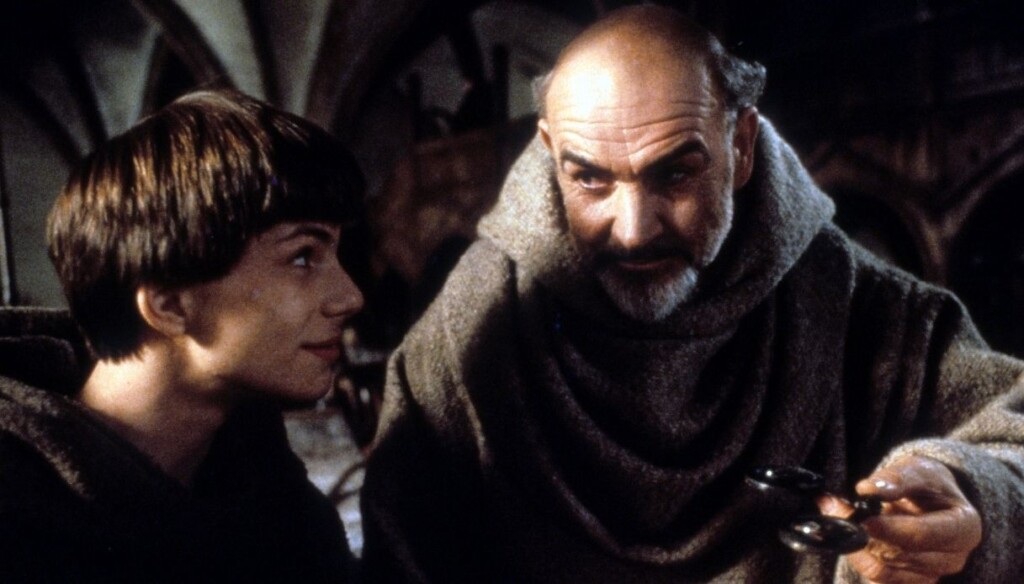
There is something quietly devastating about the act of writing down what you no longer fully understand. Not because you have forgotten the details — the cold of the stone corridor, the smell of herbs near the scriptorium, the sound of a name spoken in fear — but because the person who witnessed those things no longer exists in any meaningful sense, and the person now holding the pen was never really there. This is Adso’s condition, and it is not a literary device. It is the novel’s most precise epistemological statement.
Adso writes as an old man. He writes about a week he lived as a novice, barely formed, barely capable of reading what was happening around him. He tells us this openly, without apology, which is what makes it so disarming. He admits that he did not understand William’s reasoning as it unfolded. He admits that the woman he loved in the kitchen — the only woman he ever touched — remains nameless to him, unnamed and unnameable, a body and a warmth and an absence that he carries into old age without resolution. He gives her no name because he never knew it, and the novel does not compensate for this gap. It leaves it open, a wound in the text that the text refuses to dress.
Walter Benjamin, writing in 1936 in his essay on Nikolai Leskov, argued that the figure of the storyteller was dying. Not because people had stopped telling stories, but because experience itself had become incommunicable. The First World War had produced men who returned from the trenches not richer in communicable experience but impoverished. They had witnessed something that language could not carry intact. Benjamin’s storyteller — the one who draws on lived experience and transmits wisdom to the listener — presupposes a continuity of experience that modernity had already begun to dissolve. What replaced it was information: verifiable, immediate, self-explanatory, and therefore exhausted the moment it is consumed. Adso is the anti-informant. He gives you everything he saw and withholds the meaning, because the meaning was never fully his to give.
There is a scene — an old man sitting at a table covered in photographs, arranging and rearranging them as though their order might finally yield an answer. He has been doing this for decades. The photographs are real. The people in them were real. But the narrative he builds around them shifts each time, not from dishonesty but from the irreducible instability of memory acting on grief. What he tells his listener is true in every factual detail and structurally unreliable at its core, because the emotional logic that connects one moment to the next is not fixed — it bends toward what he needs it to mean now, today, in this room, with this much life left. The past is not retrieved by memory. It is reconstructed by it, and the reconstruction serves the present, always.
Adso’s memoir does exactly this. He is not deceiving us. He is doing what all retrospective narrators do: he is making the past cohere in the only language available to him, which is the language of the man he became, shaped by the very events he is trying to describe. The circularity is inescapable. He cannot stand outside his formation to describe his formation. And so the reader is left in a peculiar position — trusting a narrator who has explicitly told us that his understanding was incomplete, accepting a reconstruction from someone who has admitted the original was never fully legible to him.
This is not a flaw in the architecture of the novel. It is the architecture of the novel. The labyrinth is not only in the library. It is in the voice telling you about the library, a voice that circles back, that qualifies, that remembers the texture of things more reliably than their meaning, and that ends, finally, with a Latin sentence about roses that have existed and names that remain.
Semiotics, Labyrinths, and the Trap of Interpretation
There is a particular kind of madness that feels exactly like clarity. You are sitting with a map you have drawn yourself, and every new piece of information fits perfectly, every corridor leads where you expected, every symbol confirms the pattern you already suspected. The map is not describing the territory. The map has become the territory. And you are lost inside something you built.
This is the epistemological trap at the heart of the library of Aedelmoor, and it is also the trap at the heart of reading itself. The labyrinth in Eco’s novel is not a puzzle with a solution waiting patiently at its center. It is a model of how meaning works: proliferating, self-referential, never arriving. Every turn produces another sign pointing to another sign. The texts that line those hexagonal shelves do not contain truth. They contain more text. And the monk who believes he is deciphering the library’s logic is, in fact, being deciphered by it.
Eco had theorized this condition long before he dramatized it. In his 1962 Opera aperta, he articulated what he called the “open work” — a structure that is not incomplete but is constitutively multiple, inviting interpretation not as a path toward a definitive reading but as an endless productive movement around an absent center. By 1990, in The Limits of Interpretation, he felt compelled to introduce a corrective. Unlimited semiosis, the process by which every sign refers to another sign in potentially infinite chains — a concept he drew directly from Charles Sanders Peirce’s semiotics — was not a license for interpretive anarchy. The reader who believes any reading is valid because meaning is infinite has misunderstood the game entirely. There is a difference, Eco insists, between recognizing that the text cannot be exhausted and believing it can mean anything you need it to mean.
The character Jorge of Burgos is not a subtle allusion. He is a direct invocation of Jorge Luis Borges, the Argentine author whose entire body of work, from Ficciones in 1944 to El jardín de senderos que se bifurcan, constructed the library as the universe and the universe as an unresolvable interpretive labyrinth. Eco names his villain after Borges deliberately and with something close to love, because the horror of Jorge is not that he is wrong about the danger of knowledge. He is right. Unrestricted interpretation does produce chaos. What makes him monstrous is that his solution is annihilation: burn the text, erase the sign, collapse the labyrinth. He is the censor who has understood Peirce and drawn the wrong conclusion.
William of Baskerville commits a different and more instructive error. Watching him move through the investigation, you see someone who has constructed a theory of extraordinary elegance — each clue confirming the next, each death aligning with a passage from the Apocalypse, each architectural detail validating his hypothesis about the killer’s logic. And then he discovers that he was right by accident. The pattern was real, but it was his pattern, not the murderer’s. The killer was working from a completely different logic that William had never considered, and yet William’s hermeneutic machine had produced correct results through pure coincidence. He had not read the library. He had read himself, and the library had been generous enough to reflect him back.
There is a scene in which a man pieces together an elaborate theory about everyone around him from fragments so small — a glance held too long, a name repeated in different contexts, a date that appears twice — that the connections become undeniable to him precisely because he constructed them. The coherence is the proof. He feels the cold satisfaction of someone who has finally seen clearly. That feeling is the trap’s mechanism. The theory that explains everything explains nothing. The sign that confirms all others has stopped being a sign and become a mirror.
What Remains After the Fire
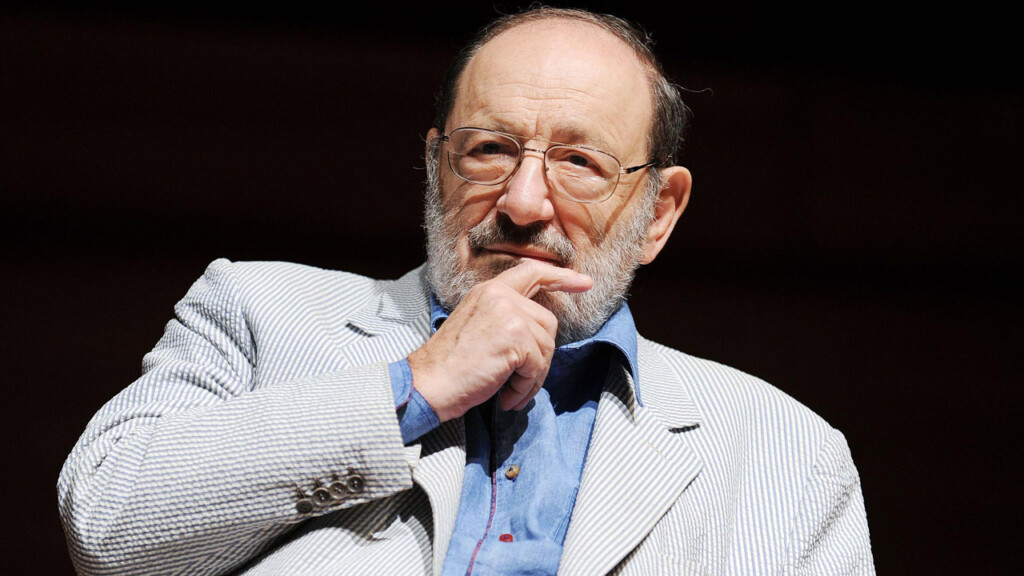
The library burns for three days. Stones crack under the heat, centuries of accumulated thought collapse into each other, illuminated manuscripts curl into ash before anyone can read what they say one final time. You watch it happen and you notice something strange: the fire is not ugly. There is a terrible coherence to it, a kind of ruthless logic that the labyrinth itself, in all its protective complexity, never quite managed to achieve. The destruction is, in some sense, the most honest thing that has happened in that place for a very long time.
Eco published his novel in 1980, a book that would go on to sell more than fifty million copies and be translated into over forty languages, making it one of the most commercially successful works of literary fiction produced in the second half of the twentieth century. The number deserves to sit with you for a moment, not as a measure of quality but as a philosophical paradox of almost painful elegance. The most widely read meditation on the destruction of knowledge became itself a mass cultural object, consumed by millions who held it on beaches and in airport lounges and on suburban sofas, a book about the horror of books disappearing absorbed into the same accelerating circulation it was ostensibly mourning. Eco, who spent his academic career theorizing semiotics and the open work, surely understood the irony. He may have intended it.
Nietzsche wrote in The Gay Science, in 1882, that what cannot communicate through its ruins was never truly alive. He was not consoling us about loss. He was saying something far more unsettling: that the test of any structure, any idea, any edifice of meaning, is precisely what it leaves behind when it collapses. Not what it preserved, but what escapes the preservation. The labyrinthine library in Eco’s novel hoarded knowledge to the point of killing for it, and when it burned, what remained was not the texts themselves but the question of why anyone believed controlling them was the same as understanding them.
There is a moment, somewhere between one life and another, when a man stands in the ruins of a house he built himself and realizes that the architecture was always secondary to the conversation that happened inside it. The walls he thought were protecting something were also, all along, limiting it. The fire did not take what mattered. It only made visible what had already been lost. This is not comfort. This is a different kind of knowledge, harder and colder than the kind stored in manuscripts.
A woman sorts through the remains of an archive that took forty years to assemble and finds that what she grieves is not the documents but the assumption that they were sufficient. That having them meant knowing. That the collection was the thought. The fire, in this sense, does not destroy understanding. It destroys the illusion that understanding can be stored, catalogued, locked behind a door for which only one person holds the key.
What the burning library in Eco’s novel finally produces is not loss but exposure. The medieval certainty that truth could be housed, protected, rationed, and controlled burns with everything else, and what stands in the smoke is the reader, holding a novel about that burning, fifty years later, having paid for it in an airport. The question the novel leaves you with is whether mass access is the same as democratization, whether availability is the same as understanding, whether the fifty million copies represent the opposite of the burned library or simply its contemporary equivalent, a different architecture for the same ancient impulse to mediate between the human mind and the ideas it cannot quite hold. Eco spent his life building elaborate structures, academic and fictional, and he understood, perhaps more than any other writer of his century, that the most rigorous act of construction is always also a meditation on what fire does to everything you build.
🌀 The Labyrinth of Signs, Faith, and Hidden Knowledge
Umberto Eco‘s The Name of the Rose is a labyrinthine meditation on heresy, the power of knowledge, and the dangerous seduction of forbidden texts. To fully grasp its medieval world, one must wander through the intersecting corridors of scholastic theology, mystical thought, and the politics of the Church. These related articles illuminate the deeper architecture behind Eco’s monastic mystery.
Aquinas’s Summa Theologica: Guide to Reading
Aquinas’s Summa Theologica stands as the supreme intellectual edifice of medieval Catholicism, the very tradition that haunts every corridor of Eco’s fictional abbey. Understanding its hierarchical reasoning and its obsession with orthodoxy reveals why the pursuit of a single forbidden book could become a matter of life and death. The tension between faith and reason that structures the Summa is the same tension that tears apart the community in The Name of the Rose.
GO TO THE SELECTION: Aquinas’s Summa Theologica: Guide to Reading
Medieval Mysticism: History and Main Figures
Medieval mysticism provided the underground current of spiritual experience that official theology constantly sought to contain and control, much as the library in Eco’s novel conceals what cannot be openly discussed. Figures like Meister Eckhart and the Franciscan spirituals represent the volatile edge of religious thought that the Inquisition was designed to suppress. Eco’s novel draws its dramatic energy precisely from this confrontation between mystical excess and institutional power.
GO TO THE SELECTION: Medieval Mysticism: History and Main Figures
Medieval Abbeys and Monasteries: History and Architecture
The physical world of The Name of the Rose is inseparable from the architecture and social life of the medieval abbey, a self-contained universe governed by rule, ritual, and hierarchy. Medieval abbeys and monasteries were not merely places of prayer but centers of knowledge, manuscript production, and political influence — exactly as Eco depicts. Exploring their history and architecture brings to life the spatial logic of the novel’s labyrinthine setting.
GO TO THE SELECTION: Medieval Abbeys and Monasteries: History and Architecture
Thomas Aquinas: Life and Philosophical Thought
Thomas Aquinas is perhaps the single most important intellectual presence hovering over Eco’s novel, both as a philosophical model and as a symbol of the rational order that the mystery threatens to undermine. His synthesis of Aristotelian logic with Christian theology defined the intellectual horizon within which all of the novel’s characters — monks, inquisitors, and scholars alike — must think and act. Understanding his life and thought is essential to grasping the philosophical stakes of the narrative.
GO TO THE SELECTION: Thomas Aquinas: Life and Philosophical Thought
Discover the Cinema of Ideas on Indiecinema
If Eco’s labyrinth of signs and hidden meanings speaks to you, Indiecinema is the streaming platform where cinema becomes a space of genuine intellectual and spiritual exploration. Discover independent films that dare to ask the same questions Eco asked — about knowledge, power, faith, and the price of truth. Start your journey into independent cinema today on Indiecinema.
👉 EXPLORE THE CATALOG: Watch Indie Films in Streaming
A vision curated by a filmmaker, not an algorithm
In this video I explain our vision

