
The Classroom You Were Never Meant to Enter
You are sitting in the third row, and you already know you don’t belong here. Not because anyone has said so — no one needs to. The teacher speaks in complete sentences, in a register that floats several centimeters above your head, and the words she uses are not the words your mother uses when she calls you in for dinner, not the words your father uses when he curses at a broken engine, not the words that live in your house, in your street, in the particular air of the place you come from. You copy what’s on the board. You memorize the conjugations. You learn to simulate comprehension the way you learn to hold a fork correctly at someone else’s table — not because it feeds you, but because it keeps the humiliation at a distance. And the strange thing, the thing that will take you decades to name if you ever name it at all, is that you will not blame the school. You will blame yourself. That is precisely how the mechanism works.

This is not a story about bad teachers or underfunded institutions, though both exist in abundance. It is a story about something far more durable: the way a civilized society can exclude entire populations from the means of self-expression while calling the process education. It is about the particular genius of a system that makes the excluded feel responsible for their own exclusion, that hands a child a tool designed for someone else’s hand and then grades the child on how naturally they hold it. In Italy, in the middle of the twentieth century, a priest who was also a painter and a radical and a man who burned with a very specific kind of fury decided he had seen enough. His name was Lorenzo Milani.
He was born in Florence in 1923, into a bourgeois family of partly Jewish origin, cultured and comfortable, the kind of family that owns books and attends concerts and speaks the Italian that schools reward. He trained as a painter, converted to Catholicism in 1943, was ordained a priest in 1947, and was assigned — in what his superiors almost certainly intended as a form of punishment — to the tiny, isolated parish of Barbiana, in the Apennine hills above Vicchio, in 1954. There were no roads. There was no running water. The children of Barbiana were the children of sharecroppers, the mezzadri, who worked land they didn’t own under contracts that kept them permanently behind. They spoke dialect. They had no relationship with written Italian except through the school that had already decided, before they arrived, that they were not its intended audience. Milani looked at these children and understood something that most educators, then and now, prefer not to articulate: that language is not a neutral tool. It is a territory. And some people are born inside its walls, and some are born outside, and the school, in most of its historical forms, does not build bridges — it guards the gate.
Pierre Bourdieu would formalize this insight years later, in works like Reproduction in Education, Society and Culture, co-written with Jean-Claude Passeron in 1970, giving it the cold precision of sociology: cultural capital, linguistic habitus, the way schools reproduce the class structure by rewarding those who already possess what the institution claims to be teaching. But Milani arrived at the same understanding through a different route — not through theory but through the faces of children who went silent when asked to read aloud, who could navigate a hillside in total darkness but could not write a letter to a government office, who possessed knowledge of extraordinary depth and texture but none of it in a language the state recognized as valid. He saw, in other words, that the classroom is never simply a room. It is a border crossing. And most of the children sitting in the third row have already been told, in every language except the one they understand, that their documents are not in order.
The Smartphone Woman
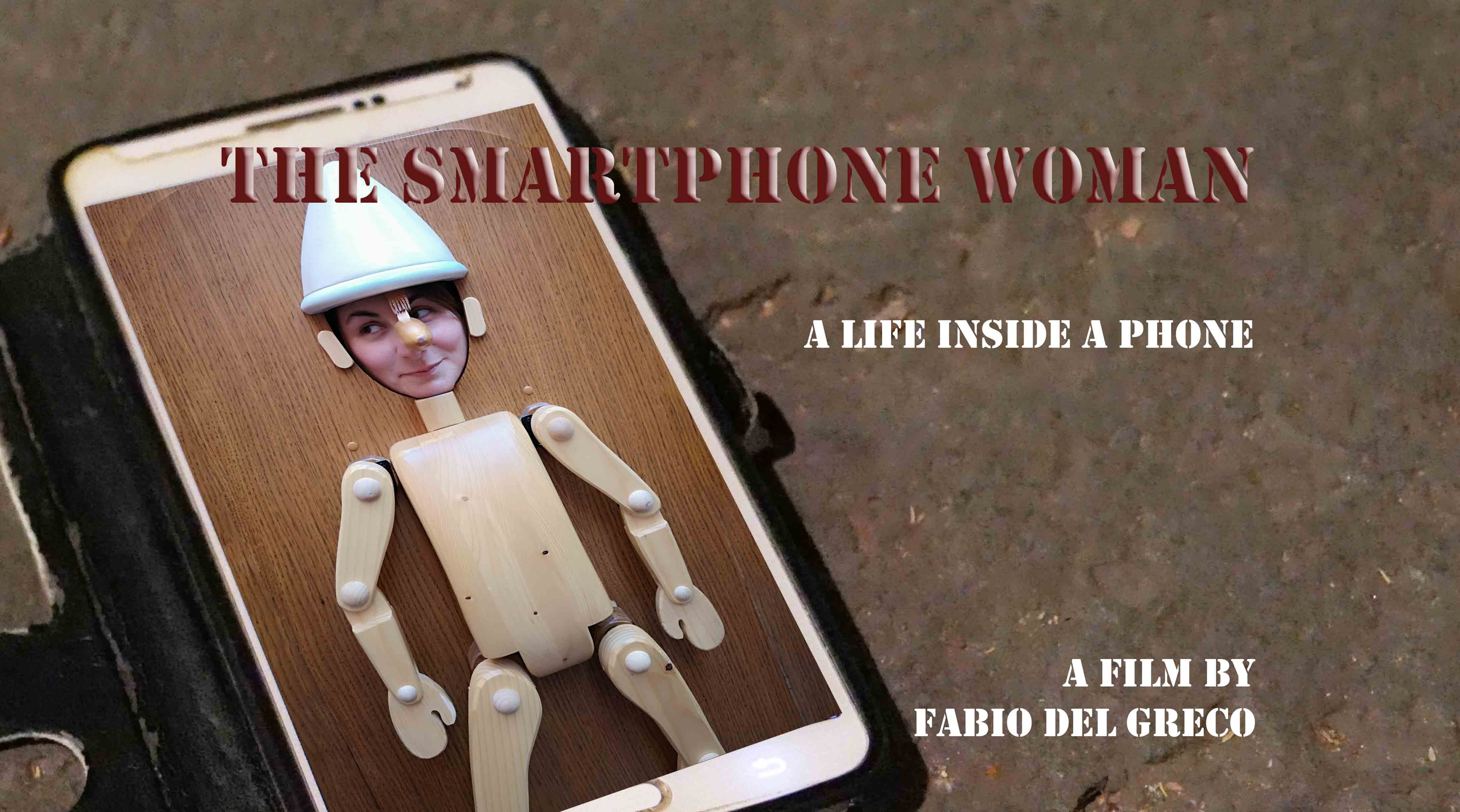
Drama, thriller, dark comedy, by Fabio Del Greco, Italy 2020.
On a bridge over the Tiber River, an elderly and severely ill man has decided to end his life, but an unusual discovery changes his mind: he comes across a lost smartphone. Intrigued, he decides to return home and watch the videos contained within it. On the screen, a series of videos unfold, telling the story of a woman who has emigrated from southern Italy to Rome to work as a teacher in schools and her struggles with integration in a social reality she cannot fully grasp.
"The Smartphone Woman" is a realistic tale of a woman's life and her complex relationship with an "infernal" city. It portrays the challenges she faces, her connection to her origins, the social discomfort she discovers in the outskirts, and the eerie presence of the ghosts of ancient Roman empire. Fabio Del Greco employs a fragmented style, using pieces of "real life" shot with the smartphone, to construct a narrative that ambiguously oscillates between fiction and truth. This creates a captivating exploration of the discomfort and alienation within the bustling city, contrasting with the peaceful village life from which the protagonist hails. The film is constructed with a variety of heterogeneous characters and situations, an emotional kaleidoscope, weaving between evenings of exploration in the Eternal City and daily struggles. Realistic smartphone-shot videos are alternated with a narrative thread reminiscent of film noir and, ultimately, surrealism in the finale. On screen, a succession of grotesque characters unfolds, representing the director's vision of a tumultuous humanity. The film's potency lies in the emotion it manages to convey and in the protagonist's naive perspective. "The Smartphone Woman" is a must-see for enthusiasts of independent and experimental cinema.
LANGUAGE: italian
SUBTITLES: English, French, German, Portuguese, Spanish
A Priest Who Refused to Save Souls Quietly
He was born in Florence in 1923 into a family that had no particular need for God. The Milanis were secular, cultured, prosperous — the kind of household where the bookshelves were dense and the dinner table conversation was denser. Lorenzo grew up inside that comfortable intellectual atmosphere, and nothing in his early formation would have predicted the priest. He converted to Catholicism at twenty, was ordained in 1947, and was assigned to San Donato di Calenzano, a parish on the industrial outskirts of Florence where the workers voted communist and the Church was, to most of them, an architectural backdrop to funerals. He did not find this troubling. He found it interesting.
What he did at Calenzano was not, strictly speaking, unusual for a zealous young priest. He opened a school for the workers and their children, taught them to read more carefully, to speak with precision, to argue without embarrassment. But the way he did it contained something the institution had not authorized: he treated the ignorance of the poor not as a moral failing to be corrected through catechism, but as a structural wound inflicted by a society that had decided, with quiet efficiency, that certain people did not need language. This was not the posture of a pastor. It was the posture of someone who had looked at the architecture of class and seen it clearly, without the softening lens of charity.
The Church noticed. Not immediately, and not loudly, but with the particular institutional patience that knows how to wait. In 1954, after he published Esperienze Pastorali, a book in which he detailed his method and, more dangerously, named the class mechanisms that kept the poor in spiritual and linguistic poverty, the Vatican ordered the volume withdrawn from circulation. The Holy Office condemned it for being too sociological, too political, insufficiently theological. The diocese of Florence responded by transferring him to Barbiana, a village in the Mugello hills so small and so remote that it barely appeared on regional maps. There was no electricity when he arrived. The nearest bus stop was an hour’s walk downhill. It was, in every practical sense, an exile designed to be mistaken for a posting.
What the institution miscalculated was the man’s relationship to irrelevance. Don Milani did not experience Barbiana as punishment. He experienced it as clarification. With nowhere to be seen and no career left to manage, he built a school in the rectory and taught the mountain children with the same furious seriousness he had brought to the factory workers. He slept four or five hours a night. He read obsessively — sociology, linguistics, law, history — and made his students read with him, not to accumulate culture but to understand the mechanisms by which their own exclusion had been manufactured and maintained. Paulo Freire would later describe this same process in Pedagogy of the Oppressed in 1968, the year after Don Milani died, naming it conscientization: the act of learning to perceive the social, political, and economic contradictions embedded in one’s own condition. Milani had been practicing it in a mountain rectory without the theoretical vocabulary, driven by something closer to fury than to pedagogy.
His biography, read honestly, is a sequence of refusals that escalated in proportion to the pressure applied. He refused to save souls quietly, which is to say he refused the implicit bargain the Church had always offered the poor: transcendence in exchange for docility. He refused the role of the compassionate intermediary, the priest who smooths the edges of injustice without naming its structure. And he refused, perhaps most scandalously, to pretend that his exile had diminished him. The institution had sent him to disappear. He sent back a school. Later, he would send back a book that a generation of Italian students would carry like a lit match into their classrooms, their families, their politics. But before that book, there was only the mountain, and a man who seemed constitutionally incapable of doing what was expected of him, even when what was expected was simply silence.

Barbiana as a Theoretical Weapon
Picture a child sitting across from a doctor, a judge, or a school administrator — someone who holds power over what happens next in that child’s life — and the child cannot find the words. Not because the thought isn’t there. The thought is perfectly formed, urgent, alive. But the language to carry it outward, to make it legible to the institution sitting across the table, simply was not given to this child. It was given to someone else, in a different house, at a different table, where dinner conversation was already a rehearsal for power.
This is the situation Lorenzo Milani found intolerable. When he arrived in Barbiana in 1954 — exiled there by a Church hierarchy that found his politics inconvenient — he encountered something that looked like poverty but was, in his reading, closer to a calculated silence. The mountain village above Vicchio had no school worth speaking of. The children of sharecroppers and woodcutters were enrolled in the municipal system, failed it at the expected rate, and then disappeared into labor. The structure worked precisely as designed. Milani understood that what was being transmitted through the school system was not primarily knowledge but a hierarchy of speech — that certain children were being told, methodically and without ever using those words, that their mouths were not the right instruments for public life.
What he built in response was not a school in any conventional sense. It was open every day of the year, from morning until dark, with no summer break and no distinction between subjects. There were eight students, no textbooks, and a wood stove. The central discipline was writing. Not writing as calligraphy or composition exercise, but writing as the act of learning to make your own experience articulable — to take what you already know and give it a form that cannot be ignored. Milani’s method was collective: a letter, an argument, a document was written by the entire group until every sentence had been tested against every student’s comprehension. If one child did not understand a word, the word was wrong, and they found another. The measure of clarity was not the teacher’s satisfaction but the least advantaged reader in the room.
Milani had no access to this vocabulary, but he had something more immediate: he had the children themselves, in front of him, every morning. He could see the exact moment a boy from a sharecropper family fell silent in the presence of a sentence he did not know how to complete. He could map the geography of that silence. And he understood — with a clarity that Bourdieu’s sociology would later confirm but never quite match in emotional precision — that the silence was not natural. It had been produced. The school had manufactured it by handing certain children a language and then testing everyone as though the distribution had been equal. What looked like individual failure was, in Milani’s formulation, collective theft. And the only adequate response was to return to the dispossessed child the tools of their own articulation — not as charity, but as
Letter to a Teacher and the Violence of Meritocracy
You already know the child they are talking about. You have seen him sit at the back of the classroom, quiet in a way that looks like indifference but is actually the particular stillness of someone who has learned that raising a hand only accelerates humiliation. He does not lack intelligence. He lacks the password. And the school, rather than teaching him the password, will spend the next several years documenting, with bureaucratic precision, the many ways in which he does not have it.
Milani’s students made this argument not in sociological terminology but in something harder to dismiss: numbers and names. They calculated that in the early 1960s, of every hundred Italian children who began elementary school, only thirteen reached a university degree. They traced the trajectory by class, by region, by the profession of the father. The filtering was not random. It followed the social map of Italy with the fidelity of a geological survey. A child from a sharecropping family in Tuscany did not fail because he lacked ability. He failed because the school required him to perform competence in a register he had never been given, then recorded his inability to perform as evidence of his limits rather than evidence of its own refusal to teach.
What makes this violence particularly durable is the role shame plays in sustaining it. The child who fails does not typically conclude that the system has failed him. He concludes that he has failed, because the system has told him so with the full authority of grades, teachers, and the apparent objectivity of written evaluation. This is what the letter called, without using the word, epistemic injustice — the condition in which someone lacks not only resources but the very conceptual framework to identify what has been done to them. They leave school not angry but diminished, carrying the institution’s verdict as though it were a fact about their nature rather than a fact about power. And the institution, having produced that diminishment, is free to call itself meritocratic, which is perhaps the most precise definition of ideological success that exists.
Obedience Is Not a Virtue

You have followed an order today. Perhaps it was small — you signed something you did not fully read, stayed silent in a meeting where a wrong thing was said, clicked “agree” on terms you never examined. You told yourself this is how things work, that resistance would cost more than compliance, that the institution is larger than your discomfort. And you were not wrong, exactly. You were simply rehearsing something very old, something that has been called, at various points in history, professionalism, duty, citizenship, and discipline. Don Milani called it by a different name.
In 1965, a group of Italian military chaplains published a statement condemning conscientious objectors as cowards, men unworthy of the Christian faith they claimed to profess. The objectors in question were young men who had refused military service on moral grounds, and the Church’s uniformed representatives had no patience for their reasoning. Milani, by then confined to Barbiana by ecclesiastical order and suffering from the leukemia that would kill him two years later, responded with an open letter that was not diplomatic, not measured, and not safe. He argued that obedience, in itself, is not a moral virtue. He wrote that the question is never whether you obeyed but what you obeyed, and that a soldier who follows an unjust order does not become innocent by virtue of the chain of command above him. The Italian state responded by charging him with vilification of the armed forces. He died before the trial concluded. The court acquitted him posthumously in 1968, which is the kind of timing that history specializes in.
Hannah Arendt had arrived at a structurally identical conclusion from a different direction. Covering the 1961 trial of Adolf Eichmann in Jerusalem for The New Yorker, she observed something that disturbed her readers far more than a monster would have: a bureaucrat. A man who had processed the logistics of genocide with the same disposition one might bring to managing a railway schedule. Her phrase “the banality of evil,” drawn from Eichmann in Jerusalem published in 1963, did not mean evil is unimportant. It meant evil does not require malevolence. It requires only the suspension of judgment, the replacement of conscience with procedure, the transformation of a moral agent into a functional one. Milani was saying the same thing in plainer language to an audience of Italian Catholics who had been told their entire lives that obedience was holy.
What makes his letter philosophically rupturing is not its anger, though the anger is real. It is the precision of the inversion. The dominant moral grammar of institutional life holds that loyalty and obedience are virtues and that refusal is selfishness, eccentricity, or cowardice. Milani did not merely challenge this — he reversed the valence entirely. He argued that the conscientious objector, the one who says no and accepts the legal consequences of that refusal, is performing an act of greater moral integrity than the soldier who complies without examination. Disobedience, under specific conditions, is not a failure of character. It is its fullest expression. The state, the Church, the school, the corporation: each of these institutions runs partly on the assumption that you will not ask that question. That you will take the order as the answer.
The difficulty is that Milani’s position does not let you off easily, because it cannot be applied selectively without becoming self-serving. If the argument is that unjust orders must be refused, then the uncomfortable work is determining which orders are unjust, and by what standard, and whether you are capable of making that determination honestly about your own situation rather than someone else’s. Arendt understood that most people preferred not to do this work. She called it the refusal to think, and she considered it the root condition of moral catastrophe, not the exception but the ordinary texture of institutional life, the thing that happens every day in offices and classrooms and meetings where someone says nothing because silence costs less than truth, and because the institution is still there tomorrow and you need it to remain so.
A vision curated by a filmmaker, not an algorithm
In this video I explain our vision
The Church Against Its Own Priest
There is a particular cruelty in punishment that refuses to call itself punishment. When Cardinal Ermenegildo Florit transferred Lorenzo Milani from Florence to Barbiana in 1954, no official document described it as exile. No ecclesiastical tribunal convened. No formal accusation was made public. There was simply a priest, and then there was a mountain, and between them a silence so complete that most of the diocese did not notice the transaction had occurred at all. Barbiana was not even a village in any recognizable sense — it was a scattering of farmhouses above Vicchio in the Mugello valley, home to thirty-six souls, reachable only by foot along a steep path, without electricity for years, without the infrastructure of parochial life that would have given Milani any institutional foothold. The geography was the sentence. The altitude was the verdict.
Michel Foucault spent a significant portion of his intellectual life demonstrating that modern power rarely operates through explicit condemnation. In Discipline and Punish, published in 1975, he traced the historical shift from the spectacle of punishment — the public execution, the body broken in the town square — toward the invisible machinery of normalization, surveillance, and administrative arrangement. Power, in its mature form, does not need to declare itself. It reorganizes space. It reassigns personnel. It makes certain bodies inconvenient in certain places and relocates them somewhere their inconvenience becomes invisible. What Florit did to Milani was not medieval; it was perfectly modern. It required no inquisition, no burning, no martyrdom that could be photographed and circulated. It required only a letter of appointment and the quiet certainty that no one would drive three hours up a Tuscan hillside to check on what was happening to a troublesome young priest.
What the Church did not anticipate — and this is the thing that makes the story unbearable to institutions even now — is that Milani accepted the geography and turned it into a weapon. The isolation that was supposed to dissolve him became the condition of his most radical thought. Removed from the moderating pressures of urban parish life, from the social negotiations that make priests palatable to their superiors, he had only the children of sharecroppers and the absolute clarity of their dispossession. The school at Barbiana was not a pedagogical experiment in the academic sense; it was a refusal to disappear. Every child who learned to read and write there, every letter composed in collective voice, every argument hammered out across a kitchen table that also served as a desk, was a direct answer to the administrative logic that had placed him there to be forgotten.
The betrayal runs deeper than Florit’s calculation, though. Milani had been formed by the Church, ordained by it in 1947, shaped by a conversion in 1943 that was not the mild cultural Catholicism of Italian bourgeois life but something metabolic and total. He believed in the institution with the ferocity of someone who had chosen it rather than inherited it. His early writings, his pastoral work in San Donato di Calenzano before Barbiana, his experiments with working-class catechesis — all of it was offered to the Church as service. The exile answered that service with administrative erasure. And yet the more devastating betrayal was structural: the Church had built, across centuries, a theology of the poor that it systematically failed to enact whenever enacting it would cost something real. Milani simply believed the theology. He read the Gospels as operational documents. That literalism — that refusal to treat the text as metaphor safely insulated from economic consequence — was what made him genuinely dangerous, not any doctrinal heterodoxy.
When Letter to a Teacher appeared in 1967, two months before Milani died of lymphoma at forty-four, it sold hundreds of thousands of copies and set off a national debate about class and education that the Italian school system had been successfully avoiding for decades. The Church that had sent him to disappear on a hillside watched a dead man become impossible to ignore.
What Meritocracy Hides in Plain Sight
You already know the child who didn’t make it. You watched them in your classroom, or you were them, sitting in a chair that had been designed, with precise institutional care, for someone else’s body and someone else’s language. The grade came back and it said something clinical, something measured, something that felt like a fact about the universe rather than a decision made by people inside a system that was built at a specific historical moment for a specific social purpose. That feeling — that the result was inevitable, natural, the pure output of ability meeting opportunity on level ground — is exactly what Lorenzo Milani spent the better part of his adult life dismantling. And the reason his work still cuts is not because the school system failed to change. It is because it changed just enough to become unrecognizable to itself.
What has happened since is not a correction. It is a renovation. The language of meritocracy in the early twenty-first century is fluent in the vocabulary of inclusion. Diversity offices issue reports. Scholarship programs carry names of philanthropists. Digital platforms promise that a child in rural Mozambique or in a housing project in Leeds now has access to the same lectures as a student at MIT, which is true in the same way that a person dying of thirst has access to the ocean. The structural gap between information and the cultural, linguistic, and social infrastructure needed to convert information into power has been precisely preserved while the rhetoric of access has been maximized. The shame, meanwhile, has been privatized. When the nineteenth-century European schoolboy failed, the failure was sometimes still legible as a class wound, a social injury that could be named and resisted collectively. When the student fails today, they fail in front of an algorithm that has been declared neutral, a standardized test that has been declared blind, a platform whose terms of service mention equity seventeen times. The failure lands as a personal verdict.
This is what Milani would have recognized instantly: not the poverty, which is still there, but the new sophistication of the mechanism that prevents the poor from seeing the poverty as structural. Michael Apple, in his 1979 Ideology and Curriculum, traced how school knowledge is always a selection from a larger cultural universe, and that the selection is never innocent. The selection in 2025 happens inside recommendation engines, inside curricula built around competencies that map neatly onto the needs of a labor market, inside the digital divide that is never just about bandwidth but about the entire social world that bandwidth either connects you to or confirms your exclusion from. Milani wrote in Lettera a una professoressa that failing a student and sending them back to the fields was not a neutral act but a political one. The algorithm does not send anyone to the fields. It simply generates a score, posts it to a dashboard, and waits for the student to draw their own conclusions about what that score means about them as a person, as a mind, as a
The Question He Left Open
He died in June 1967, forty-four years old, his body already consumed by leukemia while the ink on the pages of Letter to a Teacher was still drying. The timing has the quality of something almost too precise to be accidental — a man whose entire life had been a argument against the way systems devour the people they claim to serve, dying at the exact moment his most incendiary document was entering the world. He never held the finished book. He never heard the arguments it ignited, never read the reviews, never had to sit across from a ministry official and defend it. In a strange way, that absence protected the work from the fate of most radical pedagogy: it could not be negotiated down, softened by its author’s later compromises, diluted by the pressures that inevitably arrive when an idea becomes too visible and too inconvenient to ignore.
But the absence also left the question permanently open, and that is what we have been circling without quite naming. The question is not whether Milani was right about inequality — he was, and the data has only grown more precise in confirming it. Pierre Bourdieu and Jean-Claude Passeron, writing in France just a year after Milani’s death, would produce in Reproduction in Education, Society and Culture the theoretical architecture that explained exactly what Milani had seen from the inside of a mountain schoolroom: that the school does not neutralize the advantages of class, it launders them, transforming inherited cultural capital into apparently meritocratic achievement, making the accident of birth look like the reward of effort. What Milani had called a murder committed with a report card, Bourdieu and Passeron translated into a sociological system, complete and damning.
The question Milani left open is more uncomfortable than a matter of data. It is this: can a school built inside an unequal system ever be more than an exception that proves the rule? Barbiana worked. The boys who sat on those benches for eight, ten, twelve hours a day, who learned to read newspapers and draft legal letters and argue in complete sentences — they did not simply learn content, they learned that their minds were not inferior, which is perhaps the only thing a school can give that survives long after the specific lessons have faded. That is not nothing. That is, in fact, enormous. But Barbiana existed precisely because it existed outside. It had no curriculum to follow, no standardized examination to prepare for in the conventional sense, no administrative hierarchy looking over Milani’s shoulder. It survived on illegality of spirit, on the refusal of a single priest to accept the logic of the institution that contained him.
The moment you try to scale that refusal, you encounter the machine. Teachers who teach the way Milani taught, who refuse to accept failure as a neutral verdict, who treat a child’s silence as a symptom of injustice rather than a deficit of intelligence — those teachers exist in every generation, and they are exhausted by the structure that surrounds them. Not because they lack conviction but because conviction alone cannot redesign a timetable, cannot abolish a grading curve, cannot prevent the child of a lawyer from arriving at school having already been read to for three thousand hours more than the child of a farmhand. The system is not indifferent to these teachers. It absorbs them.
What Milani understood, and what he could not solve before the leukemia took him at forty-four, is that a school is not simply a building where knowledge is transmitted. It is a room where a society tells its children what they are worth. Changing what happens inside that room, without changing the society that built it and that continues to decide who deserves to walk through its door, may produce extraordinary individuals, extraordinary moments, extraordinary exceptions — but the sentence the institution passes on the majority of its students remains written in the same ink, in the same hand, and it reads the same way it has always read.
✊ Education, Justice, and the Voice of the Marginalized
Don Milani devoted his life to education as an act of political and moral resistance, placing language and knowledge at the center of social emancipation. His thought resonates deeply with thinkers who questioned power, class, and the purpose of culture in shaping human dignity.
Antonio Gramsci: vita e pensiero politico
Antonio Gramsci developed a political philosophy centered on the role of organic intellectuals and the struggle for cultural hegemony from below. Like Don Milani, he believed that education and critical consciousness were the most powerful tools available to the oppressed. His concept of the subaltern finds a vivid echo in the classrooms of Barbiana.
GO TO THE SELECTION: Antonio Gramsci: vita e pensiero politico
Bourdieu’s Distinction: Taste and Social Class
Pierre Bourdieu’s analysis of distinction reveals how cultural taste and educational systems reproduce social hierarchies across generations. His sociological lens illuminates the structural inequalities that Don Milani fought against in his radical pedagogical experiment. Bourdieu gave theoretical form to what Milani experienced firsthand in the mountains of Mugello.
GO TO THE SELECTION: Bourdieu’s Distinction: Taste and Social Class
Richard Hoggart: Life and Works
Richard Hoggart explored how working-class culture is shaped, eroded, and ultimately challenged by dominant educational and media systems. His work shares with Milani a deep concern for the dignity of those excluded from elite knowledge and cultural power. Both thinkers insist that the ability to read and write is never a neutral act.
GO TO THE SELECTION: Richard Hoggart: Life and Works
John Stuart Mill: Life and Works
John Stuart Mill placed individual liberty and access to knowledge at the heart of his liberal philosophy, arguing that freedom without education is hollow. His vision of a society where every person can develop their faculties resonates with Milani’s insistence on the right to language for all. Mill and Milani, though distant in time and context, share a passionate belief in education as the foundation of human freedom.
GO TO THE SELECTION: John Stuart Mill: Life and Works
Discover Independent Cinema on Indiecinema
If ideas like these move you — education as rebellion, culture as justice, the human voice reclaimed — then independent cinema has stories waiting for you. On Indiecinema streaming you will find films that ask the same urgent questions Don Milani asked, told with honesty and creative courage. Come and explore a world of cinema that thinks, feels, and resists.
👉 EXPLORE THE CATALOG: Watch Indie Films in Streaming
A vision curated by a filmmaker, not an algorithm
In this video I explain our vision

