
The Ordinary Moment Before Everything Ends
You are setting the table for two when it occurs to you that you have been doing this for so long that the motion has become entirely unconscious — the fork on the left, the glass slightly to the right of the knife, the second chair pulled out just enough so that whoever sits there doesn’t have to think about it. You don’t consider the gesture. You don’t weigh it. Your hands perform it the way lungs perform breathing, which is to say without your permission and without your awareness, which is to say that it has become part of the architecture of who you are when no one is watching. And then one evening the person doesn’t come. Not permanently, perhaps — maybe they are traveling, maybe they called to say they’d be late — but for just a moment you stand at that table and look at the second chair and feel, at the base of your sternum, something that has no name in ordinary language. It isn’t sadness exactly. It is closer to vertigo. It is the sudden recognition that the room you are standing in, the room you have always thought of as yours, was actually organized around someone else’s presence the entire time.

This is where Joan Didion begins, and this is where she refuses to let you look away. When her husband John Gregory Dunne collapsed and died at their dinner table on the evening of December 30, 2003, Didion had just returned from the hospital where their daughter Quintana lay in a medically induced coma. They had sat down. He had poured the scotch. And then he was gone. Not metaphorically, not gradually — gone between one sentence and the next, between the ordinary and the irreversible. What Didion produced in the year that followed, published in 2005 as The Year of Magical Thinking, is not a grief memoir in any sense that the category had previously implied. It does not console. It does not arc toward acceptance. It is instead a forensic investigation into the way human beings construct their entire inner lives around the continued existence of another person, and what it means when that scaffolding is removed not slowly but all at once.
The philosopher Maurice Merleau-Ponty argued in his 1945 Phenomenology of Perception that the body does not merely occupy space but organizes it — that we perceive the world not as detached observers but as embodied beings whose sense of what is near, reachable, and familiar is shaped by our habitual movements through it. What Didion encountered in the weeks after Dunne’s death was precisely this at its most devastating: the body that had organized itself around another body, now moving through rooms that no longer made spatial sense. She describes continuing to save his shoes. Not sentimentally. Because, she writes, he would need them when he came back. This is what she calls magical thinking — not delusion in a clinical sense, but the refusal of the nervous system to update its fundamental premises. The body keeps setting the table for two.
What is so difficult to accept, and what Didion makes structurally unavoidable across her 227 pages, is that this kind of devastation has almost nothing to do with love in the romantic sense that culture has trained you to celebrate and mourn. It has to do with function. With the way one person’s habits become load-bearing walls in another person’s life. You don’t know these walls are there until they are gone, which means you never actually knew the true shape of the house you were living in. You thought you were an individual moving through your own story. You were, in fact, a relational creature whose sense of continuity depended entirely on a presence so constant it had become invisible — the way the hum of a refrigerator becomes invisible until the power goes out and the silence is suddenly deafening.
The Smartphone Woman
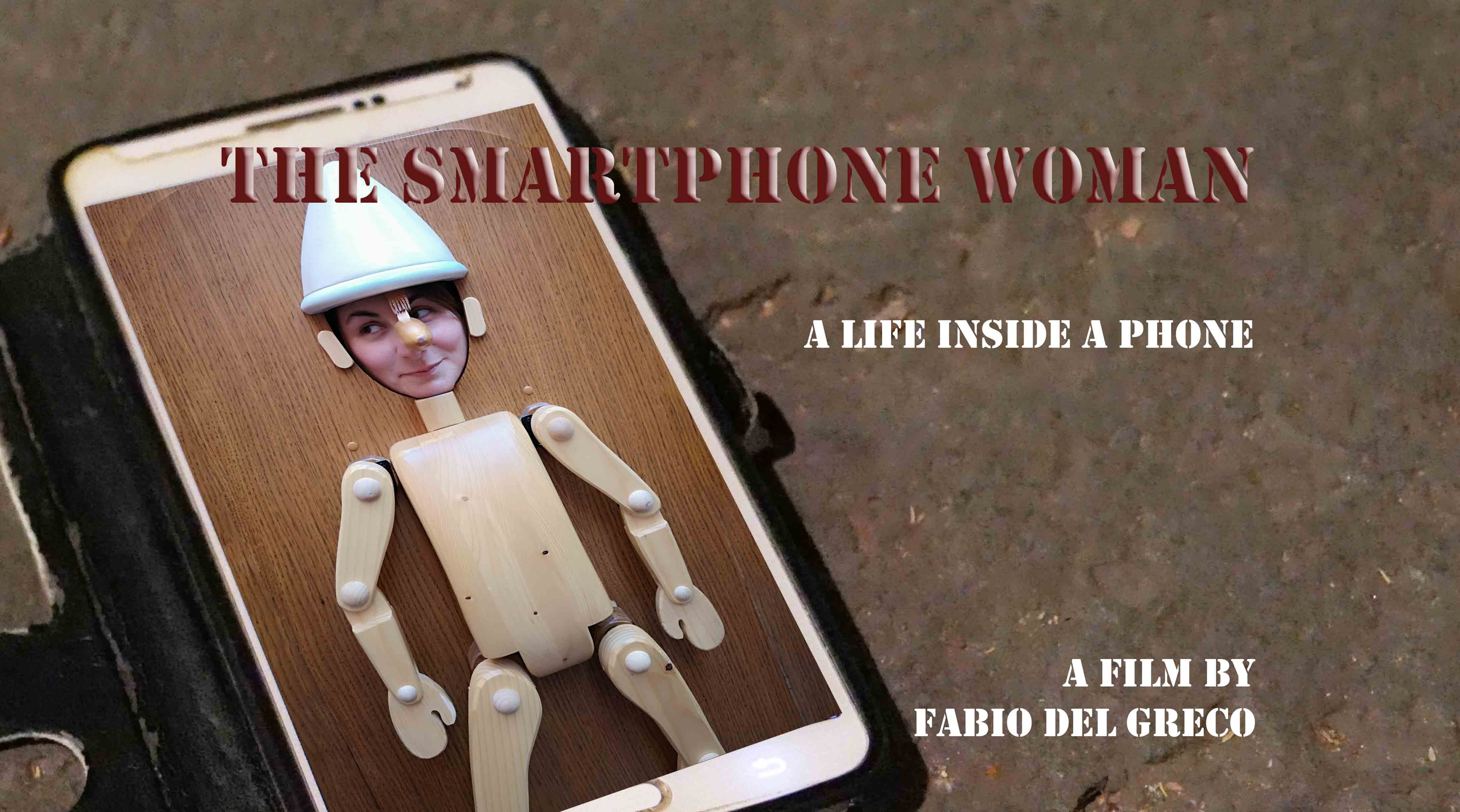
Drama, thriller, dark comedy, by Fabio Del Greco, Italy 2020.
On a bridge over the Tiber River, an elderly and severely ill man has decided to end his life, but an unusual discovery changes his mind: he comes across a lost smartphone. Intrigued, he decides to return home and watch the videos contained within it. On the screen, a series of videos unfold, telling the story of a woman who has emigrated from southern Italy to Rome to work as a teacher in schools and her struggles with integration in a social reality she cannot fully grasp.
"The Smartphone Woman" is a realistic tale of a woman's life and her complex relationship with an "infernal" city. It portrays the challenges she faces, her connection to her origins, the social discomfort she discovers in the outskirts, and the eerie presence of the ghosts of ancient Roman empire. Fabio Del Greco employs a fragmented style, using pieces of "real life" shot with the smartphone, to construct a narrative that ambiguously oscillates between fiction and truth. This creates a captivating exploration of the discomfort and alienation within the bustling city, contrasting with the peaceful village life from which the protagonist hails. The film is constructed with a variety of heterogeneous characters and situations, an emotional kaleidoscope, weaving between evenings of exploration in the Eternal City and daily struggles. Realistic smartphone-shot videos are alternated with a narrative thread reminiscent of film noir and, ultimately, surrealism in the finale. On screen, a succession of grotesque characters unfolds, representing the director's vision of a tumultuous humanity. The film's potency lies in the emotion it manages to convey and in the protagonist's naive perspective. "The Smartphone Woman" is a must-see for enthusiasts of independent and experimental cinema.
LANGUAGE: italian
SUBTITLES: English, French, German, Portuguese, Spanish
Joan Didion and the Grammar of Marriage
You do not remember the exact moment you stopped saying “we” and started saying “I.” It happens somewhere in the middle of a sentence, or maybe in the middle of a grocery list, when your hand writes down one coffee instead of two and you stare at the number as though it belongs to a foreign language you once spoke fluently. Joan Didion knew this moment with the precision of a surgeon who has also been the patient. She had spent four decades building a grammar around another person, and on December 30, 2003, that grammar collapsed without warning, between the first course and the second, while her husband John Gregory Dunne sat across from her at dinner and then simply was not there anymore. A massive coronary thrombosis. The paramedics used the phrase “sudden death.” She would spend the next two years examining the exact inadequacy of those two words.
What she produced from that winter was The Year of Magical Thinking, published in 2005, which won the National Book Award and became one of the most read accounts of bereavement in contemporary literature. But to call it a book about grief is to misunderstand its project almost entirely. It is a book about the failure of the mind to accept what the body already knows. Didion opens with the sentence that became the essay’s spine: “Life changes fast. Life changes in the instant. You sit down to dinner and life as you know it ends.” There is no metaphor there. No softening. The simplicity is the weapon. She had spent a career understanding, as she wrote in The White Album in 1979, that “we tell ourselves stories in order to live,” and now she was documenting, in real time, the precise mechanisms by which that storytelling breaks down when the story’s co-author disappears.
The magical thinking of the title is not whimsy. It is clinical. She borrowed the concept from the anthropologist Bronislaw Malinowski and the developmental psychologist Jean Piaget, who both described magical thinking as a pre-rational mode in which the mind insists that internal states can alter external reality. Didion caught herself refusing to give away Dunne’s shoes because, on some level below conscious thought, she believed he would need them when he came back. She knew he was dead. She had watched the paramedics. She had identified the body. And still she kept the shoes. This is not irrationality. This is the mind doing exactly what it was built to do, which is to protect the organism from information that would destroy its capacity to function. The mind lies on behalf of survival, and Didion, with forty years of trained precision, decided to document the lie from the inside rather than correct it from the outside.
This is what separates her from the tradition of elegiac literature that preceded her. She was not writing a monument to Dunne. She was performing an autopsy on her own cognition, with Dunne as both the subject and the instrument, the loss and the lens. The question she was really asking had nothing to do with death and everything to do with

Magical Thinking as Survival Mechanism
You keep the shoes. You do not donate them, do not move them from the closet floor, do not let anyone suggest that keeping them is a problem. The shoes are evidence of a future that has not yet been cancelled. This is not sentiment. This is architecture — a structural wall the mind erects between itself and a truth it cannot yet process without dissolving.
Joan Didion understood this only in retrospect, and the understanding did not make it less true. After John Gregory Dunne died at the dinner table on December 30, 2003, she could not give away his shoes because he would need them when he came back. She wrote it plainly, without apology, in The Year of Magical Thinking, published in 2005 — a book that arrived not as grief memoir but as forensic examination of a mind in the act of protecting itself. The shoes were not a symbol. They were a logical necessity inside a system of belief that her mind had constructed, rapidly and without her consent, in the hours after his death. The logic was intact. Only the premise was impossible.
Bronisław Malinowski spent years among the Trobriand Islanders in the early twentieth century, and what he documented in his 1925 essay “Magic, Science and Religion” was not superstition but function. He observed that ritual and magical thinking emerged with precision at the exact boundary where human skill ended and uncertainty began. Trobriand fishermen performed no rituals for lagoon fishing, which was safe and predictable. For deep-sea fishing, where death was genuinely possible and outcome genuinely unknowable, the ritual apparatus was elaborate and non-negotiable. Malinowski’s conclusion was not that these people were primitive. His conclusion was that magical thinking is the cognitive technology humans deploy when reality becomes structurally unmanageable — when the gap between what is and what can be borne grows too wide for rational thought to bridge alone. It is not a failure of intelligence. It is intelligence operating under conditions it was never designed to survive.
Paul Ekman’s work on emotional cognition adds another layer to what Malinowski observed in the field. Ekman, whose research into the physiological architecture of emotion spans decades, demonstrated that the emotional system operates faster than conscious thought — that the body has already begun responding to a threat before the cortex has finished processing whether the threat is real. Grief, in its acute phase, does not wait for comprehension. The emotional system registers annihilation and begins countermeasures before the rational mind has even finished asking what happened. What looks like denial from the outside is, from the inside, the mind buying itself seconds, then minutes, then days in which to construct a livable version of reality. The shoes remain because the emotional system has already decided that a world without Dunne is not yet a world it will agree to inhabit.
This is why Didion’s insistence strikes readers not as pathology but as recognition. The mind’s last fortress against annihilation of self is not argument. It is not therapy. It is the maintenance of small physical objects in their expected locations. It is the preservation of a routine that implies continuation. Dunne’s shoes on the closet floor meant that the story was still open, that the ending had not been written, that departure was still reversible in some register of reality that grief had opened and rationality had not yet closed. There is something Malinowski would have recognized immediately in that closet — not irrationality, but a ritual performed at the exact shoreline where the safe lagoon of ordinary life ends and the open sea of permanent loss begins.
What Didion did, and what makes The Year of Magical Thinking philosophically serious rather than merely emotionally raw, is that she refused to pathologize her own mind for having done what minds do. She documented the mechanism without dismantling its dignity. She let the shoes mean what they meant, which was everything, which was the difference between a self that could continue and a self that could not yet afford to know what had actually happened on the last night of December in the life she had been living for forty years.
Grief as Social Performance and Its Hidden Demands
You sit across from someone at dinner, three months after the worst thing that has ever happened to you, and they ask how you are doing with a particular brightness in their eyes that tells you the correct answer is “better.” Not well, not healed, certainly not the truth — better. The word functions as a social checkpoint, a small toll you pay to re-enter the ordinary world of conversation and pasta and the passing of bread. What you are being asked, beneath the syntax of concern, is whether you have completed your grief on schedule, whether you have had the decency to finish.
Philippe Ariès spent decades inside European archives reconstructing how Western civilization learned to treat death as an administrative inconvenience, and what he assembled in The Hour of Our Death in 1981 is one of the most quietly devastating arguments in modern historiography. He traced a long arc: from the medieval tame death, in which dying was a communal, public, and spiritually integrated event — the dying person at the center, surrounded, witnessed, accompanied — to what he called the invisible death of the twentieth century, in which dying was medicalized, professionalized, and moved behind institutional walls, away from the living room and into the hospital, the hospice, the funeral parlor. The body disappeared. The mourner was left not with a community that understood grief as a prolonged and legitimate state, but with a culture that had replaced duration with efficiency. By the time Ariès was writing, the acceptable window for visible grief in most of Western Europe and North America had compressed to something resembling a corporate bereavement policy: a few days, perhaps a week, and then the expectation of functional return.
Joan Didion did not return on schedule. What she wrote in The Year of Magical Thinking was not a performance of recovery but a forensic examination of what grief actually does to a mind — how it dismantles logic, how it rewires perception so that a pair of shoes becomes an unbearable object because the dead cannot come back and therefore must not need shoes removed. She kept her husband’s shoes. She understood, even as she wrote it, that this was irrational. She wrote it anyway, and in doing so she exposed the violence concealed inside every well-meaning condolence, every gentle inquiry about progress, every suggestion that time heals. Time does not heal in the way that phrase implies. Time accumulates. It does not subtract.
What Ariès identified as structural — the privatization of mourning, its exile from public life — Didion made visceral. The people around her were not cruel. That is the precise and terrible point. They were operating inside a grief culture that had taught them condolence has an expiration date, that continued mourning is a form of social imposition, that the bereaved must eventually stop requiring accommodation. The anthropologist Geoffrey Gorer had argued something similar as early as 1965, in Death, Grief and Mourning, calling the British suppression of mourning a pornography of death — the same cultural logic that made explicit sex obscene in the nineteenth century had, by the twentieth, been transferred to explicit grief. You were permitted to grieve privately, invisibly, in rooms where no one had to witness your disintegration. But you were not permitted to bring it to dinner.
The Self That Disappears When the Witness Is Gone
There is a particular cruelty in the kind of loss that does not announce itself as self-loss. You expect to grieve the other person. You do not expect to grieve your own coherence. Didion described this in terms of disorientation — the inability to think straight, to finish sentences, to recognize herself in mirrors — but what she was circling around, without quite naming it philosophically, was something George Herbert Mead had formalized decades earlier: that the self is not a private interior fact but a social construction, perpetually assembled through the reflected gaze of others. In “Mind, Self, and Society,” published posthumously in 1934 from his lecture notes at the University of Chicago, Mead argued that we do not first exist as selves and then enter into relationships. We become selves precisely because others respond to us, name us, complete our gestures with meaning. The “I” that feels so sovereign and indivisible is, in Mead’s framework, always already in dialogue with a “me” — the self as seen, as witnessed, as held in someone else’s perception.
What this means in practice, though Mead never used grief as his example, is that the disappearance of a long-term witness is not an external event that leaves the inner self intact. It amputates part of the architecture of selfhood itself. John Gregory Dunne had been Didion’s primary witness for thirty-nine years. He had seen her across a thousand versions of herself — younger, frightened, ambitious, fragile, brilliant, difficult, wrong. He carried those versions as active memory. When he died at the dinner table in December 2003, those versions did not merely lose their audience. They lost their proof of existence.
Anthony Giddens pushed this further in 1991, arguing in “Modernity and Self-Identity” that in the conditions of late modernity, personal identity is not given by tradition or community but must be reflexively constructed as an ongoing narrative — what he called a “trajectory of the self.” The crucial word is trajectory: identity is not a fixed point but a moving line, and it requires a stable external reference to remain coherent. Long-term intimate partnership, in this reading, functions as the most intimate possible reference point. The partner is not just the person who knows you; the partner is the person in whose presence you have been becoming. They hold the continuity of the story when your own memory of it wavers. They are, in the most literal structural sense, part of the apparatus through which you remain legible to yourself.
Didion registered this without the sociological vocabulary, but with the novelist’s precision that cuts deeper than vocabulary. She kept finding herself beginning to tell Dunne something — a detail noticed, a sentence formed, a reaction that needed his reaction to complete it — and then remembering. That compulsive reaching is not mere habit. It is the self still generating the signals of a circuit that no longer exists, still producing the half of a conversation that required him to become whole. The content of what she might have said is almost irrelevant. What mattered was the structural dependence: she had organized her perception of experience around the expectation of his reception of it. Without that, perception itself became strange, unmoored, producing data with no place to land.
This is what transforms grief into something closer to an identity crisis than a purely emotional event. The mourner is not simply sad. The mourner is suddenly partial, a self whose native grammar no longer has a complete syntax. Giddens had described the maintenance of selfhood as a kind of “ontological security” — the basic, background confidence that the world is stable and continuous enough for a coherent self to exist within it. The loss of the primary witness does not just wound that security. It reveals, retroactively, how much of it was never internal at all, but held in place by someone else’s continued presence in the room, still breathing, still capable of turning to look at you.
A vision curated by a filmmaker, not an algorithm
In this video I explain our vision
Language at the Edge of What Cannot Be Said

You read the same sentence three times before you realize you have not moved. Not because the prose is difficult, but because it keeps folding back on itself, turning the same phrase over with a slight variation, as if the writer is pressing her thumb against a bruise to verify it is still there. That experience — the recursive loop, the sentence that almost closes and then opens again — is not an accident of grief’s disorientation. It is a deliberate epistemological act, and once you recognize it as such, the entire text changes temperature.
Didion’s prose in that period operates at the exact threshold that Ludwig Wittgenstein identified in 1921, in the closing proposition of his Tractatus Logico-Philosophicus: whereof one cannot speak, thereof one must be silent. The sentence is famous enough to have been evacuated of its force by repetition, but what Wittgenstein meant was structurally devastating — that language does not simply fail to describe certain realities, but that those realities exist, for the speaking subject, only insofar as language can reach them. The limits of my language, he wrote, are the limits of my world. Grief, at its most acute, is precisely the experience of a world that has exceeded the boundary of what language was built to contain. The person who died was, for decades, interior to your syntax. They were embedded in your pronouns, in the we that organized your daily speech. When they disappear, the we does not simply become I. It becomes a broken referent, a pronoun without its antecedent, still in the mouth, still grammatically available, pointed now at nothing.
What Didion does — and this is where her method becomes something more than literary style — is refuse the silence Wittgenstein prescribed. She speaks anyway. She does not pretend to have found a language adequate to the experience. Instead, she documents, in real time, the inadequacy of every sentence she constructs. Her repetitions are not redundancies. They are corrections that cannot correct. She returns to the moment in the restaurant, to the chair he will not sit in again, not because she has forgotten she already said it, but because saying it once did not make it real, and saying it again does not either, and that gap between the saying and the realizing is the actual subject of the book. The text is not about John Gregory Dunne’s death. It is about the impossibility of knowing it.
This is what separates her from almost every other grief memoir written in the twentieth century. Most of them are organized retrospectively — they carry the implicit promise of integration, of a self that has survived long enough to narrate with some coherence. Didion’s sentences refuse that arc. They are written, grammatically and rhythmically, as if the loss is still arriving. The philosopher Paul Ricoeur, in his 1984 work Temps et Récit, argued that narrative is the fundamental human mechanism for making experience intelligible — that we cannot understand time or suffering except by emplotting them, by giving them beginning, middle, and something that gestures toward an end. Didion’s prose is a direct challenge to that claim. It emplotts nothing. It circles the event the way a person circles a room they cannot bring themselves to enter, touching the doorframe each time, measuring their own paralysis.
What she discovers — and what the reader discovers in their body before their mind catches up — is that the recursive sentence is not a failure of craft. It is the only cartography honest enough for the territory. A straight line through grief is a lie. A sentence that closes cleanly implies a world that has resolved. Hers do not close, and in not closing they map something true: the way a mind in extremity does not process loss sequentially but orbits it, returns to it, tests it again, finds it still impossible, and begins the orbit once more. The form is the argument. The loop is the evidence.
What the Culture Calls Recovery and What It Actually Is
You have been told, in one form or another, that grief moves. That it proceeds. That it has stations like a train line, and if you are patient and sufficiently willing, you will arrive somewhere other than where the loss dropped you. Elisabeth Kübler-Ross published her five-stage model in 1969, drawing from her work with terminally ill patients — not, it is worth noting, with the people left behind — and within a decade it had migrated from clinical observation into cultural dogma. Denial, anger, bargaining, depression, acceptance: the sequence became so embedded in the Western imagination that by the time most people reach adulthood, they carry it like a map they never chose to memorize. Grief, the culture insists, is a process. It has an exit.
George Bonanno spent years at Columbia University systematically dismantling that architecture. His 2009 work demonstrated through longitudinal research that human responses to loss are far more varied, far less linear, and far more resilient than Kübler-Ross’s model ever accounted for — and that the insistence on staged progression could itself become a form of harm, making people who grieved differently feel pathological, broken, stalled at the wrong station. What the model had never honestly confronted was the difference between describing how some people grieve and prescribing how grief should behave. The distance between those two things is where most of the damage lives.
Didion’s year does not move through stages. It circles. It doubles back. It performs functionality — she works, she edits, she attends to the practical catastrophe of her daughter’s hospitalization — and then, without warning, it collapses into the absolute. She finds herself unable to give away John’s shoes because, at some cellular level beneath rational thought, she understands that he will need them when he returns. This is not denial in the Kübler-Ross sense, something to be passed through and discarded. It is the mind doing exactly what the mind does when the world has reorganized itself around an impossibility: it holds two realities simultaneously, aware of the contradiction and unable to resolve it, because resolution would require a kind of finality the nervous system refuses to authorize. Magical thinking is not a failure of intelligence. It is intelligence in extremis, working by its own logic.
What the therapeutic framework calls recovery is, in its most honest form, a social contract. It asks the bereaved to become legible again — to return to productivity, to stop unsettling the people around them, to signal that the acute phase has passed. Acceptance, in this reading, is less an inner state than a performance of readiness to rejoin the living. Didion does not reject this contract so much as she reveals, with the precision of someone who has spent a lifetime watching language, that it was never about the grieving person at all. It was about everyone else’s tolerance for proximity to loss.
What she arrives at — and this is not a destination, not a resolution, not anything the five-stage model would recognize as its endpoint — is something closer to what psychoanalyst Darian Leader describes as the slow, incomplete work of making the dead a permanent part of the interior landscape. Not moving on. Not moving through. Integration: the absorbed presence of the absent, the way a person who is gone continues to exert gravity on every thought, every room, every sentence you write in the months and years that follow. Didion does not recover from John’s death. She is not, by the end of the year she documents, a woman who has crossed to the other side of it. She is a woman who has learned, at tremendous cost, that the other side does not exist in the way the culture promised — that what exists instead is a different relationship to the weight, and the question of whether you can carry it without pretending it has become lighter than it is.
The Permanence of the Unfinished Sentence
There is a pair of shoes sitting in a closet somewhere in the architecture of grief, and they cannot be moved. Not because moving them is physically impossible, but because moving them would complete a sentence that the person left behind is not ready to finish — and may never be. Joan Didion kept John Gregory Dunne’s shoes for over a year after he died at their dinner table on December 30, 2003, collapsing mid-conversation from a massive coronary. She could not give them away. She understood, with the part of her mind that was still functioning as a rational observer, that this was irrational. She documented that understanding in precise, clinical prose. And then she kept the shoes anyway.
The culture reads this as a stage, as something to move through and past. Elisabeth Kübler-Ross, whose 1969 framework “On Death and Dying” remains the dominant popular template for grief, gave us the five stages precisely because the Western psyche cannot tolerate open endings. Stages imply arrival. They promise that if you move through denial and bargaining and anger, something on the other side resembles resolution, and that resolution resembles the self you were before. Didion dismantled this promise not by arguing against it but by simply reporting what actually happened inside her, with the same forensic precision she had applied to the disintegration of the 1960s counterculture in “Slouching Towards Bethlehem.” The honest account was, by itself, an act of demolition.
What she was reporting, without fully naming it in those terms, was something closer to what the psychoanalyst D.W. Winnicott described when he wrote about the way we build our inner architecture in relation to other people. The self, for Winnicott, is not a sealed unit. It is a structure built in response to and partially inhabited by others, particularly those with whom we share the deep routine of daily life. When Dunne died, he did not leave a gap where he had been. He left a gap in what Didion was. The shoes were not a memento. They were a load-bearing wall that had been removed overnight, and the building was still standing in the technical sense while being structurally uninhabitable in every sense that mattered.
This is the thing the culture refuses to say plainly: that some losses do not heal because they were not wounds. They were amputations of something that was also you. The demand that the bereaved rebuild and continue, the compassionate insistence on forward motion, is not always an act of care. It is sometimes an act of social impatience, a need to stop witnessing the evidence that identity is far more porous and collective than we are willing to admit. If grief can last this long and cut this deep, then the self was never as sovereign and self-contained as we required it to be. The shoes in the closet are not just about one dead man. They are about the foundational lie of Western individualism, which is that you were ever entirely your own construction to begin with.
Didion was seventy years old when she published “The Year of Magical Thinking” in 2005. She had spent forty years as one of the most controlled stylists in American letters, a writer for whom precision was not a technique but a survival strategy. And what that lifetime of control produced, when applied to the raw material of losing Dunne, was not a monument to grief but a demonstration of its permanence as structure rather than feeling. The shoes are still in that closet in the logic of the book, still unworn, still holding the shape of feet that no longer exist. They are not waiting for anything. They are simply there, the way a missing wall is still there in the sense that everything else is built around the fact of its absence, and you feel the draft every time you walk through the room.
🌀 Grief, Memory, and the Writing Self
Joan Didion’s ‘The Year of Magical Thinking’ stands as one of the most devastating and lucid explorations of grief ever committed to prose. Its power lies in the way mourning reshapes time, identity, and the very act of remembering. The articles below trace kindred paths through loss, memory, and the literature that dares to look directly at the wound.
Paul Ricœur: Life and Philosophy of Memory
Paul Ricœur devoted much of his philosophical life to understanding how human beings construct meaning through narrative, time, and remembrance. His work on memory and mourning offers a profound theoretical complement to Didion’s raw personal account, illuminating why we tell stories about loss as a way of surviving it. Ricœur’s concept of ‘narrative identity’ resonates deeply with the way Didion rewrites and revises her memories of John Gregory Dunne throughout the book.
GO TO THE SELECTION: Paul Ricœur: Life and Philosophy of Memory
Virginia Woolf: Life and Works
Virginia Woolf occupies a singular place in the tradition of writing that maps grief and interior consciousness with unsparing honesty. Like Didion, Woolf transformed personal devastation into literary form, using the rhythms of language itself to render the fragmentation that loss produces in the mind. Exploring Woolf’s life and works reveals a shared lineage of women writers who refused to aestheticize suffering without first telling the truth about it.
GO TO THE SELECTION: Virginia Woolf: Life and Works
Annie Ernaux: Life and Works
Annie Ernaux, like Didion, works at the precise border between autobiography and literature, mining intimate experience for truths that expand far beyond the personal. Her unflinching prose style—stripped of sentiment yet saturated with emotion—makes her writing a natural companion to ‘The Year of Magical Thinking.’ Both authors demonstrate how the act of writing about loss is simultaneously an act of preservation and an act of letting go.
GO TO THE SELECTION: Annie Ernaux: Life and Works
William James and Consciousness: The Stream of Thought
William James’s concept of the stream of consciousness illuminates the psychological texture of Didion’s grief narrative, in which time collapses, memories intrude unbidden, and rational thought dissolves into associative loops. James showed that the mind does not move in straight lines, a discovery that helps explain the circular, obsessive quality of mourning that Didion documents so precisely. Understanding James’s account of consciousness deepens our reading of why Didion’s book feels so uncannily true to inner experience.
GO TO THE SELECTION: William James and Consciousness: The Stream of Thought
Discover Cinema That Understands Loss
If these reflections on grief, memory, and the fragility of the self have moved you, Indiecinema offers a carefully curated streaming library of independent and arthouse films that explore the same territories with equal depth and courage. From intimate portraits of mourning to cinematic meditations on time and identity, the stories you need are waiting for you. Visit Indiecinema and let independent cinema accompany you where words sometimes cannot reach.
👉 EXPLORE THE CATALOG: Watch Indie Films in Streaming
A vision curated by a filmmaker, not an algorithm
In this video I explain our vision

