
The Ungraspable Now
Try it right now. Stop reading for a moment and attempt to catch what you are thinking. Not what you will think next, not what you just thought — what you are thinking, precisely, in this instant. You will find nothing. Or rather, you will find the act of looking, which has already replaced the thing you were looking for. The thought has dissolved the moment you turned toward it, the way a word repeated too many times stops meaning anything, the way peripheral vision loses its object the instant you try to focus on it directly. This is not a failure of concentration. This is not something that practice will fix. This is the structure of the thing itself.

There is a particular kind of vertigo that comes from this realization, and most people encounter it at least once — usually late at night, or in a fever, or in the middle of some ordinary task that suddenly comes apart under scrutiny. You are washing dishes and you wonder: what was I just thinking? And the moment you ask, whatever thread was running through you is gone, replaced by the question, which is already a different thread entirely. You have not lost a thought. You have discovered that the thought was never a possession in the first place. It was weather. It was a current you were swimming in without knowing it, and the attempt to stand still and examine the water has already changed the water.
William James spent the better part of a decade circling this problem before he named it with the precision it required. His Principles of Psychology, published in 1890 after twelve years of composition, contains a chapter that changed everything about how the Western world understood its own interior life — not because it proposed a new theory, but because it finally described with accuracy what every conscious being already knew from the inside but had never seen articulated. He called it the stream of thought. Not a sequence, not a series, not a chain of linked units. A stream. The word was chosen with care. Streams do not have joints. They do not stop and start. They move continuously, and what looks like a pause is merely a slower current, and what looks like a clear edge is merely the eye’s imposition on something that refuses edges.
The philosophical tradition before James had largely treated consciousness as a kind of container filled with discrete objects — ideas, impressions, sensations — that could be catalogued and examined one by one. Locke built an entire epistemology on the assumption that the mind receives simple ideas and combines them into complex ones, as if experience were a matter of construction, of pieces assembled. Even Kant, whose architecture was infinitely more sophisticated, still operated with a vocabulary of representations, of faculties, of categories that sorted and organized. The metaphors were always spatial, always static. A room. A cabinet. A stage. As if consciousness were somewhere you could walk into and look around.
James destroyed this furniture. Not aggressively, not with the hammer of a polemicist, but with the patient insistence of someone who had actually looked. He had suffered enough himself — the years of depression and nervous collapse in his twenties, the crisis of will that nearly ended him, the long recuperation that forced him to live inside his own mind with an unusually honest attention — to know that consciousness does not resemble a room. It does not hold still. It does not contain. The moment you try to examine a thought directly, James wrote, you find that it “has already ceased before the examination can begin.” The object of introspection and the act of introspection cannot occupy the same moment. There is always, irreducibly, a lag — a gap where the thing you meant to catch has already become something else.
This is not a minor technical problem. This is the central problem. Everything else follows from it.
The Mirror and the Rascal

Drama film, by Valerio De Filippis, Italy, 2019.
The mirror and the rascal is an experimental film based on the tragedy "Richard III" by William Shakespeare. It tells the delirium of contemporary power in an author's reinterpretation of cinema, video art and music. The protagonist, Richard Duke of Gloucester, brother of King Edward IV, through a long series of crimes eliminates all the obstacles that stand between him and the throne of England.
Valerio de Filippis, a well-known painter who has been following his research path for a long time, investigating the relationship between light, corporeality and the psyche. The mirror and the rogue and the cinematographic equivalent of Valerio De Filippis' painting, his figurative style is in fact very recognizable looking at his paintings. But cinema is a new way where the artist can also be involved as an actor and performer, with an original mix between acting and singing. Staging the dark side of the human soul, the film is a surreal and disturbing interpretation of a great classic. The director says: "The first suggestion was musical: I was interested in transforming the text of Shakespeare's tragedy Richard III into notes. I love cinema and at a certain point I felt that the time had come to combine research on the image of painting to my love for cinema and music. When the film is finished I realize that I have remained faithful to painting: every frame of the film appears to me like a painting: the same light, the same colors, the same atmosphere ". The mirror and the rascal is a kind of psychoanalytic session that the painter does while hiding behind the mask of Richard III. Behind this ferocious and unscrupulous character we find a path of self-analysis by De Filippis, who is mainly interested in the more violent and turbid aspects. An experimental film in which, with great courage, the author gets involved completely, fragmenting the images in an unconventional montage, which is at the same time a flow of consciousness and spectacle.
LANGUAGE: English
SUBTITLES: Italian
Before the Stream, the Pond
There is a moment, familiar to almost anyone who has sat in a lecture hall or a library trying to follow an argument, when you realize that the explanation being offered to you is technically correct and experientially absurd. The philosopher at the front of the room draws a diagram: idea A connects to idea B, which connects to idea C. The chain is logical. The arrows are tidy. And something in you knows, with a certainty you cannot yet articulate, that this is not how thinking works. Not even close.
This was the inheritance James received. John Locke had laid the groundwork in his Essay Concerning Human Understanding in 1689, proposing that the mind begins as a blank slate and acquires ideas through sensory experience, each idea arriving as a discrete unit, a legible token of the world. David Hume pushed further in his Treatise of Human Nature in 1739, arguing that what we call the self is nothing more than a bundle of perceptions, each one distinct, following each other in rapid succession, with no underlying substance to hold them together. The mind, in this account, is a kind of queue. Ideas arrive, associate, link by resemblance or contiguity or causation, and produce what we mistake for continuous thought. It was elegant. It was tractable. And it mapped perfectly onto a world that was learning to love machinery, gears meshing with gears, inputs producing outputs, the universe itself reimagined as clockwork.
The associationist tradition that descended from Locke and Hume found its nineteenth-century apex in James Mill, who in his 1829 Analysis of the Phenomena of the Human Mind reduced mental life to the mechanical combination of elementary sensations. His son John Stuart Mill softened this into what he called mental chemistry, allowing that complex ideas might have properties their components lacked, but the underlying assumption remained: the mind is made of parts, and understanding the parts is understanding the whole. It was a psychology that felt like physics, and that was precisely its appeal in an age intoxicated by the promise of scientific reduction.
James came to this inheritance already cracked open. The breakdown he suffered in the early 1870s was not a romantic collapse or a crisis of faith in the ordinary sense, though it touched both. It was something more vertiginous: a dissolution of the sense that the self was a stable thing capable of choosing, acting, persisting. He described encountering, as he wrote years later in The Varieties of Religious Experience, a vision of an epileptic patient he had seen in an asylum, a greenish-skinned, entirely idiotic figure crouched on a bench, and recognizing in that figure the possibility of himself. The terror was not philosophical. It was somatic. It lived in the chest. And no associationist diagram, no chain of linked ideas, no bundle of successive perceptions, could account for what that terror felt like from the inside, or for the strange, lurching, nonlinear way that recovery happened, not by replacing bad ideas with good ones but by something more like a gradual reweaving of the capacity to inhabit time.
Twelve years later, when he finally published The Principles of Psychology in 1890, the two-volume, fourteen-hundred-page work that had consumed most of his adult life to that point, James was not simply introducing a new theory. He was settling a score with a model that had tried to describe human beings as mechanisms and had failed the test of anyone who had actually broken down and had to find their way back. The associationist mind was a pond: still, bounded, its contents catalogued, each element floating separately. What James had lived through, and what he now insisted psychology must account for, was nothing like a pond.

The River That Cannot Be Stepped In Twice
You walk down a street you have taken a thousand times, and something is wrong. Not wrong in any way you can name. The bakery is where it always was. The crack in the pavement near the second lamppost has not moved. And yet the city feels inhabited by its own ghost, layered over itself, as if every version of this walk you have ever taken is somehow present in this one, pressing through the surface like faces through thin cloth.
This is not nostalgia. This is not memory malfunctioning. This is consciousness doing exactly what it always does, which is the thing we almost never allow ourselves to notice.
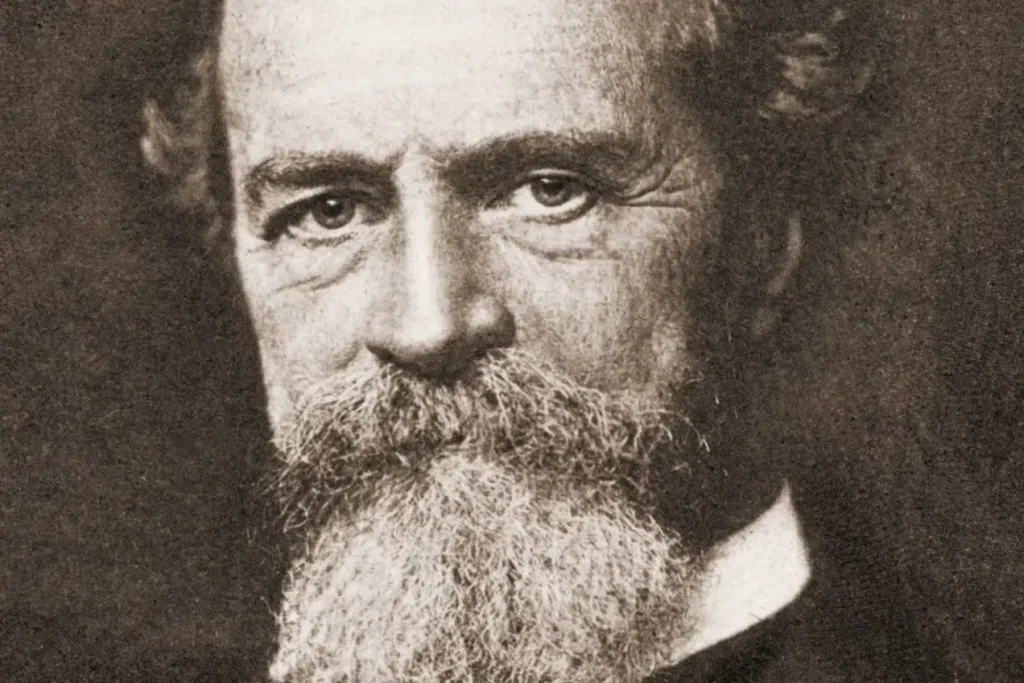
William James, in the Principles of Psychology published in 1890, did not say that the mind has a stream of consciousness. He said that consciousness is a stream, which is an entirely different claim. The first treats the metaphor as decoration. The second treats it as the most precise description available. He identified four essential properties: thought is personal, always belonging to a particular self; it is continuously changing, never identical from one moment to the next; it is sensibly continuous, never breaking into isolated pieces despite the gaps of sleep or distraction; and it is selective, always choosing some things and ignoring others from the flood of available sensation. These four properties do not describe a mechanism. They describe a texture of being that you recognize the moment someone articulates it, because you have been living inside it without having words for it.
The face of the man who passes you on that street carries, without your permission, the residue of at least four other faces. Your uncle’s way of holding his jaw. A colleague from a job you left a decade ago. Someone you loved briefly and cannot fully reconstruct. A stranger from a platform in another city whose expression you absorbed in the two seconds before your train departed. The face in front of you is all of these faces simultaneously, not because you are confused, but because James was right: consciousness does not arrive at perceptions clean. It floods forward, carrying everything it has ever touched.
He called the transitions between thoughts the “fringe,” a word that most readers skim past because it sounds decorative. It is not decorative. The fringe is the majority of conscious experience. It is the halo of meaning around each word before the word is spoken, the sense of a thought approaching before it arrives, the feeling of knowing that a sentence is going wrong three words before you finish it. Henri Bergson, working in parallel in France through the 1890s and articulating his fullest position in Matter and Memory in 1896, called something similar “duration,” the lived time of consciousness that cannot be cut into measurable instants without destroying the very thing you were trying to examine. Bergson and James knew of each other’s work and recognized in each other a common enemy: the tendency of philosophy and nascent psychology to mistake the map for the territory, to analyze consciousness by freezing it, and then to wonder why the frozen thing no longer resembled anything alive.
The river cannot be stepped in twice, Heraclitus said, because it is never the same river. But James’s revision of this insight is more radical than it first appears. It is not only that the river changes. It is that you change with it, that the person who steps in is constituted in part by the act of stepping, by the water that moment carries, by the specific light, the specific weight of what preceded this particular crossing. There is no fixed observer standing on a bank, watching thoughts pass by like water. The observer is in the flood. The observer is partially made of flood.
The city you thought you knew has always been this layered. You are only noticing it now because something slowed you down enough to see.
The Fringe and the Halo
There is a particular kind of knowing that arrives before language does. You are sitting at a table, the candles have been lit for two hours, the conversation has moved through its expected territories, and something is wrong. Not dramatically wrong. Not in any way you could point to and name. The feeling has no object you can locate, no sentence you could form to explain it to someone else without immediately feeling that the sentence had betrayed what you were trying to say. It hovers at the edge of what you can reach, pressing gently against the membrane of articulation, and every time you move toward it directly it shifts, the way a word you have forgotten retreats further the harder you chase it.
William James spent considerable effort trying to convince his readers that this penumbral state was not a failure of consciousness but one of its most essential operations. In the Principles of Psychology, published in 1890, he introduced a concept that most subsequent philosophy managed either to absorb too quickly or dismiss too easily: the fringe. Every determinate thought, every clear and nameable idea, exists surrounded by a kind of atmospheric pressure of half-formed relations, tendencies that lean toward other thoughts without yet becoming them, feelings of direction and of rightness or wrongness that precede any propositional content. The fringe is not nothing. It is not mere vagueness waiting to be resolved. It is the living tissue in which meaning actually moves.
He also called it the halo. The halo of a word is what you feel before the word arrives, the sense of the thought’s shape before it has taken form. You know what you are about to say before you say it, not as information but as felt trajectory. And when the wrong word comes out, you know it is wrong before any logical process has had time to compare it against the right one. That immediate wrongness, arriving faster than reasoning can account for it, is the fringe doing its work. It is consciousness operating at a register that ordinary introspective categories were never designed to capture.
Henri Bergson, writing in France through the same decade with almost no dialogue with James beyond mutual awareness, was circling the same territory from a different angle. His concept of duration, la durée, insisted that lived time was not a series of discrete moments lined up like beads on a string but a continuous flowing in which past and present interpenetrate without clear seams. What James called the fringe and what Bergson called the continuity of duration are not identical concepts, but they are answering the same problem: the experience of consciousness includes vastly more than the punctual, the nameable, and the clearly bounded. Edmund Husserl, working in Germany during exactly the same years, was developing his analysis of time-consciousness in lectures that would not be published until 1928, long after the ideas had been forming. His notion of retention, the just-passed moment that clings to the present without being a full memory, and protention, the anticipated next instant that leans into now before it arrives, gave phenomenological structure to precisely what James had been describing impressionistically. Three thinkers, three languages, three philosophical traditions, all pressing against the same wall from different sides.
The woman at the dinner table who cannot name what is wrong is not experiencing a deficiency. She is experiencing what consciousness actually is when it has not yet been forced into the shapes that communication demands. The unsayable weight around her clear thoughts, the felt pressure of something not yet articulated, is the fringe in its purest form. James would have recognized it immediately. He would not have told her to think harder or feel more precisely. He would have said: that hovering, that almost-knowing, that is not the edge of consciousness. That is its interior.
Selective Attention as Violence
You remember the argument clearly. You remember where you stood, what was said, the particular quality of the silence afterward. Then someone shows you a photograph taken that same evening — the angle of a room, the position of bodies — and suddenly you are not sure you were even present in the way you believed. The room you remember is not quite the room in the photograph. The people are arranged differently. You had been so certain of what you saw that the certainty itself had become the memory, papering over whatever actually occurred.
This is not a failure of memory. It is memory operating exactly as it was designed to operate. William James understood this with a precision that most cognitive science still has not fully absorbed. In the Principles of Psychology, published in 1890, he wrote that “the mind is at every stage a theatre of simultaneous possibilities” — but that consciousness does not stage all of them. It selects. It suppresses. It picks up certain threads and lets others fall into what he called the “psychic overtone,” the fringe, the barely-sensed periphery that never quite becomes thought. His phrase for the raw undifferentiated input that precedes this selection — the “blooming, buzzing confusion” — sounds almost whimsical until you sit with what it actually means: that reality, before you attend to it, is not yet your reality. It becomes yours only in the act of cutting it down.
This is not a neutral act. This is something closer to violence.
There is a particular quality to the experience of rewatching your own life — not literally, but in the sense of returning to a memory you have visited so many times it has hardened into fact, and then finding the crack in it. A man who had been through an ugly legal dispute spent years certain of what a specific conversation had contained. He had built his entire account around a single exchange, a tone of voice, a threat he was sure he had heard. When new evidence arrived — not contradicting him, exactly, but complicating him — he discovered that what he had heard was largely what he had been prepared to hear. He had walked into that room already arranged. His attention, sharpened by anxiety and years of accumulated resentment, had selected the signal and discarded everything that complicated it. He had not lied. He had perceived. And the perception had been, from its first moment, an editorial.
William Stern, writing in 1902 on the psychology of testimony, demonstrated through systematic experimentation what James had argued philosophically: that witnesses to the same event construct radically different accounts not because they are dishonest but because attention is architecturally partial. Stern showed that even highly educated, highly motivated observers missed crucial details under conditions of normal perception — not stress, not manipulation, simply the ordinary state of being a human being directing a finite beam of awareness at an infinite field. The courtroom assumption that seeing equals knowing was, Stern argued, a legal fiction with profound consequences for justice.
Georg Simmel, writing one year later in his 1903 essay on metropolitan life, approached the same problem from a different angle. The modern city, Simmel observed, overwhelms the nervous system with stimulation. The urban individual survives by cultivating what he called the blasé attitude — a systematic withdrawal of attention, a learned incapacity for response. This is not decadence. It is adaptation. The mind cannot attend to everything, so it builds filters, and those filters harden into character, into worldview, into the stories people tell about who they are and what they have seen.
What James, Stern, and Simmel are each describing is the same mechanism operating at different scales. Consciousness does not receive the world. It produces a version of it. And the version it produces is shaped by everything that came before the moment of looking — by habit, by fear, by the particular grooves worn into attention by repetition.
A vision curated by a filmmaker, not an algorithm
In this video I explain our vision
The Self That Keeps Changing Its Story

You rehearse the conversation before it happens. Standing in the kitchen, or in the shower, or stopped at a red light with no music on, you go over what you are going to say. Not just the words — you are assembling a version of yourself that will be credible in that room, with that person, under those circumstances. You are deciding which facts about your own history to foreground, which wounds to mention and which to leave out, which tone will make you sound neither too defensive nor too indifferent. By the time the conversation actually happens, you have already narrated yourself into a shape that feels coherent. And yet, if you were honest, you would admit that the shape keeps shifting slightly depending on who is listening.
James understood this with a precision that still reads as uncomfortable. In the Principles of Psychology, published in 1890, he drew a distinction that cuts through the ordinary way we talk about identity: there is the I and the Me, and they are not the same thing. The I is the self as knower — the stream itself, the ongoing act of experiencing, the thing that moves through time and cannot be captured in any single frame. The Me is the self as known — the accumulated object of reflection, the story you tell about yourself when someone asks who you are. What most people call their identity is almost entirely the Me. And the Me is not a discovery. It is a construction, and a partially borrowed one.
The Me, James argued, has three interlocking dimensions: the material self, which includes the body and everything felt as a natural extension of it — possessions, home, the people you love; the social self, which is the version of you that exists in the recognition of others; and the spiritual self, which is the sense of inner life, of something continuous beneath the surface shifts. But it is the social self that reveals the trap most clearly. James wrote that a man has as many social selves as there are individuals who recognize him. Not versions of one true self. Different selves, plural and often contradictory, each one summoned by a particular relationship, a particular audience, a particular set of stakes.
There is a scene — a man standing at his father’s bedside, grown now, powerful in certain rooms of the world, and yet everything that made him formidable elsewhere has dissolved. He is not pretending to be smaller than he is. He simply is smaller, because this relationship calls up a self that never had the chance to grow past a certain year. The I keeps flowing. The Me keeps getting ambushed by old architecture.
This is why Erik Erikson‘s concept of identity, developed in the 1950s largely in conversation with the psychoanalytic tradition James helped make possible, insists that identity is never a fixed achievement but an ongoing negotiation between inner continuity and outer recognition. The feeling of being the same person across time — what Erikson called ego identity — is not a fact about the soul. It is a project, and a fragile one, dependent on the responses of others in ways that feel like betrayal when we notice them.
What you rehearse before the difficult conversation is not preparation. It is a kind of desperate editing, an attempt to make the Me consistent enough to survive scrutiny. But the I, which is doing the rehearsing, knows something the Me refuses to admit: that the story has been revised before, and will be revised again, and that the revision always feels like recovery of truth rather than invention of it. The self that keeps changing its story insists, each time, that this version is the final one. That this time, you are finally being accurate. That the character you are performing is not a performance at all, but simply who you are, seen clearly at last.
When the Stream Runs Underground
You are moving through an ordinary Tuesday afternoon and something is slightly wrong, though you cannot name it. The coffee is warm in your hands but the warmth does not quite reach you. Someone speaks and you hear the words, process them, answer correctly, and yet the exchange feels as though it is happening at a small but uncrossable distance, as if the moment of experience and the moment of your being there for it have come slightly unstuck from each other. You are present and absent simultaneously. The afternoon light falls through the window exactly as it should, and you watch it fall, and there is nothing behind the watching.
Pierre Janet was describing this precisely in the 1890s, naming it depersonalization, trying to account for the strange doubling in which consciousness seems to witness itself from outside, the stream observing its own banks from somewhere that is not the stream at all. Janet and James were working in the same decade, across different languages, circling the same abyss from different directions. James read Janet carefully. He understood that the theory of consciousness as continuous flow was not a description of what consciousness always does but of what it does when it is fortunate.
By 1902, when he published The Varieties of Religious Experience, James had spent years collecting testimonies from the outer edges of mind — conversion experiences, mystical states, moments of oceanic dissolution where the boundaries of self evaporated not metaphorically but phenomenologically, where the person reporting the experience was genuinely, terrifyingly unable to locate where they ended and something else began. What interested him was not the theological question but the psychological one: these were not malfunctions. They were the stream running into territory for which it had no prepared channel, and being forced into new shapes, or into no shape at all.
Trauma does something structurally similar and far less luminous. What the research of Bessel van der Kolk and others has clarified, drawing on neurological evidence James could not have had, is that extreme experience does not simply enter the stream and become part of its flow. It ruptures the sequence. It creates what van der Kolk calls, in his 2014 synthesis, fragments without narrative — sensory shards that exist outside the temporal structure of memory, outside the grammar of before and after. The stream, when the flood comes, does not carry the event forward. It buries it, or it splinters around it, and both responses produce their own deformations in the flow of ordinary waking life.
There is a man sitting at a table years after something he has not integrated, and the sunlight on the wall does exactly what it always does, and he watches it, and something in him is watching him watch it, and the recursion never closes. He is not broken in any visible way. He functions. He answers. He makes the coffee warm. What is missing is not cognition but arrival — the sense that experience is completing itself, that the present moment is actually being inhabited rather than observed from a position that is half-outside it.
James was honest enough, and strange enough, to investigate his own such states. He experimented with nitrous oxide in the 1880s, trying to chemically induce the dissolution of ordinary consciousness not out of recreation but out of philosophical hunger — he wanted to know what the stream looked like from somewhere other than inside it. What he found, and reported in his essays with a directness that still reads as slightly reckless, was that the dissolution felt like truth, that the boundaries which ordinarily structure experience seemed arbitrary and constructed from a perspective that did not share them. The stream, viewed from its own interruption, revealed itself as a made thing, not a given one.
Which means the Tuesday afternoon, the coffee, the warmth that does not land — this is not a disorder superimposed on a natural state. It is the natural state making itself visible.
What the Camera Cannot Catch
There is a moment, somewhere between sleeping and waking, when you are aware of being aware, and the awareness itself feels like water held in open palms. You do not yet have words for it. You are not yet narrating yourself. You simply are, in motion, continuous, unbounded by the edges of any frame. Then language arrives, and the moment is already gone, replaced by an account of a moment, which is an entirely different thing.
This is the gap that has defeated every attempt to represent consciousness from the outside. A man sits in a darkened editing room, splicing images together, trying to render the interior life of a character who cannot speak what she feels. The footage is beautiful. The cuts are intelligent. And yet something essential evaporates in the transition from reel to reel, from frame to frame. The discontinuity is structural, built into the very machinery of representation. Cinema can approximate the stream. It cannot be the stream. No medium that must cut can render what is constitutively uncut.
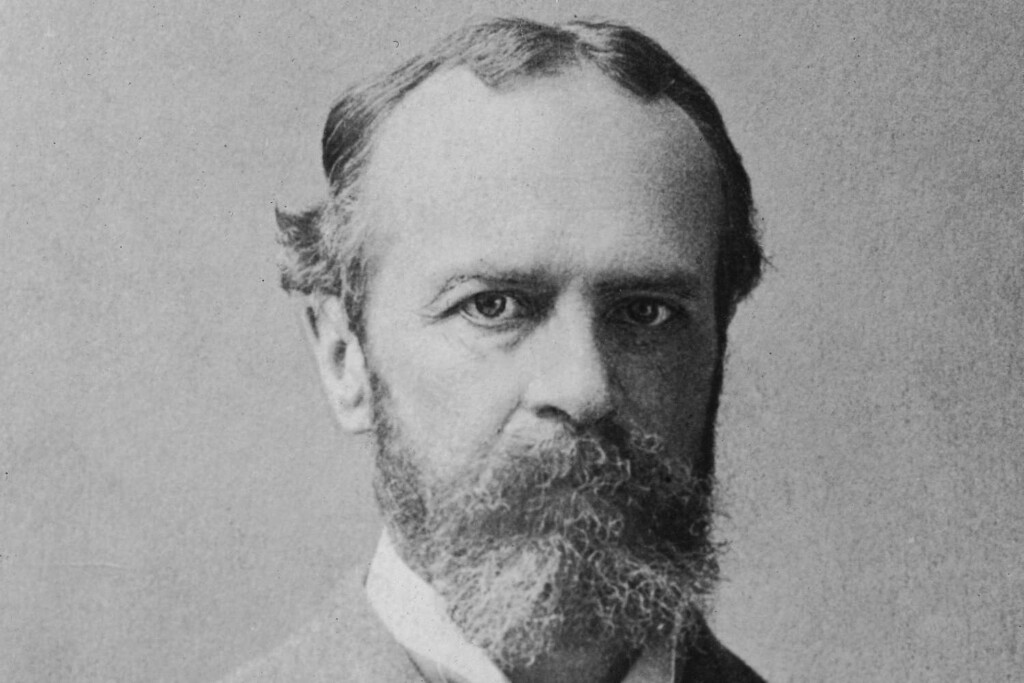
William James understood this problem not as a limitation of technology but as a condition of consciousness itself. Writing in The Principles of Psychology in 1890, he was already arguing that the attempt to analyze thought into discrete units was a betrayal of its fundamental nature. “As we take, in fact, a general view of the wonderful stream of our consciousness,” he wrote, “what strikes us first is this different pace of its parts.” Some thoughts rush, others linger, some are so fugitive that even the effort to name them destroys them, the way a hand reaching for a soap bubble does not catch it but only bursts it into nothing. The introspective method, James insisted, was always arriving late to its own subject. By the time you turned attention inward, the thing you meant to examine had already moved.
Edmund Husserl, working in the early decades of the twentieth century, would develop this into the formal architecture of time-consciousness, showing in his Lectures on the Phenomenology of the Internal Time-Consciousness, published in 1928 though delivered decades earlier, that every present moment carries within it a retentional trace of what has just passed and a protentional anticipation of what is about to come. Consciousness is never a point. It is always a thickness, a temporal smear, and any representation that tries to capture it by freezing it into a frame has already falsified it at the most fundamental level.
What the most ambitious attempts to render the interior have discovered, almost despite themselves, is that the failure is the most honest thing they produce. A woman walks through a city remembering someone she has lost, and the images that surface are not coherent, not chronological, not organized into the grammar of storytelling. They arrive with the texture of sense impressions, half-formed, overlapping, carrying emotional weight without narrative justification. The attempt to film this, to sequence it, to give it the logic of before and after, produces something that feels true in its rhythm even as it concedes defeat in its structure. The camera catches the shape of the gap without ever closing it.
Antonio Damasio, in Self Comes to Mind, published in 2010, argues that the conscious self is not a pre-given entity but something the brain constructs continuously, a narrative generated moment by moment from the integration of body states, memory, and perception. The self, in this account, is always catching up with itself, always a half-step behind the biological processes that generate it. James would have recognized this immediately. He spent his career insisting that the thinker and the thought are not two things but one process, and that the process never stops long enough to be properly seen.
What cinema keeps rediscovering, and what James articulated before cinema existed as an art form, is that the stream is not a metaphor for consciousness. It is the only honest word for something that refuses to hold still, that is always elsewhere by the time the sentence arrives to name it, that moves through every human life like water through a landscape, shaping everything it touches without ever becoming the shape itself.
🌊 Rivers of Mind: Consciousness, Self, and Inner Life
William James’s vision of consciousness as a flowing, unbroken stream opened a vast philosophical territory that later thinkers could not ignore. These related articles trace the currents of that river — from the depths of the unconscious to the mirror of the self — exploring how psychology, phenomenology, and philosophy have mapped the inner world across centuries.
Universal Consciousness
Universal Consciousness explores the idea that individual awareness is not an isolated phenomenon but a fragment of a larger, interconnected field of experience. This concept echoes James’s own interest in mystical states and the ‘fringe’ of consciousness, where the boundaries of the self become permeable. The article invites readers to question where personal experience ends and something vaster begins.
GO TO THE SELECTION: Universal Consciousness
Jacques Lacan and the Mirror Stage
Jacques Lacan‘s Mirror Stage offers a structural account of how the ego is formed through an external reflection — a founding alienation at the heart of human subjectivity. Where James described consciousness as a continuous flow, Lacan revealed the fractures and misrecognitions that shape our sense of self from the very beginning. Together, these two perspectives illuminate the tension between psychological continuity and structural division in human identity.
GO TO THE SELECTION: Jacques Lacan and the Mirror Stage
The Unconscious and its Relationship With Cinema
The Unconscious and its Relationship With Cinema examines how film, as a medium, mirrors the processes of mind that James and Freud independently sought to map. Cinema’s capacity to compress time, fragment memory, and produce dreamlike associations makes it a natural art form for staging the stream of thought. This article reveals how the moving image has become one of the richest laboratories for exploring consciousness outside the laboratory.
GO TO THE SELECTION: The Unconscious and its Relationship With Cinema
Phenomenology of Nature: Husserl and Merleau-Ponty
Phenomenology of Nature, as developed by Husserl and Merleau-Ponty, shares with William James a commitment to returning philosophy to lived, embodied experience rather than abstract construction. Merleau-Ponty in particular built a philosophy of perception that resonates deeply with James’s radical empiricism, insisting that consciousness cannot be separated from the body and its encounter with the world. This article traces how phenomenology extended and transformed the Jamesian inheritance into a fully embodied theory of mind.
GO TO THE SELECTION: Phenomenology of Nature: Husserl and Merleau-Ponty
Discover the Cinema of the Mind on Indiecinema
If these themes of consciousness, selfhood, and inner experience have stirred something in you, Indiecinema is the streaming platform where cinema becomes philosophy. Explore our curated catalog of independent films that dare to look inward — and discover stories that think, feel, and wonder alongside you.
👉 EXPLORE THE CATALOG: Watch Indie Films in Streaming
A vision curated by a filmmaker, not an algorithm
In this video I explain our vision

