
The Man Who Quit the Pulpit
You are handed a script before you are old enough to refuse it. The lines are already written, the costume already fitted, the congregation already seated and waiting. For most people, this is simply called a life. For Ralph Waldo Emerson, it was a crisis that arrived, with almost surgical precision, on September 9, 1832, when he stood before the Second Church of Boston and told them he could no longer administer the Lord’s Supper.

The formal reason was theological. Emerson had concluded that the Eucharist, as practiced, was a ritual misreading of what Jesus had actually intended — a local, culturally specific gesture transformed by institutional Christianity into a mandatory sacrament. But the theological argument was almost beside the point, a kind of polite forwarding address left for people who needed one. What was actually happening was something harder to name: a man discovering that the entire architecture of his public identity had been constructed on borrowed certainty, and that he could no longer pay the loan. He was twenty-nine years old. His young wife Ellen had died the previous year, in February, of tuberculosis, at nineteen. He had watched the body of someone he loved dissolve into nothing, and whatever consolations the institutional church was supposed to offer had apparently offered him nothing that held weight.
The Unitarian ministry of early nineteenth-century Boston was not a particularly oppressive institution by historical standards. It was, in fact, considered the liberal, rationalist alternative to Calvinist orthodoxy — a tradition that had already softened the harder edges of New England Puritanism into something more civic and enlightened. Emerson had come to it through inheritance as much as conviction. His father William Emerson had been a minister. The profession was, in the language of the time, a calling, but it was also a class position, a social contract, a form of belonging. When Emerson resigned, he was not simply changing careers. He was severing himself from the only form of cultural legibility his world reliably recognized.
What makes the resignation strange and worth sitting with is not its courage, exactly. Courage implies a clear alternative. Emerson had none. He had no philosophy yet, in the sense of a developed system. He had journals — dense, searching, privately circulating — and a growing unease with every form of secondhand authority, whether theological, literary, or philosophical. He had read Samuel Taylor Coleridge’s Aids to Reflection, published in 1825, which introduced him to a distinction between the Reason and the Understanding that would later become structurally important to his thinking. He had read, and wrestled with, the Scottish Common Sense philosophers his Harvard education had offered him. But none of this constituted a replacement for what he was walking away from. He was stepping off a ledge without knowing what was below.
This is the moment that tends to get cleaned up in retrospective biography, converted into the heroic origin story of American individualism — the brave minister who left the church to find his own truth and eventually became the Sage of Concord. That narrative is not false, but it domesticates something that was, at the time, genuinely vertiginous. The culture Emerson inhabited in 1832 did not have a prestigious category called public intellectual or philosopher-lecturer into which he could neatly slide. There was no established market for the kind of secular, spiritually charged, institutionally unaffiliated thinking he would eventually produce. He was not leaving one thing for another. He was leaving one thing for a void that he would have to populate himself, with no guarantee that anyone would follow him into it.
The following year he sailed for Europe, not in triumph but in a kind of deliberate dislocation, as if crossing the Atlantic might accelerate whatever transformation he could feel beginning in him without yet being able to describe.
I Am Nothing

Drama, thriller, by Fabio Del Greco, Italy, 2015.
The story revolves around Vasco, a Roman builder who, at the age of 74, enjoys a life of absolute comfort. His human parable takes a dramatic turn when a mysterious encounter leads him to an ambush. Having survived, but marked by a long coma, Vasco wakes up with a new sensitivity, developing an intimate and poetic bond with nature. This new relationship with the world around him leads him to deeply explore himself, in an internal and external journey. through Italy, the United States and India, in search of a higher meaning and a cure. In parallel, the threat of a planetary cataclysm adds an epic dimension to the story.
I Am Nothing explores universal themes such as time, memory, oblivion and the connection with nature. Fabio Del Greco creates an existential drama full of food for thought. The director skillfully combines different visual materials, mixing archive images with nature photographs and dreamlike visions. This visual experimentation translates into an editing that captures the viewer's attention, guiding him through a cycle of creation and destruction. The sequences that alternate the buildings, Vasco's pride, with Indian landfills and natural landscapes create a hypnotic rhythm, underlining the beauty and fragility of life. Vasco's existential journey is a hymn to transformation and rebirth. The evolution of the protagonist, from unbridled luxury to the rediscovery of purity, represents a powerful metaphor on the meaning of life and the need to reconnect with authentic values. Io sono nulla stands out for its ability to combine introspection and visual experimentation, offering a suggestive and engaging narration. It is a film that invites us to reflect on the human condition, on our relationship with power and nature, and on the possibility of finding ourselves through change. A work that leaves its mark and lends itself to multiple readings.
LANGUAGE: Italian
SUBTITLES: English, Spanish, French, German, Portuguese
Self-Reliance as Social Grenade
You are standing in a room full of people who all believe the same thing, and you believe it too, and the only thing you cannot tell is whether you believe it because it is true or because the room would go cold and quiet if you said otherwise. Emerson wrote “Self-Reliance” in 1841 for exactly that room, and he was not offering comfort to its occupants.
The essay arrived at a moment when antebellum America was doing what societies under pressure always do: manufacturing consensus. The country was fracturing along lines of slavery, industrialization, and religious authority, and the culturally approved response was to smooth those fractures over with propriety, with institutional loyalty, with what Emerson called “the other.” He was not being vague. He meant, with surgical precision, the self you perform for others — the self assembled from borrowed opinions, inherited pieties, and the chronic need for approval that most people mistake for conscience. “A man must consider what a blindman’s-buff is this game of conformity,” he wrote, and the word game carries the accusation: you are playing, and you know it, and you have agreed to pretend you do not.
What made the essay genuinely dangerous rather than merely provocative was its theological undercutting. Emerson had already delivered the Divinity School Address in 1838 and been effectively banned from Harvard for thirty years because he told a room of ministerial graduates that historical Christianity had replaced living spiritual experience with dead ceremony. “Self-Reliance” extended that attack into daily life. He was telling his readers that the institutions they trusted — the church, the charitable society, the political party — were not elevating them but sedating them. Consistency, he wrote, is “the hobgoblin of little minds.” He said it about intellectual consistency, but every reader who had ever suppressed a genuine conviction to keep peace with a neighbor understood that the charge was wider than philosophy.
The essay asked something almost impossible of its contemporary audience: not confidence, but a willingness to be despised. Emerson was explicit that the self-reliant individual would be misunderstood, would be called selfish, would lose friends. He was not describing a path to success. He was describing a path to a particular kind of exile that most people spend their entire lives engineering ways to avoid. In 1841, when community standing was the primary currency of a person’s practical safety — determining credit, marriage prospects, professional viability — this was not abstract individualism. It was a direct instruction to risk something real.
The domestication of that instruction into what the twentieth century would call motivational culture required a precise and almost elegant act of subtraction. By the time mid-century self-help publishing had finished with Emerson, the exile had been removed from the equation. What remained was the confidence without the cost, the self-expression without the social rupture, the trust in one’s instincts repackaged as a productivity strategy. Dale Carnegie’s “How to Win Friends and Influence People,” published in 1936, is in some ways the perfect inversion of “Self-Reliance”: where Emerson told you to stop managing other people’s impressions of you, Carnegie built an entire system for doing precisely that. Both texts claim to be about authenticity. Only one of them is willing to let authenticity be unpopular.
What got lost in that translation was the specific quality of Emerson’s discomfort with the reader. He was not on your side. He was diagnosing you. The essay’s most destabilizing move is that it does not describe conformists as weak or unfortunate people trapped by circumstance — it describes them as cowards who have made a choice and are living inside its consequences, adjusting their stated beliefs each morning to match whatever the room requires, and calling that adjustment maturity.

The Transcendentalist Circle and Its Contradictions
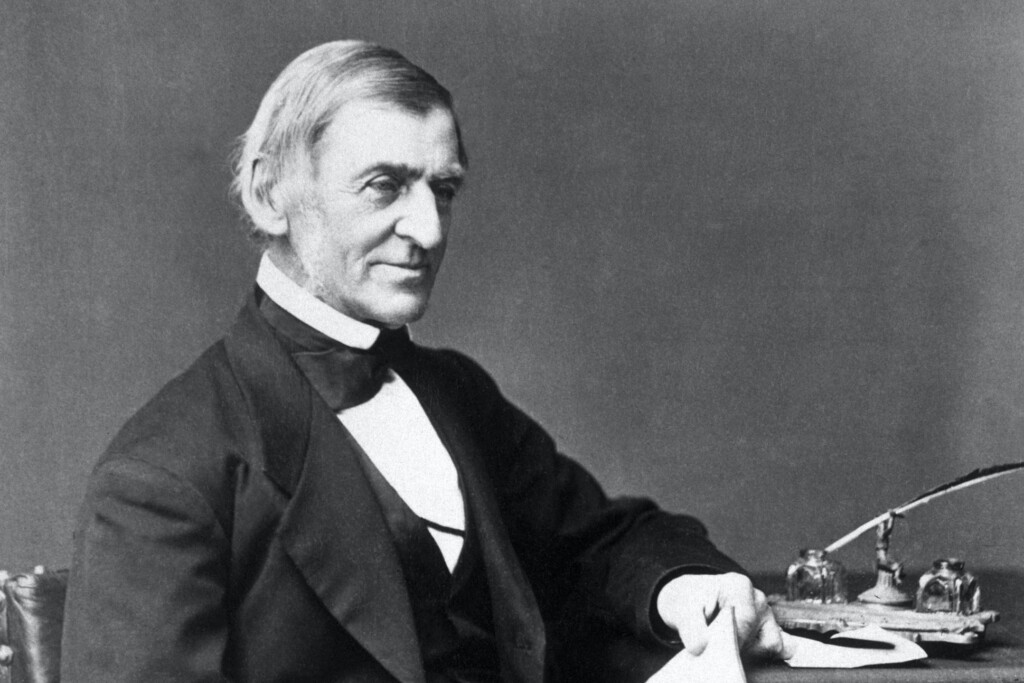
You are sitting in a parlor in Concord, Massachusetts, sometime around 1840, and the conversation has been going on for three hours. Someone is talking about the Over-Soul. Someone else is talking about the divine sufficiency of the individual. The windows are clean, the tea is warm, and outside, about thirty miles south, a man is being sold.
The Transcendentalist circle that formed around Emerson in the 1830s and 1840s was one of the most intellectually electric gatherings in American history, and it was also one of the most insulated. Emerson stood at its center not as a formal leader but as a gravitational force, the writer whose 1836 work Nature had given the movement its founding document, a treatise arguing that the natural world was a symbolic language through which the human spirit could read universal truth. Around him gathered figures of genuine brilliance: Henry David Thoreau, whose confrontational simplicity sharpened every idea Emerson ever softened; Margaret Fuller, whose 1843 essay in The Dial and subsequent 1845 book Woman in the Nineteenth Century pushed the group’s rhetoric of self-reliance into territory that made several of its male members visibly uncomfortable. The Dial itself, the movement’s journal founded in 1840 and co-edited by Fuller, was a remarkable artifact — idealistic, uncompromising, and read by almost nobody outside the circle’s own orbit.
What the circle produced philosophically was real. The insistence that the individual consciousness had direct access to moral and spiritual truth, without mediation by institution or doctrine, was a genuine rupture with the Calvinist inheritance that still haunted New England. Emerson’s essay “Self-Reliance,” published in 1841, told its readers that imitation was suicide, that conformity was a conspiracy against the vitality of the self. These were not empty words dressed up as philosophy. They were words that cost something to say in a culture still shaped by inherited hierarchy, denominational authority, and the social pressure to defer.
But the circle’s vision of the sovereign individual carried a hidden subsidy. Thoreau could spend two years at Walden Pond, from 1845 to 1847, conducting his experiment in deliberate living because he was not responsible for anyone else’s survival. Emerson could write about the infinitude of the private man because his household was staffed, his debts were manageable, and his whiteness rendered invisible to him the degree to which American individualism was a geographically and racially bounded promise. The transcendentalist idea of nature as a spiritual resource available to all who opened themselves to it quietly assumed that the person doing the opening had both the leisure and the safety to stand still in a field and feel something.
Frederick Douglass, who published his Narrative in 1845 — the same decade the circle was most active — described a relationship to nature that had nothing in common with the Concord model. For an enslaved person, the open landscape was not a site of spiritual encounter but a boundary, a place where capture or death waited beyond every tree line. The transcendentalists knew this. Emerson gave anti-slavery addresses. Fuller wrote with urgency about the connections between the oppression of women and the institution of slavery. Thoreau was arrested in 1846 for refusing to pay a poll tax in protest of the Mexican-American War and the expansion of slave territory. The political commitments were real and, in some cases, courageous.
Yet the philosophical architecture of the movement remained untouched by these commitments. The Over-Soul did not distinguish between bodies. The infinitude of the private man did not ask which bodies had been historically prevented from being private, from owning their own labor, from standing alone in a field and calling it solitude rather than exposure. The circle’s idealism was not cynical. It was simply built on a foundation it never excavated, using tools it never turned on itself, asking questions whose answers it had already arranged to find acceptable before it began.
Nature and the Violence of Pure Thought
You are standing at the edge of a forest at dawn, and something in you wants to call it sacred. The light comes through the trees in a way that feels addressed to you personally, as if the world has arranged itself for your contemplation. This is not an accident of mood. This is a trained reflex, and Ralph Waldo Emerson spent his most consequential year building the machinery that produces it.
In 1836, Emerson published Nature anonymously, a slim book that would become one of the founding documents of American intellectual life. Its central argument moves with the confidence of someone who has never had to worry about where the next meal comes from: the physical world is not ultimately real. It is a symbol. The tree, the stone, the river are a language spoken by a spiritual intelligence, and the properly awakened human mind — the transparent eyeball Emerson famously invokes, that strange figure of pure vision without a body — exists to receive and decode that language. Matter points beyond itself. The world is a text, and the scholar is its ideal reader.
There is genuine philosophical power in this. The tradition Emerson draws from is ancient and serious, running through Neoplatonism, through Emmanuel Swedenborg’s doctrine of correspondences, through Immanuel Kant’s insistence that the mind structures experience rather than merely receiving it. When Emerson argues in Nature that “every natural fact is a symbol of some spiritual fact,” he is not writing greeting-card mysticism. He is making a rigorous claim about the relationship between perception and meaning, one that anticipates the semiotics of the twentieth century and the phenomenology of writers like Maurice Merleau-Ponty, who would spend his career arguing precisely the opposite — that the body is not an obstacle to understanding the world but the very condition of knowing it at all.
But the violence of Emerson’s framework is not in what it says. It is in what it makes invisible. To treat the material world as symbolic, as a veil over spiritual truth, requires a very specific starting position: you must already be safe enough to look past the material. The symbolic forest is available to someone who is not cold. The spiritual meaning of water is accessible to someone who is not thirsty. Karl Marx, writing his Economic and Philosophic Manuscripts just eight years after Nature, diagnosed this exact structure — not in Emerson, but in the idealist tradition Emerson perfected in American idiom — as the philosophical gesture of a class that has already solved the material problem and can therefore pretend it does not exist. In 1836, the year Emerson published his transcendental vision, the United States economy ran in significant part on the labor of enslaved people whose relationship to the natural world was one of coerced extraction, not spiritual communion. The soil was not a symbol to someone forced to work it until their hands bled. The forest was not a cathedral to someone hunted through it.
This is not a sociological complaint imported from outside the text. It is a pressure the text generates internally and then refuses to address. Emerson’s Nature builds a philosophy of perception so elegant that poverty begins to look like a failure of vision rather than a condition imposed from outside. If the world is available to anyone willing to open their eyes with sufficient purity, then the person who cannot see its spiritual depths must be looking wrong. The structure produces blame without ever naming it. It is a metaphysics that aestheticizes the world for those who can afford aesthetics and quietly pathologizes everyone who cannot.
The transparent eyeball sees everything except the conditions that made it possible to stand still long enough to see.
Emerson and Slavery: The Long Delay
You are sitting in a lecture hall in 1838, listening to a man tell you that every soul contains its own divine authority, that no external institution can claim dominion over the self-reliant individual, that moral truth rises from within like a natural force. The man is compelling, luminous even, and you leave feeling enlarged. You do not yet notice that the man himself owns no slaves, is troubled by slavery in the abstract, and will spend the next decade and a half doing almost nothing about it in public.
Emerson’s first serious public statement against slavery came in 1844, in his address on the tenth anniversary of West Indian Emancipation — a full sixteen years after he began preaching the gospel of individual moral sovereignty in his early sermons, and six years after “Self-Reliance” had already made him the most celebrated intellectual voice in America. The timing is not incidental. It is the central fact. A philosophy that located moral authority entirely within the individual conscience proved, in practice, to be extraordinarily comfortable for a man who found political engagement distasteful, crowds vulgar, and collective action philosophically suspect. What looks like spiritual elevation has another name when measured against the calendar: insulation.
Ralph Waldo Emerson was not indifferent to the suffering of enslaved people in any simple psychological sense. His journals from the 1820s and 1830s register genuine revulsion at the institution. He called it a “deformity” and a “mischief” in private. But the philosophical architecture he was simultaneously constructing — one in which history is the slow unfolding of Spirit through the individual, in which material conditions are ultimately subordinate to consciousness — gave him a framework in which urgency itself could be deferred. If the Oversoul is moving inevitably toward freedom, the abolitionist’s frantic insistence begins to look like a failure of philosophical nerve rather than a moral imperative.
This was precisely what William Lloyd Garrison and Frederick Douglass found maddening about a certain class of Northern intellectuals in the 1840s. Douglass, who published his Narrative in 1845 and spent years watching Transcendentalist sympathy fail to become action, understood something that Emerson’s philosophy could not quite metabolize: that the man in chains does not have the luxury of waiting for history’s Spirit to catch up with his body. Garrison had founded The Liberator in 1831, fourteen years before Emerson would make slavery a consistent subject of public address. The gap between those two dates is not philosophical nuance — it is a measure of what idealism costs when someone else is paying the price.
The passage of the Fugitive Slave Act in 1850 finally cracked Emerson’s detachment in a way that no amount of private journal-writing had. The law required Northern citizens to participate actively in the capture and return of escaped enslaved people, and this — the demand that complicity become personal and physical — provoked Emerson into the furious public opposition that his philosophy of moral sovereignty had, in principle, always demanded of him. He called the Act “a filthy law” and said he would not obey it. It is worth sitting with what that moment reveals: a man whose entire intellectual system was built on the supremacy of individual conscience required an external legal compulsion to finally force conscience into the open.
After 1850, Emerson’s anti-slavery speeches became genuine, passionate, and historically significant — he praised John Brown with a force that shocked even sympathetic audiences, calling him a man who would “make the gallows glorious like the cross.” But the late intensity cannot undo the earlier chronology. What the long delay exposes is the silent agreement inside any philosophy that centers growth, consciousness, and self-cultivation: that the self being cultivated is already free enough to take its time.
A vision curated by a filmmaker, not an algorithm
In this video I explain our vision
The American Scholar and the Manufacturing of Genius

You are handed a diploma and told you are now capable of thought. The ceremony has weight, the Latin phrases land with gravity, and somewhere in the ritualized applause you absorb the message underneath the message: that thinking, real thinking, belongs to those who have passed through the correct doors. Ralph Waldo Emerson stood before the Phi Beta Kappa Society at Harvard in August 1837 and delivered what Oliver Wendell Holmes would later call America’s intellectual Declaration of Independence. The address burned with genuine fury against imitation, against the scholar who merely hoards the ideas of Europeans and calls it learning. Emerson wanted the American mind to stand upright, to trust itself, to become what he called Man Thinking rather than a mere bookworm. The oration crackled. The room felt it. And yet the architecture of that liberation contained walls that almost no one named.
The brilliant sleight of hand in “The American Scholar” is that it universalizes a particular. Emerson speaks of Man Thinking as though this category inhales the whole human species, as though the barriers between a Harvard-educated Brahmin and a woman sewing in a Lynn shoe factory or an enslaved man breaking Georgia soil were simply matters of will and awakening. He argues that the scholar must draw from nature, from books used critically, and from action — three sources democratically available, in theory, to every soul. But theory was doing enormous labor that reality refused to perform. In 1837, women were systematically barred from higher education in the United States; Oberlin had only just begun admitting them three years earlier, and even there the curriculum bent toward domestic virtue. The Harvard audience Emerson addressed was not incidentally male — it was constitutively, structurally, legally male, and his rhetoric of universal genius could not dissolve that fact by refusing to acknowledge it.
What makes this more than a simple historical oversight is what it reveals about how liberation rhetoric functions. The philosopher Charles Mills, in The Racial Contract published in 1997, demonstrated that Enlightenment universalism routinely wrote contracts that defined the fully human agent as implicitly white, implicitly male, implicitly propertied, while deploying the grammar of universality as cover. Emerson’s “Man Thinking” performs exactly this operation. The very force of the phrase — its refusal of the passive, its muscular self-reliance — presupposes a body that society already permits to be active, a mind that institutions have already agreed to recognize as a mind. Self-reliance is a different proposition when the self in question has been legally classified as property.
There were approximately 2.5 million enslaved people in the United States the summer Emerson gave that address. Frederick Douglass, then nineteen years old, was still enslaved in Maryland, teaching himself to read through strategies that required extraordinary courage and secrecy, not because original thought was beyond him but because the law made literacy itself an act of resistance. His 1845 Narrative would become one of the most original intellectual documents of the century — a work that thought from the body, from brutality, from the specific weight of chains — and it did not require Harvard, Phi Beta Kappa, or Emerson’s permission to constitute genius. Which raises the question the 1837 address never asks: if original thinking can emerge from conditions of violent deprivation, then what exactly was the address liberating scholars from, and for whom was that particular liberation designed?
The danger is not that Emerson was hypocritical in the small, personal sense. The danger is that the speech was structurally sincere — he genuinely believed in the emancipatory power he was describing — and that this sincerity is precisely what made the exclusion invisible. A cynical manifesto announces its limits. A sincere one buries them inside its own conviction, and the burial is deep enough that generations of readers have quoted the call to original thinking without noticing who was never invited to answer it.
The Representative Men and the Myth of the Exceptional Individual
You have been told, at some point in your education, that certain lives matter more to history than others. Not as a cruel fact, but as an obvious one — self-evident, like gravity. The teacher doesn’t announce it. The curriculum enacts it. Six names, twelve dates, and the implicit lesson that the arc of human events bends toward individuals of unusual force.
In 1850, Ralph Waldo Emerson published Representative Men, a collection of lectures in which he profiled six figures — Plato, Swedenborg, Montaigne, Shakespeare, Napoleon, Goethe — as vessels through whom universal forces expressed themselves. The argument was not precisely that these men were superior. Emerson was more elegant than that. His claim was that they were representative: that each distilled something latent in all humanity, that the great man is great only because he reads what is already written in the rest of us. “To be great is to be misunderstood,” he had written years earlier, and in Representative Men he extended the logic — greatness is a kind of fluency in the common language of the species. The book was widely admired. Seven editions appeared in the first decade alone.
But the architecture of the argument does something the argument itself never announces. By organizing history around six extraordinary individuals, Emerson does not merely celebrate genius — he produces a model of causation. Events have authors. Progress has faces. The reorganization of human consciousness in any given century is legible through a single biography, a single set of choices, a single exceptional nervous system. Thomas Carlyle, Emerson’s transatlantic correspondent and intellectual sparring partner, had made this explicit in On Heroes, Hero-Worship, and the Heroic in History in 1841, arguing that “the history of the world is but the biography of great men.” Emerson softened the aristocratic edge of this claim, but he did not dismantle it. He democratized the aspiration while preserving the structure.
What vanishes in that structure is the texture of collective life — the grain of it, the friction and negotiation and anonymous labor through which any idea actually moves through a society. Shakespeare did not write alone into silence; he wrote for paying audiences in a specific commercial theater economy, surrounded by rival playwrights, dependent on acting companies, shaped by censorship regimes and plague closures. The Globe Theatre burned down in 1613 during a performance of Henry VIII. None of that appears in Emerson’s portrait. What appears is the mind — solitary, luminous, inexplicably large. The material conditions that made the mind possible are dissolved into atmosphere.
By 1850, this was not a neutral philosophical position. It was a politically loaded one. The abolitionist movement was at a critical juncture — the Fugitive Slave Act was passed the same year Representative Men was published, requiring citizens of free states to participate in the capture of escaped enslaved people. Frederick Douglass was rewriting his autobiography. Harriet Tubman had already led her first group north. The transformation of American society being fought for and bled for by hundreds of thousands of people was happening through collective action, through networks of ordinary individuals who would never be profiled in any lecture series. The great-man framework did not just fail to capture this. It actively obscured it, by training the reader’s eye toward the singular and the exceptional, away from the structural and the shared.
There is a particular seduction in Emerson’s version of this framework, because it flatters the reader. If great men are representative — if Napoleon’s will is your will writ large, if Plato’s questions are your questions clarified — then reading about them is a form of self-recognition. The book becomes a mirror. And in that mirror, the reader sees themselves as a potential vessel for universal forces, rather than as someone embedded in conditions they did not choose and cannot simply transcend by thinking harder about their own nature.
The Afterlife of Emerson: Who Claims Him and Why
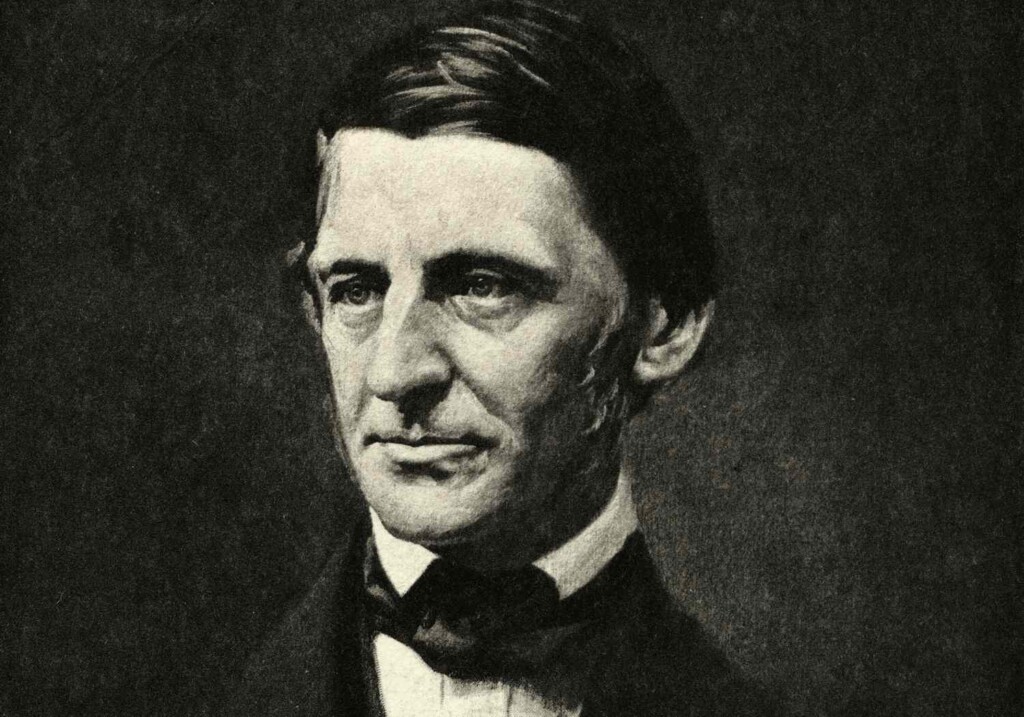
You already know the version of Emerson you inherited. It came to you through a motivational poster, a commencement speech, a business book with a minimalist cover, or perhaps a life coach who quoted “Self-Reliance” the way a priest quotes scripture — with the confidence of someone who has never questioned the source. That Emerson, the one who tells you to trust yourself absolutely, to shed the dead weight of other people’s expectations, to become the sovereign author of your own fate, is one of the most successful ideological constructions in American cultural history. It is not a misreading of Emerson. It is a selective reading, which is far more dangerous.
The libertarian appropriation of Emerson did not happen by accident. It followed the internal logic of a philosophy that, by design, placed the individual conscience above every external institution. When Emerson wrote in 1841 that “society everywhere is in conspiracy against the manhood of every one of its members,” he was diagnosing a spiritual suffocation he had lived through in the Unitarian pulpit. But the sentence survives its context beautifully, and it reads, stripped bare, as a near-perfect justification for dismantling any collective claim on individual behavior. The American right discovered this in the twentieth century with the enthusiasm of someone finding a loaded weapon in a drawer. Ayn Rand, who despised Emerson’s mysticism but borrowed his architecture, built her entire ethic of rational self-interest on the same foundational suspicion of the social. The lineage is not coincidental.
What the self-help industry did was subtler, and in some ways more total. It took Emerson’s insistence on inner transformation and converted it into a product cycle. By the time Napoleon Hill published Think and Grow Rich in 1937, the transcendentalist intuition that the mind shapes reality had been laundered into a prosperity theology with no remainder. The collective dimension of Emerson’s project — his abolitionism, his grief, his terror at his own inconsistency — was quietly retired. What remained was the engine without the friction, a philosophy of becoming that asked nothing of you except that you believe in yourself harder. Self-help as an industry in the United States now generates over eleven billion dollars annually, and its foundational grammar is Emersonian — not Emerson’s actual grammar, with its contradictions and its darkness, but a smoothed version that functions as an analgesic rather than an irritant.
The nationalist inflection is perhaps the most revealing. Emerson spent much of his later career, particularly in English Traits published in 1856, theorizing Anglo-Saxon cultural superiority in ways that sit uncomfortably beside his earlier universalism. He believed, at least periodically, that certain peoples were constitutionally more capable of self-reliance than others. Theodore Roosevelt read Emerson closely. The strenuous life, the cult of individual vitality, the suspicion of softness — these were all transmissions, however distorted, from Concord. When a philosophy of radical inwardness gets combined with a theory of national character, what emerges is not liberation but a hierarchy dressed in the language of freedom.
What all three of these inheritances share is a single operation: the extraction of the self from any web of mutual obligation. Emerson’s philosophy, taken at its most seductive, offers the individual an exit from solidarity. It does not require cruelty. It simply requires you to believe that your development is the primary moral project of your life, that the claims of others on your attention and resources are, at best, secondary. A philosophy built in genuine anguish, by a man who had watched his son die and his first wife dissolve into tuberculosis at eighteen, by a man who sat with the most radical abolitionists of his century and still could not fully resolve what he owed the world — that philosophy became the spiritual vocabulary of a culture that would rather optimize than grieve, rather ascend than remain accountable to the people standing beside it.
🌿 Voices of Nature, Self, and American Soul
Ralph Waldo Emerson’s thought did not emerge in isolation — it grew from a rich landscape of philosophical inquiry, literary courage, and a deep relationship with nature and the self. These articles explore the ideas and figures most intimately connected to Emerson’s vision of the individual, the wild, and the transcendent.
American Transcendentalism: History and Thought
American Transcendentalism is the philosophical and literary movement that Emerson himself helped to found and define. This article traces the history of that current of thought, exploring how figures like Emerson, Thoreau, and Margaret Fuller reimagined the relationship between the individual, nature, and the divine. Understanding Transcendentalism is essential to grasping the full scope of Emerson’s intellectual ambition.
GO TO THE SELECTION: American Transcendentalism: History and Thought
Henry David Thoreau: Life and Works
Henry David Thoreau was Emerson’s most celebrated disciple and, in many ways, his most radical interpreter. This article traces Thoreau’s life and works, showing how he transformed Emerson’s philosophical idealism into lived practice — in the woods, in civil resistance, and on the page. The friendship and intellectual tension between the two men remains one of the most fertile relationships in American literary history.
GO TO THE SELECTION: Henry David Thoreau: Life and Works
Thoreau’s Walden: Meaning and Analysis
Walden is the text in which Thoreau most directly enacts Emersonian principles, turning a two-year retreat into the woods into a philosophical manifesto on simplicity, self-reliance, and the examined life. This analysis unpacks the layers of meaning in Thoreau’s famous experiment, from its ecological vision to its spiritual undertones. Reading Walden alongside Emerson reveals how a great idea can transform into a great life.
GO TO THE SELECTION: Thoreau’s Walden: Meaning and Analysis
Shelley and the Defence of Poetry: Poets as Legislators
Percy Bysshe Shelley’s Defence of Poetry articulates a vision of the poet as moral and spiritual legislator of humanity — a claim that deeply resonates with Emerson’s own conception of the poet as seer and representative man. This article examines Shelley’s passionate argument for the social and metaphysical power of verse. Together, Shelley and Emerson form a transatlantic chorus insisting on the redemptive power of creative thought.
GO TO THE SELECTION: Shelley and the Defence of Poetry: Poets as Legislators
Discover Cinema That Thinks for Itself
If these ideas about individual freedom, nature, and the power of vision inspire you, Indiecinema offers a curated streaming experience of independent films that carry the same spirit of inquiry and authenticity. Explore our catalog and find the cinema that dares to ask the questions that matter.
👉 EXPLORE THE CATALOG: Watch Indie Films in Streaming
A vision curated by a filmmaker, not an algorithm
In this video I explain our vision

