
The Man in the Room
You pick up the book because someone left it on a table, or because the cover was ugly in an interesting way, or because a person you half-trusted told you it would bother you. Within three pages you have stopped underlining because you would have to underline everything. The prose is flat, almost deliberately graceless, and yet it finds you with a precision that feels invasive. It is not describing a character. It is describing the specific texture of your own disappointment — the kind you have never spoken aloud because you suspected it made you defective. You put the book down. You pick it up again. This is already a different relationship than the one you have with literature you admire.

What you are reading is not constructed to seduce you. There is no beautiful sentence designed to make you feel that the author is sensitive and therefore you are sensitive for reading him. The style refuses ornamentation the way a man refusing to dress for a dinner party refuses it — not out of carelessness but out of a precise and considered contempt for the performance the dinner party requires. The narrator observes the world the way a coroner observes a body: with full attention, without tenderness, and without the pretense that what he is finding is a surprise. The market has organized desire. Desire has been made into a competition. Most people are losing. The prose does not mourn this. It simply refuses to look away.
Michel Houellebecq was born in 1956 on the island of Réunion, though the biographical detail that shaped him more decisively was being left, as a young child, by both parents — abandoned first by his mother, then essentially by his father, and raised by a paternal grandmother whose Communist convictions and emotional severity appear throughout his fiction as a kind of original wound that never closed. He has spoken about this abandonment with a flatness that mirrors his prose, which is itself the tell: the affect has not been processed into meaning, it has been converted directly into a literary method. Extension du domaine de la lutte, published in 1994 and later translated into English as Whatever, announced the arrival of something that French literary culture did not entirely know how to receive — a novel that applied the logic of economic liberalism directly to sexual and emotional life, arguing that the same forces producing winners and losers in the marketplace were producing winners and losers in the domain of human intimacy, and that the two hierarchies were not analogous but identical.
This was not a metaphor. Houellebecq meant it structurally, and the violence of the claim came precisely from its refusal to be poetic. He was not lamenting a culture that had become too commercial. He was identifying a mechanism — the extension of competitive individualism into every domain of human experience — and showing what that mechanism actually produced in the bodies and psyches of ordinary people who had been told they were free. The narrator of that first novel is not a rebel. He is not suffering from false consciousness. He understands perfectly well what is happening to him and finds the understanding useless.
The writer who emerges from that book is one who has made a career of being precisely wrong in the way that embarrasses people who are technically right. His predictions — about Islam in Europe, about reproductive technology, about the spiritual vacancy of liberal democratic consensus — have a habit of arriving before the conversation is ready for them, which is not the same thing as being prophetic. It may simply mean that he is willing to follow an argument to conclusions that more careful thinkers stop short of, not because the conclusions are illogical but because logic, pursued far enough, becomes socially unacceptable. That is the room he has chosen to live in.
Crazy World
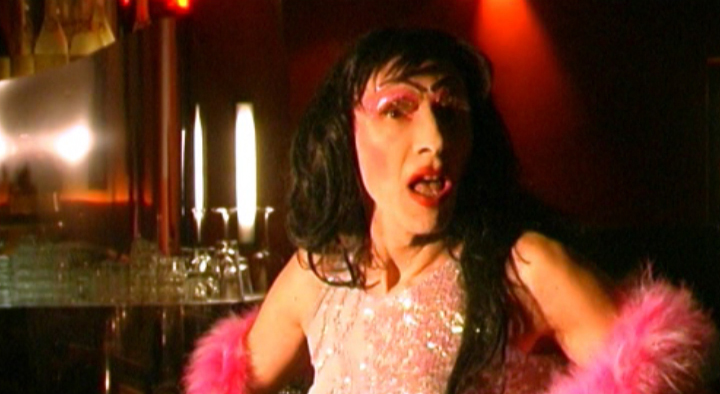
Drama, thriller, by Fabio Del Greco, Italy, 2010.
Luca is poor and works, precariously, as a waiter. He lives a problematic relationship with his girlfriend, and his life is full of doubts. One day Luca meets Chiara, a friend who had studied philosophy with him at university. She has realized her dream of opening a night and is now well-off. Luca leaves everything behind and starts a relationship with Chiara. He manages the nightclub with her and, thanks to the cocaine and call girls sold to politicians, he gets out of his hard economic situation. But Chiara does not manage to obtain the contract for an old furnace, so she blackmails Saverio, a member of the Parliament. Chiara owns a video in which Saverio has sexual intercourse with a transsexual.
LANGUAGE: Italian
SUBTITLES: English, French, Spanish, German, Dutch, Portuguese.
A Childhood Made of Absence
You are six years old and the woman who gave birth to you has already decided you are not part of her plan. There is no dramatic scene, no suitcase packed in tears, no farewell that at least grants the child the dignity of being seen leaving. There is simply a subtraction — a presence that becomes an absence so gradually and then so completely that the architecture of the self forms around the missing wall, building its load-bearing structures precisely where there should have been a door.
Michel Thomas was born on February 26, 1956, in Réunion, a French overseas island in the Indian Ocean — a detail that already places him outside the metropolitan center of the culture he would spend his life dissecting. His mother, Lucie Ceccaldi, a woman who would later write a furious memoir attempting to reclaim the narrative, handed him over first to his paternal grandmother, then eventually to Henriette Houellebecq, a communist and a woman of firm convictions, whose surname the writer would eventually adopt as his own. This act of naming is not incidental. To take the name of the grandmother rather than the mother is to perform, in language itself, the replacement of biological origin with the origin that actually held you. It is a rewriting of genealogy that the novelist would spend forty years enacting in fiction.
What gets formed in those early years of transferred custody is not simply a wound but a cognitive structure. The British psychoanalyst John Bowlby, whose attachment theory emerged through the 1960s and 1970s in works like Attachment and Loss, demonstrated that early relational discontinuity does not merely leave a child sad — it rewires the child’s fundamental model of what other people are. When the primary attachment figure is absent or unreliable, the developing mind begins to treat closeness itself as a precursor to loss. The person most dangerous to love is the one nearest to you. This is not a poetic insight. It is a neurological reorientation that shapes every subsequent intimate encounter.
The literary universe Houellebecq would construct decades later is precisely this reorientation made into a world. His characters do not fail at love because they are weak or neurotic in the conventional sense. They fail because they have correctly identified, at some pre-verbal level, that love is a system designed to generate maximum exposure to the one experience they cannot survive: abandonment. Extension du domaine de la lutte, published in 1994, introduced a narrator so sealed behind irony and withdrawal that the reader initially mistakes his detachment for superiority. It is not superiority. It is a man who learned very early that the cost of wanting something from another person is the certainty that they will eventually stop providing it.
The communist grandmother is worth pausing on, not for ideological reasons but for what the household represented structurally. A home defined by collective ideology and political conviction is a home where the child’s interior life is always subordinated to a larger framework of meaning that exists entirely outside him. The child does not matter as a singular, irreducible subject — he matters as a member of something. This is, in its way, another form of invisibility. Not abandonment through departure, but abandonment through absorption into the abstract. The self that develops under such conditions learns to locate meaning in systems, in historical forces, in sociological mechanisms — anything large enough to explain the smallness of the individual without requiring that the individual be seen.
This is why Houellebecq became a writer who thinks in demographics and surveys and statistical averages rather than in the interiority of unique persons. Les Particules élémentaires, published in 1998, frames human desire and suffering through the lens of molecular biology and population genetics. The move is not intellectual posturing. It is the genuine cognitive inheritance of a child for whom the personal was never allowed to be simply personal — for whom meaning always arrived wrapped in a framework too large to refuse and too cold to hold.

The Positivist Inheritance

You are sitting in a lecture hall in Paris, sometime in the early 1980s, and the professor is explaining soil composition, nitrogen cycles, the irreversible chemistry of organic decay. The young man taking notes is not yet a novelist. He is learning, with some precision, that living systems obey laws — that what appears as vitality is in fact a set of measurable transactions between organisms and their environment, and that collapse follows the same logic as growth, only in the opposite direction. This is not a metaphor he is being handed. It is a methodology.
Houellebecq studied agronomy at the Institut National Agronomique Paris-Grignon, graduating in 1978, and later attended IDHEC, the Institut des Hautes Études Cinématographiques. The combination is stranger than it appears. Agronomy teaches you that the earth does not care about your intentions — it responds to conditions. Cinema, particularly the tradition IDHEC was embedded in, teaches you that meaning is manufactured through framing, sequencing, the deliberate exclusion of what the eye might otherwise rest on. Between these two disciplines, a writer acquires something genuinely dangerous: the ability to describe human behavior as a field phenomenon while simultaneously understanding how the description itself is constructed. Most novelists never learn either lesson.
Auguste Comte, who coined the word “sociology” and spent the better part of the 1840s systematizing human knowledge into a hierarchy that culminated in the science of society, believed that the same positivist methods applied to celestial mechanics could eventually be applied to love, politics, and collective delusion. His Cours de philosophie positive, published between 1830 and 1842, was scandalous not because it was wrong but because it was relentlessly consistent — it refused to grant human experience any exemption from the laws it sought to describe. What Houellebecq absorbed from this tradition, filtered through an agronomist’s training rather than a philosopher’s library, was not Comte’s optimism about progress but his refusal of exemption. In Houellebecq’s fiction, desire is not elevated; it is measured. Loneliness is not lamented; it is mapped, with something close to clinical indifference, as a structural condition produced by specific historical and economic arrangements.
H.P. Lovecraft, whom Houellebecq studied with enough seriousness to publish a critical essay on him in 1991, offered something complementary and far colder. Lovecraft’s cosmicism — the sustained literary position that the universe is indifferent to human suffering not as a philosophical stance but as an ontological fact — gave Houellebecq a narrative permission that realism alone could not provide. The Lovecraftian universe does not punish its characters for moral failure; it ignores them entirely. This is a different kind of cruelty than tragedy offers, and Houellebecq recognized in it a tool for describing late-modern life more accurately than any social realism could manage, because what defines late-modern loneliness is precisely the absence of the meaningful opposition — the universe is not hostile, it is simply not interested.
The result is a literary method that strips characters of the romantic exemptions most fiction quietly extends to them — the assumption that suffering confers depth, that desire signals aliveness, that loneliness is somehow evidence of a richer inner life incompatible with the surrounding world. In Houellebecq’s hands, a man in his forties who cannot form a connection with another person is not a tragic hero misunderstood by his era. He is a data point in a distribution. The prose does not console him, and it does not console the reader watching him. It simply continues recording, with the patience of a laboratory instrument that has no stake in the outcome of the experiment it is measuring — and that patience, that absolute refusal to look away or to soften the notation, is not cruelty. It is the most honest inheritance a writer trained to read soil chemistry could possibly bring to the novel form.
Extension du domaine de la lutte and the Thermodynamics of Desire
You are standing in a company break room sometime in the mid-1990s, fluorescent light humming overhead, a man in his late thirties eating a sandwich alone while his colleagues laugh at something behind him. He is not ugly, not cruel, not broken in any legible way. He has simply lost the ability to generate desire in others, and he knows it with the same flat certainty with which he knows his electricity bill is overdue. This is not a scene of suffering. It is something colder — a man who has understood the mathematics of his own erasure.
The novel that contains this kind of figure, published in France in 1994, arrives not as a provocation but as a diagnostic report. Houellebecq’s narrator in Extension du domaine de la lutte is a software consultant, unnamed, functional, adrift. What the novel proposes, with the calm of someone reading a spreadsheet, is that the deregulation of affective life follows the same logic as the deregulation of any other market. Where capital concentrates, scarcity deepens elsewhere. Sexual freedom, extracted from its older structures of obligation and ritual, does not distribute itself evenly. It pools. The attractive, the confident, the culturally legible accumulate partners and possibility. The rest experience a slow withdrawal of access that no political language of the 1990s had yet been designed to describe.
This was not metaphor. The sociologist Jean-Claude Kaufmann, working through the 1990s on the phenomenology of the single person in France, documented precisely this stratification — the way bodily capital, like financial capital, compounds or depletes across time, and how social atomization intensifies rather than equalizes its distribution. Kaufmann’s 1999 work La femme seule et le prince charmant mapped the emotional economy of individuals navigating a dating landscape newly freed from communal mediation, finding not liberation but a brutal new meritocracy of attractiveness and social fluency. Houellebecq was writing from inside that same landscape five years earlier, without the sociologist’s professional distance, and with considerably more hatred for what he found there.
What Michel Maffesoli had been theorizing since the late 1980s in works like Le Temps des tribus offers a parallel and unsettling context. Maffesoli argued that modernity’s promise of sovereign individualism had fractured into something else entirely — not liberated subjects but anxious tribal clusters, people performing identity through consumption, aesthetic affiliation, and the micro-rituals of belonging. The individual of liberal ideology was, in practice, perpetually auditioning for temporary collectives. Houellebecq’s narrator cannot pass this audition. He lacks the vocabulary, the body, the ironic flexibility that tribal membership now requires. He is not an outsider in the romantic sense — he has not refused the system. He has simply been refused by it.
What makes the novel philosophically rupturing rather than merely depressing is its refusal to locate the cause in personal psychology. The narrator is not depressed because of childhood wounds or chemical imbalance, though these are present. He is depressed because the organizational logic of his society has produced him as a necessary byproduct — as excess. Capitalism requires losers not as a flaw but as a structural feature. Extend that same competitive logic to intimacy, and the losers of desire become just as inevitable, just as invisible, just as easy to dismiss as the economically discarded. The novel’s title, borrowed from a Marxist vocabulary of class struggle, is not ironic. It is precise. The domain of the struggle has been extended. The battlefield is now the body.
By 1994 the internet had not yet reshaped dating; Tinder would not exist for another nineteen years. What Houellebecq was describing had not yet fully arrived in its technological form. He was reading a tendency, a direction, a thermodynamic law — that desire, like heat, moves from concentration to dispersal only when something forces it to, and that in the absence of such force, it simply
Les Particules élémentaires and the End of the Human Subject
You are standing in a bookshop in Paris in September 1998, and the novel you are holding has already caused a minor scandal before you have opened it. The back cover tells you almost nothing useful. The title gestures at physics, at reduction, at the annihilation of complexity into something far colder and more fundamental. You open it anyway, and within three pages you understand that whatever you expected from a French literary novel — the interiority, the ambivalence, the carefully hedged moral intelligence — is not coming. Something else is here instead, something that does not flinch and does not apologize and, more disturbingly, does not seem to need your sympathy to survive.
The two half-brothers at the center of the novel are not characters in any conventional sense. They are positions. Michel, the molecular biologist, has evacuated himself of desire so completely that he exists as a kind of pure cognitive instrument, moving through the world without friction because he has removed everything that generates friction. Bruno, the literature teacher, has done the opposite: he has pursued desire so relentlessly, so desperately, across degrading encounters in sexual liberation camps modeled on the real Antennae communities that flourished in France during the 1980s and 1990s, that desire has consumed him entirely. Neither man arrives anywhere. Michel’s asceticism does not produce wisdom or peace; it produces a scientific breakthrough that renders the human species obsolete. Bruno’s hedonism does not produce pleasure or connection; it produces a psychiatric ward. The novel’s geometry is pitiless: these are not two paths through modernity but two versions of the same dead end, dressed differently.
What Peter Sloterdijk diagnosed in his 1983 Kritik der zynischen Vernunft is exactly the trap this novel springs on its reader. Sloterdijk argued that modern cynicism is not ignorance but enlightened false consciousness — the subject knows perfectly well that the ideological game is rigged and plays it anyway, because no alternative presents itself. The novel operates on precisely this structure. It does not expose the failures of sexual liberation or scientific rationalism from some superior vantage point. It performs those failures from inside, using a narrative voice so flat and so apparently convinced of its own diagnosis that you cannot locate the irony you keep reaching for. When the prose describes mass tourism, pharmaceutical depression, the commodification of bodies, it does so with the affectless precision of a geological survey. You look for the gap between the narrator and the text, the space where critique lives, and it is not there. Or if it is there, it is so narrow as to be functionally absent.
This is what made the novel genuinely dangerous, not its explicit sexuality or its contempt for 1968 and its aftermath, but its refusal to provide the reader with a stable epistemological floor. Every previous novel about disillusionment — and French literature is saturated with them, from Flaubert’s Sentimental Education in 1869 onward — preserved somewhere a register of value against which the disillusionment could be measured. The lost ideal still glowed faintly behind the wreckage, which is what made the wreckage legible as wreckage. Here the ideal has been not merely lost but surgically removed, and the surgery itself is presented as a form of honesty. The novel ends with a posthuman future in which the biological human has been superseded by a cloned species incapable of suffering, and this future is described without horror, without mourning, with something closer to relief.
The question the novel leaves open — and has never stopped leaving open — is whether that relief is the author’s, the narrator’s, or yours, because by the final pages the distinction has become harder to maintain than you would like it to be.
A vision curated by a filmmaker, not an algorithm
In this video I explain our vision
Islam, Submission, and the Trap of the Provocateur

You are standing in a Paris bookshop on January 7, 2015, holding a copy of a novel that has just appeared that morning, its cover clean and provocative in the way only French literary fiction allows itself to be. By afternoon, the city is no longer the same city. Twelve people are dead at a satirical magazine two arrondissements away, and the book in your hands has suddenly been transformed, by the alchemy of catastrophe, into something its author never wrote.
Soumission appeared on the same day as the Charlie Hebdo massacre, and that coincidence destroyed any chance of reading it honestly for at least a decade. The political right claimed it as prophecy. The liberal left condemned it as incitement. Both readings required the same foundational error: mistaking a novel about exhausted men for a novel about dangerous religions. Houellebecq had written a portrait of François, a middle-aged academic specialist in Joris-Karl Huysmans, a man so hollowed out by comfort and meaninglessness that he converts to Islam not out of faith or fear but out of sheer fatigue with having to keep choosing. The Islam in the book is almost incidental to this diagnosis. What Houellebecq was describing was the willingness to surrender the burden of selfhood to any structure large enough to receive it.
Alexis de Tocqueville, writing in Democracy in America in 1840, identified what he called soft despotism — a form of power that does not break men but rather infantilizes them, covering their lives with a network of small and complicated rules, keeping them in perpetual childhood, until they resemble nothing so much as timid and industrious animals. Tocqueville was not describing authoritarianism in the classical sense. He was describing the democratic citizen’s own desire to be managed, the quiet abdication that masquerades as contentment. François in Soumission does not submit to Islam because Islam conquers him. He submits because submission is the only posture that still makes sense to a man who has already surrendered everything else — erotic vitality, intellectual conviction, civic belonging — to the soft machinery of late institutional life.
The accusation of Islamophobia collapses under the weight of the novel’s actual mechanics. The Muslim Brotherhood government in the book is not violent, not repressive in any recognizable totalitarian register. It is competent, paternalistic, well-administered. It offers the universities generous funding, the men plural wives, the intellectuals prestige and purpose. The horror Houellebecq stages is not the horror of oppression. It is the horror of relief. François feels relief. That detail alone should have made readers uncomfortable in a way that has nothing to do with Islam, and everything to do with recognizing the specific sensation of giving up.
What both the book’s attackers and its defenders missed was that the university itself, that supposedly secular fortress of Enlightenment values, capitulates before any external pressure is applied. The faculty accommodate, rationalize, and retire gracefully. The institution demonstrates not resistance but the elegant efficiency of a body that has been, for years, practicing the gestures of meaning without the substance. Houellebecq had spent his entire career cataloguing this kind of hollow performance — the performance of desire, of political conviction, of aesthetic engagement — and Soumission was simply the logical endpoint of that catalogue, the moment when the performance finally encounters a structure willing to make it real in exchange for compliance.
To read the novel as a warning about Islam is to be precisely the kind of reader Houellebecq has always written against: the reader who identifies the symptom as the disease, who looks at the water rising and blames the rain rather than the decade of decisions that left every door unlocked, every wall unmaintained, every person inside quietly grateful that someone had finally come to decide things for them.
The Sérotonine Threshold and Late Capitalism’s Nervous System
You take a pill every morning before you are fully awake, before the day has made any demand of you, and for a few hours the world seems manageable — not good, not meaningful, but manageable. This is not a metaphor yet. This is Florent-Claude Labrouste, the protagonist of Sérotonine, published in January 2019 to a France already trembling with the first convulsions of the gilets jaunes protests. He takes Captorix, a fictional SSRI, which eliminates his libido entirely and gradually dissolves his capacity for genuine emotional response. He does not suffer dramatically. He simply recedes, like a tide that stops returning.
What Houellebecq understood, and what the novel performs rather than argues, is that the pharmaceutical management of misery is not a solution to civilizational decline but its most precise symptom. The pill does not cure the wound; it lowers the body’s ability to register that the wound exists. Florent-Claude is not broken in any singular way — he is the aggregate product of a society that has systematically dismantled every structure that once gave ordinary life its density: agricultural community, romantic fidelity, regional identity, inherited work. The France he moves through is not dystopian in any science-fictional sense. It is recognizable, contemporary, and exhausted in exactly the way that the people reading the novel are exhausted — which is what made critics so uncomfortable.
Mark Fisher, in Capitalist Realism published a decade earlier in 2009, described the peculiar psychic condition of late capitalism as one in which it is easier to imagine the end of the world than the end of the current economic arrangement. What Fisher identified as the cultural dominant — a kind of depressive realism, a foreclosure of future-oriented desire — Houellebecq renders in biological terms. Florent-Claude’s serotonin deficiency is not incidental to the novel’s agrarian subplot; it is structurally identical to it. The Norman farmers he encounters, crushed by European agricultural policy, global price competition, and the slow abandonment of everything that made smallholder farming viable, are not radicalized ideologues. They are men who cannot see a future and have stopped trying to imagine one. The gilets jaunes appear at the edges of the novel like weather — not as a political program but as the sound a society makes when managed decline becomes unmanageable.
This is precisely where accusing Houellebecq of nihilism misses what the novel is actually doing. Nihilism is indifferent to loss; it regards nothing as having been worth keeping. But Sérotonine is saturated with grief, and grief requires an object. Florent-Claude mourns Camille, a woman he loved and destroyed through his own cowardice and appetite, and the mourning is unbearable not because she was perfect but because she represented something that was genuinely possible — a life organized around continuity, care, and presence — and he chose against it freely, repeatedly, without adequate reason. That specific structure of mourning, a loss that was avoidable and therefore inexcusable, is more politically corrosive than despair, because despair asks nothing of you while mourning implies that different choices existed.
The novel’s agrarian dimension presses this further into history. French agricultural policy since the 1960s, accelerated through successive waves of European market integration, systematically replaced diversified smallholding with industrial monoculture and then abandoned even that when global commodity prices made it uncompetitive. By 2019, the average age of a French farmer was fifty-two, suicide rates in rural communities had climbed to among the highest of any professional demographic in the country, and the landscape Houellebecq describes — beautiful, depopulated, economically incoherent — was not invented for literary effect. It was simply observed. The pill Florent-Claude swallows each morning is the same pill the state offers to the rural communities it has rendered surplus to requirements: not recovery, not transformation, but the chemical suppression of the knowledge that something has been lost and that someone chose to lose it.
The Aesthetics of Ugliness as Moral Stance
You are reading a sentence that refuses to save you. No image lifts it, no rhythm carries it forward, no metaphor arrives to make the contact bearable. The prose simply states what happened and moves on. This is not accident or incompetence — it is a decision with philosophical weight behind it, a choice made with full awareness of what literature usually does and a deliberate refusal to do it.
Roland Barthes, in Writing Degree Zero published in 1953, identified what he called “white writing” — a mode of expression that strips away the ornamental function of style, that refuses to let form become a form of comfort. Barthes saw in Camus’s L’Étranger an early symptom of this: prose that does not modulate, does not swell, does not reward the reader with the minor satisfactions of beautiful language. His argument was that every stylistic flourish carries an implicit ideology, a way of making the world feel managed and survivable. To write beautifully is, in some sense, to lie — to suggest that existence has the texture of art, that suffering resolves like a chord.
Houellebecq understood this viscerally before he could theorize it. His 1992 poetry collection La Poursuite du bonheur — “The Pursuit of Happiness” — reads nothing like the title promises. The lines are short, affectless, stripped of the music one expects from verse. They describe desire and loneliness with the clinical neutrality of a patient’s file, and the effect is not numbness but something closer to nausea, a recognition that the distance between what we feel and what language usually does with feeling is precisely where the wound lives. The poems do not celebrate longing. They X-ray it.
What this produces across a career spanning more than three decades — from Extension du domaine de la lutte in 1994 through Anéantir in 2022 — is a sustained formal argument: that the consolations of prose style are a bourgeois anesthetic, a way of making the degradation of ordinary life feel dignified, even interesting. His characters do not grow. They endure, or they fail to. They age badly. They have mediocre sex or no sex. They work in offices that are exactly as soul-destroying as offices actually are. The novel does not transform this into meaning. It simply records it, the way a security camera records — without judgment, without narrative arc, without redemption.
This is why the charge of pessimism fundamentally misreads what he is doing. Pessimism is still a position of investment, still a way of caring about the gap between what is and what should be. What Houellebecq’s prose enacts is something more dispassionate: a fidelity to the actual textures of contemporary experience that most literary fiction cannot afford because it relies on reader goodwill, on the transaction in which beautiful writing is offered in exchange for continued attention. He breaks that contract deliberately. The ugliness is the honesty.
There is a woman in one of his novels who realizes, at some point in her forties, that the life she is living is not a temporary situation she is passing through but the life itself, permanent and complete and nothing like what she had imagined. The sentence that delivers this realization is flat. There is no shadow falling across a wall, no music from another apartment, no metaphor to carry the weight. The sentence just says it and ends. And the reader, if they are honest, recognizes that this is exactly how that recognition arrives — not with poetry, but with the quiet cessation of hope that sounds, from the inside, like nothing at all.
What Houellebecq has built across his career is not a literature of despair but a literature of witness, and its refusal of beauty is the most morally serious thing about it — because beauty, in the end, is always a form of forgetting, and he has chosen, at considerable cost, to remember.
🧭 Navigating the Ruins of Modernity
Michel Houellebecq’s fiction thrives at the intersection of social critique, spiritual emptiness, and the discontents of Western liberal culture. These related articles trace the literary and intellectual currents that surround his provocative vision of contemporary life.
Annie Ernaux: Life and Works
Annie Ernaux shares with Houellebecq a cold, almost clinical gaze directed at the wounds inflicted by class, desire, and social mobility in contemporary France. Her autofictional approach strips away sentiment to expose the structural violence embedded in everyday life. Reading Ernaux alongside Houellebecq illuminates two radically different yet complementary responses to the same cultural malaise.
GO TO THE SELECTION: Annie Ernaux: Life and Works
Didier Eribon: Life and Works
Didier Eribon‘s work on returning to working-class origins and the shame it carries resonates deeply with the sociological underpinnings of Houellebecq’s fiction. Both writers engage with how class formations and ideological shifts have reshaped French identity in the neoliberal era. Eribon provides the theoretical scaffolding that helps explain the disillusioned characters populating Houellebecq’s novels.
GO TO THE SELECTION: Didier Eribon: Life and Works
Karl Marx and Alienation: Economic and Philosophical Manuscripts
Karl Marx’s concept of alienation, as developed in the Economic and Philosophical Manuscripts, is an essential philosophical key for unlocking Houellebecq’s literary universe. His protagonists are quintessential alienated subjects, estranged from their labor, their bodies, and any meaningful human connection. The Marxian framework reveals how Houellebecq transforms a political-economic critique into existential despair.
GO TO THE SELECTION: Karl Marx and Alienation: Economic and Philosophical Manuscripts
Albert Camus: Life and Philosophical Thought
Albert Camus‘s philosophy of the absurd offers one of the most illuminating counterpoints to Houellebecq’s literary sensibility, even where the two diverge sharply. While Camus insists on revolt as a dignified response to meaninglessness, Houellebecq’s characters tend toward passive submission and bitter resignation. Placing the two in dialogue sharpens our understanding of how twentieth-century existentialism mutated into the nihilism of contemporary literary fiction.
GO TO THE SELECTION: Albert Camus: Life and Philosophical Thought
Discover the Cinema of Disenchantment on Indiecinema
If Houellebecq’s unflinching portraits of modern emptiness resonate with you, Indiecinema’s streaming catalog offers a rich selection of independent and arthouse films that explore the same fractured terrain of desire, alienation, and the search for meaning. From European auteur cinema to boundary-pushing international productions, Indiecinema invites you to continue the conversation that great literature begins.
👉 EXPLORE THE CATALOG: Watch Indie Films in Streaming
A vision curated by a filmmaker, not an algorithm
In this video I explain our vision

