
The Laugh That Knows It Will Die
You are standing at the back of a room where someone you loved is being lowered into the ground, and something — a stumble by the priest, a phone ringing with an absurd ringtone, the precise way a stranger’s hat sits crooked on his head — cracks you open. Not with grief. With laughter. You feel it rising before you can name it, that seismic pressure behind the sternum that has nothing to do with joy, and you press your lips together and stare at your shoes and your shoulders shake anyway, and for three or four seconds you are more alive than you have been all week. Then the shame arrives, right on schedule, and you spend the drive home constructing explanations for what just happened to you.

The explanations will be wrong, because the question is older and stranger than any comfort you might reach for. Aristotle, in the Poetics, placed comedy firmly below tragedy in the hierarchy of artistic forms — comedy dealt with the inferior, the ugly, the base, while tragedy elevated its audience through catharsis. This was not a moral judgment so much as a structural one: laughter, for Aristotle, required a safe distance from real pain. The comic subject had to be defective but not dangerously so, ridiculous but not wounded in any way that implicated the audience. What this elegant theory cannot accommodate is the laugh that emerges precisely when that distance collapses — when the defect is mortal, when the wound is yours, when the ridiculous thing happening is a coffin.
Sigmund Freud got closer to the mechanism in 1905, in Jokes and Their Relation to the Unconscious, by arguing that humor is a form of economy: the psyche spends enormous energy suppressing what terrifies it, and a joke is a momentary permission slip, a brief licensed discharge of that suppressed tension. The relief you feel when you laugh is the relief of pressure released from a system that has been holding too much. But Freud’s model still assumes a fundamental separation between the funny and the fatal — humor is the pressure valve, death is the boiler. He does not fully account for the cases where the boiler and the valve are the same object, where the horror is not suppressed but confronted directly and the laughter emerges not as escape but as recognition.
What the nervous system appears to understand, before the conscious mind catches up, is that horror and absurdity share an identical logical structure. Both involve a violent gap between what a situation promises and what it delivers. You attend a funeral because it promises solemnity, ritual, meaning — the communal performance of grief. The crooked hat delivers instead the raw fact that the world does not reorganize itself around human suffering, that objects remain indifferent, that strangers remain strangers even at the edge of the grave. This gap is precisely what philosophers of the absurd would later articulate, but the body had already been responding to it for centuries before Albert Camus formalized anything. The laugh is not a failure of mourning. It is the nervous system’s instantaneous philosophical response to a universe that refuses to hold still and be tragic on schedule.
This is where the conversation becomes genuinely dangerous, because if laughter at catastrophe is not a malfunction but a form of perception, then black humor is not a deviation from serious thought — it is serious thought operating at a register that polite culture finds intolerable. Every society draws a line around what may be laughed at and enforces that line with the most powerful tool available: shame. Cross the line and you are not merely rude. You are revealed as someone who sees the machinery beneath the ceremony, and that vision is contagious in ways that authority, in every era, has recognized as threatening long before it could explain why.
Spider Baby
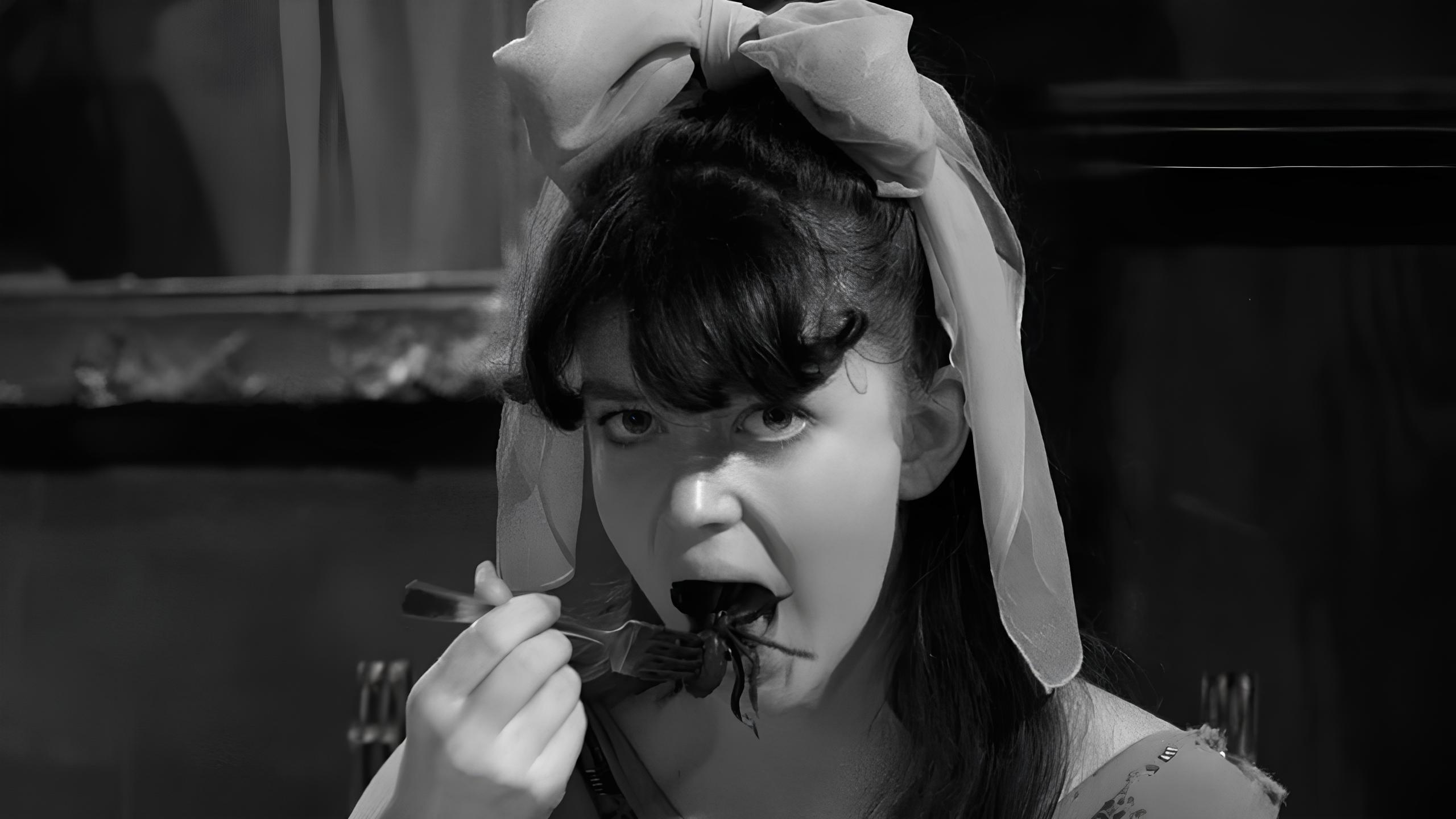
Horror, comedy, by Jack Hill, United States, 1967.
Spider Baby is a grotesque cult horror film that tells the story of the Merrye family, affected by a genetic disease that causes mental regression and feral behavior as they grow older. In an isolated house live Baby, her sisters, and the affectionate caretaker Bruno (Lon Chaney Jr.), who tries to contain their madness when unsuspecting guests arrive. The film mixes a gothic atmosphere, dark humor, and surreal tones, creating a disturbing yet almost fairy-tale world, a bizarre blend between classic horror and morbid comedy. Chaney delivers a surprisingly touching performance, and the direction manages to turn a tiny budget into a unique experience.
Spider Baby is an important cornerstone of American independent cinema: ironic, macabre, melancholic, and unconventional. Spider Baby is an experience that does not rely solely on fear, but plays with the theme of the “monstrous family” to talk about isolation, diversity, and decay, becoming over time a beloved cult title for those who seek a different kind of horror — deformed, grotesque, and unsettling at the same time.
LANGUAGE: English
SUBTITLES: Spanish, French, German, Portuguese
Antiquity's Grinning Corpse
You are sitting in the theater at Epidaurus, roughly 420 BCE, and the man on stage is wearing a leather phallus the size of a forearm. He is also dying — or pretending to, grotesquely, with great theatrical investment in the sounds a body makes when it fails. The audience is laughing. Not nervously, not guiltily, but with the full-throated release of people who have been given official permission to watch mortality made ridiculous, and who find that permission indistinguishable from relief.
The satyric drama was not a footnote to Greek tragedy. It was structurally required, the fourth play in a tetralogy, obligatory in the same way that a foundation is obligatory to a building. After Oedipus discovers what he has done to his mother and to his own eyes, after Agamemnon bleeds across the threshold, the Athenian festival demanded a satyr play — a burlesque populated by half-animal creatures whose primary concerns were wine, sex, and the humiliation of heroes. Heracles, the greatest of men, was a recurring target, made to stumble and fart and misunderstand. The Greeks were not confused about the relationship between sublimity and its undoing. They built that relationship into the calendar.
Rome inherited this structure and metabolized it into something stranger. The concept scholars now call the risus paschalis — the paschal laugh — migrated through Latin culture long before Christianity attempted to domesticate it: the idea that death itself contains a cosmic joke, that the universe’s indifference to human dignity is so total it becomes, at some angle of vision, genuinely funny. Roman funeral processions employed professional mourners alongside performers called archimimi, actors hired to imitate the deceased in a kind of grotesque mime, mocking the dead man’s gestures, his vanities, his characteristic walk. The corpse was eulogized and lampooned simultaneously. This was not disrespect. It was a precise theological position about what a body means once it stops being inhabited.
Mikhail Bakhtin, writing in 1965 in “Rabelais and His World,” made the argument that should have permanently embarrassed every cultural historian who had ever treated carnival as mere peasant entertainment. What Bakhtin excavated in Rabelais’s sixteenth-century mountains of flesh and rivers of bodily fluid was not vulgarity tolerated by a more innocent age but a coherent philosophical system — one in which the grotesque body, the body that eats and excretes and bleeds and reproduces and decays, was the central category of reality. The official body of medieval and Renaissance culture was closed, complete, hierarchically positioned. The carnival body was open at every aperture, constantly exchanging itself with the world around it, dying into fertility, eating what it would become. Bakhtin called this the “gay relativity” of all things, and he meant it seriously: not relativism as intellectual cowardice but as the recognition that nothing that presents itself as absolute survives contact with the body’s actual operations.
What makes this more than academic excavation is the precision of the inversion Bakhtin identified. In carnival logic, the lowest part of the body — the belly, the genitals, the intestines — is not degraded but generative. The mockery of the king, the priest, the judge, is not nihilism but cosmology. Everything that claims to transcend the body is returned to it, and the laughter that accompanies that return is not cynical but festive, because the return is also a kind of truth-telling that the official culture has suppressed at enormous psychic cost. The people attending the Roman funeral, watching the archimimus waddle across the procession imitating their dead father’s pomposity, were not being cruel. They were being accurate — about what power looks like from outside itself, about what a lifetime of dignity amounts to in the end.
The grotesque did not arrive in Western culture as a disruption. It was there at the foundation, built into the ritual calendar as a structural necessity, a pressure valve that was also a lens, focusing something about human existence that straightforward mourning or straightforward celebration could not hold.

The Body as Argument
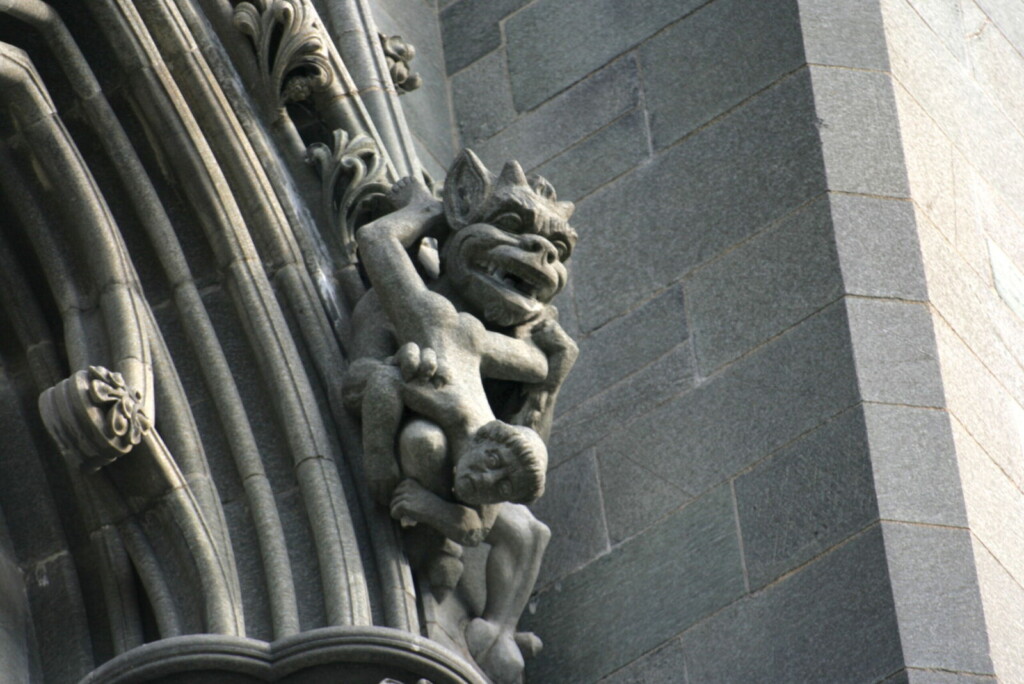
You are sitting at a table when someone nearby begins to choke, really choke, face purpling, hands clawing at their throat, and what you notice — what shames you afterward — is that for a fraction of a second you almost laughed. Not from cruelty. From the shock of suddenly being reminded that a human being is, beneath every layer of dignity and language and self-conception, a tube that can fail.
Rabelais understood this before anatomy made it fashionable. Gargantua and Pantagruel, published across the 1530s and 1540s in installments that terrified the Sorbonne and delighted half of France, is not a comedy of manners. It is a comedy of matter. The giant Gargantua is born through his mother’s ear after a catastrophic feast of tripe. Pantagruel’s birth kills his mother by sheer dimensional excess. Characters drown in urine, lose themselves in philosophical disputes inside intestines, consult oracles through the logic of a wine bottle. The flesh in Rabelais is not a backdrop to the human story. It is the argument itself. It insists, it overflows, it refuses to be bracketed.
What makes this philosophically radical is what came after it. René Descartes, writing in the Meditations on First Philosophy in 1641, roughly a century later, built the architecture of modern thought on a separation so clean it still structures the way educated people speak about themselves: the thinking thing on one side, the extended thing on the other. The cogito rescued certainty from doubt by evacuating the body entirely from the site of truth. Mind became the guarantor of meaning; flesh became the noise that the mind had to manage. Every tradition descending from that cut — Kantian reason, Hegelian spirit, even twentieth-century analytic philosophy’s love of propositions stripped of context — inherits the assumption that the body is epistemologically irrelevant, that what you know is independent of the fact that you leak, rot, hunger, and die.
Rabelais had already made the counter-argument before Descartes made the argument. This is not a coincidence of timing — it is a structural feature of what the grotesque does. Mikhail Bakhtin, in Rabelais and His World published in Russian in 1965, identified the Rabelaisian body as a specifically carnivalesque instrument: open, unfinished, connected to the world at its orifices, defined by ingestion and excretion rather than by the sealed, classical contours that Renaissance idealism was already starting to prefer. But Bakhtin was describing something more corrosive than a medieval festival. He was describing a body that cannot be used as a vehicle for abstraction because it keeps interrupting abstraction with its own insistent materiality.
Black humor, in its deepest structural logic, is anti-idealist in exactly this way. It does not merely shock with morbid content. It uses the shock of matter — of shit, disease, deformity, the mechanical failure of the organism — to collapse the distance that idealist thought requires in order to function. The moment you laugh at something dying or monstrous, you have briefly closed the gap between the observer and the observed, between the thinking subject and the body that thinking happens inside. That closure is destabilizing because it undoes the premise on which most moral and metaphysical seriousness depends: the premise that meaning can be established from a position outside the mess.
Thomas Hobbes, who almost never makes anyone laugh, was nonetheless circling the same territory in Leviathan in 1651 when he defined laughter as the sudden glory arising from the perception of some eminence in ourselves by comparison with the infirmity of others. What he missed, or refused to see, was the subspecies of laughter that arises not from superiority but from recognition — from the sudden perception that the infirmity is yours too, that the grotesque body on display is not a cautionary spectacle but a mirror.
Beat the Devil
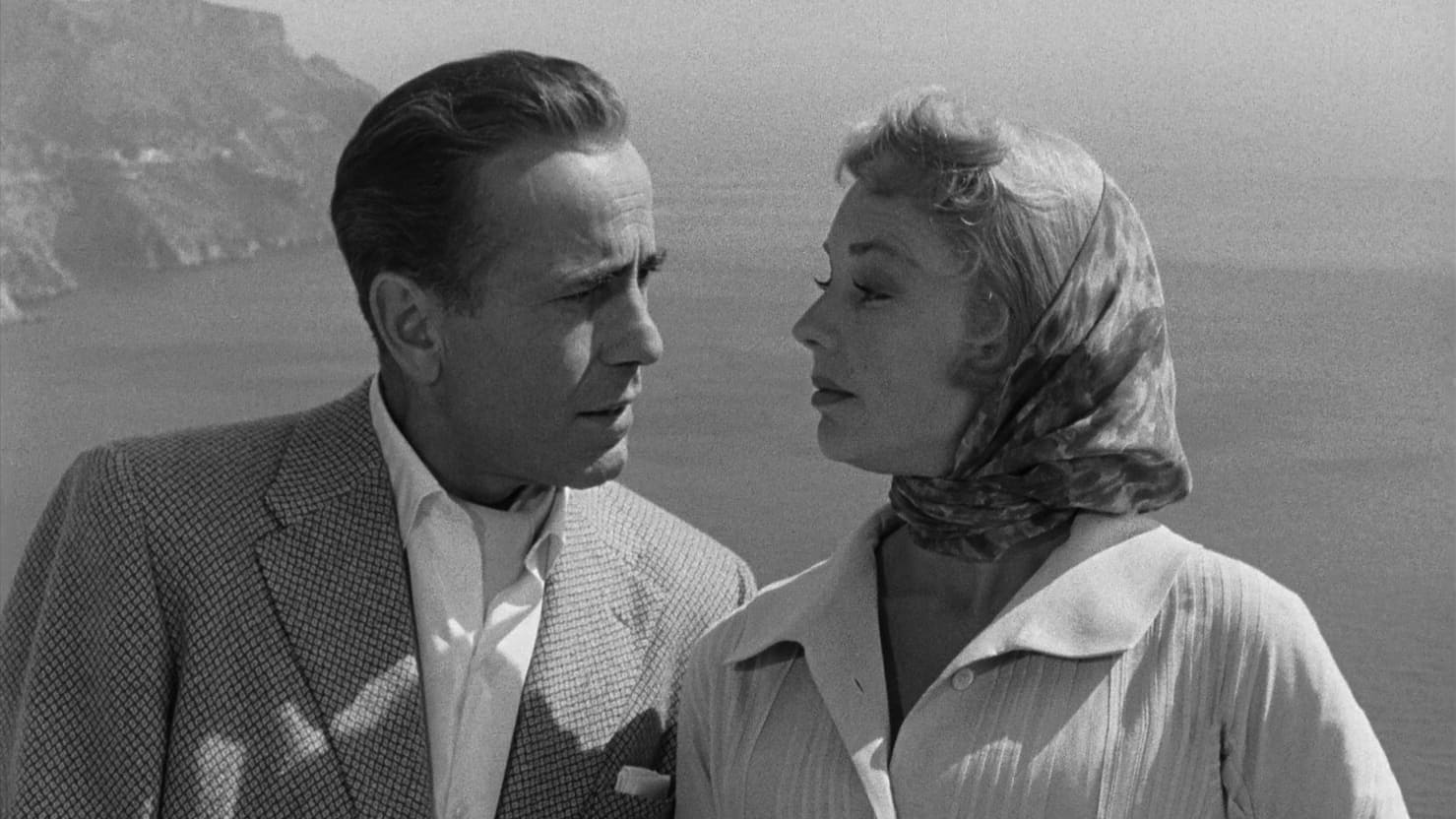
Adventure, comedy, by John Huston, United States, 1953.
The film begins with a group of very varied and ambiguous characters who find themselves in an Italian port waiting for a boat to go to Africa. The group consists of Billy Dannreuther (played by Humphrey Bogart) and his wife Maria (played by Gina Lollobrigida), Charles "O'Hara" (played by Peter Lorre) and his wife Gwendolen (played by Jennifer Jones), as well as an eccentric and wealthy British gentleman, Peterson (played by Robert Morley). These characters, along with others, are all interested in going to a uranium mine in Africa to exploit its potential profits. However, each of them hide their secrets and hidden motivations. As they wait for their transport, they spend their time interacting and trying to decipher each other's true goals. During the journey, tensions and betrayals emerge between the members of the group. The Dannreuthers are revealed to be trying to dupe the other members, Peterson is trying to protect his own financial interests, and O'Hara appears to have a connection to a mysterious hidden diamond. Meanwhile, the idea arises that the mine may be a scam and that the plan may be doomed to fail. The story becomes increasingly chaotic, with unexpected twists and intrigues.
The film is based on a novel of the same name by James Helvick (pseudonym of Claud Cockburn) and is a grotesque comedy that mixes elements of adventure, noir and comedy, often with a satirical tone. The cast of is remarkable and includes actors such as Humphrey Bogart, Jennifer Jones, Gina Lollobrigida, Peter Lorre and Robert Morley. The film was initially advertised as a serious thriller, but in the end it turned out to be very different from the public's expectations, with a lighter and more ironic tone. Although it was a box office failure and received mixed reviews upon its release, over the years it has become a cult film due to its unique style and outlandish nature. It was praised for its daring blending of genres and the eccentric performances of the cast. It is a film that stands out for its unconventional approach and its blend of different elements. His reputation has grown over the years, and today he is often held up as an example of how cinema can experiment with the boundaries of genres and audience expectations.
LANGUAGE: English
SUBTITLES: Spanish, French, German, Portuguese
Swift's Arithmetic of Atrocity
You are reading a pamphlet. The prose is measured, the syntax immaculate, the tone that of a man who has done his homework. He has consulted economists. He has performed calculations. He notes, with the calm authority of a colonial administrator, that the children of the Irish poor are a burden upon the kingdom, and that a one-year-old, properly dressed and cooked, would serve four adults at dinner. He recommends them fricasseed, or in a ragout, depending on the occasion.
What happens to you in that moment — the moment the pamphlet stops being satire and becomes, briefly, legible — is the entire philosophical event. Jonathan Swift published “A Modest Proposal” in 1729, and what he engineered was not a joke but a trap. The trap requires your complicity to close. You follow the logic because the logic is, by every formal standard of Enlightenment discourse, correct: there is indeed overpopulation, there is indeed famine, there are indeed economic pressures that colonial administrators genuinely discussed in precisely this register. The horror arrives not when Swift states his proposal, but when you notice that you were, for approximately two sentences, nodding.
This is the weapon that most political satire since has failed to replicate with any fidelity. It is not enough to mock power from outside. Swift’s method requires you to temporarily occupy the perspective of power so completely that you taste its internal coherence, its self-satisfying reasonableness. The colonial gaze he mimics was never cartoonishly cruel — it was bureaucratically serene. It did not see Irish children as children; it saw a surplus variable in a resource equation. Swift does not attack that gaze. He inhabits it until it consumes itself.
The philosophical mechanism here belongs to what Mikhail Bakhtin, writing two centuries later in “Rabelais and His World” (1965), would identify as carnival inversion — the temporary occupation of a perspective that reveals its own grotesquerie through perfect performance rather than explicit critique. But Swift strips this of any festive release. There is no catharsis, no laughter that purges. The reader who finishes “A Modest Proposal” is not relieved; they are implicated. The text offers no exit door labeled “this was irony.” It simply ends, still wearing the bureaucrat’s face.
What makes 1729 a specific historical threshold is that Swift was writing into an already-existing genre — the economic pamphlet — with enough precision to pass, momentarily, as authentic within it. He understood that the violence of colonial administration was not performed in dungeons but in spreadsheets, in policy documents, in the patient language of resource optimization. When Charles Trevelyan, overseeing British policy during the Irish famine of the 1840s, wrote that the catastrophe was “the direct stroke of an all-wise and all-merciful Providence” rationalizing non-intervention, he was not speaking a different language than Swift’s fictional proposer — he was speaking exactly the same one, without the irony.
This is the unbearable insight that black humor, at its most rigorous, keeps forcing back into view: the language of atrocity is never the language of atrocity. It is the language of reason, of necessity, of reluctant pragmatism. It is the language of men who would be deeply offended to be called cruel. Swift understood this before the British Empire had fully consolidated the rhetorical infrastructure of colonial justification, which means “A Modest Proposal” is not only a satire of 1729 — it is a blueprint for reading every subsequent act of administered suffering dressed in the vocabulary of regrettable necessity.
The grotesque in Swift does not distort reality. It clarifies it by refusing to look away from the point where reasonable premises, followed with perfect consistency, arrive at eating children — and noting, without flinching, that nobody in power had actually bothered to notice the difference.
Freud's Uncomfortable Room
You are sitting across from someone who has just learned they are dying, and they make a joke. Not a nervous deflection, not a social performance to spare the room — a real joke, precise and cold, with the timing of someone who has stopped pretending. The laughter it produces is the most uncomfortable sound you will ever hear, because it is genuine.
Sigmund Freud spent the last decade of his life returning obsessively to this problem. His 1927 essay “Humour” — a slim, late text, almost a footnote to his larger project — argues that gallows humor represents the highest achievement of the human ego. Where repression bends the mind under pressure and neurosis deforms it, humor, Freud claims, refuses. The ego announces to reality: you cannot touch me. The joke about the man being led to execution on a Monday who mutters “well, this is a fine start to the week” is, in Freud’s reading, not escapism but triumph — the psyche asserting its own sovereignty at the exact moment it is most nakedly threatened. He calls this a “fine and elevating” refusal, borrowing a phrase that sounds almost Victorian in its moral confidence, as though the joke were a kind of heroic act.
The problem Freud does not name, and perhaps could not name given what it would cost him to name it, is structural. For the gallows joke to function — for it to produce that specific register of laughter that is not quite comfort and not quite horror — the gallows must be real. The joke does not transcend the execution; it feeds on the execution’s absolute certainty. Remove the noose and you remove the joke. The ego’s “triumph” is therefore not a negation of death but a performance staged on death’s permanent stage, with death as the unchanged condition of the performance. Every act of black humor, understood this way, is less a victory over the abyss than a handshake with it.
This is the fracture Freud leaves open in the room. He was writing in 1927, eleven years before the Nazis entered Vienna, before the cancer in his jaw had progressed to the point where he could barely eat, before he would flee to London and die there in 1939 asking his physician for enough morphine to end it. The biographical weight is not incidental — Freud spent his final decade living inside precisely the conditions that his essay describes. And when you read “Humour” knowing that, the triumphalism of the ego starts to sound less like a philosophical claim and more like a wish. The essay performs the very structure it theorizes: it makes a joke about death in order to feel, briefly, that death is manageable.
What this reveals is that black humor operates not as a weapon against darkness but as a form of intimacy with it. The comedian who jokes about genocide, terminal illness, or annihilation is not standing outside the catastrophe delivering commentary — they have made the catastrophe into the primary material, which means the catastrophe is never absent from the room. George Bataille, writing in “Literature and Evil” in 1957, understood that transgressive laughter is not liberation from the forbidden thing but a form of contact with it, a way of touching what cannot be touched directly. The joke is the hand reaching into the fire to demonstrate the fire is real.
There is a further wrinkle that neither Freud nor Bataille fully accounts for, and it has to do with audience. The dying person who makes a joke at their own expense controls the terms of the contact — they choose when to reach. But black humor, as it travels from individual act to cultural form, transfers that reaching to people who are not dying, not threatened, sitting at a safe distance from the catastrophe being named. The joke migrates from the condemned to the spectator, and what was once an act of impossible sovereignty becomes something considerably stranger — a borrowed proximity to an annihilation that belongs to someone else entirely.
A vision curated by a filmmaker, not an algorithm
In this video I explain our vision
The Surrealist Sabotage

You are handed a book in 1940, in Paris, while the city is already rehearsing its occupation, and the cover tells you nothing about what is inside except a name and a date. André Breton assembled his Anthologie de l’humour noir that year with the precision of someone building a bomb from parts that no one recognized as explosive individually. The Marquis de Sade was there. Georg Christoph Lichtenberg was there. Lewis Carroll and Alfred Jarry were there. The collection looked, from a distance, like an eccentric literary survey. It was not. It was a prosecution.
What Breton was charging, specifically, was causality itself — the bourgeois conviction that events follow from reasons, that consequences are proportional to causes, that the world, however cruel, at least makes logical sense. The figures he assembled shared no aesthetic, no century, no national tradition. What they shared was a compulsion to expose the machinery of rational order until it started smoking and then caught fire. Sade’s relentless geometric cataloguing of atrocity was not pornography in Breton’s reading; it was a satirical mirror held up to Enlightenment systematism, showing that any sufficiently rigorous application of reason produces monstrousness as its cleanest output. The scandal was never the content. The scandal was the method.
Lichtenberg, the eighteenth-century German physicist and aphorist whose Sudelbücher remained scattered notebooks until long after his death, understood something that his scientific contemporaries could not afford to admit: that the instruments of rational inquiry, turned inward, dissolve the very subject doing the inquiring. His fragment “I have found nothing so difficult as not deceiving myself” is not a confession of personal weakness. It is an epistemological catastrophe compressed into a sentence. Breton recognized in this a form of violence against certainty that was more destabilizing than any political manifesto, because it operated from inside the house of reason rather than throwing stones at the windows from the street.
Carroll’s contribution was structurally different but functionally identical. The rules governing Wonderland are not the absence of rules; they are rules applied with fanatical consistency to premises that have been quietly replaced. The Queen’s logic is impeccable once you accept that verdict precedes trial. What Carroll demonstrated, in 1865, in a book sold as children’s entertainment, is that the architecture of rational authority becomes indistinguishable from arbitrary tyranny the moment you examine the foundations rather than the facade. Breton did not find this charming. He found it catastrophic, which is why it belonged in his anthology.
Jarry’s Ubu Roi, performed in 1896 to an audience that rioted, accomplished something different again. Ubu is not a critique of power — he is power with the civilizing varnish stripped away, speaking in his invented language of compacted vulgarity, operating through pure appetite dressed in the costume of governance. The play was condemned as obscene, but obscenity was never the point. The point was that Ubu was recognizable. The audience that booed had seen something they could not unsee, which is why the booing was so loud and sustained. Recognition dressed as outrage is one of the more reliable signatures of the grotesque.
What Breton understood, assembling these figures across three centuries, was that humour noir was never a literary genre. It was a cognitive operation — the deliberate construction of a vantage point from which the normal arrangements of cause, punishment, logic, and social hierarchy become visible as contingent, fragile, and faintly ridiculous. Suffering is not made funny. Rationality is made visibly insane by being followed to its conclusions without flinching. The laughter this produces, if it comes at all, arrives after a delay and carries no warmth. It is the sound a person makes when they finally understand a joke that was told at their expense years ago, in a room they thought they were hosting.
The Second Scene: A Bureaucrat and a Gas Form
He sits at a desk that is neither dirty nor clean, in a room that smells of paper and the faint electrical warmth of a lamp left on too long. The forms in front of him are organized into three stacks. He works through them methodically, initialing the lower right corner of each page, occasionally pausing to consult a reference chart pinned to the board above his desk. At one point, the stapler jams. He shakes it, opens its jaw, removes a crumpled piece of metal, and reloads. He resumes. The forms he is completing determine, with bureaucratic finality, which human beings will be transported to their deaths within the coming week. He is not aware of performing an atrocity. He is aware of being slightly behind schedule.
What makes this scene unbearable is not what it contains but what it refuses to contain. There is no trembling. There is no dramatic pause in which the functionary stares into the moral abyss of his own actions. The horror is generated by the total evacuation of dramatic register — by the fact that the machinery of extermination runs on the same psychological fuel as the machinery of municipal taxation. Hannah Arendt watched Adolf Eichmann in a Jerusalem courtroom in 1961 and published her report two years later under the title Eichmann in Jerusalem: A Report on the Banality of Evil. What she saw confounded every expectation the twentieth century had trained observers to bring to such a moment. Eichmann was not monstrous. He was not even interesting. He spoke in clichés, expressed pride in his organizational competence, and appeared genuinely confused by the suggestion that personal moral responsibility was something distinct from institutional role. Arendt’s phrase — banality of evil — was misread by critics as exculpatory, as if she were minimizing the crime by humanizing the criminal. She was doing the opposite. She was identifying something far more terrifying than the demonic: the possibility that industrialized mass murder requires no special psychological equipment, only the ordinary human capacity to subordinate reflection to procedure.
This is precisely the structure of the straight-man in black comedy. The straight-man does not react. He processes. His function is to receive the most catastrophic inputs and return outputs that are proportionate only to institutional expectation, never to moral reality. The gap between input and output is where the grotesque lives. Jonathan Swift understood this in 1729 when A Modest Proposal offered the eating of Irish infants as a rational solution to poverty, couching genocide in the sober syntax of economic pamphleteering. The joke, if it can be called that, is that the syntax is doing real work — the same syntax that actual policy papers used to discuss the Irish as an administrative problem. Swift didn’t invent a new voice. He borrowed the existing one and refused to let it flinch.
Arendt’s bureaucrat and Swift’s projector share the same formal commitment: they will not break. The unbroken register is the instrument of exposure. Mikhail Bakhtin, in Rabelais and His World published in 1965, described the grotesque as a form that holds death and birth in the same gesture, refusing the cultural apparatus that keeps them separated into tragedy and comedy. The bureaucrat at his desk is Bakhtinian in precisely this sense: in his hands, the administrative form becomes both birth certificate and death warrant, and the stapler jam occupies exactly the same emotional bandwidth as either. The register doesn’t collapse because the person performing the task has never allowed a register capable of collapsing to develop. What Arendt was really describing was not the absence of conscience but the successful installation of a replacement conscience — one calibrated entirely to process, in which the question “am I doing this correctly?” has permanently displaced the question of whether the thing being done should exist at all.
When the Joke Stops Being Yours
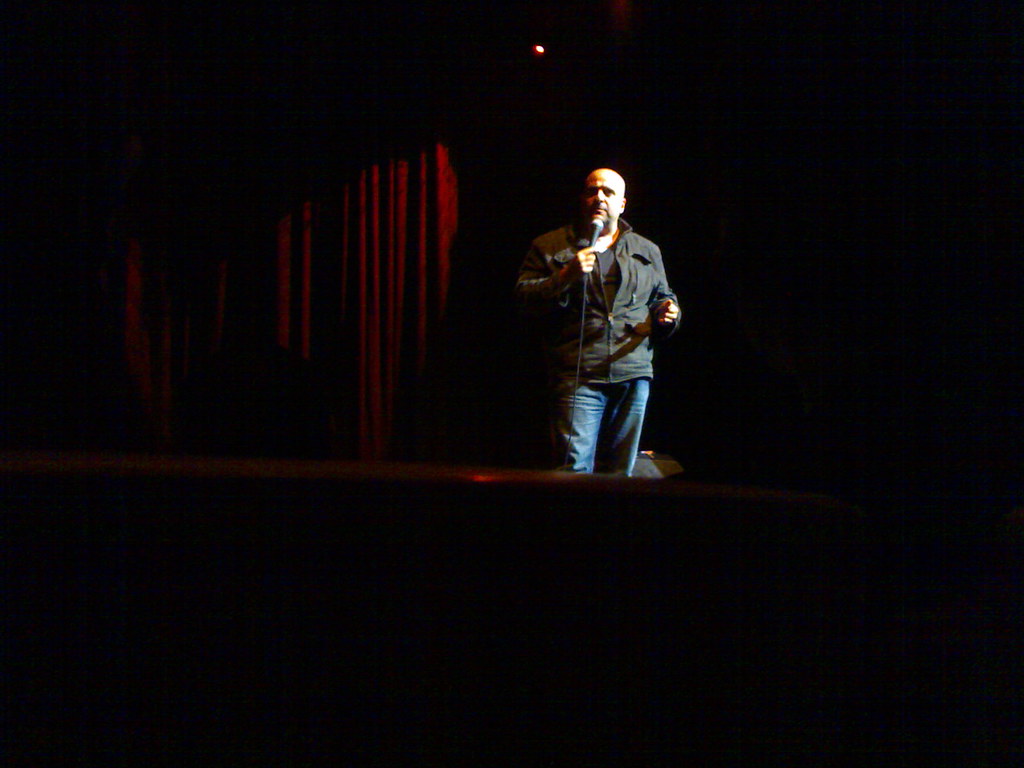
You are sitting in a theater, laughing, and somewhere in the third second of that laugh you feel it curdle. The joke was about degradation — specific, clinical, almost surgical in its detail — and you laughed because the person on stage seemed to own it, seemed to have purchased it through some cost you could not fully calculate from your seat. Then the laugh finishes and you are left holding something you cannot quite name, a residue that feels collaborative in a way you did not consent to.
Richard Pryor understood this residue better than almost any artist of the twentieth century. His 1979 concert film, recorded live at the Terrace Theatre in Long Beach, did not simply mine his own suffering for comedy — it performed a kind of ontological autopsy on what it means to survive in a body that American society has already decided is expendable. His bit about his heart attack, in which he gives voice to his own heart as a character delivering a furious monologue, is not a joke about illness. It is a joke about the negotiations a Black man conducts continuously with a system that monitors his body as threat before it registers it as person. The audience laughing in that room was laughing at something they understood viscerally, because many of them inhabited the same ontological position. The joke was not being performed at them. It was being performed from inside them.
The question of inside and outside is precisely what Mikhail Bakhtin never fully resolved when he theorized carnivalesque laughter in Rabelais and His World in 1965. He celebrated the grotesque body as a democratizing force, the great leveler that pulls the high down into the low, but he underestimated how quickly the carnival ground gets sold to landlords. Laughter that emerges from within a community’s experience of its own abjection functions as reclamation. The identical gesture, performed by someone positioned outside that experience, becomes extraction — a kind of comedy mining in which someone else’s wound is processed into entertainment and the profits do not return to the site of excavation.
Sarah Silverman‘s early work in the late 1990s and through her 2005 concert film made this structure uncomfortably visible by weaponizing it deliberately. Her technique was to inhabit racist and misogynist language from inside an apparent innocence, daring the audience to decide whether they were watching a critique of bigotry or a performance of it. The joke always had two exits, and the audience chose which one they walked through, which meant the audience was also always choosing something about themselves. What her work exposed was that the ideology inside a joke is not contained in the words — it is activated by the transaction between performer, material, and room. The same sentence produces entirely different moral events depending on the geometry of who is speaking and who is absorbing the impact.
This is why the ownership problem inside grotesque comedy cannot be solved by content regulation or by simple identity arithmetic. The issue is not merely who has the right to name a particular suffering. It is that naming, in the register of laughter, is never neutral description — it is always an act of positioning, of installing a perspective that the audience then inhabits for the duration of the joke. When that perspective is imposed from outside the experience being named, the laugh it generates is not liberation. It is a brief, pleasurable colonization of someone else’s wound, a tourist visit to an abyss that others cannot leave when the show is over.
Freud argued in 1905 that jokes were the most socially efficient mechanism for expressing what civilization forbids, but he did not ask who built the civilization doing the forbidding, or whose experience gets classified as forbidden material. The grotesque has always known that the mouth of the abyss and the edge of the stage are not the same location, and that the distance between them is measured entirely in power.
🎭 When Laughter Turns Dark: Humor, Horror, and the Absurd
Black humor and the grotesque have always thrived at the intersection of comedy, dread, and philosophical unease. The following articles explore the literary, theatrical, and philosophical traditions that gave birth to this unsettling aesthetic — from the absurd theater of Beckett to the savage satire of Brecht. Each piece illuminates a different facet of how art transforms suffering and social hypocrisy into something disturbingly funny.
Beckett’s Waiting for Godot: Analysis
Beckett’s Waiting for Godot stands as one of the most radical expressions of the grotesque in twentieth-century theater, reducing human existence to a bleak vaudeville of waiting and forgetting. The play’s black humor emerges from the gap between the characters’ desperate hope and their utter inability to act, a tension that is simultaneously tragic and farcical. Understanding Beckett is essential for anyone seeking the philosophical roots of the modern grotesque.
GO TO THE SELECTION: Beckett’s Waiting for Godot: Analysis
Brecht’s The Threepenny Opera: Analysis
Brecht’s Threepenny Opera is a masterwork of grotesque satire, exposing the moral rot beneath bourgeois respectability through savage irony and darkly comic musical numbers. By blending criminality with capitalist virtue, Brecht constructs a world where the grotesque is not an exception but the very texture of everyday life. This analysis reveals how black humor can function as a weapon of ideological critique.
GO TO THE SELECTION: Brecht’s The Threepenny Opera: Analysis
Social Hypocrisy: The Double Face of Respectability
Social hypocrisy is one of the most fertile grounds for black humor, since the grotesque is born precisely from the monstrous distance between appearance and reality. This article examines how respectability becomes a mask concealing violence, greed, and absurdity — the same themes that run through the great traditions of satirical and grotesque literature. From Molière to Maupassant, the double face of propriety has always been comedy’s darkest mirror.
GO TO THE SELECTION: Social Hypocrisy: The Double Face of Respectability
Albert Camus: Life and Philosophical Thought
Albert Camus identified the absurd as the fundamental condition of human existence, and his philosophy forms one of the deepest philosophical underpinnings of black humor as an art form. When the universe offers no meaning and yet we persist in demanding one, laughter becomes a form of rebellion — precisely the spirit of the grotesque. This article on Camus is an indispensable companion to any serious study of dark comedy and its existential roots.
GO TO THE SELECTION: Albert Camus: Life and Philosophical Thought
Discover the Cinema of the Grotesque on Indiecinema
If these dark philosophical corridors have stirred your curiosity, Indiecinema is the place where the grotesque truly comes alive on screen. Our streaming platform gathers the most daring, unconventional, and thought-provoking independent films — those that dare to laugh where others fall silent. Explore our catalog and let independent cinema take you to the uncomfortable edges of the human comedy.
👉 EXPLORE THE CATALOG: Watch Indie Films in Streaming
A vision curated by a filmmaker, not an algorithm
In this video I explain our vision

