
The Scroll and the Mirror
You are not watching because you care. You are barely watching at all — the word “watching” implies a direction of attention you no longer possess at this hour, after midnight, the phone tilted toward your face like a confessional screen. Your thumb moves without instruction. A woman you have never met is stepping out of a car in a city you will never visit, wearing something that cost more than your monthly rent, and you are consuming this image with the focused vacancy of someone eating chips without tasting them. You are not envious, exactly. You are not even interested, exactly. There is something else happening, something that does not have a clean name, a kind of hollow ache that the scroll both produces and promises to relieve, endlessly, in a loop you did not consciously choose to enter.

What is striking about this moment — and it happens to millions of people simultaneously, every night, across time zones, in languages that have nothing in common — is how little it resembles the way culture has traditionally imagined fan behavior. The screaming teenager at an airport. The obsessive collector pinning photographs to a wall. Those images were at least legible: desire, identification, a hunger for proximity to something that felt larger than ordinary life. What you are doing at midnight is different. It is not worship. It is not even admiration. It is closer to the sensation of pressing your tongue against a sore tooth — repetitive, slightly unpleasant, impossible to stop.
Guy Debord, writing in 1967 in “The Society of the Spectacle,” argued that in modern capitalist society all lived experience had been replaced by its representation — that we had ceased to live and begun instead to watch ourselves not living. He was describing television, billboards, the architecture of passive consumption. He could not have anticipated the particular cruelty of an interface designed to make passive consumption feel interactive, to give the thumb something to do while the mind dissolves. The scroll is not a window onto spectacle. It is spectacle that has learned to breathe, to refresh, to generate the sensation of incompleteness sixty times a minute so that completion is always one image away and never arrives.
What celebrity provides within this system is not a person. That is the first thing to understand, and it destabilizes more than it seems to. The individual human being behind the name — with contradictions, bad days, private humiliations, a body that hurts and ages — is precisely what the mechanism requires you not to see. What you consume instead is a surface that has been engineered at considerable expense and labor to produce specific emotional responses: aspiration, intimacy, the illusion of access. Sociologist Chris Rojek, in “Celebrity” published in 2001, made the distinction between what he called “achieved” and “attributed” fame, but more pressingly he identified the parasocial relationship — the one-sided emotional bond that feels mutual — as the actual product being sold. You are not buying a glimpse of someone’s life. You are buying the sensation of having a relationship without the cost, friction, or risk that relationships actually require.
And the cost of that substitution is not nothing, even if it accumulates so quietly that you do not notice it until you look up one day and realize you know more about the interior of a stranger’s villa in Calabria than you know about what your closest friend is afraid of. The trade has already been made. The emotional bandwidth that might have flowed toward people who can touch you, disappoint you, need you in the middle of the night, has been quietly redirected toward a face on a screen that will never know your name — and the redirecting felt, at every step, like a choice freely made, which is precisely why it was so effective.
A Better Life
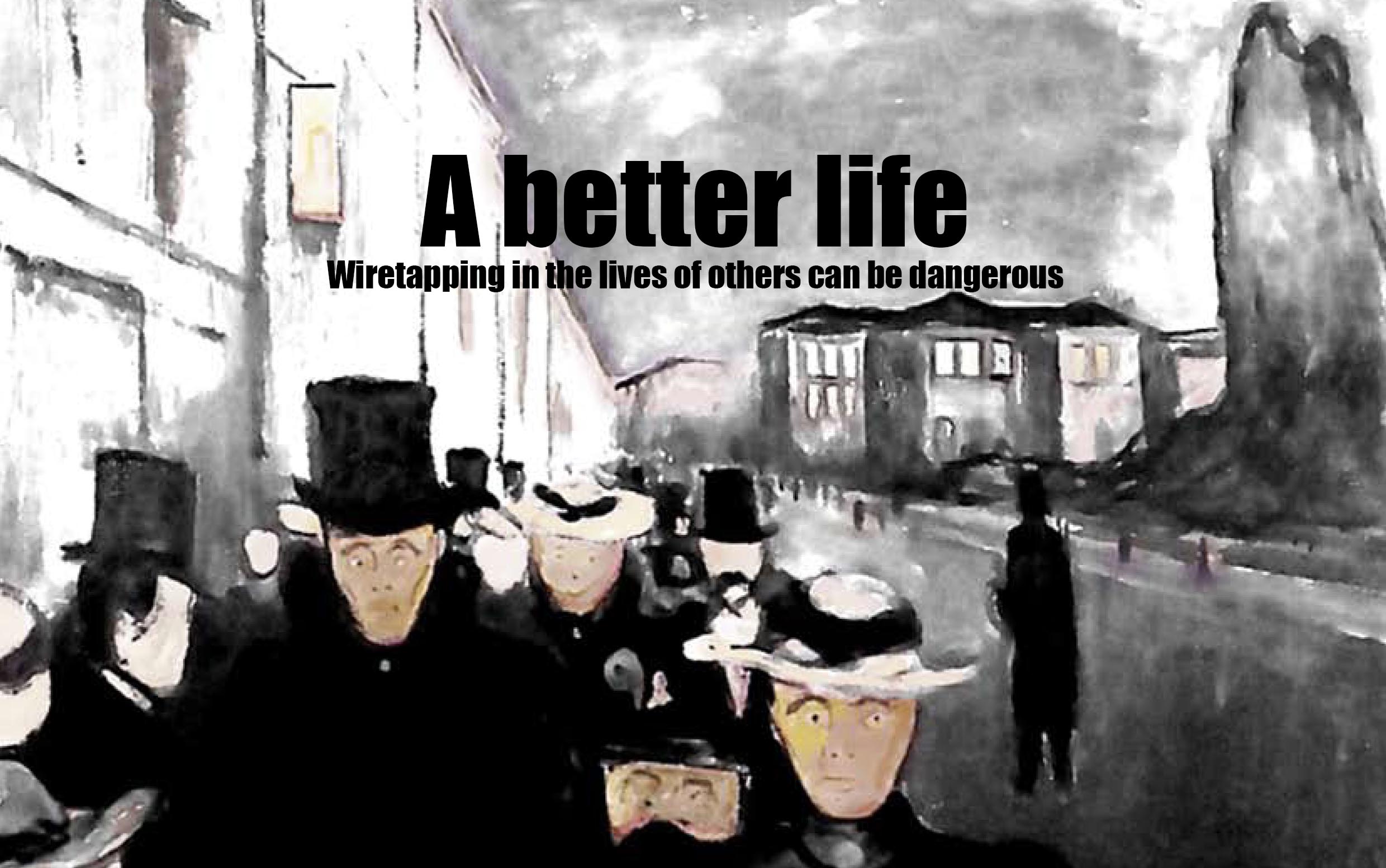
Drama, thriller, by Fabio Del Greco, Italy, 2007.
Rome: Andrea Casadei is a young investigator specializing in audio wiretapping who conducts investigations commissioned by husbands betrayed by their wives, or by parents worried about what their children are doing outside the home. But what interests him most is understanding the human soul, listening to casual conversations in the streets, knowing what people think. He often meets in Piazza Navona with his friend Gigi, a frustrated street artist obsessed with success at all costs, with whom he shares a passion for wiretapping. Shocked by the mystery of the disappearance of Ciccio Simpatia, another street artist common friend, Andrea decides to abandon the commissioned works to seek a better life and reflect on his own and others' existence. He will meet the actress Marina and with a bug he will slowly enter her life until he discovers her most unthinkable secrets. The film deals with an important theme of contemporary Western society: the lack of love. The mysterious and tormented figure of Marina is reflected in a gloomy and soulless Rome.
Director Fabio Del Greco declared about his film: "Perhaps this film is a reflection on the art of observing, of listening, in short, of what one does when one leaves the real world to tell about it. Perhaps he wants to talk about the subtle relationship between the mirages of success touted by today's society, power and the most authentic human relationships.A 'dark cloud' hangs over the city: it is engulfing everyone in a sort of indistinct, uniform mass, where everyone thinks the same things, where everyone they are more alone. Where is the truest part that makes us unique? Maybe you can try to intercept it only secretly."
LANGUAGE: Italian
SUBTITLES: English, Spanish, French, German, Portuguese, Dutch.
The Architecture of Visibility
You are watching someone you have never met walk into a room, and the room reorganizes itself. Not because of anything they have done — no discovery, no sacrifice, no act that preceded their entrance — but because a sufficient number of cameras once pointed in their direction, and now the pointing is the only credential that matters. The room does not ask what they built. The room asks only whether the light found them first.
This is not a corruption of something that once worked properly. It is the mature form of a structure that was always heading here. Daniel Boorstin, writing in 1961 in The Image: A Guide to Pseudo-Events in America, identified the fault line with almost uncomfortable precision: a pseudo-event is an occurrence staged not because something happened, but in order to generate the report that something happened. The press conference exists to produce the coverage. The coverage exists to produce the figure. The figure exists to generate the next press conference. What Boorstin described was not yet the world we inhabit — social media had not yet collapsed the distance between the staging and the audience — but he saw the grammar of it clearly. Fame was decoupling from achievement and becoming a self-sustaining engine, feeding on its own exhaust.
Before that decoupling completed itself, fame was at least nominally legible as a residue. It trailed behind something: a battle won, a book written, a voice that moved crowds toward something larger than itself. Fame was, in that configuration, almost a nuisance to the famous — the shadow cast by a life lived at sufficient intensity. Lord Byron reportedly woke one morning in 1812 to find himself famous after the publication of Childe Harold’s Pilgrimage and described the experience as disorienting, accidental, an effect he had not calculated. That involuntary quality is precisely what distinguishes it from what followed.
The industrial production of celebrity required the dismantling of that involuntary structure. What the entertainment press of the early twentieth century began to understand — and what the studio system formalized — was that public appetite for proximity to elevated figures was not contingent on those figures having done anything. The appetite was prior. It existed independently, waiting to be attached to whoever the machinery selected. By the 1940s, studios were manufacturing biographies for actors before the actors had lived them, assigning backstories that would metabolize more cleanly in fan magazines. The image preceded the person. The person was then asked to grow into it.
What that system created was a new ontological category: the human being who is famous for being famous, a phrase so overused it has lost its capacity to disturb. But the disturbance is real and worth recovering. The circularity it describes is not a logical paradox — it is a functional description of how attention economies operate. Visibility produces more visibility not because the visible thing is worth seeing, but because visibility itself acts as a social signal of importance. Andy Warhol intuited this in 1968 when he said that in the future everyone would be world-famous for fifteen minutes, but the remark is usually treated as prophecy when it was diagnosis. He was describing the logic of a machine already running, one that had made the duration of fame irrelevant and the reason for it structurally optional.
The trap, then, is not that people want to be famous for the wrong reasons. The trap is that the architecture of visibility has made merit a variable rather than a prerequisite — something that may or may not accompany the light, but whose absence does not prevent the light from arriving. A system in which any connection between what you have done and how widely you are seen has become genuinely contingent is not a broken meritocracy. It is a different structure entirely, with different rules, producing different kinds of people, none of whom chose the building they were handed the keys to.

Desire Borrowed from Others
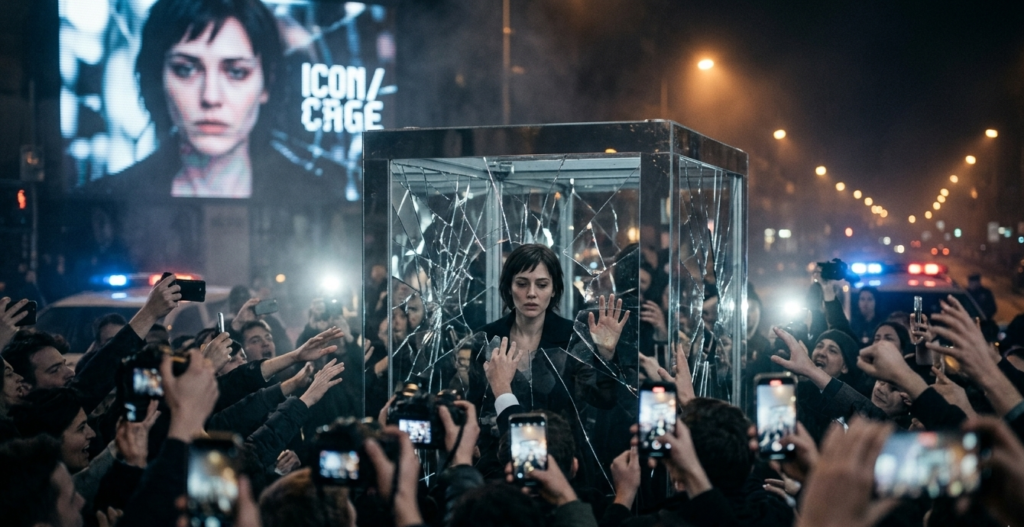
You have rehearsed this scene so many times you no longer notice it happening. You scroll past a face — famous, lit with that particular quality of light that studios and iPhones now conspire to produce — and something contracts in your chest. Not lust exactly, not admiration exactly, but something more restless and harder to name. You want something. You are simply not sure what.
René Girard spent decades trying to explain what that contraction actually is. In “Deceit, Desire, and the Novel,” published in 1961, he argued that human desire is almost never spontaneous, almost never aimed directly at its object. Instead, it moves in a triangle: a subject, a mediator, and an object that the subject wants primarily because the mediator appears to want it. The desire is borrowed before it is felt. What looks like personal longing is actually an imitation, a mirror held up to someone else’s apparent hunger, and the object itself is largely incidental — a pretext for the real psychological drama, which is the relationship between the imitator and the model.
This would be uncomfortable enough if our mediators were people we actually knew, friends whose appetites we silently catalogued and replicated. But celebrity culture has industrialized the mediator role, manufacturing figures whose entire social function is to appear perpetually desirous — of products, lifestyles, experiences, versions of themselves — so that millions of triangles can form simultaneously, all pointing at the same apex. The celebrity does not need to be present. She does not need to want anything genuinely. The apparatus around her only needs to produce the convincing performance of wanting, and the mimetic machinery starts turning on its own.
What Girard identified as a feature of great novels — Stendhal, Flaubert, Dostoevsky, each anatomizing the borrowed quality of their characters’ passions — has become the organizing principle of an entire attention economy. The influencer’s morning routine, the athlete’s recovery regimen, the musician’s creative process: these are not windows into authentic life. They are desire-machines, designed to produce in the viewer a specific kind of triangulated longing that feels intimate precisely because it has been engineered to feel that way. The closer the simulation of proximity, the more powerful the mimetic pull.
But the deeper trap is not that you want what they appear to want. The deeper trap is that you begin to want to be wanted the way they are wanted. This is the vertigo at the center of celebrity culture that most of its critics fail to reach. The self stops asking what it desires and starts asking how it appears to others who are watching it desire. The gaze of the imagined audience becomes the actual engine of selfhood. And because the celebrity is the purest symbol available of a person being watched and wanted at scale, the mimetic triangle tilts: the object of desire becomes not a product, not a lifestyle, but the celebrity’s position itself — that specific exposure to collective wanting.
Psychoanalytically, this maps onto what Jacques Lacan described as the desire of the Other — the structural impossibility of wanting something for yourself when the very concept of selfhood has been constituted through another’s gaze. By 1964, in his seminar on the four fundamental concepts of psychoanalysis, Lacan was already arguing that the subject does not know what it wants, only that it wants to be recognized as wanting correctly. Celebrity culture turns this structural feature of human subjectivity into a commercial product. It sells the fantasy that recognition at scale would finally resolve the question of whether your desire is real, whether you are real, whether the wanting has ever genuinely been yours.
The tragedy is not that people are foolish enough to chase this. The tragedy is that the chase is internally coherent — that wanting to be wanted, as a substitute for knowing what you want, makes a terrible kind of sense when the alternative is the terrifying open silence of a desire that belongs entirely to you, with no mediator and no audience to confirm it.
The Economy of Attention as Existential Condition
You scroll past a face you have seen ten thousand times and feel, briefly, something. Not admiration exactly, not envy exactly — something murkier, a faint gravitational pull that registers in the body before the mind has named it. That pull is not incidental. It is the product of an apparatus so finely calibrated that its results can be measured in milliseconds of hesitation, in the micro-pauses that advertising algorithms read as signals of desire. The face has been placed there not to be seen but to be felt, and the feeling is the capture.
Bernard Stiegler spent the better part of three decades arguing that what industrial capitalism colonized in the twentieth century was not primarily labor or land but time — specifically, the interior time of psychic life. In his three-volume work Technics and Time, and more urgently in Taking Care of Youth and the Generations published in 2008, Stiegler described what he called the industrialization of memory: the process by which tertiary retentions — externalized records, images, sounds, narratives — come to replace the living accumulation of individual experience. When a culture outsources its memory to media objects, it does not simply record life more efficiently. It begins to substitute those recordings for life itself. The self, which forms through the sedimentation of singular experiences, finds those experiences pre-formatted, pre-felt, pre-desired by someone else’s production schedule.
Celebrity is the most efficient delivery mechanism this substitution has ever found. A recognizable face carries with it an entire emotional grammar — a catalog of associations, aspirations, and anxieties that have been rehearsed so many times they feel native to the observer. The viewer does not construct a relation to the famous person; the relation arrives pre-assembled. What looks like fascination is closer to occupation: a foreign structure installed in the place where autonomous desire might otherwise have grown. Stiegler called this process psychic disindividuation — the erosion of the capacity to become singular, to want what no one has yet wanted, to feel what no template has yet scripted.
The economics of this erosion are not metaphorical. In 2023, a single sponsored post from a top-tier celebrity on Instagram generated average engagement rates that advertisers valued at between four hundred thousand and two million dollars, depending on vertical. That number is not measuring fame. It is measuring the reliable capacity to redirect attention — and with attention, the vectors of wanting. The philosopher Yves Citton, in The Ecology of Attention published in 2014, distinguished between captured attention and cultivated attention: the first is harvested, the second grows something in the one who exercises it. Celebrity culture runs entirely on the first economy, and the second economy quietly starves.
What starves is not some abstract faculty. It is the specific, bodily capacity to sit with the unresolved — to not know what one wants, to endure that not-knowing long enough for something genuinely one’s own to surface from the discomfort. This is what psychoanalysis has always called desire in the strict sense: not appetite, not preference, but the lived experience of a gap that cannot be filled by any available object. Celebrity culture does not fill that gap. It abolishes it. It provides an endless succession of proxies so compelling that the gap never gets the silence it requires. The person who cannot name what they want but knows with perfect clarity which ten public figures they follow most loyally is not a person with many interests. They are a person whose interiority has been rented out, quietly, over years, in increments too small to feel like loss.
And the cruelest feature of this arrangement is that it presents itself as freedom — as chosen entertainment, as personal taste, as the democratic right to admire whom one wishes. The cage is built from the inside, using materials that feel exactly like preference.
A Man Rehearsing His Own Disappearance
He stands in front of the bathroom mirror forty minutes before the interview, moving his jaw slightly left, then right, testing a half-smile that he has seen work before on a panel show — the one that reads as self-deprecating but not weak, curious but not lost. He tries it again. Then again with the eyes doing something slightly different. He is not nervous in the ordinary sense. He is calibrating. What he is calibrating, he could not exactly say, except that it feels necessary and that the necessity itself no longer strikes him as strange.
This is what visibility does at its intermediate register, not at the level of global fame where at least the machinery is obvious and the distortion can be named, but at the minor, grinding level of recognizability — the person who gets stopped occasionally, who has a number of followers that feels both too large to ignore and too small to justify the weight it has taken on. The philosopher Charles Taylor, writing in Sources of the Self in 1989, described the modern self as constituted through a process of articulation, the idea that identity is not discovered but produced through the act of expressing it. What he could not have fully anticipated is the degree to which that articulation would be outsourced to platforms designed to reward the most legible version of a person, the most reproducible emotional signal, the face that travels fastest through a network built on frictionless recognition.
The man rehearsing in the mirror is not lying, and that is precisely what makes the scene so difficult to resolve morally. He is doing what any competent performer learns: managing the gap between interior state and exterior presentation. But professional performers know they are performing. They carry the role at a distance, even when they carry it for decades. What erodes at the intermediate register of minor celebrity is exactly that distance. The performance and the person begin to share the same address. Erving Goffman, in The Presentation of Self in Everyday Life published in 1959, argued that all social interaction involves a front stage and a back stage, that the management of impression is not pathology but structure. What he described as normal social theater has now been industrialized into something that operates without an audience that ever goes home.
By 2020, researchers studying identity disruption in social media influencers with audiences between ten thousand and five hundred thousand — the precise demographic bracket of minor public visibility — found measurable fragmentation in self-narrative coherence, meaning the stories people told about themselves in private became increasingly inconsistent with the personas they had publicly maintained. Not because they were dishonest, but because the public persona had accumulated so much behavioral history, so many documented reactions, so many visible preferences, that it had developed its own gravity. The private self began orbiting it rather than the reverse.
What the mirror reveals is not vanity. It reveals the terrifying possibility that the face being rehearsed is more real, in the functional sense, than the face that was there before anyone was watching. The Hungarian-American psychologist Mihaly Csikszentmihalyi wrote in 1990 about attention as the fundamental unit of psychological experience, the argument being that what you give sustained attention to is, in a very real sense, what you become. A man who has given ten thousand hours of attention to the question of how he appears has not merely cultivated a skill. He has reorganized his inner architecture around an external gaze that may not even be looking anymore.
The interview will go well. He will seem natural, which means the rehearsal will have worked, which means something was successfully concealed — though from whom, and at what cost to the concealer, is a question that does not get answered in the green room or in the comments afterward or in the quiet of the drive home where he finds himself already reviewing the footage in his mind before it has aired.
A vision curated by a filmmaker, not an algorithm
In this video I explain our vision
The Therapeutic Alibi

You are watching someone cry on a screen — not a character, but a person who has chosen, at a carefully selected moment in their career, to let you see them break. The lighting is soft. The pause before the answer is exactly long enough. And something in you responds, genuinely, with the kind of recognition you rarely feel watching the news or reading a policy document. You feel close to them. You feel, almost, that you know what they are carrying.
Eva Illouz, in her 2007 work Cold Intimacies: The Making of Emotional Capitalism, traced the precise historical moment when the language of therapy migrated from the clinic to the market — when corporations, media platforms, and public figures discovered that emotional disclosure was not a vulnerability but a currency. She identified how the self that confesses, that names its wounds, that performs its own interiority with fluency, becomes more legible, more trustworthy, more sellable. What looked like the dissolution of professional distance was, in structural terms, the invention of a new kind of professional surface: warmer, more personal, and therefore more adhesive.
The public figure who speaks about their anxiety, their childhood fractures, their relationship with their body, is not stepping outside the logic of celebrity. They are operating at its most sophisticated register. Authenticity, as a product category, commands a premium precisely because it mimics what the market cannot openly sell — the sense that someone is not selling you anything. The confession becomes the advertisement. The breakdown becomes the brand extension. And the audience, trained by decades of therapeutic culture to read emotional disclosure as proof of genuine humanity, receives it as intimacy rather than strategy.
This is not cynicism about individual suffering. The pain may be entirely real. What is constructed is the occasion, the framing, the platform, and the monetization of its release. By 2019, the global wellness industry had reached a valuation of 4.5 trillion dollars — a figure that only makes sense when you understand that vulnerability, properly packaged, is one of the most profitable goods in circulation. The celebrity who announces a mental health diagnosis does not merely share an experience; they anchor a product line, validate a fanbase, and generate engagement metrics that translate directly into advertising revenue.
Representation enters this architecture with particular force. The argument that seeing people who look like you, speak like you, suffer like you in positions of visibility constitutes a form of political progress is not wrong — but it is dangerously incomplete. It locates transformation at the level of the image rather than the structure, and celebrity culture has proven extraordinarily capable of absorbing difference without redistributing anything. The face changes; the machinery does not. A Black woman with a billion-dollar fortune navigating a hostile media apparatus is not the dismantling of that apparatus — she is evidence of its flexibility, its capacity to generate new premium categories out of previously excluded identities.
What gets called representation is often the rebranding of aspiration: the system proving that it can include you while leaving the conditions of exclusion entirely intact. The emotional labor that marginalized public figures perform — the constant explanation of their experience, the patience with which they educate audiences who could have educated themselves — is absorbed by platforms and broadcast as content. Their specificity becomes a demographic. Their history becomes a narrative arc that keeps people watching.
The deepest function of the therapeutic alibi is that it makes critique feel like cruelty. To question the political content of a celebrity’s emotional disclosure is to appear to dismiss their pain. To examine the structural role of representation is to seem ungrateful for whatever visibility has been conceded. The language of healing seals the conversation inside an emotional register where power rarely gets named — where the question you are not supposed to ask is whether being seen was ever, by itself, the same thing as being free.
Immortality Projects and the Borrowed Self
You have probably never said the words out loud, but somewhere in the architecture of how you follow a certain person’s career — their releases, their appearances, their controversies, their recoveries — there is a logic that has nothing to do with entertainment. It is older and more desperate than that. It is the logic of survival by proxy.
Ernest Becker spent the last years of his life, before dying of cancer in 1974, arguing that virtually every structure of human civilization is a response to a single unbearable fact: that we are animals who know we will die. The Denial of Death, published the year of his death and awarded the Pulitzer Prize in 1974, is not really a book about psychology. It is a book about what people build in order to not think about decomposition. Becker called these constructions “immortality projects” — the systems, causes, beliefs, and symbolic identities through which a person participates in something that will outlast their body. Religion was the most ancient of these. Fame, in the modern secular world, has become one of the most potent.
What Becker did not live to see, but which follows directly from his logic, is what happens when a culture loses its shared theological scaffolding and replaces it with a media system that produces luminous, seemingly permanent figures on an industrial scale. The celebrity, in this framework, is not primarily a product of entertainment. They are a container for other people’s terror. They exist — in the psychological economy of the audience — as proof that a human life can exceed its physical limits, that a name can be carved into something more durable than flesh. The fan does not consciously think any of this. That is precisely what makes it work.
Identification is the mechanism. Not admiration, not aspiration — identification, which is a more primitive and more dangerous operation. When a person fuses their sense of self to a public figure, they are not borrowing the figure’s talent or beauty. They are borrowing their symbolic permanence. The famous person’s image will persist in archives, in cultural memory, in the recursive loops of the internet long after both of them are gone — but in the act of identification, the boundary between the two selves becomes porous enough that the audience member experiences that permanence as partially their own. It is a kind of metabolic trick the psyche plays on itself.
This is why the death of a celebrity produces grief that astonishes even those who feel it. The mourning is real, but its depth is disproportionate to any actual relationship. What has died is not just a person but a piece of the self that was constructed around that person’s continued existence — a piece that was doing the quiet, unconscious work of holding mortality at bay. When David Bowie died in January 2016, what millions of people reported was not merely sadness but a specific sensation of exposure, as though something that had been standing between them and some fundamental darkness had been removed. The language people used — “a piece of my childhood is gone,” “I feel less safe” — was not hyperbole. It was accurate testimony about what the figure had been doing structurally inside their psyches.
The celebrity industry understands this, not theoretically but commercially. Legacy editions, posthumous releases, holographic performances, estate-managed social media presences — all of these extend the symbolic life of the figure and, with it, the audience’s access to borrowed permanence. A dead celebrity is in some ways more useful to this economy than a living one, because they can no longer disappoint, age, or contradict the version of themselves that people have incorporated into their self-structure. They become fixed. Pure symbol. And the people who built part of themselves around that symbol can continue the project indefinitely, without the friction of an actual human being getting in the way.
What the Trap Requires of You
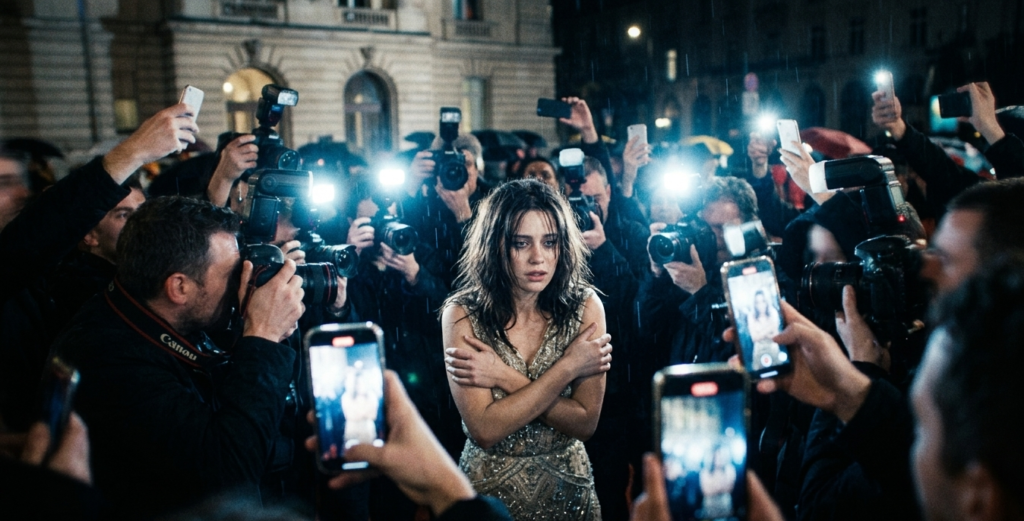
You are scrolling through someone’s life at two in the morning, and somewhere between the fourth and fifth video, you stop being a witness and become a participant. You did not agree to this. No contract was signed. But the architecture of the exchange was designed precisely so that agreement would never be necessary — only continuation.
What celebrity culture demands from its audience is not admiration, and not even attention in the ordinary sense. It demands a specific posture: the willingness to receive another person’s performed interiority as a substitute for one’s own. Guy Debord understood in 1967, in The Society of the Spectacle, that the spectacle was not a collection of images but a social relationship between people mediated by images. What he could not have fully anticipated was the degree to which that mediation would become indistinguishable from intimacy itself — that the image would not merely represent life but colonize the very texture of how one feels alive.
The mechanism is not passive. It requires your active cooperation, your emotional investment, your willingness to care about outcomes that have no material bearing on your existence. And this is where the demand becomes structural rather than personal: the system does not ask you to be foolish. It asks you to be human. It exploits the same neurological pathways that attach you to people you actually know — the mirror neuron systems that fire identically whether you witness something or merely observe someone else experiencing it, a phenomenon catalogued by Vittorio Gallese in his work at the University of Parma in the 1990s. Your nervous system cannot fully distinguish between a friend’s grief and a celebrity’s grief performed for a camera. The trap is biological before it is cultural.
What gets consumed in this exchange is not your time, precisely, though time is certainly taken. What gets consumed is the raw material of selfhood — the capacity for interiority that requires silence, boredom, and unstructured experience to develop. The psychologist Sherry Turkle documented in Alone Together, published in 2011, how continuous connectivity had begun to erode the tolerance for solitude that is, paradoxically, the condition under which a coherent self can form. When every unoccupied moment is immediately filled with another person’s performed existence, the question of what you yourself think or feel or want becomes not unanswerable but unasked.
The celebrity, meanwhile, is not exempt from this erosion. The performer who built an audience by exposing vulnerability soon discovers that the audience has metabolized that vulnerability and needs more. Andy Warhol’s prediction about fifteen minutes of fame missed the more sinister inversion: not that everyone would have fame briefly, but that those who had it would be required to continuously exceed themselves to retain it. What begins as self-expression becomes self-extraction — the progressive mining of experience, trauma, and private feeling to feed a public that has been trained to mistake rawness for authenticity.
This is what the trap requires of both parties: that the watcher surrender the labor of their own inner life, and that the watched surrender the privacy that makes an inner life possible in the first place. The exchange appears reciprocal but is structurally asymmetrical, because one party is visible and one is not, and visibility, under capitalism, is always a form of exposure rather than power. Susan Sontag noted in Regarding the Pain of Others that the act of watching suffering at a distance produces not solidarity but a subtle immunization against it — the watched become less real the more they are consumed, and the watcher becomes less present to their own reality the more thoroughly they outsource their emotional experience to the screen.
The question that remains is not whether you have been shaped by this — you have, and so has everyone reading this sentence. The question is whether the self that has been watching all this time still contains something it has not yet handed over.
🪞 When Fame Becomes a Labyrinth
Celebrity in contemporary culture often functions less as a reward than as a carefully constructed trap — a maze of mirrors in which identity dissolves under the weight of public expectation. The following articles explore the literary and philosophical roots of this condition, tracing how thinkers and writers have long understood the fragility of selfhood when placed on display.
One, No One and One Hundred Thousand by Pirandello: Analysis
Pirandello’s meditation on the multiplicity of the self is strikingly prescient when read through the lens of modern celebrity. His insight that one person can fracture into a hundred thousand versions — each shaped by the gaze of others — anticipates the way social media and public scrutiny strip the famous of any stable core. The celebrity, like Pirandello’s protagonist, becomes a hostage to the identities others project onto them.
GO TO THE SELECTION: One, No One and One Hundred Thousand by Pirandello: Analysis
Jorge Luis Borges and the Labyrinth of Identity
Borges conceived of the labyrinth not merely as a physical structure but as an existential condition — one in which identity loops back on itself endlessly without resolution. His exploration of mirrors, doubles, and infinite corridors maps almost perfectly onto the experience of celebrity, where the public persona and the private self become hopelessly entangled. Fame, in Borgesian terms, is a maze from which there is no true exit.
GO TO THE SELECTION: Jorge Luis Borges and the Labyrinth of Identity
Jorge Luis Borges: Life and Works
Jorge Luis Borges spent a lifetime constructing literary architectures that questioned whether a coherent self could survive infinite reflection and repetition. His life and works reveal an author obsessed with the trap of representation — how a name, an image, or a reputation can overtake the living person behind it. For anyone studying the machinery of celebrity, Borges remains an indispensable guide through the hall of mirrors.
GO TO THE SELECTION: Jorge Luis Borges: Life and Works
Pinocchio: Esoteric Meaning and Symbolism
Pinocchio’s journey from puppet to boy is, at its esoteric core, a story about the dangers of performance and the desire for external validation. The puppet’s strings are a powerful symbol of the celebrity condition — the sense of being animated by forces outside oneself, made to perform for an audience that defines one’s very existence. Collodi’s tale warns that the pursuit of approval can enslave as surely as any physical constraint.
GO TO THE SELECTION: Pinocchio : Signification ésotérique et symbolisme
Discover More on Indiecinema
These themes of identity, performance, and entrapment are not confined to literature — independent cinema has long been their most vital and daring arena. On Indiecinema, you’ll find a curated streaming selection of films that explore the darker corridors of fame, selfhood, and freedom. Step beyond the mainstream and let independent cinema guide you through the maze.
👉 EXPLORE THE CATALOG: Watch Indie Films in Streaming
A vision curated by a filmmaker, not an algorithm
In this video I explain our vision

