
The Face in the Mirror That Belongs to Someone Else
You are walking past a shop window on an ordinary afternoon — not looking for your reflection, not thinking about yourself at all — and then you see it: a face, slightly slack, slightly unfamiliar, moving when you move, wearing your clothes. The recognition comes a half-second late, and in that half-second something slips. Not a metaphor. Not a poetic device. An actual brief collapse of the machinery that stitches a person together. Then the machinery reboots, the face becomes yours again, and you continue walking.

Luigi Pirandello spent an entire career studying what happens in that half-second. But it was not until 1926, with Uno, nessuno e centomila, a novel he had been circling for fifteen years, that he managed to drive the entire weight of that instant into prose form without letting the machinery reboot. The book begins with a marriage, a mirror, and a nose. Vitangelo Moscarda’s wife mentions, in a tone of mild domestic observation, that his nose tilts slightly to the right. Moscarda has never noticed this. He has looked at his own face thousands of times and seen — what, exactly? Not a face at all. A confirmation. A familiar signal that the self he carries internally has a corresponding presence in the world. The wife’s remark destroys that confirmation in a single sentence, and Moscarda, unlike you walking past the shop window, refuses to let the machinery reboot.
What Pirandello understood — and what makes the novel something more dangerous than a philosophical thought experiment — is that the self most people defend most ferociously is not even their own construction. It is assembled by others and then handed to them like a coat. William James, writing in The Principles of Psychology in 1890, proposed that a person has as many social selves as there are individuals who recognize him. Pirandello takes this observation and removes every trace of comfort from it. If each person who knows Moscarda holds a different image of him, then the name Vitangelo Moscarda does not refer to a unified being but to a crowd. One hundred thousand versions of a man who is, at the center of all those versions, no one in particular.
This is not solipsism and it is not nihilism, though it rhymes with both. Pirandello was trained in philology at Bonn, wrote his dissertation on the dialect of his native Agrigento, and carried throughout his life a scholar’s suspicion of words that claim to fix living things in place. The word “I” is the most violent of these. It arrives in a child’s mouth around the age of two, and from that moment forward the child begins the lifelong project of making reality conform to what that syllable promises — a stable, continuous, singular entity behind all actions and reactions. The project is fraudulent from the start, and most people know this somewhere below the level of consciousness, which is precisely why the shop-window moment produces that specific quality of dread before the machinery reassembles.
The novel’s form mirrors its argument in ways that took decades of criticism to fully articulate. Pirandello does not give Moscarda a reliable narrator’s voice. The prose shifts, doubles back not on its ideas but on its own certainty, catches itself making claims about interiority that the text has already undermined. By 1926, Pirandello had already won a reputation across Europe as a playwright — Six Characters in Search of an Author had detonated in Rome in 1921 and traveled to Paris, London, and New York within two years — but the novel operates in a register that theater cannot fully reach. It reaches into the reader’s first-person experience in a way that a stage character observed from a seat cannot. Moscarda’s crisis is designed to become your crisis, not through identification but through contamination, because the question he cannot answer — which one of the hundred thousand versions of himself is actually him — is a question that survives the last page and walks out of the book with you.
Arte
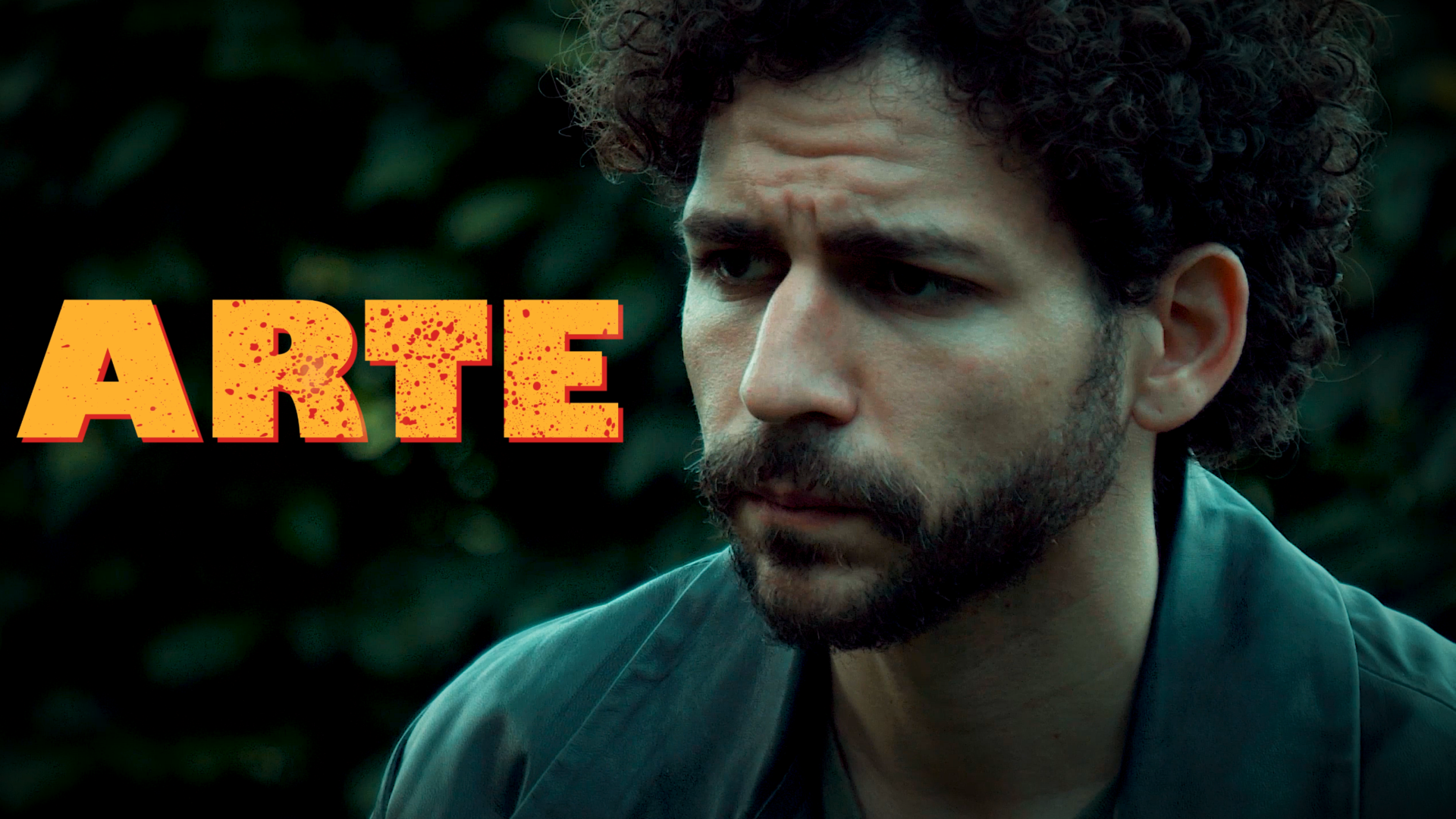
Drama, thriller, by Stefano Scala, Simone Arcidiacono, Italy, 2023.
In a secret and fascinating world, four people meet every week at the mysterious "The Circle" for a gripping game, knowing nothing about each other. However, fate has a different plan for them. As the game progresses, their lives begin to intertwine in unpredictable ways. The boundaries between the game and reality start to blur, revealing buried secrets and creating unthinkable connections. In the heart of "The Circle," the masks fall, and the players' lives will be forever changed.
LANGUAGE: Italian
SUBTITLES: English, Spanish, French, German Portuguese
Vitangelo Moscarda and the Architecture of Imposed Identity
You are standing in front of a mirror you have looked into a thousand times, and for the first time you see something that was always there. Not a new flaw, not a change — something permanent, structural, belonging to you before you were old enough to know your own name. Your wife mentions, almost without interest, that your nose tilts slightly to the right. She is not being cruel. She does not even pause to watch the remark land. But it lands like a blade finding the gap between armor plates, and suddenly the man you believed yourself to be — the man you have been narrating internally for decades — has a face you have never actually seen.
This is how Luigi Pirandello opens the catastrophe at the center of his 1926 novel, not with a philosophical argument but with a nose. Vitangelo Moscarda, the protagonist, is a man of inherited wealth, a usurer’s son living on income he did not earn, insulated from the friction of real labor by the comfortable machinery of money and social convention. He has, in short, had every reason never to look too closely at himself, because comfort is precisely what makes introspection unnecessary. It is his wife’s offhand remark that punctures that insulation, and what floods in is not self-knowledge in the liberating sense — it is the vertiginous realization that he has been constructing a self entirely from the inside, while the world has been constructing a completely different one from the outside, and these two projects have never once consulted each other.
Pirandello understood the body not as a vessel for identity but as its first betrayer. The tilted nose is not a metaphor he plants for literary convenience — it is the precise mechanism by which the self loses its claim to sovereignty. Once Moscarda understands that others have been perceiving a physical feature he was blind to, the entire architecture collapses, because the body is supposed to be the one thing that belongs to us most immediately, most privately, most certainly. If that can be unknown to us, then nothing in the register of selfhood is safe. What follows in the novel is not a journey toward self-discovery but a systematic demolition: Moscarda begins cataloguing all the ways in which others know him differently, perceive him differently, have named and filed and stored a version of him that he was never consulted about. He counts at least a hundred thousand versions of himself living in the minds of those around him, none of which correspond to the nobody he finds when he searches inward.
The philosophical weight here draws directly from Pirandello’s earlier theoretical work, his 1908 essay “L’umorismo,” where he distinguishes between the comic and the humorous by precisely this structure of double consciousness — seeing a thing and simultaneously seeing its underside, its contradiction, the mechanism behind its surface. The humorist, for Pirandello, does not laugh at the mask; he feels the mask’s pressure on the face beneath it, and the pain of that pressure is what generates the particular quality of Italian verismo pushed into existential territory. Moscarda is not a comic figure despite all the absurdity surrounding him — he is a humorous one in exactly this technical sense, because he cannot stop feeling the weight of what others have made of him.
What Pirandello refuses to do, and what most novelists before him had always done, is offer the protagonist a stable interior as compensation for the unstable exterior. The Romantic tradition had given us interiority as refuge — however the world misreads you, the self knows itself. Moscarda destroys that consolation completely. He searches inside and finds not a solid core but an absence so complete it functions almost like a presence, a nobody so total it begins to resemble the only honest thing he has ever encountered about himself.

One Hundred Thousand Prisons Without Bars
You wake up one morning and realize that somewhere across the city, a woman who was once your closest friend still carries a version of you frozen at twenty-three — reckless, a little cruel, certain of things you have long since stopped believing. She has never updated the file. Why would she? The image she holds is complete enough to function, to explain her behavior toward you whenever you happen to cross paths, to justify the slight tension in her voice. You are not a person to her anymore. You are a verdict she reached years ago and never reopened.
This is the architecture Pirandello tears open in One, No One and One Hundred Thousand, published in 1926 after more than a decade of intermittent composition. Vitangelo Moscarda discovers that his wife sees the tilt of his nose differently than he does, and what should be a trivial domestic observation detonates into an existential crisis of extraordinary scope. He begins cataloguing the versions of himself that exist in other people’s minds — the banker’s son, the useless husband, the eccentric, the madman — and finds that he cannot locate himself in any of them. Each person who has registered him has done so the way a camera registers a subject: in a single frozen instant, under specific light, at one particular angle, with all the distortions of the lens and the mood of the photographer. The result is not a portrait. It is a prison cell built in someone else’s imagination, and the prisoner never agreed to enter.
William James, writing in 1890 in The Principles of Psychology, observed something that his contemporaries were not entirely prepared to absorb: a man has as many social selves as there are individuals who recognize him. James meant this not as a metaphor but as a psychological description of how identity is actually constructed in social life. The self, for James, is not a unified interior substance but a distributed phenomenon, scattered across relationships, each instance shaped by the perceptions and needs of the perceiving party. What Pirandello does, thirty-six years later and from within a completely different intellectual tradition, is take James’s clinical observation and push it to its savage logical conclusion: if your social self is genuinely multiple, and if the people who perceive you hold fixed images rather than living impressions, then you are simultaneously imprisoned in a hundred different cells, serving a hundred different sentences, for crimes you may not recognize as your own.
The mechanism is not malicious. That is what makes it so difficult to resist. The people who crystallize us do so out of cognitive necessity. The brain cannot afford to re-evaluate every relationship from scratch each morning; it relies on established patterns, stored impressions, predictive models. This is not a failure of character — it is how perception works at the neurological level, a point the American psychologist Jerome Bruner would make much more explicitly in his work on social perception in the mid-twentieth century. But what is efficient for the perceiver is annihilating for the perceived. Every time someone acts toward you based on the stored image rather than the living person standing in front of them, they are, in a very precise sense, interacting with a ghost.
Moscarda’s particular torment is not that people misunderstand him. It is that they understand some past version of him with perfect consistency and complete fidelity, and that this consistency functions as a wall. The hundred thousand versions of him are not random distortions — they are coherent, stable, internally logical portraits, each one accurate to the moment of its creation. Their accuracy is exactly the problem. A caricature you can dismiss. A portrait painted with genuine attention, just frozen in time, just sealed off from revision — that you cannot argue with, because it was once true, and the person holding it has no reason to know that it no longer is.
The Kempinsky Method

Drama, by Federico Salsano, Italy 2020.
The introspective imaginary road movie of a man in the maze of his own mind, his memories of his youth, his never dormant passions and contradictory truths. The road is made of water, the destination is falsely unknown. His traveling companions are three mysterious men, projections of his imagination and of different aspects of his personality: the perennial melancholy, the crazy creative, the introverted child. He is also followed by a female presence that tells the umpteenth human story. At a certain point of the crossing he decides to abandon the boat and his ghosts of him diving into the sea and arrives swimming on a deserted beach, naked, with a small Pinocchio puppet closed by a padlock.
In this splendid film life is like a long sea voyage and the human being is a small creature confronting immensity. Sometimes the ocean is calm, other times there are terrible storms. Sometimes we are captains of a boat with a well-defined route, other times we are shipwrecked in search of a land in which to save ourselves. But despite the long journey and the movement in physical space, there are other questions that resonate in the mind: who are these men I travel with? What is the mystery of this immense mass of water that seems to be made of my memories? You can circumnavigate the whole world but the main question always remains the same: who am I really?
LANGUAGE: italian
SUBTITLES: english, spanish, portuguese, german, french
The Trap Built by Naming
You have been called by your name so many times that you have stopped hearing it as a sound and started hearing it as a verdict. Somewhere in your childhood, before you could object, a word was pressed onto you like a brand, and the world organized itself around that word ever after — your face, your habits, your failures, your small treacheries, all filed neatly beneath it. Vitangelo Moscarda notices one morning that the nose on his face tilts slightly to the right, a detail his wife mentions with casual indifference, and this trivial anatomical fact detonates something he cannot name precisely because the problem is naming itself.
Ferdinand de Saussure, working in Geneva in the early twentieth century and posthumously published in 1916 through his students’ reconstruction of his lectures as the Cours de linguistique générale, established that the linguistic sign is arbitrary — the word “tree” has no natural connection to the object it designates, only a social contract enforced by repetition. What Saussure described as a structural condition of language, Pirandello experienced as an existential wound. The moment a name is attached to a person, the same arbitrary and violent logic applies: the word is not the person, but the word wins. It always wins. Because language does not merely describe — it legislates. It tells others, and eventually the named one, what they are allowed to be.
Roland Barthes extended this brutality outward into culture when he identified in 1957 how myth operates not by lying but by naturalizing — by taking historical, contingent, man-made constructions and presenting them as obvious, eternal, simply the way things are. A name is one of the most efficient myths a society produces. “Moscarda” is not just a label; it carries class, family history, the reputation of his father’s usury, a physiognomy others have already decided on. What looks like identification is actually containment. The noun functions as mythology in the precise Barthesian sense: it empties the living complexity of a person and fills the hollow with a social image that serves the community’s need for predictability.
Moscarda spends the novel trying to destroy that image, not through silence but through excess — by doing things so inconsistent with what “Moscarda” supposedly is that the noun buckles under the contradiction. He evicts a tenant generously, gives away his inheritance, behaves without apparent motive, and the town reads each act not as a rupture of the category but as confirmation that he was always strange, always unstable — because the category absorbs contradiction rather than breaking from it. This is the trap’s real architecture: the social name is not falsified by counterevidence. It metabolizes counterevidence. Every act that should disprove the label is reinterpreted to sustain it, because the people doing the interpreting need the label more than they need the truth.
There is something structurally identical between this and what the sociologist Erving Goffman documented in Stigma in 1963 — the process by which a marked identity colonizes the entire person, so that everything they do is read through the mark first, the person second, and usually never. Goffman was writing about disability, race, and social disgrace, but the mechanism is the same one Pirandello dramatized forty years earlier through a relatively comfortable bourgeois who simply made the mistake of looking in a mirror too carefully. The horror is that you do not need to be exceptional, stigmatized, or extraordinary to disappear inside your own name. You only need to exist in a society that requires stable nouns to function, and every society does.
What Moscarda’s rebellion ultimately confronts is not other people’s cruelty but language’s structural indifference to the interior life it claims to represent — a system that was never designed to hold a person, only to locate one.
Identity as a Social Contract You Never Signed
Imagine you are halfway through a sentence at a dinner table — formal, candlelit, the silverware arranged with the quiet authority of institutions — and you realize, with a clarity that feels almost physical, that you did not choose the words currently leaving your mouth. The sentence is finishing itself. The anecdote you are telling, the register you are using, the slight self-deprecating laugh you will insert at the end — none of it was decided. It was convened. The room convened it: the host’s expectations, the professional titles of the people across from you, the particular way the wine was poured, the social altitude of the occasion itself. Stopping mid-sentence would require a kind of rupture that no one at that table has agreed to survive. So you finish the sentence. You insert the laugh. You become, for the next two hours, exactly what the room needed you to be. And the most unsettling part is that you are quite good at it.
Erving Goffman spent years documenting exactly this phenomenon, not as an aberration of weak personalities but as the fundamental architecture of social life itself. In The Presentation of Self in Everyday Life, published in 1959, he argued that the self is not something a person carries into a situation and then expresses. It is something a situation produces, through the collaborative pressure of everyone present. Goffman borrowed the vocabulary of theater — front stage, back stage, performance, audience — not as metaphor but as literal structural description. Every interaction is a scene being negotiated in real time, with implicit stage directions that no one wrote down and everyone follows. The individual is less a sovereign consciousness and more a responsive actor, adjusting their performance to maintain what Goffman called face: the social image that the group has tacitly agreed to uphold for you and that you are expected to uphold in return.
What makes this more than sociology is the recognition that the performance is not experienced as performance. That is the trap’s elegance. The person at the dinner table is not conscious of playing a role, because the role has been rehearsed across decades until it coincides with the sensation of being authentic. Childhood teaches you which version of yourself receives warmth and which receives withdrawal. Adolescence punishes deviation with an efficiency that no formal institution could match. By adulthood, the performance has been internalized so completely that the actor no longer feels the costume — which is precisely when the costume becomes the skin.
Pirandello understood this twenty years before Goffman formalized it. Vitangelo Moscarda’s entire crisis in One, Nobody, and One Hundred Thousand erupts the moment he catches himself from outside — glimpsing, in someone else’s casual remark about his nose, the unbridgeable gap between the self he experiences from within and the self that has been assigned to him by every pair of eyes that has ever landed on him. What collapses for Moscarda is not his identity but his belief that he ever held it. The hundred thousand selves that other people carry in their minds under his name are not distortions of some truer original. They are the only version of him that exists socially — which, in a world made entirely of social contracts, means they are the only version that exists at all.
The contract metaphor is worth pressing on, because contracts imply consent. You did not sign this one. No one asked whether you agreed to become the responsible older sibling, the reassuring colleague, the person who always handles logistics, the one who never cries in public. These identities were imposed through accumulated social expectation, quietly, across years, the way sediment becomes stone — and then one day someone asks you who you are, and you reach for the sediment as if it were your hand.
A vision curated by a filmmaker, not an algorithm
In this video I explain our vision
The Historical Moment That Made Moscarda Inevitable

You are standing in a government office in Rome, 1926, holding a document that insists you are a single person. It has your name on it, your date of birth, your profession, your address. It has been stamped. It is official. The bureaucrat behind the desk looks at you the way a naturalist looks at a pinned specimen — with the calm satisfaction of something correctly classified. This is not a minor administrative inconvenience. This is the philosophical premise of the modern state made paper.
Luigi Pirandello published Uno, Nessuno e Centomila in serial form beginning in 1925 and as a complete novel in 1926, the same year Mussolini formally dismantled what remained of Italian parliamentary democracy and declared the construction of the totalitarian state. The proximity is not coincidental and should not be treated as atmosphere. Pirandello was writing during the precise historical moment when the Italian state was asserting, with unprecedented institutional aggression, that the individual had a fixed, legible, administrable identity — that the self was a knowable object, a unit that could be conscripted, catalogued, taxed, mobilized, and if necessary disappeared. The novel’s obsession with Vitangelo Moscarda’s inability to be any single coherent person is not a private psychological crisis dressed in literary clothing. It is a diagnosis of what the political apparatus of his era required the human being to become.
Michel Foucault, working decades later in Discipline and Punish (1975), would give this dynamic a name and a genealogy: the modern state produces what he called the “docile body,” a subject whose legibility to power is the condition of their participation in society. To be administered, you must be fixed. To be fixed, you must agree — consciously or through exhaustion — to be seen as one thing. Pirandello’s Moscarda resists this not through political action but through ontological refusal. He cannot stabilize himself into the single figure his wife, his associates, and eventually the legal and financial institutions around him require. And what the novel reveals, quietly and devastatingly, is that this instability is not his pathology. It is his accuracy.
Fascist ideology in its Italian variant was philosophically invested in the idea of the unified subject — not the autonomous liberal individual, but the individual dissolved upward into the collective will of the nation, the race, the Duce. Giovanni Gentile, who served as Mussolini’s Minister of Public Instruction and was the regime’s most sophisticated philosophical apologist, argued in his actualist idealism that the true self was realized only through participation in the ethical state. The fractured, self-doubting, socially illegible figure Pirandello was constructing in fiction was precisely the kind of subject that Gentile’s philosophy — and the apparatus building itself around that philosophy — could not accommodate. Fragmentation was not merely aesthetically unfashionable. It was politically suspect.
What makes the novel’s intervention so strange and so durable is that Pirandello was himself, at this moment, a public supporter of the regime. He joined the National Fascist Party in 1924, publicly defended it, and later accepted the directorship of the Teatro d’Arte di Roma under Mussolini’s patronage. This biographical fact does not collapse the novel’s critical force — it complicates it in ways that should make any reader uncomfortable. The man writing the most radically anti-identitarian Italian novel of the century was simultaneously offering his own identity, stamped and legible, to the state that required fixed subjects. Whether this is contradiction, compartmentalization, or a form of terror so internalized it produced its opposite in art, the question remains open and unanswerable, which is perhaps the only honest position to hold.
The state needs you to have a nose that is slightly crooked in a specific, recordable direction. It needs your wife to know which version of you comes home at night. It needs Moscarda to be the banker’s son and nothing else, because everything else is ungovernable, and the ungovernable is always, in the end, the first thing a consolidating power moves to
The Dissolution That Is Not Liberation
You are standing at the edge of a field at dusk, and the last thing you expected was to feel nothing. Not peace. Not relief. Just the particular emptiness of a man who has stopped arguing with the walls of a room he has already left. This is where Vitangelo Moscarda arrives at the end of Pirandello’s novel, and generations of readers have made the mistake of calling it arrival.
The romantic reading of Moscarda’s dissolution is seductive precisely because it borrows the grammar of spiritual liberation without paying its philosophical debts. He withdraws from society, renounces his name, his property, his social identity, and surrenders to a kind of formless presence in the world — a new man in every moment, unanchored from the prison of fixed selfhood. Critics have returned to this ending repeatedly as though it were an affirmation, a hard-won transcendence, a Zen-inflected victory over the tyranny of the constructed self. But this reading performs an act of selective blindness that the novel itself does not authorize.
Friedrich Nietzsche, in The Gay Science published in 1882, described the death of God not as a liberation but as a catastrophe whose full weight humanity had not yet begun to feel. The madman who announces it in section 125 is not celebrating. He is horrified. He asks who gave us the sponge to wipe away the entire horizon, and the question is not rhetorical — it is a diagnosis of vertigo, of the nausea that follows when the organizing principle of a world is removed and nothing has yet grown to replace it. What Pirandello stages in Moscarda’s final pages is structurally identical, except the horizon being wiped away is not divine but personal. The stable self — the one that anchors desire, memory, social continuity, ethical commitment — is declared dead. And the man left standing in its absence is not free. He is weightless in the way a body is weightless in freefall.
Weightlessness is not the same as flight. This is the distinction that celebratory readings of the novel consistently refuse to make. Moscarda does not transcend the trap of social identity by discovering something truer beneath it. He survives it by becoming unreachable to it, which is a fundamentally different operation. A person who cannot be located cannot be trapped, but they also cannot be found, cannot be loved in any sustained way, cannot be responsible to anyone, cannot build. The dissolution Pirandello depicts is not a solution to the problem of identity — it is the point at which the problem becomes so acute that the self simply stops functioning as a unit of meaning.
There is something deeply honest in the novel’s refusal to sentimentalize this. Moscarda does not end up happy. He ends up outside happiness as a category, outside suffering as a category, outside the whole grammar of a human life as it is ordinarily conducted. He describes the sensation of living moment to moment, unrecognizable to himself, and what he describes is not enlightenment — it is dissociation. The clinical literature on depersonalization disorder, particularly the work developed through Pierre Janet’s late nineteenth-century studies on psychological automatism, describes almost exactly this phenomenology: the feeling of observing oneself from outside, the collapse of the narrative thread connecting past to present to future, the strange flatness of a world that has lost its grip.
To read Moscarda’s ending as freedom requires ignoring what freedom actually costs in practice. It requires treating the absence of constraint as though it were the same thing as the presence of possibility. But a man who has dissolved his selfhood has also dissolved the agent who would exercise that freedom. He has not escaped the hundred thousand versions of himself that others imposed on him. He has simply stopped being the nobody who was fighting them, which is not a victory so much as a kind of voluntary
What the Novel Refuses to Offer You
You have been waiting, without perhaps knowing it, for the moment when the novel hands you something to carry out with you — a technique, a reorientation, a way of standing differently inside your own life. That moment does not come. Pirandello is not withholding it out of cruelty or artistic perversity; he is withholding it because it does not exist, and the entire architecture of the book has been constructed to make that absence undeniable rather than decorative.
Vitangelo Moscarda does not arrive at a reconstructed self. He arrives at a village charity house, stripped of property, name, and social function, watching light move across a wall and telling himself that he dies every instant only to be reborn without memory in the next. Readers have sometimes mistaken this ending for enlightenment — a kind of Italian Zen, the ego finally dissolved into pure presence. But that reading requires ignoring the fact that Pirandello gives his character nothing to do with this dissolution, no community, no language that reaches another person, no inhabitable life. What looks like liberation is clinically indistinguishable from annihilation. The novel does not celebrate this. It simply refuses to look away from it.
Simone de Beauvoir, writing in 1947 in The Ethics of Ambiguity, made a related observation from a different philosophical direction: bad faith is not a stable position. You cannot permanently inhabit the pretense that your identity is fixed, natural, and unchosen, because existence itself keeps breaking through. The flight from freedom is always temporary, always requiring maintenance, always on the verge of collapse under the weight of the very consciousness it tries to suppress. What de Beauvoir understood, and what Pirandello had dramatized two decades earlier without offering her solution, is that the exposure of bad faith does not automatically produce good faith. There is a gap between the collapse of the false and the construction of the livable, and that gap is not a brief corridor — it can be a room you live in for years, or a room you never leave.
The social machinery that produces identity does not pause while you renegotiate your relationship with it. The forms still arrive with your name on them. The people who love you still use the word they have always used when they want your attention. The institutions that granted you credentials, credit, and civic standing encoded a version of you that they will continue to cite regardless of any interior revision you attempt. Identity, in the practical world, operates on a subscription model: others renew it for you constantly, whether or not you consented to the original terms.
This is the specific discomfort the novel engineers and declines to relieve. It does not argue that the self is an illusion in the abstract philosophical sense — that is a much easier claim to absorb and dismiss. It argues that the self you believe to be most intimately yours, the one prior to performance and social role, the one that feels like bedrock, was assembled by forces that predate your capacity to evaluate them, installed before you had any framework for refusal. The name your parents chose, the language that shaped the categories in which you think, the decade you were born into and the class position that calibrated your expectations — none of these were submitted for your approval, and yet they constitute what you experience as the interior life you defend.
So the question the novel leaves open is not philosophical in the comfortable, seminar-room sense. It is immediate and slightly vertiginous: the name you answer to without hesitation, the one that feels so obviously yours that hearing it spoken in a crowd will turn your head before your mind has registered anything — where, exactly, did you acquire the certainty that it belongs to you, and has that certainty ever actually been tested, or merely assumed so long it passed for knowledge?
🪞 Mirrors of the Self: Identity, Masks, and Fragmented Souls
Pirandello’s meditation on the dissolution of the self in ‘One Nobody and One Hundred Thousand’ resonates across literature and philosophy wherever identity becomes a labyrinth with no exit. These articles trace the same vertiginous question through different authors and traditions: who are we beneath the masks others force upon us?
The Double in Literature: From Dostoevsky to Stevenson
The literary double has haunted writers from Dostoevsky to Stevenson, reflecting a deep cultural anxiety about the coherence of selfhood. Like Pirandello’s Vitangelo Moscarda, who discovers he is a stranger to himself through another’s gaze, the doppelgänger tradition stages the terror of encountering one’s own multiplicity. This article maps the symbolic and psychological terrain of that uncanny encounter across European literature.
GO TO THE SELECTION: The Double in Literature: From Dostoevsky to Stevenson
Hesse’s Steppenwolf: Analysis
Hesse’s Steppenwolf presents a protagonist torn between bourgeois identity and a wilder, uncontainable inner nature, much as Pirandello’s hero is shattered by the realization that identity is socially constructed and infinitely malleable. Both novels use a crisis of self-perception as the engine of a radical existential journey. Reading them together illuminates how modernist fiction turned the instability of the self into its central subject.
GO TO THE SELECTION: Hesse’s Steppenwolf: Analysis
Jacques Lacan and the Mirror Stage
Lacan’s mirror stage offers a psychoanalytic framework that illuminates Pirandello’s narrative with striking precision: the self is constituted through an external, alienating image reflected back by others. Just as Moscarda is undone by what his wife sees in him, Lacan argues that our very sense of ‘I’ is a fiction born from misrecognition. This article unpacks that foundational concept and its lasting influence on literature, film, and cultural theory.
GO TO THE SELECTION: Jacques Lacan and the Mirror Stage
Kafka and Bureaucracy: The Trial and The Castle
Kafka’s bureaucratic labyrinths in ‘The Trial’ and ‘The Castle’ trap their protagonists in a world of opaque social machinery that assigns identity from the outside, denying any authentic selfhood—a predicament closely related to Pirandello’s vision of the self as a social imposition. The anonymous forces that define Josef K. or K. are not unlike the hundred thousand faces others project onto Moscarda. This article explores how Kafka transforms institutional absurdity into one of literature’s most haunting meditations on identity and power.
GO TO THE SELECTION: Kafka and Bureaucracy: The Trial and The Castle
Discover the Cinema of the Fragmented Self on Indiecinema
If these reflections on identity, masks, and the labyrinth of the self have stirred something in you, Indiecinema’s streaming platform offers a curated selection of independent films that explore the same existential depths. From avant-garde explorations of consciousness to intimate portraits of fractured lives, our catalog invites you to keep searching — one frame at a time.
👉 EXPLORE THE CATALOG: Watch Indie Films in Streaming
A vision curated by a filmmaker, not an algorithm
In this video I explain our vision

