
The Ghost at the Threshold
You are walking home along a road you have taken a thousand times, and something is wrong with the light. Not the darkness itself — you know darkness — but the quality of a shadow that does not belong to any object you can identify. Your feet slow before your mind gives the instruction. Your chest tightens around something older than language. And in that suspended second, before rationality reassembles itself and supplies its usual sedatives, you are already inside the oldest archive Japan has ever built.

Japanese folklore is not a collection of charming stories for children or a museum exhibit of peasant superstition. It is a precision instrument. For more than a millennium, the archipelago’s oral and written traditions have been encoding, in the bodies of spirits and demons and wandering dead, everything that a rigidly hierarchical society could not allow its members to express in direct speech. The yokai, the yurei, the oni — these are not failures of scientific understanding. They are diagnostic categories for social wounds that had no other legitimate vocabulary. When a culture forbids the direct articulation of grief, rage, shame, or injustice, those forces do not disappear. They find form.
The earliest systematic engagement with this idea appears in the Kojiki, compiled in 712 CE at imperial command, a text that modern scholars like Donald Philippi have shown to be not a mythology in the Western sense but a political cosmology — a way of anchoring the authority of the Yamato court inside a framework of divine precedent. What is striking is not what the Kojiki includes but what it reveals about the emotional architecture of the culture constructing it. The dead are restless. The boundary between the living and the dead is not a wall but a membrane, perpetually under pressure from the side that cannot speak. Izanami, abandoned in the underworld, does not simply grieve. She becomes dangerous. Her transformation from wife to threat is one of the oldest recorded equations in Japanese cultural logic: unacknowledged suffering becomes a force that pursues.
This equation did not remain confined to aristocratic texts. By the Heian period, roughly 794 to 1185, the capital at Kyoto was structured in part around the management of vengeful spirits — goryo — those of people who had died in circumstances of injustice or neglect. The Gion Festival, which still takes place every July in Kyoto, began not as a celebration but as a ritual quarantine, a civic attempt to contain the fury of Sugawara no Michizane, a scholar-official who died in exile in 903 after being politically destroyed by rivals. When plague and disaster followed, the explanation was not metaphorical. It was administrative. A specific injured party required specific ceremonial address. The entire city organized itself around this acknowledgment, and the festival that emerged from that negotiation has run for over twelve hundred years without interruption, making it one of the longest continuously practiced expressions of collective psychological reckoning in human history.
What this reveals is something that the anthropologist Norbert Elias spent much of The Civilizing Process, published in 1939, trying to articulate for European culture: that the refinement and formalization of social behavior does not eliminate violent or disruptive emotional energies. It displaces them. Japan’s displacement mechanism was exceptionally sophisticated, because it did not merely suppress these energies — it gave them names, addresses, ritual protocols, and aesthetic forms. A spirit could be painted. A demon could be worn as a mask. The unbearable could be given a face and, once given a face, could be approached, negotiated with, temporarily appeased. This is not superstition operating in the absence of better tools. It is a technology of the intolerable, developed by a society that understood, long before psychoanalytic theory formalized the insight, that what cannot be spoken will be enacted — and that it is safer to stage the enactment on controlled ceremonial ground than to wait for it to arrive uninvited on a darkened road.
When the Supernatural Was Administrative
You are a scribe in the eighth century, and your task is not to worship the gods but to file them.
The Nara period produced two of the most consequential documents in Japanese cultural history within eight years of each other — the Kojiki in 712 and the Nihon Shoki in 720 — and the received wisdom has always been to read them as the spiritual inheritance of a people, the sacred wellspring of Shinto cosmology, the ancient breath of the Japanese soul made manuscript. This reading is precisely what those texts were engineered to produce. Commissioned by imperial decree under Emperor Tenmu and completed under Empress Genmei, both works were acts of statecraft first and cosmology second. The gods did not inspire these chronicles. The Yamato court assembled them.
What was actually happening in 710, when the capital was formally established at Nara, was the construction of a centralized Chinese-style bureaucratic state on an archipelago where political authority had never been fully unified. The Taika Reform of 645 had already attempted to model Japanese governance on Tang dynasty administrative codes, redistributing land, restructuring taxation, and reorganizing the provinces under imperial appointment. The problem was legitimacy. You can redistribute land through force, but you cannot manufacture the sense that the redistributor was always meant to rule. That requires mythology — and mythology, in this context, meant something much more precise than story. It meant genealogy.
The Kojiki traces the imperial line directly to Amaterasu, the sun goddess, through an unbroken chain of divine descent that conveniently terminates in the Yamato emperors. The function of this genealogy was identical to what the sociologist Max Weber, writing in Economy and Society in the early twentieth century, called the legitimation of domination through charismatic authority — the ruler claims not merely military or administrative supremacy but an ontological right to govern, embedded in the structure of the cosmos itself. Amaterasu dispatches her grandson Ninigi to rule the earth, and from that descent every emperor draws his mandate. The supernatural has not been recorded; it has been deputized.
What makes this especially legible as administrative logic is the treatment of rival clans. Japan in the seventh and eighth centuries was not ethnically or politically monolithic. The Izumo region had its own distinct mythological tradition centered on the god Okuninushi, whose cult commanded deep loyalty across significant portions of the archipelago. The Nihon Shoki does not suppress Okuninushi — it stages his submission. In a narrative episode that reads less like theology than like a treaty, Okuninushi surrenders his earthly dominion to the heavenly deities, ceding the land willingly, his power acknowledged and then permanently subordinated. Rival spiritual geography absorbed, neutralized, and filed under imperial jurisdiction.
The historian Herman Ooms, in his 2008 work Imperial Politics and Symbolics in Ancient Japan, makes the case that these early chronicles functioned as what he calls political theology — a system where cosmological narrative and administrative ambition are not in tension but are structurally identical. The gods are not invoked to sanction power from outside it; they are woven into the architecture of power so completely that questioning one requires dismantling the other. This was not uniquely Japanese — the Carolingian dynasty was performing almost identical operations with Christian hagiography at roughly the same historical moment — but the Japanese version has proven unusually durable, its logic surviving into contexts that would have bewildered its original architects.
What gets lost in treating these documents as folklore rather than statecraft is the sophistication of the mechanism. Folklore implies something that bubbled up from the people, something anonymous and accretive, the long slow sediment of collective imagination. The Kojiki was dictated by a court-appointed memorizer named Hieda no Are and transcribed by a court official named O no Yasumaro under explicit imperial commission, with specific political outcomes required before a single character was brushed onto the page.

The Thousand Faces of Yokai
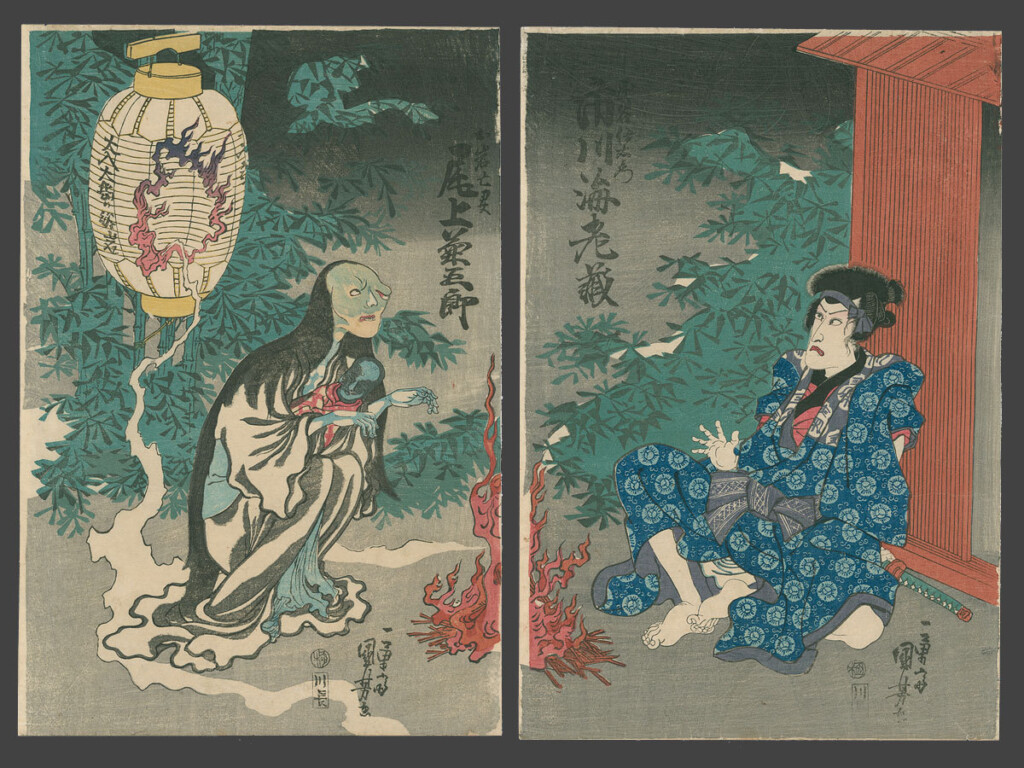
You have pulled a drawer open in a museum archive and found, stacked in careful rows, hundreds of hand-painted creatures — each with a name, a habitat, a set of specific behaviors. They do not look chaotic. They look organized. This is precisely the uncanny part.
The Edo period, which ran from 1603 to 1868, was a stretch of enforced internal peace under the Tokugawa shogunate, a system so architecturally rigid it dictated which roads merchants could travel, which fabrics peasants could wear, which words could be printed without inviting punishment. Into this sealed container, something had to go. What went in was monsters. Not metaphorical ones — illustrated ones, named ones, cross-referenced ones, sold in woodblock-printed volumes at urban bookshops to readers who had disposable income and an appetite for the organized uncanny.
Toriyama Sekien published his first illustrated compendium of supernatural beings, the Gazu Hyakki Yakō — translated roughly as “The Illustrated Night Parade of a Hundred Demons” — in 1776. He followed it with three more volumes, cataloguing creatures pulled from regional legend, classical literature, and, when those sources ran dry, his own invention. What matters is not the inventory itself but the gesture of inventory. Sekien was an artist and a teacher of the ukiyo-e tradition, which means he understood visual pleasure and mass reproduction simultaneously. He knew that a monster given a name and a fixed visual form becomes, in some precise sense, less monstrous. It becomes legible. And legibility is the first cousin of control.
The sociologist Norbert Elias, writing in “The Civilizing Process” in 1939, traced how European courts gradually displaced physical violence into symbolic codes of manners and taste. The logic was analogous in Edo Japan: energy that could not be expressed politically found other channels, and the publishing market — itself a relatively new mass phenomenon, expanding rapidly in the eighteenth century through commercial houses in Osaka and Edo — became one of those channels. Fear was repackaged as entertainment, and entertainment was sold by the sheet.
What makes the yokai encyclopedias strange, when you sit with them, is that the creatures they describe are almost never apocalyptic. They are not end-of-world figures. They are figures of inconvenience, of contamination, of boundary confusion. The kappa, the river child, who drowns horses and challenges unwary travelers to sumo — it is negotiable. Bring it a cucumber, bow to it, and it bows back, spilling the water from the hollow of its head and losing its power. The tengu, the mountain spirit with its elongated nose and feathered cape, disrupts religious hierarchies and humbles arrogant monks — it is satirical. The nurikabe, an invisible wall that stops travelers on lonely roads at night, is barely even threatening; it is an inconvenience made visible. A society that codifies its supernatural threats in terms of inconvenience and negotiable danger is telling you something about what it is permitted to fear.
Politically, the Tokugawa period suppressed peasant uprising, restricted foreign contact with near-total ferocity after the Sakoku edicts of the 1630s, and maintained social hierarchy through a caste structure that criminalized lateral movement. The legitimate targets of fear — the magistrate, the rice tax, the crop failure that would not be discussed in any printed text without risk — were invisible in the monster catalogs. What filled those catalogs instead were creatures born from abandoned umbrellas, from overused sandals, from neglected household objects. The tsukumogami, the animated artifacts, were the supernatural consequence of waste and forgetting. In a period when consumption was itself regulated by sumptuary laws, the idea that your old sandal might turn against you if you discarded it carelessly is not superstition — it is economic anxiety wearing a painted face.
Sekien’s fourth volume, the Hyakki Tsurezure Bukuro of 1784, contains creatures he largely invented himself, thinly veiled parodies of human social types dressed in supernatural costume. By that point the catalog had consumed its own original material and begun to eat social reality directly, which is when you know the system has become something other than folklore.
What Women Become When They Are Not Allowed to Grieve
You are standing at the edge of a well in the dark, and you already know something is wrong before you see anything. The wrongness precedes the image. It lives in the air, in the stillness, in the particular quality of silence that surrounds a place where something was swallowed and never spoken. This is not horror as entertainment. This is recognition.
Tsuruya Nanboku IV staged his masterwork in Edo in 1825, and audiences did not simply watch it — they absorbed it as confirmation of something they had collectively refused to name. Yotsuya Kaidan gave the culture its most enduring female ghost: Oiwa, a wife slowly poisoned by a husband who wanted a wealthier replacement, her face disfigured by the very remedy she was handed as kindness. She dies without recourse, without witness, without legal standing. What she becomes afterward is not metaphor. It is a structural inevitability. Feudal Japanese law under the Tokugawa shogunate offered women almost no mechanism for formal grievance. Divorce was largely a male prerogative, codified in what were colloquially called “three-and-a-half-line letters” — the husband’s written repudiation sufficient to dissolve a marriage, while a wife’s desire to leave required either temple sanctuary or extraordinary circumstances. Betrayal, abuse, slow erasure — none of these met the threshold.
What the legal system foreclosed, the supernatural opened. The onryō tradition did not emerge from nowhere; it crystallized a pre-existing cosmological logic in which extreme emotional states — particularly jealousy, grief, and longing in women — were understood to generate spiritual force. The Heian-era text Genji Monogatari, composed around 1008 by Murasaki Shikibu, already stages this: Lady Rokujō’s living spirit, her ikiryo, leaves her sleeping body and attacks the women who have displaced her in Genji’s attention. She does not choose this. Her resentment is so total, so uncontainable, that it acts independently of her will. The horror here is not possession but overflow — a woman whose interior life exceeds every vessel her society has constructed to hold it.
What distinguishes the onryō from other categories of vengeful spirit across world mythologies is the precision of its grievance. These are not random hauntings. The female ghost in this tradition returns to specific people, for specific reasons, across specific thresholds of time. Folklorist Noriko Reider’s scholarship on supernatural femininity in Japanese narrative tradition traces how the yūrei’s physical markers — disheveled black hair, white burial kimono, the downward float that removes her from the plane of the living — are not arbitrary aesthetic choices but a visual grammar of social death. Women in feudal Japan who were abandoned, murdered, or driven to suicide occupied a kind of ontological borderland even before death. The haunting is merely the continuation of a condition that began in life.
There is a violence in being required to disappear quietly. The entire moral architecture of the period demanded precisely this from women — decorum, self-erasure, the performance of acceptance before circumstances that would have broken anyone. The onryō is what happens when the performance fails at the level of the body, when grief becomes too dense for flesh to contain and bleeds outward into the world as agency. She cannot petition a court. She cannot remarry freely. She cannot speak in the public record. But she can return, and her return is unignorable, and the men who structured her silence must now confront something that cannot be administratively dismissed.
What makes this tradition irreducible to simple wish-fulfillment or cautionary moralism is that the onryō does not ultimately restore justice. She redistributes suffering. Her haunting rarely produces accountability in any legible sense — it produces dread, madness, death, the collapse of households. This is not the satisfaction arc. It is closer to testimony delivered in a language designed to be felt rather than adjudicated, addressed to a society that never built the structures capable of hearing it any other way.
Shintoism’s Convenient Amnesia
You have probably stood before a shrine gate and felt something — not faith exactly, but a pull, a hush, a sense that the air is slightly different on the other side of that vermilion threshold. That feeling is genuinely old. What the gate was made to mean is not.
When the Meiji government formalized State Shinto beginning in 1868, it did not simply elevate a religion. It performed a kind of surgical flattening on centuries of wildly contradictory local belief, cutting away the parts that could not be made to march in formation. The foxes that had once been morally ambiguous tricksters — as likely to ruin a family as to bless it — were reclassified as loyal messengers of Inari, a deity now carefully aligned with agricultural productivity and imperial prosperity. The ambiguity was not a theological accident. It had been the point. A spirit that could harm you demanded genuine respect, negotiation, reciprocity. A spirit rewritten as a state servant demanded only obedience to the regime that claimed to command it.
Historians of religion like Murakami Shigeyoshi, in his 1970 study Kokka Shinto, documented how the bureaucratic machinery of the Meiji and subsequent Taisho and Showa periods methodically separated what officials called “pure Shinto” from the folk practices that had accumulated over a millennium of localized worship. Hundreds of small village shrines were forcibly merged into larger, administratively convenient units under the Shrine Merger Policy of 1906 to 1910, eliminating thousands of sacred sites tied to specific communities, specific landscapes, specific histories of grief and gratitude. An estimated 200,000 shrines were reduced to roughly 110,000 in under a decade. The spirits those smaller shrines housed were not retired gracefully — they were simply made bureaucratically invisible.
What replaced them was the architecture of a usable past. Kokugaku scholars of the eighteenth century, particularly Motoori Norinaga in his monumental forty-four volume commentary on the Kojiki completed in 1798, had already begun constructing a version of Japanese spiritual identity that was racially exclusive and temporally pure — unsullied by Chinese or Buddhist influence, rooted in a divine imperial lineage that descended unbroken from the sun goddess Amaterasu. The Meiji state took this scholarly project and industrialized it. Mythology became curriculum. The creation narratives that had once coexisted in regional variation, where local kami held genuinely local power and allegiance, were standardized into a single authorized cosmology that began and ended with the emperor’s divine body.
The danger in this is not merely historical. When a culture encodes its spiritual life into instruments of state power, it loses something that cannot be legislated back into existence: the capacity for its sacred figures to be genuinely threatening. The oni of older tradition — the horned, club-wielding demons appearing prominently in Heian-era literature and setsuwa tales compiled in collections like the twelfth-century Konjaku Monogatari — were not allegories for foreign enemies or moral failings. They were the uncategorizable, the socially expelled, the things a community could not assimilate. Making them enemies of the emperor gave them a function. It also defanged them completely, because a demon with an assigned role in a national narrative is no longer a demon at all.
A soldier raised on State Shinto doctrine encountered death with a cosmological framework that made self-annihilation on behalf of the imperial body not merely acceptable but spiritually necessary. The kami of fallen warriors, enshrined at Yasukuni beginning in 1869, were not worshipped despite dying in war — they were worshipped because of it. The logic required that death in service to the state be the highest form of spiritual transformation available to an ordinary person, which meant every older tradition suggesting that spirits of the violently dead were dangerous, restless, in need of careful appeasement, had to be quietly removed from the authorized picture.
What the Meiji engineers could not fully erase was the fear underneath.
A vision curated by a filmmaker, not an algorithm
In this video I explain our vision
The Folklore the Tourists Never See

You are standing in a souvenir shop in Kyoto, and every surface is covered with the same seven or eight creatures — the round-eyed tanuki, the fox with its elegant tails, the maneki-neko beckoning from a shelf. The selection feels ancient and inevitable, as though these were the spirits Japan has always offered the world. They were not chosen by accident.
What a culture exports of itself is always a self-portrait painted to be loved. The folklore that travels is the folklore that translates cleanly into charm, into whimsy, into the kind of safely uncanny that a tourist can photograph and carry home without disturbing anything. The darker materials — the ones tied to specific geographies, specific injuries, specific social contradictions — tend not to make the journey. Not because they are obscure, but because they are too honest about what they encode.
In the western prefectures of Shikoku and parts of the Chugoku region, the tradition of the inugami — literally “dog deity” but more precisely a bound familiar spirit created through deliberate ritual torture of a dog — operates as something closer to a social instrument than a ghost story. Inugami possession was documented by ethnographer Kunio Yanagita in his foundational 1910 collection Tono Monogatari and revisited across decades of Japanese folklore scholarship precisely because it functioned as a mechanism for articulating social fear: certain families were said to harbor inugami across generations, and accusation of inugami ownership served as a way of marking and isolating households considered economically threatening or socially transgressive. The creature itself was almost beside the point. What mattered was the accusation, the stigma that could calcify around a family name for a century. This is not folklore as enchantment. It is folklore as a weapon with plausible deniability.
The kuchisake-onna — the woman with the slit mouth who stops children on the street and asks whether she is beautiful — emerged not from medieval woodblocks but from a specific moment: Japan in 1978, when the legend spread through schoolyards with a velocity that alarmed educators and was covered in newspapers as a genuine social panic. Scholars studying the episode, including Isao Kagawa in his analysis of contemporary Japanese legend cycles, noted that the story appeared at precisely the moment when anxieties about physical appearance, cosmetic surgery culture, and the violent pressure on women to meet narrowing beauty standards were sharpening in urban Japan. A woman disfigured by the surgical pursuit of beauty, who now demands that her violence be called beautiful — the subtext is not subtle, but it does not need to be. What is remarkable is how quickly the culture processed it as mere entertainment and moved on, leaving the wound underneath undisturbed.
The satoyama — the managed woodlands and transitional landscapes between mountain and village that structured agricultural life for centuries — carried their own spirit ecologies, and those spirits were directly indexical of land-use conflict. Certain kami were understood to withdraw or turn malevolent precisely when their territory was converted, logged, or absorbed into expanding cultivation. The violence of those spirits in local legend traditions was not metaphorical. It described real friction between communities expanding their resource use and the ecological limits of landscapes that could not absorb indefinite pressure. When post-war Japan’s rapid industrialization consumed the satoyama at scale — by the 1970s, rural landscape conversion had transformed millions of hectares — these spirit traditions lost their geographic anchors and largely vanished from living practice. The tourism economy that later rebuilt interest in rural Japan had no infrastructure for spirits whose entire meaning was an argument about land rights.
What gets exported from any culture’s folklore is never neutral curation. It is an act of selective self-presentation that requires the suppression of everything too local, too litigious, too recently painful to be made into a souvenir.
Animism as Epistemology, Not Spirituality
You walk through a forest in rural Nagano, and the cedar trees do not feel like obstacles or scenery. They feel like they are tracking you. Not metaphorically. The sensation is immediate, pre-linguistic, arriving before the interpretive mind can label it as projection or fantasy. Most visitors from Western cities dismiss this within seconds, reaching for the familiar explanation: it is just the brain pattern-matching, just evolution making us see faces in bark. That dismissal is not a neutral observation. It is a trained reflex, and it was installed deliberately.
Graham Harvey, writing in 2005’s Animism: Respecting the Living World, makes a distinction that cuts through two centuries of anthropological condescension. The older definition of animism, assembled by Edward Tylor in 1871’s Primitive Culture, framed it as the mistaken attribution of souls to inanimate objects — an intellectual error made by people not yet sophisticated enough to distinguish the living from the non-living. Harvey dismantles this completely. What indigenous and traditionally animist cultures practice is not a failure of categorization. It is a different and arguably more precise epistemology: one that begins from the premise that personhood is not exclusive to humans, and that attention to the relational qualities of other-than-human beings constitutes a form of knowledge, not a form of delusion.
Japanese folk cosmology has never needed this defense articulated from outside because it never accepted the premise it is meant to refute. The category of kami does not map onto the Western concept of god, spirit, or soul. It describes something closer to what philosopher David Abram, developing his phenomenological theory of perception in the late twentieth century, called the animate earth — the understanding that sensory experience is always already a conversation, never a one-way extraction of data from passive matter. Abram drew on Maurice Merleau-Ponty’s work on embodied perception to argue that modernity’s severance from what he called the more-than-human world was not philosophical progress but perceptual impoverishment. Japanese animism, in this reading, preserved something that European enlightenment rationalism systematically destroyed.
The practical implications are not minor. When an eighteenth-century Japanese artisan paused before discarding a worn tool and offered a small acknowledgment of gratitude — a gesture that persists in contemporary needle memorial ceremonies, kuyo rituals practiced across craft communities today — this was not superstition performing the role of sentiment. It was a recognition that the object had participated in a relationship, that ending a relationship without acknowledgment produces a kind of ethical residue. Commodity logic cannot survive this epistemology. If a tool has relational standing, it cannot be simply consumed and replaced without remainder. The entire architecture of industrial capitalism depends on the radical passivity of the non-human world, on its absolute availability as resource. Animism makes that availability philosophically indefensible.
This is precisely why Western modernity did not simply ignore animism — it pathologized it. The anthropological literature of the nineteenth and early twentieth centuries is dense with the language of developmental stages, evolutionary hierarchies of thought, children and primitives occupying the same rung on a ladder that climbs toward secular rationalism. That framing was never merely academic. It accompanied colonial land seizures that required the prior inhabitants to be demonstrably wrong about the nature of the land they occupied — wrong in a way that voided their relationship to it. To see a forest as a community of persons is to make it unavailable for clear-cutting. The epistemological question and the economic question were always the same question.
Japan’s historical resistance to full Cartesian disenchantment — uneven, contested, frequently interrupted by its own modernizing impulses during the Meiji period — is not a sign of intellectual lag. The persistence of animist attention in daily practice, in seasonal ritual, in the way certain elderly farmers still address their fields at planting, represents a refusal whose full weight contemporary philosophy is only beginning to measure against what was lost when perception was declared a private, interior event with no binding claims on a mute and ownerless world.
The Living Tradition and Its Open Wound
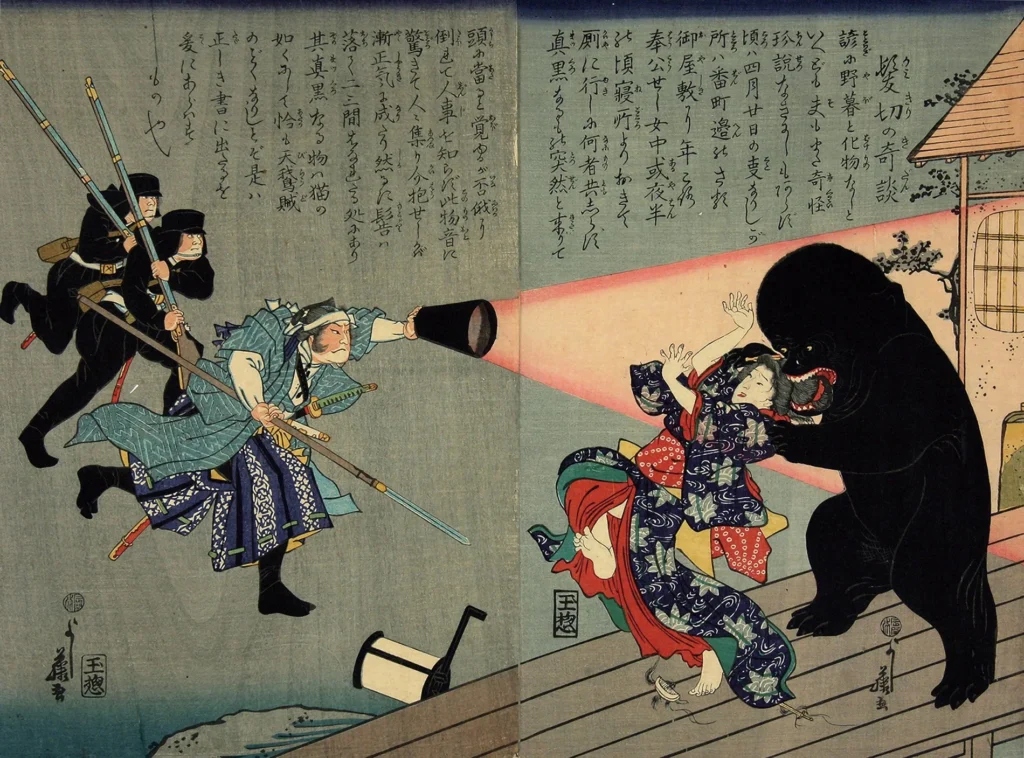
You are standing in a hospital corridor in Hiroshima, August 1945, three weeks after the blast, and the nurses have begun reporting that the dead do not know they are dead. They wander the wards asking for water, asking for family members whose names no one recognizes, and the nurses — trained women, pragmatic women — do not reach for medical explanations first. They reach for older ones.
This is not a failure of modernity. It is modernity revealing the substrate beneath itself, the deep grammatical layer of a culture that had spent centuries developing precise and elaborate languages for exactly this kind of rupture. Japan’s encounter with the atomic bomb did not shatter its folkloric tradition. It fed it, and what grew back was stranger and more durable than anything the original mythology had produced.
The hibakusha, the survivors of the bombings in Hiroshima and Nagasaki, carried not only physical radiation but a social contamination that Japanese culture encoded through proximity to the spirit world. Folklorists documenting testimonies in the 1950s and 1960s found consistent patterns: survivors described the dead as present, visible, insistent, often angry, demanding recognition before they would leave. Yanagita Kunio had already established in his 1910 work “Tono Monogatari” — assembled from oral accounts of a rural community in Iwate Prefecture — that Japanese folk belief treats the unquiet dead not as metaphor but as social problem. The dead become dangerous precisely when their death is violent, unwitnessed, or denied communal mourning. Hiroshima produced tens of thousands of such deaths simultaneously, and the spirit framework that absorbed them was not strained by the scale. It expanded.
What is genuinely unsettling is how radiation anxiety, which has no historical precedent in any culture, was metabolized through existing frameworks of pollution and contagion that predated germ theory by a millennium. The Shinto concept of kegare — ritual impurity spreading from death, blood, or transgression — had always required purification rites to prevent contamination from moving outward into the living community. After 1945, survivors reported feeling kegare-marked not because of any explicit religious instruction but because the social behavior of their communities told them so: avoided, whispered about, excluded from marriage arrangements. The invisible damage of radiation found its cultural container in an invisible damage that Japanese civilization had theorized long before any physicist had split an atom.
The mutation accelerated through popular culture in ways that looked, from the outside, like entertainment but functioned internally as ongoing collective processing. The kaiju, those colossal irradiated creatures rising from contaminated seas that dominated Japanese cinema from the mid-1950s onward, carried the explicit biological signature of nuclear exposure while drawing on dragon-deity traditions stretching back to the Nihon Shoki compiled in 720 CE. The water deity and the irradiated monster occupied the same cultural slot: enormous, inhuman, capable of annihilating entire communities, and fundamentally ambivalent — not evil in the Western theological sense, but operating according to logics that human society had offended and could not fully comprehend.
The question that this layering eventually forces into the open is whether the folkloric absorption of trauma constitutes healing or prolonged inhabitation of the wound. Robert Lifton, working directly with Hiroshima survivors in his 1967 study “Death in Life,” found that many hibakusha existed in a state of psychic numbing combined with a persistent identification with the dead — not metaphorically but as literal ongoing relationship. The spirit frameworks their culture provided gave that relationship a name, a protocol, a set of acceptable behaviors. Whether naming a wound closes it or simply makes it livable is a question that folklore, by its very nature, refuses to answer, because folklore was never designed to resolve what it touches — only to ensure that what cannot be healed can still, somehow, be held.
🌸 Myths, Spirits, and Ancient Wisdom of the East
Japanese folklore is a living tapestry woven from centuries of myth, spiritual belief, and literary imagination. To fully appreciate its depth, it helps to explore the broader cultural currents that shaped storytelling traditions across Asia and the wider world of the fantastical.
Ueda Akinari: Life and Works
Ueda Akinari stands as one of the most important figures in Japanese literary history, crafting ghost stories and supernatural tales that drew deeply from classical folklore and Chinese narrative traditions. His work Ugetsu Monogatari remains a cornerstone of Japanese Gothic imagination, blending the eerie and the elegant in ways that continue to influence writers and filmmakers. Understanding his life and works opens a direct window into the mythological undercurrents that define Japanese storytelling.
GO TO THE SELECTION: Ueda Akinari: Life and Works
The Literary Fantastic: Todorov and the Theory of the Fantastic
Tzvetan Todorov’s theory of the fantastic provides essential conceptual tools for analyzing the uncanny narratives at the heart of Japanese folklore, where the boundary between the natural and supernatural is perpetually unstable. His framework of hesitation — the reader’s inability to decide whether strange events are real or imagined — maps perfectly onto the ambiguous spirit worlds of Japanese legend. This article traces how literary theory can illuminate the deeper logic of mythological tradition.
GO TO THE SELECTION: The Literary Fantastic: Todorov and the Theory of the Fantastic
Eliade’s The Myth of the Eternal Return: Analysis
Mircea Eliade’s analysis of the myth of the eternal return resonates powerfully with Japanese folk cosmology, where seasonal rituals, ancestral spirits, and cyclical time form the backbone of cultural life. The idea that sacred time can be recovered through myth and ceremony is central to both Shinto practice and the folkloric calendar of rural Japan. Exploring Eliade’s thought offers a comparative lens through which Japanese traditions gain new philosophical resonance.
GO TO THE SELECTION: Eliade’s The Myth of the Eternal Return: Analysis
Chinese Alchemy: Taoism and Immortality
Chinese alchemy, rooted in Taoist philosophy and the quest for immortality, shares deep structural and symbolic affinities with Japanese esoteric traditions that absorbed and transformed continental influences over centuries. The pursuit of spiritual purification, the veneration of nature, and the symbolism of transformation all flow between these interconnected cultural worlds. This article illuminates the broader East Asian spiritual context from which many Japanese folkloric beliefs drew their energy.
GO TO THE SELECTION: Chinese Alchemy: Taoism and Immortality
Discover World Cinema on Indiecinema
If these mythological and cultural explorations have sparked your curiosity, Indiecinema streaming is the perfect place to continue the journey. Our curated catalog features independent and world cinema films that bring folklore, spirituality, and cultural memory vividly to life on screen. Dive in and let the stories of the world carry you somewhere unexpected.
👉 EXPLORE THE CATALOG: Watch Indie Films in Streaming
A vision curated by a filmmaker, not an algorithm
In this video I explain our vision

