
The Body That Refuses to Disappear
He wakes before five. Not because he has to, but because the protocol demands it. The supplements are arranged in a specific order — NAD+ precursors, resveratrol, metformin borrowed from a longevity clinic, a handful of other compounds whose names sound like incantations. He tracks his heart rate variability, his sleep cycles, his blood oxygen. He has had his biological age tested and found it younger than his chronological one, which he mentions with the studied casualness of someone who mentions it often. His body is a project. His body is the project. Everything else — the work, the relationships, the afternoons — orbits around this central obsession: the refusal to disappear.

We tend to look at this kind of person and see something new. A product of Silicon Valley optimism, of transhumanist ideology, of an era so drunk on data it has begun to believe that death is simply a problem awaiting the right engineering solution. We see modernity in its most concentrated form. What we do not see, because we have been trained not to, is how ancient this gesture is. How precisely it rhymes with something that was already fully formed in China two and a half thousand years ago, when the alchemical pursuit of physical immortality was not a fringe fantasy but a legitimate and systematic inquiry undertaken by some of the most rigorous minds of the age.
The concept at the center of that inquiry was xian — the immortal, the transcendent person who had succeeded in transforming the body so thoroughly that death could no longer find purchase in it. The character itself, in its earliest written form, suggests a human figure ascending a mountain, or in some interpretations a dancing figure, airborne. Not a ghost, not a spirit in the Christian sense that has abandoned the flesh — quite the opposite. The xian was emphatically embodied. The goal was not to escape the body but to refine it, to purify it so completely that it became capable of enduring indefinitely. This distinction is not a minor theological footnote. It is the entire point.
The Warring States period, that roughly two-and-a-half-century crucible between 475 and 221 BCE in which Chinese philosophy produced ideas still unreplaced, was already dense with practitioners seeking this transformation. The early Taoist texts — the Daodejing, the Zhuangzi — circled around the question of the natural order and the human place within it, and from that circling emerged a practical tradition of cultivation: breath control, dietary restriction, meditative visualization, physical movement. These were not metaphors. They were techniques, tested and refined across generations, aimed at a specific physiological outcome.
It is Ge Hong, writing in 320 CE during the Eastern Jin dynasty, who gives us the most rigorous surviving account of what this tradition had accumulated. His Baopuzi — the title translating roughly as The Master Who Embraces Simplicity — is a document of extraordinary ambition, part philosophical treatise, part technical manual, part polemic against skeptics. Ge Hong was not a mystic muttering at the margins. He was a military officer, a scholar, a man who had served the state and read widely in its literature. When he wrote about the possibility of physical immortality through alchemical practice, he wrote as someone who considered the evidence carefully and found it compelling. He distinguished between waidan, the external alchemy of mineral compounds and elixirs, and neidan, the internal alchemy of breath, meditation and the cultivation of the body’s own vital forces. Both paths pointed toward the same destination.
What is interesting — genuinely, uncomfortably interesting — is how confidently we assume he was wrong. Not on the basis of having engaged seriously with what he actually claimed, but on the basis of a prior conviction that people in the fourth century could not have known things we do not.
Gold That Does Not Rust, Fire That Does Not Burn
He lifts the cup with both hands, the way a man holds something he has waited his entire life to receive. His fingers do not tremble. That is the most disturbing part — the absolute steadiness of someone who believes completely. He drinks. He sets the cup down. He waits for the transformation that will never come, or rather, that will come in a form he did not intend, the body beginning its slow, systemic betrayal from the inside, the organs quietly capitulating to what the mind insisted was salvation.
This is not metaphor. This happened. It happened repeatedly, across centuries, in the most powerful courts in human history, to men who had every reason to know better and every reason not to care.
The practice known as waidan — outer alchemy, laboratory alchemy, the alchemy of furnaces and crucibles and mineral compounds reduced and recombined over months of ritual heating — was not the pursuit of deluded peasants. It was the obsession of emperors. The Han dynasty alone watched several of its rulers decline and die under regimens of alchemical supplementation, their bodies accumulating mercury and lead and arsenic in concentrations that modern toxicology would recognize immediately as lethal. The Emperor Jiajing of the Ming dynasty, in the sixteenth century, was so consumed by the pursuit of the golden elixir that he essentially abandoned governance, retreating into a compound of laboratories and Taoist practitioners, spending decades refining formulas that included, among other ingredients, the menstrual blood of young women mixed with cinnabar and realgar. He lasted a remarkably long time under these conditions before his body finally surrendered — which only seemed to prove something to those who came after him. Tang Emperor Xuanzong, that great patron of culture and catastrophic lover, was reported to have maintained an enthusiasm for mineral elixirs even as his court fractured around him, as though immortality might compensate for everything else that was dissolving.
Mircea Eliade, writing in The Forge and the Crucible in 1956, made a claim that changes how all of this looks. The alchemist, Eliade argued, does not believe he is doing something unnatural. He believes he is doing what nature itself does, only faster. Metals grow inside the earth, he observed — they mature, they transform, they move toward perfection over geological time. Gold is what all metal is trying to become. The alchemist simply accelerates this process, compresses centuries of subterranean becoming into months of controlled heat. He is not violating nature. He is finishing nature’s sentence for it.
This reframing makes the emperors’ deaths feel different. They were not simply foolish. They were men who believed that the gap between the living and the eternal was a technical problem, solvable with sufficient knowledge and sufficient fire. Cinnabar — mercuric sulfide, that red mineral that bleeds color like something already sacred — was central to most formulations precisely because it seemed to embody transformation itself: heat it and it releases quicksilver, a metal that moves like water, that refuses to hold still, that seems alive. Heat the mercury further and the cinnabar reconstitutes. It cycles. It does not die. Why would a body that ingested this principle not begin to share it?
The logic is not insane. It is, in its way, exquisitely coherent. And that coherence is exactly what makes it lethal — not the poison itself, but the beauty of the reasoning that delivers you to the poison with your hands perfectly steady, absolutely certain that what is killing you is, in fact, the deepest form of care you have ever offered your own existence.

The Tao That Cannot Be Named Is Already Inside You
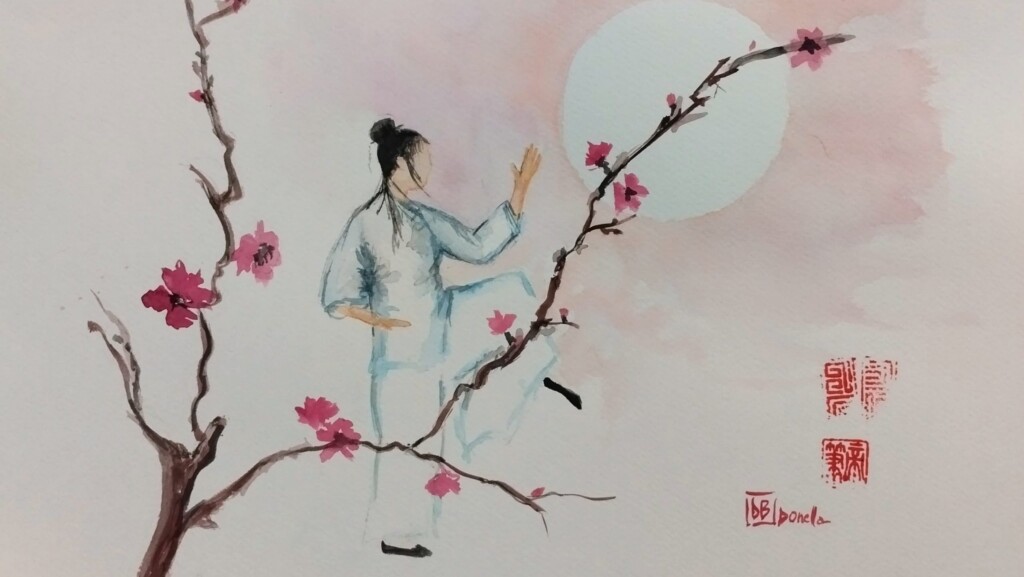
There is a moment some people recognize, usually in the middle of an ordinary afternoon, when the noise that has been running continuously beneath everything — the internal chatter, the ambient planning, the low hum of unfinished thoughts — suddenly drops out. Not through effort. Through exhaustion, perhaps, or the strange grace of a moment when nothing demands attention. And in that silence, something else becomes audible. Not a voice. More like a pressure. A sense that something has been there the whole time, patient, waiting under the noise like bedrock under traffic.
A man sits alone in a room stripped of everything he had spent decades accumulating. He does not move. He does not speak. At some point his breathing changes, slows, and his face shifts into an expression that is not peace exactly, but recognition. As if he has arrived somewhere he already knew.
This is what the practitioners of neidan, the inner alchemy that began to crystallize during the Tang dynasty and reached its philosophical apex in the twelfth and thirteenth centuries, were attempting to describe. Not a metaphor. A physiology. A map of what actually happens inside the body when a human being stops fleeing themselves.
The turn inward was not a sudden rupture with what had come before. The outer laboratories did not simply close. But figures like Lü Dongbin, the legendary eighth-century adept whose influence spread so far that he became one of the Eight Immortals of popular religion, began articulating something that the furnaces and cinnabar compounds could never quite reach. The gold was already inside. The transformation sought through external substances was, at its deepest level, a projection outward of a process that could only occur within the body itself. By 1167, when Wang Chongyang founded the Complete Reality School, the Quanzhen tradition, in Shandong province, this inward turn had become institutional. A school, a discipline, a lineage — built entirely around the proposition that the immortal body is not constructed but uncovered.
The internal cosmology that neidan developed is precise in a way that surprises anyone expecting vague mysticism. Three fundamental substances: jing, the generative essence rooted in the lower abdomen, dense and sexual and biological; qi, the vital breath that animates movement and circulates through channels the body does not reveal in dissection; and shen, the spirit, luminous and fine, seated in the chest and head. These are not metaphysical abstractions. Kristofer Schipper, in his indispensable 1982 study The Taoist Body, spent years living inside Taoist communities in Taiwan before writing about this, and what he insists on, against every temptation to allegorize, is that practitioners experience these distinctions as lived bodily states. Jing depleted feels like one thing. Shen cultivated feels like another. The map is not a symbol system. It is a phenomenology.
Michel Foucault, writing about what he called technologies of the self, described practices through which individuals attempt to transform themselves — their bodies, their souls, their ways of being — by their own means or with the help of others. He was thinking primarily of Greek and Christian traditions, but the concept lands with unusual force on neidan. What Tang and Song dynasty China produced was an entire science of self-transformation located resolutely inside the flesh. Not in doctrine, not in prayer directed outward, not in the intervention of an external deity. In the body’s own substances, refined upward through breath and attention and stillness, jing transmuting into qi, qi into shen, shen dissolving back into the undifferentiated source the tradition calls the Tao.
The man in the stripped room is still sitting. His breathing has become something he is barely doing. Something is doing it for him. He has not found anything new. He has stopped covering something old.
Immortality as Social Trap and Political Weapon
There is a moment most people have witnessed at least once, in a boardroom or a dinner table or the antechamber of someone who holds enough power to make others nervous. A man sits at the center of the room. Others arrange themselves around him at a careful distance. Someone speaks, and what they say is not precisely a lie — it is something more sophisticated than a lie. It is a truth so selectively assembled, so architecturally designed to confirm what the man already wants to believe, that it functions as a drug. The man nods slowly. He feels understood. He feels, in some cellular way, invincible.
This scene is not metaphorical. It has been repeating for at least two thousand three hundred years.
When Qin Shi Huang, the First Emperor, unified the warring states under a single imperial authority in 221 BCE, he had accomplished something genuinely unprecedented in Chinese history. He had also, in doing so, placed himself in a position that no political ideology had yet found words to sustain. The problem of supreme power is not how to acquire it. It is what to do with the terror of losing it. And it was precisely into this terror that the fangshi stepped, those magician-technicians who populated the Han court and its predecessors, men who occupied an ambiguous position between ritualist, chemist, astronomer, and courtier. Marcel Granet observed in his analysis of Chinese thought that the Chinese cosmological imagination was not primarily metaphysical but operational — it was concerned with the management of forces, with timing, with the correct alignment of human action within a universe that was less a creation than a process. The fangshi understood this, and they understood something else too: that a man who believes he might live forever is a man who will defer almost any discomfort in the present.
Around 219 BCE, the emperor dispatched an expedition under a figure named Xu Fu, who told the court that the islands of the immortals lay somewhere in the eastern sea and that their elixirs were within reach. The expedition departed with hundreds of young men and women, with supplies for a long voyage, with the implicit promise of returning with something that would solve the one problem that imperial power cannot solve by decree. They did not return. A second expedition was sent. That too dissolved into the horizon. What is extraordinary is not the credulity of the emperor, which is easy to condescend to from a distance of millennia. What is extraordinary is the structural elegance of the arrangement. The fangshi needed the emperor’s belief to maintain their position. The emperor needed the fangshi’s promises to maintain his sense of purpose. Neither party could afford the truth, which meant the truth was the one thing the conversation could never contain.
Benjamin Elman’s work on the history of Chinese science reveals how the alchemical tradition that surrounded these courts was not simply folk superstition dressed in courtly language. It was a sophisticated technical and philosophical enterprise whose practitioners engaged seriously with questions of material transformation, of the relationship between heat and substance, of the body as a site where cosmic forces could be concentrated and refined. What the political appropriation of this tradition accomplished was a slow severance between its genuine philosophical depth and its social function. The Taoist understanding of transformation — of wu wei, of yielding as a form of power, of the uncarved block that contains all possible shapes — was metabolized by the imperial machine into its precise opposite: a fantasy of permanence, of the self made impervious to time, of control exercised not through release but through accumulation.
The population, meanwhile, received their own version of the promise.
What We Are Actually Afraid Of
There is a man sitting in a very expensive clinic, somewhere with white walls and soft lighting designed to feel like the future. He is in his mid-forties. Someone is measuring his biological age with a panel of biomarkers, and the number that comes back is younger than his chronological age, and he smiles at this the way a person smiles when they have briefly outrun something they know is still behind them. He has optimized his sleep, his diet, his hormone levels, his gut microbiome. He takes over a hundred supplements a day. He has invested, conservatively, millions of dollars into the project of his own continuation. And sitting there in that white room, for just a moment, a look crosses his face that has nothing to do with triumph. It is the same look that crosses a face when the music stops at a party and the silence is suddenly total.
Bryan Johnson‘s Blueprint project, in which a technology entrepreneur subjects himself to one of the most rigorously quantified anti-aging protocols in recorded history, is not an eccentricity. It is a confession. Aubrey de Grey’s SENS Foundation, which has attracted hundreds of millions in funding since its formal establishment in the early 2000s, proceeds from the explicit premise that aging is not a natural condition but an engineering problem, a collection of cellular damages that can, in principle, be repaired indefinitely. The global anti-aging industry was valued at over sixty billion dollars in 2021 and is projected to more than double within a decade. Cryonics facilities preserve bodies at negative 196 degrees Celsius against a future in which death itself will be technically reversible. The language has changed. The crucibles are made of different materials. The ambition is identical to what was being practiced in the mountains of Tang Dynasty China over a thousand years ago, and the psychological architecture underneath it is identical too.
Ernest Becker argued in The Denial of Death in 1973 that virtually the whole of human culture is a defense mechanism, an elaborate symbolic structure built to keep the knowledge of mortality from becoming fully conscious. What he called the immortality project is not a religious concept or a philosophical abstraction. It is the actual operating system beneath most of what people construct with their lives, their legacies, their bodies, their children, their reputations, their savings. The Chinese alchemist grinding cinnabar was not categorically different from the man in the white clinic. Both are building something that functions as an argument against the finality of the self. Both are engaged in what Paul Tillich would recognize as an inversion of the courage to be, a courage that Tillich defined not as the elimination of anxiety but as the act of affirming existence in full knowledge of its limits, because the courage being performed in both cases is designed precisely to make those limits disappear rather than be inhabited.
The question the alchemists were actually asking, what is the self that persists, was never answered by their experiments. It was only deferred, refined, repackaged, and handed down. Every new laboratory that sequences a genome looking for longevity markers is inheriting that question without acknowledging the inheritance. And the question itself may be the thing, the only thing that has ever genuinely persisted, passed from one civilization to the next not as a solution but as an unresolved charge, something that cannot be dissolved by any amount of knowledge or funding or optimization because the self doing the asking is the same self that is afraid, and the asking and the fearing are not two separate activities but one continuous and deeply human act that has never once, in all of recorded time, arrived anywhere but here.
A vision curated by a filmmaker, not an algorithm
In this video I explain our vision
🔮 Ancient Paths to Immortality and Inner Gold
Chinese Alchemy and Taoism share deep roots with the broader alchemical tradition that spans cultures and centuries. These related explorations reveal how the search for immortality, transformation, and spiritual refinement has shaped esoteric thought across the world. Dive deeper into the threads that connect inner cultivation with the universal pursuit of the philosopher’s stone.
What Is Alchemy: History and Origins
Understanding the history and origins of alchemy is essential to appreciating how Chinese Taoist practices fit into the global alchemical mosaic. From Hellenistic Egypt to Tang dynasty China, the dream of transmutation was never merely material — it was always a spiritual quest. This article traces the earliest roots of alchemical thought and reveals how universal the longing for transformation truly is.
GO TO THE SELECTION: What Is Alchemy: History and Origins
Spiritual Alchemy: Inner Transformation and Symbolism
Spiritual alchemy offers a powerful lens through which to read the inner practices of Taoist immortality cultivation. Just as Taoist adepts refined the three treasures of Jing, Qi, and Shen, Western spiritual alchemists mapped a parallel journey of inner death and rebirth. This article explores the symbolic vocabulary of transformation that unites East and West across millennia.
GO TO THE SELECTION: Spiritual Alchemy: Inner Transformation and Symbolism
The Dance of Yin and Yang: Harmony Between Opposing Forces
The dance of Yin and Yang is one of the most fundamental principles underlying Chinese alchemy and Taoist cosmology. This dynamic interplay of opposing yet complementary forces governs everything from the refinement of elixirs to the cultivation of immortal vitality. Understanding this balance is indispensable for anyone wishing to grasp the deeper logic behind Taoist alchemical practice.
GO TO THE SELECTION: The Dance of Yin and Yang: Harmony Between Opposing Forces
Jungian Alchemy: Jung and Alchemical Psychology
Carl Jung saw in alchemy a mirror of the psyche’s deepest processes, and his insights resonate profoundly with the inner dimensions of Taoist immortality practice. Jung’s concept of individuation parallels the Taoist alchemist’s gradual refinement of the self toward a luminous, undivided wholeness. This article explores how Jungian psychology and alchemical symbolism converge in a shared map of spiritual transformation.
GO TO THE SELECTION: Jungian Alchemy: Jung and Alchemical Psychology
Discover the Cinema of the Spirit on Indiecinema
If these esoteric and alchemical horizons stir something deep within you, Indiecinema is your gateway to independent films that dare to explore the invisible dimensions of existence. From mystical documentaries to avant-garde meditations on consciousness and transformation, our streaming platform curates cinema that goes beyond entertainment into genuine spiritual inquiry. Join us and let independent film become your own path to illumination.
👉 EXPLORE THE CATALOG: Watch Indie Films in Streaming
A vision curated by a filmmaker, not an algorithm
In this video I explain our vision

