
The Pharmacist Who Dreamed of Ghosts
You are standing in a narrow wooden shop on the edge of Osaka’s Dōjima quarter, and the air smells of dried chrysanthemum root and something darker — ginseng, maybe, or the particular mustiness of old paper that has been handled too many times. It is somewhere around 1760, and the man behind the counter is not yet thirty years old. He grinds ingredients with a practiced rhythm that suggests the body performing what the mind has abandoned. On the shelf behind him, between the lacquered boxes of powdered bark and the ceramic jars of preserved roots, there is a manuscript. It is not a medical text.

Ueda Akinari was born in Osaka in 1734, the illegitimate son of a woman whose occupation history has recorded with a kind of pointed discretion, and he was adopted as an infant into the household of a paper and oil merchant in the Sonezaki district. The adoption gave him stability and a trade, but it also gave him something more ambiguous: the permanent sensation of belonging to a life that was not quite his. At five years old he contracted smallpox, and the disease left his fingers partially fused, distorted in ways that made conventional calligraphic study both painful and humiliating. He became instead a reader — obsessively, almost defensively — devouring the Japanese vernacular classics and then moving sideways into Chinese fiction, particularly the strange, unclassifiable story collections of Pu Songling, whose Liaozhai Zhiyi, compiled in the mid-seventeenth century, gathered tales of fox spirits, scholar-ghosts, and women who were not entirely women with the clinical tenderness of a naturalist cataloguing impossible specimens.
What Akinari found in that Chinese tradition was not escapism. It was a formal permission to take seriously what polite society required you to dismiss. The merchant class of mid-Edo Osaka was prosperous, pragmatic, and deeply suspicious of anything that could not be weighed or invoiced. Chōnin culture — the culture of the townspeople, the artisans and traders who had built Japan’s urban economy into something the samurai class simultaneously despised and depended upon — had developed its own sophisticated aesthetics, its kabuki and its woodblock prints and its popular fiction, but these forms operated under a constant social pressure to remain entertainment, to never quite tip into the serious. A merchant who spent his evenings writing about the ghost of a drowned court lady was not engaged in a legitimate intellectual project. He was indulging himself, which was almost the same as wasting money.
Akinari ran the family pharmacy for years, compounding medicines and managing accounts, and the historical record of this period is thin precisely because it was ordinary. What survives is the texture of an interior life pressing against an exterior routine. He had already published two volumes of comic fiction in the sharebon style — witty, lightly satirical, pleasurably disposable — because that was the kind of writing a merchant might reasonably do without inviting social censure. But alongside those sanctioned productions he was constructing something else entirely, a set of nine stories that would take the supernatural seriously as a mode of philosophical inquiry, that would ask what loyalty means when the person you are loyal to has been dead for five hundred years, that would place a man inside a house that should not exist and refuse to explain how he got out.
The collection that would become Ugetsu Monogatari — Tales of Moonlight and Rain — was completed around 1768 and published in 1776, and it arrived in Japanese literary culture with the quiet force of something that had been accumulating pressure for a long time. But the publication date flattens what the composition period reveals: these stories were written by a man who was simultaneously filling prescriptions, who had sick customers and ledger books and a social identity entirely organized around usefulness, and who was nevertheless spending his private hours inside a world where the dead returned not because they were evil but because they were unfinished.
Ugetsu
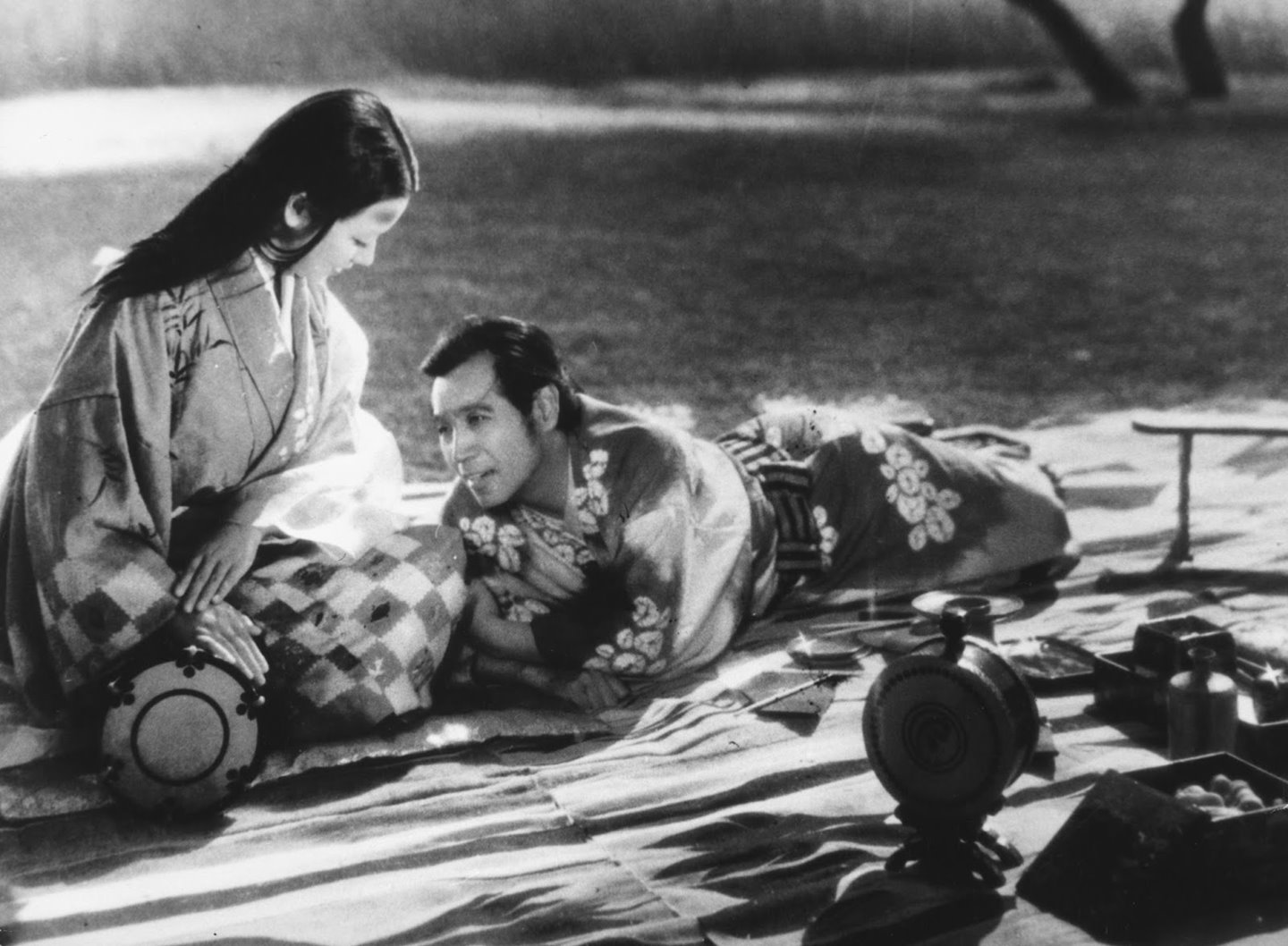
Drama, fantasy, by Kenji Mizoguchi, Japan, 1953.
Japan, late 16th century: the potter Genjurō and his brother Tobei live with their wives Miyagi and Ohama in a village in the Omi region; Genjurō, convinced that he can earn a lot of money by selling his goods in the nearby city, goes to the county of Omizo with Tobei, who joins him with the sole purpose of being able to become a samurai. Back home with a good income, the two work hard to make even more money; Tobei, increasingly obsessed with the ambition of becoming a samurai, needs the money to buy an armor and a spear while Genjurō, overcome by greed, tries to cook a batch of crockery with his brother in just one night. Legend and innovation of cinematic language, a wonderful world next to a brutal and cruel world. Mystery film that opens a discourse with the invisible planes of existence, ghosts and forays into the fantastic, made by Kenji Mizoguchi in a Japan still frozen by the two atomic bombs dropped on Hiroshima and Nagasaki. Fundamental work by Mizoguchi, recognized as one of the greatest expressions of the Seventh Art. A lofty lesson in directing that creates wonder with a dramatic tale of greed and lust for possession. A woman who is a tempting demon and a wife abandoned to a fate of war and misery, Mizoguchi uses the camera to enter "another world".
Food for thought
According to ancient Eastern traditions there are other non-physical planes beyond the physical plane. The etheric plane envelops the physical body, gives it vital energy and acts as an intermediary with the higher levels. Beyond the etheric plane there is the astral plane where entities may exist that have not been able to resign themselves to the loss of their body and wander in search of sensations. They are what are commonly referred to as "ghosts". These entities are looking for bodies that have unbalanced etheric planes to "hook up" to in order to experience sense satisfaction through them.
LANGUAGE: Japanese
SUBTITLES: English, Spanish, French, German, Portuguese
Smallpox, Disfigurement, and the Body That Would Not Cooperate
You are six years old and your hands are wrong. Not broken, not missing — wrong in a way that is harder to explain than absence, because they are still there, still attached, still reaching, but the fingers have fused at the joints where smallpox burned through you and left its signature in scar tissue that calcified into something neither hand nor claw. You will spend the next seventy years writing with these hands.
Akinari contracted smallpox around 1740, in Osaka, before he had a name worth keeping — he was still the illegitimate child of a woman whose own social position was tenuous enough that she had already given him away once. The disease remade him at a cellular level before he had formed any coherent idea of who he was. This matters because it means he never experienced an intact body and then mourned its loss. He had no prior self to compare himself against. What he had, instead, was a body that announced itself constantly, that refused the Tokugawa ideal of the cultivated gentleman whose physical presence was seamlessly subordinated to his intellectual and social performance. The hands were always visible. They were always, in a culture structured around gesture and calligraphy and the ritual presentation of oneself through brushwork, making a statement he had not chosen to make.
In Tokugawa Japan, the body was a social text, and certain bodies were illegible in ways the system did not tolerate gracefully. The scholar-physician Sugita Genpaku, translating Dutch anatomical texts in 1774, was already disturbing the official Chinese-derived understanding of the body as a system of correspondences rather than mechanics — but that conceptual revolution had almost no effect on how disfigurement was read socially. A fused finger was not a medical condition. It was a sign, and signs in hierarchical Confucian social orders tend to migrate toward moral interpretation. Akinari would have known this. He became a physician himself, practicing medicine in Osaka for years, which means he had the anatomical vocabulary to understand exactly what had happened to him and simultaneously the social literacy to understand how it would be read by everyone who was not a physician.
He addresses his own body, obliquely and without sentimentality, in the preface to Ugetsu Monogatari, published in 1776. The preface is strange and deliberately evasive — he calls himself Senshi Kijin, roughly the Eccentric of Mushroom Cottage, and gestures toward his physical strangeness as part of his literary persona without ever reducing himself to it. What he does not do is apologize. He does not perform the compensatory humility that the period demanded from anyone who occupied a socially awkward position. Instead he treats his eccentricity, physical and intellectual, as the condition of possibility for a particular kind of seeing — the idea that the person who cannot move through the world frictionlessly is the one who notices what frictionless movement makes invisible.
This is not a consolation he invented for himself. It is closer to an epistemological claim, and it corresponds to something the anthropologist Robert Murphy documented in The Body Silent in 1987 — that chronic bodily difference produces a mode of consciousness that is perpetually double, simultaneously inside and outside social convention, because the body keeps breaking the fantasy of seamless belonging. Akinari could not forget he had a body. Everyone he met reminded him, if only by the slight recalibration of their attention when they saw his hands. That persistent reminder did not make him bitter in any legible way, but it made him interested in surfaces — in what they conceal, in the gap between the face a person presents and the thing that moves behind it.
The ghost stories he would write are full of bodies that betray their inhabitants, that transform without permission, that cannot hold the shape social expectation demands of them.

The Merchant Class and Its Forbidden Imagination
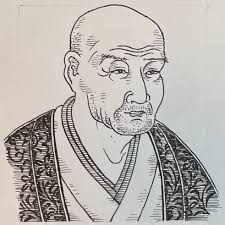
You are born into a ledger. Not metaphorically — literally: the Tokugawa census system classified every subject by hereditary occupation, and that classification determined where you lived, whom you could marry, what you could wear, and which futures were legally available to your body. Ueda Akinari entered the world in 1734 as the illegitimate son of a woman in Osaka’s pleasure district, adopted into the household of a merchant dealing in lamp oil and paper, and from that moment forward the machinery of the bakufu had already written the first and last sentences of his life. The chonin class — townsmen, merchants, artisans — occupied the bottom rung of the Confucian four-tier hierarchy beneath samurai, farmers, and craftsmen, despite the fact that Osaka merchants moved more actual capital than most domain lords could dream of controlling.
This is where the structural irony bites deepest. Norbert Elias spent much of “The Civilizing Process,” published in two volumes in 1939, demonstrating that social orders do not merely restrict the people inside them — they actively cultivate specific forms of interiority, refinement, and imaginative capacity as instruments of class distinction, then deny those same people the institutional outlets through which such cultivation could be expressed or rewarded. The aristocratic court, in Elias’s reading, produced an elaborate psychology of self-restraint, aesthetic sensitivity, and long-range emotional calculation precisely because these qualities marked the boundary between those who belonged and those who did not. The merchant class of Tokugawa Japan was caught in an almost identical trap from the opposite direction: economically indispensable, legally subordinate, culturally productive, and politically voiceless.
Akinari spent decades immersed in the Man’yoshu, the eighth-century imperial anthology, in Tang dynasty poetry, in the classical kana prose of the Heian court, in the Chinese vernacular fiction collections that circulated through Osaka’s thriving book trade. He studied kokugaku — the nativist philological movement attempting to recover an authentic Japanese literary spirit beneath centuries of Chinese influence — under figures who were simultaneously his intellectual peers and his social superiors. He read Motoori Norinaga, who would publish his monumental “Kojiki-den” between 1798 and 1822, arguing that the ancient texts encoded a Japanese emotional essence, a mono no aware, irreducible to Chinese rational categories. What Akinari absorbed from all of this was not a program but a hunger: for a language capable of holding the uncanny, the morally unresolved, the beautiful thing that destroys you.
The merchant world had its own approved imaginative outlets — the kabuki theater, the ukiyo-e print, the licensed pleasure quarters, the popular sharebon and kibyoshi novelettes that circulated in paper wrappers among townspeople who could not afford hardback scholarship. These were the cultural products that the chonin were expected to consume and, if talented, to produce. They were deliberately lightweight, deliberately ephemeral, deliberately unserious — pleasure goods designed not to challenge the architecture of the world that made them necessary. A merchant who aspired to the classical forms, who wanted to write in the mode of the courtly monogatari tradition or engage the deep philological questions of Chinese poetics, was reaching across a boundary that the social order had drawn in permanent ink.
Akinari reached anyway. His Ugetsu Monogatari, completed around 1768 and published in 1776, is written in a prose that openly courts the classical registers — dense, allusive, weighted with the authority of texts no townsman was supposed to handle with such ease. The supernatural in those nine tales is never decorative. It is precisely the pressure of everything the chonin world could produce in a human being but could not accommodate: the rage, the longing, the intellectual ambition, the refusal to be bounded by what commerce and law had decided was the ceiling of a life.
Ugetsu Monogatari and the Refusal of Moral Resolution
You sit with the ninth tale and realize the ghost has already left the room — not dramatically, not with a shriek or a vanishing, but simply by ceasing to be distinguishable from the living. That is the violence Ueda Akinari commits against you in the pages of Ugetsu Monogatari, published in 1776 after nearly a decade of revision that his contemporaries neither fully appreciated nor safely ignored. The collection’s nine tales do not punish the wicked or reward the virtuous. They do something considerably more unsettling: they refuse to tell you which is which.
The source materials Akinari drew from — principally Qu You’s Jian Deng Xin Hua, a fifteenth-century Chinese collection of strange tales, and scattered episodes from the Nihon Shoki and the Genji Monogatari — were themselves already morally ambiguous, but the Edo literary establishment had developed sophisticated mechanisms for neutralizing that ambiguity. A ghost story could be permitted if the ghost ultimately demonstrated karmic logic, if suffering mapped onto transgression, if the reader closed the final page with their cosmological coordinates intact. Akinari systematically dismantled every one of those mechanisms. In “Asaji ga Yado,” a man returns from years of wandering to find his wife still waiting — except she has been dead long enough for the moss to have grown over the threshold, and neither of them acknowledges this, and the horror is not the revelation but the conversation they have before it. Two people speak across an impossible distance, and the words are entirely ordinary.
This is what the epistemological rupture looks like in practice: not the monster at the door but the moment you cannot determine whether what you know is knowledge or projection. The philosopher of science Gaston Bachelard, writing in La Formation de l’esprit scientifique in 1938, identified the “epistemological obstacle” as the accumulated familiar — the intuition, the image, the habitual association that makes genuine inquiry impossible. Akinari was operating on this terrain a century and a half earlier, understanding that the greatest impediment to seeing clearly is not ignorance but the comfortable architecture of what one already believes to be true. His characters do not fail because they are wicked. They fail because they are certain.
The Confucian orthodoxy that Edo censors were tasked with protecting depended on legibility — on the conviction that moral categories were stable and that literature’s duty was to reinforce their stability. A collection like Ugetsu Monogatari was therefore dangerous not because it depicted demons but because it declined to locate the demonic with any reliability. “Kikuka no Chigiri,” in which a samurai’s bond of loyalty persists beyond death with a tenderness that exceeds anything the living manage between themselves, does not condemn its supernatural premise. It elevates it. The affective world of the dead is rendered more coherent, more honorable, more legible than the political world of the living — and this inversion had no sanctioned place in the aesthetic categories of 1776.
What Akinari understood, and what his readers sensed without quite being able to articulate, was that the supernatural in these tales functions as a diagnostic instrument. The ghosts and fox-women and ancient priests are not the problem the stories are investigating. They are the pressure applied to the problem, which is the instability of human certainty itself — certainty about loyalty, about time, about whether the beloved sleeping beside you is the person you married or something that has displaced them so gradually you participated in your own deception. The scholar Shigehisa Kuriyama has written about how premodern Japanese medical thought located the self not in a fixed interior but in a series of responsive surfaces, perpetually renegotiated through contact with the world. Akinari’s characters have no defended interior. They are entirely penetrable, and the tales never decide whether this is tragedy or simply the accurate description of what a self has always been.
What the Wet and Moonlit Means
You are standing at a window during a rainstorm, watching the street below dissolve into something that no longer resembles the street you crossed this morning. The gutters run, the lamplight bleeds sideways, and a figure moving past the glass seems for half a second to be someone you have buried. That half-second is not an error in your nervous system. It is the precise meteorological and psychological condition that Ueda Akinari encoded in the word ugetsu — rain and moon, moisture and luminescence, the two atmospheric agents most responsible for making the edges of things unreliable.
The compound itself performs what it names. Ugetsu does not describe a weather event so much as it describes what happens to the perceiving mind when the world loses its hard surfaces. Rain diffuses, softens, and multiplies reflections. Moonlight flattens depth and bleaches color, making the familiar strange and the strange plausible. Together they constitute an epistemological condition: you can no longer trust the boundary between what exists and what your longing or grief has projected onto the visible world. Akinari titled his 1776 collection Ugetsu Monogatari not as a gesture toward atmospheric beauty but as a precise claim about the kind of stories he was telling and the kind of reading they required. You were being asked to enter a state of compromised perception and stay there long enough to recognize something true.
Sigmund Freud, writing in 1919 in his essay “Das Unheimliche,” located the disturbing power of certain experiences not in genuine foreignness but in the return of something that was once intimate and has since been repressed, buried under the social sediment of maturity and rationality. The uncanny, for Freud, is heimlich — homely, familiar, domestic — turned inside out. What frightens is not the alien but the recognition: the childhood belief that the dead remain nearby, the animist intuition that objects harbor intentions, the certainty that a face glimpsed in a crowd belongs to someone who cannot possibly be there. These were never fully external ideas that culture introduced from outside. They were internal structures that civilization required you to abandon, and the repression was never complete. Under conditions of ugetsu — sensory ambiguity, emotional extremity, the hours between two and four in the morning — the seal fails.
Akinari’s narrative architecture in Ugetsu Monogatari is organized around precisely these failures of seal. In “Asaji ga Yado,” a woman waits so long for her husband’s return from war that her waiting becomes indistinguishable from haunting, and when he arrives he cannot determine whether she is still alive or whether his own need has reconstituted her in a form the house can hold. The story does not resolve the question. It refuses the resolution as a matter of principle, because resolution would require the kind of clear atmospheric conditions — daylight, certainty, unambiguous contour — that the title has already promised you will not receive. Akinari understood that the ghost story is not a special genre standing apart from realism. It is realism pushed to the point where desire becomes structurally indistinguishable from the world it is projecting onto.
What makes this more than a poetic trick is the anthropological precision underneath it. Eighteenth-century Japan had no clean secular category for the separation between the living and the dead. The Buddhist framework installed by the Tokugawa administration coexisted with older animist obligations, and the yearly Obon festival — when the dead were formally welcomed home, fed, and then escorted back — was not metaphor but operational social practice. Akinari was not inventing a mythology of blurred boundaries. He was writing inside a culture that had never fully insisted on the boundary in the first place, and ugetsu was the name for the weather in which that underlying condition became briefly, dangerously visible to the people living inside it who had learned to forget.
A vision curated by a filmmaker, not an algorithm
In this video I explain our vision
The Kokugaku Wars and a Man Who Refused Both Sides

You sit across from someone who believes, with the full weight of their conviction, that the land where they were born carries a spiritual superiority encoded into its very language, that the sounds of ancient Japanese poetry contain a vibratory truth unavailable to any other civilization. You find this person brilliant. You also find them dangerous. And you are not willing to pretend otherwise just because they happen to be on your side.
This was the position Ueda Akinari occupied in the late eighteenth century, and it cost him precisely the kind of legacy that requires institutional approval to survive. The kokugaku movement — nativist scholarship devoted to excavating an authentically Japanese spirit from beneath centuries of Chinese and Buddhist influence — was producing, by the 1780s, some of the most consequential philological work in Japanese intellectual history. Motoori Norinaga had published his monumental Kojiki-den, a forty-four-volume commentary on Japan’s oldest chronicle, beginning in 1798 after decades of preparation, and had built from it a vision of Japan as a divinely exceptional nation whose native sensibility, the aesthetic category he called mono no aware, represented a form of emotional truth superior to anything continental philosophy had produced. The argument was not merely scholarly. It was political in the way that all claims about cultural essence are political: it drew a border around who could truly feel, truly know, and therefore truly belong.
Akinari refused it. Not from indifference to Japanese antiquity — he had devoted years to his own readings of the Man’yoshu and the Kojiki, and his philological precision was by any measure as rigorous as Norinaga’s — but because he understood that the desire to find a sacred origin in language was itself a distortion of the evidence. The two men exchanged direct written challenges in the 1780s, a dispute that centered ostensibly on the origin of waka poetry but was in reality a contest over whether scholarship was permitted to produce inconvenient conclusions. Akinari argued that the gods-age narratives in the Kojiki were not literal history but something closer to mythological construction, that the Japanese poetic tradition was entangled with continental influence in ways no amount of nationalist longing could dissolve. Norinaga responded with the kind of controlled fury available to men who have built systems large enough to feel like cathedrals: you do not walk into a cathedral and point at the cracks.
What makes this dispute genuinely strange, historically, is that Akinari was not arguing from a position of cosmopolitan universalism or Chinese cultural supremacy — the opposing pole that kokugaku defined itself against. He had no interest in replacing one absolute with another. His skepticism was structural: he distrusted the mechanism by which any movement converts philology into prophecy, any moment when the reading of old texts stops being an act of inquiry and becomes an act of consecration. In this he was almost uniquely isolated, because the intellectual landscape of his moment rewarded certainty. Norinaga’s school would go on to influence the ideological currents that fed, however indirectly, into nineteenth and twentieth-century Japanese nationalism. Akinari left no school. His position was not a position so much as a refusal of the available positions, which is the most honest intellectual stance and the least transmissible one.
Harusame Monogatari and the Aesthetics of Incompletion
You read Harusame Monogatari differently once you know it was written by a man who could no longer see the page. Akinari dictated, revised, set aside, returned, and ultimately left the collection unfinished at his death in 1809 — nine tales in various states of incompletion, their edges unresolved, their silences not yet filled. Most literary histories treat this as misfortune, the residue of old age and grief after the death of his wife Ueda Tama in 1797. But to read incompletion as biographical debris is to misunderstand what the text is actually doing.
The prose in Harusame Monogatari is noticeably thinner than in Ugetsu Monogatari. The sentences are less armored, less ornamented. Where the earlier collection moved with the confidence of a man who had studied Chinese classical narrative and Japanese court literature and synthesized them into something dense and deliberate, the late prose moves differently — slower, more hesitant, as though aware of its own exposure. The ghosts here do not arrive with the same theatrical force. They appear at edges, in half-sentences, in conversations that trail into silence. A woman is mentioned who may or may not still be alive. A monk speaks, and the text does not confirm whether anyone is listening. This is not narrative breakdown. It is a different understanding of what a story must accomplish.
Maurice Blanchot, writing in L’Espace littéraire in 1955, argued that the literary work does not aspire toward completion the way a craft object does — it aspires toward a space where meaning becomes possible without being settled. For Blanchot, the unfinished work is not a failure of execution but the purest instantiation of what literature always already is: something that opens without closing, that begins without being able to end in the way resolution demands. He was not describing Japanese literature, and Akinari certainly never read him, but the encounter between their sensibilities is not accidental. Both emerged from traditions where the fragment was not shameful. Both understood that the text which refuses to close creates a different kind of reader — one who cannot simply receive and leave.
In the tale “Miyagi ga tsuka,” the narrative circles a burial site connected to the Genji tradition, and Akinari allows the connection to float rather than anchoring it. Readers familiar with Murasaki Shikibu’s eleventh-century court epic recognize the echo, but Akinari does not explain or exploit it. The reference exists the way a half-remembered name exists — present, charged, structurally significant, and yet not resolved into argument. This is what the thinned prose creates: a text that trusts resonance over statement, that allows incompletion to do semantic work that closure would undo.
What makes this more than a consoling story about old age and artistic acceptance is that Akinari had always been interested in what exceeds representation. His annotations on the Man’yoshu and his polemical exchanges with the nativist scholar Motoori Norinaga throughout the 1790s show a mind that refused systematic totality. He disagreed with Norinaga’s insistence that mono no aware — that distinctly Japanese sensitivity to the pathos of transience — could be treated as the single organizing principle of Japanese literary culture. Akinari thought the tradition was more unruly than that, more contradictory, less reducible to a single emotional key. The unfinished collection enacts that argument structurally. It does not resolve into a mood, a lesson, or a worldview.
The Archive That Keeps Losing Him
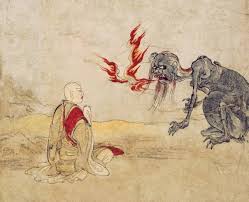
You have probably held a book that felt like it was holding you back — the weight of it specific, the margin notes of strangers pressing against your own reading like a crowd that arrived before you and never left. That pressure is not accidental. It is what canons do: they pre-read the text so thoroughly that encountering the actual words becomes an act of archaeology, scraping through layers of authorized interpretation to find something that may no longer be there at all.
Akinari entered the Meiji period as a problem to be solved. The new literary nationalism needed a classical tradition that could answer European models — a tradition with interiority, with aesthetic refinement, with the kind of cultivated melancholy that could be presented as evidence of civilization rather than exoticism. He was retooled accordingly. The rougher biographical edges — the poverty, the years of commercial obscurity, the quarrels with Norinaga that were as much about wounded pride as about philological method — were smoothed into the portrait of a dedicated man of letters whose eccentricities confirmed rather than disturbed the emerging national literary canon. By the time Meiji scholars were finished with him, Akinari had become the kind of figure a young nation could be proud of: difficult enough to require expertise, legible enough to be taught.
The Western comparativist project of the mid-twentieth century committed a different but equally decisive distortion. Scholars trained in European literary genealogies arrived at Ugetsu Monogatari and immediately reached for Edgar Allan Poe — the uncanny, the dissolution of rational certainty, the beautiful prose standing guard over an abyss. The comparison is not wrong so much as it is narrowing. It converts Akinari’s relationship to Chinese classical sources, to the specific social textures of Edo-period anxieties about money and loyalty and disease, into mere background coloring for a universal Gothic sensibility that was in fact very locally European and very specifically nineteenth century. What got lost in that translation was precisely the thickness of the original cultural embedding — the way his supernatural figures are not metaphors for psychological states but participants in a moral world that the reader of 1776 would have navigated with a different kind of seriousness.
Then the cinema arrived, and with it a third erasure disguised as homage. After 1953, the visual grammar of a single adaptation became, for most of the world, the primary experience of Akinari’s material. The images were extraordinary. They were also someone else’s argument, translated into light and shadow with such authority that they replaced the source rather than pointing back to it. Critics began describing the original stories through the vocabulary of the film’s visual choices, as though Akinari had written in frames and fog rather than in a prose style whose difficulty and compression are inseparable from its meaning. The canonization was complete precisely because it no longer required the text.
What each recuperation shares is a structural need for Akinari to be recognizable — to fit inside a category that already exists: nationalist ancestor, proto-modernist, source material. The actual figure who emerges from his letters, his medical practice, the long argument about the Japanese classics conducted with barely concealed fury, the stories written under conditions of physical deterioration that gave them a quality of urgency his earlier work does not have — that figure keeps sliding out of the frames built to hold him. Canons do not preserve writers. They preserve the version of a writer that a particular moment needed badly enough to fabricate.
Akinari died in 1809, nearly blind, having outlived most of his contemporaries and the cultural world that had first made sense of his work. The archive that claims him is enormous. The man it describes grows less substantial with every addition, which may be the most precise thing any archive has ever accidentally said about the difference between a life and its uses.
🌀 Voices from the Edge of the Known World
Ueda Akinari dwelt at the crossroads of the supernatural and the literary, weaving tales where reality dissolves into dream and identity loses its solid ground. The authors and works gathered here share that same restless edge, where storytelling becomes a labyrinth of the self and the uncanny.
Jorge Luis Borges: Life and Works
Jorge Luis Borges constructed a literary universe where labyrinths, mirrors, and infinite libraries echo the architecture of the human mind. Like Ueda Akinari, Borges transforms the uncanny into a precise philosophical instrument, using narrative as a vehicle for metaphysical inquiry. His work remains one of the most radical explorations of how fiction can dissolve the boundaries between reality and illusion.
GO TO THE SELECTION: Jorge Luis Borges: Life and Works
Jorge Luis Borges and the Labyrinth of Identity
In this focused study, Borges’s obsession with the labyrinth becomes a meditation on identity itself, a self that multiplies and vanishes the more closely it is examined. The labyrinth functions not as a mere architectural metaphor but as the very structure of consciousness and cultural memory. This resonates deeply with Akinari’s ghostly protagonists, who are perpetually lost within identities that shift like reflections on water.
GO TO THE SELECTION: Jorge Luis Borges and the Labyrinth of Identity
The Literary Fantastic: Todorov and the Theory of the Fantastic
Tzvetan Todorov‘s theory of the fantastic offers the essential critical lens for understanding authors like Ueda Akinari, who inhabit the trembling border between the natural and the supernatural. Todorov identifies hesitation as the defining feature of the fantastic mode, and it is precisely this hesitation that gives Akinari’s tales their haunting psychological power. Understanding the fantastic as a genre illuminates why Akinari’s stories feel so disturbingly modern despite their Edo-period setting.
GO TO THE SELECTION: The Literary Fantastic: Todorov and the Theory of the Fantastic
Meyrink’s The Golem: Meaning and Analysis
Gustav Meyrink‘s The Golem conjures a Prague saturated with occult atmosphere, where an ancient legend bleeds into the unconscious life of its protagonist in ways that recall Akinari’s Japan of vengeful spirits and uncanny encounters. Both authors use the supernatural not as mere spectacle but as a language for expressing psychological and spiritual depths beyond rational reach. Meyrink’s novel stands as one of the great monuments of the literary fantastic, a tradition to which Akinari’s Ugetsu Monogatari unmistakably belongs.
GO TO THE SELECTION: Meyrink’s The Golem: Meaning and Analysis
Discover the Cinema of the Uncanny on Indiecinema
If the worlds of Ueda Akinari and his kindred spirits have stirred something in you, Indiecinema is the place to follow that feeling further. Our streaming platform curates independent and art-house films that explore the supernatural, the labyrinthine, and the beautifully strange with the same depth you find in great literature. Step into Indiecinema and let cinema take you where the visible world ends.
👉 EXPLORE THE CATALOG: Watch Indie Films in Streaming
A vision curated by a filmmaker, not an algorithm
In this video I explain our vision

