
The Stranger in the Threshold
You are standing inside something that used to be a room. The ceiling has partially collapsed, and what remains of it hangs at an angle that should not be structurally possible, yet here it is, suspended in a kind of arrested catastrophe. Your camera is raised. You know you are going to take the photograph. But for a moment — and this is the moment worth paying attention to — you do not press the shutter. You stand there breathing, and something is happening in your chest that has no clean name. It is not fear, or not only fear. It is closer to recognition, the way you feel when someone describes a dream you yourself have had but never spoken aloud.

The wallpaper is still there. Floral, faded to a color that was never a color, somewhere between rose and ash. Whoever chose it is dead or old or somewhere entirely elsewhere, and the choice they made — intimate, domestic, probably unremarkable at the moment of making — has outlasted every intention it was meant to serve. That is the first thing ruins do to you: they make the ordinary monstrous by simply continuing to exist after the life that organized them has withdrawn. The floor is soft in places where moisture has been working for years. A chair remains, missing one leg, propped against the wall at an angle that looks almost deliberate, almost posed, and this is the unsettling part — that decay begins to resemble composition, that ruin begins to look curated.
Photographers have known this for nearly as long as photography has existed. The medium was barely a decade old when practitioners began pointing their equipment at what was broken, abandoned, overtaken. In 1851, the Mission Héliographique sent five photographers — among them Gustave Le Gray and Henri Le Secq — across France specifically to document architectural ruins before restoration could erase them. The project was funded by the state, framed as preservation, but the images that emerged were something harder to institutionalize than preservation. Le Secq’s photographs of the cathedral at Reims have a quality that exceeds documentation entirely: they make the stone look like it is in the process of becoming something else, slowly, at a pace no human life can witness in full.
What the camera does to ruins is not simply record them. It freezes a moment in a process that has no interest in moments. Entropy does not pause. Decay is not a state but a verb, a continuous action that the photograph converts into a noun, and this conversion is a kind of violence that produces beauty. The philosopher Walter Benjamin, writing in the 1930s in his unfinished Arcades Project, described the ruin as the site where history becomes nature — where what was built by human will begins to obey geological time, where the cultural and the geological trade places. He was writing about the iron-and-glass arcades of Paris as they aged into obsolescence, but the observation reaches further: every ruin is a place where two different time signatures are sounding simultaneously, and the human nervous system, caught between them, produces the exact frequency you felt in your chest before you pressed the shutter.
There is something else happening, though, beneath the aesthetic theory and the archive fever. Something more uncomfortable. When you raise your camera inside that collapsed room, you are not only a witness. You are also an intruder, and on some level you know it. The threshold you crossed to get here was not just architectural — it was ethical, and it was temporal. You have entered a space that was not built for you, that did not anticipate you, that carries the residue of lives organized entirely around premises you cannot fully reconstruct. And you are going to make it beautiful. You are going to take it home inside a rectangle of light, and something about that transaction deserves to be examined before it is celebrated.
Desire Dressed as Aesthetics
You stop in front of the photograph and feel something open in your chest — not grief exactly, not pleasure exactly, something that borrows from both and belongs to neither. The crumbling facade, the light falling through a collapsed roof onto tiles erupting with moss, the chair left behind as if someone had simply stepped out for a moment and then ceased to exist. You call what you feel aesthetic appreciation. You would stake something on that description. But the name you have given it is doing a great deal of quiet work on your behalf.
Brian Dillon, writing in “Ruins” in 2011, identified what he called a structured longing at the heart of Western visual culture — a desire not merely to witness decay but to consume it, to take it in through the eyes in a way that produces a sensation unmistakably close to hunger. Rose Macaulay had tracked the same compulsion across centuries in “Pleasure of Ruins” in 1953, cataloguing how painters, poets, and travelers had consistently sought out broken architecture not as evidence of tragedy but as a stage set for emotional performance. The ruin, in both accounts, is less a historical artifact than a mirror held up to a very particular kind of desire — one that requires the suffering of the past to remain safely in the past, frozen and aestheticized, so that the living observer can feel something without being in any danger.
Photography arrived with precisely the equipment needed to serve this desire while concealing its nature. The frame excises context. The lens elevates texture over meaning. The shutter stops time in a way that confirms the ruin’s most essential fiction: that what happened here is finished, that the violence of abandonment or war or economic collapse has been resolved into beauty, that the wound has become an ornament. Susan Sontag argued in “On Photography” in 1977 that the camera teaches us to see the world as a series of potential acquisitions — every scene becomes something that can be possessed, extracted, owned. The ruin photograph is perhaps the purest expression of this logic, because what is being acquired is not merely an image but an emotion, a depth-effect, a feeling of historical weight that the photographer carries away intact while the building continues to fall.
What disguises this transaction so effectively is the language that has grown around it. The photographer who ventures into an abandoned asylum or a collapsed factory describes their practice in terms of witness, preservation, elegy. They are saving something from oblivion, they say, or honoring the lives that passed through these walls. This rhetoric is not entirely false, which is what makes it so difficult to dispute. But honoring and consuming are not the same act, and the difference matters most in what remains when the camera leaves. The image circulates, accumulates likes, earns a place in a gallery or a photobook or a carefully curated social media feed. The building continues its collapse. Nobody has been held accountable for the hospital that shut, the neighborhood that emptied, the workers who were never compensated. The photograph has transformed a political fact into a mood.
There is a class dimension embedded in this that almost never gets spoken aloud. The people who left those apartments, who worked in those factories, who were treated in those asylums, are almost never the people framing the ruins for aesthetic consumption. The observers arrive with equipment worth thousands of dollars, with the leisure time and physical mobility to seek out locations, with the cultural capital to know that what they are making will be recognized as art. The ruins that generate the most intense version of ruin lust are almost always ruins that belong to someone else’s catastrophe — geographically, temporally, economically distant enough that the desire never has to account for itself.

The Industry of Authentic Decay
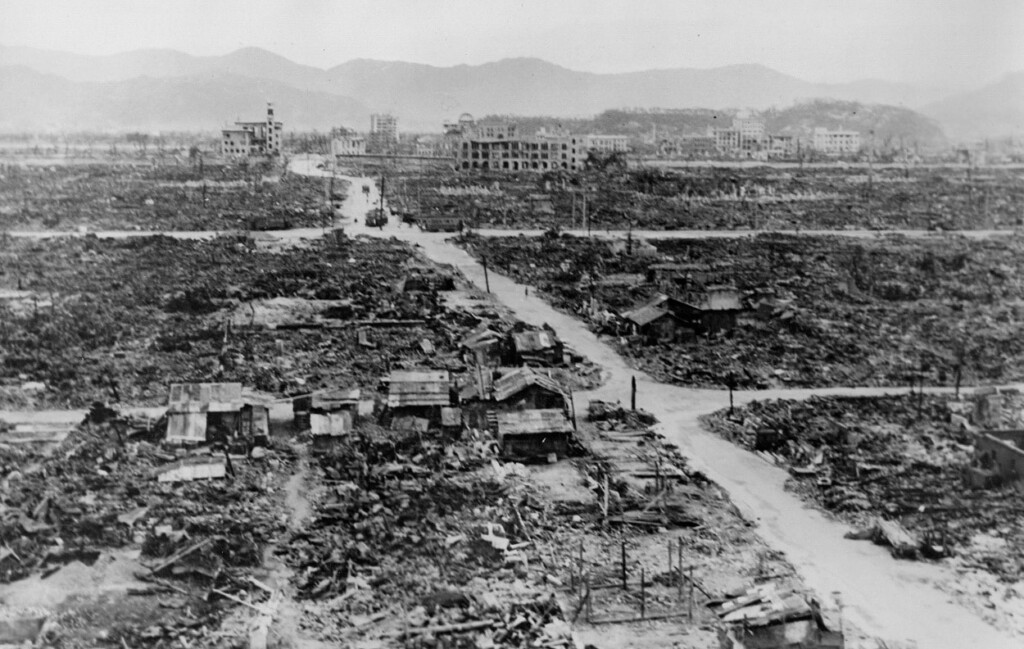
You have paid to see this. Not with a ticket stub or a museum entrance fee, but with something more intimate — your attention, your scroll, your follow, the quiet minutes you gave to a photograph of a collapsing factory floor in Michigan, its roof open to rain, its machinery furred with rust the color of dried blood. You felt something genuine looking at it. That feeling was real. What manufactured it was not.
Since roughly 2009, in the immediate wake of the financial crisis that emptied entire industrial corridors across the American Midwest and the European rust belt, urban exploration shifted from a marginal subculture practiced by a few hundred obsessives with flashlights into a documented economic phenomenon. Detroit alone — which filed for the largest municipal bankruptcy in American history in July 2013, shedding 18 billion dollars in liabilities — became a destination. Travel agencies began offering guided decay tours of the Packard Automotive Plant, abandoned in 1958 and left to collapse for six decades across 3.5 million square feet. Photographers who had been documenting those spaces for years suddenly found themselves competing with weekend tourists carrying mirrorless cameras and itineraries. The ruin had been scheduled.
Chernobyl absorbed the same logic with breathtaking efficiency. After the 2019 HBO miniseries brought the exclusion zone back into mass consciousness, visitor numbers to the site jumped by more than forty percent in a single year, reaching approximately 124,000 people in 2019 according to official Ukrainian tourism figures. The town of Pripyat — which housed 49,360 residents before the evacuation of April 27, 1986, and has been uninhabited since — became one of the most photographed places on earth, its ferris wheel and gymnasium floor reproduced millions of times across platforms designed to quantify human approval in units of heart-shaped icons. The radioactive dust coating those floors carries a half-life of thirty years. The Instagram post carrying that image carries a lifespan of roughly forty-eight hours before the algorithm buries it.
Hashima Island off the coast of Nagasaki — a concrete island that once housed over 5,000 coal miners and their families at population densities higher than any place on earth, abandoned in 1974 when the mine closed — was designated a UNESCO World Heritage Site in 2015. The designation was contested; Korean and Chinese governments objected, citing the forced labor of their nationals on the island during Japanese imperial rule. UNESCO listed it anyway. What was preserved by international cultural consensus was the aesthetic of collapse itself, stripped of the coercion that had generated it. The ruin was curated. Its violence was archived out of the frame.
This is where the machinery becomes precise. Susan Stewart, in her 1993 work On Longing, argued that the souvenir and the collection are both instruments for converting lived experience into narrative property — they take something that existed in time and transform it into an object that exists outside of time, available for contemplation without consequence. Ruin photography does exactly this, but at industrial scale. What the photograph removes from the abandoned factory or the irradiated apartment block is precisely the process that created it: the economic decisions, the political failures, the human displacement. What it preserves is only texture. The peeling paint. The broken glass catching afternoon light. The aesthetic residue of catastrophe without the catastrophe itself.
The market that grew around this residue is not incidental. By 2017, accounts dedicated to urbex — urban exploration photography — were generating hundreds of millions of aggregate views on platforms where attention translates directly into advertising revenue. The photographer becomes an intermediary in a transaction between collapsed infrastructure and consumer desire, taking a cut in the currency of followers and brand partnerships. The collapse funds the photographer. The photographer funds the platform. The platform funds itself by selling the audience — which is you — to the brands that want to be seen adjacent to authentic feeling.
What no one in this chain has any incentive to ask is what it means that authenticity now requires a ruin to feel real.
What Benjamin Saw Before the Shutter Clicked
You stand in front of a collapsed factory floor, and without thinking you raise the camera to your eye. Something in you has already decided what this means before the shutter opens — and that decision is the most revealing thing you will produce all day.
Walter Benjamin spent over thirteen years accumulating notes for what became the Arcades Project, an unfinished monument published posthumously in 1982 from thousands of index cards and fragments. He was not studying ruins in any conventional archaeological sense. He was studying how the past persists inside the present as a kind of pressure — specifically, how certain objects and spaces become what he called dialectical images: moments where two historical times collide and briefly illuminate each other like flint against stone. The ruin, for Benjamin, was the quintessential form of this collision. Not because it showed you what had been destroyed, but because it showed you the exact texture of the ideology that had surrounded the destruction with silence.
The dialectical image does not belong to the past. It erupts in the present at a moment of recognizability — Benjamin’s word was Jetzt der Erkennbarkeit, the now of knowability — and it forces whoever encounters it into an involuntary self-disclosure. What you perceive in the ruin reveals the structure of your own historical moment with a precision that no direct political statement could achieve. This is why two photographers standing before the same collapsed building will return with photographs that are essentially confessions from different psychological and cultural positions, even if the aperture settings are identical.
The industrial ruins of the American Rust Belt were photographed obsessively throughout the 2000s and 2010s, and a persistent pattern emerged in the work that circulated most widely: the images were beautiful in a way that depoliticized what they depicted. Broken assembly lines transformed into cathedral naves. Collapsed ceilings became abstract paintings. The aesthetic apparatus of the sublime was applied to spaces where specific communities had been methodically abandoned by deliberate economic policy. The photographers were not lying. They were confessing, with total sincerity, the particular numbness of a cultural class that had learned to experience social catastrophe as visual opportunity.
Benjamin understood this dynamic precisely because he watched it operating on himself. His essay on photography from 1931, “Little History of Photography,” contains a passage where he notes that the camera has the capacity to introduce the unconscious into visual perception — the optical unconscious, he called it, those details the eye moves past but the lens arrests. Every photograph of a ruin is therefore also an arrest of the photographer’s unconscious attitude toward what has been ruined. The more aesthetically accomplished the image, the deeper the confession tends to run, because craft is precisely the tool by which the photographer most fluently disguises the nature of what they are drawn to.
There is something almost violent in this logic. It means that a photographer who spends years documenting the ruins of Soviet collective farms in Ukraine, selecting the most formally perfect angles, building a portfolio that galleries receive as meditative and lyrical, has produced above all an autobiography of detachment — a record of how someone from a particular position in the present regards the collapse of a particular form of historical hope without feeling required to situate themselves in the political consequences of that collapse. The photograph does not lie. It simply confesses something the photographer never intended to say.
Benjamin’s own project collapsed unfinished when he died at the Spanish border in September 1940, pursued by the same historical catastrophe he had been trying to theorize. The Arcades Project became, in its incompleteness, precisely the kind of dialectical image it had theorized — a ruin of thought that speaks about the violent truncation of European intellectual life with more force than any completed argument could carry.
The Body That Cannot Be in Two Times at Once
You stand inside a building that should not still be standing, and your body knows it before your mind does. The floor gives slightly under your weight in a way that floors are not supposed to give. The smell hits a register that bypasses language entirely. Something in the chest tightens, not from fear exactly, but from a confusion the nervous system cannot categorize — because the nervous system evolved to read time as a single, coherent stream, and this place is running two streams simultaneously, overlapping, neither canceling the other out.
Maurice Merleau-Ponty argued in his 1945 Phenomenology of Perception that the body is not a vessel through which consciousness observes the world but the very medium through which the world becomes intelligible at all. Perception is not a mental event that happens after the body collects data — it is the body already interpreting, already oriented, already making meaning through posture, weight, muscle tension, the angle of the head. What this means in practice is that when you enter a space whose temporal logic has collapsed, the disorientation is not intellectual. It is proprioceptive. You do not think that time has fractured here. You feel it in your feet.
The photographer who raises a camera inside a ruin is not documenting with a tool while their body stands neutral and uninvolved. The body is the first instrument, the one that has already been changed by the space before the shutter is even considered. The selection of frame, the instinctive crouch toward low light, the hesitation before a particular angle — these are not aesthetic decisions made in a vacuum. They are the body’s attempt to metabolize a temporal experience it cannot resolve. The image becomes the residue of that metabolic failure, proof that the body tried and could not fully absorb what it encountered.
This is precisely what separates ruins photography from architectural photography in any conventional sense. A building that functions in present time is readable by the body — the body knows how to be inside it, knows what its surfaces demand, what movements it permits and discourages. A ruin refuses this contract. The staircase that ends in open air, the doorframe that opens onto rubble, the ceiling that has become sky — each of these is not merely a visual surprise but a somatic contradiction. The body prepares a gesture the space then refuses to receive. And in that refusal, something very old activates: the neurological signature of threshold experience, of being at the edge of a system that no longer obeys the rules you were trained on.
Gaston Bachelard, writing in The Poetics of Space in 1958, described how inhabited spaces accumulate what he called the density of daydreaming — the way rooms hold the compressed memory of bodies that moved through them. He was writing about houses still alive with use, but the inverse is equally true and perhaps more violent: a space that held that density and then had it evacuated does not become neutral. It becomes a negative pressure. The photographer standing inside it is not adding presence to an absence. They are registering the force of the evacuation itself, the way a room can be louder after everyone has left it than it ever was when occupied.
What the camera captures in that moment is therefore not the ruin as object but the body’s encounter with temporal vertigo as event. The slight blur at the edge of a long exposure is not a technical artifact. It is the body swaying almost imperceptibly because it cannot settle into a space whose chronology refuses to stabilize. The grain, the uneven light, the compositions that feel both deliberate and slightly off-balance — these are not stylistic choices borrowed from a tradition. They are the direct physiological record of a nervous system trying to be in two times at once, and discovering that no body, regardless of how trained or how still it holds itself, can actually manage that.
A vision curated by a filmmaker, not an algorithm
In this video I explain our vision
A Woman Reads a Letter in a Burned Archive
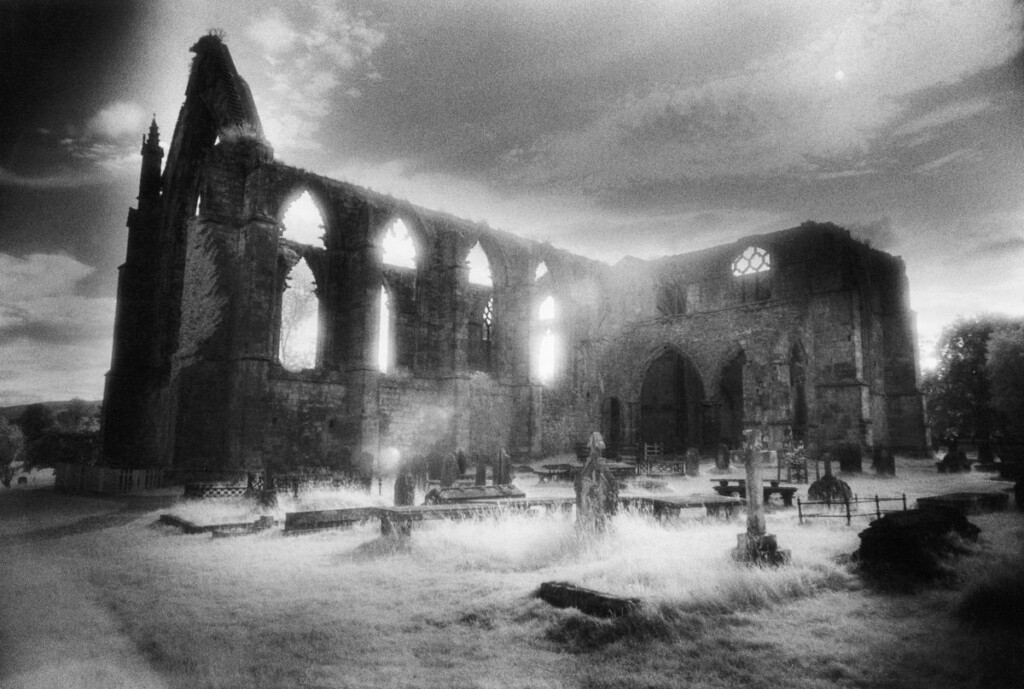
She is standing inside what used to be a municipal records building, somewhere in a mid-sized European city that flooded twice and burned once, and she is reading. Not transcribing, not photographing, not lifting the page toward the light to better frame it against the collapsed ceiling. Just reading. The paper is so fragile it has become a kind of membrane, a surface that exists only in the present tense of being held, and she knows that the act of reading it is also the act of consuming it, that the warmth of her hands and the moisture of the room are already completing what the fire began. She reads it anyway. Whatever is written there will end with her eyes and not travel further, and she seems, somehow, to have made peace with that.
This is the moment photography cannot enter without destroying something that has nothing to do with the image. Not because cameras are crude instruments or because documentation is inherently violent, but because what she is doing requires a particular species of attention that the camera’s logic actively dismantles. Roland Barthes, writing in Camera Lucida in 1980, identified something he called the punctum — the detail in a photograph that wounds, that escapes the photographer’s intention, that arrives unbidden. But the punctum only works on the viewer of the image, the person who receives it later, elsewhere, in safety. The woman reading the burned letter has no punctum. She has presence, which is its opposite: not a wound from a distance but a total exposure at close range, with no frame to mediate it.
The camera, when it enters a ruin, performs an extraction. It takes the pathos of decomposition and converts it into an artifact that can be owned, shared, rated, archived. Walter Benjamin argued in his 1936 essay that mechanical reproduction strips an object of its aura — that singular quality of existing here, now, unrepeatable. What ruin photography has done, with extraordinary efficiency, is to market the aura itself as the product. The photograph says: look, I found something real. But the transaction of finding it and framing it has already made it less real, has already begun the second erasure that follows the first one left by time.
There is a specific psychological mechanism Susan Sontag diagnosed in On Photography, published in 1977, where she observed that to photograph something is to have a relation to it that resembles knowledge while actually substituting for it. People photograph ruins, she suggested, partly to manage the discomfort of standing inside entropy, to impose a syntax of meaning on a situation that actively resists meaning. The burned archive resists meaning. The charred ledger with its still-legible names of people who owed property taxes in 1923 resists meaning. Reading it forces you to hold the meaninglessness in your body; photographing it lets you export that discomfort to a future viewer who will call it beautiful.
What the camera steals is not the image of the thing. It is the particular cognitive vertigo of being present in a place where time has behaved badly, where the normal contract between matter and duration has been violated. A ruin is not a monument to the past. It is a wound in the present that the past is still inflecting. To stand inside it without documentation is to accept being inflected, to let your understanding of your own temporality be briefly destabilized by the evidence that buildings, records, entire administrative architectures of human certainty have already been digested by time once and are currently being digested again. The camera offers an exit from that destabilization. It lets you name what you are seeing, freeze it, carry it out like evidence of something, when the actual experience demands that you stay illegible to yourself for slightly longer than is comfortable.
The woman folded the letter along its original crease and set it back where she found it.
Nostalgia as a Political Sedative
You have seen the photograph a hundred times without recognizing what it does to you. A collapsed factory floor somewhere in the American Midwest, light pouring through a shattered skyline of windows, nature already reclaiming the concrete in patient green tendrils. You feel something. The feeling arrives before thought, which is precisely the point — because what you feel is not anger at the decision to close the plant, not fury at the financiers who extracted value and then departed, not grief for the fifty thousand livelihoods dissolved in a boardroom calculation. What you feel is beautiful sadness. You feel, in a word, nostalgic. And nostalgia, as Svetlana Boym argued in The Future of Nostalgia in 2001, is never politically neutral. It is always doing something, always serving someone.
Boym drew a line between two modes of longing that look identical from the outside but operate as opposite forces from within. Restorative nostalgia wants to rebuild what was lost, to reassemble the ruins into the original structure — it is nationalist, it is mythological, it refuses the rupture and insists the break can be sutured. Reflective nostalgia, by contrast, lingers in the wound deliberately, knows the lost thing cannot return and finds a kind of dwelling in that impossibility. One is political in the mobilizing sense, the other in the paralyzing sense. What ruin photography most commonly produces, even when it appears to belong to the reflective mode, is something more insidious than either: an emotional state that aestheticizes abandonment so completely that the viewer is moved without being moved to act. The melancholy is the destination. The ruin is not a symptom pointing toward a cause — it becomes the cause of a feeling that exhausts itself in the looking.
This is how aesthetics can function as sedation at scale. When the collapse of Detroit’s manufacturing economy between 1950 and 2010 — a loss of roughly a million residents, a tax base gutted by deliberate corporate flight and racist highway policy — becomes the subject of gallery exhibitions and coffee-table volumes, something important has been converted. Real dispossession, carried in the bodies of people who were not photographed and did not choose to leave, gets translated into a visual grammar of sublime decay that invites contemplation rather than accountability. The people who once worked those floors do not appear in the frame. Their absence is aesthetic, not political. The viewer inherits the image of collapse without inheriting any relationship to its cause.
There is a specific violence in making suffering beautiful that does not announce itself as violence. John Berger, in Ways of Seeing published in 1972, understood that every image encodes a set of social relations — not just in what it shows but in what position it assigns to the one looking. The ruin photograph places the viewer above the wreckage, temporally and emotionally elevated, a survivor of something they did not experience and bear no responsibility for surviving. This is not a neutral aesthetic posture. It is the posture of someone who has been handed permission to feel without being required to think about the structure that produced the thing they are mourning.
What gets protected by that emotional permission is the structure itself. If the viewer leaves the gallery or closes the book feeling the melancholy weight of time, feeling the philosophical gravity of impermanence, feeling vaguely sad in a way that feels almost wise — that feeling has consumed exactly the energy that might otherwise have asked who benefited from the abandonment, who lobbied against the zoning protections, who collected the insurance, who now owns the land. The beauty is not incidental to the forgetting. The beauty is the forgetting’s most sophisticated mechanism, dressed in aperture and light, hanging in a white room at a price that the workers who built that floor could never have paid.
The Lie of the Timeless Frame
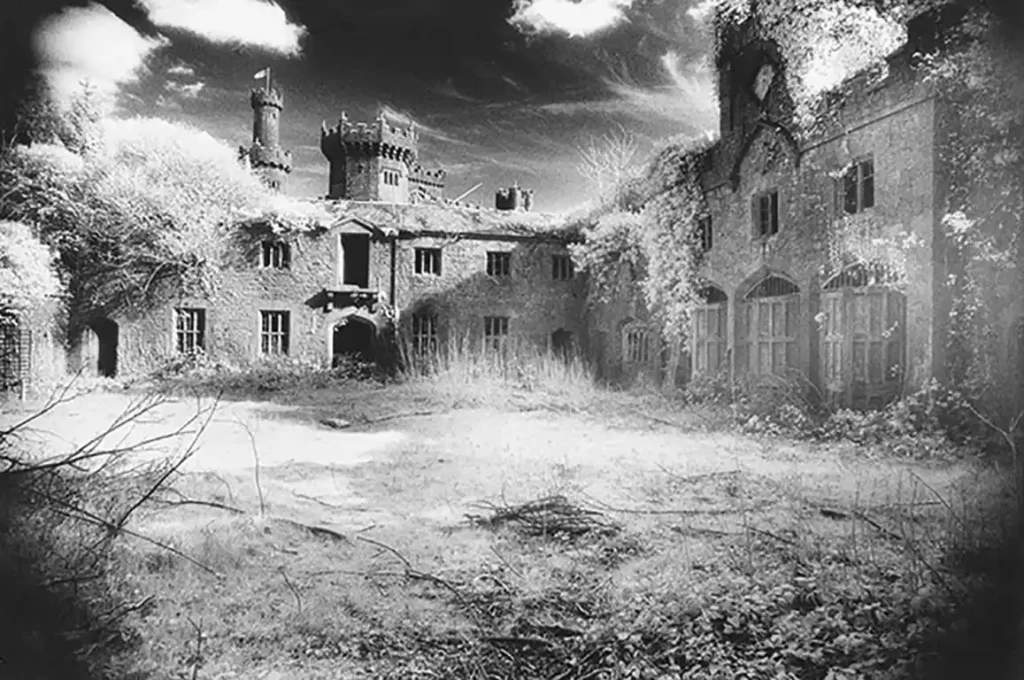
You have seen the photograph before you recognized it as a choice. The long exposure has smoothed the sky into a single grey breath, the broken windows frame nothing but absence, and the floor, colonized by moss and pale fungi, seems to belong to a geological epoch rather than to the specific Tuesday in 1987 when the last worker locked the door and did not return. The camera has done something precise here, something that required planning, tripod placement, a deliberate wait for overcast light that would flatten shadows and drain the scene of the specific hour it actually inhabits. The result feels discovered. It was constructed.
The formal grammar of ruin photography is not neutral documentation but a rhetoric with its own ideology, and its central operation is the erasure of agency. Desaturation pulls color toward the tonal range of historical archive, activating in the viewer a sensation of temporal distance that the building’s actual age may not justify. A factory abandoned in 2003 becomes, through a desaturated palette and a 30-second exposure that blurs any residual motion, aesthetically indistinguishable from something lost in 1943. The gap between the real timeline and the felt timeline is where the ideology lives. Roland Barthes, in Camera Lucida published in 1980, described the photograph as a certificate of presence — proof that this existed, here, once — but the ruin photograph systematically corrupts that certificate by presenting a constructed absence as though it were simply what time left behind.
The human figure is almost never there. This is not accidental framing — it is a doctrine. The presence of a person would introduce scale, yes, but more dangerously it would introduce contemporaneity, the contamination of the now, the reminder that someone chose to enter this place, someone is breathing in the asbestos-laden air, someone is deciding what to include and what to step over. The excluded human is not merely aesthetic minimalism; it is the suppression of the witness, which is also the suppression of the question of who is watching and why and with what interest. Susan Sontag argued in On Photography, written in 1977, that photography teaches people a new visual code while altering and enlarging our notions of what is worth looking at — but what ruin photography does is more specific: it teaches the viewer that certain kinds of devastation are worth contemplating as beauty precisely when stripped of the people to whom that devastation happened.
What gets aestheticized in the long-exposure silence of a shuttered hospital or a collapsed public housing block is not actually time. It is the concealed outcome of specific budget decisions, specific municipal disinvestments, specific policies that allocated repair money elsewhere and let particular communities absorb the entropy. The photograph, by converting those decisions into atmosphere, performs a kind of laundering. The ruin stops being the evidence of a choice and becomes the evidence of time’s indifference — and time, unlike a city council or a corporate board, cannot be held accountable. Siegfried Kracauer observed in 1927, in his essay on photography published in the Frankfurter Zeitung, that the photographic image captures the spatial configuration of a surface while discarding the meaning that inhabited it, leaving behind what he called a ghost of the object rather than the object itself. The ruin photograph does not merely confirm this — it exploits it as a production value.
What the frame refuses to show is that ruins are almost always made. Someone decided the building was not worth saving. Someone decided the people inside it were not worth the cost of continuity. The aesthetic of timelessness is precisely what prevents you from asking who that someone was, because a scene that looks like the inevitable residue of centuries does not invite the question of last Thursday’s vote, and that immunity from the specific is not a side effect of the formal choices — it is their entire point.
⏳ When Time Leaves Its Mark: Memory, Decay, and Beauty
Ruins are not simply broken things — they are time made visible, the slow handwriting of history on stone and silence. Photography that captures decay invites us to confront impermanence, the passage of civilizations, and the strange beauty that emerges when nature reclaims what humanity once built. These related readings deepen the philosophical and aesthetic dimensions of that fascination.
Memento Mori: History and Meaning
Memento mori is one of the oldest invitations to contemplate death and impermanence, woven into art and culture for millennia. In the context of ruin photography, every crumbling wall and rusted threshold becomes a modern memento mori — a reminder that all human constructions are temporary. This article traces the deep symbolic history of that reminder, from skull paintings to contemporary visual culture.
GO TO THE SELECTION: Memento Mori: History and Meaning
Vanitas in Art: Symbolism and Meaning
Vanitas imagery in Western art has long used decaying objects — wilting flowers, extinguished candles, deteriorating surfaces — to evoke the fleeting nature of earthly existence. Ruin photography inherits this tradition directly, transforming abandoned architecture into monumental vanitas compositions. Understanding the symbolic grammar of vanitas enriches the way we read the visual language of decay captured through a lens.
GO TO THE SELECTION: Vanitas in Art: Symbolism and Meaning
Japanese Aesthetics: Wabi-Sabi Mono no Aware and Yugen
Japanese aesthetics offer some of the most refined philosophical frameworks for understanding beauty in imperfection and transience. Wabi-sabi, mono no aware, and yūgen each articulate a deep sensitivity to things that are incomplete, aged, or fading — qualities that lie at the very heart of ruin photography. This article explores how these concepts can illuminate not only Japanese culture but a universal human experience of time and loss.
GO TO THE SELECTION: Japanese Aesthetics: Wabi-Sabi Mono no Aware and Yugen
Friedrich Nietzsche and Memory: On the Uses and Disadvantages of History
Nietzsche’s reflection on history and memory asks a provocative question: when does the past become a burden that crushes the living rather than a foundation that sustains them? Ruin photography sits precisely at this tension — it honors what remains while confronting the weight of what has been lost. This article explores Nietzsche’s nuanced argument about the uses and dangers of historical consciousness, offering a sharp philosophical lens for any meditation on ruins.
GO TO THE SELECTION: Friedrich Nietzsche and Memory: On the Uses and Disadvantages of History
Discover the Cinema of Time and Beauty on Indiecinema
If these reflections on ruins, memory, and the aesthetics of impermanence have stirred something in you, Indiecinema is the place to follow that feeling further. Our streaming platform gathers independent and art-house films that dare to slow down, to look at what has been left behind, and to find meaning in the margins of time. Come explore a cinema that, like a great photograph of ruins, reveals more the longer you look.
👉 EXPLORE THE CATALOG: Watch Indie Films in Streaming
A vision curated by a filmmaker, not an algorithm
In this video I explain our vision

