
The Canvas Before the Storm
You are not looking at the painting. You are inside it, and the distinction has already dissolved. The light does not come from a source you can locate — it radiates from the canvas itself, from the air between you and the surface, from somewhere behind your sternum. The horizon has gone. What you thought was water may be sky. What you thought was a ship is a smear of ochre and bone-white that your mind assembles into a vessel only because it needs something solid to hold. Turner has taken the solid thing away from you on purpose, and you are standing in a gallery in London or in Paris or in Washington with your hands at your sides, perfectly still, slightly afraid, and you cannot explain to the person next to you why your breathing has changed.

Joseph Mallord William Turner was born in Covent Garden in 1775, the son of a barber, and he died in Chelsea in 1851 having produced something close to thirty thousand works — oils, watercolors, sketches, studies — a volume of output that suggests not ambition in the conventional sense but compulsion, the way a person speaks when they are trying to say something the language does not yet contain. He was elected an associate of the Royal Academy at twenty-four, the youngest in its history at that point, and yet the institution that celebrated him spent decades uncertain what to do with his later work, which seemed to abandon the very craft it was supposed to crown. His contemporaries accused him of painting with tinted steam. They meant it as an insult. They had no idea they were describing exactly what he was doing.
The Romantic movement, which Turner inhabited without ever being entirely consumed by it, was not primarily a style. It was a diagnosis. Edmund Burke had published A Philosophical Enquiry into the Origin of Our Ideas of the Sublime and Beautiful in 1757, and the argument at its center was unsettling in a way that polite aesthetics had not previously permitted: that the most powerful experiences available to human consciousness were not pleasurable but threatening, that what arrested the mind most completely was not harmony but the vertiginous sensation of being small before something that could destroy you. The sublime, in Burke’s formulation, was essentially a near-death experience converted into feeling. It required distance enough to survive but proximity enough to feel the annihilation.
Turner collapsed that distance. Where other painters of the period — his contemporary John Constable among them — offered the landscape as something a human eye could possess, could organize into foreground, middle ground, and receding perspective, Turner systematically dismantled the geometry of possession. The paintings refuse the fiction of the stable observer. Snow Storm — Steam-Boat off a Harbour’s Mouth, exhibited at the Royal Academy in 1842, was reportedly based on Turner having himself lashed to a mast during an actual storm at sea, though historians debate whether the episode occurred as described. What is not debatable is what the canvas does: it places you inside the vortex, not above it, not beside it, in it, with no privileged position from which to aestheticize your way to safety.
This is what separates Turner from the picturesque tradition he was trained in and eventually destroyed. The picturesque, as theorized by William Gilpin in his Observations on the River Wye published in 1782, was a mode of consuming landscape, a set of compositional rules that told the educated traveler how to frame a view so that wilderness became scenery, threat became pleasure, and the unruly natural world became a painting one could mentally hang on a wall. It was a technology of distance. Turner looked at that technology and began, with extraordinary patience and precision, to take it apart piece by piece, until the viewer had nowhere left to stand.
Simon Marsden’s Haunted Life In Pictures
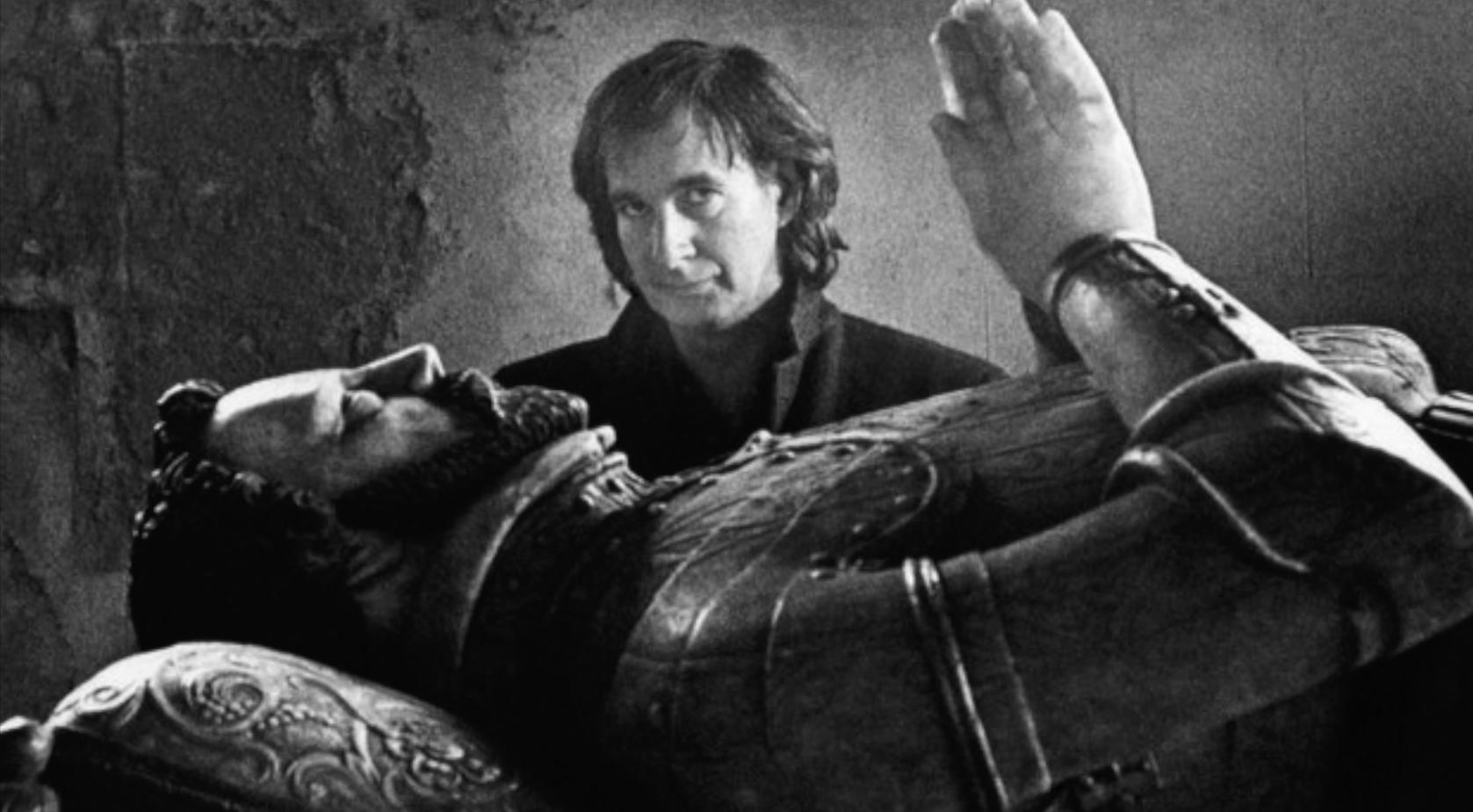
Documentary, by Jason Figgis, United States, 2019.
This documentary retraces the life and work of Simon Marsden, widely regarded as one of the foremost photographers of the supernatural. Premiered at the British Film Institute in London, the film offers a fascinating journey into his creative universe, appealing not only to photography enthusiasts but also to scholars, teachers, students, and anyone intrigued by the mysteries of the unseen. Through evocative imagery and first-hand accounts, it explores the artistic path of a photographer whose work has appeared in books, on U2 album covers, and in museum exhibitions around the world.
Although convinced of the existence of ghosts, Marsden never claimed to capture them directly with his camera. Instead, he used black-and-white infrared film to record the atmosphere and the invisible traces that, in his view, spirits left imprinted upon places. From the landscapes of Ireland to the vast expanses of Russia, passing through Venice and the American Southwest, he transformed historic buildings, ruins, and haunting locations into deeply evocative images capable of suggesting dark and unsettling stories. His photographs continue to captivate the imagination, demonstrating how the most powerful works of art can leave a lasting impression on those who behold them.
LANGUAGE: English
SUBTITLES: Spanish, French, German, Portuguese
When Romanticism Was a Provocation, Not a Style
You have been taught to admire Turner’s paintings the way you’ve been taught to admire sunsets — as something decorative, emotionally appropriate, aesthetically pleasing in a way that requires nothing from you. That is precisely the distortion that needs dismantling before a single brushstroke makes sense.
When Joseph Mallord William Turner exhibited Rain, Steam and Speed at the Royal Academy in 1844, the industrial locomotive tearing through fog and rain was not a celebration of technological progress. It was a confrontation. The machine appears almost swallowed by the landscape, diminished by the atmospheric violence surrounding it, and the hare racing ahead of the engine on the track — which most viewers miss entirely — is one of the most devastating ironies in the history of Western painting. Speed against speed, flesh against iron, both consumed by forces neither can outrun. Turner was not painting the triumph of industry. He was painting its vanity against the indifferent enormity of the natural world.
To understand why that act of painting was philosophically violent in its moment, you have to place it inside the intellectual war being fought across Europe since the mid-eighteenth century. The Enlightenment had constructed a very specific idea of what knowledge was for: to classify, to measure, to dominate through rational comprehension. Nature, in this framework, was a system to be decoded, a mechanism operating according to laws that the human mind could master and eventually command. Francis Bacon had set the terms in the early seventeenth century, and by the time the Industrial Revolution began reshaping England’s countryside in the 1780s and 1790s, those terms had become physical infrastructure — mills, enclosures, canals, and the systematic conversion of common land into private capital. Reason was not just a philosophy. It was a bulldozer.
Edmund Burke published his Philosophical Enquiry into the Origin of Our Ideas of the Sublime and Beautiful in 1757, and it detonated something that rationalism had no category for: the productive terror of encountering what cannot be controlled. Burke drew a precise distinction between beauty, which pleases through order, proportion, and familiarity, and the sublime, which overwhelms through vastness, obscurity, darkness, and the threat of annihilation. Crucially, he located the sublime not in human achievement but in the encounter with powers that dwarf human scale entirely — storms, abysses, oceanic depths, unbroken horizons. The emotional response he described was not peaceful admiration. It was astonishment edging toward dread, a sensation he called “astonishment” in its strongest form, which “so entirely fills the mind with its object that it cannot entertain any other, nor by consequence reason on that object which employs it.” Burke was describing a condition in which rational comprehension temporarily collapses. For the Enlightenment project, this was not an aesthetic curiosity. It was a threat.
Romanticism seized that threat and weaponized it. It was never a style — never merely a preference for misty mountains over neoclassical columns. It was an argument that the measurable world was not the whole world, that human reason was structurally insufficient in the face of existence’s actual scale, and that what the Enlightenment called progress had purchased its efficiency at the cost of something irretrievable. When the Enclosure Acts between 1750 and 1860 eliminated roughly 6.8 million acres of common land in England, they did not just dispossess rural populations economically. They severed a relationship between people and landscape that had organized human experience for centuries. The Romantic painters and poets were not being sentimental about that loss. They were documenting an amputation while the surgeon insisted nothing had been cut.
Turner’s canvases were produced in precisely this contested space, where Burke’s philosophical vocabulary met the visible consequences of a civilization reorganizing itself around extraction and measurement, and where the question of what nature actually was — resource, backdrop, or autonomous force — had not yet been settled by anyone.

Turner’s Biography as Rupture, Not Origin Story
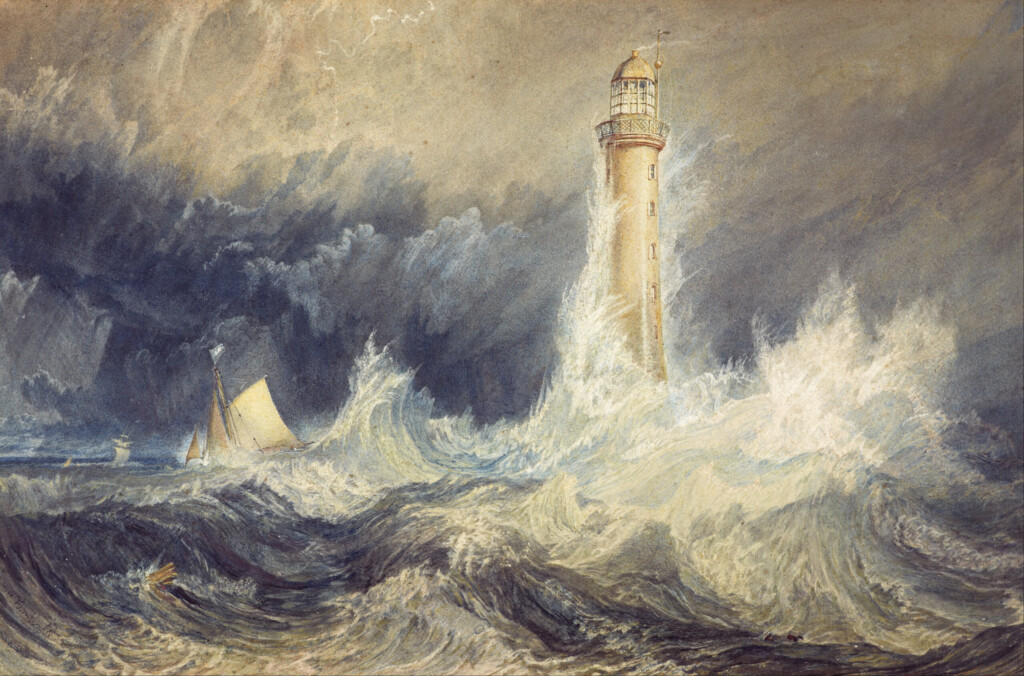
You are standing in a barbershop on Maiden Lane in 1775, the smell of lather and singed hair thick in the air, and somewhere in the back rooms a child is being born into a city that has already decided what he is worth. Covent Garden was not picturesque. It was the district of market stalls and night workers, of theater crowds and street violence, of a London that the painters of Burlington House pretended did not exist when they arranged their classical allegories and their portraits of landed gentry against invented Arcadian skies.
Joseph Mallord William Turner’s father was a barber. Not a surgeon-barber with institutional standing, not a tradesman of the respectable middling sort, but a man who washed and cut other men’s hair for coins. This is the fact that the mythology of genius most urgently needs to dissolve. The biographical tradition around Turner has always been tempted to transform this poverty into a kind of noble primitive origin — the untouched mind, uncontaminated by convention, rising naturally toward greatness as a plant bends toward light. That story is false, and its falseness matters enormously, because it replaces a structural observation with a romantic fable.
What the Covent Garden childhood actually produced was not innocence but hypervigilance. A child who grows up on the wrong side of the city’s invisible lines learns to read systems of exclusion with extraordinary precision, because those systems are not abstract to him — they are the specific textures of which doors do not open, which rooms fall silent when you enter, which praise arrives with a barely audible reservation attached to it. When Turner entered the Royal Academy Schools at fourteen in 1789, he was not some unformed vessel. He was already a reader of codes, and the Academy’s codes were simply another language spoken by people who assumed he couldn’t hear them clearly.
The Academy itself was forty years old in 1789, still consolidating the authority Joshua Reynolds had given it through his Discourses — fifteen lectures between 1769 and 1790 that systematically ranked artistic genres and declared history painting the summit of legitimate ambition. Landscape was minor. It was decorative, associative, pleasant — the intellectual equivalent of wallpaper. Turner understood this hierarchy not as a natural order of things but as a claim made by specific people in a specific room to protect specific investments. He began to work inside that system with the deliberate attention of someone who has memorized a rulebook in order to know exactly which rules carry real weight and which are merely ceremonial.
His early watercolors — topographical, commissioned, technically impeccable — are not the work of a genius biding his time. They are the work of someone building institutional credit with full knowledge of its eventual use. By the time he was made a full Royal Academician in 1802, at twenty-six, the youngest in the institution’s history to that point, he had accumulated enough standing to begin the long project of making the minor category absorb everything the major categories claimed to own. Landscape would take on the moral weight of history painting, the psychological depth of portraiture, the metaphysical ambition of allegory — not by arguing for its elevation but by enacting it until the hierarchy had no vocabulary left with which to resist.
There is something almost methodical in how this happens, and the methodology is inseparable from class. A man who grew up inside an institution would have internalized its values as natural. Turner never did. The academy remained, for him, a legible construction — a set of choices made by human beings who could have chosen otherwise, and therefore a set of choices that could be remade.
The Royal Academy and the Politics of Beauty
You are handed a credential before you understand what you have done to earn it, and the institution that grants it assumes, silently, that the credential will tame you.
Turner was elected a full Academician of the Royal Academy in 1802, at twenty-six — two years after his initial associate membership, both distinctions arriving with a speed that the Academy’s own bylaws barely accommodated for someone so young. The institution had been founded in 1768 under Joshua Reynolds, whose Discourses on Art codified a hierarchy of taste in which historical painting reigned supreme and landscape occupied a lesser, decorative register. Turner entered a building whose walls were organized around a theory of what beauty was supposed to do: elevate, instruct, confirm the viewer’s moral standing. What he brought in through the door was a counter-pressure the Academy had no language for, and so it did what institutions always do with what they cannot name — it celebrated him.
The celebrated and the domesticated are often the same person seen from different angles. When John Ruskin published the first volume of Modern Painters in 1843, he was twenty-four years old and attempting something that looked like defense but functioned as capture. His central argument was that Turner surpassed every landscape painter who had preceded him precisely because he rendered natural truth more faithfully — clouds behaved as clouds behave, light fell as light actually falls, geological formations obeyed their real structure. It was a brilliant argument and a devastating one, because it anchored Turner’s ferocity to a program of accurate observation. Ruskin wanted to save Turner from his critics by proving he was a realist. What this required was quietly setting aside everything in Turner’s work that observation cannot account for: the dissolution of form, the scenes where the horizon becomes indistinguishable from the water beneath it, the late oils where a figure might be a wave or a flame or a human body losing its boundary with the air.
The Academy’s politics of beauty operated not through censorship but through framing. Turner served as Professor of Perspective from 1807 to 1828, a role so exquisitely administrative that it seems almost designed to keep a disruptive intelligence occupied with the geometry of vanishing points. His lectures were notoriously difficult, sometimes incoherent, and he used them to wander into optics, color theory, and the history of painting in ways that had nothing to do with technical instruction. The audience expected a craftsman explaining tools. What they received was a man thinking out loud about what vision itself was for.
This gap between institutional expectation and actual practice is not incidental to Turner’s biography — it is the engine of his development. Because the Academy had decided he was a master, he was given the freedom that mastery pretends to confer but actually does the opposite with: the freedom to be watched, assessed, and placed. Every painting he submitted to the annual exhibitions was hung in a space organized by other people’s ideas about progression and influence. He was compared to Claude Lorrain repeatedly, almost ritually, as though Claude were a ceiling he was trying to touch rather than a floor he had already passed through. By 1812, when he exhibited Snow Storm: Hannibal and his Army Crossing the Alps, the critics found in it the sublime machinery they recognized from Edmund Burke’s 1757 Philosophical Enquiry — terror, vastness, obscurity — and used that recognition to feel that they had understood it.
Understanding has always been the mechanism by which the unsettling becomes safe. Ruskin gave Turner’s chaos a vocabulary of natural philosophy. The Academy gave it a wall. Burke’s aesthetics gave it a category. Each gesture of comprehension was also, necessarily, a reduction — the substitution of a map for the territory the map was drawn to avoid.
Light as Ontology, Not Technique
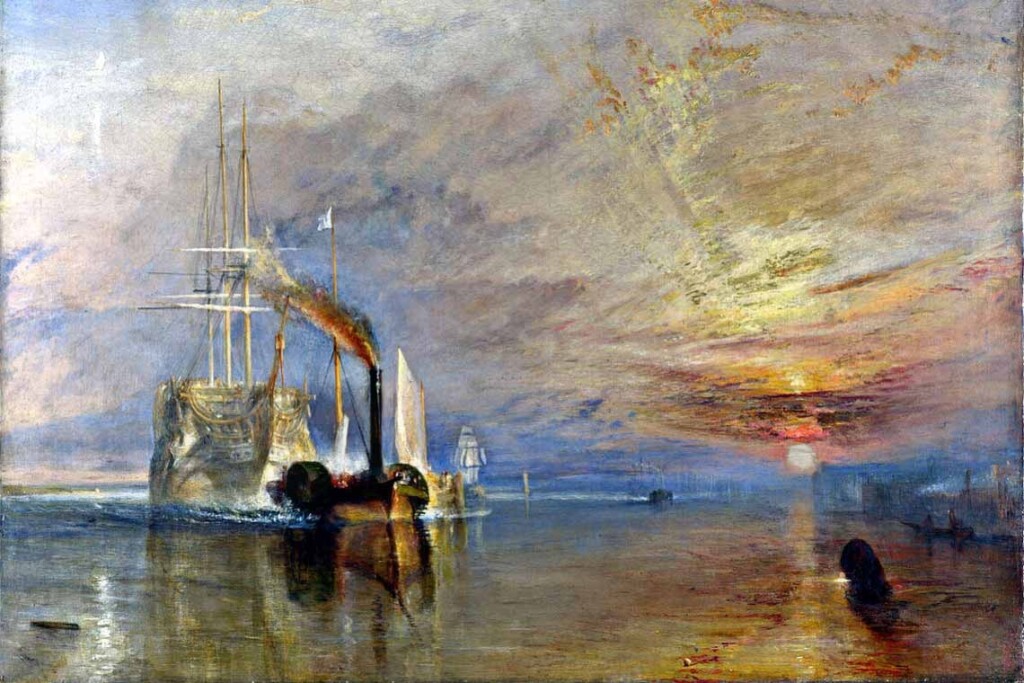
You are standing in front of a canvas and you cannot find yourself in it. Not because the painting is abstract in any modern, self-congratulatory sense, but because the painter has made a specific and devastating argument: there is no privileged position inside the world being depicted. The tug pulling the old warship toward its last berth is not a symbol. The steam is not a metaphor. The dying light over the Thames in 1839 is not atmosphere added to a scene — it is the scene, and everything solid within it is already dissolving into it, already losing the argument.
What Turner accomplished in the final decades of his career was not a stylistic evolution but an ontological proposition. The humanist tradition in Western painting had always organized visual space around a perceiving subject — the vanishing point in Renaissance perspective is, at its root, a philosophical claim that the world radiates outward from a human eye standing somewhere specific and secure. Leon Battista Alberti’s codification of perspective in De Pictura in 1435 was not merely a technical manual; it was a metaphysical guarantee that the viewer occupied a center. Turner spent the better part of four decades methodically dismantling that guarantee.
By the time Rain, Steam and Speed arrived at the Royal Academy in 1844, the dissolution was nearly total. A locomotive crosses a bridge over the Thames in fog and driving rain, and the geometry of the machine — the one element that should anchor industrial modernity into legible, triumphant form — is consumed by its own atmosphere. The train is there, yes, but it arrives as a darkening within light, a density within dissolution, not a solid fact cutting through chaos but something born from the same undifferentiated field as the water and the mist and the spectral hare that runs ahead of it on the tracks. That hare, which so many early viewers noticed and then quickly forgot how to account for, is doing philosophical work: it belongs to no category the composition privileges over any other. The ancient animal and the modern machine occupy identical ontological ground because the painting refuses the very notion of hierarchy between foreground and background, between witness and world.
Georg Wilhelm Friedrich Hegel, writing in his Lectures on Aesthetics delivered in Berlin between 1820 and 1829, argued that Romantic art represented the spirit turning inward, away from the external world and toward interiority. Turner’s paintings perform the opposite gesture so violently that they nearly disprove the framework. The self does not turn inward in these late works — the self is turned outward until it disperses. The light is not a projection of human feeling onto an indifferent nature. The light is prior. It was here before the figure arrived and it will be undisturbed when the figure is gone.
This is where the viewer’s daily self-conception begins to feel unstable, because the humanist subject who walks through contemporary life still operates on the Albertian premise even without knowing Alberti’s name. You locate yourself at the center of your own narrative. Your suffering is foreground; the suffering of others is background detail. Your decade is the hinge of history. Turner paints a world in which this arrangement was never structurally guaranteed — only ever temporarily tolerated by a universe that does not organize itself around witnesses. The philosopher Maurice Merleau-Ponty, in his 1945 Phenomenology of Perception, tried to restore the body as the anchoring point of experience, arguing that perception is always situated, always rooted in flesh. But Turner’s light doesn’t care about the situated body. It arrives before the body orients itself. It is already doing what it does before any perceiving subject has decided where to stand, before any human eye has negotiated terms with the visible, before the very decision to look has been made by anyone at all.
A vision curated by a filmmaker, not an algorithm
In this video I explain our vision
The Industrial Machine Inside the Sublime
You are standing in a gallery in 1844, and the painting in front of you shows a locomotive hurtling through rain and fog across the Maidenhead Railway Bridge, the locomotive a dark iron fist punching through a luminous dissolution of gold and grey. You feel something like awe. So did the men who commissioned the railways.
This is precisely where the trap closes. When steam and iron appear inside Turner’s atmospheric vortex not as violations of nature but as participants in its drama, they inherit the moral grammar of the sublime itself. The locomotive in Rain, Steam, and Speed does not desecrate the landscape; it seems almost summoned by it, as though Brunel’s Great Western Railway were a natural event on the same ontological level as a thunderstorm. For the industrialists and financiers flooding the Royal Academy’s exhibition rooms in the 1840s, this was not a provocation but an absolution. The painting handed them a cosmology in which their machinery belonged to the same transcendent order as the cliffs of Dover.
Edmund Burke had laid the philosophical groundwork nearly a century earlier in his 1757 Philosophical Enquiry into the Origin of Our Ideas of the Sublime and Beautiful, where he located the sublime specifically in experiences of overwhelming, asymmetrical power — vastness, obscurity, terror held at a safe aesthetic distance. What Turner accomplished, consciously or not, was to transfer that category from volcanic eruptions and ocean storms to coal-fired engines. The emotional technology remained identical. The object it sanctified had changed entirely. Capital does not need to argue its legitimacy openly when culture has already done the work of embedding it inside a sacred register.
John Ruskin, Turner’s most fervent advocate, detected something of this contamination without naming it cleanly. In the five volumes of Modern Painters, published between 1843 and 1860, Ruskin built an entire ethical architecture around Turner’s treatment of natural light, insisting the paintings were moral education, a corrective to the materialism spreading through English society like smoke. Yet Ruskin’s own patrons were industrialists. The cultural apparatus through which Turner was celebrated — the exhibitions, the critics, the collecting class — was financed by precisely the machinery Turner’s fog appeared to transcend. Critique does not automatically escape the economic circuit it anatomizes; it sometimes becomes its most elegant ornament.
This structural co-optation is not unique to Turner’s century. Herbert Marcuse identified in One-Dimensional Man, published in 1964, what he called the “affirmative character” of high culture: its capacity to absorb and neutralize opposition by elevating dissent into aesthetic experience, something to be contemplated rather than acted upon. A painting that makes industrialization feel sublime performs exactly this function. It does not argue that the factory is good. It does it something more effective: it makes the factory feel inevitable, cosmically authorized, woven into the same fabric as weather and light and geological time. By 1850, British coal production had already surpassed 50 million tons annually, and the men overseeing those numbers were hanging Turner’s incandescent storms in their dining rooms, consuming the sublime as a form of self-congratulation.
What makes this dynamic so difficult to disentangle is that Turner himself was not a propagandist, and his vision was not cynical. The sincerity of his atmospheric obsession is beyond reasonable dispute. But sincerity is not immunity. A genuinely felt aesthetic can be harvested for purposes entirely alien to its origin, and the harvesting leaves no fingerprints. The painting remains unchanged. Only its social function shifts, silently, the way meanings migrate inside languages without anyone deciding to move them. The canvas that was meant to dissolve certainty becomes instead the most expensive certainty money can hang on a wall.
What We Mean When We Say ‘Nature’
You stand in front of a canvas roughly two and a half meters wide, and something in your chest opens involuntarily. The light does that. The formlessness does that. You have been trained, across centuries of accumulated aesthetic conditioning, to receive this sensation as contact with something real, something outside culture, something that existed before you and will endure after you. What you are actually receiving is a very sophisticated argument about what nature is, dressed in pigment and linseed oil.
Timothy Morton‘s Ecology Without Nature, published in 2007, dismantles the foundational grammar of that argument with uncomfortable precision. The concept Morton calls the mesh — the radical entanglement of all organisms and environments in a continuous, non-hierarchical web of dependency — has no room for an observer standing at a respectful distance, absorbing the sublime. The mesh is not beautiful. It is not vast. It does not inspire awe because it does not present itself as spectacle. It is the mold on your bathroom wall, the bacterial colony in your gut, the mycorrhizal threads beneath a forest floor exchanging phosphorus for carbon in transactions that predate vertebrate life by hundreds of millions of years. It refuses the position of the viewer entirely, because the viewer is already inside it, already part of its accounting.
What the Romantic tradition achieved — and Turner achieved it more completely than almost anyone — was the construction of a viewing position that felt transcendent precisely because it had been aesthetically laundered of all such entanglement. The vortex in Snow Storm: Steam-Boat off a Harbour’s Mouth, painted in 1842, is total atmospheric violence, and yet the viewer is safe. The painting produces this safety structurally: the canvas edge, the frame, the museum wall, the bodies of other visitors — all of these conspire to locate you outside the event, consuming it as experience rather than surviving it as participant. The Romantic sublime is, at its technical core, a mechanism for being devastated by nature without being accountable to it.
This is where the cultural technology reveals its politics. Passivity in the face of ecological destruction is not a psychological failure or a moral weakness in individuals. It is the trained and practiced response of people who have been taught, for roughly two hundred and fifty years, that their proper relation to the natural world is one of witness. The category of the Picturesque emerged in England in the late eighteenth century — William Gilpin was systematizing it by the 1790s — as a literal method for converting landscape into pictures in the mind, for teaching the eye to compose what it saw into aesthetic units. Nature became a gallery you moved through. The emotional payload of that movement was wonder, melancholy, awe. None of those states require action.
What they require is distance. And distance, when it becomes the default epistemological posture of an entire civilization, produces a specific kind of subject: one who can be genuinely grief-stricken by footage of a burning rainforest and return to ordinary life within the hour, because the burning was received as image, as sublime event, as the kind of terrible beauty Turner had already taught us to hold. The aesthetic framework does not blunt the feeling. It channels the feeling into a form that exhausts itself without converting into agency.
Morton is not arguing against beauty. The mesh is not a counsel of ugliness or indifference. What it demands is that we stop narrating nature as something encountered, something approached, something framed by our arrival and departure. The fog Turner dissolved his figures into was never metaphor. It was the actual condition — permeability, dissolution, the failure of the boundary between observer and event — and the tragedy of his legacy is that the tradition mistook his vertigo for grandeur, and taught the vertigo to stand still inside a frame and mean something safe.
The Second Scene: A Museum in the Present Tense
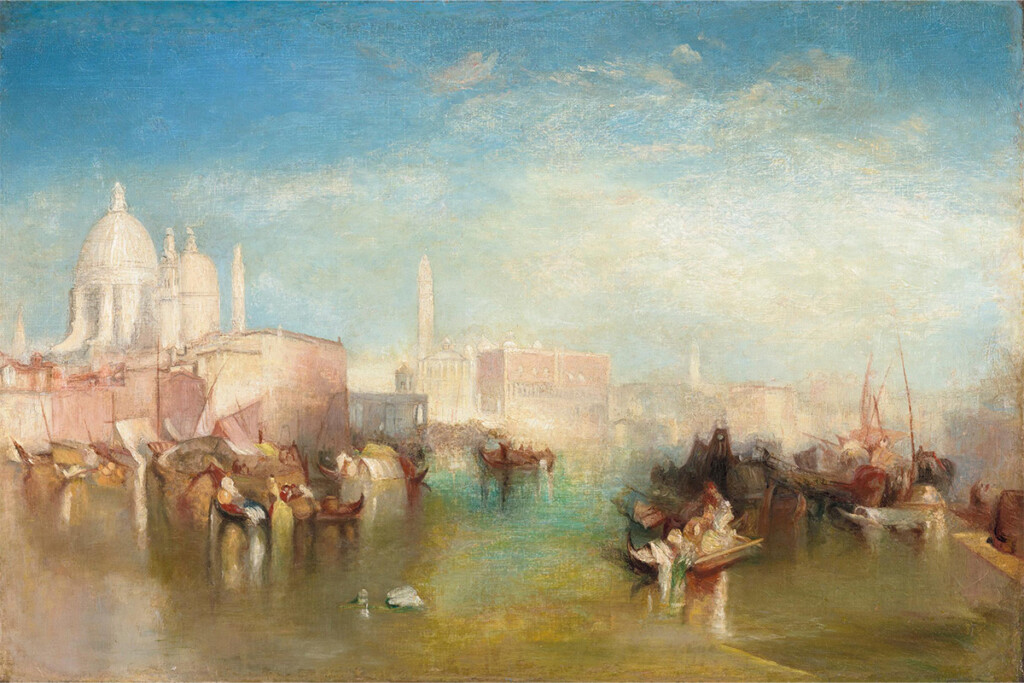
She raises the phone before she has even stopped walking, the screen already framing what her eyes have not yet fully received, and in that half-second she has already decided that the painting must become a record before it can become an experience.
The canvas in front of her is one of Turner’s late interiors of light — one of those works from the 1840s where the subject has been so thoroughly dissolved into luminous atmosphere that critics at the time accused him of painting chaos, of abandoning the civilized contract between artist and audience. John Ruskin, in the first volume of Modern Painters published in 1843, argued the opposite with almost desperate force: that Turner was not abandoning nature but reading it at a frequency no previous painter had been trained to hear. What Ruskin perceived, and what the woman with the phone has not yet been given a moment to perceive, is that the painting is not an image of something. It is a condition. The rectangle of canvas does not represent light. It enacts a pressure.
The cognitive reflex that sends a hand toward a phone in front of a work of art is not frivolity or disrespect. It is something more structurally interesting: it is the mind’s instinct to convert the unbounded into the portable, to impose edges on what Turner spent forty years trying to convince us has no edges. Edmund Burke, writing in 1757 in his Philosophical Enquiry into the Origin of Our Ideas of the Sublime and Beautiful, identified the experience of the sublime precisely as the encounter with something that exceeds the mind’s capacity to contain it. The emotion produced is not pleasure in the ordinary sense but a kind of ecstatic disorientation, the self briefly losing its coordinates. Turner’s late canvases are among the most literal executions of that theory ever made in pigment. The phone, raised to that canvas, is Burke’s “beautiful” asserting itself against the sublime — the human organism reaching for scale, for frame, for manageable proportion, because the alternative is to stand inside the disorientation and let it work.
What makes the gesture more than merely symptomatic is that it mirrors something Turner documented in his own figure compositions. Small dark silhouettes appear throughout his canvases — witnesses at the base of avalanches, passengers on storm-lit decks, spectators at the edge of fires — and they are almost never the subjects of the paintings. They are the paintings’ measure of human inadequacy before the event. The woman with the phone has, without knowing it, placed herself inside that tradition. She is the silhouette. The luminous atmosphere of the canvas extends beyond the phone’s frame in every direction.
The image she captures will be flat, slightly overexposed from the gallery’s protective lighting, and shorn of the physical scale that makes standing before a large Turner a mildly vertiginous experience — the works grow in presence as you approach them, which reverses the logic of most representational painting, where proximity reveals brushwork and dissolves illusion. Turner’s paintings intensify as you close the distance, the atmosphere thickening rather than breaking apart. No compression algorithm holds that. No screen reproduces the way the eye is pulled inward without arriving anywhere, the way resolution keeps promising to emerge and never quite does.
She lowers the phone eventually, and there is a moment — three seconds, perhaps four — where she simply looks. The painting does nothing to reward her attention in any language she was trained to expect from pictures. It does not resolve. It does not deliver a composition she can summarize or a subject she can name. It simply continues radiating at the frequency Turner found and held onto through decades of public ridicule and private obsession, a frequency that was old when he discovered it and will outlast every device ever raised against it.
🌊 Nature, Sublime, and the Romantic Soul
William Turner‘s vision of nature as an overwhelming, almost divine force connects deeply to a broader tradition of Romantic and philosophical thought. These articles explore the currents of ideas — from transcendentalism to phenomenology — that shaped how Western culture learned to see the natural world not merely as landscape, but as cosmic presence.
American Transcendentalism: History and Thought
American Transcendentalism arose from the same Romantic impulse that drove Turner to dissolve solid forms into light and atmosphere. Thinkers like Emerson and Thoreau believed nature was the visible face of an infinite spiritual reality, a conviction that mirrors Turner’s painterly quest for the numinous. Understanding this movement illuminates why the Romantic landscape was never merely decorative but always a form of metaphysical inquiry.
GO TO THE SELECTION: American Transcendentalism: History and Thought
Thoreau’s Walden: Meaning and Analysis
Thoreau’s Walden is one of the most radical experiments in listening to nature as a living, intelligent force — an act of attention that Turner performed with his brush on canvas. Both men sought to strip away civilization’s noise and confront the raw, transformative power of the natural world. Reading Walden alongside Turner’s paintings reveals a shared Romantic grammar of solitude, wonder, and cosmic immersion.
GO TO THE SELECTION: Thoreau’s Walden: Meaning and Analysis
Phenomenology of Nature: Husserl and Merleau-Ponty
Husserl and Merleau-Ponty’s phenomenology of nature offers a philosophical framework for understanding why Turner’s storms and sunsets feel so viscerally alive to the viewer’s body and consciousness. Merleau-Ponty in particular argued that perception is not a passive reception but a bodily participation in the world’s unfolding, which resonates with Turner’s technique of placing the viewer inside the meteorological event. This article traces how philosophy and the senses converge around the mystery of natural experience.
GO TO THE SELECTION: Phenomenology of Nature: Husserl and Merleau-Ponty
Shelley and the Defence of Poetry: Poets as Legislators
Percy Bysshe Shelley‘s Defence of Poetry proclaims that poets — and by extension artists — are the true legislators of humanity because they perceive and transmit the hidden order underlying visible nature. This idea places Turner squarely within the Romantic project of making the invisible visible, translating cosmic energy into chromatic sensation. Shelley’s manifesto helps us understand why Turner was not simply painting weather but prophesying a new relationship between humankind and the universe.
GO TO THE SELECTION: Shelley and the Defence of Poetry: Poets as Legislators
Discover Cinema that Captures the Infinite
If Turner’s vision of nature as cosmic force stirs something deep in you, Indiecinema’s streaming catalog holds films that pursue the same sublime — works of independent and art-house cinema that transform light, landscape, and the elements into pure cinematic experience. Explore Indiecinema and let the screen become your window onto the infinite.
👉 EXPLORE THE CATALOG: Watch Indie Films in Streaming
A vision curated by a filmmaker, not an algorithm
In this video I explain our vision

