
The First Note That Undoes You
You are sitting in a dim concert hall — or perhaps it is a courtyard, the night air still warm, a single lamp throwing amber light across the face of a musician who has not yet looked up — and something begins that you cannot immediately identify as music. There is a sound, singular and sustained, bending at its edges in a way that no piano string ever could, and your ear reaches for it the way a hand reaches for a railing in the dark, finding nothing. The note does not land. It circles. It approaches a resolution that never comes, and in that refusal, something in your chest tightens — not with displeasure, but with a kind of vertigo, the specific feeling of a ground that is no longer where you expected it.

Western harmonic training, even the informal kind absorbed simply by growing up inside Western popular culture, is a training in expectation and resolution. The chord wants to move. The melody wants to close. Heinrich Schenker spent his career — most ferociously in his 1935 work “Der freie Satz” — arguing that all tonal music is fundamentally a prolonged motion from tension to rest, that every structural level of a Western composition is performing the same gravitational fall toward the tonic. You did not read Schenker. You did not need to. The logic entered you through ten thousand pop songs, film scores, lullabies, the way a hymn at a funeral eventually settles into something that permits the mourners to exhale. Your nervous system learned the grammar before your mind had language for it.
What unfolds in a Hindustani raga refuses that grammar at the root. The alap — the opening, unmetered exploration that can extend for forty minutes before a single rhythmic cycle enters — is not a delay of the real music. It is an ontological statement about what music is for. The musician is not building toward a climax you will be released from. They are inhabiting a tonal universe that has its own internal logic, its own hierarchy of notes, its own rules about which pitches may ascend and which may only descend, which intervals carry grief and which carry the specific quality the Sanskrit tradition calls shringar — erotic longing, the ache of beauty that cannot be possessed. Ravi Shankar once described the raga not as a scale but as a personality, and the precision of that word deserves attention: a personality does not exist to satisfy you.
The disorientation you feel is not aesthetic failure on your part. It is the collision of two entirely different theories of time. European classical music, even at its most complex, operates within a framework where duration is measured, where the bar line is a kind of contract with the listener, where you always know, roughly, where you are. The rhythmic cycles of Hindustani music — the tala — are real and rigorous, some extending across sixteen beats, others across ten or twelve, the tabla player and the soloist maintaining a relationship to the sum that is more like a conversation between two people who share a secret than a mechanism keeping tempo. When the sam arrives, the first beat of the cycle, it lands with a weight that is entirely different from a downbeat: it is a return, not a continuation, and the distinction is not subtle.
Pandit Bhimsen Joshi, performing Raag Bhairav in the early morning hours for which that raga was composed — its notes calibrated for the specific quality of pre-dawn silence — was not offering an aesthetic experience in the way a concert is typically understood in the West. He was enacting a cosmology in which sound is not a human expression but a fundamental property of existence, and the listener’s job is not to evaluate but to be altered.
Thirsty
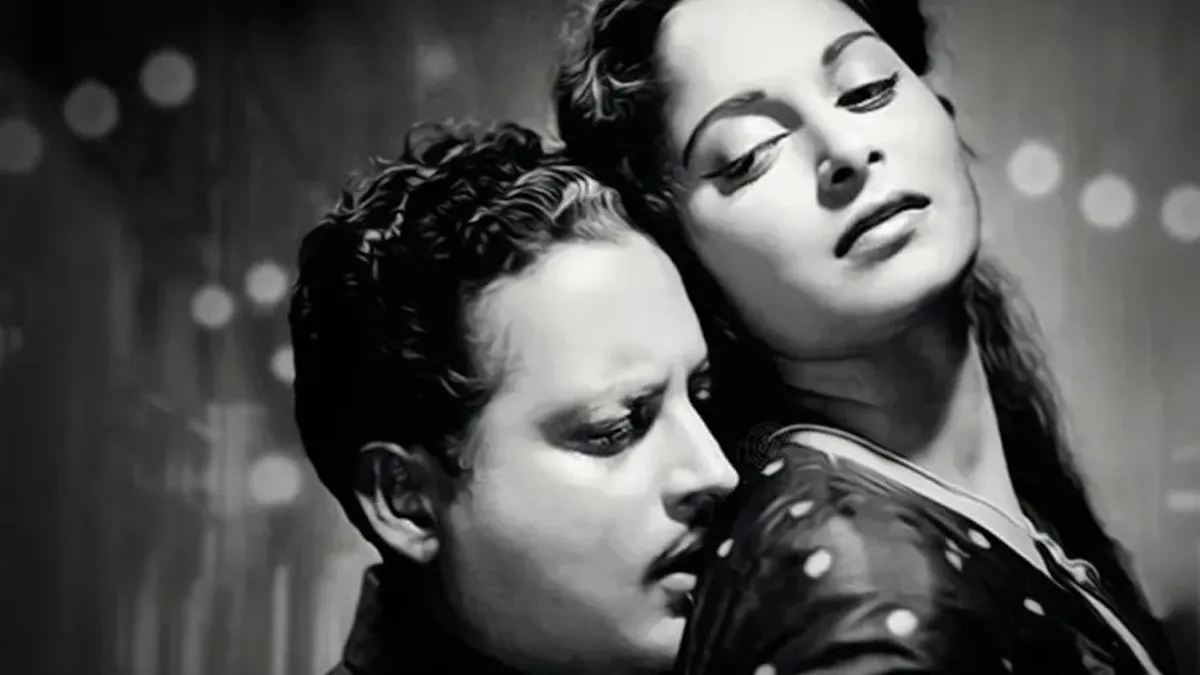
Drama, musical, by Guru Dutt, India, 1957
Thirsty is the heartbreaking story of Vijay, a young poet living in Calcutta who dreams of giving voice to the suffering and injustice of the world through his verses. Idealistic and sensitive, Vijay clashes with a society that despises his art because it is not profitable and does not cater to the tastes of the public. His brothers consider him a failure, the woman he loves leaves him for a marriage of convenience, and his poems are ignored by publishers. Only Gulabo, a prostitute with a pure heart, recognizes the beauty and truth of his words. When a misunderstanding leads everyone to believe Vijay is dead, his name and poetry suddenly become famous, exposing the hypocrisy of those who had previously rejected him.
Watching Thirsty means immersing oneself in a work that goes beyond melodrama, blending poetry, music, and imagery into a profound reflection on the human soul and the value of art. Guru Dutt, director and protagonist, creates one of the most intense and poetic films in world cinema, where black-and-white cinematography, expressive framing, and evocative lyrics produce an atmosphere of poignant melancholy. It is a film about the misunderstanding of the artist, pure love, and society’s hypocrisy, but also a universal critique of materialism and opportunism. Even today, Thirsty moves and provokes thought because it sincerely tells the story of the need to remain true to oneself in a world that measures people’s worth solely by their success.
LANGUAGE: Hindi
SUBTITLES: English, Spanish, French, German, Portuguese
A System Built on Breath, Not Score
You sit across from your teacher for the third year in a row, and you have still not been given a second raga. You have spent one thousand hours inside a single melodic framework, and your teacher watches your face more than your fingers, because the face is where the lie lives first.
This is not pedagogy in any sense the Western conservatory would recognize. There is no syllabus, no grade, no external examination waiting at the end of the corridor. What is being transmitted cannot be written down — not because the technology for writing it down does not exist, but because the writing would falsify it at the molecular level. The moment you pin a raga to a page, you have killed what it actually is: a living probability space, a set of tendencies and gravitational pulls that only become music when a specific human nervous system moves through them in real time, in a specific season, at a specific hour of the day.
The Natya Shastra, composed somewhere around 200 BCE and attributed to the sage Bharata Muni, is the foundational text that first systematized the relationship between sound, emotion, and cosmic time in the Indian tradition. It codified the concept of rasa — the aesthetic emotional essence that music is meant to evoke and transmit — and it laid the groundwork for understanding ragas not as scales but as personalities, as entities with gender, with seasonal associations, with times of day in which they are capable of functioning and times in which their performance is considered not merely incorrect but spiritually dissonant. This is not mysticism as decoration. It is a theory of resonance so precise that it treats the human body and the cosmos as tuned to the same frequencies, and it demands that the performer know exactly where they stand in that larger temporal architecture before they play a single note.
Western musical notation, perfected across the seventeenth and eighteenth centuries, was designed to solve a specific problem: how to transmit a fixed composition across space and time without the composer present. It is a system built around the idea that the music exists in the score, and that the performer’s job is to reproduce it faithfully. Johann Sebastian Bach could die in 1750, and a musician in Leipzig in 1850 could play what he wrote. The notation made this possible, and it was a genuine achievement. But it encoded a philosophical assumption so deep that most Western musicians have never had to examine it — the assumption that music is a thing that can be fixed, that its ideal form is its completed form, that variation from the original is deviation rather than discovery.
The guru-shishya parampara, the lineage-based oral transmission that has carried Indian classical music through roughly two millennia, operates on the opposite premise entirely. The student does not receive a recording of the correct version. The student receives a relationship. Ravi Shankar spent years living in Maihar with Allauddin Khan before he was considered ready to perform publicly, and what was transferred in those years was not a collection of compositions but a way of listening, a set of physical intuitions, a capacity to make decisions in real time that honored the raga’s internal logic without ever treating that logic as a cage. The music lives in the body of the teacher and migrates, imperfectly and beautifully, into the body of the student — and the imperfection is not a failure of transmission but its most honest product.
What this means is that every performance in the Indian classical tradition is simultaneously an act of preservation and an act of creation that has never existed before and will never exist again, and no staff notation on earth has the resolution to capture both of those things at once.

The Raga as Emotional Law
You are sitting in a room where the temperature has not changed, the light has not shifted, and no one has spoken — and yet something inside you has moved. Not toward emotion exactly, but into it, the way a hand submerges into water rather than touching its surface. The musician has not played a single note you could call beautiful in isolation. What has happened is more disturbing than beauty: you have been placed.
This is what the raga does, and it is worth being precise about what that means, because the Western instinct is to reach immediately for the word “scale” and thereby lose the entire conversation. A raga is not a scale. A scale is a neutral infrastructure, a ladder anyone can climb in any direction for any purpose. A raga carries within it a specific emotional jurisdiction — a time of day at which it is permitted to be played, a season in which its full meaning becomes audible, a psychological state it does not merely suggest but is understood to produce with something close to pharmacological reliability. Bhairav belongs to the grey dissolution of early morning, when the self has not yet reassembled from sleep. Yaman opens in the early evening, carrying a quality of longing that has not yet become grief. Bhairavi, often played last in a concert, holds the mood of farewell and completion so precisely that to play it mid-performance would feel like reading the final page of a book to someone who has just sat down.
The theoretical scaffold behind this is rasa, a concept elaborated with extraordinary precision by the Sanskrit dramaturgist Bharata Muni in the Natyashastra, a text composed somewhere between 200 BCE and 200 CE that amounts to one of the most rigorous aesthetic philosophies ever produced. Bharata identified eight primary rasas — erotic, comic, pathetic, furious, heroic, terrible, odious, wondrous — and the entire purpose of artistic performance was not to entertain or to demonstrate skill but to reliably transport the audience into one of these states. The word rasa itself means juice or essence, which is already more honest than the Western concept of aesthetic pleasure, because juice implies something extracted from matter, something interior released by pressure. The musician is not performing for you. The musician is performing on you.
What makes this framework genuinely unsettling, once you hold it long enough, is what it implies about the relationship between structure and feeling. The Western romantic tradition has spent roughly two centuries insisting that authentic emotion is spontaneous, individual, and fundamentally resistant to formula — that the moment you can predict a feeling, you have already falsified it. Rasa theory disagrees with a calmness that borders on contempt for that position. It says that emotion has grammar, that interior states are not private weather systems but repeatable phenomena that can be entered through precise formal gates. The grief that Bhairavi produces in a room at the end of a concert is not your personal grief, not a coincidence, not a projection. It is a third thing, impersonal and ancient, that the raga has always known how to locate.
This is where the figure of the gharana — the hereditary school of transmission through which ragas have been passed for centuries — becomes more than institutional history. The Kirana gharana, associated with the vocalist Abdul Karim Khan in the late nineteenth and early twentieth centuries, developed an approach to tonal sustain and microtonal inflection that treated each note as a world requiring extended inhabitation rather than rapid passage. What was being transmitted was not technique in any modern sense of the word. It was a set of instructions for reliably producing a specific quality of interior pressure in a listener across generations, across bodies, across the entire apparatus of individual personality that we have been taught to treat as the final and irreducible seat of feeling.
What Colonialism Stole From the Sound
You are sitting in a concert hall in Madras in 1934, and the woman on stage has spent forty years learning to make her body and voice into a single instrument. The audience is small, nervous, and the applause, when it comes, is polite in the way that apology is polite. She is being permitted. She is not being celebrated. The distinction is the entire weight of the last century.
The British colonial administration did not arrive with the explicit intention of destroying a musical culture. It arrived with something more corrosive: the bureaucratic certainty that what it did not recognize, it had the right to classify. The Criminal Tribes Act of 1871 codified hereditary performer communities — communities whose social function had been the transmission of specialized sonic knowledge across generations — as structurally suspect, their mobility a form of vagrancy, their professional identity a marker of moral disorder. This was not ignorance. It was a specific epistemological violence, the kind that functions by renaming. A hereditary musician who had spent twenty years in a gurukul apprenticeship became, under colonial taxonomy, a member of a wandering caste with no fixed legitimate occupation.
The devadasi institution had sustained temple music and classical dance for roughly fifteen centuries before colonial administrators began legislating against it in earnest. The 1934 Madras Devadasis (Prevention of Dedication) Act was the culmination of a reform campaign that had run since the 1890s, backed by both British officials and a section of Indian social reformers who had absorbed Victorian bourgeois ideas about female respectability. What was eliminated was not merely a category of performer but an entire pedagogical infrastructure. Devadasis were not ancillary to classical transmission — they were primary custodians of repertoire, of compositional memory, of performance grammar that existed nowhere in written form. When the institution was dismantled, that knowledge did not migrate cleanly into brahminical concert halls. Much of it simply ceased to be transmitted.
Court patronage, which had underwritten the other major channel of classical development — the Mughal courts, the Maratha kingdoms, the Nizam’s Hyderabad — had already been systematically defunded through the Doctrine of Lapse and the post-1857 restructuring of princely economies. By the early twentieth century, the ustads of Agra, Jaipur, and Gwalior found themselves without the institutional ground their art had grown from. The raga system had evolved over centuries in a context of sustained, unconditional patronage — an artist could spend a decade deepening a single raga because the court both funded and demanded that depth. Removing that material condition did not leave the music intact and simply unsponsored. It changed what music was possible to make.
What replaced court and temple patronage was radio, and radio arrived with a logic entirely alien to the grammar of classical transmission. All India Radio, formalized in 1936 under the direction of Lionel Fielden and subsequently developed under Indianized administration, required music that could be broadcast in fixed time slots, music that could be evaluated by committees, music whose practitioners could be vetted for respectability. The standardization committees of the 1930s and 1940s made consequential aesthetic judgments while presenting them as administrative ones. Ragas that were too long, too slow, too regionally particular, or associated with performer lineages the committees deemed low-status were quietly deprioritized. The khayal form, already dominant in North Indian classical music, was further entrenched. Dhrupad, which had been the prestige form of Mughal court music and which demanded a kind of concentrated listening that broadcast formats structurally discouraged, began its long marginalization.
What this produced was not a corruption of classical music in some pure prior state — there was never a pure prior state, only a continuous negotiation between form and context. What it produced was a dramatic narrowing of which negotiations were permitted to continue, and which were reclassified as illegitimate before they could generate the next century’s vocabulary.
Ravi Shankar, Carnegie Hall, and the Price of Legibility
You are sitting in Carnegie Hall in 1956, and something is happening to you that you do not have words for. The man on stage has been playing for forty minutes and has not yet, by any measure you were taught to apply, begun. The audience around you shifts. Someone coughs. You wait for the melody to arrive, not understanding that you are already inside it, that the architecture you keep waiting to enter is the room you have been standing in since the first note.
Ravi Shankar understood this problem before his audiences did, and his genius — and his tragedy — was that he solved it for them. The solution required a kind of surgery. He began introducing his performances with spoken explanations: the name of the raga, its corresponding season, the emotional state it was meant to induce, the approximate time of day for which it was historically prescribed. These were not lies. But they were reductions of a living metaphysics into a program note, and program notes exist to make audiences comfortable, which is precisely the opposite of what a raga is designed to do. By 1966, when George Harrison sat at his feet in Esher and emerged weeks later convinced he had absorbed something transmissible, the frame had already been built. Indian classical music had been given a door through which Westerners could walk without having to change their posture.
What was stripped away in that transaction was not the sound but the demand the sound made on the listener’s relationship with time. Alain Daniélou, writing in his 1943 work Introduction to the Study of Musical Scales, had already mapped with uncomfortable precision the way ragas operate on a system of intervallic relationships tuned to microtonal frequencies that fall between the notes of equal temperament — the tuning system that had governed Western music since Bach’s Well-Tempered Clavier standardized it for keyboard instruments in 1722. This is not a trivial technical gap. The notes Western ears are trained to hear as stable, as resolved, as home, are in the raga system slightly mistuned, and the correct frequencies produce a physiological effect that equal temperament literally cannot replicate. When Shankar performed on a stage built for Brahms, he was operating in a room whose acoustic and cultural architecture quietly rejected the very frequencies his music required to do its deepest work.
The counterculture latched onto what remained after this filtering, and what remained was legible: meditative, exotic, spiritual in the vague sense that requires no doctrine. By 1967, the sitar had become a texture, an atmosphere, a signifier of expanded consciousness available for purchase. The sociologist Sarah Thornton, in her 1995 study Club Cultures, demonstrated how subcultural capital works precisely by flattening the original context of a practice into a sign that circulates without its roots. The raga became that sign. Its actual function — which was liturgical, which was tied to specific hours and seasons and states of ritual preparation in the listener, which assumed a relationship between performer and audience built over years rather than acquired in a single concert — was replaced by an aesthetic feeling that could be reproduced on a studio album between a rock track and a ballad.
Shankar himself was not naive about this. His 1968 autobiography, My Music My Life, contains a passage in which he describes watching Western audiences applaud between movements — between the alap and the jod, the two sections of a performance that function as a single breath — and feeling something close to bereavement. The applause was enthusiastic. The applause was the problem. Because what it marked was the moment the audience recognized something, and recognition is the death of encounter. The raga was never meant to be recognized. It was meant to arrive in the body before the mind could name it, to move through a person the way weather moves, without asking permission and without leaving anything they could describe at dinner afterward.
A vision curated by a filmmaker, not an algorithm
In this video I explain our vision
Time as the Real Instrument

You are sitting in a concert hall where nothing has resolved for forty minutes, and you realize with a start that you have not been waiting for anything to resolve. Something in your body adjusted without asking your permission. The pulse you feel is not driving toward a destination — it is orbiting one.
The tala is not a time signature. A time signature tells a musician where the bar begins so that everyone can agree on when to arrive at the next one. It is a bureaucratic convenience, a way of synchronizing effort, a shared clock. The tala is something categorically different — it is a cosmological proposition about what time actually is. In the Natya Shastra, the foundational treatise on performance arts attributed to Bharata Muni and dated somewhere between 200 BCE and 200 CE, time in music is described not as a line moving from past to future but as a wheel. The sam, the first and most weighted beat of any tala cycle, is not a beginning in the Western sense. It is a horizon that the performance perpetually approaches, touches, and escapes again. The musician is not building toward the sam — the musician is always, already, inside a cycle that has been turning since before the performance began.
This distinction undoes something most listeners from Western musical traditions carry without knowing they carry it. The entire architecture of Western classical composition, from the sonata form crystallized in the late eighteenth century to the harmonic language that dominated European concert music for two hundred years, operates on the logic of tension and release. A chord introduces instability; resolution is promised; the listener leans forward in a posture of expectation that the music eventually rewards. Leonard Meyer, in his 1956 work Emotion and Meaning in Music, argued that musical emotion in the Western tradition is essentially the experience of expectation being delayed or fulfilled. The whole apparatus runs on anticipation as its fuel.
In a rhythmic cycle of, say, Jhaptal — ten beats divided asymmetrically as 2-3-2-3 — the sam is not a reward. It is a landmark passed, like a tree you recognize on a road you have been traveling so long the tree is almost a friend. The tabla player and the vocalist are not synchronized in the way a conductor synchronizes an orchestra. They are, in the deepest sense, in conversation about where the sam is, how to arrive at it, how to veer away from it and recover with a precision that feels like controlled falling. Ustad Zakir Hussain once described this as playing with the edge of the beat — not landing on it, but making the listener feel the exact weight of the space just before it lands.
What this produces in the listener is not anticipation but something closer to spatial awareness. You are not leaning forward; you are learning to feel where you are inside a structure that does not end. Ethnomusicologist Martin Clayton, in his 2000 study Time in Indian Music, documented how tal cycles create what he called embodied entrainment — the listener’s nervous system begins to physically map the cycle, not as an intellectual exercise but as a somatic one. The body learns the shape of time rather than predicting its destination.
This is why a sixteen-beat Teentaal performed at a slow tempo can produce something that resembles, in physiological effect, meditation. The cycle is long enough that the sam retreats into a near-distance, and the space between beats becomes a landscape rather than a countdown. The musician inhabits that landscape rather than moving through it toward an exit. The performance does not end because it has resolved — it ends because the musicians choose to stop orbiting, and even then, the wheel keeps turning.
The Listener's Discipline
You sit in the darkened hall, hands folded in your lap, and someone near you leans over to whisper that you should not clap between movements. You already knew this. You were taught it without being taught it — absorbed it from the posture of other bodies around you, from the hushed reverence that precedes the first note, from the architectural fact of the velvet seats themselves, which fix you in place and angle your gaze forward like an animal trained to receive. What you are performing in that moment is not appreciation. It is submission to a listening protocol invented in nineteenth-century Vienna and exported to the rest of the world as though it were the natural shape of musical attention.
The European concert hall as a disciplinary institution did not arise from musical necessity. It arose from class anxiety. When public ticketed concerts expanded through the 1800s, the bourgeois audience needed a way to distinguish its listening from the rowdy participatory noise of the tavern and the street fair. Silence became the marker of cultivation. Lawrence Levine documented this transition with precision in his 1988 work Highbrow/Lowbrow: The Emergence of Cultural Hierarchy in America, tracing how American concert audiences who had once talked, moved, and responded openly during symphonic performances were gradually disciplined into immobility. By 1900, the silent, still, self-erasing listener was the standard — and this standard traveled, colonially and commercially, into contexts where it had never belonged.
In the Hindustani tradition, the gap between performer and audience has always been porous by design. When a vocalist finds the precise intonation of a gandhar in the upper register, when a tabla player lands a tihai with such geometric perfection that the sum resolves like a theorem proved in real time, the listeners respond immediately and audibly — a sharp exhale, a murmured wah, a nodding repetition of the phrase just heard. This is not interruption. It is information. The performer reads that response and decides whether to linger, to push further, to test the next boundary. The audience participates in the composition of what happens next. Without that feedback, the performance becomes a monologue delivered into a void, and the music loses one of its actual structural components.
Carnatic concerts historically operated on the same principle, particularly in the sabha culture that developed in Chennai through the early twentieth century. But even the sabha, which emerged partly in dialogue with nationalist pride and partly in imitation of Western presentational formats, began importing silence as legitimacy. The scholar Amanda Weidman, in her 2006 study Singing the Classical, showed how the professionalization of Carnatic music involved a systematic feminization and then defeminization of the devadasi repertoire, but also a pacification of the listening body — turning communal musical exchange into aesthetic consumption. What was lost was not merely atmosphere. What was lost was a whole epistemology of listening in which knowledge moved laterally, between bodies in a room, rather than descending vertically from the stage.
The passive listener is not a neutral creature. The passive listener is a produced subject — produced by architecture, by ticketing, by the pedagogical assumption that the musician is an expert delivering content to a receptive vessel. This model transfers musical authority entirely to the performer and critic, and it evacuates the room of a particular kind of shared intelligence that cannot exist when everyone is waiting in silence for permission to feel. Pierre Bourdieu‘s analysis of cultural capital in Distinction, published in 1979, showed how the performance of aesthetic appreciation is itself a class behavior — but he could not fully account for traditions where appreciation was not performed silently upward toward the stage but generated horizontally across the gathering, where the listener who recognized a rare raga variant and voiced that recognition was not showing off but completing a circuit.
What that severance costs is not recoverable by merely clapping louder at the end.
Infinity as Structural Principle
You are sitting in a concert hall at eleven o’clock at night, and the musician has not yet begun to play. He is tuning, but the tuning is already the performance, and the audience knows this, which is why no one is leaving to check their phone or consulting the program notes for a scheduled end time. The hall has no scheduled end time. It never did.
The Upanishads, composed between roughly 800 and 200 BCE, did not produce a theory of music. They produced a theory of existence in which sound was the primary substance, the vibrational ground from which material reality precipitated like dew from air. Nada Brahma — sound as the absolute, the divine not as a being who speaks but as the act of speaking itself, undifferentiated and total — meant that a musician was not an artist in any sense the Renaissance would later codify. The musician was a practitioner of ontology. The raga was not a melody but a controlled aperture into a frequency domain that predated human consciousness and would outlast it. To play was to participate in something already in motion.
This is not metaphor dressed as philosophy. The entire technical architecture of the tradition follows from it with logical severity. The concept of shruti — the microtonal interval smaller than any Western semitone, of which the tradition recognizes twenty-two within a single octave — exists not to produce exotic color but because the practitioner believes the universe vibrates at these frequencies whether or not a human instrument sounds them. The instrument is not creating the sound. It is revealing it, as a lens reveals light that was already traveling. Pandit Vishnu Narayan Bhatkhande, who spent the early twentieth century systematizing the North Indian raga canon into what became the Kramik Pustak Malika series, was doing archival work in the deepest sense: cataloguing a physics, not composing an aesthetics.
The modern concert economy encounters this and produces a category error so fundamental it cannot see itself making it. A festival slot is ninety minutes. A recording contract requires a product of marketable duration. Streaming platforms pay per play, meaning a three-hour dhrupad performance generates the same revenue as a three-minute pop song played forty times, and the platform’s algorithm treats this as identical value. When Ali Akbar Khan performed at the Edinburgh Festival in 1955 — the first major Western platform for Hindustani classical music — critics reached for the vocabulary of jazz improvisation, which was the closest available Western framework, and missed the entire structural premise: that what they were hearing was not a variation on composed themes but a real-time navigation of a sonic cosmos with its own gravitational laws. The comparison flattered Western ears and erased the cosmological claim entirely.
What remains irreducible is the demand the music makes on time. Raga Bhairav belongs to dawn. Raga Yaman opens the early evening. Raga Darbari Kanada descends past midnight. These are not performance conventions or romantic associations accumulated over centuries. They are claims about the actual relationship between temporal position, atmospheric state, and vibrational possibility — claims that preclude the raga from being performed correctly outside its time, which means the tradition is fundamentally incompatible with the logic of the ticketed event. You cannot schedule the cosmos. You cannot charge admission to a specific hour of the night and expect the music to behave as though the hour were arbitrary.
And yet here it persists, structurally unchanged, carried by musicians who still train for a decade before performing publicly, who still measure mastery not in technique but in the capacity to sustain a rasa — an emotional-vibrational state — across hours without repetition, without resolution, without the consolation of an ending the audience can anticipate. The music does not conclude. It withdraws, the way a tide withdraws, leaving the shore altered and the ocean exactly as it was.
🎵 Sound, Infinity, and the Music of the Soul
Indian classical music is not merely an art form but a philosophical journey into the boundless nature of consciousness and time. The articles below explore kindred territories where sound, the infinite, the sacred, and the aesthetics of transcendence converge. Each path leads deeper into the labyrinth of human experience.
Immanuel Kant and the Sublime: When Reason Meets the Infinite
Immanuel Kant’s analysis of the sublime offers a profound philosophical framework for understanding why certain experiences — like a raga that unfolds without end — overwhelm the rational mind. The infinite in Indian classical music mirrors precisely the moment when reason confronts what it cannot fully contain. Kant’s thought illuminates how beauty can dissolve into something far vaster and more terrifying than mere aesthetic pleasure.
GO TO THE SELECTION: Immanuel Kant and the Sublime: When Reason Meets the Infinite
Japanese Aesthetics: Wabi-Sabi Mono no Aware and Yugen
Japanese aesthetics — wabi-sabi, mono no aware, and yūgen — share a deep spiritual kinship with the Indian classical tradition’s embrace of impermanence and ineffable beauty. Both cultures cultivate an art that gestures toward what cannot be named, allowing silence and resonance to carry meaning beyond words. Exploring these Eastern aesthetic philosophies enriches our understanding of how music can become a doorway into the infinite.
GO TO THE SELECTION: Japanese Aesthetics: Wabi-Sabi Mono no Aware and Yugen
Tagore’s Gitanjali: Analysis
Rabindranath Tagore‘s Gitanjali — offerings of song and devotion — emerges from the same cultural and spiritual soil that nurtured Indian classical music’s deepest impulses. His poetry breathes the same longing for the divine that animates the alap of a dawn raga or the meditative unfolding of a dhrupad composition. Reading Tagore alongside listening to Indian classical music reveals a unified vision of art as sacred dialogue.
GO TO THE SELECTION: Tagore’s Gitanjali: Analysis
Universal Consciousness
The concept of universal consciousness lies at the very heart of Indian classical music, which understands sound — nāda — as a vibrational manifestation of the cosmos itself. Every performance becomes a ritual attempt to align the individual self with that greater, undivided awareness. This article explores how this ancient idea continues to resonate across cultures, philosophies, and contemplative traditions worldwide.
GO TO THE SELECTION: Universal Consciousness
Discover the Cinema of Infinite Journeys on Indiecinema
If these explorations of sound, consciousness, and the infinite have stirred something within you, Indiecinema streaming is your next destination. Our curated selection of independent and art-house films carries the same spirit of depth, wonder, and transformation that lives inside a great raga. Come listen — with your eyes open.
👉 EXPLORE THE CATALOG: Watch Indie Films in Streaming
A vision curated by a filmmaker, not an algorithm
In this video I explain our vision

