
The Prayer You Did Not Choose to Offer
You pick up the book because someone left it on a table, or because the title had a sound you could not place, or because you were in a particular kind of exhaustion that makes you reach for things without understanding why. The pages are thin. The language is plain in a way that disarms you before you can build any defenses against it. And then, somewhere around the seventh or eighth poem, something happens that you were not prepared for — not the emotion of beauty, which you have felt before and can name and set aside, but something closer to recognition. As if a voice from a room you have never entered is describing the furniture you grew up with.

This is the first trap Rabindranath Tagore sets, and it is the most elegant. Gitanjali, published in its English prose-poem translation in 1912, dedicated to William Rothenstein who first pressed Tagore to share his private manuscript, distributed quietly before it became a sensation, is a book that appears to give you access to someone else’s devotion. You believe you are reading a man’s prayer. What you do not immediately realize is that by the time you feel moved, the prayer has already become yours, and you never agreed to that transaction.
The Bengali originals — 157 songs composed between 1908 and 1910, in the wake of the death of Tagore’s wife Mrinalini Devi, of two of his children, of his father — carry a weight of biographical grief that the English translation does not announce. Tagore himself translated and assembled 103 of those poems into English, not as a scholarly exercise but as something closer to a second act of creation. He made choices. He smoothed, he lifted, he opened certain doors and sealed others. What arrived in the hands of W.B. Yeats, who wrote the famous introduction and reportedly carried the manuscript in his coat pocket for weeks, was not a transparent window into a Bengali soul. It was a crafted instrument designed, whether consciously or not, to bypass the Western reader’s usual filters of distance and cultural patronage.
Yeats wrote in 1912 that he had found in Gitanjali “a world I have dreamed of all my life long.” That sentence deserves to be held up to the light slowly, because it reveals the mechanism of the book’s first reception and the distortion that followed. What Yeats found was not Tagore — it was the reflection of Yeats’s own longing, his Celtic mysticism, his hunger for a spirituality that felt ancient and uncompromised. The Nobel Prize followed in 1913, the first awarded to an Asian writer, and the citation spoke of “his profoundly sensitive, fresh and beautiful verse, by which, with consummate skill, he has made his poetic thought, expressed in his own English words, a part of the literature of the West.” Notice how the prize celebrates assimilation. Notice who is being complimented on the translation.
None of this diminishes what happens to you when you read it. That movement in the chest, that inexplicable sense of being addressed directly, is real and it is not nothing. But it is worth understanding what produces it, because the mechanism is not purely aesthetic. Tagore writes in the register of longing directed toward an unnamed presence, and that register is one that human beings are structurally prepared to receive, having spent their entire lives inside relationships where love was never fully requited, where belonging was always slightly conditional, where the divine or the beloved or the parent was perpetually just beyond the grasp of complete understanding. The poems do not create that feeling in you. They locate it where it was already living, unnamed, and give it a syntax.
Which is why the question is not whether Gitanjali is beautiful. The question is what kind of beauty requires that you not see clearly in order to feel it fully.
I Am Nothing

Drama, thriller, by Fabio Del Greco, Italy, 2015.
The story revolves around Vasco, a Roman builder who, at the age of 74, enjoys a life of absolute comfort. His human parable takes a dramatic turn when a mysterious encounter leads him to an ambush. Having survived, but marked by a long coma, Vasco wakes up with a new sensitivity, developing an intimate and poetic bond with nature. This new relationship with the world around him leads him to deeply explore himself, in an internal and external journey. through Italy, the United States and India, in search of a higher meaning and a cure. In parallel, the threat of a planetary cataclysm adds an epic dimension to the story.
I Am Nothing explores universal themes such as time, memory, oblivion and the connection with nature. Fabio Del Greco creates an existential drama full of food for thought. The director skillfully combines different visual materials, mixing archive images with nature photographs and dreamlike visions. This visual experimentation translates into an editing that captures the viewer's attention, guiding him through a cycle of creation and destruction. The sequences that alternate the buildings, Vasco's pride, with Indian landfills and natural landscapes create a hypnotic rhythm, underlining the beauty and fragility of life. Vasco's existential journey is a hymn to transformation and rebirth. The evolution of the protagonist, from unbridled luxury to the rediscovery of purity, represents a powerful metaphor on the meaning of life and the need to reconnect with authentic values. Io sono nulla stands out for its ability to combine introspection and visual experimentation, offering a suggestive and engaging narration. It is a film that invites us to reflect on the human condition, on our relationship with power and nature, and on the possibility of finding ourselves through change. A work that leaves its mark and lends itself to multiple readings.
LANGUAGE: Italian
SUBTITLES: English, Spanish, French, German, Portuguese
A Nobel Prize Built on a Mistranslation
You are handed a book of prayers. That is what you think you are holding — a slim volume of devotional verse, hushed and trembling with submission, the kind of spiritual transport that Victorian drawing rooms had learned to receive from the East like a gift they always suspected was coming. The year is 1913. The Swedish Academy has just awarded its Nobel Prize in Literature to Rabindranath Tagore, citing his “profoundly sensitive, fresh and beautiful verse” and, crucially, the way his ideals formed “a part of the literature of the West.” That last clause is not incidental. It is the entire verdict.
What the Academy actually read was a text Tagore himself had produced in English beginning in 1912, during a period of convalescence in England, translating his own Bengali poems into a prose-poetry that bore almost no structural resemblance to the originals. The Bengali Gitanjali, published in 1910, was written in a metric system called payar and matrabritto, forms with rhythmic and tonal properties inseparable from oral performance and the Baul devotional tradition — a tradition that is simultaneously erotic, antinomian, and working-class in its spiritual genealogy. The body in the Bengali text is not metaphor. It is the site of encounter. The beloved is addressed with a longing that oscillates between the physical and the divine in ways the Bengali literary tradition deliberately refused to resolve. Tagore was working inside a long lineage of Vaishnava poetry in which desire and worship are not opposites but the same motion.
None of this survived the translation. What emerged in English was a register of hushed surrender, of a soul dissolving before an infinite presence, written in a cadenced prose that owed far more to the King James Bible and to the Celtic Twilight of W.B. Yeats — who famously wrote the introduction to the 1912 English edition — than to anything Bengali. Yeats himself admitted he knew no Bengali. He edited Tagore’s drafts toward his own aesthetic hungers, toward the mystical Ireland he was constructing in parallel, and the result was a text that confirmed every orientalist fantasy about Eastern spirituality as passive, feminized, and ecstatically self-annihilating. The East, in this version, does not think. It surrenders.
What the Nobel Committee rewarded was precisely this confirming gesture. The 1913 prize was not a recognition of Tagore’s actual literary achievement — which was enormous, encompassing novels like Ghare-Baire, short stories of devastating psychological precision, and a body of song that would eventually number over two thousand compositions — but a reward for the West’s own reflection returned to it in an acceptably exotic vessel. Edward Said‘s framework in Orientalism, published in 1978, gives a name to this operation: the Orient is produced as a text by the West, for the West, and any Oriental who wishes to be legible must participate in that production. Tagore, perhaps unknowingly, perhaps strategically, perhaps both, did exactly that.
The deeper wound is that Tagore knew what he was losing. His letters from the period show a man translating in a kind of grief, aware that the music was not crossing over, that the intimacy of address in the Bengali — where God is sometimes accused, sometimes seduced, sometimes bargained with like a negligent lover — could not be reconstructed in English without becoming something scandalous to its intended audience. He chose legibility over fidelity. And the choice was rewarded with the highest literary prize in the world, which then fixed the sanitized version as the authoritative Tagore for the next several decades in the Western imagination, making the real text harder to reach not despite the prize but because of it.
A translation that wins a Nobel does not remain a translation. It becomes the original. And the original becomes the rumor.

Bhakti, Desire, and the God Who Is a Lover
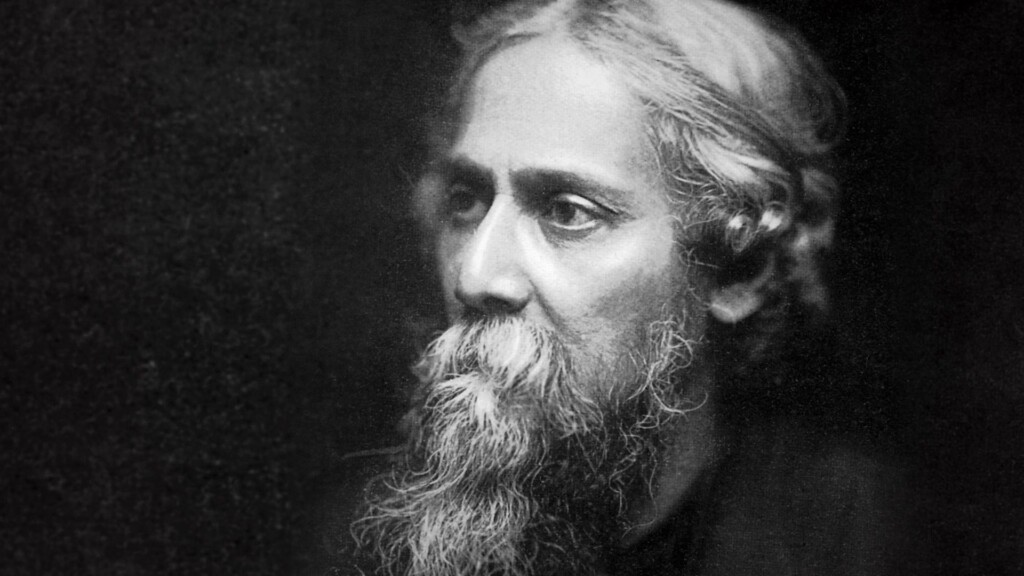
You have heard the word “devotion” your entire life and assumed you understood it — a kind of pious quietude, a bowing of the head, a renunciation of appetite in favor of something cleaner and higher. That assumption is precisely the cultural sediment that makes reading Gitanjali in English so treacherous, because the tradition from which Tagore writes has almost nothing to do with renunciation and everything to do with the body’s most ungovernable urgency.
The Vaishnava bhakti current that flows beneath Gitanjali is not a metaphor for erotic longing — it is erotic longing, ontologically serious, theologically precise. When the twelfth-century Sanskrit poet Jayadeva composed the Gita Govinda, he was not writing sacred poetry that happened to use the imagery of lovers. He was insisting, with the full weight of philosophical conviction, that the relationship between the devotee and Krishna is structurally identical to the relationship between Radha and her god — which is to say, it is a relationship of burning, of absence, of the body made hollow by want. The heroine of that text writhes in the night, and her writhing is the theological argument itself. Desire, in this framework, is not the obstacle to the divine. It is the only reliable vehicle toward it.
Chaitanya Mahaprabhu, the Bengali saint-mystic born in Nabadwip in 1486, pushed this further. His ecstatic practice — weeping, trembling, losing consciousness in public, his body registering the pain of separation from Krishna as though it were literal — was not theater. It was a rigorous epistemology. He argued, through the philosophical elaborations his disciples would later systematize, that virahabhakti, the devotion of separation, was the highest form of love precisely because it could never be satisfied, because the incompleteness was its power. The self is not dissolved into the divine; it is kept exquisitely, torturously alive in order to keep longing. Annihilation would be too easy.
Tagore inherits all of this directly, in Bengali, through a childhood and a literary formation saturated in baul songs, in kirtan, in the Vaishnava padavali tradition of poets like Chandidas and Vidyapati, who wrote in the fourteenth and fifteenth centuries about the god who will not stay, the god who arrives in darkness and leaves before dawn. When Tagore writes in Bengali of waiting, of a door left open, of a lamp kept burning, these are not sentimental gestures. They are loaded with six centuries of theological argument about what the soul is and how it moves.
The English Gitanjali performs an amputation. W.B. Yeats, who wrote the 1912 introduction that launched Tagore’s Western fame, was drawn to what he called a “nobility” in the poems, a serenity he associated with the mysticism he had been assembling from Neoplatonism and the occult. What he could not translate — and what Tagore, translating himself into English prose poems, systematically softened — was the erotic grammar that structures the original. Nouns were made vague. The feminine speaker who waits for her lover-god became a genderless voice. The specific charge of virahabhakti, its insistence that longing is not a problem to be solved but a state to be inhabited with the full intensity of desire, vanished into what reads like spiritual contentment.
This is not a trivial loss of flavor. When the gender of the devotee disappears, the entire Vaishnava logic collapses — because that logic depends on the male poet adopting a feminine subjectivity, inhabiting Radha’s body, her sleeplessness, her willingness to be ruined by waiting. The practice is not about transcending gender; it is about moving through it, using the specificity of erotic feminine vulnerability as the sharpest possible instrument of spiritual knowledge. A genderless yearning for an unnamed divinity is a different claim about reality entirely, and it is the claim the English-speaking world received and celebrated as universal.
Yeats, Empire, and the Manufacture of the Mystic East
You are handed a slim volume in 1912, the pages still carrying the scent of recent translation, and you feel — or you are meant to feel — that something ancient and healing has arrived from the East, something the West has been waiting for without knowing it needed.
That feeling was manufactured. William Butler Yeats wrote the introduction to the English Gitanjali with the force of a man who had found a mirror, not a window. His prose describes Tagore’s poems as evidence of “a tradition where poetry and religion are the same thing,” a civilization that had preserved what European modernity had destroyed. The introduction runs to several thousand words and contains almost nothing accurate about Rabindranath Tagore‘s actual life, his political commitments, his arguments with the Indian nationalist movement, or the colonial machinery grinding around him in Bengal. What it contains is an elaborate self-portrait of Western longing, dressed in borrowed saffron.
The irony is structurally necessary rather than accidental. Yeats was writing at the precise moment when British imperial confidence was beginning to require spiritual justification. By 1912, the Indian independence movement had grown sophisticated enough to embarrass the Empire philosophically. The Partition of Bengal in 1905 had radicalized an entire generation of Bengali intellectuals. The empire needed the subcontinent to produce saints, not strategists — mystics, not Swadeshi organizers. Tagore, translated into English and framed as a vessel of timeless devotional wisdom, served that need with uncomfortable precision. The Nobel Prize followed in 1913, the first awarded to a non-European writer, and the Swedish Academy’s citation echoed Yeats almost word for word: “his profoundly sensitive, fresh and beautiful verse, by which, with consummate skill, he has made his poetic thought, expressed in his own English words, a part of the literature of the West.” The phrase “a part of the literature of the West” is worth sitting with. It does not say Tagore enriched world literature. It says he was admitted.
What Yeats could not read — because he did not read Bengali and worked entirely from Tagore’s own prose translations, which were themselves acts of cultural negotiation rather than transparent windows onto the originals — was the Tagore who had written furiously against Hindu orthodoxy, who had founded Santiniketan as a direct rebuke to colonial education, who had returned his knighthood to the British Crown in 1919 after the Jallianwala Bagh massacre in which British troops killed hundreds of unarmed civilians in Amritsar. The mystic of the introduction had no knighthood to return, no political fury, no body living under occupation. He was a projection with a name attached.
The philosopher Partha Chatterjee, writing in The Nation and Its Fragments in 1993, identified this mechanism as one of colonialism’s deepest tricks: the colonized intellectual becomes legible to the metropolis only through the categories the metropolis has already prepared. Spirituality, timelessness, otherworldliness — these were the categories. They performed a double erasure: they stripped the colonized subject of historical specificity while simultaneously flattering the colonial audience with the suggestion that their hunger for meaning was noble rather than symptomatic. The reader of the 1912 Gitanjali was invited to feel spiritually impoverished and therefore humble, never to feel politically implicated.
Tagore himself understood this trap and eventually said so publicly. His disillusionment with Western reception became one of the quieter dramas of his later career, as lecture audiences in Europe and America continued to demand the guru he had never claimed to be, growing visibly disappointed when he spoke instead about education, nationalism’s dangers, or the violence being administered to his country. The mystic was a costume they had sewn for him, and the man inside it kept trying to take it off in public, which audiences found, inexplicably, rude.
The Self That Dissolves and the Self That Resists
You stand at the edge of something enormous and feel, for a moment, that the appropriate response is to disappear into it. The ocean does this to people. So does grief. So does the kind of prayer that stops being addressed to anyone and becomes instead a quality of attention, directionless and total. Tagore knew this feeling with the precision of a surgeon, and Gitanjali — published in Bengali in 1910, translated by Tagore himself into English prose poems by 1912 — circles it obsessively, approaching and retreating from the annihilation it seems to promise.
The Upanishadic tradition that runs beneath the text like an underground river carries a specific philosophical verdict: the individual self, the atman, is not ultimately separate from Brahman, the ground of all being. This is not metaphor. The Chandogya Upanishad, composed somewhere between the eighth and sixth centuries BCE, makes it structural — tat tvam asi, you are that, spoken by a father to his son as the most devastating possible compliment, a dissolution disguised as recognition. The logic is merciless: if the self and the absolute are identical in their deepest nature, then the project of selfhood — the maintenance of a distinct interior life, the cultivation of personal longing, the cherishing of private grief — is a kind of elaborate error. Liberation, in this framework, means seeing through the error until it loses its grip.
But Tagore was not, finally, a philosopher of erasure. His concept of jivan devata — the god of one’s inner life, the intimate divine who lives inside personal experience rather than beyond it — insists on something the Upanishadic dissolution cannot accommodate: the value of the particular. The jivan devata is not a universal principle encountered through the dismantling of individuality. It is a presence that knows your name, that enters through the specific textures of your own existence, that meets you precisely where you are most irreducibly yourself. This is not mysticism softened for Western consumption, as some of Tagore’s critics after the Nobel Prize in 1913 condescendingly implied. It is a genuine philosophical counterposition, one that has more in common with Martin Buber‘s I-Thou relation — articulated in Ich und Du in 1923 — than with the impersonal absolute of Advaita Vedanta.
What makes Gitanjali philosophically restless rather than doctrinally settled is that these two orientations never fully resolve. The speaker in poem after poem reaches toward union, uses the language of surrender, courts disappearance — and then pulls back into something stubbornly relational, stubbornly voiced. The divine in these poems is addressed. It is a you. And you cannot address what has already consumed you. The grammar of devotion requires a speaker who survives the encounter.
William Radice, one of the more careful translators of Tagore’s Bengali work, noted in his 1985 Penguin edition of selected poems that the English Gitanjali obscures certain technical and tonal features of the original that sharpen this tension. What reads in English as serene spiritual longing carries in Bengali a more turbulent rhythm, a closer proximity to the devotional poetry of Kabir and Mirabai, in which the human speaker is not dissolved but rather sharpened by desire — made more intensely individual by the very force of what they reach toward. Absence, in that tradition, does not erase the self. It etches it.
This is perhaps the most honest thing Gitanjali offers: not a map toward transcendence but an unresolved argument between the part of a person that wants to vanish into something larger and the part that knows, with quiet ferocity, that it does not want to stop existing as itself — that to stop existing as itself would be to lose the one thing that made the reaching worth anything at all.
A vision curated by a filmmaker, not an algorithm
In this video I explain our vision
Silence as Political Form
You are standing in a room where someone more powerful than you is speaking, and you realize, with a cold clarity, that the most devastating thing you can do is simply not answer. Not refuse — that would be legible, manageable, punishable. Just wait. Let the silence pool around their words until those words start to sound strange even to them.
Tagore understood this with a precision that his commentators have consistently misread as spirituality. The Gitanjali’s recurring posture of waiting — the speaker standing at a threshold, the lamp untrimmed, the hour not yet come — has been absorbed into a narrative of Eastern mysticism, of a poet dissolving into the divine, of quietism dressed in beautiful clothes. What this reading requires you to ignore is that these poems were written by a Bengali intellectual during the height of British imperial administration, in a language his colonizers could not access, about a silence they could not interpret. The waiting is not emptiness. It is a form of refusal so complete it doesn’t even announce itself as refusal.
Homi Bhabha, working through Fanon in The Location of Culture published in 1994, identifies colonial mimicry as one of the central anxieties of imperial power: the colonized subject who almost mirrors the colonizer’s values and manners but not quite, whose resemblance is always slightly off, always unsettling. The menace in mimicry, Bhabha argues, is that it reveals the arbitrariness of the original — if a Bengali lawyer can wear a suit and speak perfect English and still be considered irreducibly foreign, then the suit and the English were never really the point. But Tagore does something more radical than mimicry. He doesn’t almost-mirror. He turns away entirely, and in doing so makes the colonizer’s entire symbolic architecture irrelevant. You cannot demand an answer from someone who has already addressed themselves to something else.
The political valence of this becomes sharper when you consider what colonial administration required above all else: legibility. The empire ran on documentation, on categorization, on the production of knowable subjects — knowable in their labor, their caste, their taxable property, their measurable compliance. The Census of India, conducted decennially from 1871 onward, was not simply a bureaucratic exercise; it was an epistemological project, an attempt to render a billion lived complexities into columns that a district officer in Birmingham could read over breakfast. Against this machinery, a poetry of interior stillness and deferred arrival is not apolitical. It is structurally resistant. It insists on a form of being that cannot be entered into any ledger.
There is a particular poem in the Gitanjali’s sequence — number 35 in the English rendering Tagore himself produced in 1912 — where the speaker waits at a crossing, watching a procession pass that does not stop for him, and finds in that non-arrival not grief but a strange completeness. The standard reading hears renunciation, the mystic releasing attachment to worldly recognition. But read it against the political landscape of a colonized intellectual in 1912 Calcutta, and what you hear is something more unsettling: the decision not to need recognition from a procession you did not choose to join. The empire offered Indians a very specific transaction — accept subordination, perform gratitude, earn incremental access. To wait outside that system, serenely, without apparent anguish, was to refuse the transaction without making the refusal available for punishment.
This is what makes the quietude confrontational rather than retreating. It does not oppose power directly — opposition requires acknowledging the opponent’s frame. It simply occupies a different register entirely, one that the colonial administrative apparatus had no vocabulary for. You cannot discipline a man for standing still. You cannot fine him for an interior life you cannot read. The silence in Gitanjali is not the silence of submission. It is the silence of someone who has already decided which conversations are worth having.
What Surrender Actually Costs
You are standing in a room you have spent years furnishing, and someone asks you to leave everything in it behind. Not to burn it, not to donate it — simply to walk out and stop calling it yours. The discomfort you feel in that imagined moment is not grief. It is the exposure of how much of what you call “yourself” is actually inventory.
This is the psychological ground on which Gitanjali operates. Tagore’s speaker, across poem after poem, performs an act of total offering — the self laid bare before the divine, nothing withheld, no corner kept private. Generations of readers have received this gesture as spiritual elevation, as the highest expression of devotional maturity. But elevation is rarely the whole story. When a person offers themselves completely, the first question worth sitting with is not what they gain in the offering, but what they are relieved of.
Erich Fromm, writing in 1941 in Escape from Freedom, identified a pattern that cuts uncomfortably close to this territory. Analyzing the psychological conditions that made authoritarian submission not just possible but actively desired, he argued that human beings frequently experience their own freedom as unbearable. The burden of selfhood — of choosing, of being responsible for the shape of one’s own life — produces an anxiety so corrosive that many people do not flee from authority but run toward it, offering themselves to something larger as an exit from the terror of being a distinct, accountable individual. The submission is experienced as liberation. The dissolution is called transcendence. And the relief is genuine — which makes it harder, not easier, to examine.
What Fromm described in political terms maps with unsettling precision onto the interior architecture of devotional surrender. In poem 28 of Gitanjali, Tagore writes that the speaker desires to be stripped of everything — pride, accumulated virtue, the private treasury of personal achievement — so that the beloved divine may find an empty vessel. The theological reading presents this as humility reaching its perfection. The psychological reading asks a different question: what kind of self finds its deepest longing in its own erasure? And more precisely — what did the weight of that self cost to carry, that its disappearance reads as grace?
This is not an accusation leveled at Tagore. It is an observation about what devotional literature almost universally refuses to investigate: the relationship between the enormity of the surrender and the specific nature of the burden being surrendered. The Bhakti tradition into which Gitanjali partially flows had already, by the fifteenth century, developed in figures like Kabir and Mirabai a vocabulary of self-annihilation that doubled as a record of social suffocation. Mirabai’s surrender to Krishna was also her refusal of a widow’s constraints, a marital prison, a body that belonged to a household before it belonged to her. The divine beloved absorbed what the social world would not release. Surrender was the only door.
The genius of Gitanjali — and its most seductive danger — is that it aestheticizes this structure so completely that the underlying pressure becomes invisible. The Bengali original moves with a rhythmic ease, and even in Tagore’s own English prose translation of 1912, the sentences carry a liquid quality that makes the relinquishment feel like swimming rather than drowning. But the content, when read against its grain, describes a speaker who is exhausted. Who has tried, repeatedly, to bring something of value and been refused. Who has arrived at total offering not from a position of overflowing abundance but from the particular desolation of someone who no longer knows what else to try.
William James, in The Varieties of Religious Experience published a decade before Gitanjali reached its English audience, described the “twice-born” soul — the person who arrives at spiritual transformation not through gradual cultivation but through collapse, through the failure of every self-directed effort. The surrender comes after the self has already been ground down by its own inadequacy.
Which means the offering is not always a gift freely given.
The Song That Cannot Be Sung Twice
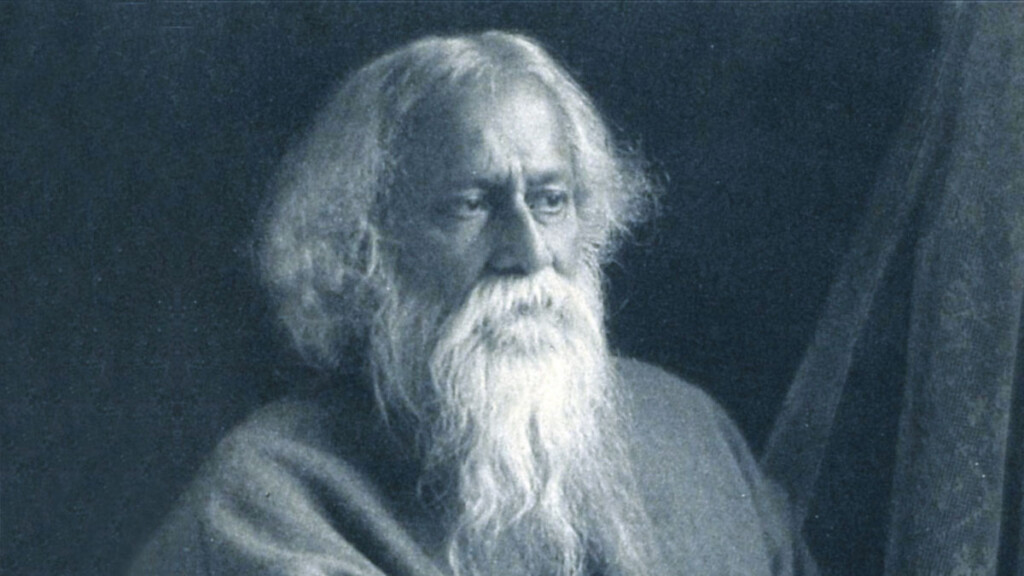
You are listening to something you have never heard, and you already know you are missing it. The translated page in your hands carries meaning the way a photograph carries light — it documents something real, but the thing itself has already moved on, already dissolved back into the air that briefly held it. This is not a failure of translation. This is the structural condition of what Tagore made, because Gitanjali was never, at its deepest level, a collection of poems. It was a collection of songs, and the distance between those two categories is not a matter of degree but of kind.
Rabindra Sangeet — the musical tradition Tagore built across more than two thousand compositions — operates according to a logic that Western aesthetics struggles to even name properly. In the Indian classical tradition, particularly as Tagore synthesized it through Baul folk music, Hindustani raga structures, and Bengali devotional forms, the relationship between word, melody, and rhythm is not hierarchical. One does not carry the others. They are simultaneous, a single act of meaning-making that cannot be subdivided without destruction. When Tagore set these poems to music — and virtually all of Gitanjali was set to music — the melody was not an interpretation of the text. The melody was the text, from a different angle. Remove it and you have not extracted the poem from its container. You have amputated part of the poem’s body and left it breathing with half a lung.
W. B. Yeats, who wrote the celebrated introduction to the 1912 English Gitanjali, confessed he had been reading the manuscript in proof sheets on the London Underground, so moved he was afraid to look up in case strangers saw the tears on his face. What Yeats encountered was already the second body — the prose translations Tagore himself had made, already stripped of their melodic architecture. And yet even that residue was enough to convince Yeats he was in the presence of something outside the European tradition, something that reminded him of the Upanishads, of a civilization that had not yet severed the sacred from the quotidian. He was right about the difference and wrong about the cause. It was not ancient India he was sensing. It was the particular mind of one man who had grown up in Jorasanko, Calcutta, hearing his father Debendranath sing in the early morning hours, absorbing music before he could read it, building a creative identity in which sound was the primary organ of thought.
The Bengali reader — or rather the Bengali listener — encounters Gitanjali through a body memory that the translated text cannot reproduce. There are words in the original that have been worn smooth by generations of mouths, that carry the residue of specific ragas, that arrive already emotionally loaded before the semantic content has time to register. The word amar, meaning mine or my, when sung in the context of Tagore’s devotional framework, accumulates so much tonal history that it almost stops being a possessive pronoun and becomes something closer to a gesture — an outstretched hand. There is no English equivalent for this, not because English lacks possessives, but because English lacks the specific acoustic tradition that has burned this particular weight into this particular syllable.
This is what the Nobel Prize of 1913 honored without quite knowing what it was honoring — a form that had already exceeded the category it was being celebrated in. The Swedish Academy gave Tagore the prize for literature, and literature was only part of what he had made. The other part lives in a frequency the page cannot carry, in performances that exist only in the moment of their happening and then dissolve completely, in a tradition that resists archiving precisely because its meaning is inseparable from the breath that produces it.
🌸 Mystic Voices: Poetry, Spirit, and Inner Devotion
Tagore’s Gitanjali is a work that transcends literary boundaries, weaving together devotion, spiritual longing, and the poetic search for the divine. To fully appreciate its depth, one must explore the broader traditions of symbolism, mysticism, and the philosophy of consciousness that surrounded it. The articles below open pathways into those interconnected worlds.
Poetic Symbolism: History and Main Authors
Poetic symbolism, as a movement and a philosophy, sought to dissolve the boundary between the visible and the invisible, between language and silence. Tagore’s Gitanjali breathes deeply within this tradition, using imagery and rhythm to gesture toward transcendence rather than describe it. Understanding symbolism’s history and its major figures illuminates why Tagore’s hymns felt so universal to European readers when the collection was first translated.
GO TO THE SELECTION: Poetic Symbolism: History and Main Authors
Poetry as a Form of Knowledge: History and Theory
The question of whether poetry constitutes a genuine form of knowledge has occupied thinkers from Plato to the Romantics and beyond. Tagore himself believed that song and verse could access truths that rational discourse could not reach, a conviction that lies at the heart of Gitanjali’s devotional power. This article traces the philosophical tradition that treats poetry as a mode of knowing, providing essential context for reading Tagore’s work.
GO TO THE SELECTION: Poetry as a Form of Knowledge: History and Theory
Meister Eckhart: Life and Mystical Philosophy
Meister Eckhart‘s mystical philosophy, centered on the soul’s union with the divine ground, resonates strikingly with the spiritual yearning expressed throughout Gitanjali. Both Tagore and Eckhart describe a dissolution of the self into something vaster, an experience that language can only approach obliquely. Exploring Eckhart’s life and thought reveals a cross-cultural conversation about the soul that spans centuries and continents.
GO TO THE SELECTION: Meister Eckhart: Life and Mystical Philosophy
Medieval Mysticism: History and Main Figures
Medieval mysticism produced a rich vocabulary for the soul’s journey toward the divine, a vocabulary that finds unexpected echoes in Tagore’s Bengali devotional poetry. The mystics of the Christian West and the Vaishnava poets of Bengal share a common impulse: to express the inexpressible through image, paradox, and song. This overview of medieval mysticism’s history and key figures provides a vital comparative lens for reading Gitanjali.
GO TO THE SELECTION: Medieval Mysticism: History and Main Figures
Discover Cinema That Touches the Sacred
If Tagore’s Gitanjali has awakened in you a hunger for art that reaches toward the spiritual and the ineffable, Indiecinema is the streaming platform where that journey continues. From devotional documentary to poetic independent film, you will find works that speak the same language as Tagore’s songs. Explore Indiecinema and let independent cinema become your own offering of prayer.
👉 EXPLORE THE CATALOG: Watch Indie Films in Streaming
A vision curated by a filmmaker, not an algorithm
In this video I explain our vision

